Self-Guided Riga Old Town Walk
The complete local guide — 12 stops through 800 years of history. The cobblestones are free. The stories take a little longer.
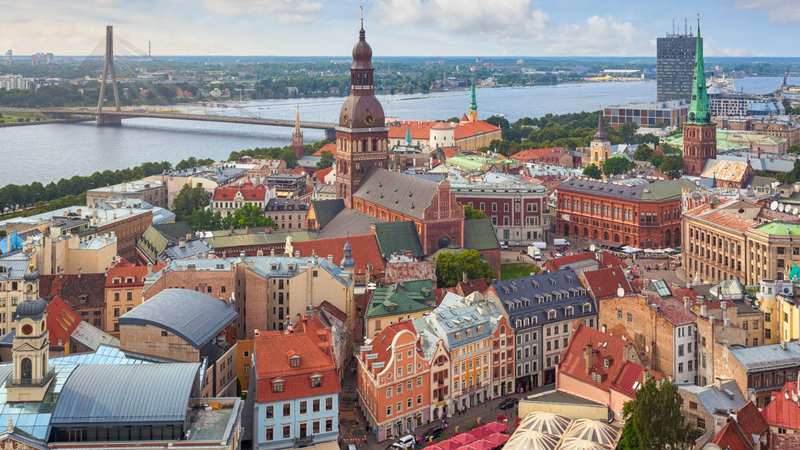
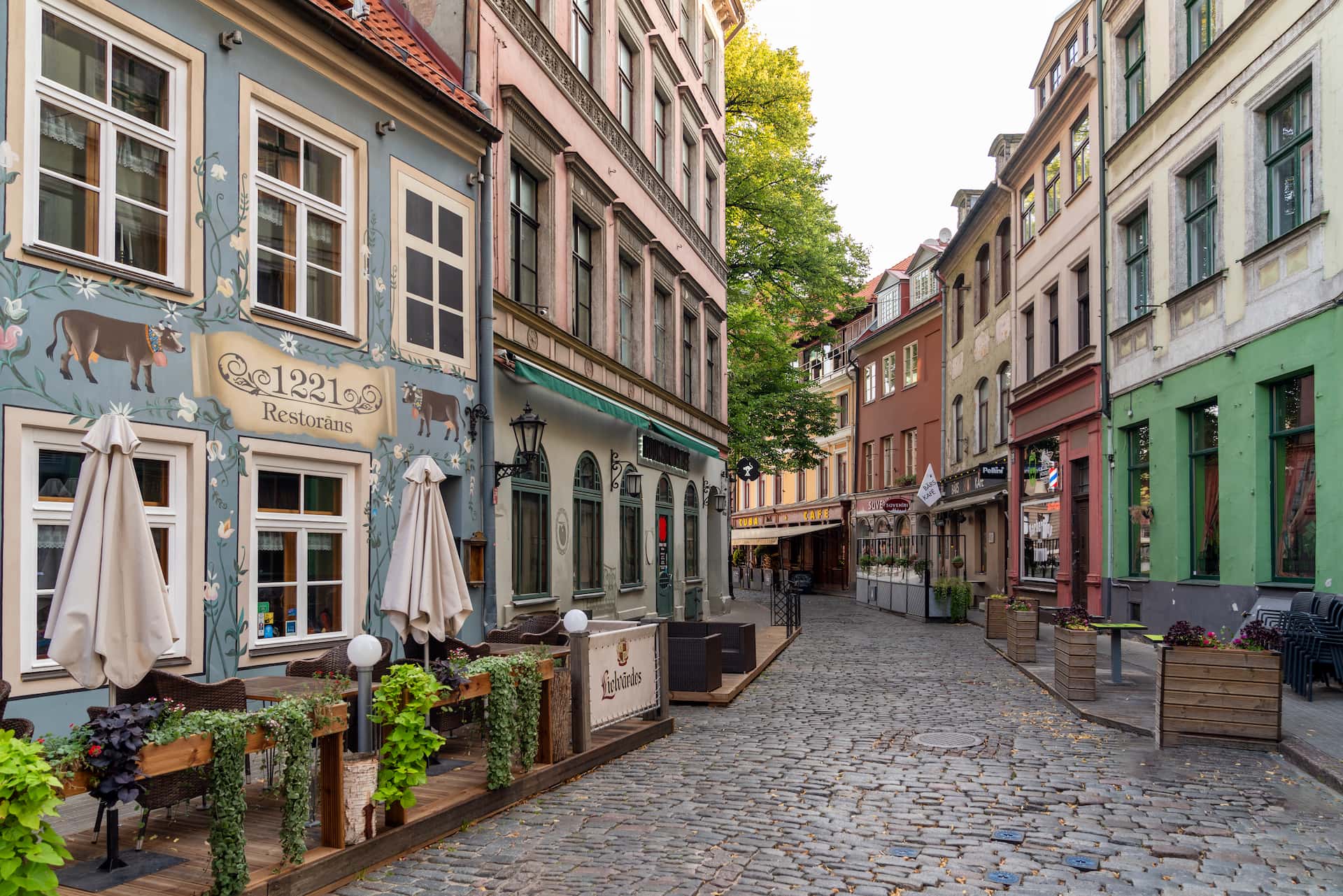
Riga Old Town is consistently TripAdvisor's top-rated attraction in Riga — which, when you walk in, is not hard to understand. Medieval guild halls, Gothic church spires, Baroque merchant houses, cobblestone lanes that dead-end into quiet courtyards. People live here. Offices operate here. Cafés occupy the ground floors of 15th-century merchant houses. The city just kept going, and the old parts kept going with it.
The Old Town covers approximately 54 acres — compact enough to cross in 20 minutes if you walk in a straight line, but so dense with things worth stopping at that most people spend half a day here without noticing. Riga's historic centre, which encompasses both the Old Town and the Art Nouveau district, has been a UNESCO World Heritage Site since 1997. The nomination describes it as an outstanding testimony to the historical significance of Riga as a centre of commerce and cultural influence in the eastern Baltic region.
This guide is meant to be the thing you actually use. The walk route, the key landmarks with opening times and entry prices, the churches worth stepping inside, where to eat without getting stung, and a pronunciation table so you can attempt a street name without looking completely lost. Nothing more complicated than that.
"Old Town isn't something you tick off in an hour. The people who get the most out of it are the ones who wander, look up, and go down the streets that look like they go nowhere."
— Daiga, Barefoot Baltic
Historic centre listed since 1997 — one of the best-preserved medieval urban ensembles in northern Europe.
Consistently the city's top-rated attraction. The whole Old Town, not just a single building.
About 22 hectares. Medieval streets, 800 years of layers, and still a living neighbourhood.
Rather have Daiga show you around?
This guide is designed so you can do it yourself. But if you'd like stories that don't appear in any guidebook — the real reasons things were built, the people who lived here — Barefoot Baltic runs small-group Old Town walks.
See the Old Town excursion →- SPowder Tower — Smilšu iela 20Your starting point. The only surviving medieval round tower from Riga's old city walls — built in the 14th century, rebuilt after Swedish cannons destroyed it. The Latvian War Museum is inside (free entry). Cannonballs are still embedded in the walls. Start here.
- 1Swedish Gate & Jacob's Barracks — Torņa iela 11Riga's only surviving city gate, built 1698 under Swedish rule. The story goes that a soldier who courted a local girl in secret was walled up inside when they were caught. Walk through it. The barracks building alongside it — built into the old city wall — housed Swedish troops and now has apartments.
- 2The Three Brothers — Mazā Pils iela 17, 19, 21Three adjoining medieval houses built between the 15th and 17th centuries — the oldest surviving residential buildings in Riga. No. 17 (white, late 15th century) is the oldest. No. 19 was the bakery. They look deliberately different from each other, which is half the point. The Museum of Architecture is in No. 19 — worth a look even if you don't pay the entry fee, just for the courtyard.
- 3Riga Castle — Pils laukums 3The official residence of the President of Latvia and seat of several national museums. The exterior is worth seeing — it's been rebuilt so many times it's a collage of architectural periods. Best view is from the embankment along the Daugava. The National History Museum and Foreign Art Museum are inside if you want to go in. The Presidential flag flies when the President is in residence.
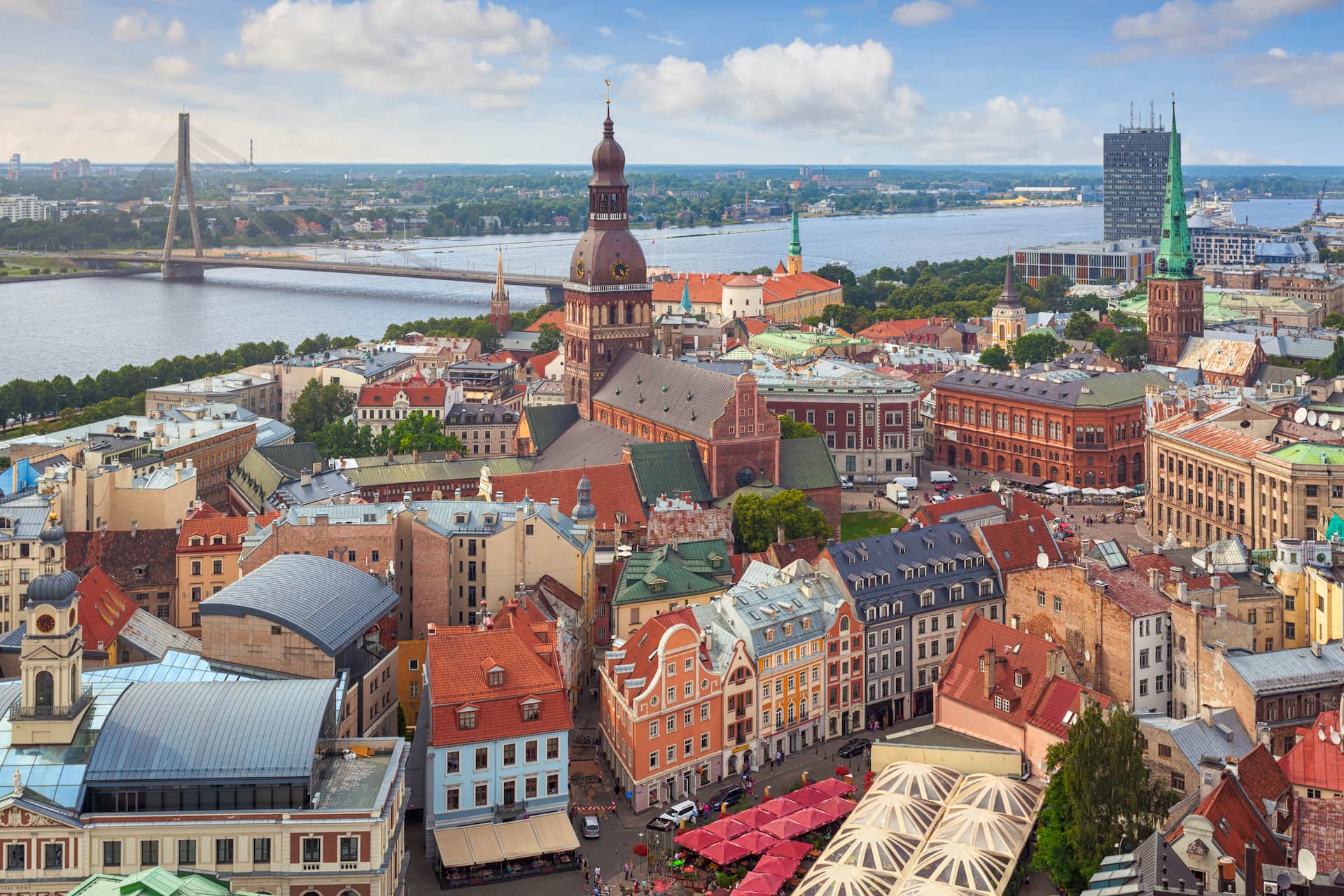
- 4Dome Cathedral & Square — Doma laukums 1The largest church in the Baltic states, started in 1211. The square in front — DOH-ma LAU-kumsDoma laukums — is the central gathering place of Old Town. The organ inside has 6,718 pipes and was the largest in the world when it was installed in 1884. Entry €3. Organ concerts happen regularly — check the schedule at the door. Even if you skip the interior, sit on the square for five minutes.
- 5Great Guild & Small Guild — Amatu iela 6Two medieval guild halls facing each other across a narrow street. The Great Guild (1330s) was the exclusive club for wealthy German merchants. The Small Guild was for craftsmen — a deliberate snub in architecture. The Cat House just around the corner (Meistaru iela 19) is the famous building whose owner placed cats on the roof with their backsides pointed at the Great Guild after he was refused membership. The Guild complained. He was eventually accepted, and the cats were turned around.
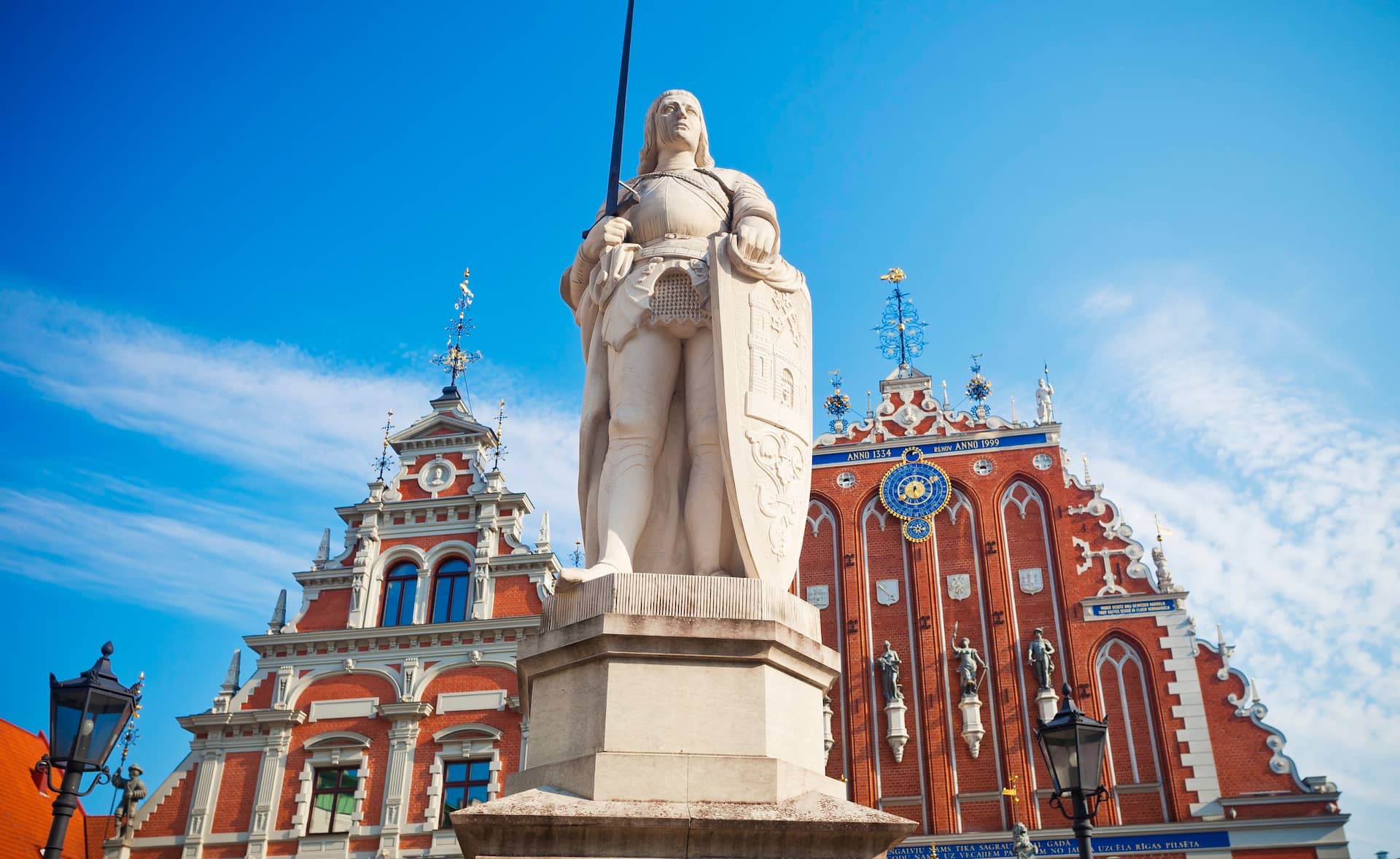
- 6House of Blackheads — Rātslaukums 7The most photographed building in Riga. Built in 1334 for the Brotherhood of Blackheads — unmarried foreign merchants who named themselves after their patron saint, the Moorish St. Maurice. The original was heavily bombed in WWII and demolished by Soviet authorities in 1948. What you're seeing was rebuilt in 2001 from historical records. Entry €8. The interior is ornate and genuinely interesting if you go in.
- 7Town Hall Square & Roland Statue — RātslaukumsRiga's main historic square and the heart of medieval commercial life. The Roland Statue in the centre is a 1999 replica of the 15th-century original (the original is now inside the House of Blackheads). Roland was the symbol of city independence — if a city had a Roland statue, it had the right to trade freely. Stand with your back to the House of Blackheads and look at the Town Hall. Then look left along the square. This is the view that makes people stop mid-sentence.
- ★St. Peter's Church Tower — Reformācijas laukums 1The spire of St. Peter's is the defining feature of Riga's skyline — 123 metres tall, and when it was completed in 1690 it was the tallest wooden structure in the world. It has burned down and been rebuilt several times since. Take the lift to the observation deck (€9, open daily). The view over Old Town, the Daugava River, and the Art Nouveau district beyond is the single best view in the city. Do not skip this.
- 9St. John's Church & Courtyard — Jāņa iela 7A Gothic church hidden behind a narrow passage — you'd walk past the entrance without knowing it was there. Jāņa sēta (St. John's Courtyard) just beside it is one of the finest medieval courtyards in the Baltics. Look for the two stone faces embedded high in the outer wall — said to be two monks who were walled in alive as martyrs. Local legend. Not verified. Worth looking for anyway.
- 10Livu Square & Latvian Riflemen Monument — Kalku iela / Livu laukumsThe Latvian Riflemen monument stands at the edge of Old Town — a Soviet-era sculpture of three soldiers that remains controversial. The Latvian Riflemen were WWI heroes who later became an elite unit that helped defend the Soviet revolution in Russia. The square behind it (Livu laukums) is ringed by outdoor café terraces in summer and transforms into the Christmas market in December. One of the nicest spots for a drink if the weather cooperates.
- FCat House & Freedom Monument — Meistaru iela 19 / Brīvības bulvārisFinish at the Cat House — look up at the Art Nouveau cats on the corner turrets to complete the guild story. From there it's a short walk to the Freedom Monument (Brīvības piemineklis), which marks the boundary between Old Town and the Art Nouveau district. A good place to sit, take stock, and decide whether you want to continue into the Art Nouveau district next.
How long to allow
Town Hall Square, House of Blackheads, Dome Cathedral exterior, a lap of the main streets. Enough to say you've been.
The full 12-stop walk, St. Peter's tower, Dome Cathedral interior. Lunch somewhere. The version you'll actually remember.
Add a museum, wander every courtyard, linger over lunch, then walk into the Art Nouveau district at the end. Nothing rushed.
Want the guided version of this walk?
Barefoot Baltic runs small-group Old Town walks with Daiga and the team — with the history, the gossip, and the stories that live guides know and guidebooks don't.
See the Riga Old Town excursion →Riga was founded in 1201 by Bishop Albert of Buxhoeveden, a German cleric who arrived with crusading knights, built a cathedral, and established a city on the eastern bank of the DAU-ga-vaDaugava river. The people already living here — Livs, Latgalians, Curonians — were not consulted. This is how most medieval cities began, and Riga was no different.
Within a generation, Riga had joined the Hanseatic League — the great trade network that connected cities from Bruges to Novgorod. That membership shaped the city's character for the next four centuries. Merchant wealth poured in. Guild halls went up. The Dome Cathedral was built and expanded. Defensive walls were added, then upgraded, then eventually demolished when they became obsolete. The Old Town you walk through today was built on top of all of it.
Then came the power struggles. Polish-Lithuanian. Swedish. Russian. Each occupier left something behind — architecture, legislation, street names, graves. Sweden's era (1621–1710) produced the Swedish Gate and significant urban expansion. Russian imperial rule (1710–1917) brought the railways, industry, and the population surge that eventually spilled beyond the old walls and created the Art Nouveau district. The First Republic of Latvia (1918–1940) was the period when Latvians finally governed themselves — brief and, by all accounts, flourishing.
The Second World War was devastating. Soviet and Nazi occupations alternated. Buildings were bombed, people were deported, the Jewish community — which had been central to Riga's life for centuries — was almost entirely destroyed. The Old Town survived relatively intact structurally, but the city's human fabric was permanently changed.
Latvia regained independence in 1991. What you see in Old Town today is a city that has been repaired, restored, and — in some places, like the House of Blackheads — entirely rebuilt from scratch. It's complicated. But it's also undeniably beautiful.
Riga under different rulers — a simplified timeline
| Period | Ruler / Influence | What it left behind in Old Town |
|---|---|---|
| 1201–1561 | Livonian Order / German Bishop | Dome Cathedral, city walls, medieval street pattern, guild halls |
| 1561–1621 | Polish-Lithuanian Commonwealth | St. Peter's Church rebuilt, Baroque elements appear |
| 1621–1710 | Swedish Empire | Swedish Gate (1698), city planning improvements, Protestant reforms |
| 1710–1917 | Russian Empire | Old city walls demolished, ring of boulevards created, Nativity Cathedral |
| 1918–1940 | First Republic of Latvia | Freedom Monument, Latvian cultural institutions, restoration work |
| 1991–present | Republic of Latvia | House of Blackheads rebuilt (2001), UNESCO listing (1997), major restoration programme |
The Hanseatic League — why it matters for what you see
Riga was a Hanseatic city from the mid-13th century until the League formally dissolved in 1669. This means it was part of the most powerful trade network in medieval northern Europe — a voluntary association of merchant cities that collectively set trading standards, defended sea lanes, and accumulated enormous wealth. The Hanseatic connection is the reason Riga has so many medieval merchant houses and guild halls. The money to build them came from trade: amber, furs, wax, grain, cloth. If you're standing in front of the House of Blackheads or the Great Guild, you're standing in front of the physical residue of that commerce.
Common questions about Riga's history
When was Riga founded?
Why was Old Town so well preserved?
Who were the Brotherhood of Blackheads?
What happened to the Jewish community of Riga?
Is Riga on the UNESCO World Heritage List?
Combine Old Town with a day excursion
Old Town is just the start. Barefoot Baltic also runs full-day excursions to Rundale Palace, the Gauja Valley, Jūrmala, and beyond — departing from central Riga.
Browse all Barefoot Baltic excursions →Riga Old Town has more churches per square kilometre than almost anywhere in the Baltic. This is partly medieval history — the city was founded by a bishop and shaped by religious orders — and partly because successive rulers brought their own faiths and built accordingly. Lutheran, Catholic, Orthodox, Reformed: they're all here, sometimes within a few minutes' walk of each other.
The largest church in the Baltic states and the oldest building in Latvia still in regular use. The Romanesque exterior hides a surprisingly light interior. The famous organ — 6,718 pipes, largest in the world when installed in 1884 — is still used for concerts. The cloister on the south side is one of the finest in northern Europe.
The oldest church in Riga and the symbol of the city's skyline. The spire has burned down and been rebuilt multiple times — the current one dates from 1973. The observation deck at 72 metres is the best viewpoint in Old Town. The interior has a fine Baroque altar and good temporary exhibitions of contemporary Latvian art.
Hidden in plain sight — you walk past the entrance without knowing it's there. Originally a Dominican monastery church, handed to Lutherans in the Reformation. The Gothic interior is austere and magnificent. The St. John's Courtyard (Jāņa sēta) beside it is one of the finest medieval courtyards in the Baltics — quiet and almost always crowd-free.
The only Catholic cathedral in Riga and the seat of the Archbishop. Originally built for the Livonian Order, it spent several centuries as a Lutheran church before returning to Catholicism. The interior is relatively simple — the grandeur is in the exterior tower, the oldest church tower in Riga. Very active parish church; services in Latvian, Polish, and English.
A smaller Catholic church on the edge of Old Town, built for the Russian imperial garrison. The interior retains original 18th-century Baroque decoration that escaped Soviet-era intervention. Not on most tourist itineraries, which means it's quiet.
The only English church in the Baltics — built in 1857 for the substantial British merchant community that lived in Riga at the height of its trading importance. A Victorian Gothic building that looks slightly out of place and is all the more interesting for it. Services in English on Sundays. Regular musical events.
Prefer to explore Old Town with a local?
Daiga's Old Town walk covers the stories behind these churches — who built them, why, and what happened to them under each successive occupation. Small groups, unhurried pace.
See the Riga Old Town walk →Riga Old Town is roughly triangular — bounded to the west by the Daugava River, to the north by the castle, and to the east by the old moat line (now a green strip of park and the City Canal). It's small enough that you can't get badly lost, but the street layout is genuinely medieval — which means irregular, sometimes dead-ending, occasionally counterintuitive. Embrace it. Some of the best things in Old Town are the things you find when you take the wrong turn.
Key streets and what's on them
Getting to Old Town
From the Freedom Monument: 5-minute walk west. From the Central Market: 15–20 minutes north. From the main train station: 10–15 minutes northwest. Old Town is entirely walkable from most central Riga accommodation.
Old Town is pedestrian-only for most of it. The nearest public car parks are at Prāgas iela (south edge) and Krišjāņa Valdemāra iela (east edge). Paid parking. Park and walk — it's easier than trying to drive in.
Cobblestones: Old Town is almost entirely cobblestoned. This is beautiful and historically authentic, and it is genuinely hard on wheeled luggage, pushchairs, and high heels. Flat, comfortable shoes are strongly recommended. If you're bringing a pushchair, the Dome Square and Rātslaukums areas are the most accessible; many smaller streets are difficult.
Old Town rewards going slowly. The obvious things — the House of Blackheads, St. Peter's spire, the guild halls — are all there. But there's a lot between them if you look.
Medieval wall fragments
About 400 metres of Riga's original city walls are still visible — integrated into later buildings, embedded in courtyards, occasionally just standing on their own. The stretch behind Jacob's Barracks near Torņa iela is the most accessible. Once you start looking for the wall, you see it everywhere.
The Cat House cats
Two black cats on the corner turrets of Meistaru iela 19. Look at the angle of each one carefully — they face the Great Guild hall, and the story of how they ended up there is the best piece of guild politics in Riga. One of the few Old Town details with a genuinely satisfying punchline.
Cannonballs in the Powder Tower
The lower half of the Powder Tower has cannonballs visibly embedded in the stonework — fired during the Swedish siege of 1621 and never removed. The Latvians have a word for this: liecinieki (witnesses). Physical evidence of things that happened that no one has bothered to clean up.
The walled-in monks
Two stone faces embedded high in the outer wall of St. John's Church — said to be two monks who were walled in alive as martyrs at the request of the Dominican order who built the church. The story isn't confirmed by historical records. But the faces are definitely there, and they definitely have a slightly resigned expression.
The medieval street plan
Look at a map of Old Town and compare it to the Art Nouveau district. Old Town's street plan is organic and irregular — streets follow the logic of where carts could pass, where water drained, where the market needed to be. The Art Nouveau district is a perfect 19th-century grid. The contrast shows you exactly where medieval Riga ended and modern Riga began.
The merchant house proportions
Medieval Riga taxed buildings by their street frontage — the wider the ground floor, the higher the tax. So wealthy merchants built tall, narrow buildings: thin street frontages, deep lots running back from the street. This is why Old Town buildings look the way they do. The narrowness is deliberate tax avoidance from the 14th century.
Hidden courtyards
Look for archways and passages between buildings — many of them lead into courtyards that aren't visible from the street. The best are around Jāņa sēta (St. John's Courtyard), Aldaru iela, and the streets behind Dome Square. They're almost always quiet. Some have cafés or workshops in them. Go through any archway that looks like it leads somewhere.
Layers of restoration
Some Old Town buildings are genuinely medieval, some are 17th or 18th-century reconstructions of medieval buildings, some are post-WWII Soviet restorations of earlier structures, and some (like the House of Blackheads) are 2001 rebuilds. Learning to read which is which is one of the more interesting things you can do with an hour in Old Town.
"The best version of Old Town is 8am on a weekday in spring. The tour groups haven't arrived yet. The light is doing something interesting to the cobblestones. You can hear your own footsteps."
— Daiga
A word of warning: Old Town has a lot of tourist restaurants. Many are fine. Some are very average at inflated prices. The rule of thumb: the further you get from Rātslaukums and Kalku iela, the better the value. Streets like Mārstaļu iela, Audēju iela, and the area around Jāņa sēta have better options at more reasonable prices.
What to try — genuinely Latvian food
If you want to eat something actually Latvian rather than pan-European café food, look for: grey peas with smoked bacon (pelēkie zirņi ar speķi) — the national dish, simple and good; rye bread (rupjmaize) — dense, slightly sour, served everywhere; cold cuts and smoked meats — Latvia has excellent charcuterie; and kvass (kvass) — a lightly fermented rye drink, non-alcoholic, slightly sweet, tastes like something your grandmother would have made. Also: Black Balsam (Rīgas Melnais Balzāms) — the famous 45% herbal liqueur. Acquired taste. Worth trying at least once, ideally in coffee or hot chocolate.
Places worth knowing about
A proper Latvian beer cellar that does grey peas, smoked ribs, and hearty soups in a vaulted basement with folk music some evenings. Not a tourist trap — it's where Latvians actually go. The grey peas are the real thing. Long tables, communal seating, excellent local beer on tap. Reliable and unpretentious.
The most Latvian lunch you can have in Riga without someone's grandmother cooking it. LIDO is a large self-service Latvian canteen — long counters of rye bread, cold cuts, smoked meats, hot soups, pelēkie zirņi (grey peas with bacon), curd pastries, and traditional desserts. Grab a tray, point at things, pay almost nothing by Old Town standards. The first floor by the windows looks over the street and is genuinely pleasant — worth arriving slightly early for a window table, especially if there's daylight. No pretence, no tourist premium. Very popular with Rigans at lunch.
A medieval-themed restaurant in a genuine 13th-century vaulted cellar — the theatrical setting is real, not constructed. The food is loosely inspired by historical recipes (game, root vegetables, rye bread) and served by staff in period costume. More expensive than most Old Town options but the atmosphere is genuinely extraordinary. Book ahead for dinner.
The cafés ringing Dome Square are tourist-priced but the location is genuinely pleasant — sitting outside with the cathedral behind you is hard to beat on a warm day. Good for coffee and cake. Don't expect kitchen food at this price point, but the terraces are enjoyable if you accept the setting premium.
Adjacent to Folkklubs, a good place for a Latvian craft beer or a Rīgas Melnais Balzāms mixed drink. Straightforward, fair prices, good selection of Latvian beers including Valmiermuiža, Labietis, and Tērvetes.
Not in Old Town, but worth mentioning: the Central Market (Centraltirgus), in five Zeppelin hangars south of the train station, is the best food market in the Baltics and one of the biggest in Europe. For breakfast, lunch, or picking up picnic supplies before a walk, it beats anything in Old Town on quality and price. The smoked fish hall alone is worth the detour.
Taste Riga with a local
The Barefoot Baltic Riga Food Market excursion takes you through the Central Market with Daiga as a guide — the history, the stalls worth finding, the things to taste. A full morning that most guests rate as a highlight of their Riga visit.
See the Food Market excursion →Medieval stories are good stories
Old Town has genuine advantages for families with children — the stories are dramatic, the streets are car-free, and the cat house, the cannonballs in the tower, and the walled-in monks are exactly the kind of slightly macabre detail that children remember for years. The challenge is cobblestones and the fact that many interiors are less engaging for young children than the exteriors.
What children usually respond to
Cannonballs in the Powder Tower
Actual cannonballs from 1621, still embedded in the walls. The Latvian War Museum inside is free and has interactive exhibits. Good for children from about age 7 upwards.
The Cat House story
The story of the merchant who put cats with their bottoms pointing at the rival guild is genuinely funny to children. Point out both cats on the roof. Ask them which direction the cats are facing and why. It sticks.
St. Peter's tower observation deck
The lift ride up (it's an old-fashioned cage lift) and the views from 72 metres are reliably impressive to children of all ages. Worth the €9 entry. Allow 30–45 minutes.
The city walls
Walk the section near Torņa iela where the medieval walls are still visible. Explain that the whole city was once surrounded by a wall like this. Children often respond well to the scale of it.
Practical advice for families
Old Town cobblestones are genuinely difficult for pushchairs and wheelchairs. The smoothest surfaces are in Dome Square, Rātslaukums (Town Hall Square), and the main pedestrian streets. Many narrow side streets are very rough. A front-facing carrier or sling is more practical than a pushchair for young children here.
Public toilets in Old Town: at Rātslaukums (small fee), inside St. Peter's Church (paying), and in the basement of the House of Blackheads. Most cafés will let you use their facilities if you buy something — Dome Square cafés are the most convenient option.
Practical questions
Is Riga Old Town safe for tourists?
Do I need to book attractions in advance?
Is there free Wi-Fi in Old Town?
How do I get from the airport to Old Town?
Old Town photographs well from almost anywhere, but there are specific angles and times of day that make a real difference. These are the ones Daiga keeps going back to — not the tourist-board shots, but the ones that actually look like Riga rather than a stock photo.
The classic shots — done well
House of Blackheads — from the south
Stand at the far south end of Rātslaukums, with the Roland Statue between you and the building. Best light: morning (east-facing facade). The facade is in shadow by early afternoon. Include the Roland Statue foreground for depth — it stops the shot being flat. Avoid midday July–August when tour groups block the square.
St. Peter's spire — from Skārņu iela
Walk to Skārņu iela, the narrow street running alongside St. Peter's from the east. Look back west along the street with the spire rising behind the rooflines. The street is cobbled, slightly downhill, and frames the spire in a way the open square doesn't. Best in soft morning light or overcast days — direct sun creates harsh contrast.
Old Town skyline — from the Akmens Bridge
The stone bridge (Akmens tilts) crossing the Daugava gives the classic Riga panorama — St. Peter's spire, the Dome, Riga Castle all in one frame with the river in the foreground. Sunrise is exceptional here in summer (the sun rises northeast, lighting the Old Town facade). Golden hour before sunset also works well. A wide lens or phone panorama gets everything in.
Old Town skyline — from the AB Dam viewpoint
On the Left Bank (Pārdaugava), just past the Akmens Bridge, there's a raised embankment section that gives a slightly elevated view of the entire Old Town waterfront. Less visited than the bridge itself. Works well at dusk when the buildings are lit. Cross the bridge and turn right along the riverbank.
Less obvious angles
Swedish Gate — looking through it
Stand outside the gate on Torņa iela and shoot through the arch into the passage. The curve of the arch frames whatever's on the other side — cobblestones, a figure walking through, the wall beyond. Go at 7–8am when the light comes through from the east. A person walking through the gate gives the shot scale.
The Three Brothers — tight and looking up
Most people photograph the Three Brothers from across the street, getting all three together. Instead: stand close to No. 17 (the oldest, white one) and shoot straight up the facade. The narrow proportions of the building and the overhanging upper floors create a strong vertical composition. Works on any overcast day — no harsh shadows.
Cat House cats — from diagonally across
The cats on the Cat House turrets are small and high up. From directly below, you get a foreshortened view that loses the cat. Cross to the opposite corner of Meistaru iela and Brīvības iela and shoot diagonally — you get the turret, the cat, and a bit of the street below. A short telephoto (50–85mm equivalent) works better than a wide lens.
Jāņa sēta courtyard — for quiet atmosphere
St. John's Courtyard (Jāņa sēta) off Jāņa iela is one of the best spots in Old Town for atmospheric shots with no crowds. Medieval stone walls, irregular paving, arched passages. Works well on rainy days when the wet cobblestones reflect light and most tourists have gone inside. Bring a lens that handles low light.
Dome Square at dusk
Dome Square (Doma laukums) is at its best at dusk in summer — the cathedral is lit, the café terrace lights are on, and there's still enough ambient light in the sky to see the building outlines. Around 10pm in midsummer. The crowd thins out. The cafe umbrellas and terrace lights make good foreground elements.
Jauniela — the Sherlock Holmes street
Jauniela, the narrow street that was used to film the Soviet Sherlock Holmes TV series as a stand-in for Victorian London, is one of Old Town's most photogenic streets. Best shot: stand at the north end and look south down the street, using the overhanging facades to create a tunnel perspective. Works at any time of day — the street is narrow enough to be naturally soft-lit even in direct sun.
St. Peter's view — from the observation deck
From the St. Peter's tower observation deck at 72m, the best shots are northeast (Art Nouveau district roofline and spires), and directly down onto the Old Town rooftops. The courtyard immediately below makes a strong aerial composition. Shoot in both directions — the city view and the intimate rooftop view are very different photos.
Early morning — the whole Old Town
Before 8am on a weekday, Old Town is almost empty. The light is low and directional. The cobblestones are often damp and reflective. Shop fronts haven't opened. No tour groups. If you're serious about photographing Old Town, set an alarm. An hour before the crowds is worth three hours after.
Capture it with Daiga
On the guided Old Town walk, Daiga knows exactly where to stand and when. Small groups mean no one blocking your shot.
See the Old Town walk →See Old Town in person with Daiga
While we finish the videos — the real thing is better than any film. Small groups, real stories, no script.
See the Old Town walk excursion →| Latvian | Say it like this | Notes | Listen |
|---|---|---|---|
| Rīga | REE-ga | The capital. Slight roll on the R. Latvians will appreciate the attempt. | |
| Vecpilsēta | VETS-pil-se-ta | Old Town. Vecs = old. pilsēta = city. | |
| iela | YEH-la | Street. Follows every street name. | |
| laukums | LAU-kums | Square. As in Doma laukums, Rātslaukums. | |
| Doma laukums | DOH-ma LAU-kums | Cathedral Square. Doms = Cathedral (from German Dom). | |
| Rātslaukums | RATS-lau-kums | Town Hall Square. The main historic square. | |
| Pulvertornis | POOL-ver-tor-nis | Powder Tower. Pulveris = powder. | |
| Trīs brāļi | TREES BRA-lyi | Three Brothers. Trīs = three, brāļi = brothers. | |
| Kaķu māja | KA-kyu MA-ya | Cat House. Kaķis = cat, māja = house. | |
| baznīca | BAZ-nee-tsa | Church. You'll see it on signs everywhere. | |
| Melngalvju nams | MEHL-ngal-vyu NAMS | House of Blackheads. Melns = black, galva = head. | |
| Daugava | DAU-ga-va | The river that runs alongside Old Town. AU as in "cow". | |
| Pils | PILS | Castle. As in Rīgas pils (Riga Castle). | |
| Brīvības piemineklis | BREE-vee-bas pyeh-mi-nek-lis | Freedom Monument. Brīvība = freedom. | |
| Paldies | PAL-dyehs | Thank you. Use this. People genuinely appreciate it. | |
| Sveiki | SVAY-ki | Hello. Informal but friendly. Works in any café or shop. | |
| Lūdzu | LOOD-zu | Please. Also means "you're welcome" when someone thanks you. | |
| Priekā! | PRYE-ka | Cheers! For when you have a beer in Folkklubs. |
Latvian has consistent pronunciation rules — once you know them, it's actually very regular. The accent is almost always on the first syllable. Long vowels (ā, ē, ī, ū) are simply held for twice as long. The letters š = "sh", ž = "zh" (like the "s" in "measure"), č = "ch".
Audio recordings by Sofija, one of Daiga's core guides — a native Latvian speaker from Riga.