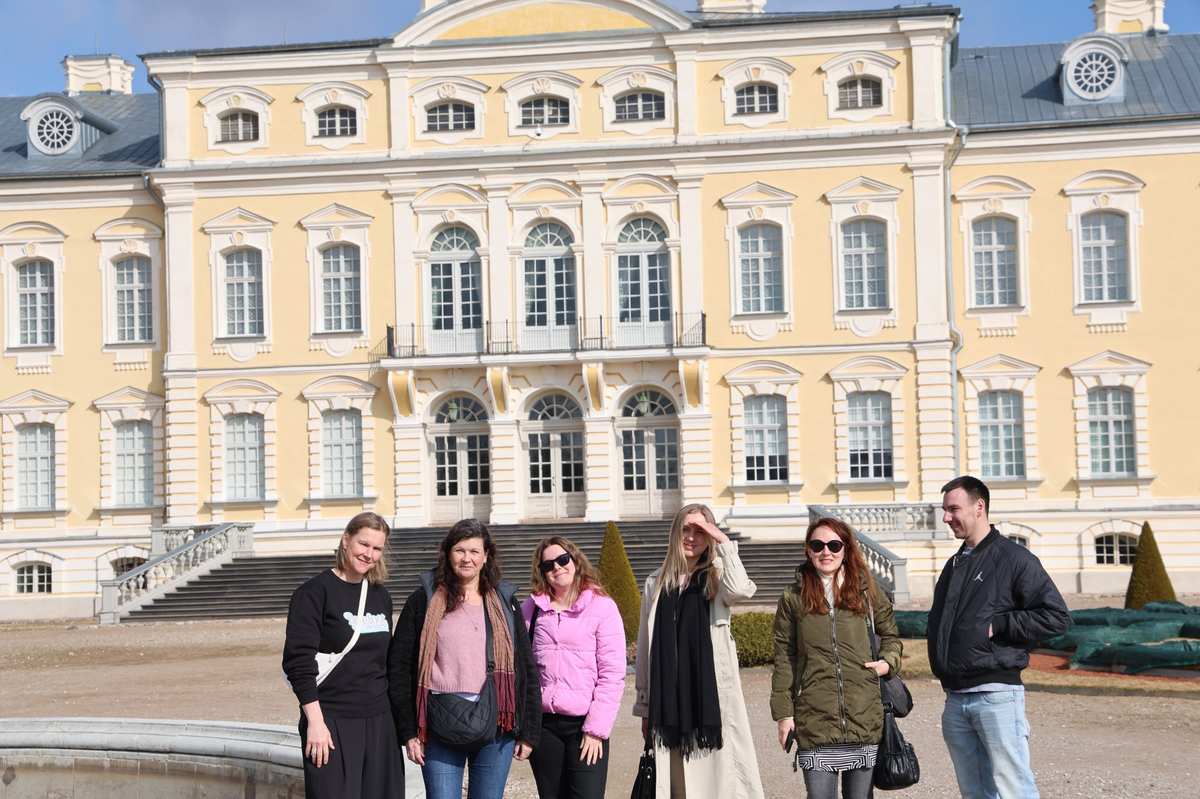
Let me tell you about a man who had everything, lost everything, spent twenty years in Siberia, came back, and finished building his palace anyway. If that doesn't make you want to visit Rundāle, I don't know what will.
Meet Ernst Johann von Biron
To understand Rundāle Palace, you first need to understand the extraordinary man who built it — and the even more extraordinary woman who made it all possible.
Ernst Johann von Biron was born in 1690 into a minor Baltic German noble family in Courland — the southern part of what is now Latvia. The Birons were not wealthy. They were not powerful. By the standards of European aristocracy, they were essentially nobody. Ernst Johann studied briefly at the University of Königsberg, was reportedly expelled for bad behaviour (the details are murky, which usually means interesting), and returned home without obvious prospects.
Then he met Anna.
Anna Ivanovna was the niece of Peter the Great and the newly widowed Duchess of Courland. She was lonely, far from the Russian court, and living in relatively modest circumstances in the Latvian town of Jelgava. Biron became her confidant, her advisor, and — according to every source from the period — her lover. The relationship would last the rest of their lives and change the course of Baltic history.
From Nobody to the Most Powerful Man in Russia
In 1730, when Anna unexpectedly became Empress of Russia, she brought Biron with her to St Petersburg. Overnight, the minor nobleman from Courland found himself at the centre of the largest empire in the world. Anna made him Duke of Courland, showered him with estates and titles, and relied on him so completely that the entire period became known as the "Bironovshchina" — the age of Biron.
The Russian nobility despised him. Here was a foreigner, a Baltic German with a funny accent, who couldn't even speak proper Russian, and he was effectively running the empire. The gossip at court was savage. They called him a jumped-up stable boy (his grandfather had indeed managed horses). They whispered that his children were actually Anna's — a rumour that has never been conclusively confirmed or denied, which is the best kind of historical gossip.
But Biron didn't care what they thought. He had wealth beyond imagination. When historians later inventoried his possessions, they counted over 100 gold and silver snuffboxes, entire rooms of furniture shipped from Paris, a diamond collection that rivalled the Empress's own, and enough silverware to serve 400 guests at once. His personal stables housed some of the finest horses in Europe — he never quite shook off the family connection to horses, but now they were thoroughbreds worth more than most people's houses.
And in 1736, at the peak of his power, he hired the hottest young architect in the Russian Empire — a 36-year-old Italian named Francesco Bartolomeo Rastrelli — to build a summer palace in Courland that would announce to the world exactly who Ernst Johann von Biron had become.
Building a Dream: 1,500 Workers in a Latvian Wheat Field
Picture this: 1736, the flat agricultural countryside of Zemgale in southern Latvia. Wheat fields in every direction. Scattered farmsteads. Cows. And suddenly, 1,500 workers descending on a patch of ground to build a 138-room baroque palace.
The logistics were staggering. The Zemgale plain has no natural building stone, so everything had to be brought in. Bricks were fired on site in massive kilns that ran day and night. Stonemasons came from Italy and Germany. Stucco artists, woodcarvers, and painters arrived from across Europe. Hundreds of local Latvian labourers — many of them serfs from Biron's own estates — did the heavy lifting, digging foundations and hauling materials.
Rastrelli threw himself into the project with the energy of a man who knew he was building something important. He designed everything — the palace layout, the interiors, the ceilings, the gardens. The Gold Hall, which you can stand in today, was his masterpiece: a vast ballroom with gilded stucco, painted ceilings, and proportions calculated to make every guest feel simultaneously magnificent and slightly underdressed. After nearly 300 years, it still works. I've seen guests walk in and instinctively straighten their posture.
The Fall
Empress Anna died in October 1740. Within weeks, Biron's world collapsed like a house of gilded cards.
He had been named regent for the infant Tsar Ivan VI — the most powerful position in Russia. He held it for exactly 22 days. On the night of November 8, 1740, Field Marshal Münnich arrived at Biron's bedroom with a detachment of soldiers. Biron was arrested in his nightshirt. His wife Benigna, according to eyewitness accounts, was carried out of the palace screaming, still in her bedclothes, into the freezing November air.
The sentence was death. Then it was commuted to life exile in Siberia. The man who had dined off gold plates and commissioned palaces was heading to the frozen edge of the known world.
And here's the detail I always share with visitors, because it tells you absolutely everything about Ernst Johann von Biron: he was allowed to take servants with him to exile. He took sixteen. Sixteen personal servants. To Siberia. This was a man who, even in the worst moment of his entire life, was not going to lower his standards.
The palace at Rundāle stood half-finished. The scaffolding came down. The workers went home. The 138 rooms sat roofless and empty in the Latvian wind for two decades.
Twenty Years of Waiting
Biron spent the next twenty years in exile — first in the Siberian town of Pelym, where conditions were genuinely harsh, then in Yaroslavl, about 250 kilometres northeast of Moscow, where life was more bearable. He was eventually allowed a small household, received occasional visitors, and maintained a stubborn correspondence with anyone who might help restore his fortunes.
He was in his fifties when he arrived. Most exiles of his era simply faded away — broken by isolation, boredom, and the Russian winter. Biron waited. And waited. Through three changes of monarch. Through twenty Russian winters. Through the agonising knowledge that his palace sat unfinished, the rain getting into the plasterwork, the weeds growing in the foundations of his formal garden.
The Sweetest Comeback
In 1762, the new Tsar Peter III — in one of those abrupt reversals that make Russian history such a rollercoaster — pardoned Biron and restored his title as Duke of Courland. Biron was seventy-two years old. He had been in exile for over twenty years.
And the first thing he did was go back to Rundāle and call Rastrelli.
Rastrelli, who had spent the intervening decades building the Winter Palace and the Catherine Palace in St Petersburg — becoming arguably the most celebrated architect in Russian history — came back to finish the job he'd started in a Latvian wheat field twenty-five years earlier. I like to imagine that conversation. Two old men, looking at an unfinished palace, deciding to finish it anyway. That takes a particular kind of stubbornness that I deeply admire.
The second phase of construction, from 1764 to 1768, gave us the rooms you see today — the White Hall, the Duke's private apartments, and the extraordinary ceiling paintings by the Italian artist Francesco Martini. Biron was in his seventies. He walked through his palace every day, checking progress, adjusting details, being generally impossible to satisfy (good for us — the quality is extraordinary).
He died in 1772, having enjoyed his finished palace for less than a decade. But he died as Duke of Courland, in his palace, on his terms. I find something genuinely moving about that. Twenty years in Siberia, and he still got the Gold Hall.
What Daily Life in the Palace Actually Looked Like
Now, when you walk through these beautifully restored rooms, it's natural to imagine some sanitised version of aristocratic life — all champagne, harpsichords, and elegant conversation. The reality was considerably more human.
The palace had no running water. Not a drop. Every single bit of water — for drinking, cooking, bathing, washing, and the elaborate fountain displays in the gardens — had to be carried by servants from wells and the nearby river. During the summer season, with over 200 staff and a rotating cast of guests, this was a monumental daily operation. There were servants whose entire job description was carrying water up staircases. Imagine doing that in July, in a wool uniform, up three flights of stairs, twelve times a day.
The kitchens — which you can visit in the basement, and please don't skip them — operated on a scale that would make a modern hotel kitchen look like a camping stove. Dinner for the Duke and his guests might run to twelve courses. The kitchen staff started preparing at dawn for a meal that would be served at three in the afternoon, the fashionable European dining hour. Everything was cooked over open fires. The heat down there in summer must have been absolutely brutal.
Mornings followed a strict routine. The Duke would rise, be dressed by his valets (this alone could take an hour — the layers of 18th-century aristocratic clothing were not a joke), receive visitors in his private chambers, attend to correspondence, then walk the gardens before the midday heat. The formal gardens weren't just decorative — they were an outdoor extension of the palace's social space, a place to be seen, to conduct conversations you didn't want overheard in the echoey halls, and to demonstrate your exquisite taste to visitors who were probably plotting against you.
And then there was the matter of... sanitation. Chamber pots, discreetly managed by dedicated servants. The palace had designated areas for this delicate operation, but in a building with 138 rooms and dozens of overnight guests during the summer, the logistics were constant. When I mention this to visitors, they always look at the gilded stucco slightly differently afterwards. Suddenly it feels a little more real. Which is exactly the point.
The Gardens — Don't Rush Past Them
I say this to every single guest because people always underestimate the gardens. Always.
The French formal garden behind the palace was painstakingly restored between 2004 and 2015 using 18th-century plans and descriptions. The rose garden has over 2,300 roses. In late May and June, when they're in full bloom, it is genuinely one of the most beautiful things I've seen in Latvia — and I say that as someone who drives past this palace for work and should probably be immune to it by now. I'm not.
The geometry of the garden is deliberate and philosophical. Stand at the palace steps and look south along the central axis: the clipped hedges, the parterres, the gravel paths, all converging toward the horizon. This is the 18th-century idea that nature should be ordered, controlled, made beautiful by human intelligence. It's a landscape designed to make you feel that the person who owns it has mastery over the world itself. Biron, freshly back from Siberia and having mastered precisely nothing except the art of survival, must have found that irony delicious.
Visiting Today
Getting There
Rundāle is about 70 km south of Riga — roughly 75 minutes by car. There's no useful public transport. Your options are a rental car, an expensive taxi (around €80–100 each way), or a guided excursion. I'll be direct: this is one of those places where having a guide transforms the experience. The story I just told you? It's not on the plaques. Most of it isn't in the audioguide. The palace rewards context — and context is what I do.
How Long to Allow
At least 2–3 hours. If you're the kind of person who reads every panel and sits on every garden bench — and you should be — allow half a day.
Best Time
Late May to mid-June for the roses. September for golden light and that melancholy Baltic autumn atmosphere that makes everything look like a Dutch painting. Weekday mornings are quietest. Even in peak summer, you won't experience anything close to the crowds at Versailles or Schönbrunn. This is Latvia. We don't do queues.
Atvykite pamatyti su manimi
I run a full-day excursion from Riga that combines Rundāle Palace with Bauska Castle and a local brewery. I'll tell you about Biron's sixteen servants in Siberia, the Latvian labourers who built the palace, and where to find the best ceiling painting that almost nobody looks up to see.
Žiūrėti ekskursiją →Why Rundāle Still Matters
I've taken hundreds of visitors to this palace, and the question I get most often is: "Why have I never heard of this place?" It's a fair question. A 138-room baroque palace designed by the architect of the Winter Palace, set in restored French formal gardens, with a story involving exile, Siberia, and a seventy-two-year-old duke's defiant comeback — this should be on every European itinerary.
The answer, of course, is Latvia itself. We're a small country that spent most of the 20th century behind the Iron Curtain. Our treasures are still being discovered by the wider world. Rundāle is not a ruin or a curiosity — it's a fully restored, world-class palace that happens to be in a country most people can't yet find on a map.
I'd recommend visiting soon — while you can still stand in the Gold Hall on a Tuesday morning with the sunlight streaming through the tall windows and have the room almost entirely to yourself. That won't last forever. And it's an experience that Versailles stopped offering about a hundred years ago.
Biron would have approved. He always did like having the best of everything — and he didn't like sharing.