If you've already decided that Rundāle Palace is on your Latvia itinerary, this article is for you. We're skipping the construction history (we cover that elsewhere) and walking you straight through the doors, room by room, so you know what's waiting for you inside before you ever set foot on the gravel of the front courtyard. Think of this as a written preview of the route you'll take, almost forty rooms across two wings, written in the voice we'd use if we were guiding you ourselves.
A small note before we begin. Rundāle is not a palace where you breeze through three "highlight" rooms and leave. The whole point is the cumulative effect. One ceiling speaks to the next. The colour of one set of wallcoverings makes the next set feel deliberate, and the Duke's wing and the Duchess's wing tell two slightly different stories about how an eighteenth-century ruling couple actually lived. This guide is structured the way the visitor route is structured, so you can read it on the bus on the way down from Riga and arrive already oriented.
About the photos. Each section below now opens into a clickable gallery of photographs taken on a real visitor day (286 photographs across 44 rooms). Tap the hero image to enlarge, or pick a thumbnail.
The Entrance Vestibule and Galleries, Where You Arrive
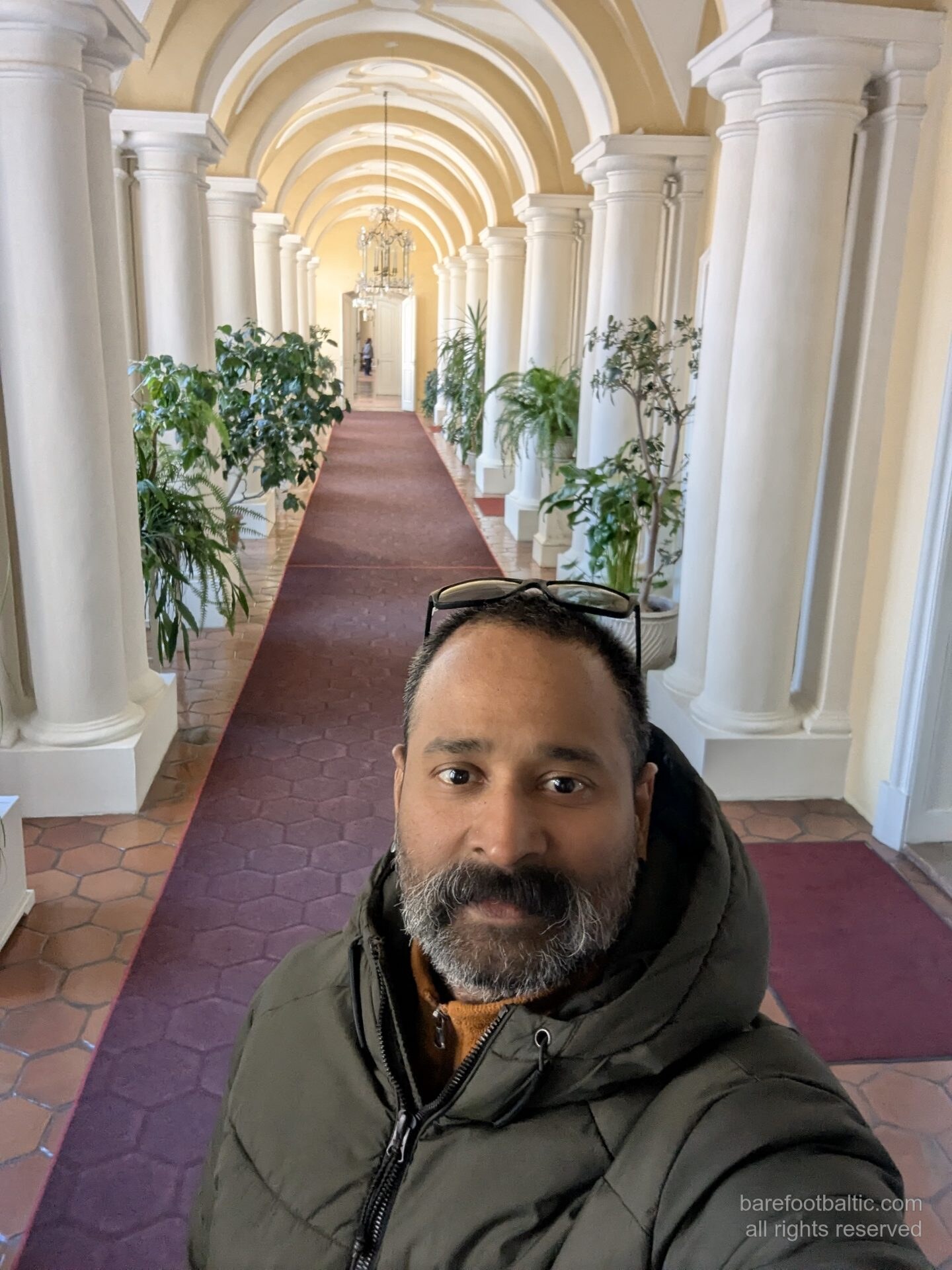
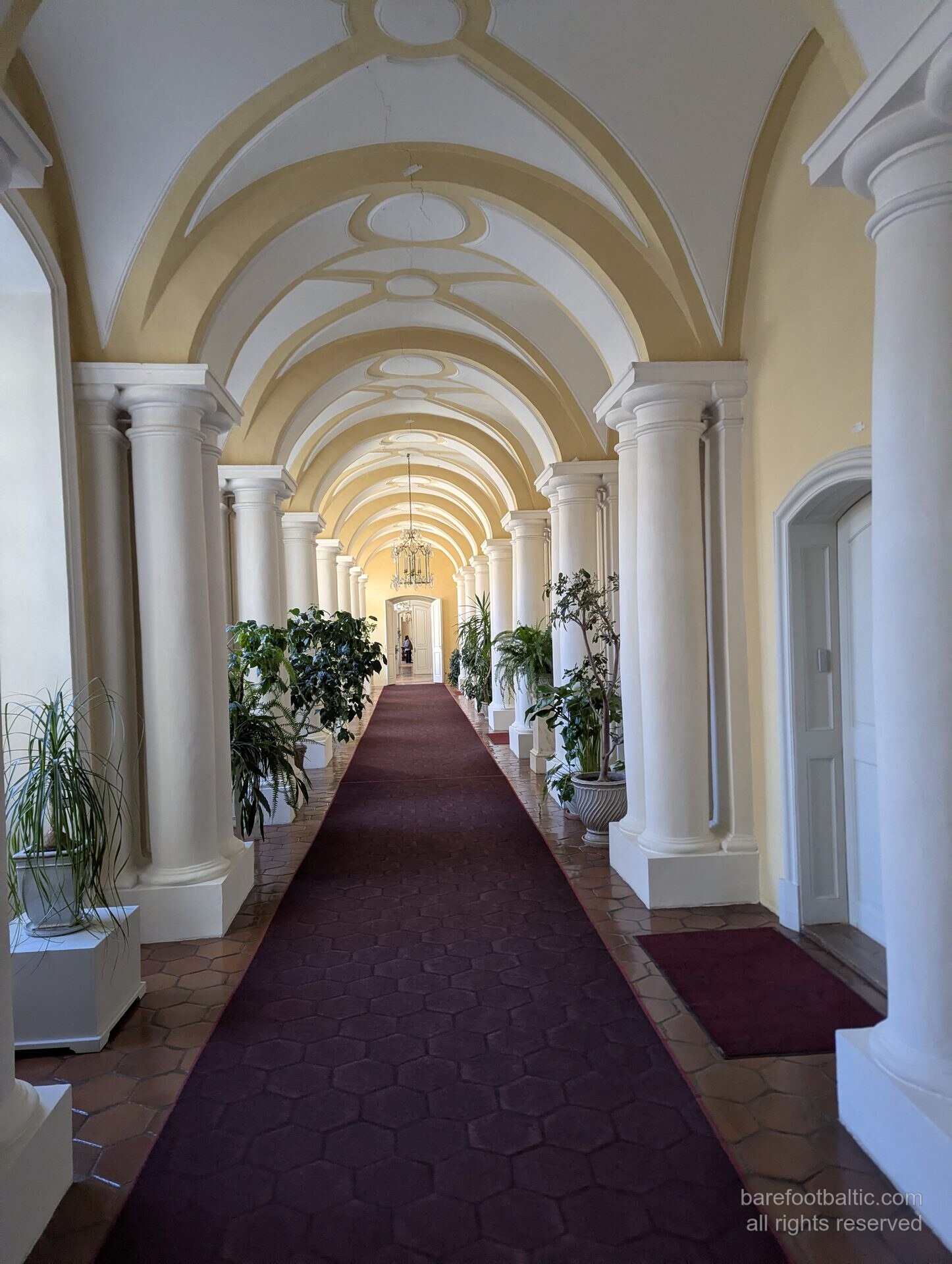
You walk in from the great state courtyard and the first room you find yourself in is the central vestibule. The mood here is intentionally restrained. Restrained Baroque, to be precise. The architecture of the vestibule mirrors the façades, and the ground floor's interior decoration has actually survived from the very first construction period, which is rare in this building.
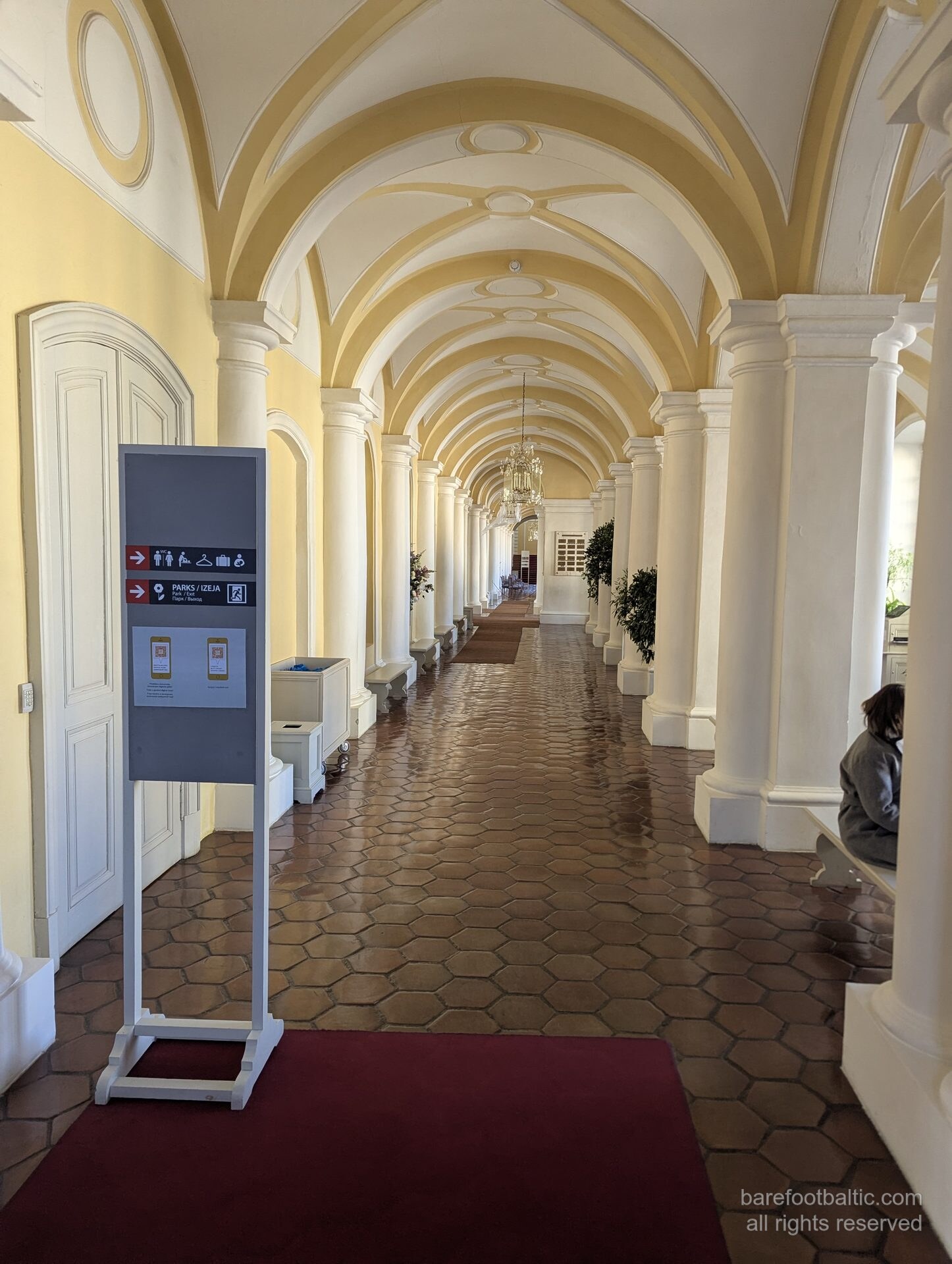
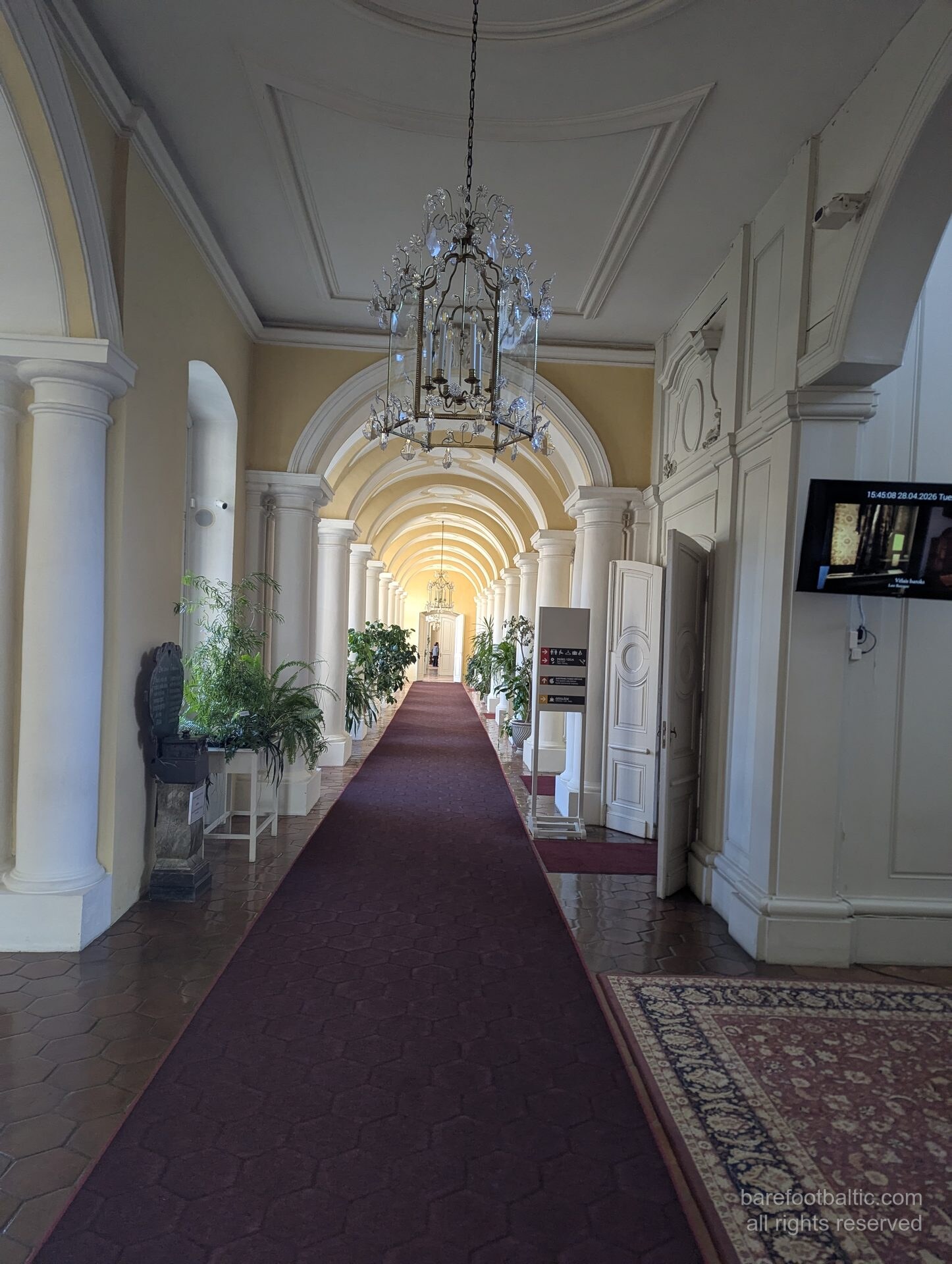
Look at the entrance door. It faces the garden, not the courtyard. To either side of you, vaulted galleries with colonnades divide the space and lead toward the two state staircases. Francesco Rastrelli, the architect, originally envisioned something more luxurious for this entry. He wanted black and white marble flooring, the sort of finish you'd expect in St Petersburg. But because he was juggling the parallel construction of the Duke's residence in Jelgava, he simplified the plan and laid clay tiles instead. They're still there.
Turn left along the columns toward the east-side staircase. At the bottom of the stairs, before you go up, take the corridor running off to the side. It leads to the palace kitchen.
The Palace Kitchen
This is one of only two rooms in the wing where the original clay floor tiles were able to be restored in their original positions. Everywhere else, they're modern reconstructions.
There are four hearths built into the kitchen, and food was prepared on open fire. Full-length flues run the entire height of the palace to create the draft needed to cook for a court. You'll see cauldrons with adjustable hanging devices, spit holders, tripods, and cooking grates. Pay close attention to the spit rotation device on the second hearth. It works with a clock-like mechanism. Inside the third hearth there's a masonry platform finished in Dutch tiles, used for preparing smaller dishes.
The collection of utensils includes pots, pans, colanders, cups, cans, and a separate display case showing faience and tinware. Clay bowls, the kind widely used in eighteenth-century European kitchens, were also discovered in archaeological excavations near the palace. The walls are hung with eighteenth-century paintings and engravings of kitchen scenes. Two paintings by the eighteenth-century German painter Justus Juncker show activity around a hearth, and two by the Austrian painter Lautter depict shelves with polished dishes. There are ceiling chains and meat hooks for hanging carcasses. A painting by the seventeenth-century Dutch artist Isaac van Ostade above the second hearth shows game ripening on so-called "bacon hooks", two of which are actually displayed in the third hearth.
In the corners opposite the hearths sit two large brass water containers with lids. A water pipe was already installed in this kitchen during the Duke's reign, and fragments of it have been preserved in the original location in the basement under the kitchen.
Now we walk back through the hallway and head up.
The Green Glass Exhibition
Next to the old kitchen is a small but elegant exhibition called The Green Glass. Four vitrines display a collection of green glass household objects donated to the Museum by Karin von Borbély of Germany. It takes about three minutes if you're moving, ten if you really look. The colour catches differently in each piece.
The State Staircase
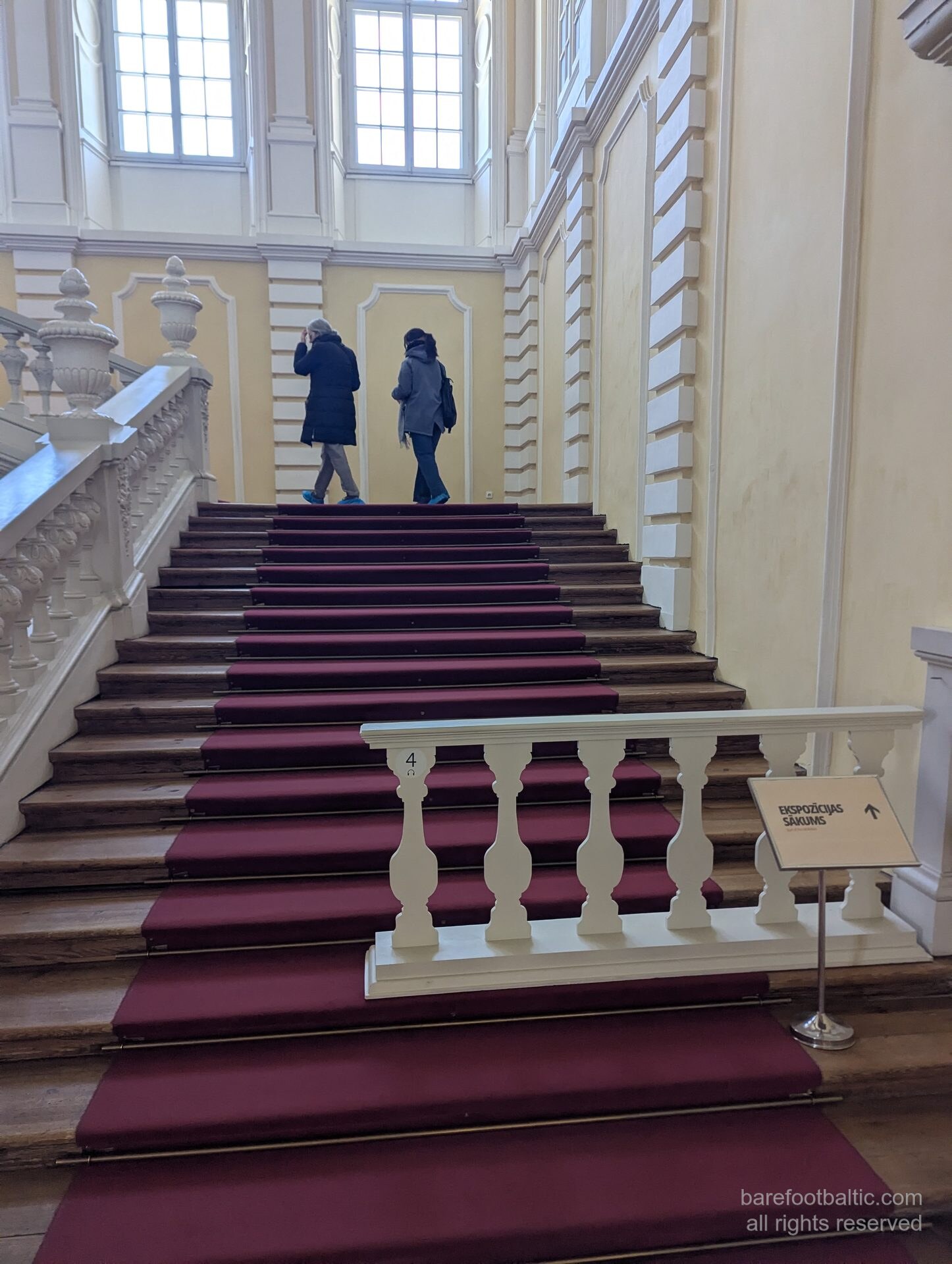
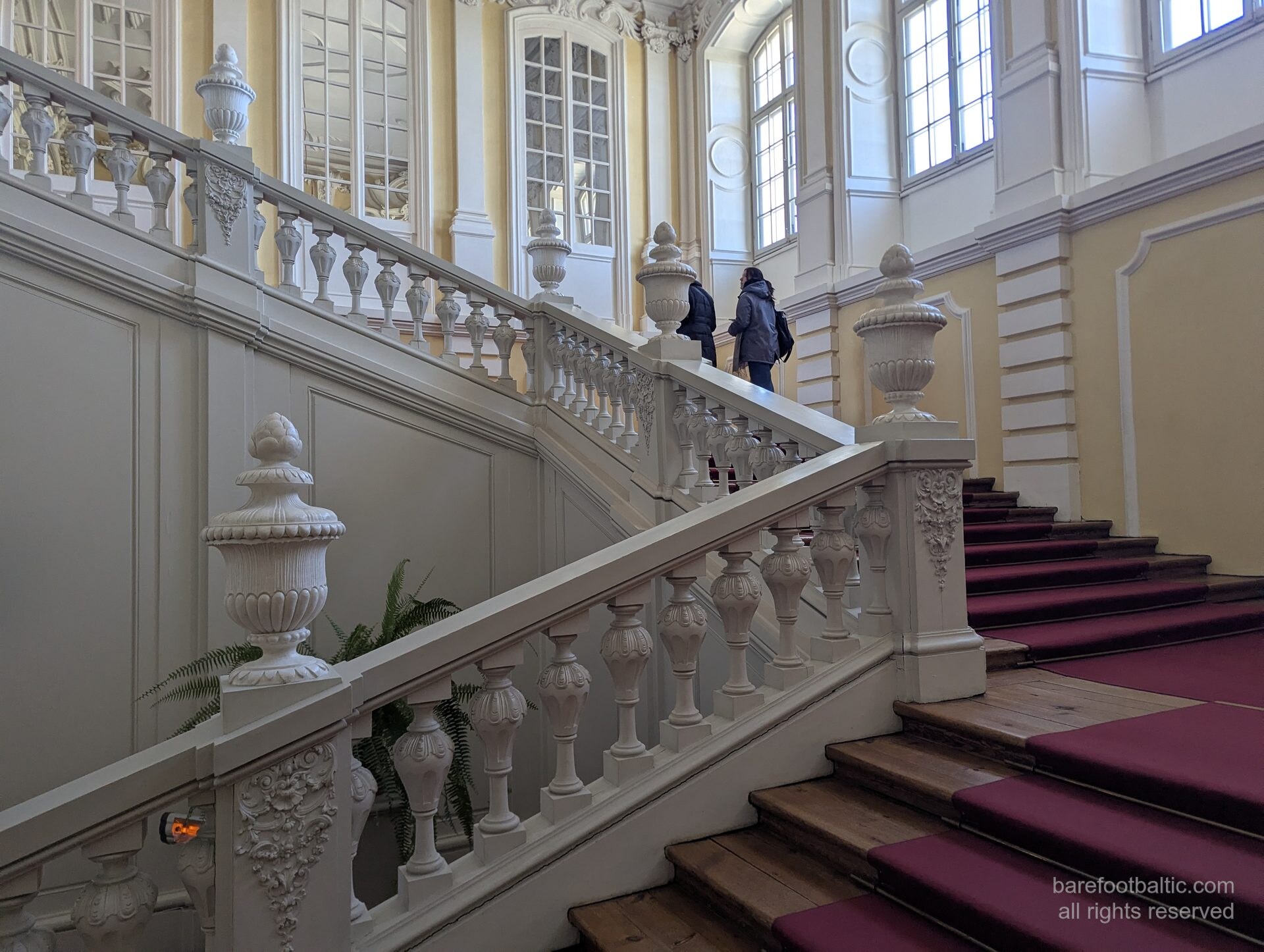
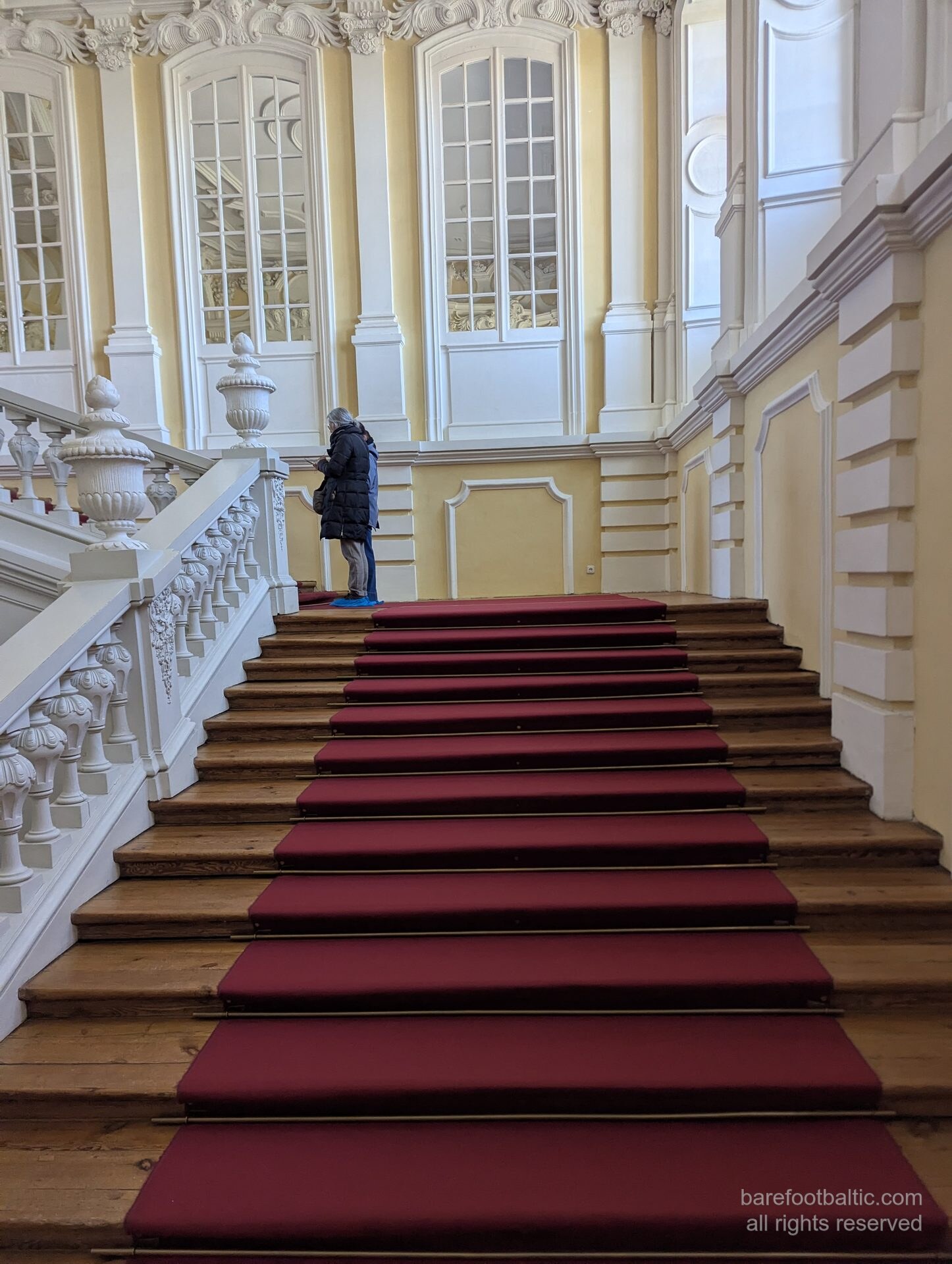
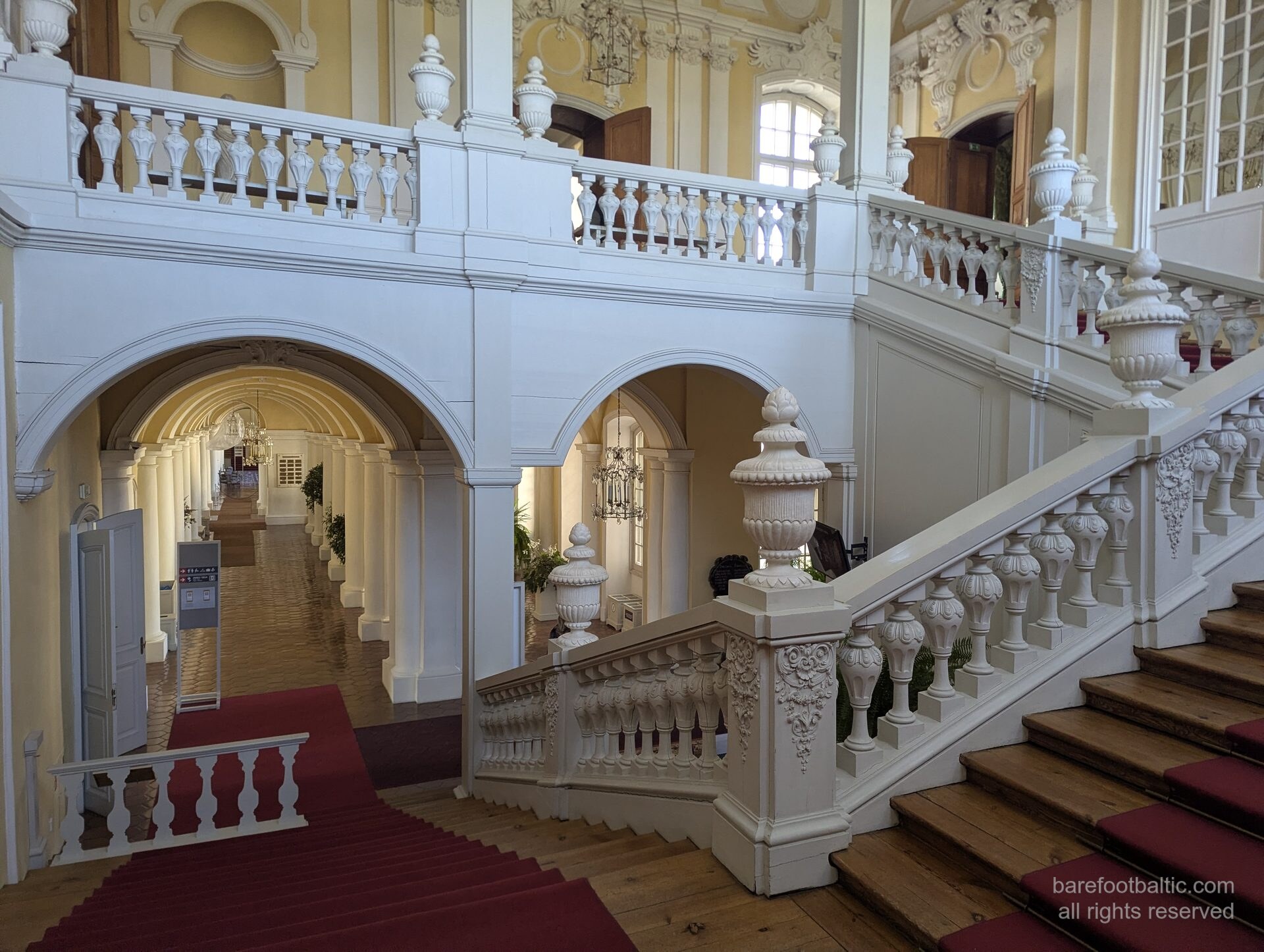
There are two state staircases at Rundāle, almost identical to each other. We follow the east-side one because that's the one used during festivities. The west-side staircase serves the Duke's family wing, and we'll come to it later.
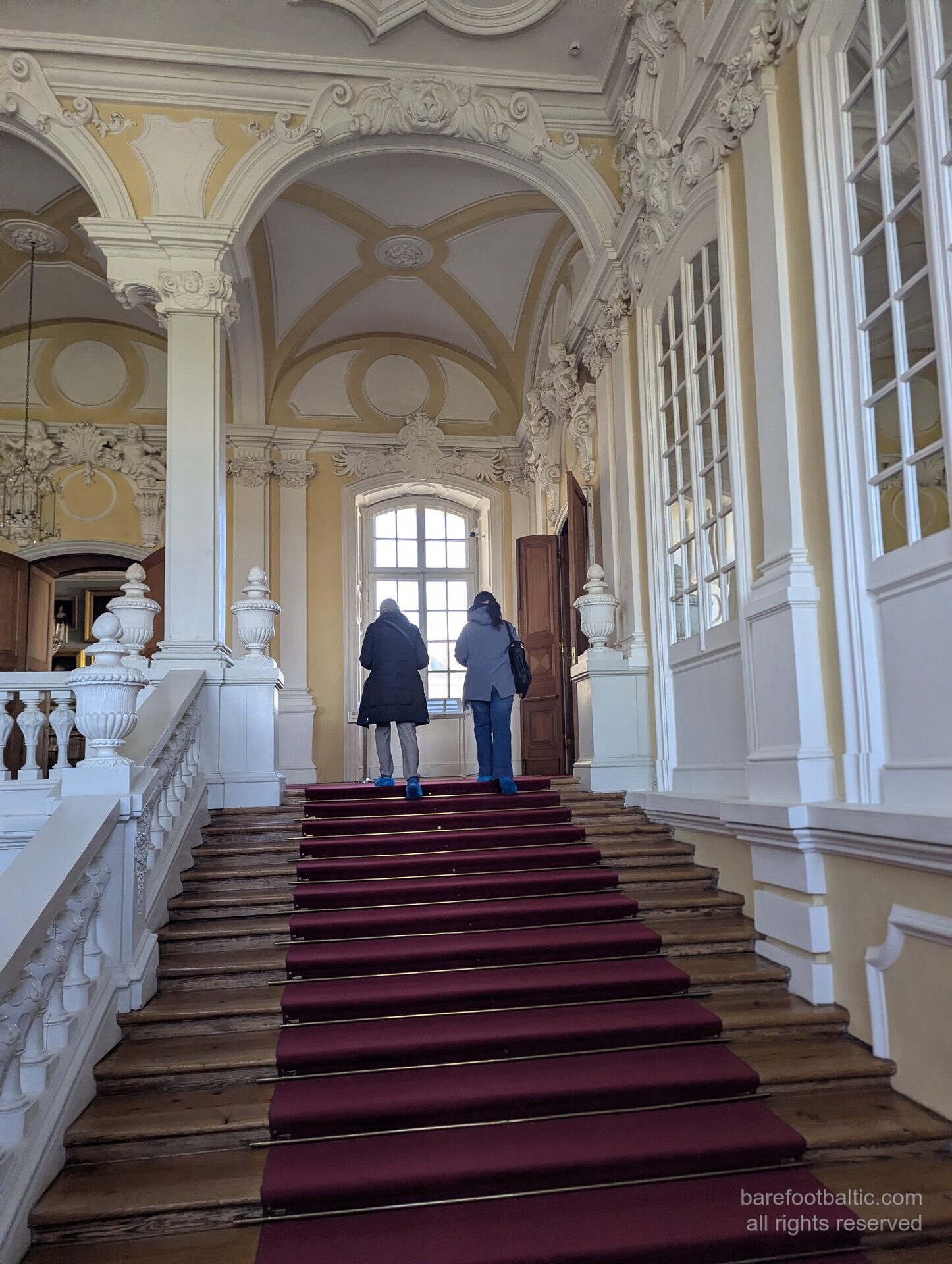
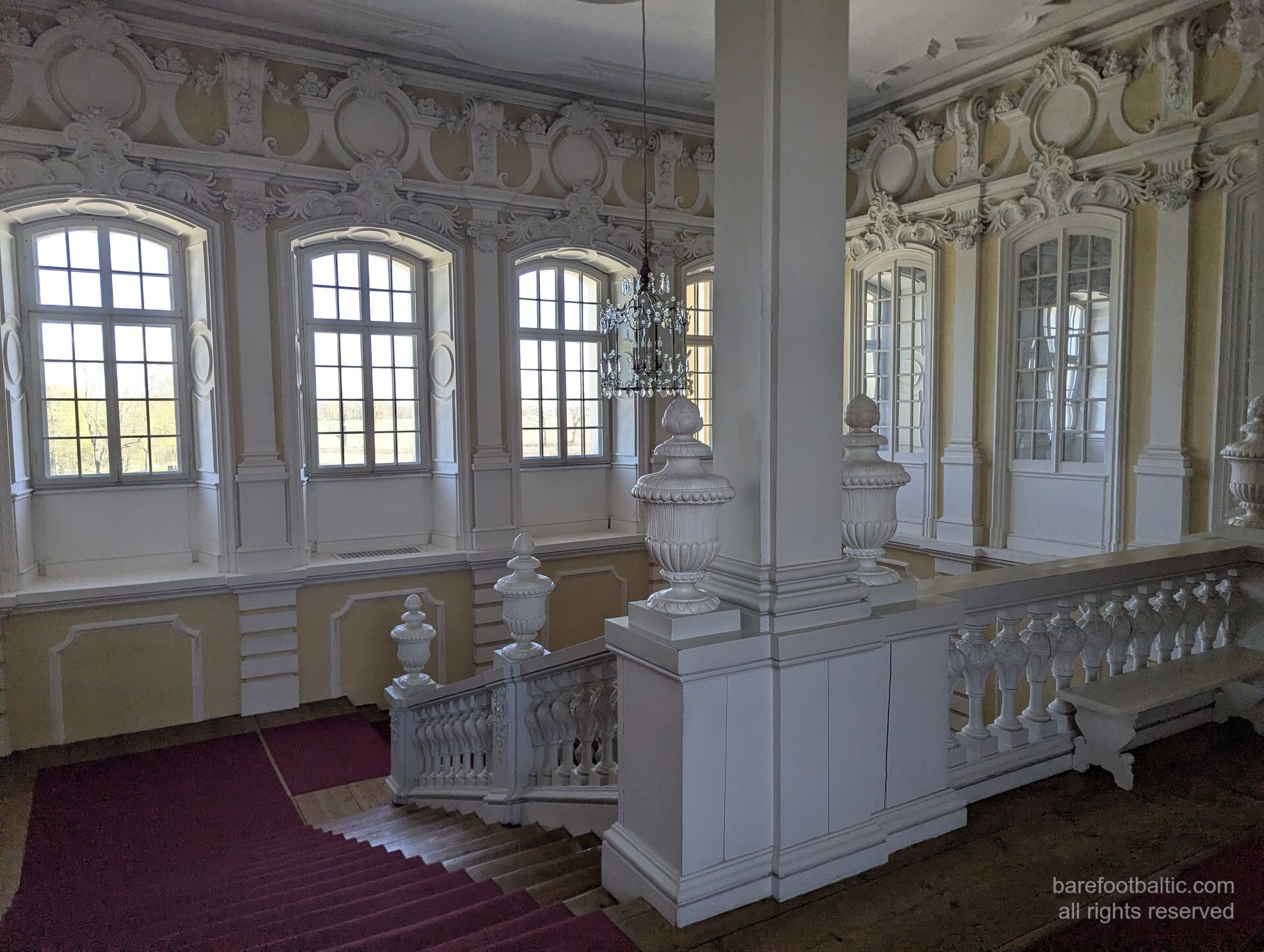
By 1740, the walls and ceilings of the stairwells had been adorned with stucco decorations, gypsum and lime mass used as decorative sculpture, featuring stylised human faces (mascarons), flowers, palm branches, acanthus leaves, and volutes. Carved pedestals and balusters were finished too, although the railing vases were originally meant to be more luxurious. The ones with sculptures on pedestals never happened.
Here is what makes this staircase remarkable. It's the only interior from Rastrelli's early period that was actually implemented according to his design and has survived to today. The stucco work was done by Russian masters called quadrators, working under Pyotr Yefremov, using models created by a German master.
During the restoration, the mirror windows that Rastrelli originally planned were finally installed. Throughout the Duke's era they'd only been faux glazing bars painted on the wall, common Baroque practice, since mirrors create the illusion of a larger space. The stair railings and steps survive from the first construction period. The railing vases were made and installed in the second construction period, then reconstructed during restoration. The ceiling lantern was made after a sample from Kuskovo Palace near Moscow. Lanterns went into rooms where ordinary candles would otherwise be blown out by the draft.
From the top of the staircase, guests could enter either the state rooms (right) or the Duke's state apartments (left). The Duke had a third option, a private door in the middle of the staircase, usually closed because it led to his private rooms.
We turn right, toward the Gold Hall.
The Antechamber of the Gold Hall
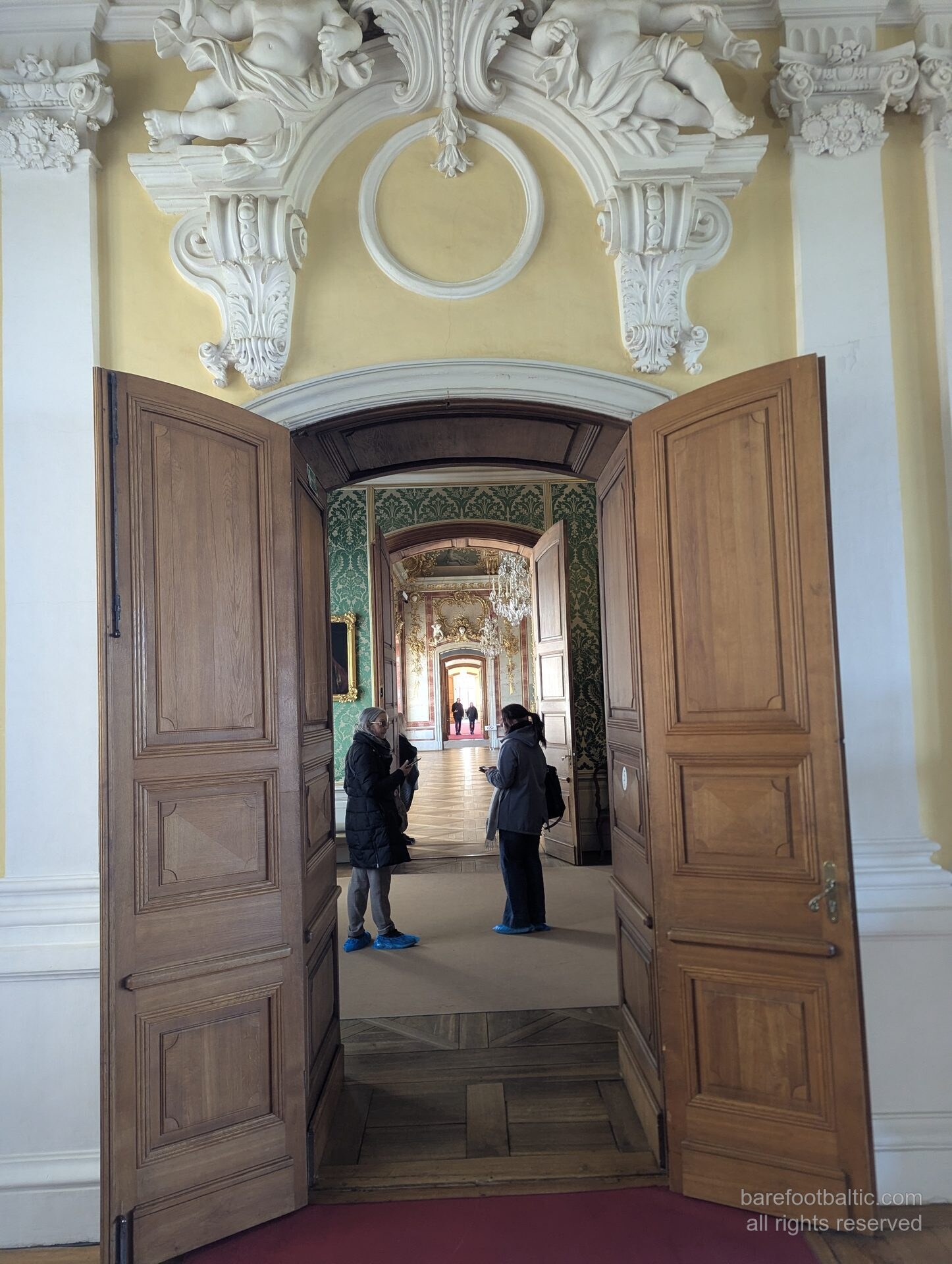
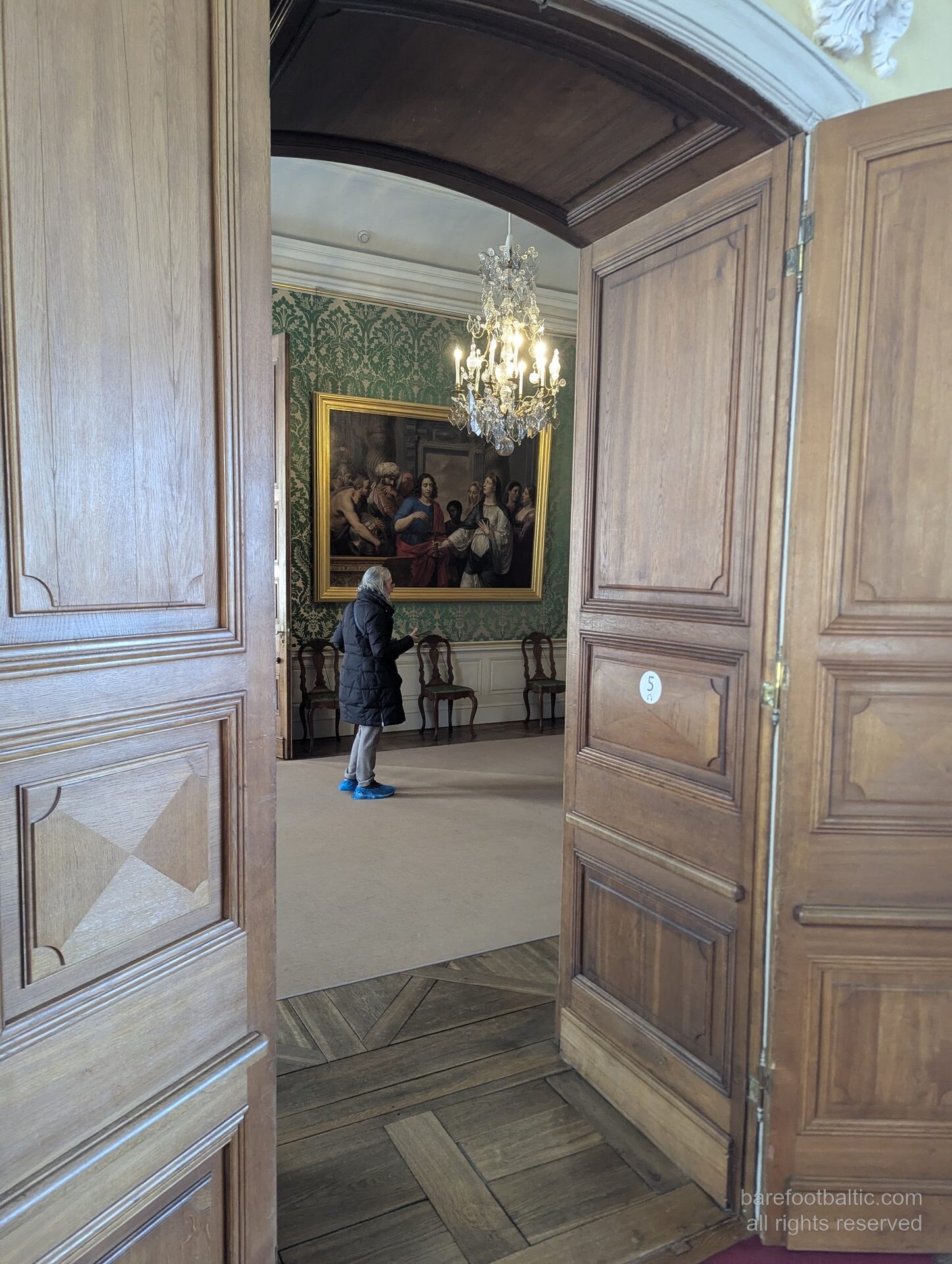
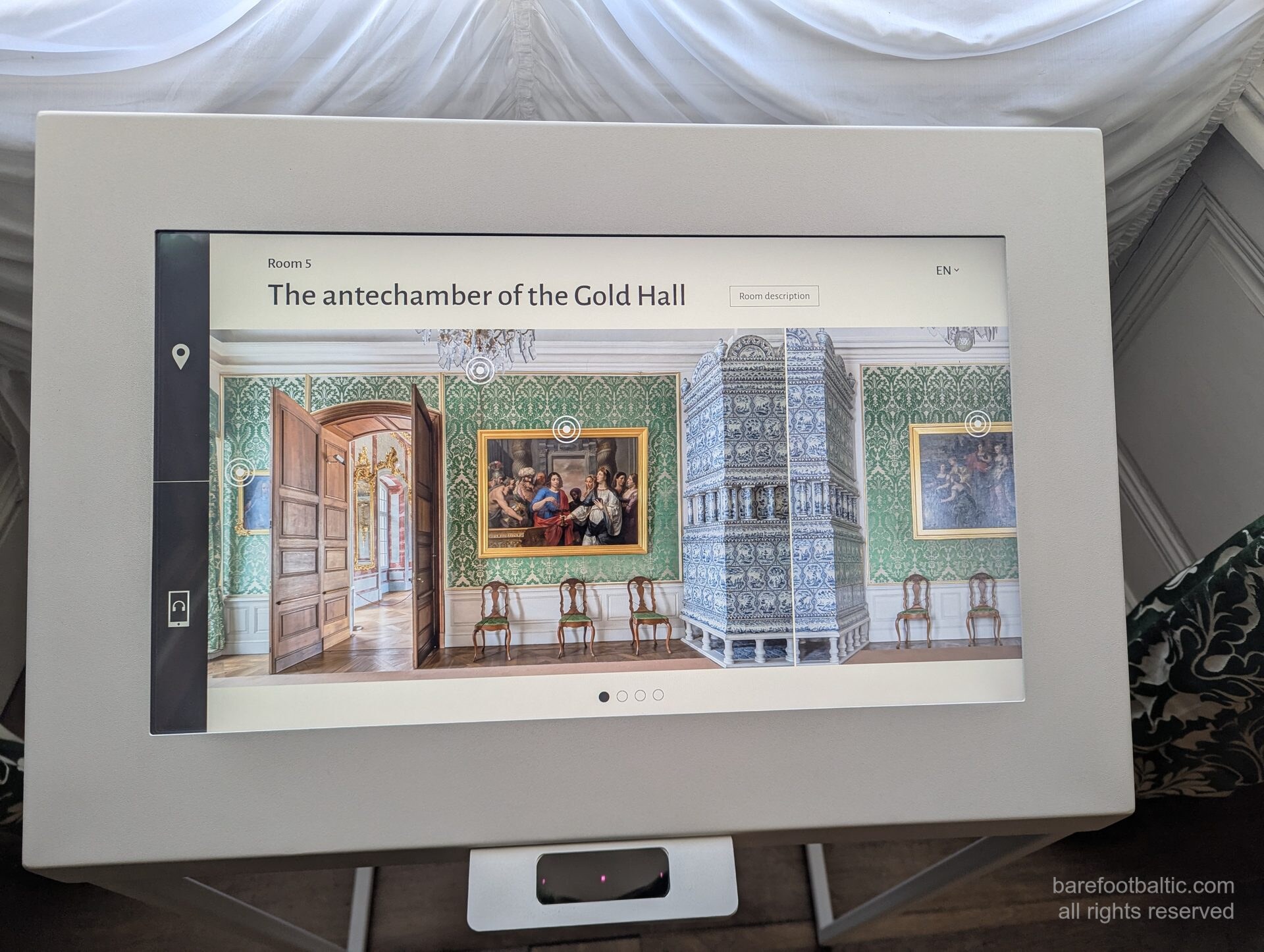
We're in the east wing of the palace now, the side where court celebrations took place, which is why the artistic décor here is opulent. This was made during the second construction period and is considered an outstanding example of decorative art in the then-popular Rococo style. The ground floor reflects the first construction period's Baroque era, but up here on the first floor the visual language has shifted.
Because these rooms had representational functions, they aren't crammed with furniture. Instead, they showcase monumental sculpture and painting, works of art from the Museum's collection.
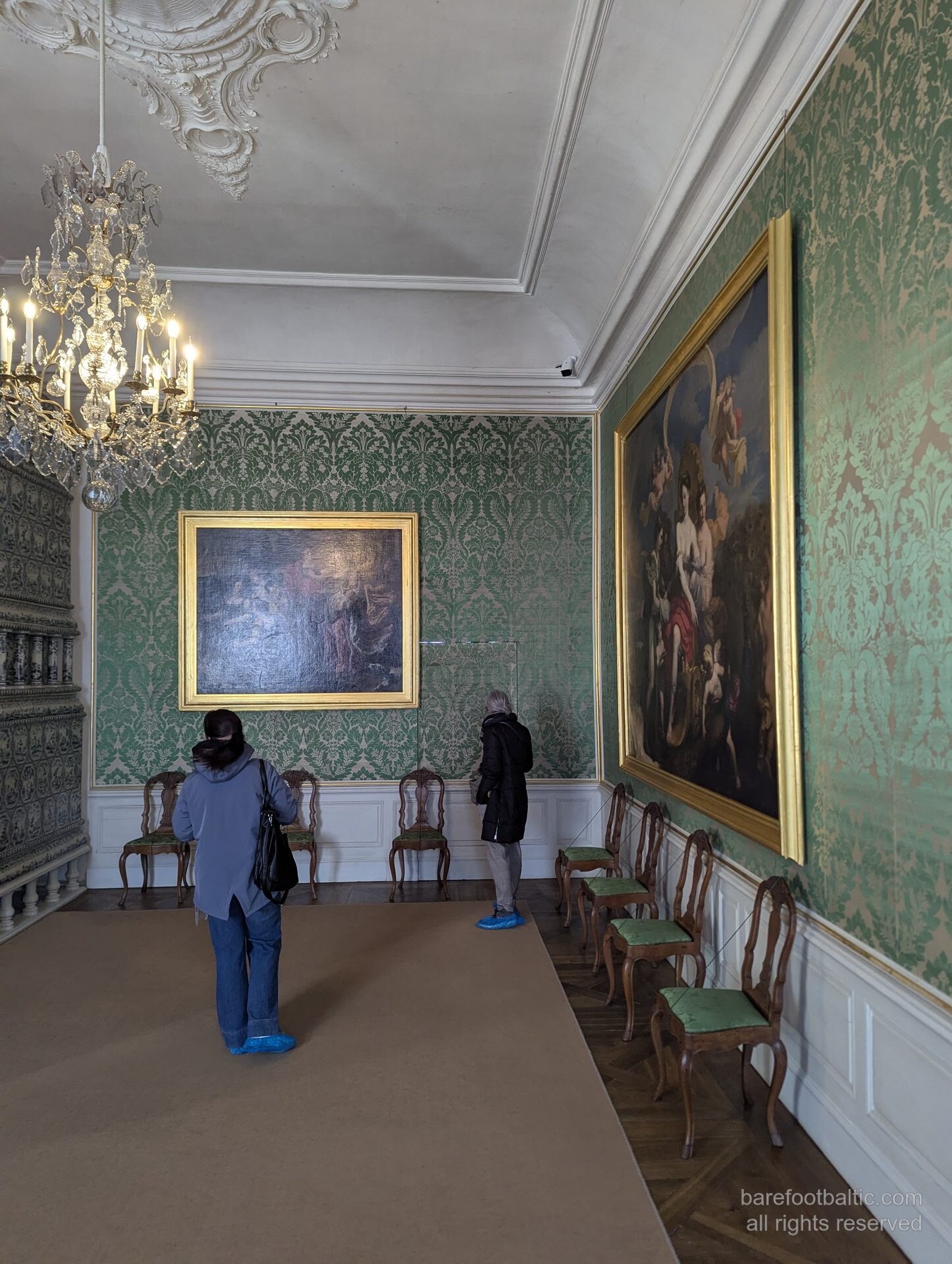
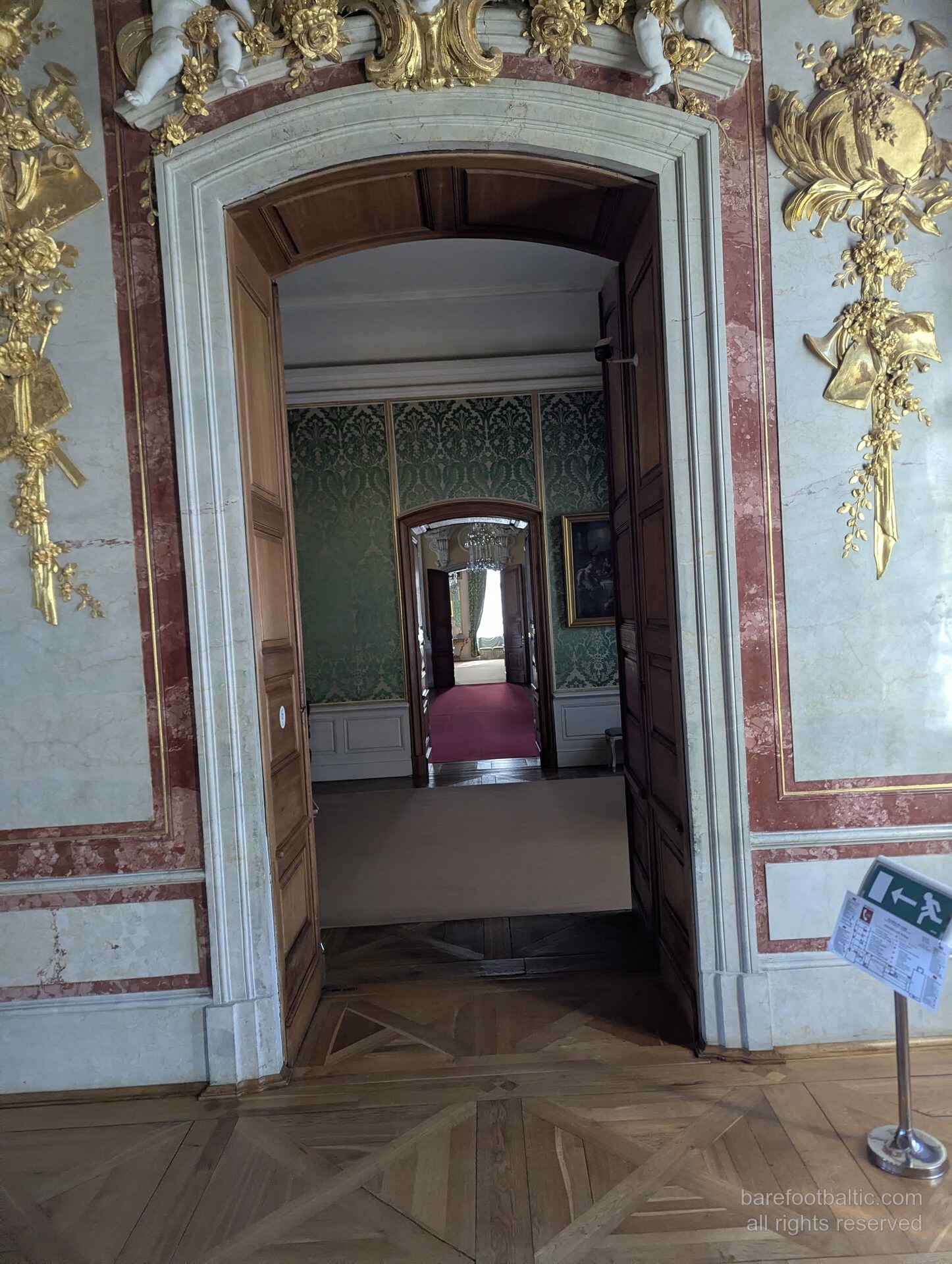
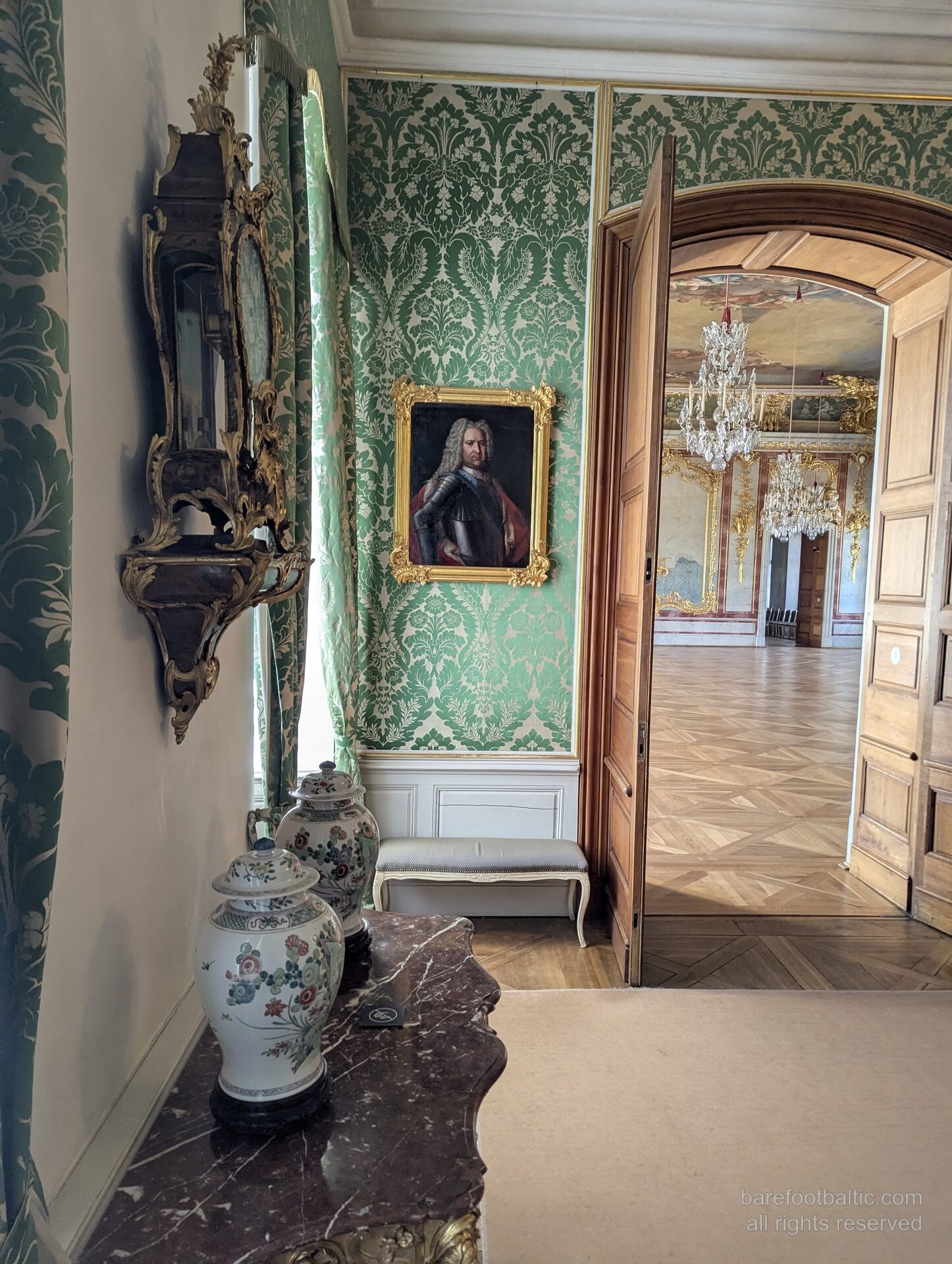
The Duke's guests would have waited here in the antechamber until the doors of the throne hall opened and they were solemnly announced. On the left of the door leading to the Gold Hall is a portrait of Duke Ernst Johann himself, painted in Courland around 1740. The probable author is Christian Sidow.
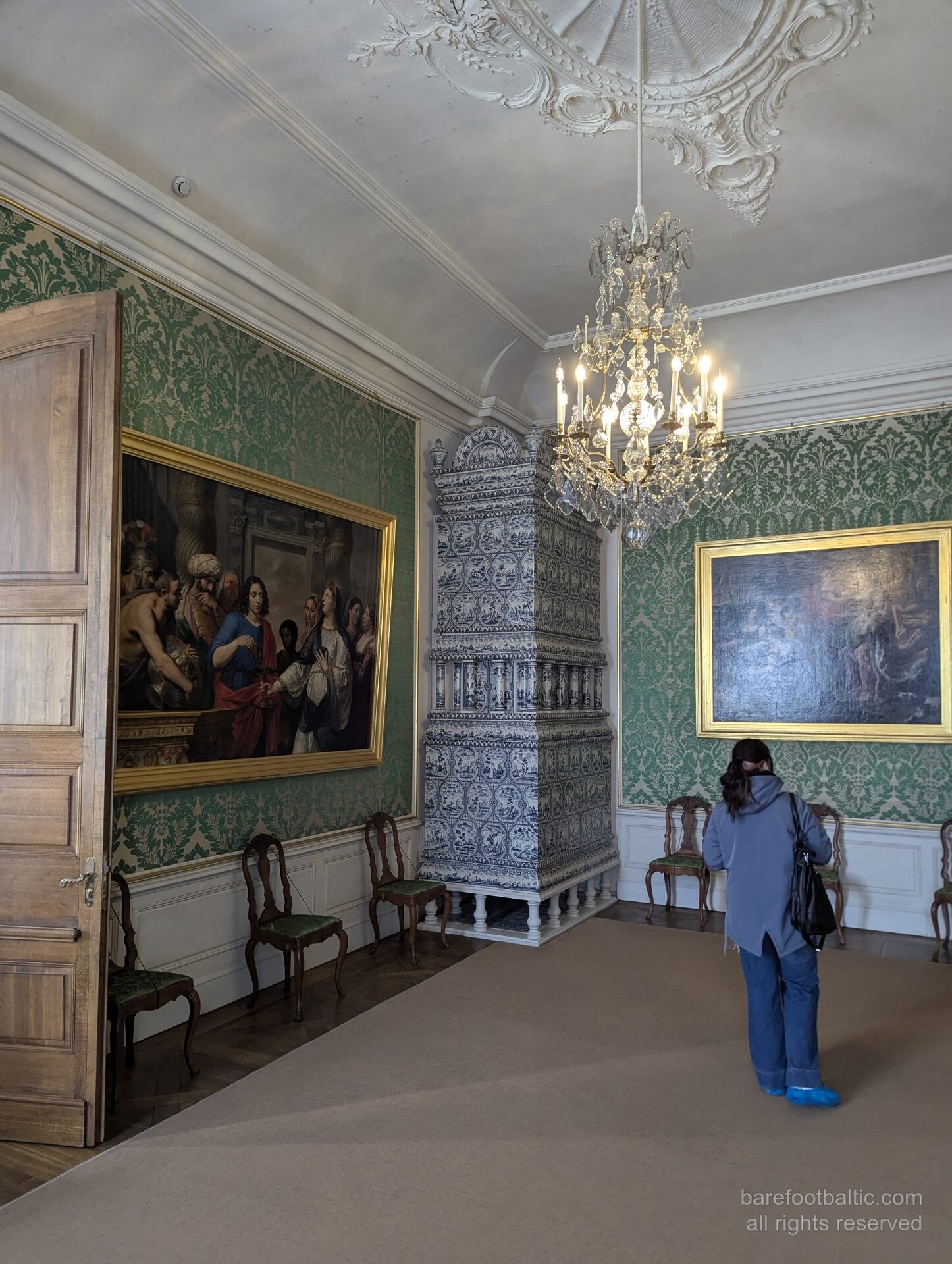
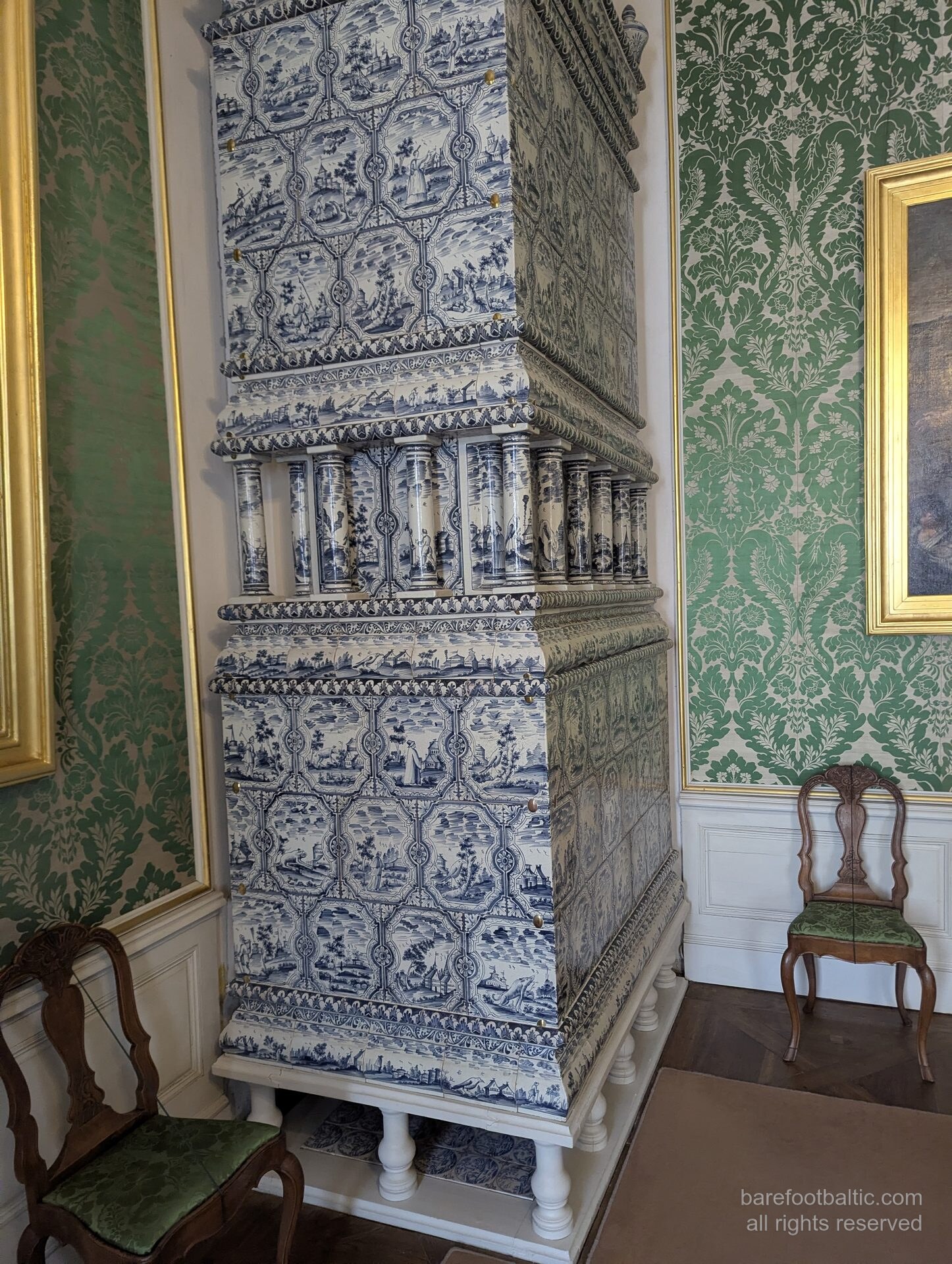
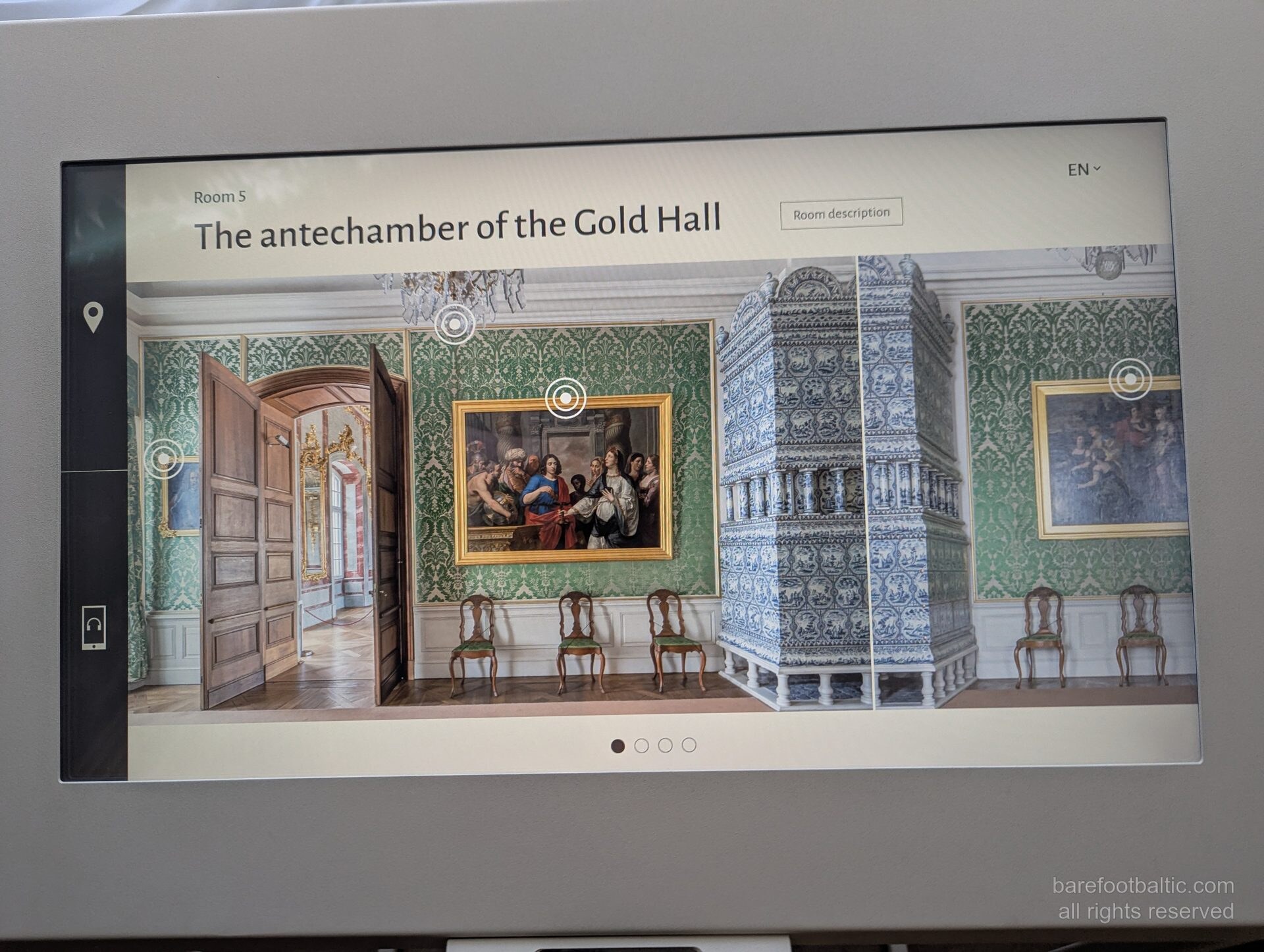
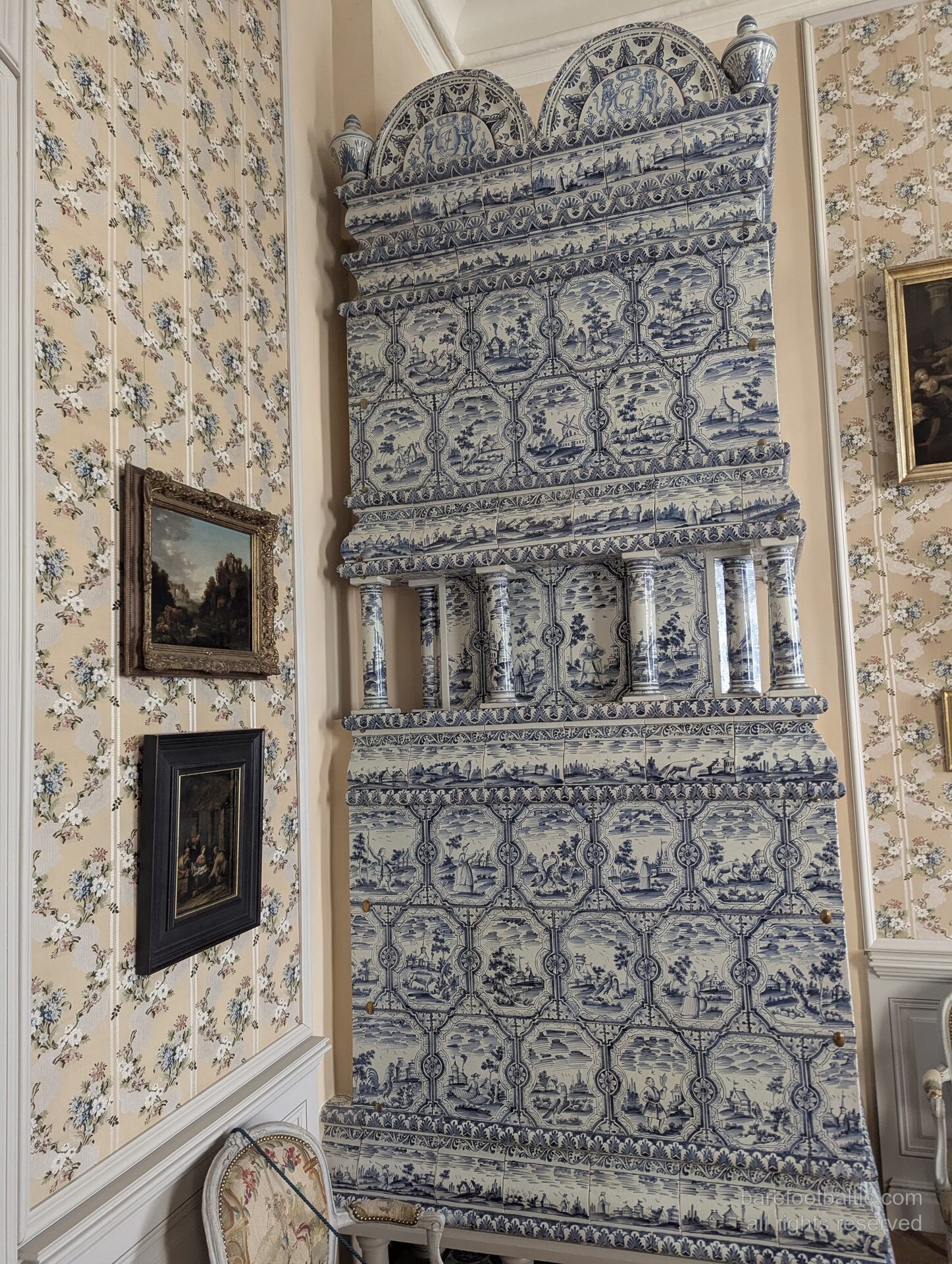
In the second construction period, the decorative sculptor Johann Michael Graff produced remarkable work here. He was at Rundāle from 1765 to 1768. The ceiling rosette he created has been well preserved. A lot of pieces in this room, like the parquet, wall panels, doors, and doorway decoration, survive from the first construction period because after returning from exile, Duke Ernst Johann wanted to restore his property as quickly as possible. The stove in the corner is one of seventeen copies made in Leningrad in the 1970s, based on preserved samples of painted tiles from the eight original stoves. The walls are upholstered with period-appropriate fabric.
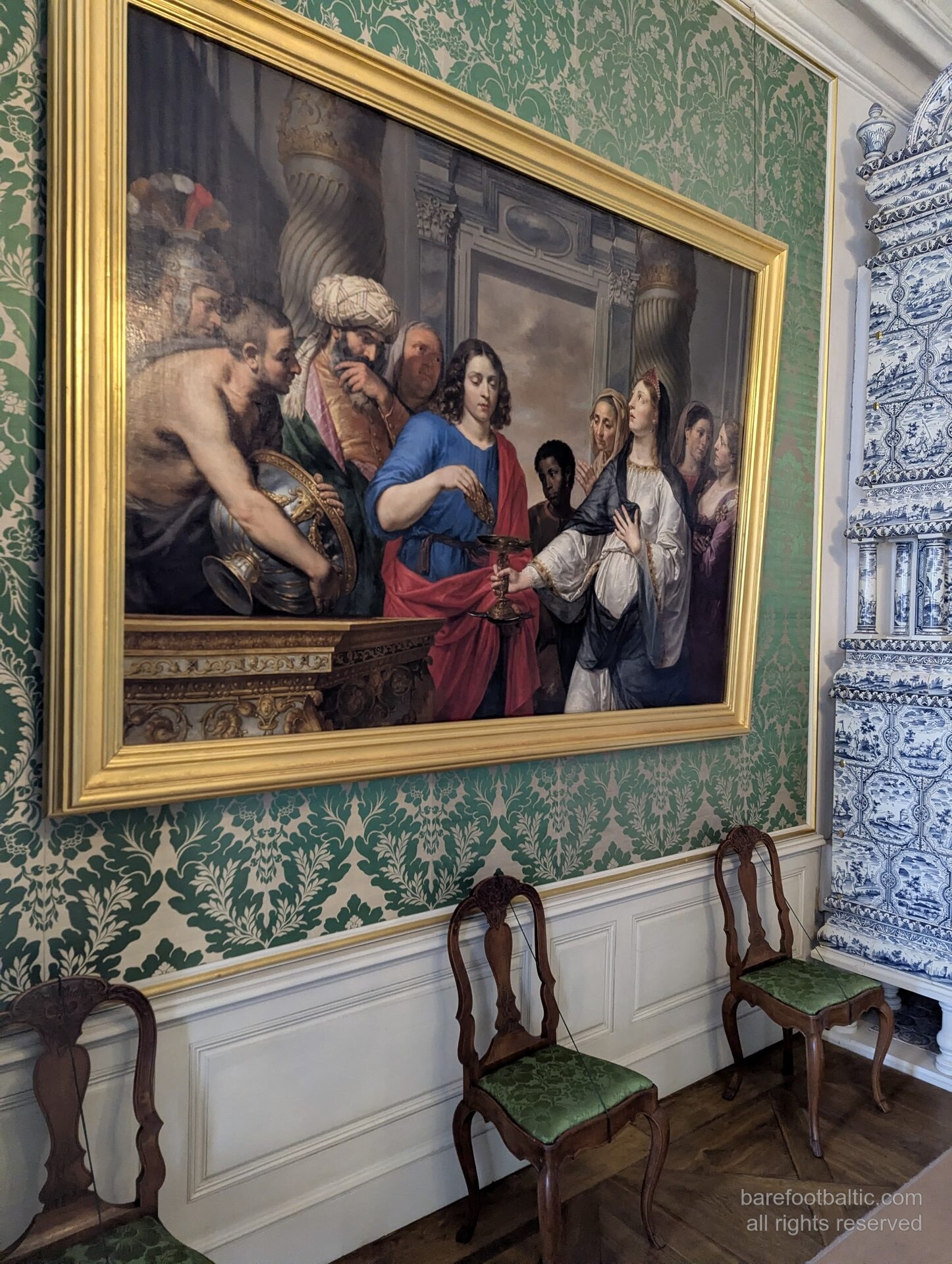
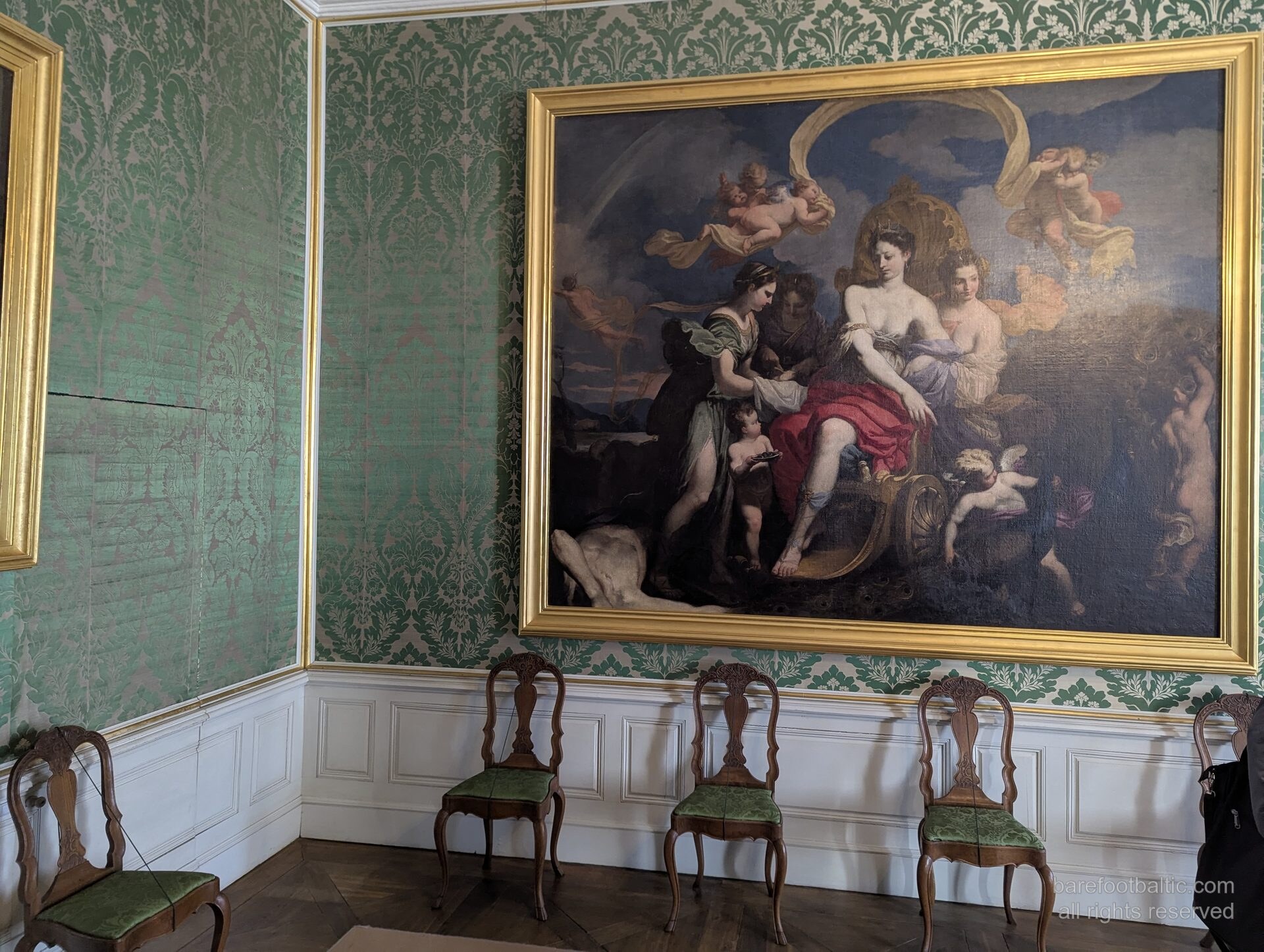
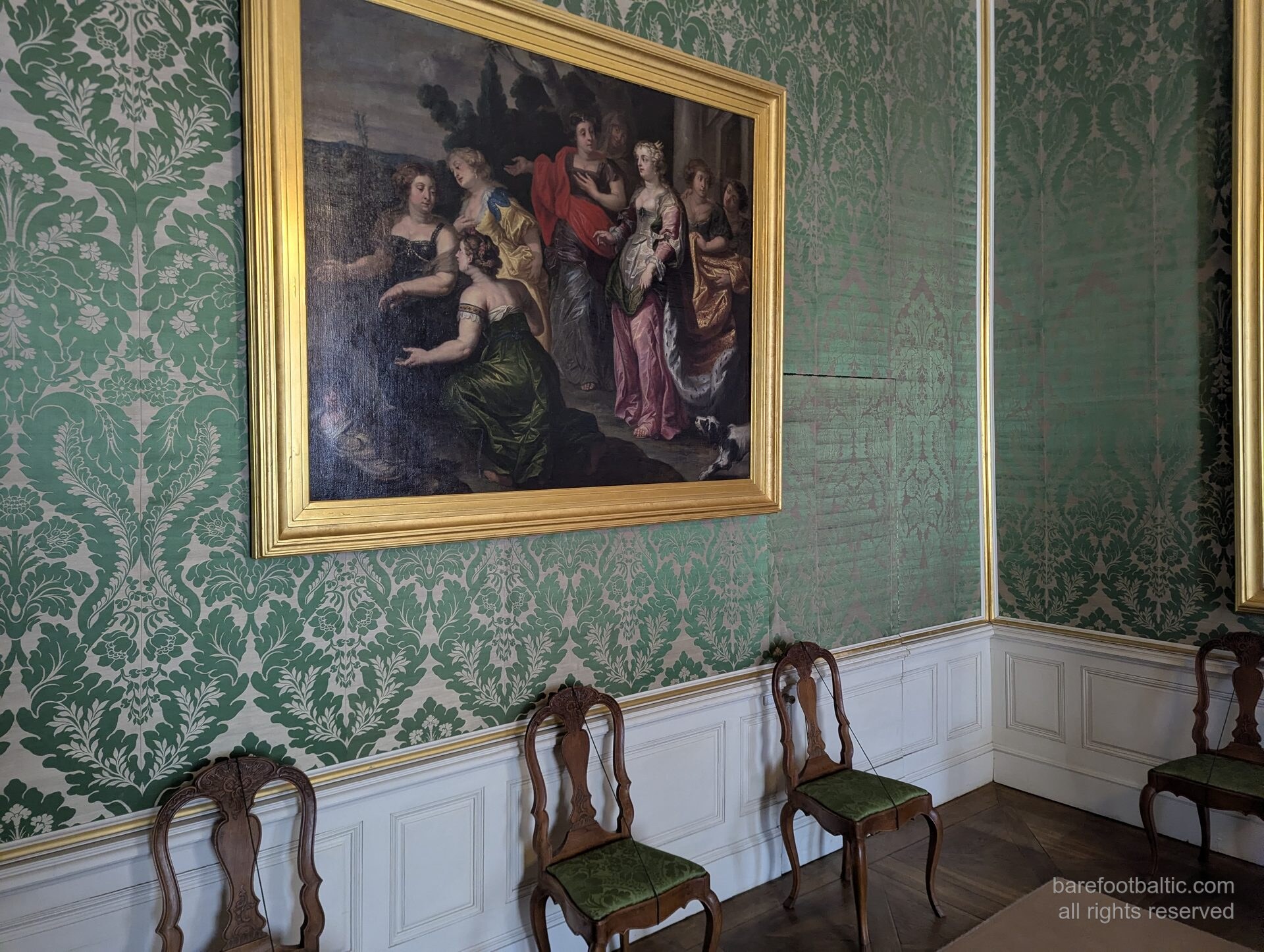
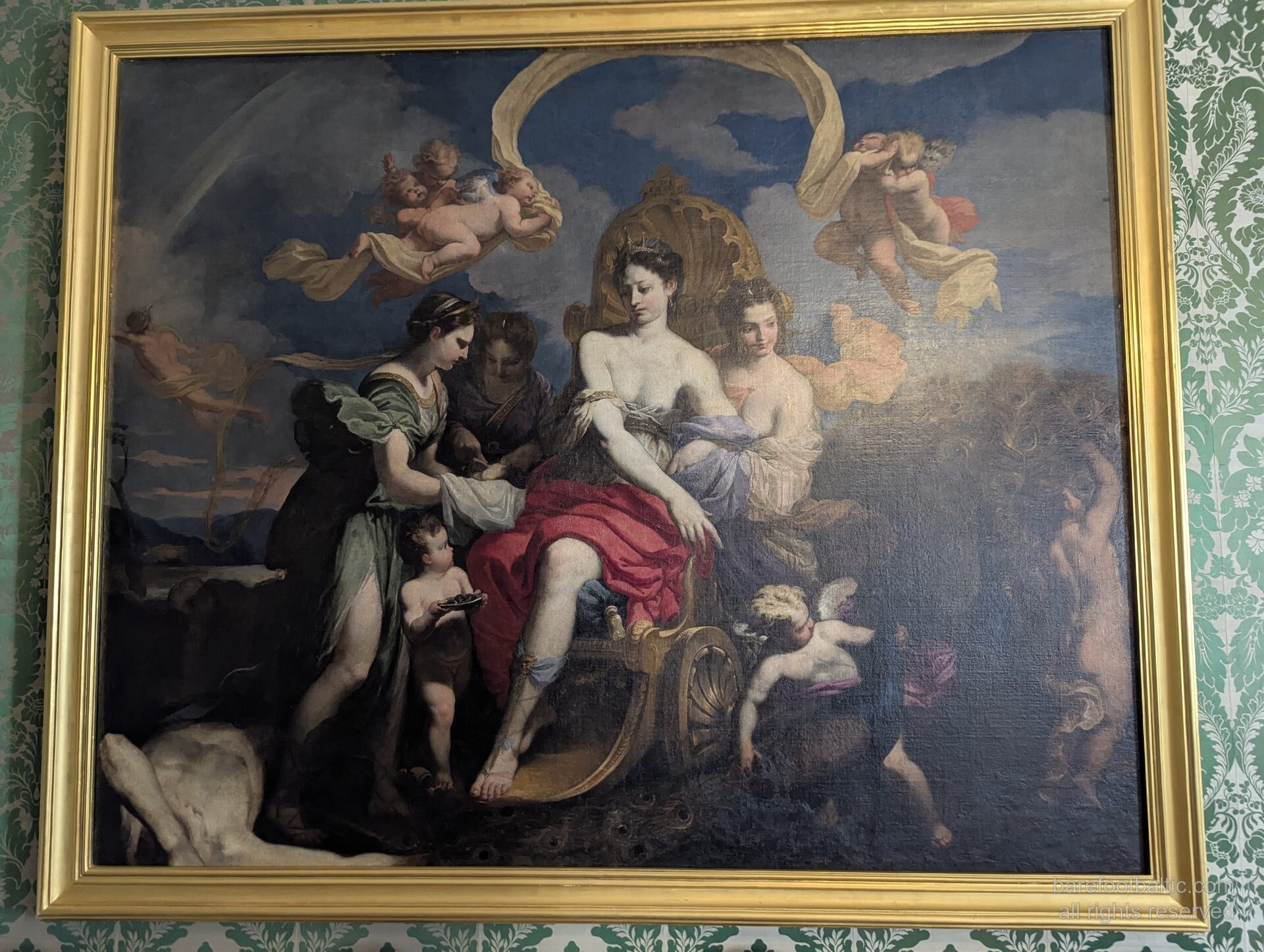
For the convenience of waiting guests, there's seating, a console table, and a clock. Large-format seventeenth-century paintings depict scenes from the antique world and the Bible. Next to the door to the Gold Hall is a painting called Artemisia by the Dutch artist Jan de Bray, depicting the faithful love of Artemisia, widow of King Mausolus. On the opposite side, an unknown Italian painter shows the Roman goddess Juno at the corpse of the many-eyed giant Argus Panoptes. The far end wall holds The Finding of Moses by an unknown Flemish artist.
Through the next door is the Gold Hall itself.
The Gold Hall
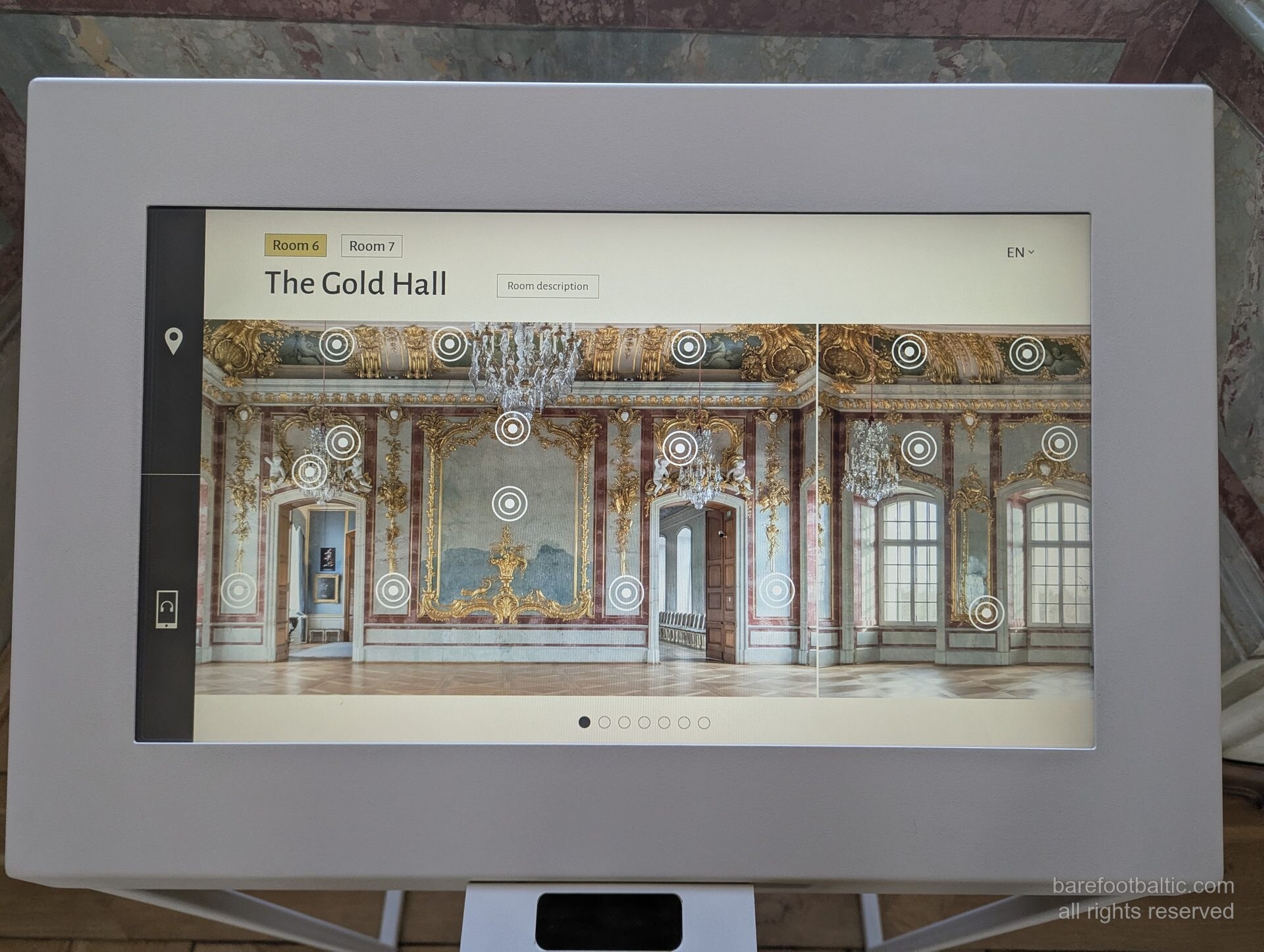
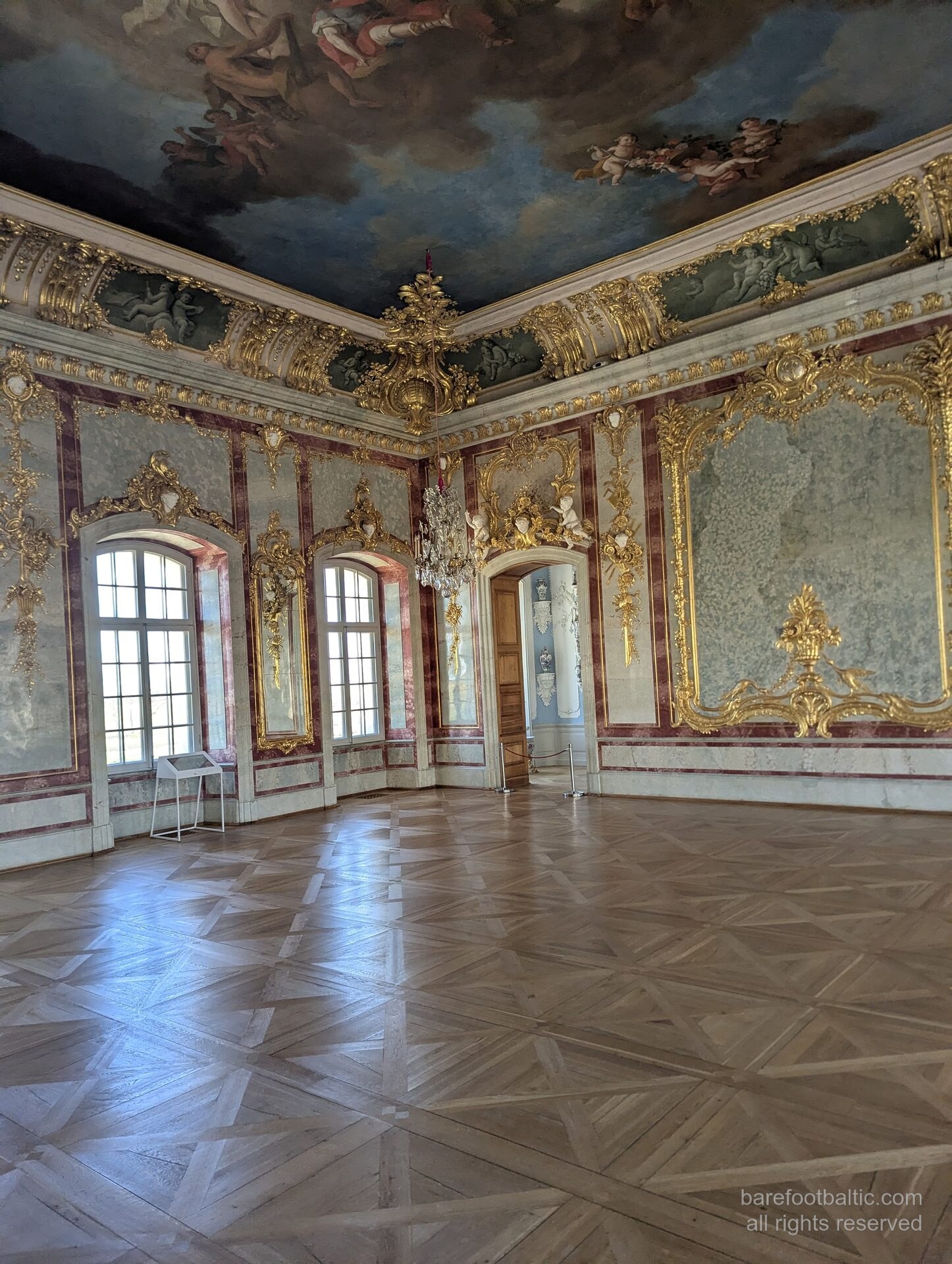
This is the most luxurious room in the palace. The Duke's throne stood directly opposite the entrance door at the far end of the hall, and it was the only piece of furniture in here, because guests stood. Walk forward and stand where the throne once stood. From there, look up.
The ceiling painting, the plafond, is dedicated to him. The theme is the glorification of the ruler's virtues, an apotheosis. As elsewhere in the palace, the source of inspiration was ancient Roman mythology. The Duke is personified by Mars (god of war), with a ruddy flag and a tilted Saturn's death scythe next to him. The central group of figures depicts the virtues of the ruler. A woman sitting at the obelisk with a trumpet symbolises Fame. A woman with the sun over her head and a green branch in her hand is the Truth. Peace is symbolised by a woman holding a wand with snakes or caduceus in one hand and a flame in the other. A cornucopia held by Generosity, and a design of the building held by Magnificence. In the strip between the walls and the ceiling, the ceiling cove, you can view eighteen allegorical and emblematical paintings executed in grisaille technique, using lighter and darker shades of the same colour.
Children figures depicted in the paintings are putti (the singular is putto). Here, the putti represent various art forms and activities. On the left, just above the window by the entrance to the Grand Gallery, a putto supports a plate with the year 1767, the year the ceiling painting was completed. The plafond was a collaboration between two Italian artists, Francesco Antonio Martini and Carlo Zucchi. They came to Rundāle from St Petersburg, where they'd been working on the interiors of the Winter Palace. Martini was born in Ticino in the Italian-speaking part of Switzerland and worked in northern Germany and Denmark. Zucchi was a member of a large family of Venetian artists who'd worked in Dresden and Krakow.
Now the walls. The stucco marble was done by the same master as in many other rooms, Johann Michael Graff, together with his brother Joseph and two assistants, Virgilius Baumann and Andreas Lanz. The colours were originally brighter and the gilded stucco decoration stood out perfectly against the vivid background, but more than 250 years later the green pigment has faded. Stucco decorations are partially covered in the original gilding, which has been preserved and restored.
Sculptural garlands on the walls were also done by Graff's team. They're emblematic, meaning they depict objects that symbolically represent arts and activities supported by the Duke. The wall next to where the Duke's throne used to stand is decorated with garlands glorifying music, science, and architecture. The opposite wall, between the hall and the porcelain cabinet, celebrates fine arts, music, dance, sculpture, painting. The garlands on the side walls are dedicated to fishing, hunting, cattle-breeding, and horticulture. The central square of the far end wall features the initials of Duke Ernst Johann, "EJ", on a silver background.
There were very few chandeliers at Rundāle in the eighteenth century. Mostly portable candleholders were used. The Gold Hall is one of the few rooms originally designed with five chandeliers for a particularly festive atmosphere. The current chandeliers are copies of French type with bronze frames and cut crystal glass pendants, made after a sample at Kuskovo Palace. Their lustre is multiplied by trumeau mirrors, which makes the room read as larger and brighter than it actually is. At the time, mirror glass of the required size couldn't be cast in one piece, so each mirror is composed of several pieces.
An open door stands out among the gold. Behind it, light blue and white. That's the Porcelain Cabinet. Let's go.
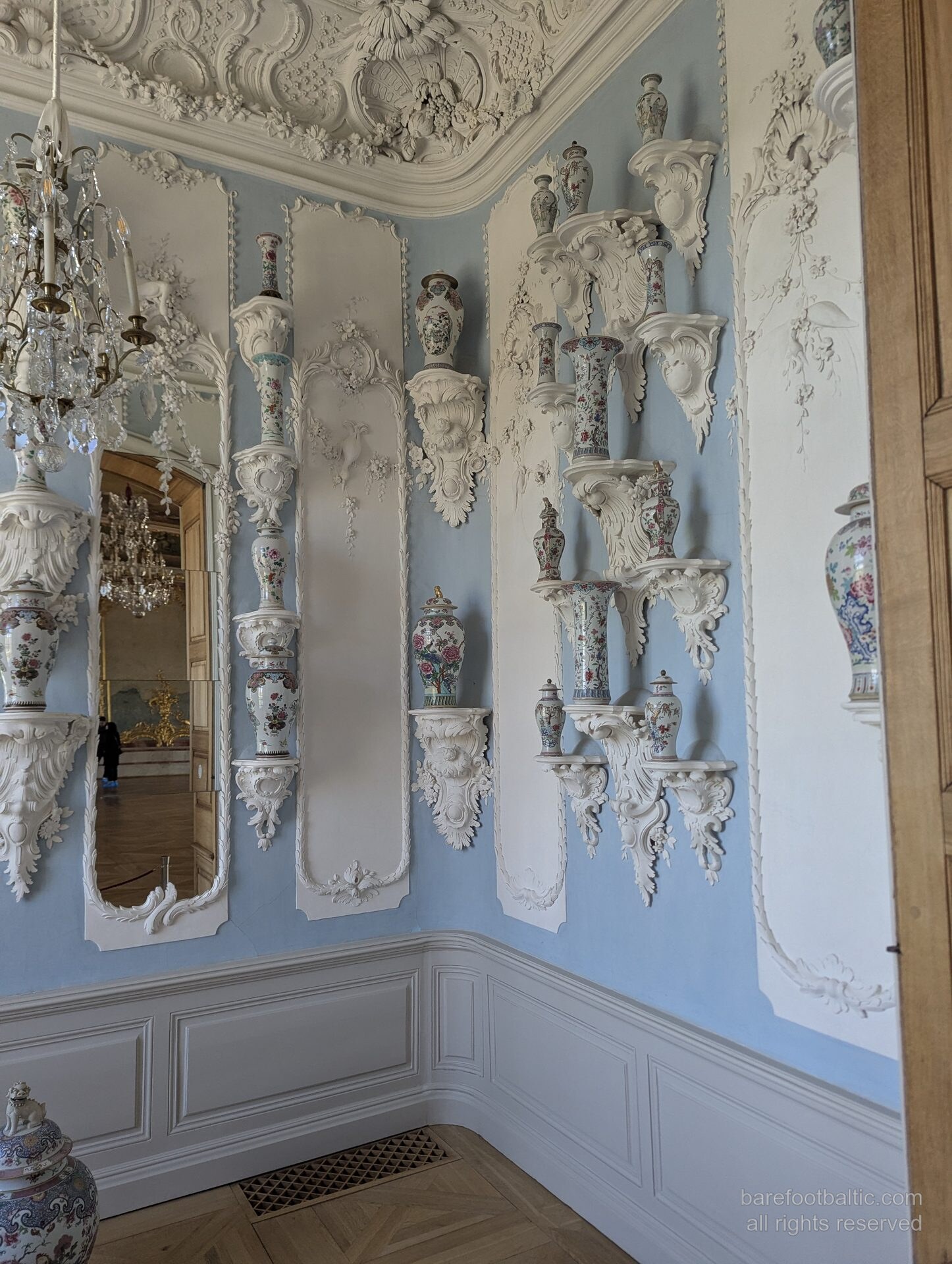
The Porcelain Cabinet of the Gold Hall
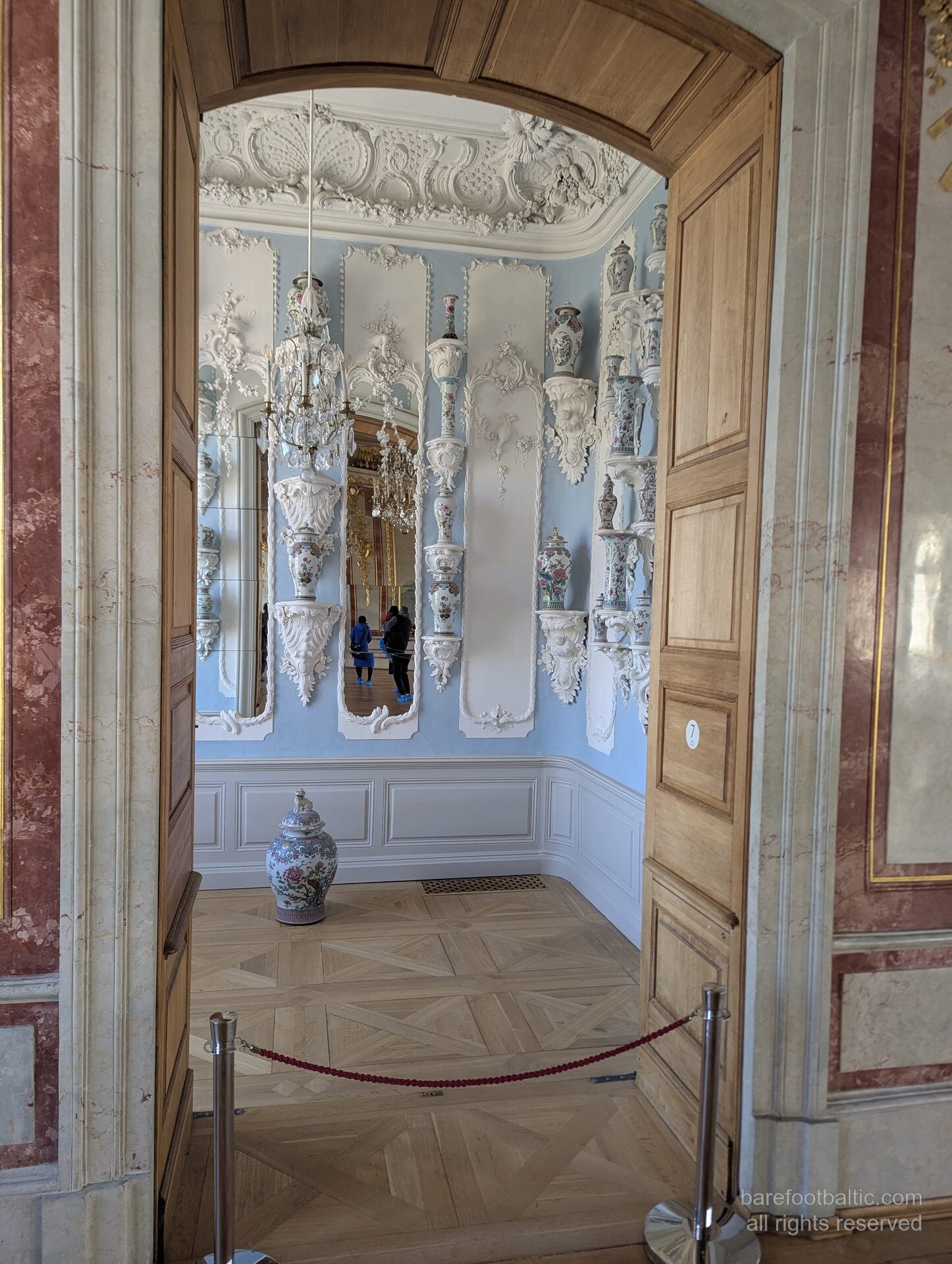
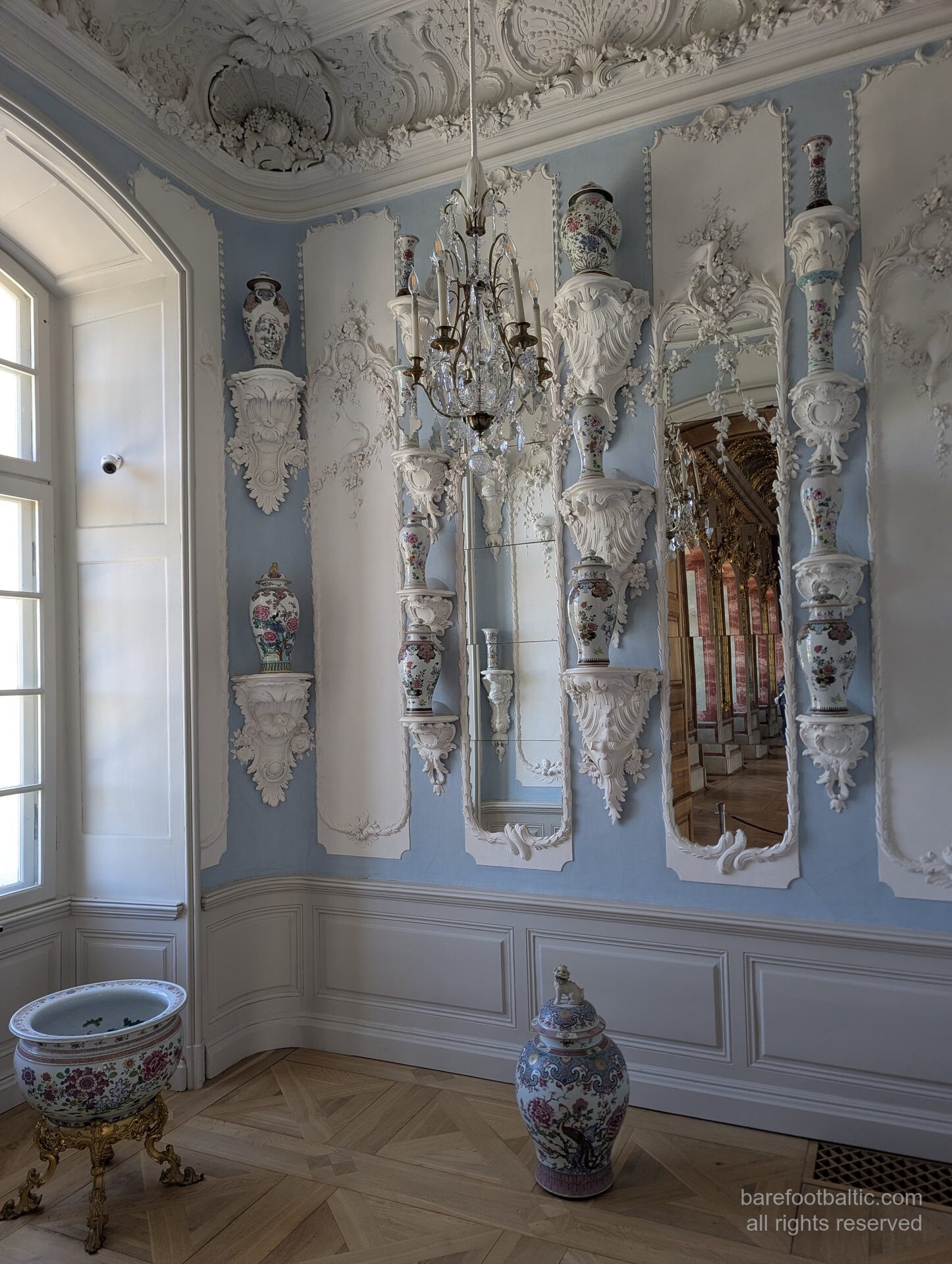
This was one of two rooms where the Duke displayed his porcelain collection. Collecting Oriental porcelain was a passion of many European rulers in the eighteenth century. It was a marker of taste and status, the way collecting contemporary art might be today.
The cabinet is deliberately designed to contrast the Gold Hall. Where the larger room is opulent, this one is luxurious in a stylistically opposite key. Light blue and white dominate. The light blue wall planes are divided by white stucco panels, two of which have built-in mirrors that optically expand the space. To display porcelain items, there are 34 shelves or consoles made in rocaille ornamentation. The vases here are Chinese, of the so-called famille rose range (French for "pink family"), in which rosy tones stand out.
Directly opposite the Porcelain Cabinet is the Grand Gallery.
The Grand Gallery
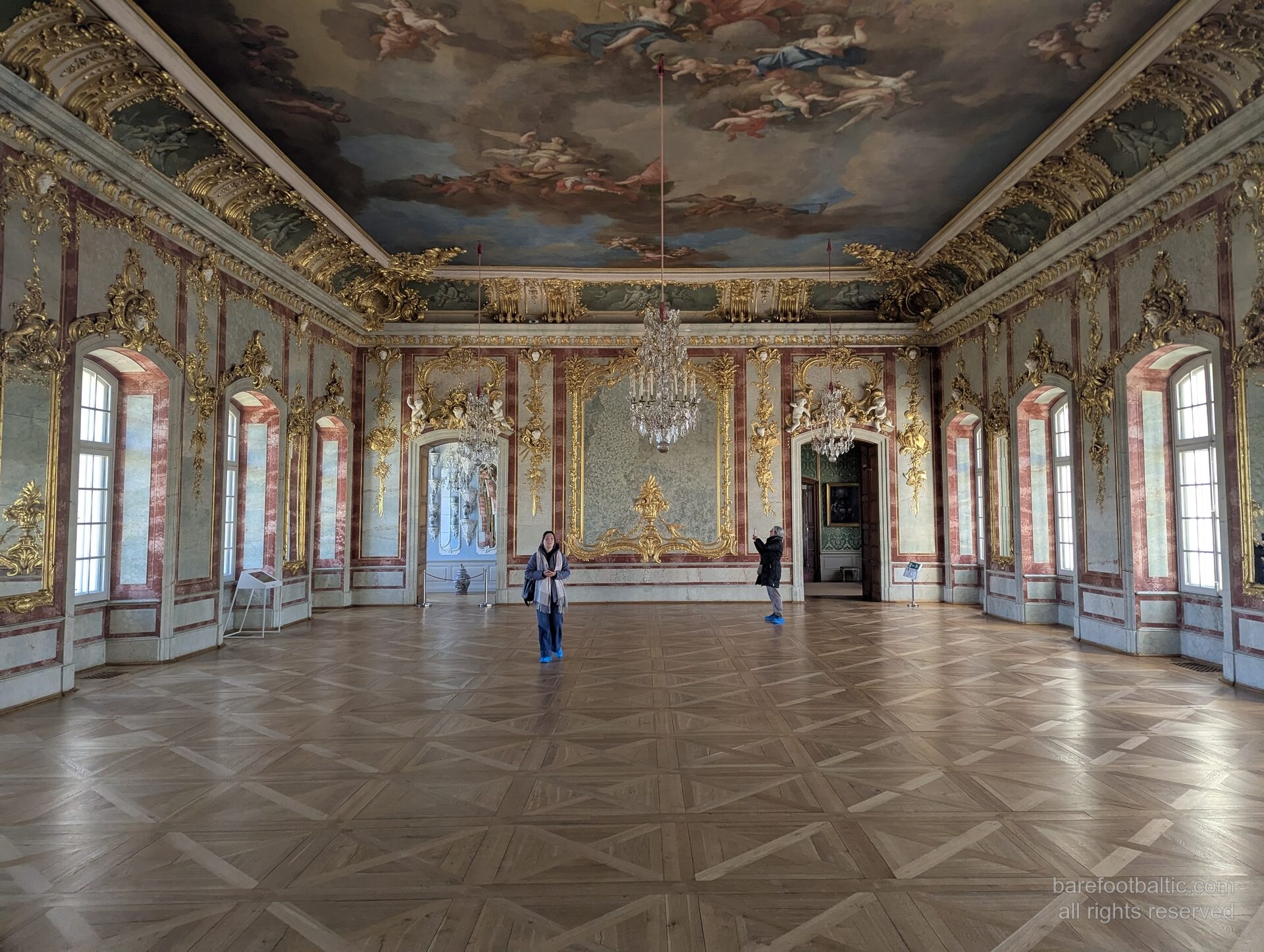
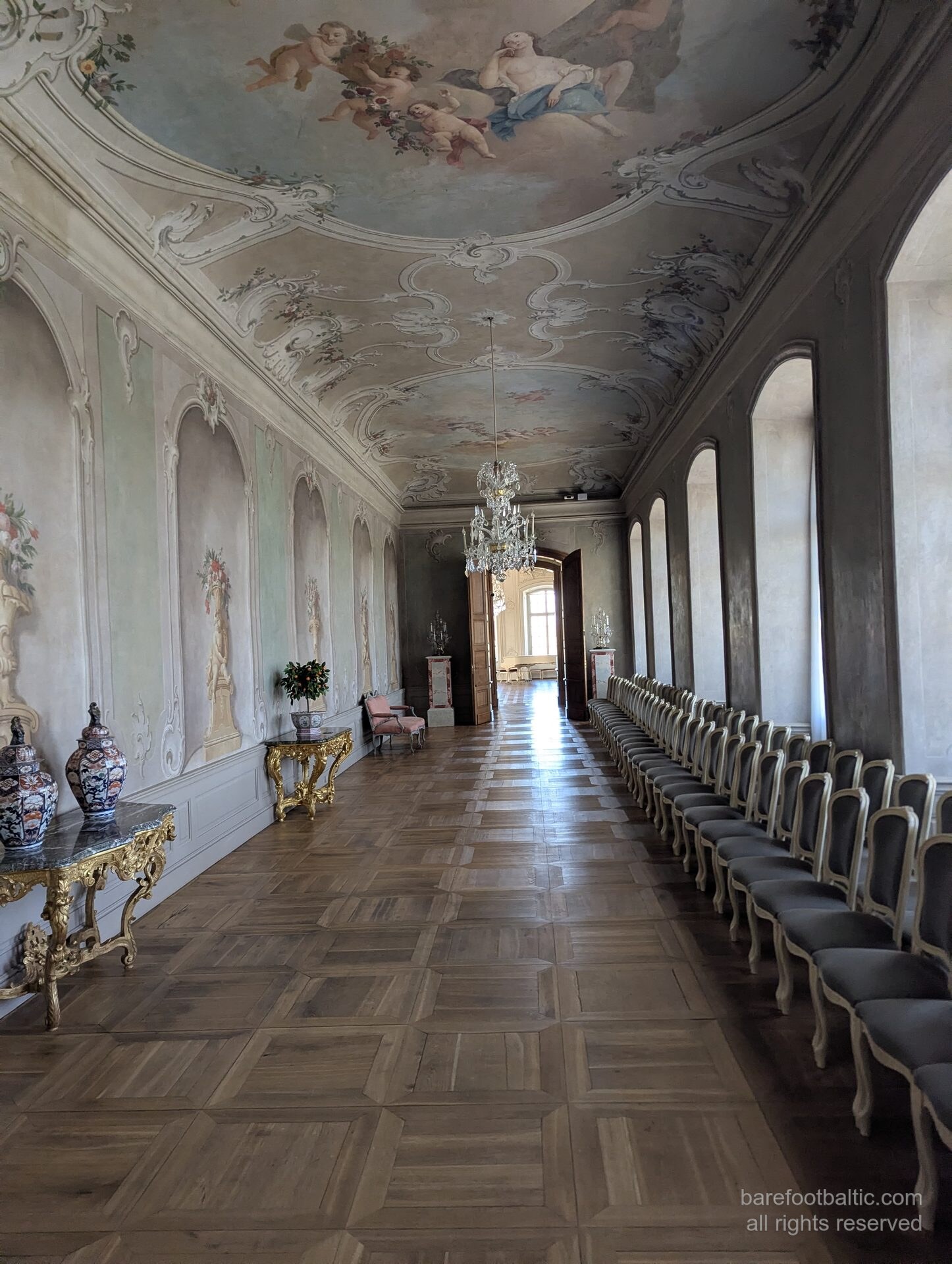
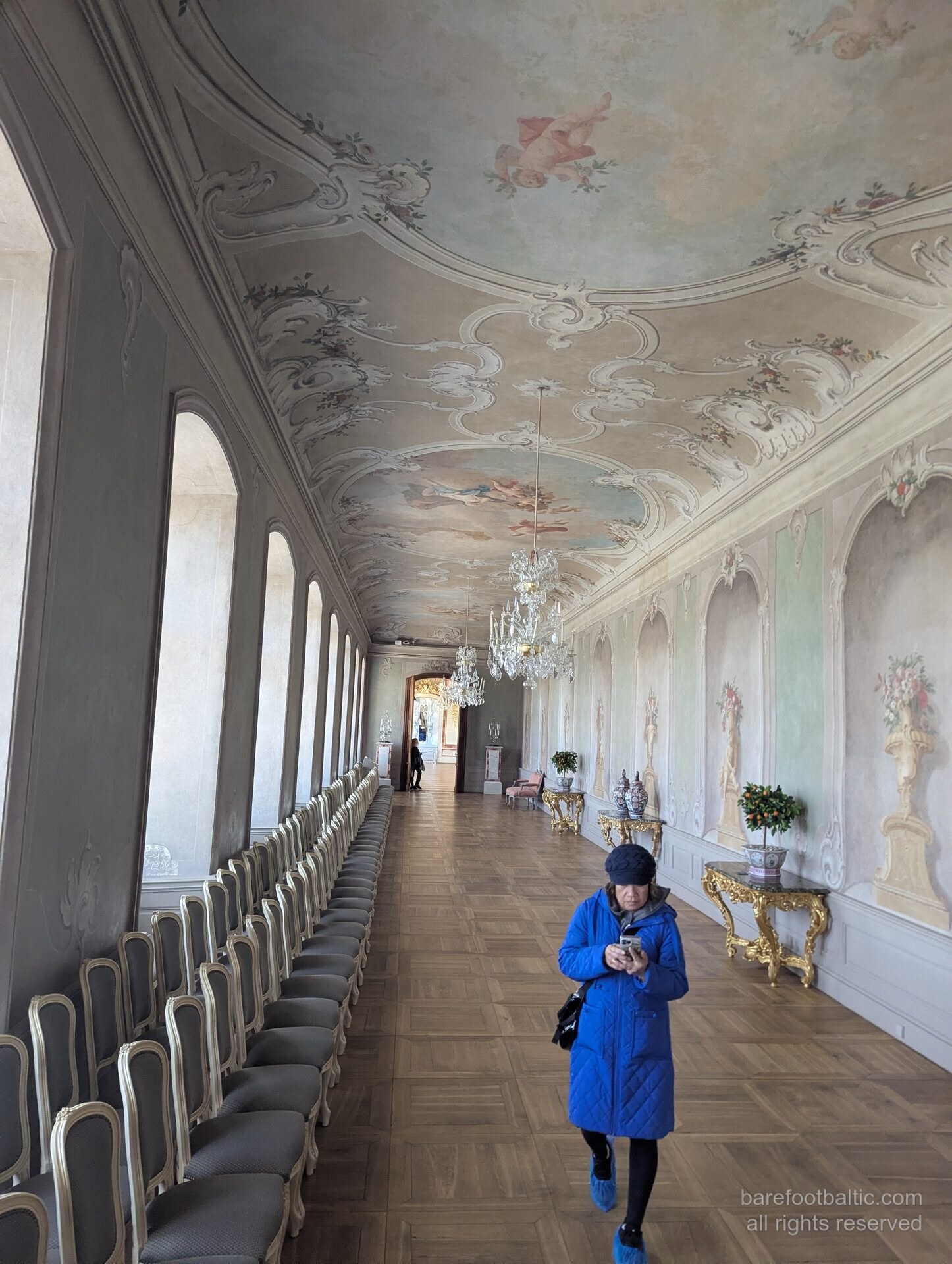
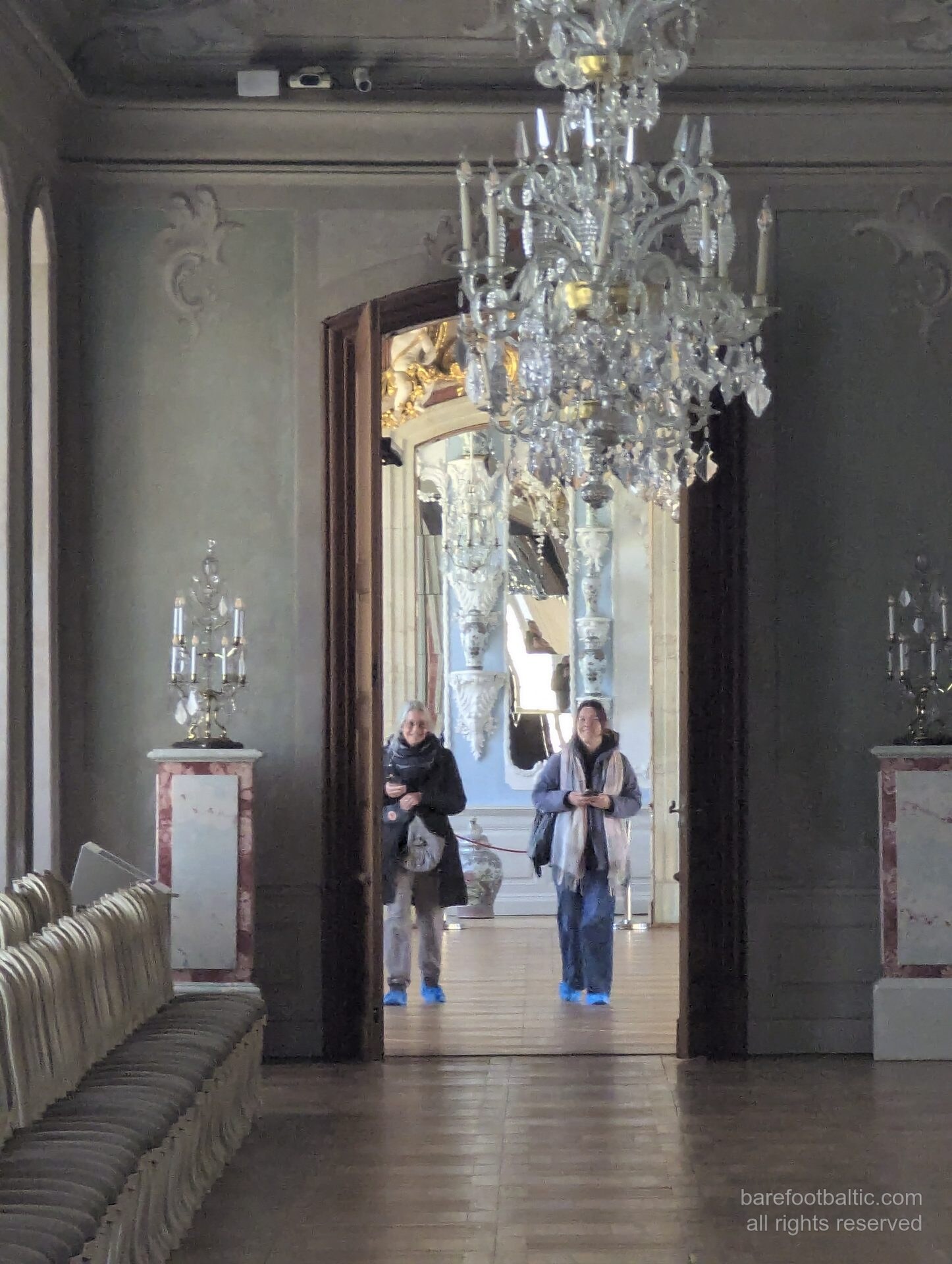
A banquet table ran the length of this room during court celebrations. No more than 60 guests could be seated in the 30-metre-long room. Between celebrations, the Grand Gallery looked just as it does now, a few console tables and seating furniture along the walls.
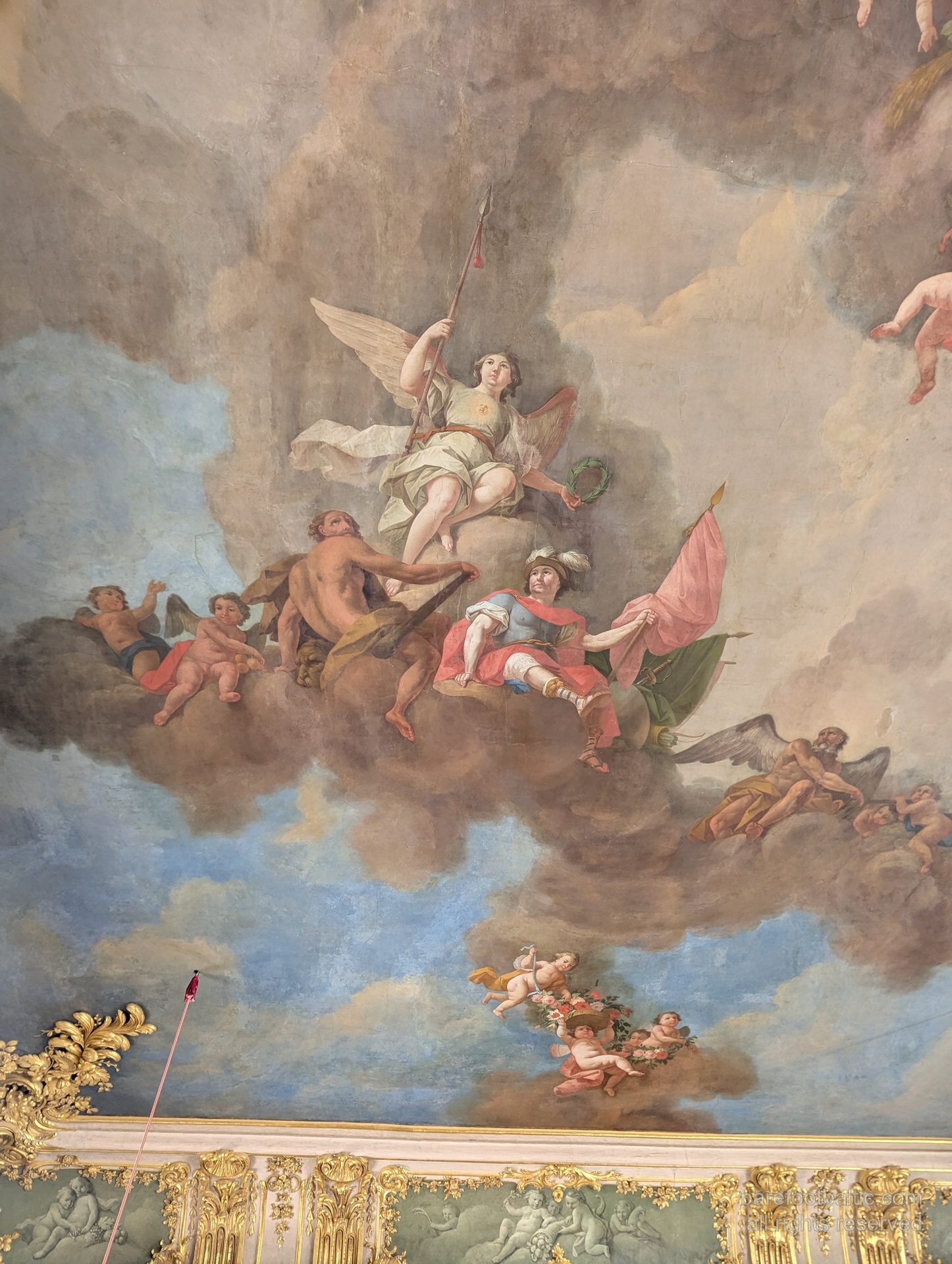
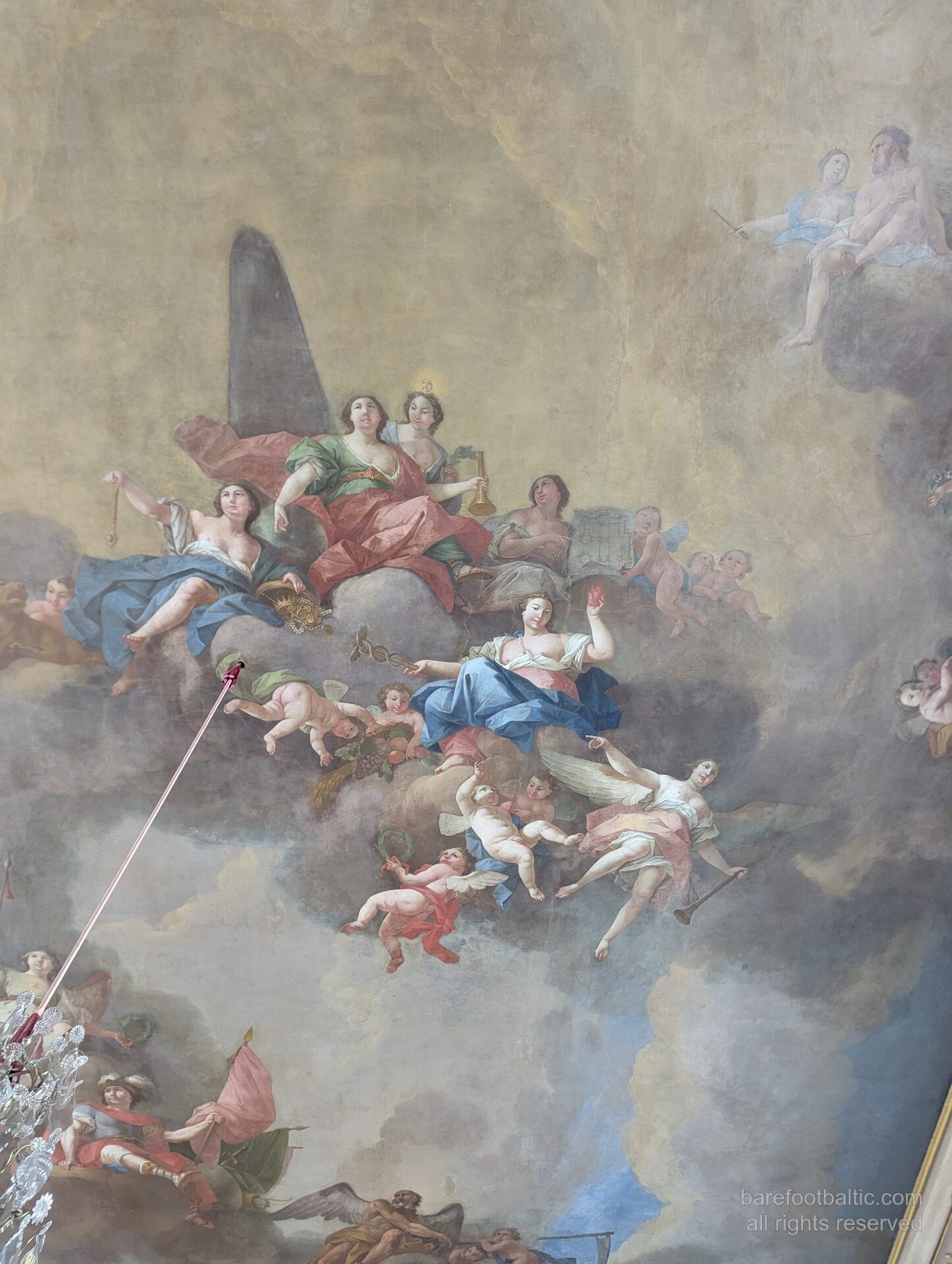
Look up first. The ceiling painting is by Francesco Antonio Martini. Thematically it corresponds to the room being on the east side of the palace. The central medallion depicts Nox, the goddess of night, as a putto wrapping her in a veil of darkness. Other putti carry flower wreaths to Apollo, the god of sun and light, who is observing the arrival of the carriage of Aurora, the goddess of dawn.
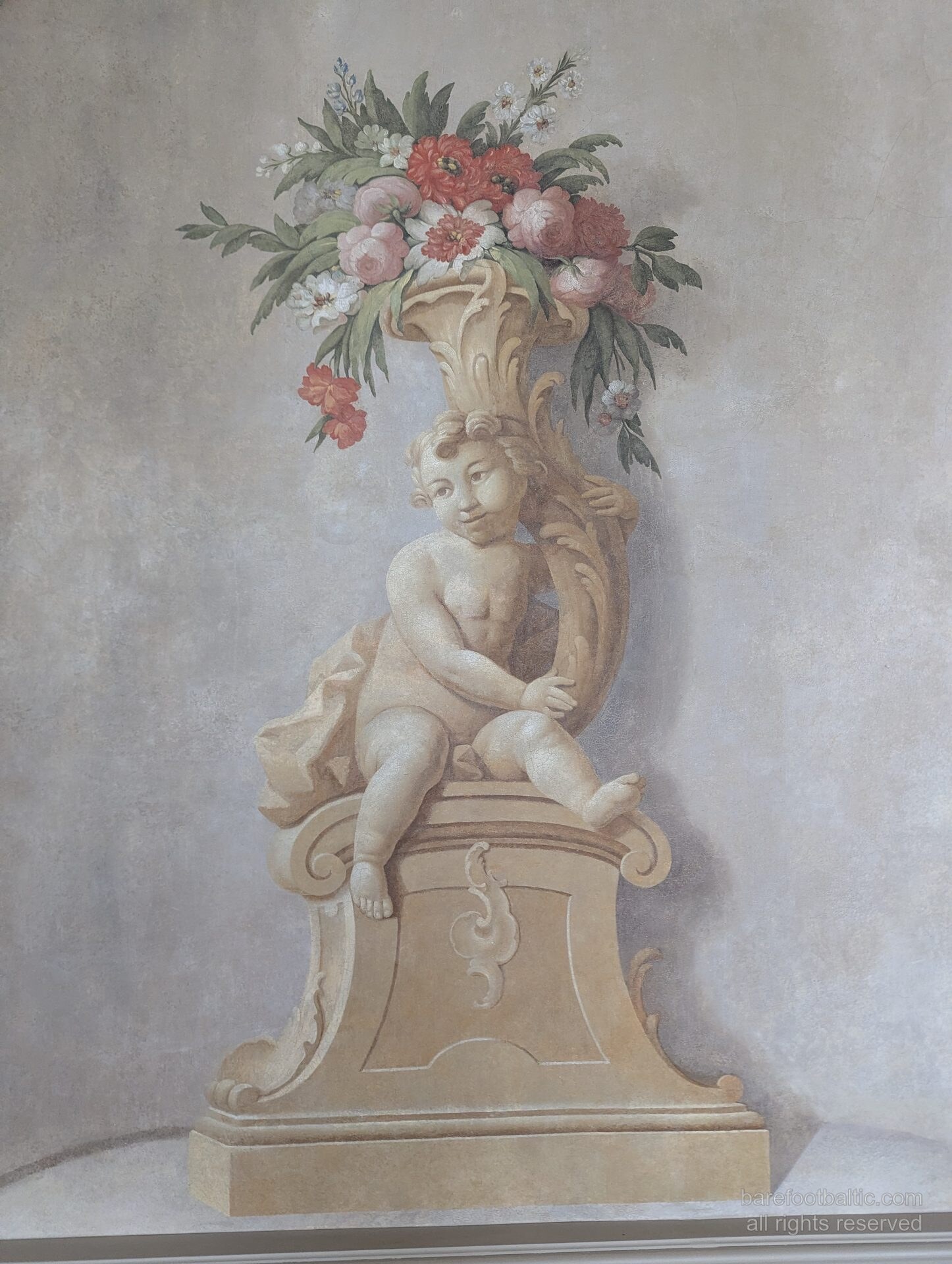
The walls have been repainted twice, first in 1813 to cover the devastation of war, and again in 1892. The original wall painting, which depicts putti supporting cornucopia and flower vases in illusory niches, was revealed during restoration. In the second niche from the side of the Gold Hall, you can see samples of historical paint. The oldest is greenish-grey, the most recent is reddish-brown. A fragment of the decorative strip painted in 1813 has been preserved above the farthest door.
The Bohemian-type chandeliers with glass arms and cut crystal glass pendants have been restored and reconstructed from parts of a chandelier made in the 1780s that once hung in Liepupe Lutheran Church.
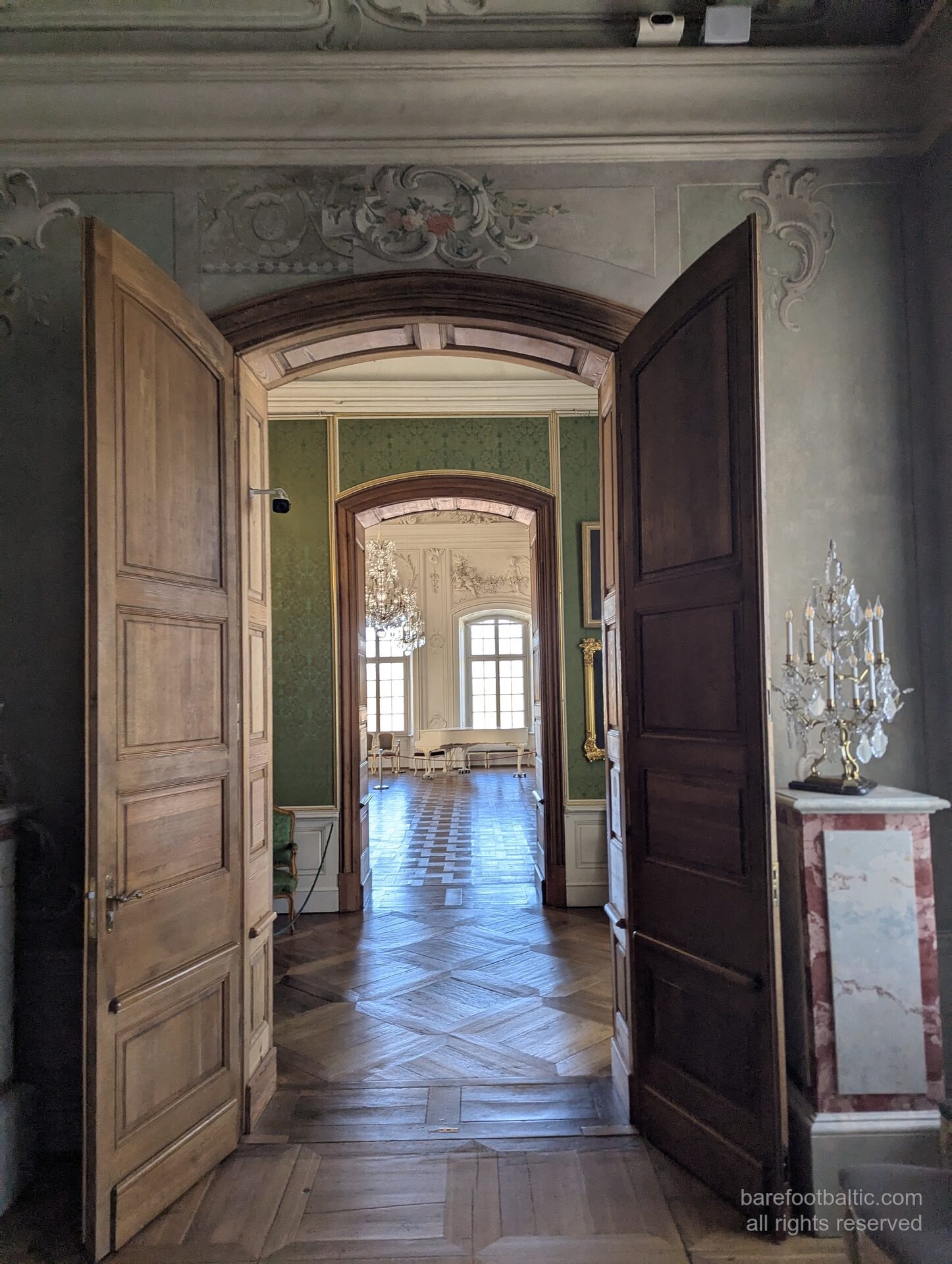
Now we move to a small room, upholstered in green, between the Grand Gallery and the White Hall.
The Adjoining Room to the White Hall
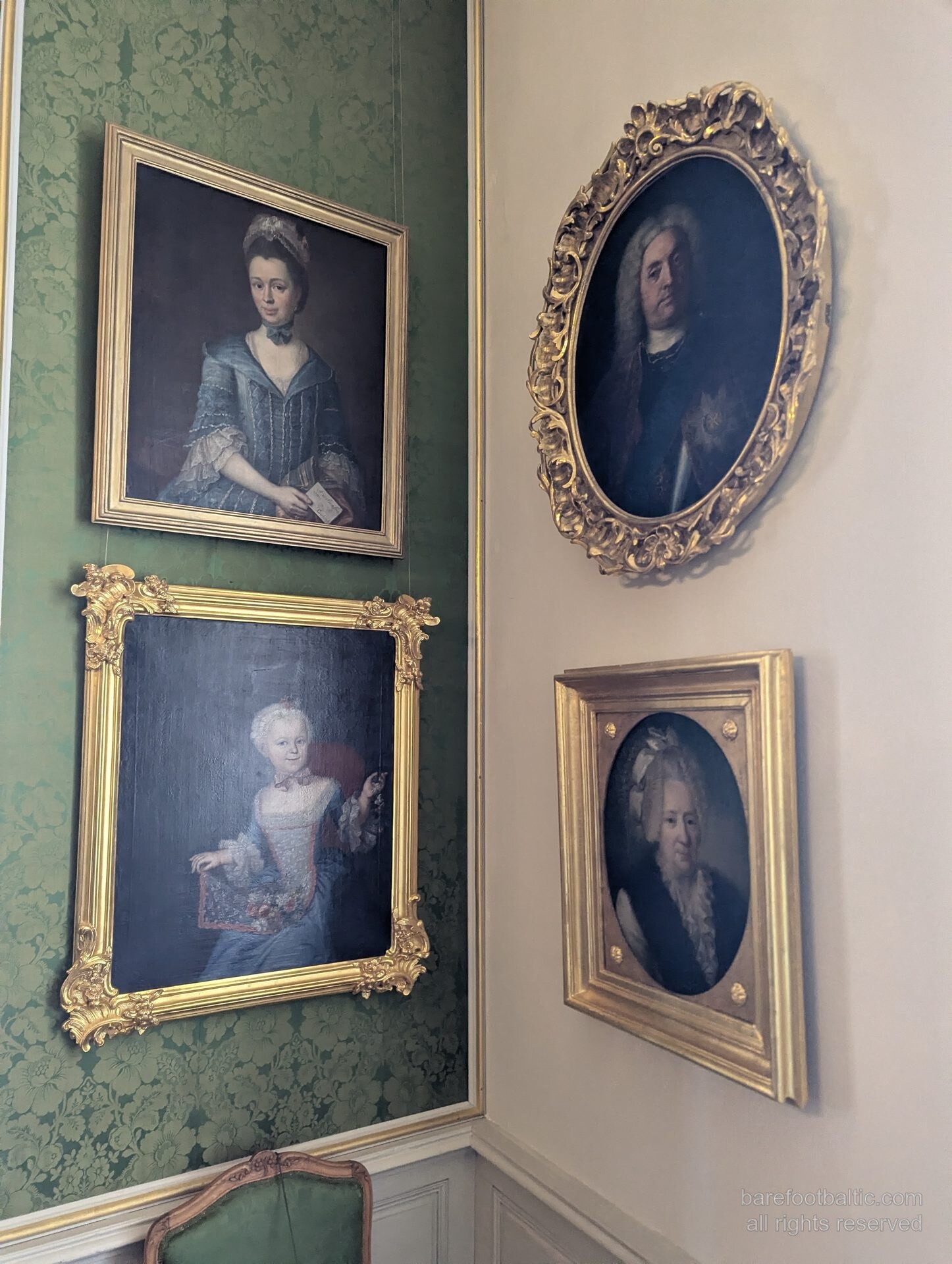
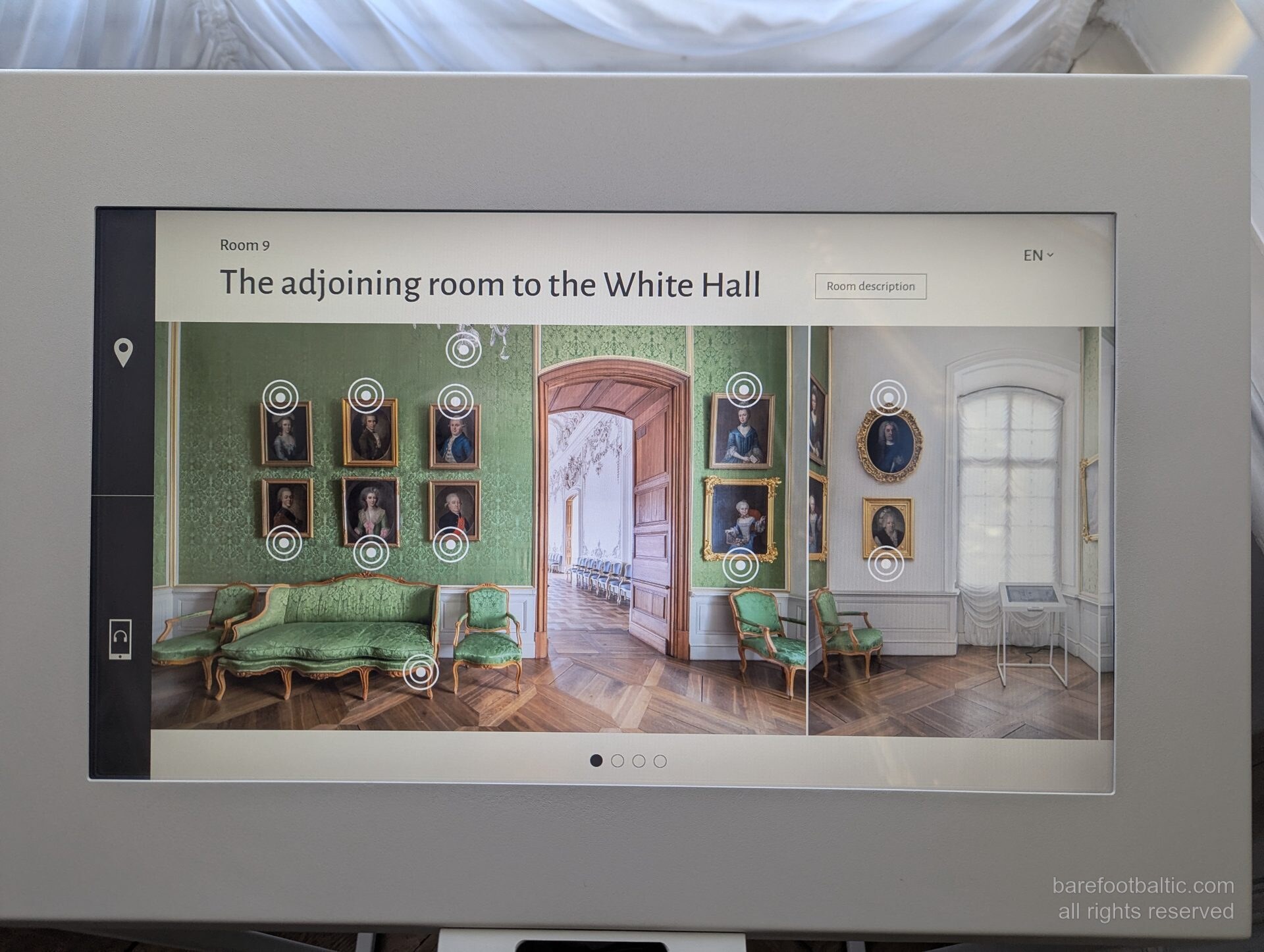
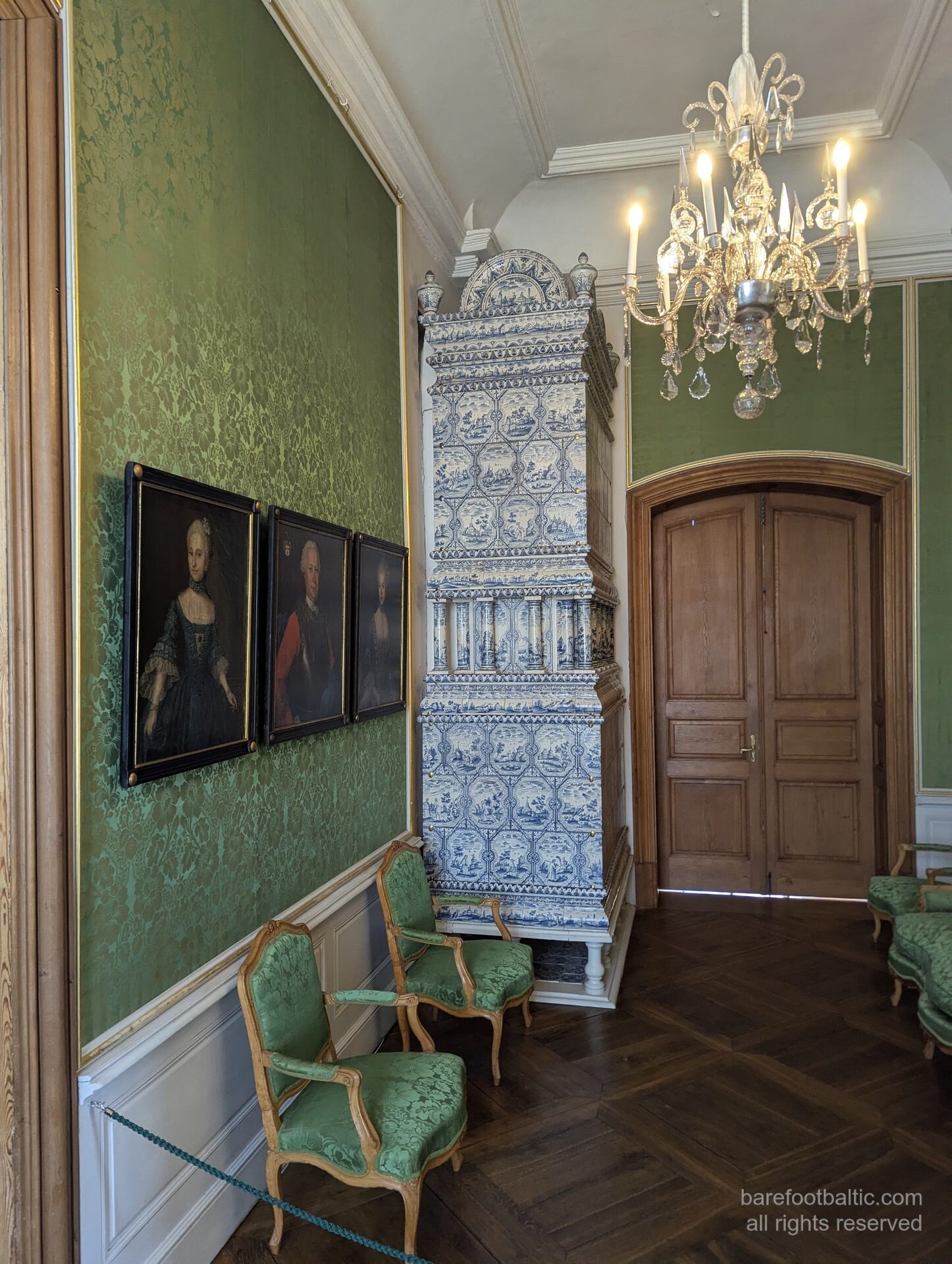
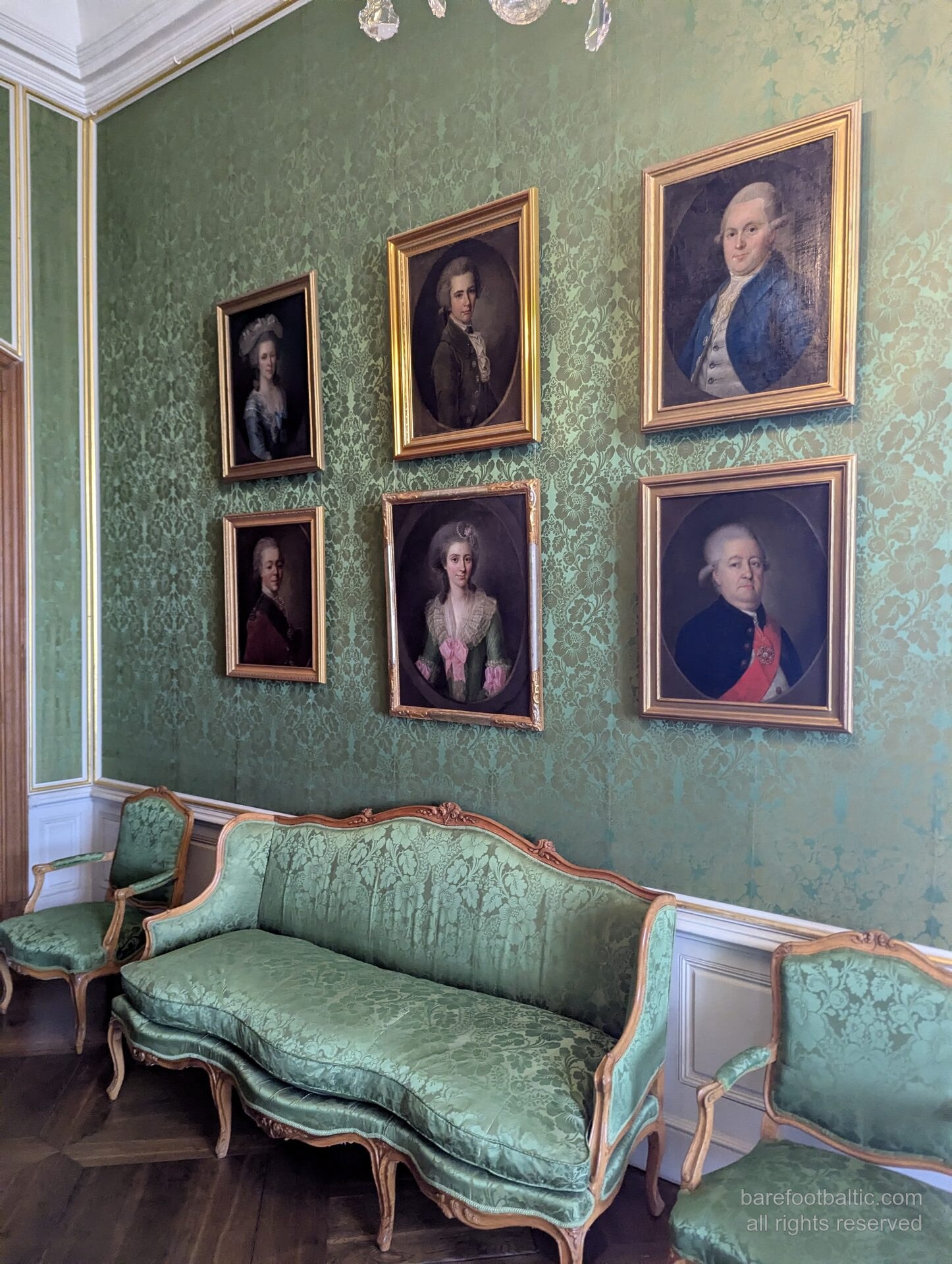
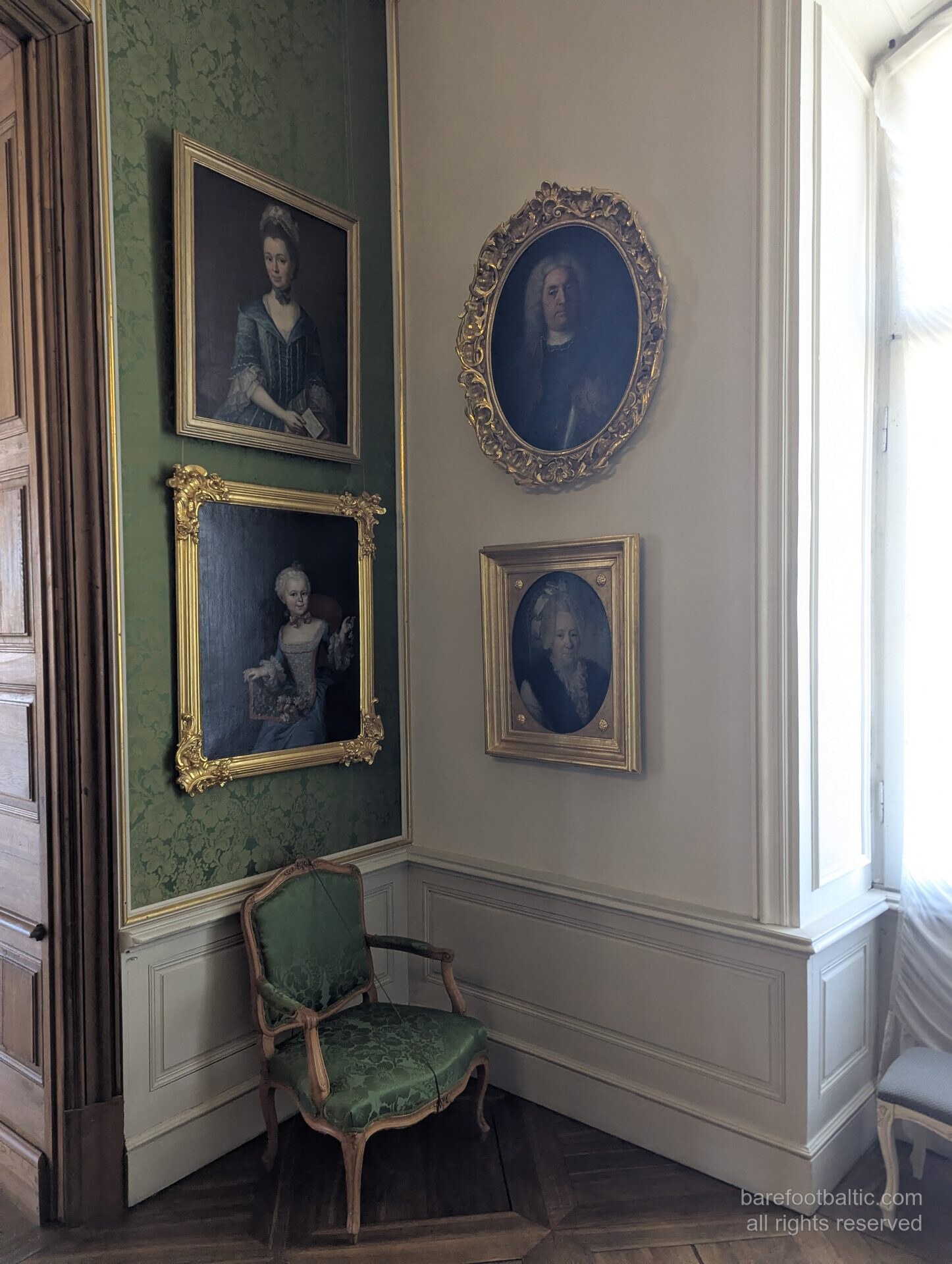
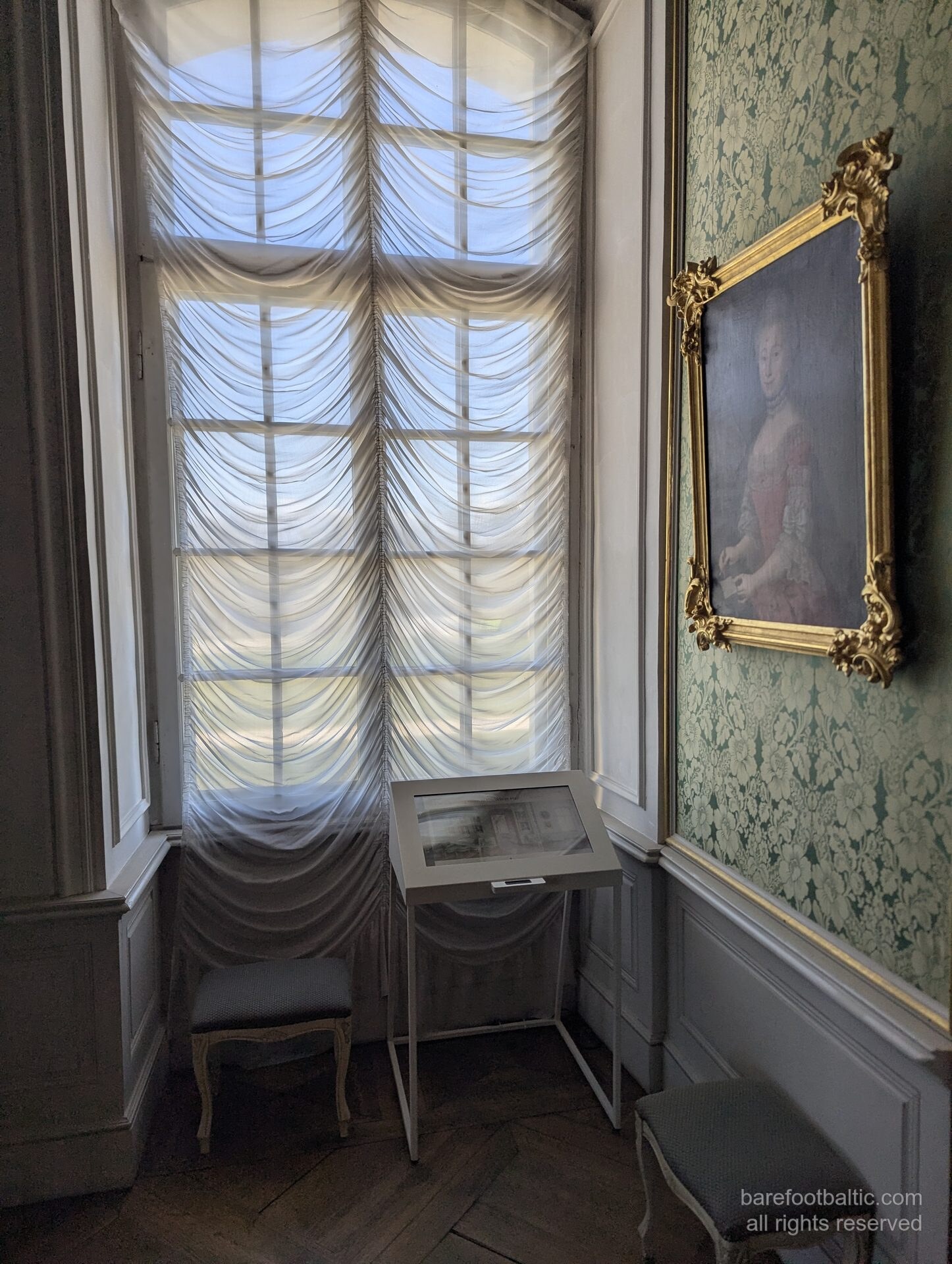
During court celebrations, this small green room was used for delivering food from the kitchen to the Grand Gallery. It now houses part of the Museum's eighteenth-century portrait collection.
On the wall to the left of the window is a girl with a bouquet on her lap. This is Anna Margarethe Heydwinckel, who in 1764 presented flowers to Duke Ernst Johann's benefactor Catherine the Great in Riga. Above it is a portrait of Dorothea von Witten, painted in 1775 by the German artist Johann Gottlieb Becker, who worked in Jelgava. On the next wall is an oval portrait of Count Andrey Ostermann, adviser to Duke Ernst Johann, painted in the 1730s by the Russian portrait master Andrei Matveyev. Next to the stove, portraits of members of the noble von Klopmann family from Courland, by Leonhard Schorer.
The next door takes us into the White Hall.
The White Hall
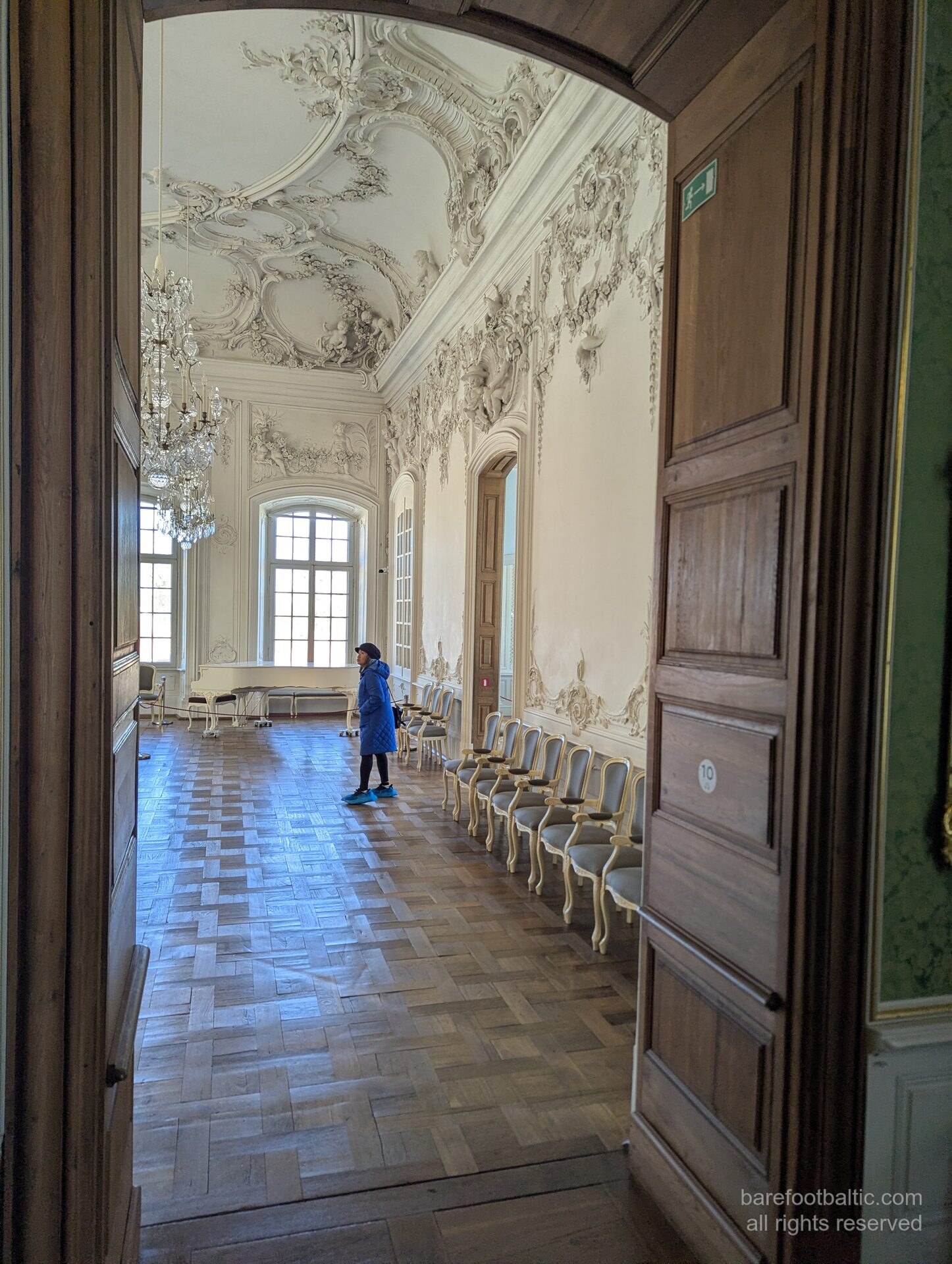
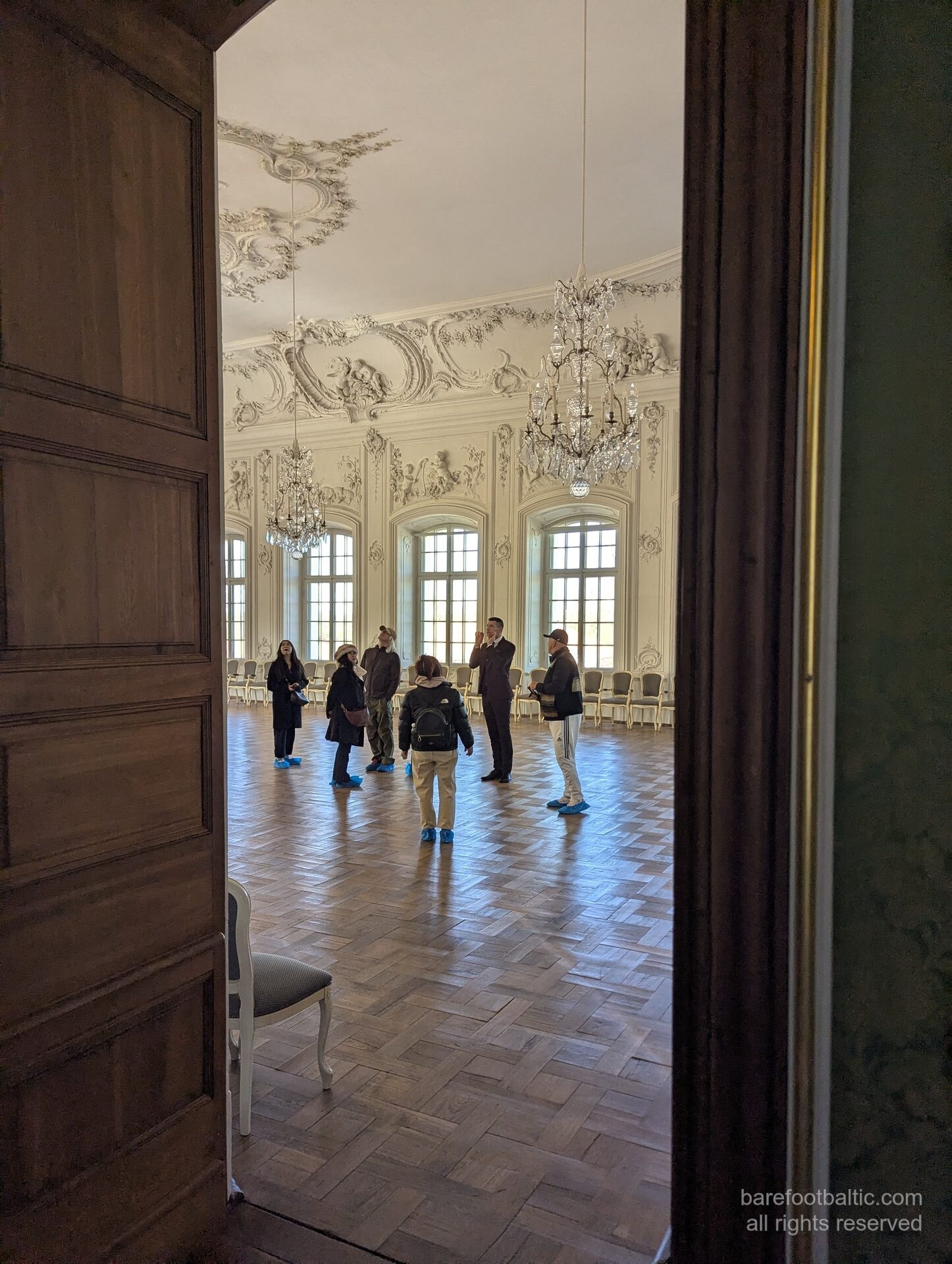
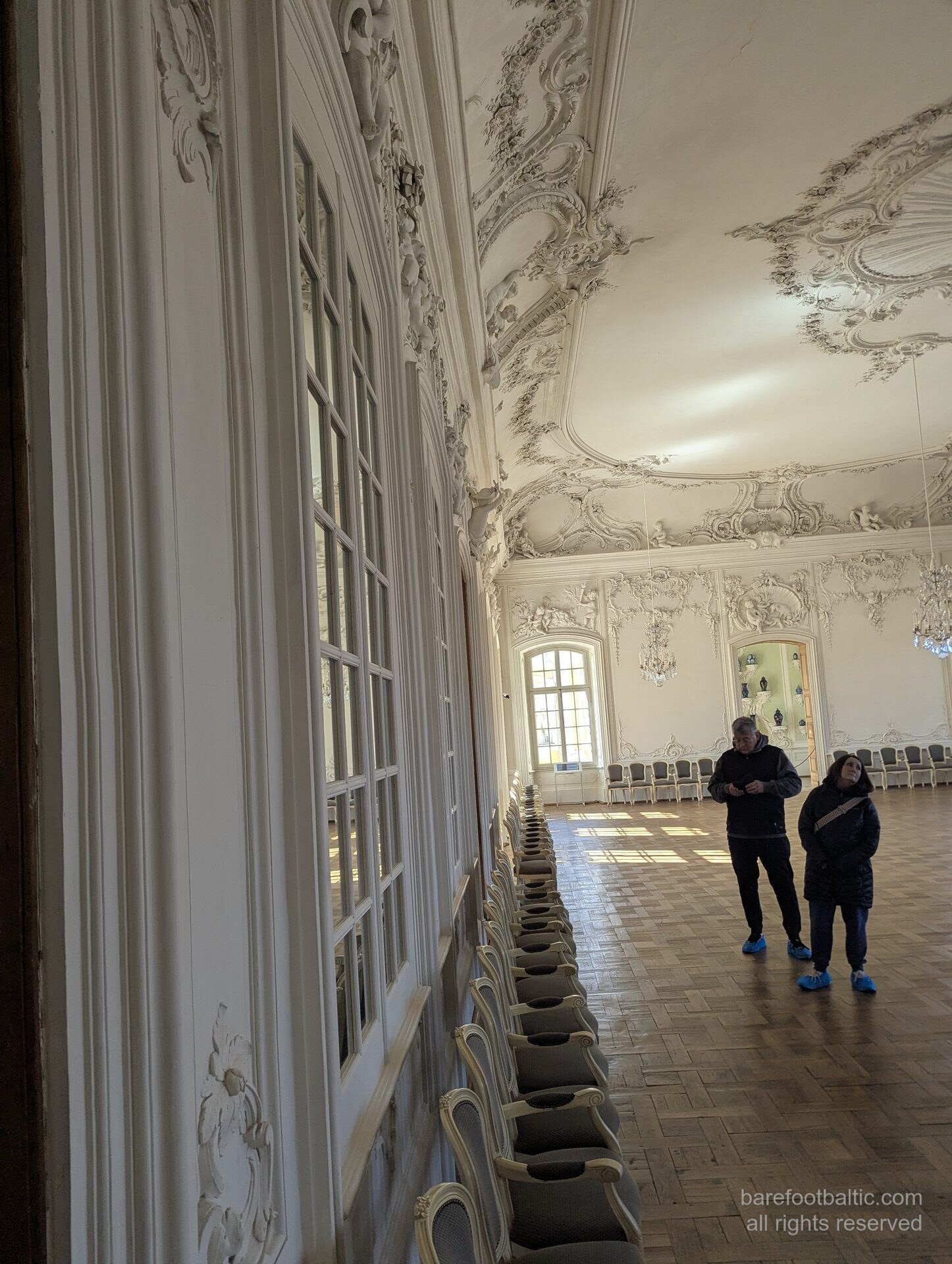
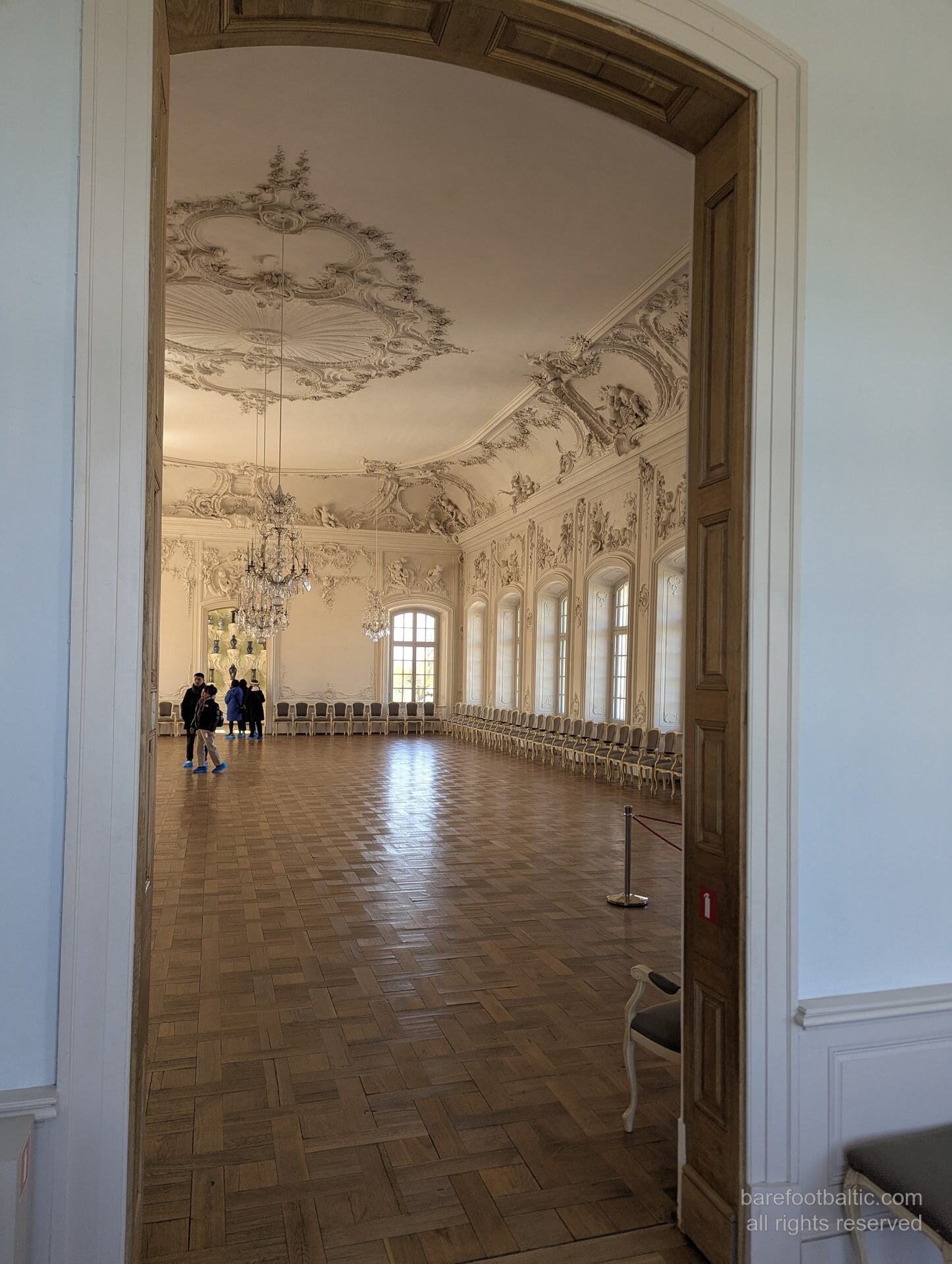
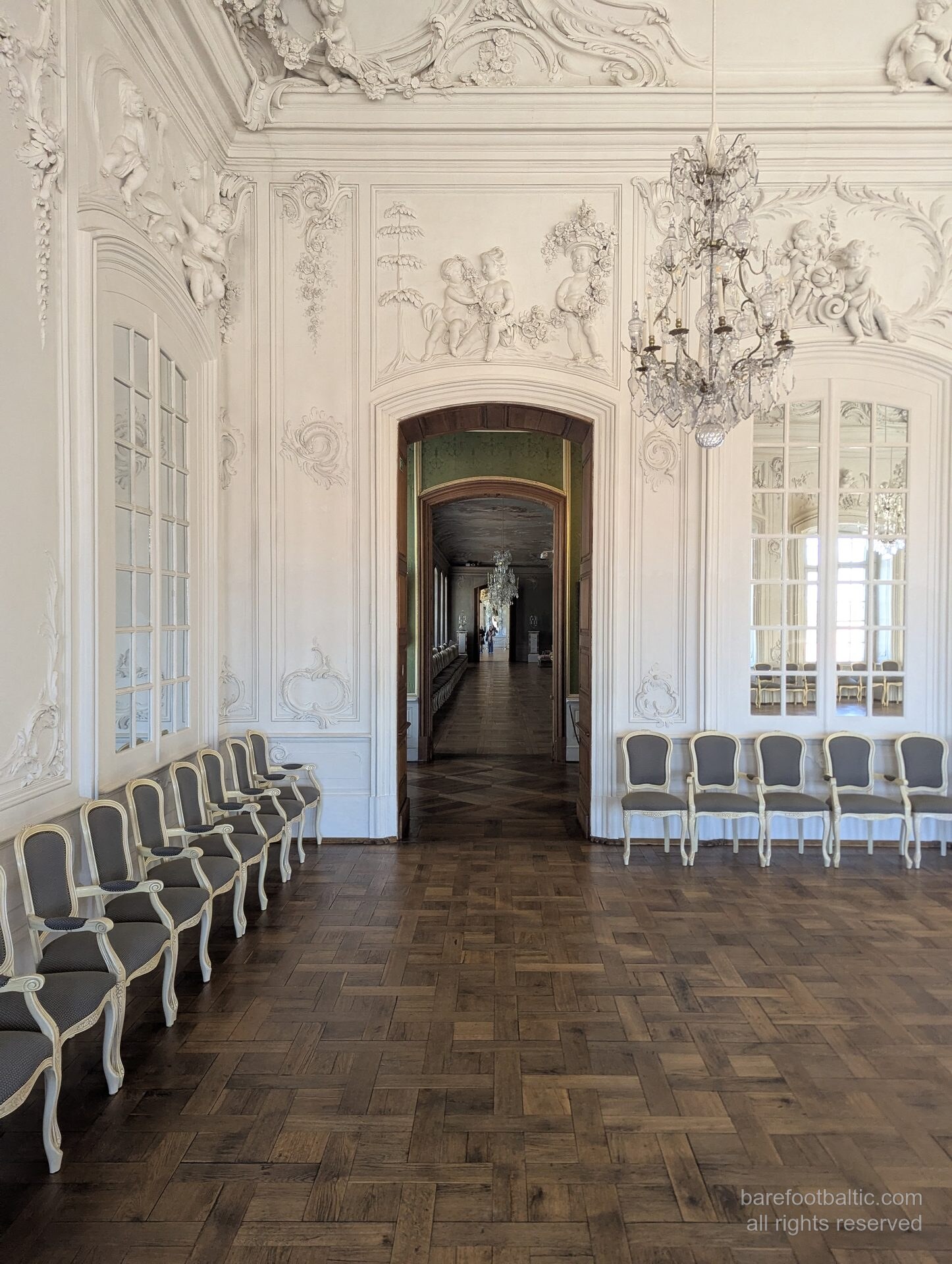
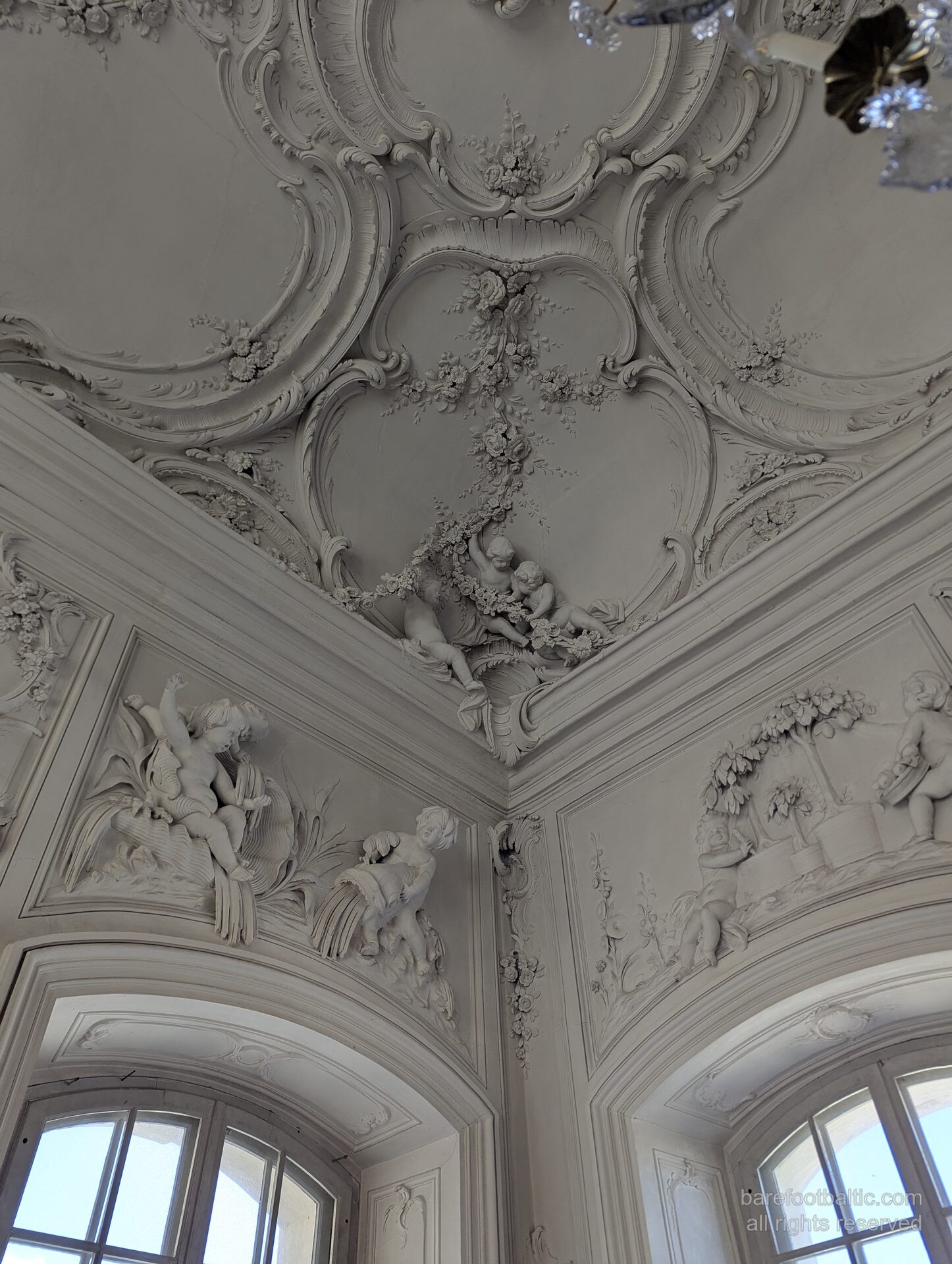
The décor of the White Hall is a masterpiece by Johann Michael Graff and his assistants. Above the windows and doors are 22 thematic reliefs, and the room contains 76 figures and roughly 2050 flower casts in stucco. During construction, certain parts were cast in pre-prepared moulds, but each composition was then sculpted freely in situ. The figures of children, for example, were made using a few sample heads, arms and legs, then assembled and supplemented to suit the activity of each composition. The craftsmen had to work neatly and precisely, without corrections.
Like in the Gold Hall, the décor is symbolic and reads as a story.
At the centre of the ceiling is the Sun, sign of life and the passage of time. Birds are next to it. Look at the stork's nest. It's made of real twigs, covered in gypsum mass. In the ceiling cove, perceived as the next level, there are depictions of the four seasons, with putti placed above the cornice bearing appropriate attributes. Warm hats and capes indicate Winter (this decoration is near the door to the Grand Gallery). Floral wreaths represent Spring. Ears of grain represent Summer. Vines mean Autumn. Below, between the windows and the mirror windows, is the level inhabited by us. Humans, ruled by the four elements of nature. These elements are shown high up on both far end walls, with torch and dragon for Fire, the waterfall for Water, the lion and tree for Earth, the birds for Air. On the same level, encircling the hall, are music-making, gardening, cattle-breeding, bird and forest animal hunting. The small putti are depicted in expressive poses, and scenes are complemented by plants, birds, animals, weapons, tools and musical instruments, each detail carrying symbolic meaning.
Mirror windows in the room create an impression of spaciousness and light. When it gets dark, the seven French-type chandeliers can be lit. They are copies of a chandelier sample at Kuskovo Palace. The original parquet didn't survive. The current one dates from 1892, when the flooring may have been replaced because it had been worn out by dancing.
Through the windows you can see the carriage yard and the stables. The Danish architect Severin Jensen, the Duke's court architect during the second construction period, designed those stables and coach houses, and his favourite reddish-brown tone in combination with white is what was applied to paint them.
Small cabinets were created at both ends of the White Hall. We'll visit the porcelain cabinet first.
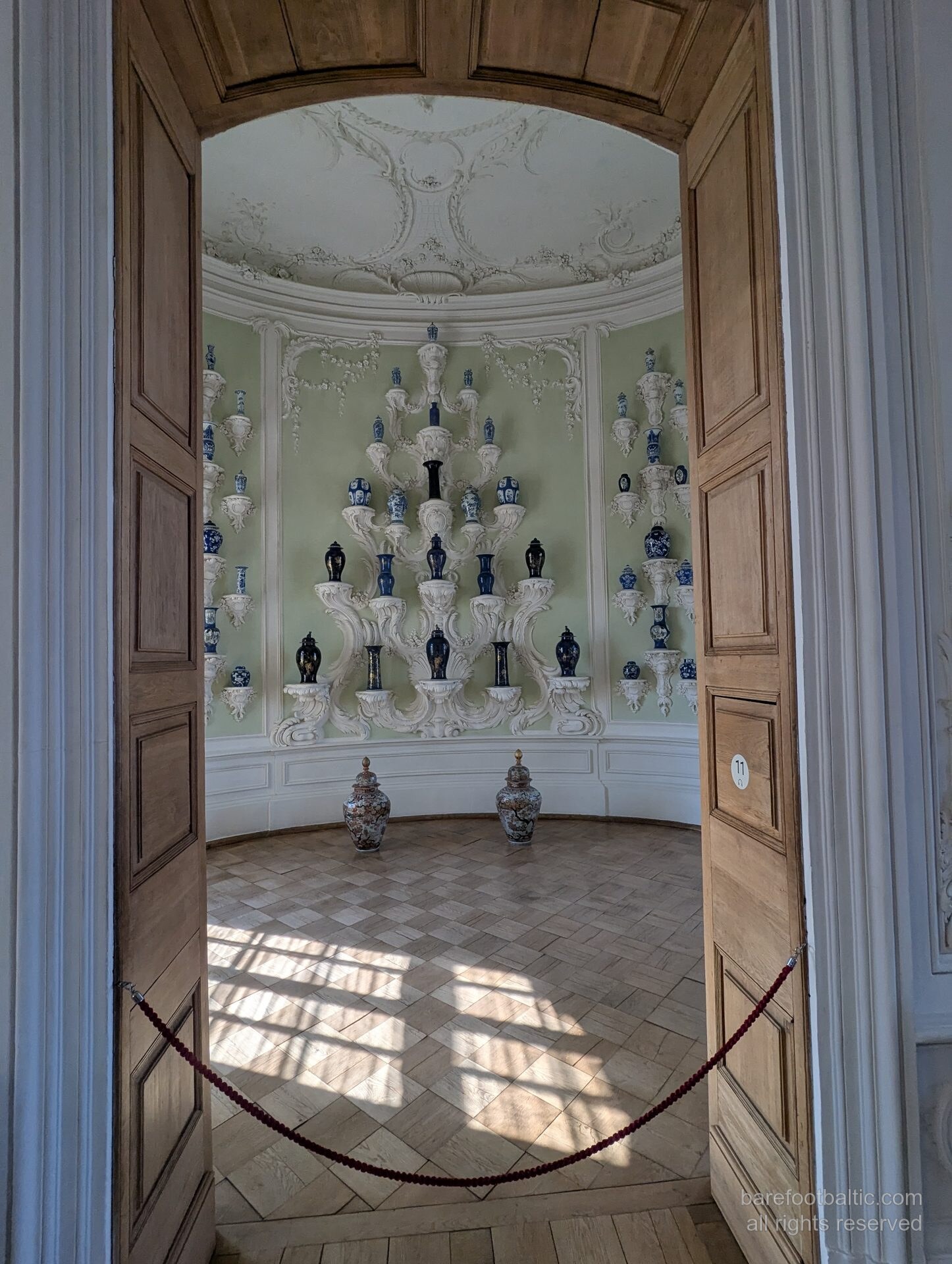
The Oval Porcelain Cabinet
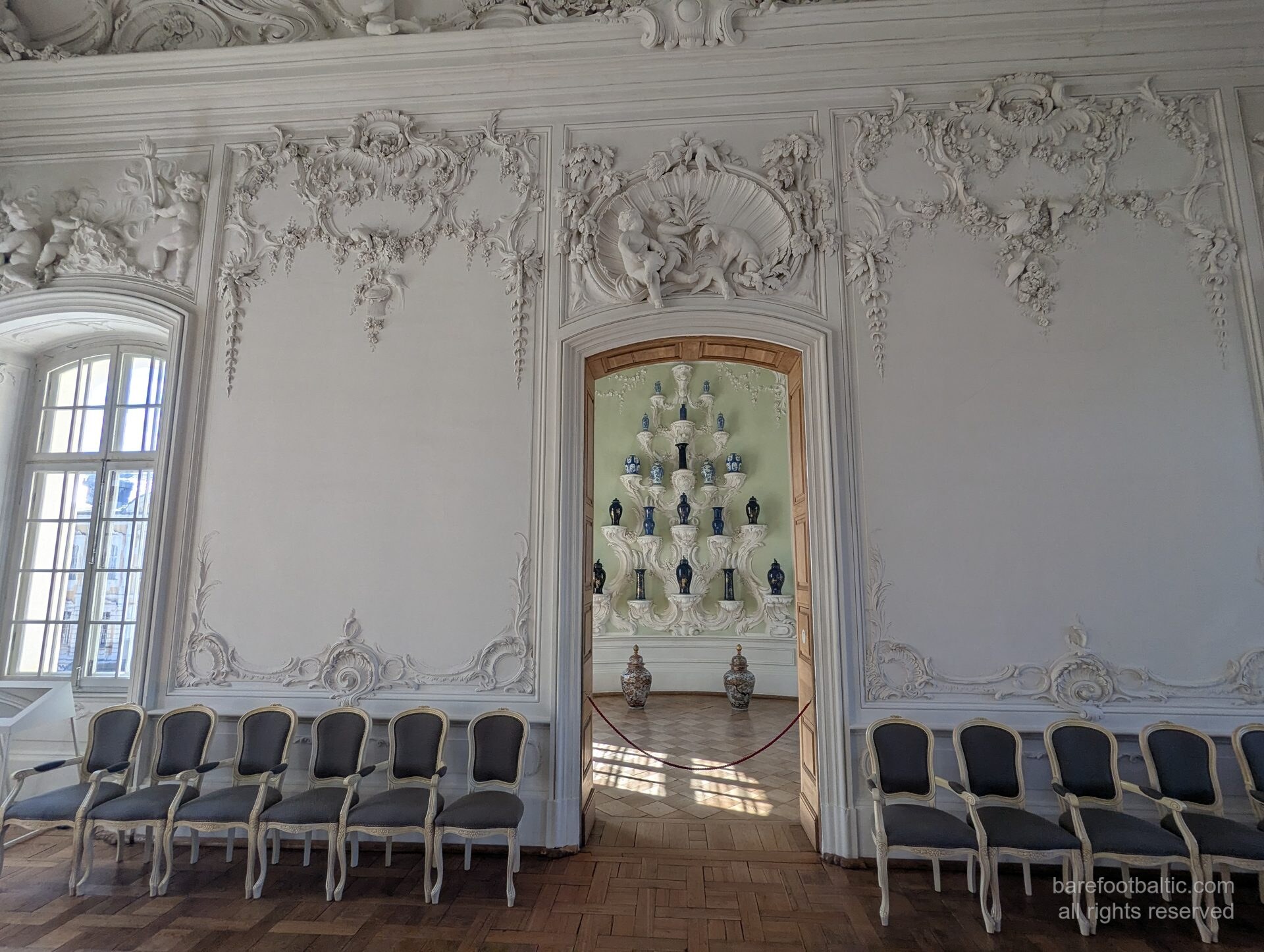
This room is a sort of architectural redirection. Originally, this space was supposed to be a church. When the church idea was abandoned, the sculptor Johann Michael Graff used the space to create another porcelain cabinet in place of the former stairwell.
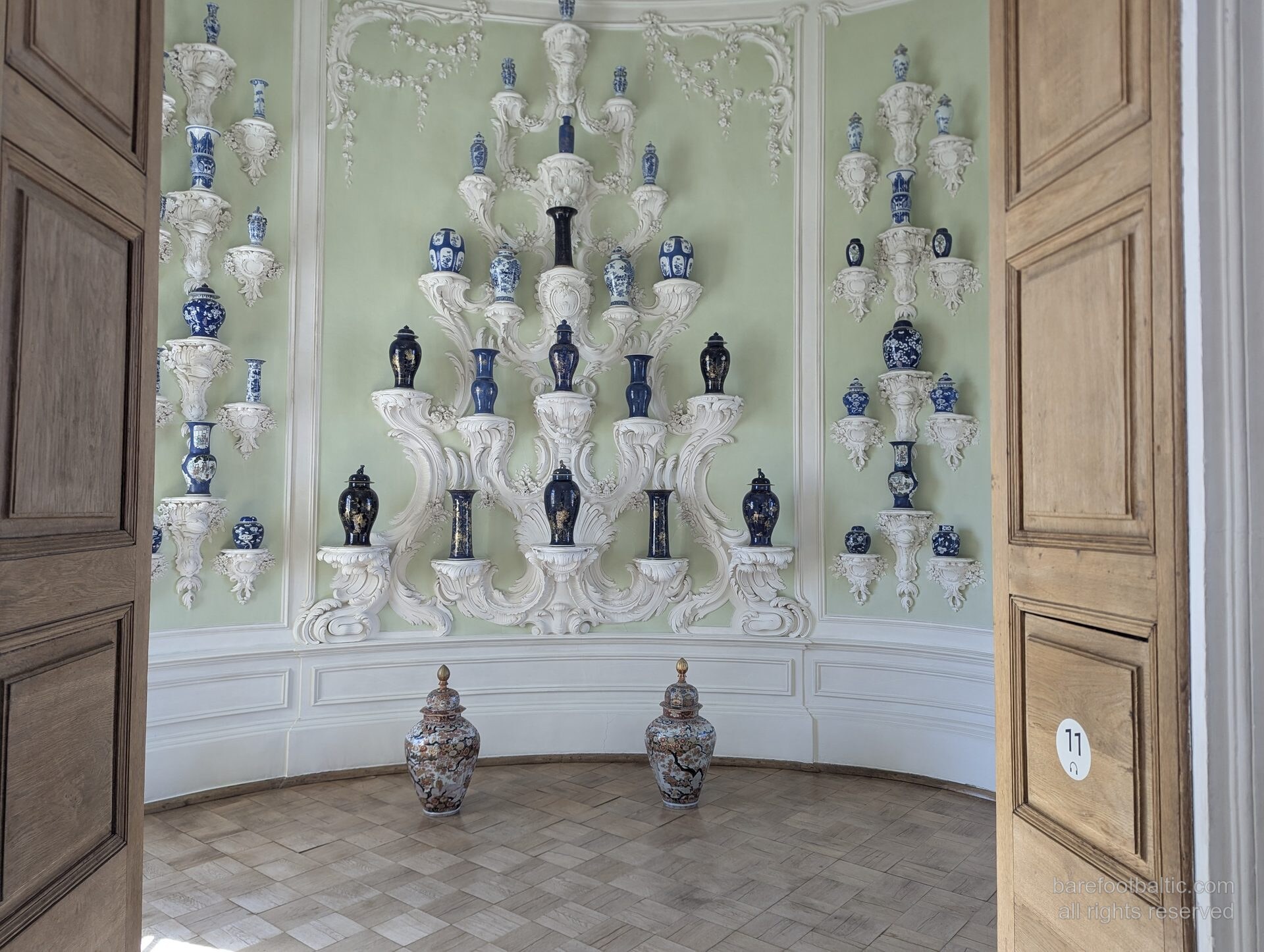
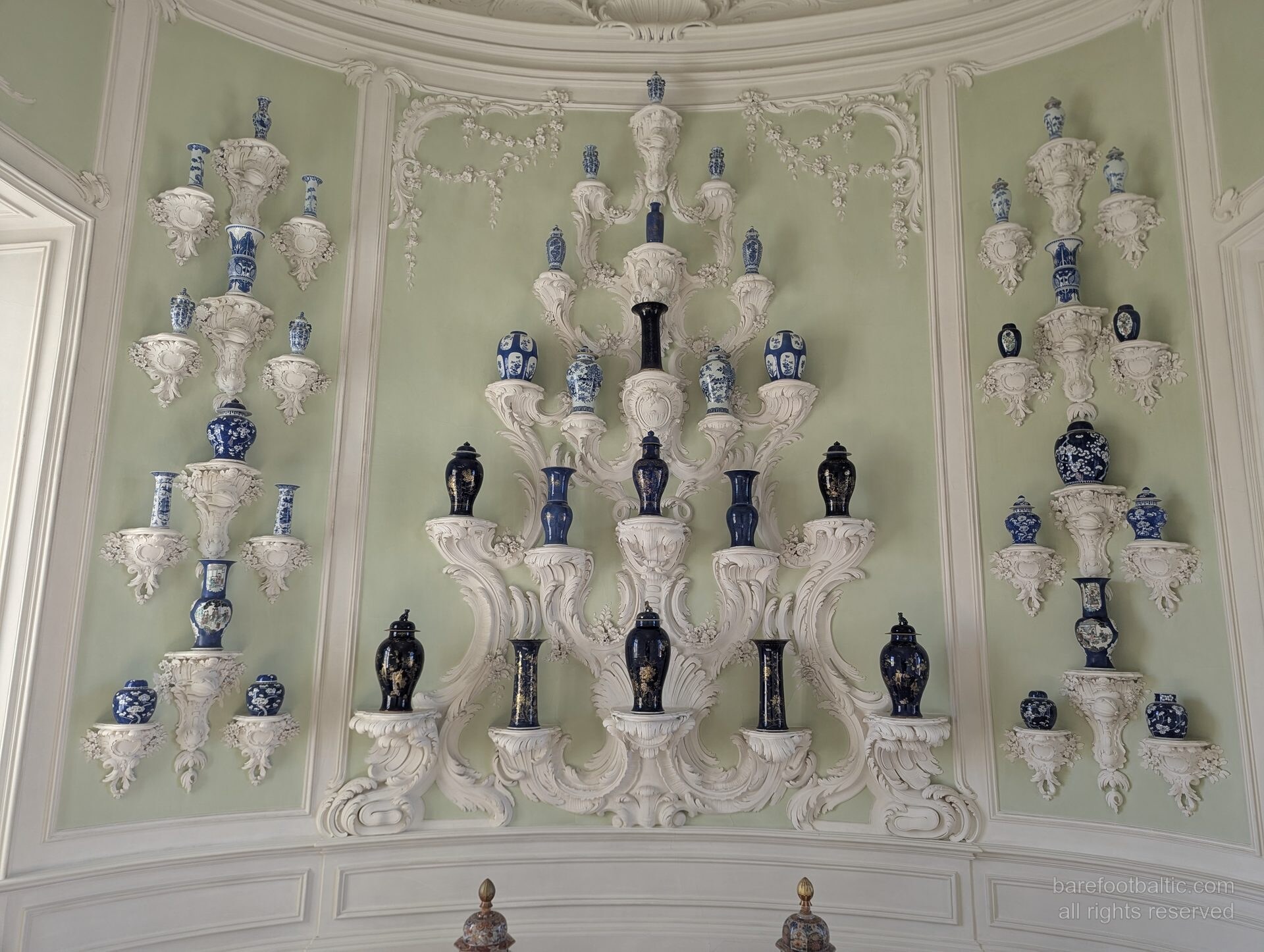
There are 45 stucco consoles for displaying porcelain items. The central composition is so expressive it resembles a foaming fountain.
Inside the cabinet you'll see Chinese porcelain ware of the seventeenth and eighteenth centuries with several types of cobalt underglaze painting. In the centre, look for the so-called "powder blue" items with gold, and on the floor, Japanese porcelain vases with blue and red painting, complemented with gilding.
Now back across the White Hall to the opposite end, where there are three small cabinets.
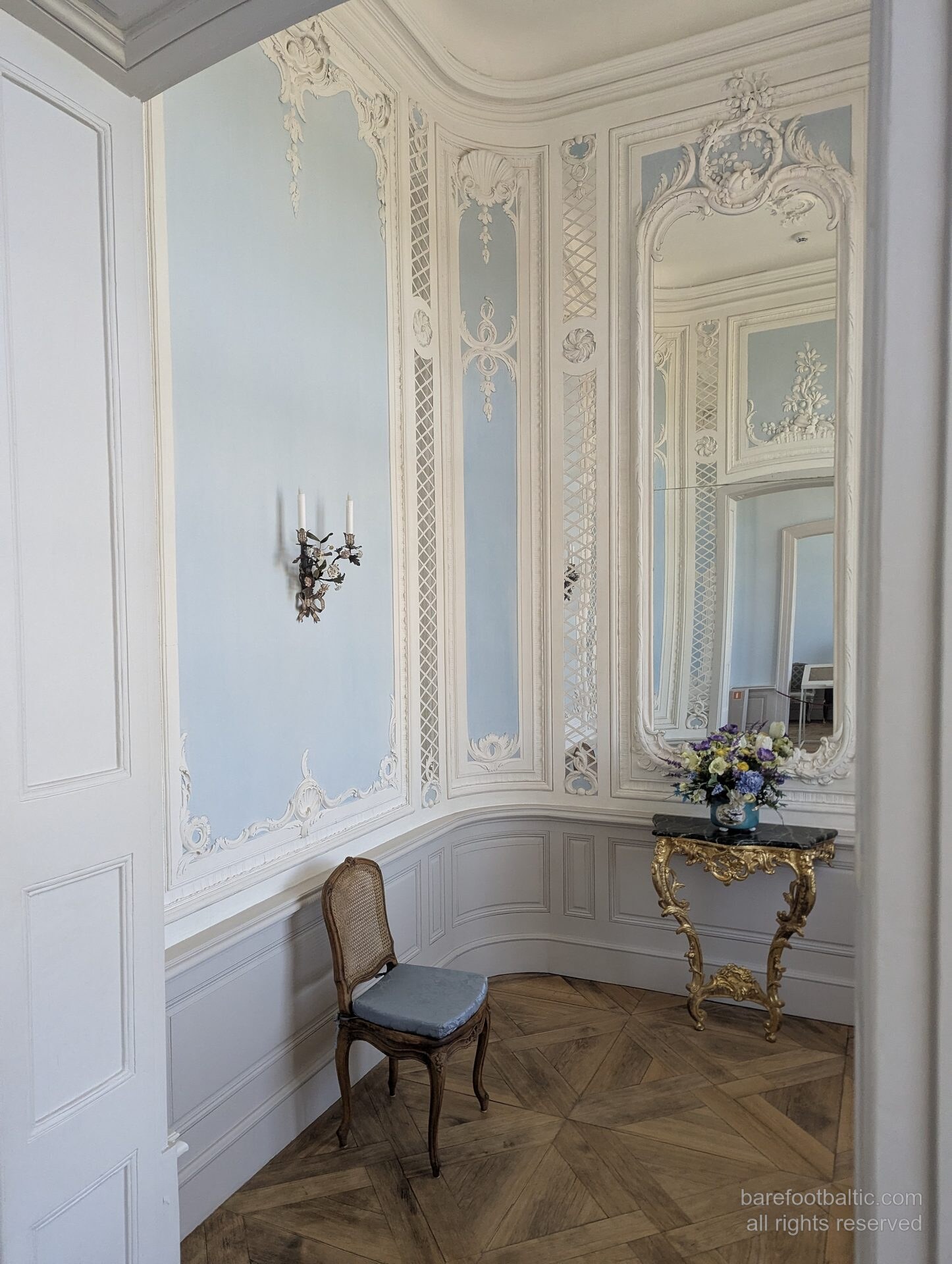
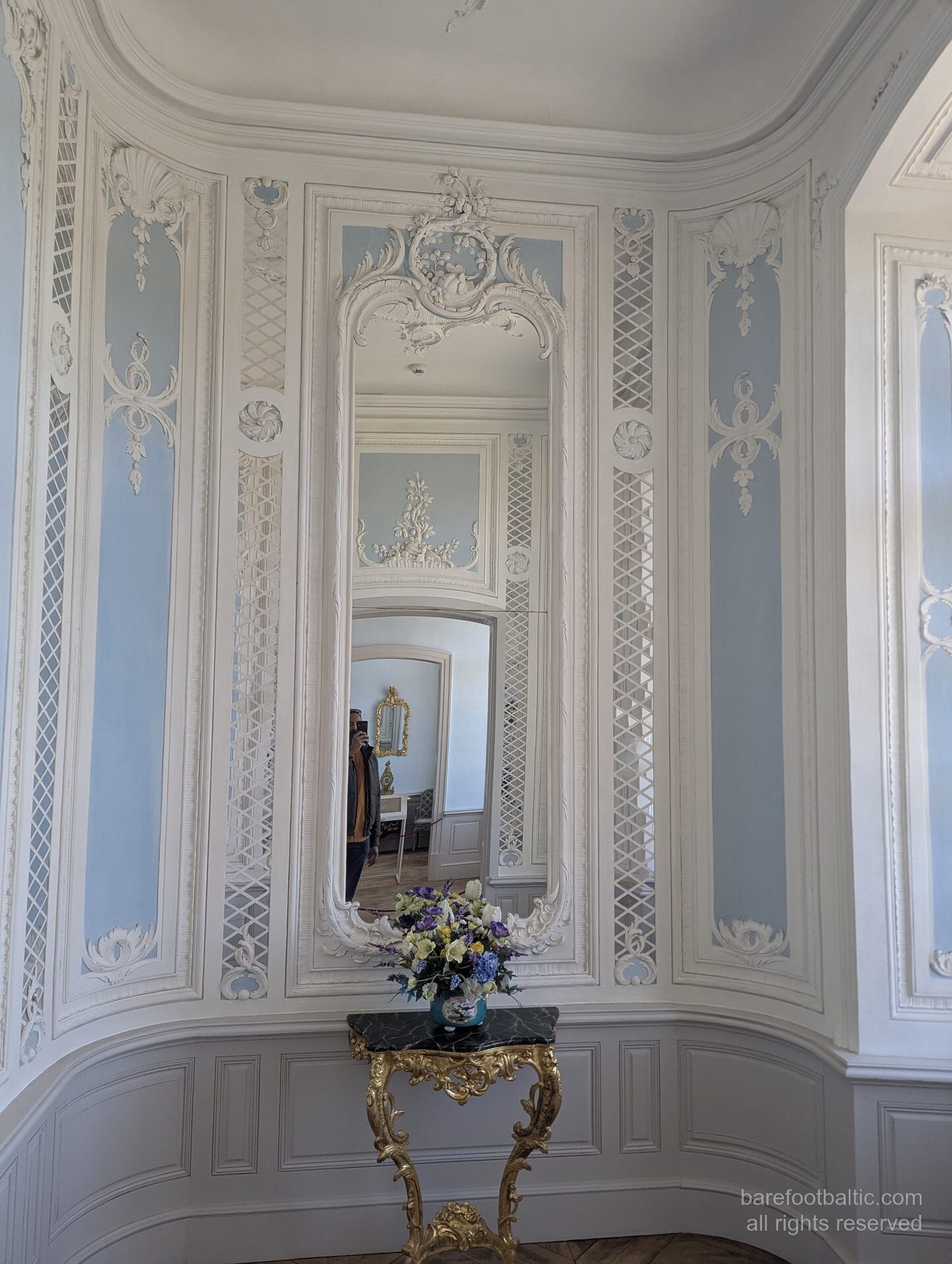
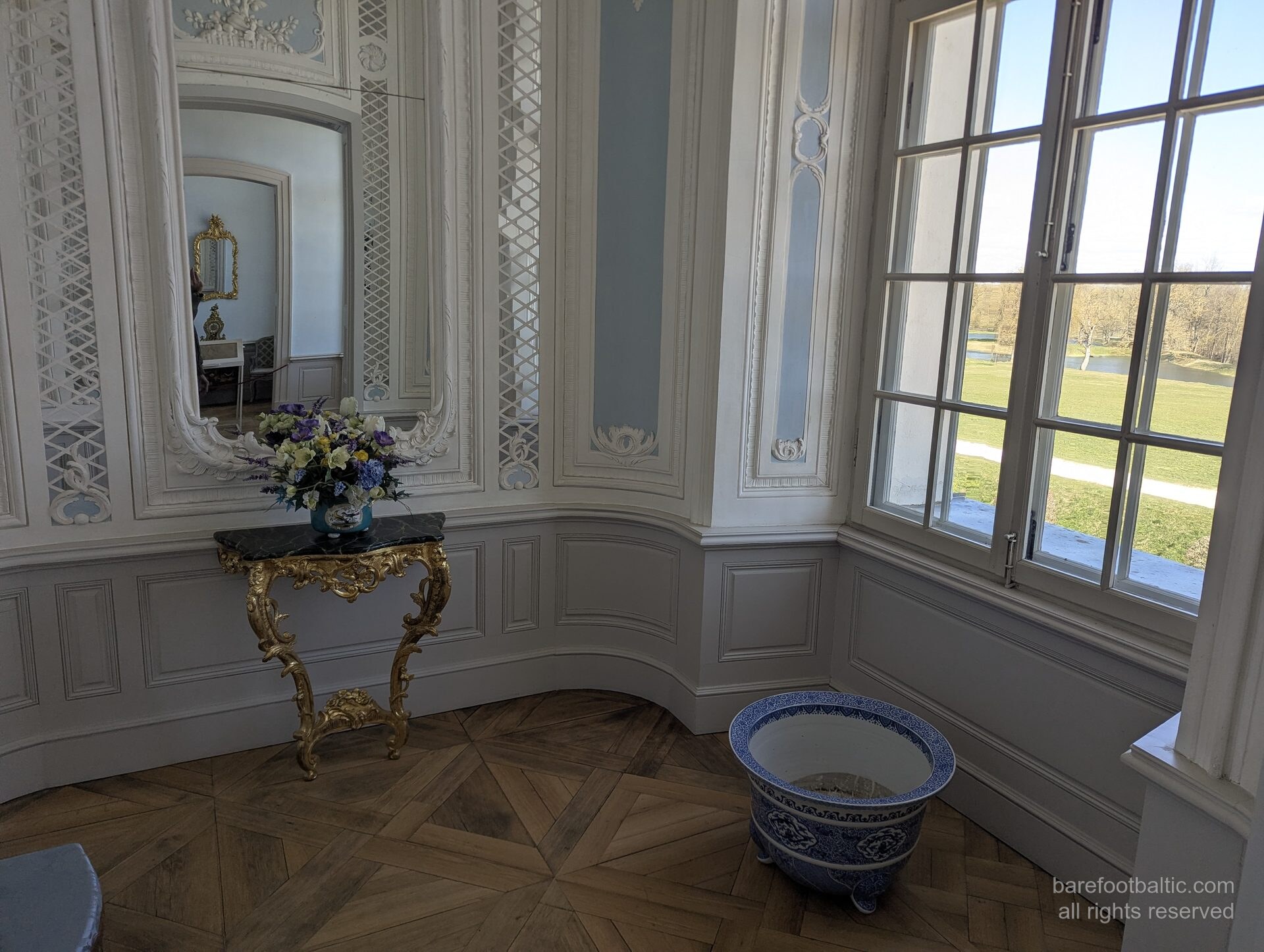
Three Cabinets at the White Hall
According to Rastrelli's original idea, there should have been an altar here, a chapel. But in 1740, the Duke abandoned the idea of having a church built, and the already finished wood-carved altar was taken to the chapel of Jelgava Palace.
In the second construction period, rooms were set up here for resting and refreshing during court festivities. It's presumed that completion of the décor in the small cabinets was interrupted because the Duke was keen to settle into the palace after returning from exile, so out of three rooms, only one has the kind of finish typical of European royal residences. In that one, the Mirror Cabinet on the left, sculptor Graff supplemented stucco décor with narrow strips of mirrored glass rhombi. The middle room is decorated with a ceiling composition and a mirror. To the right is the only room in Rundāle Palace where tulips are depicted on the ceiling rosette.
Such lounges were furnished with only a few elegant pieces. Pay attention to the lacquer commode by the Parisian master Etienne Avril.
The next room is the Small Gallery, running parallel to the Grand Gallery you've already seen.
The Small Gallery
During the reign of the Dukes, the Small Gallery was part of the household zone. Servants moved along it while delivering dishes from the kitchen to the Grand Gallery.
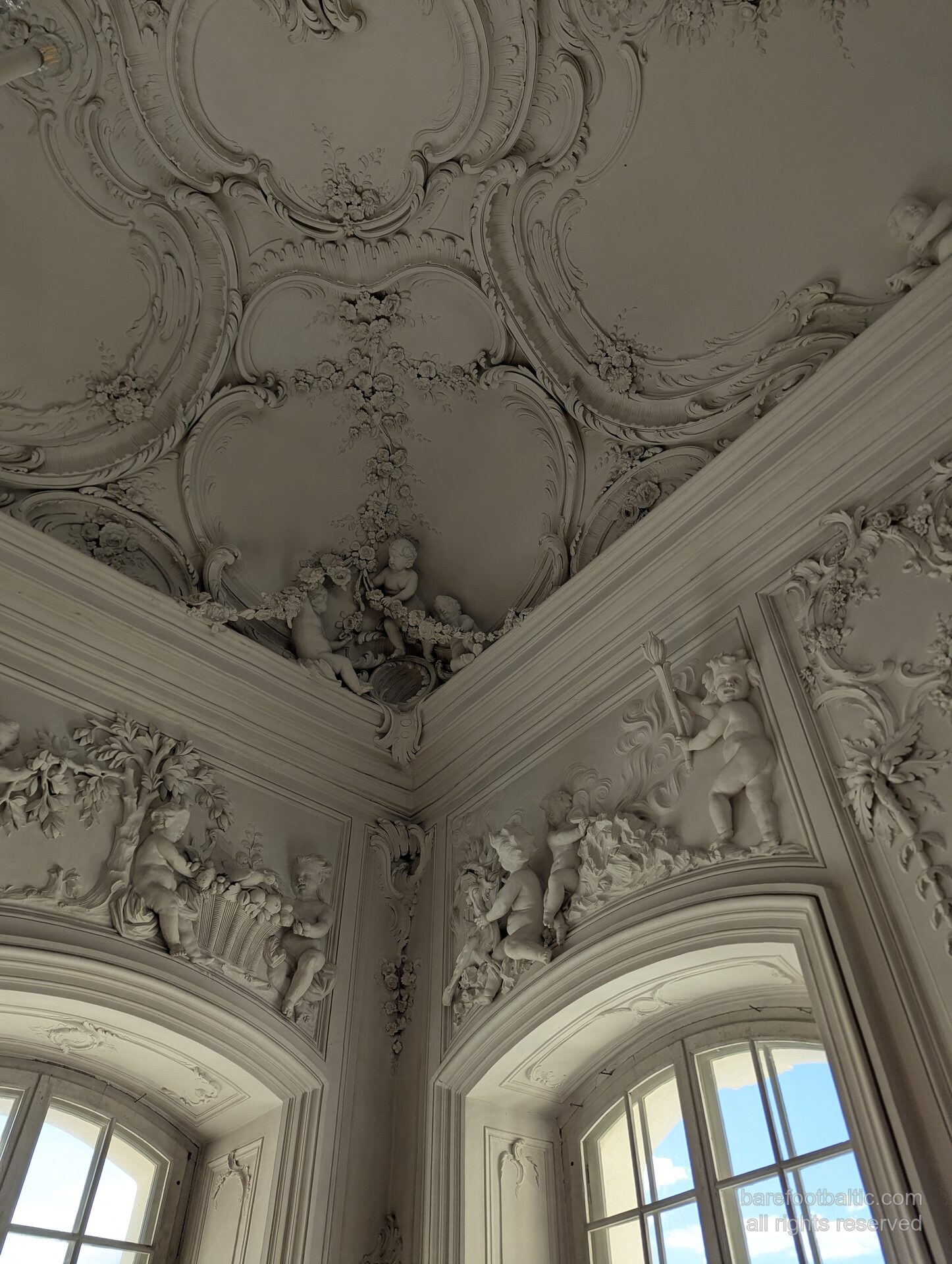
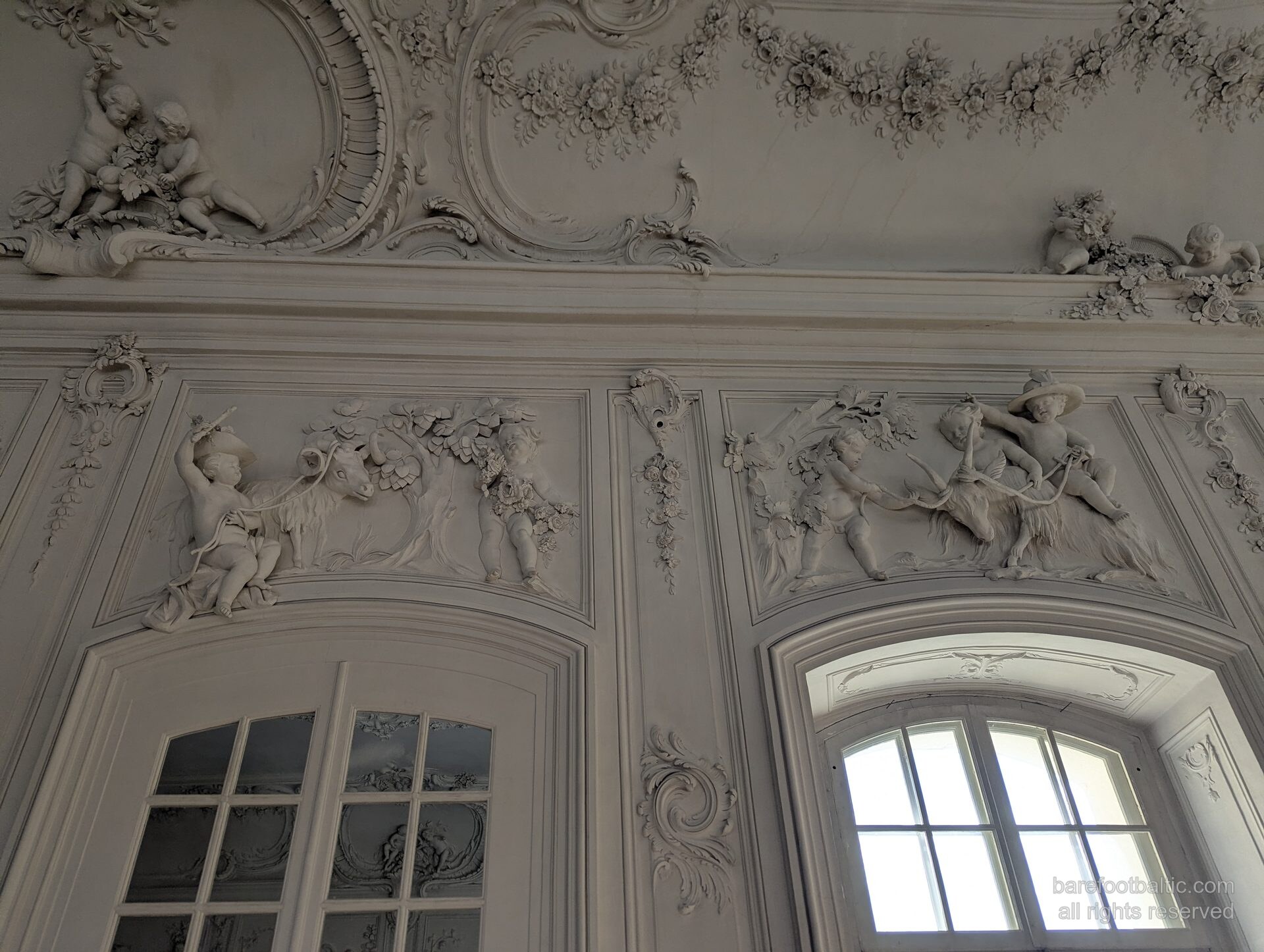
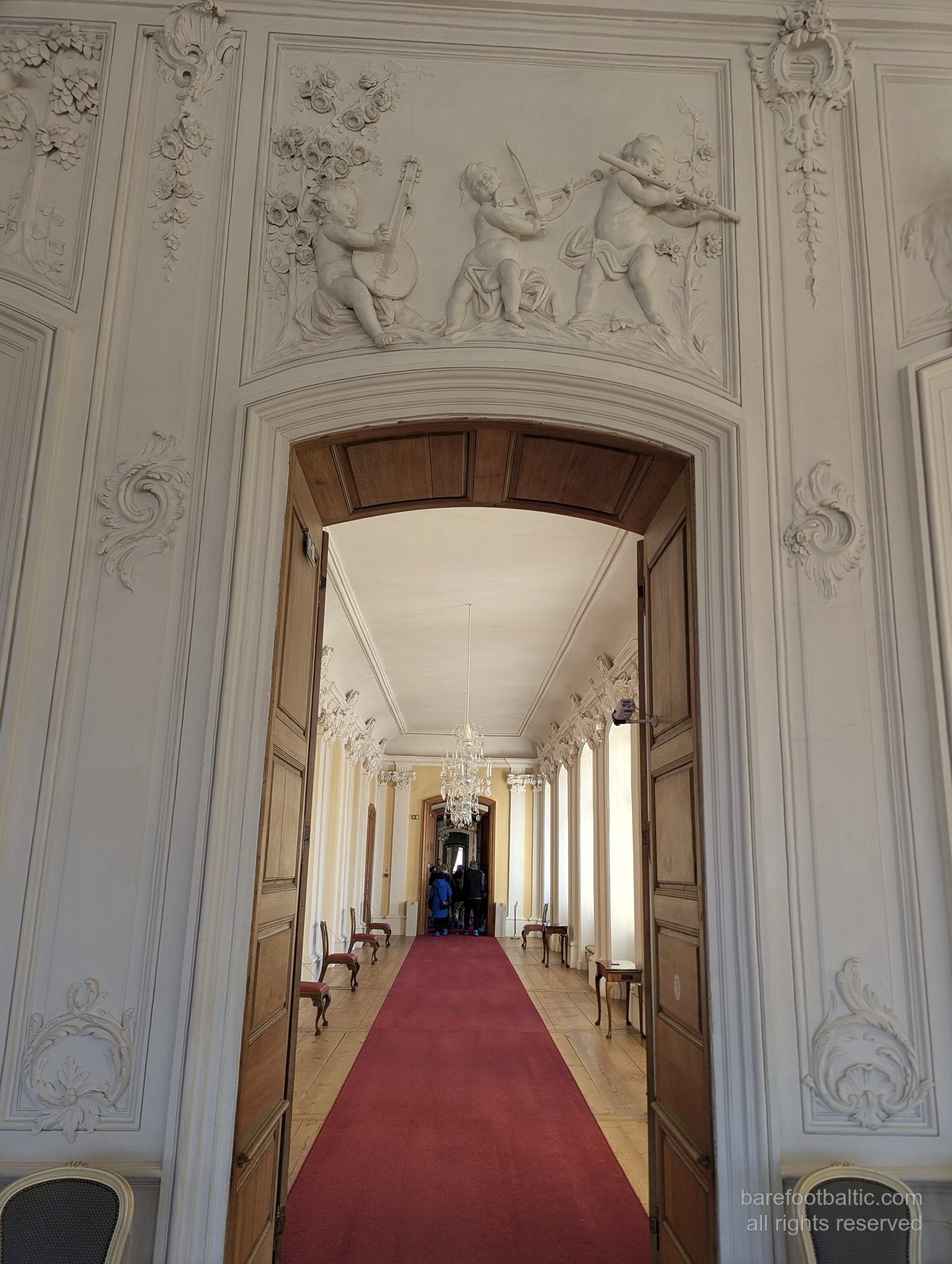
This is one of the few rooms in the palace not changed during the second construction period. Francesco Rastrelli's Baroque stucco décor with flowers and mascarons, which we saw earlier in the state staircase, has been preserved here. The composition of the wall décor suggests mirror windows should have been symmetrically placed opposite the windows (a sophisticated idea common to all residences of European rulers), but during the restoration that idea was not implemented. Plain softwood floorboards from the first construction period, fastened with nails, remain in the room.
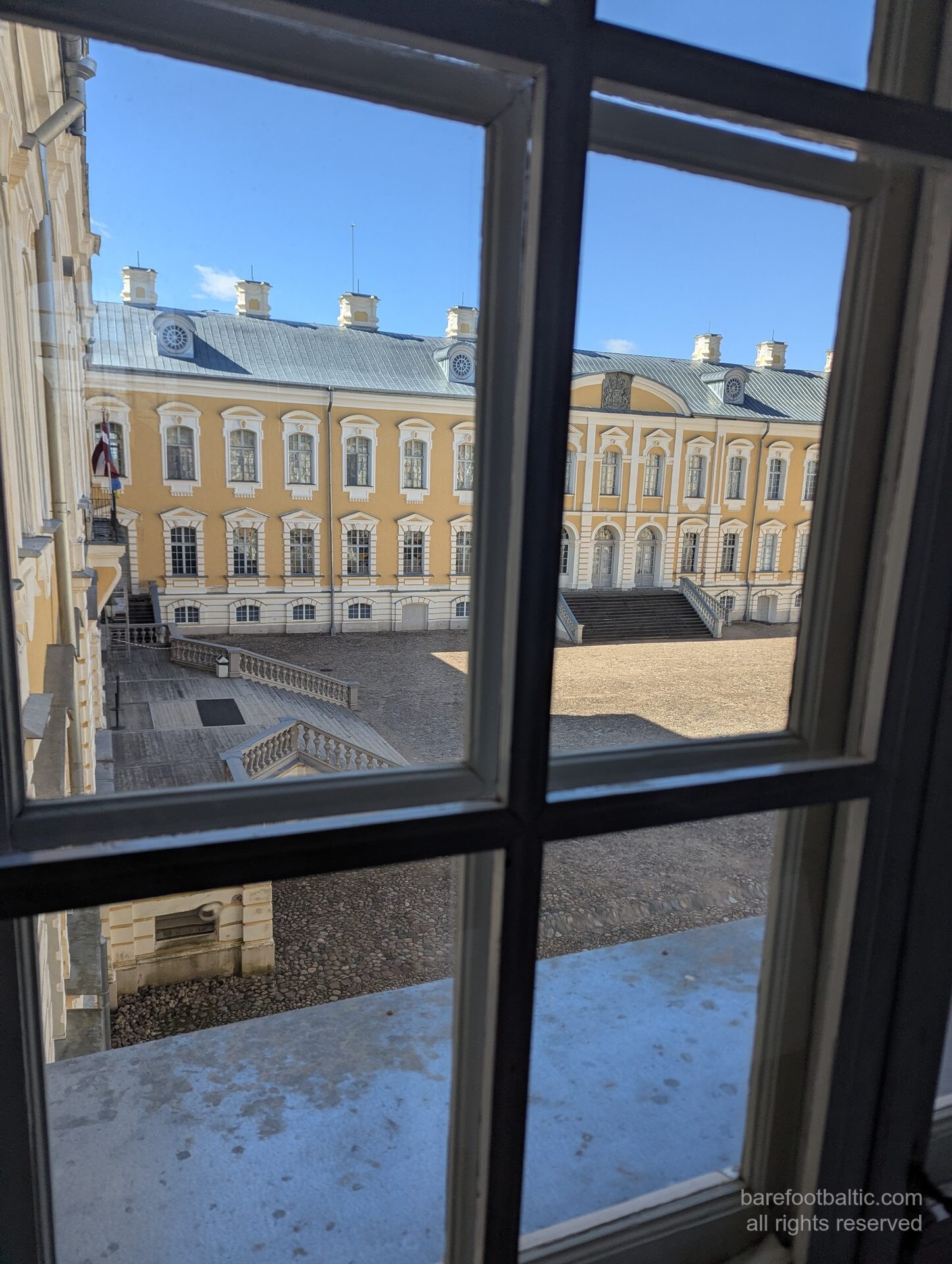
Look out the window. The coat of arms of the Shuvalov family carved in wood is on the opposite façade. Look at the palace courtyard, where the original paving has been restored, depicting three swan motifs in a network of rectangles and rhombi.
As you move on, you'll reach back stairs connecting the first floor and the kitchen, the same stairs you saw at the very start, before the state rooms.
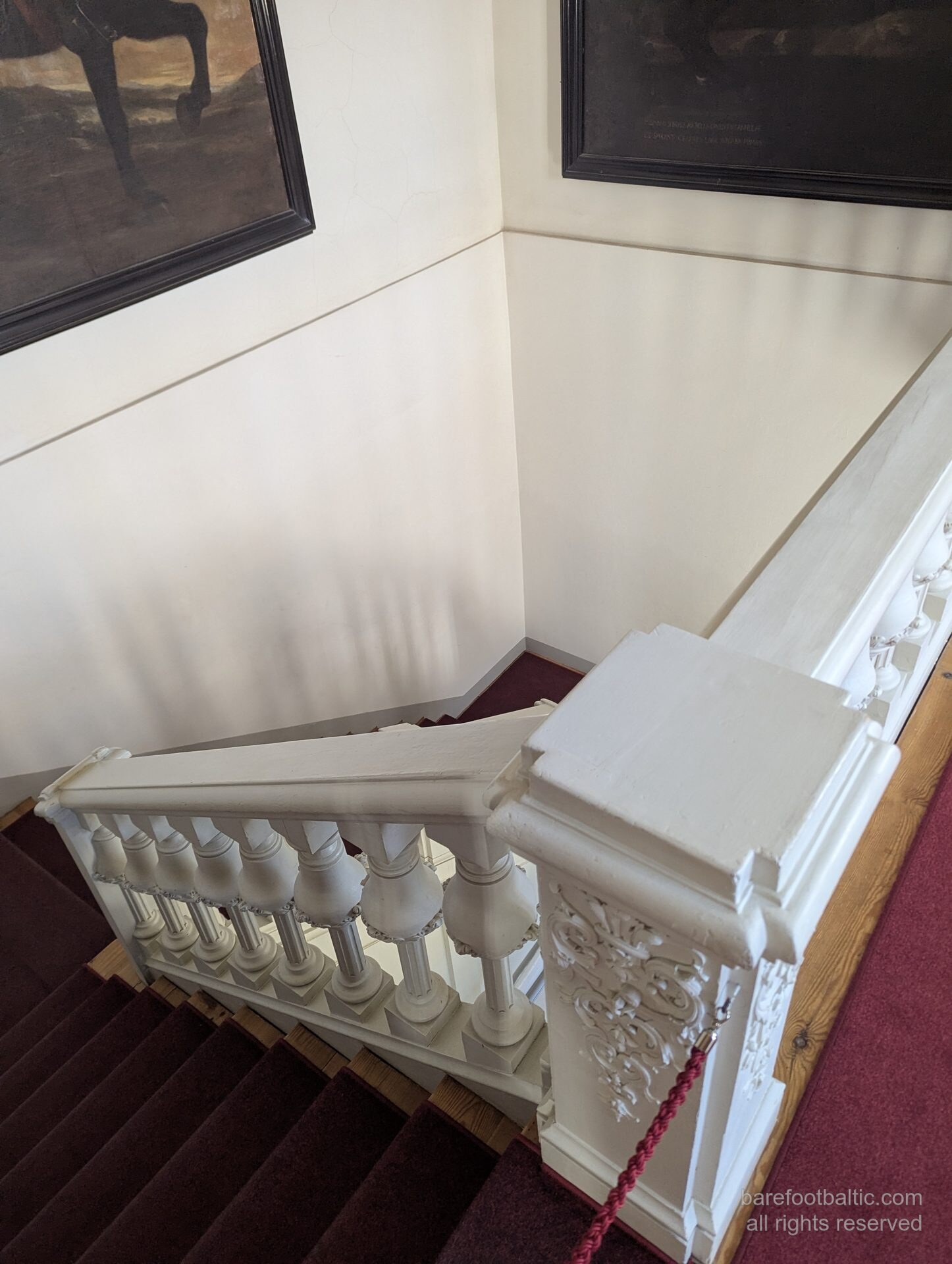
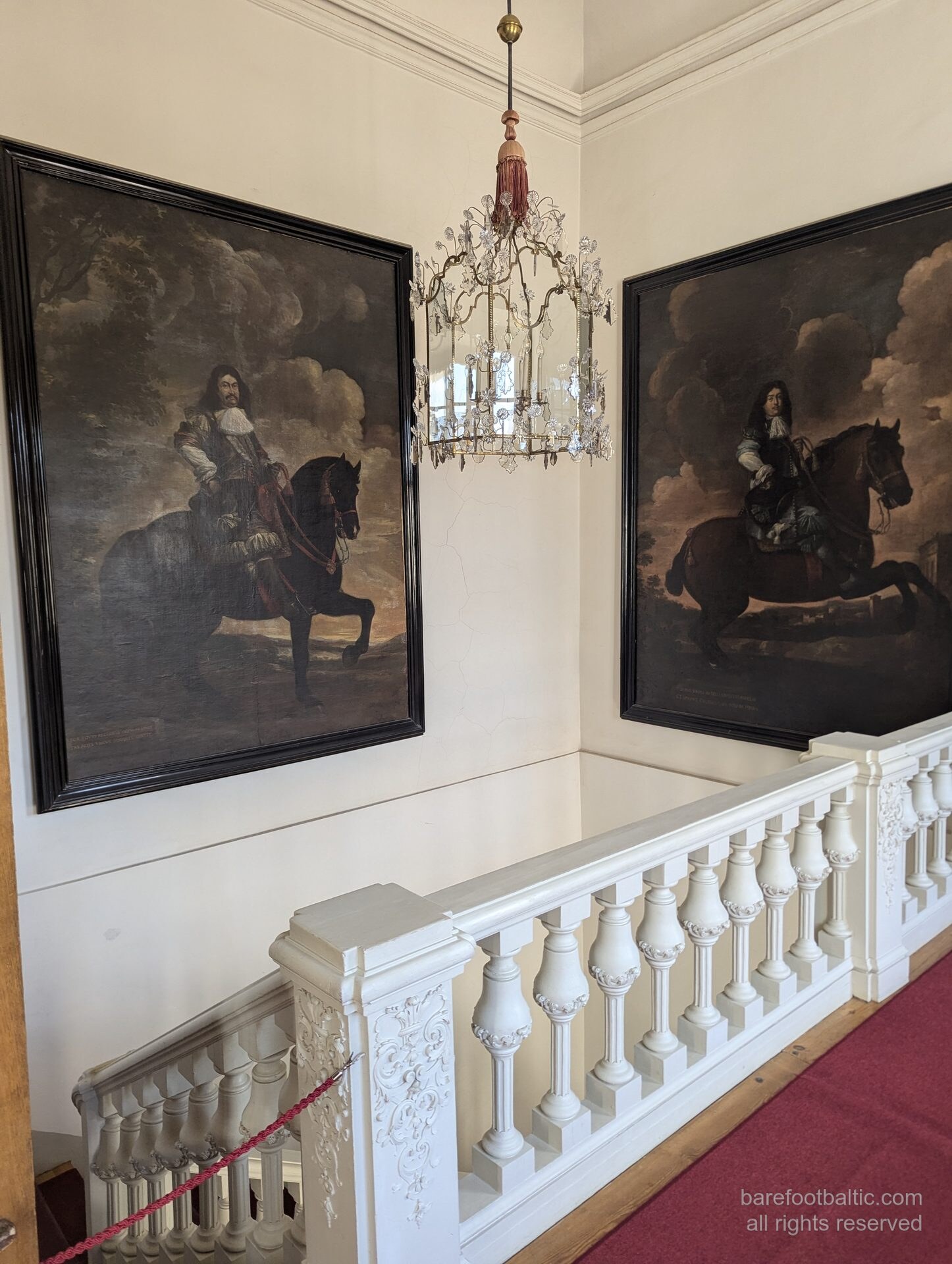
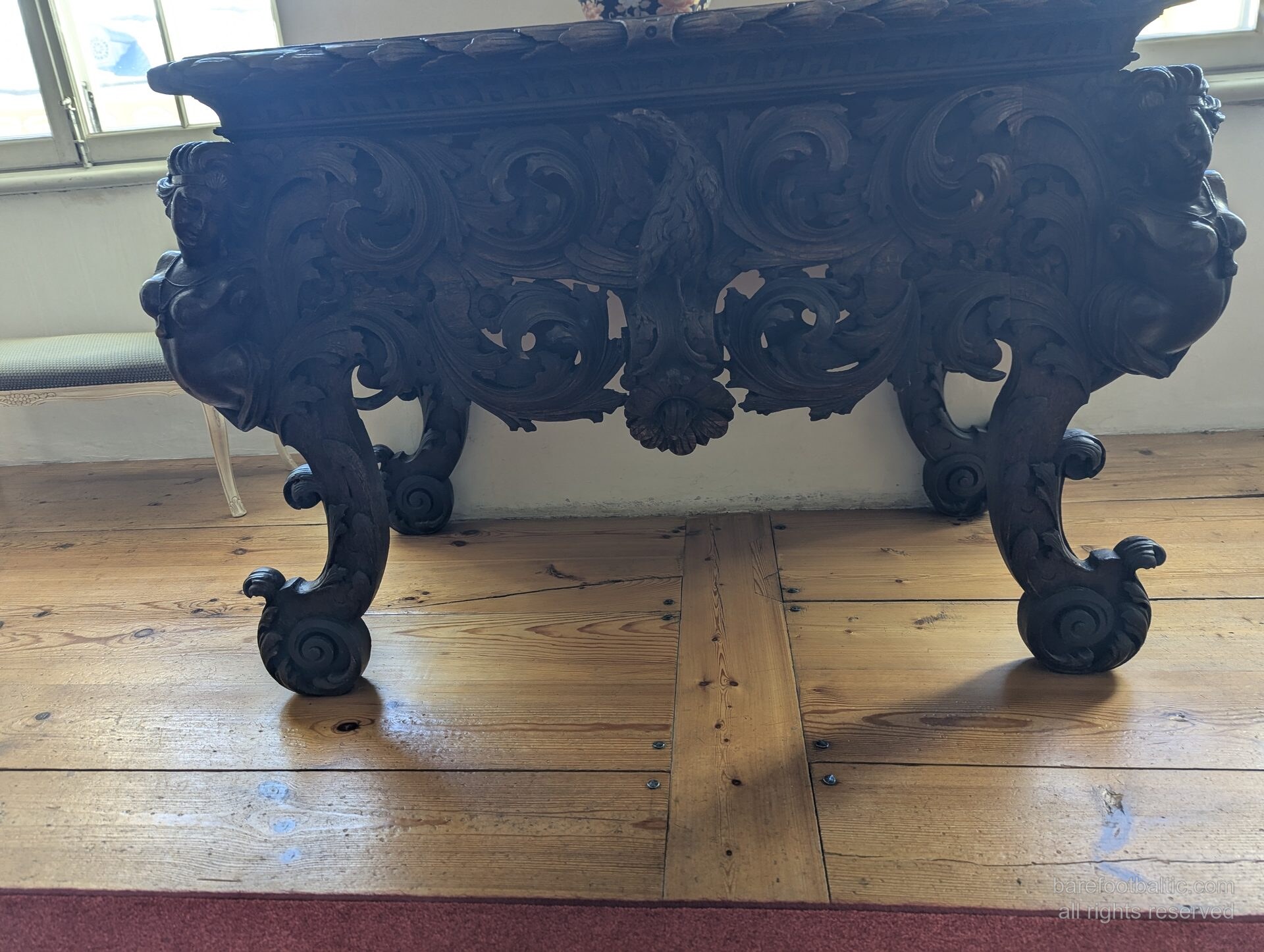
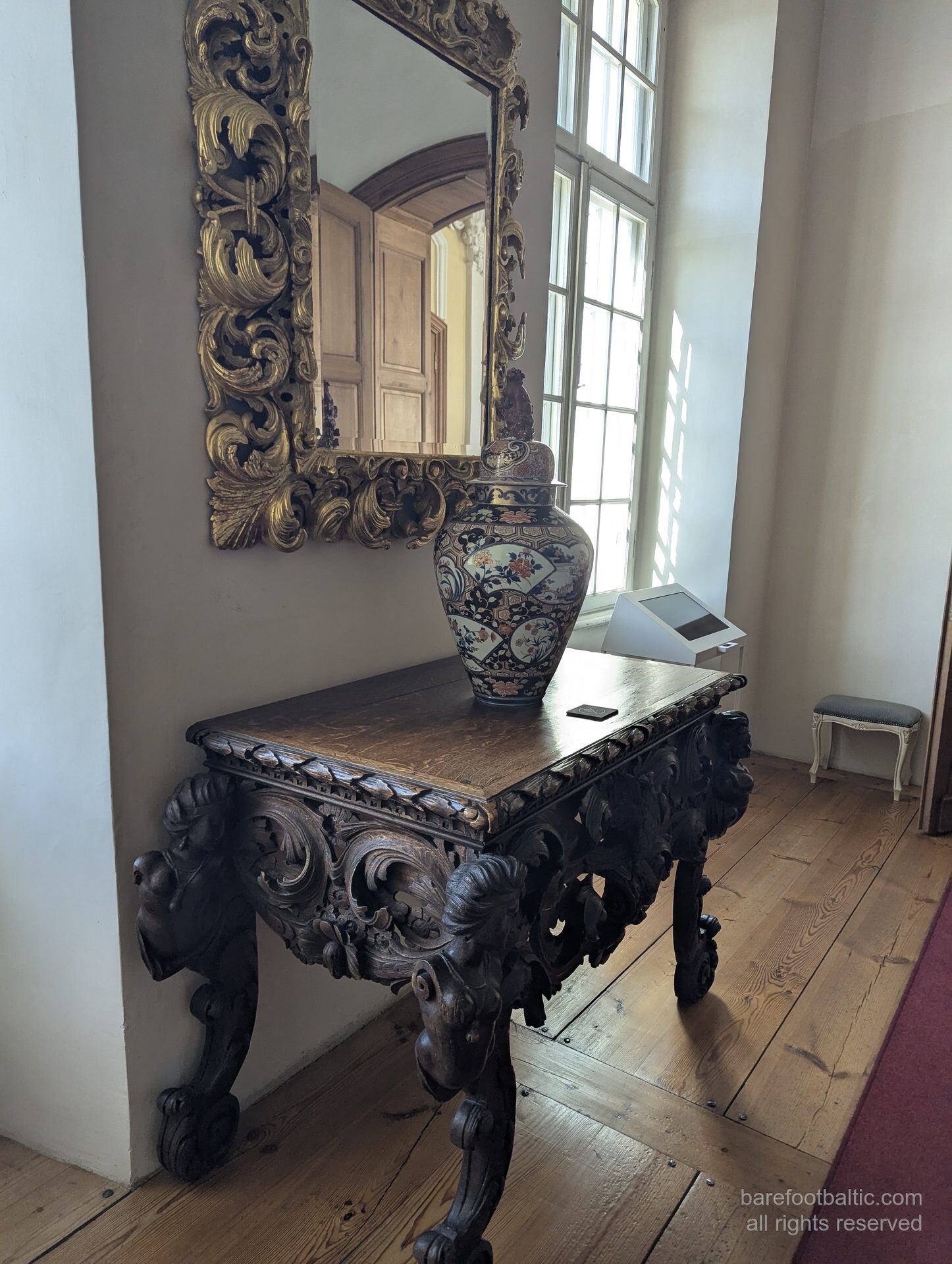
The Kitchen Stairwell
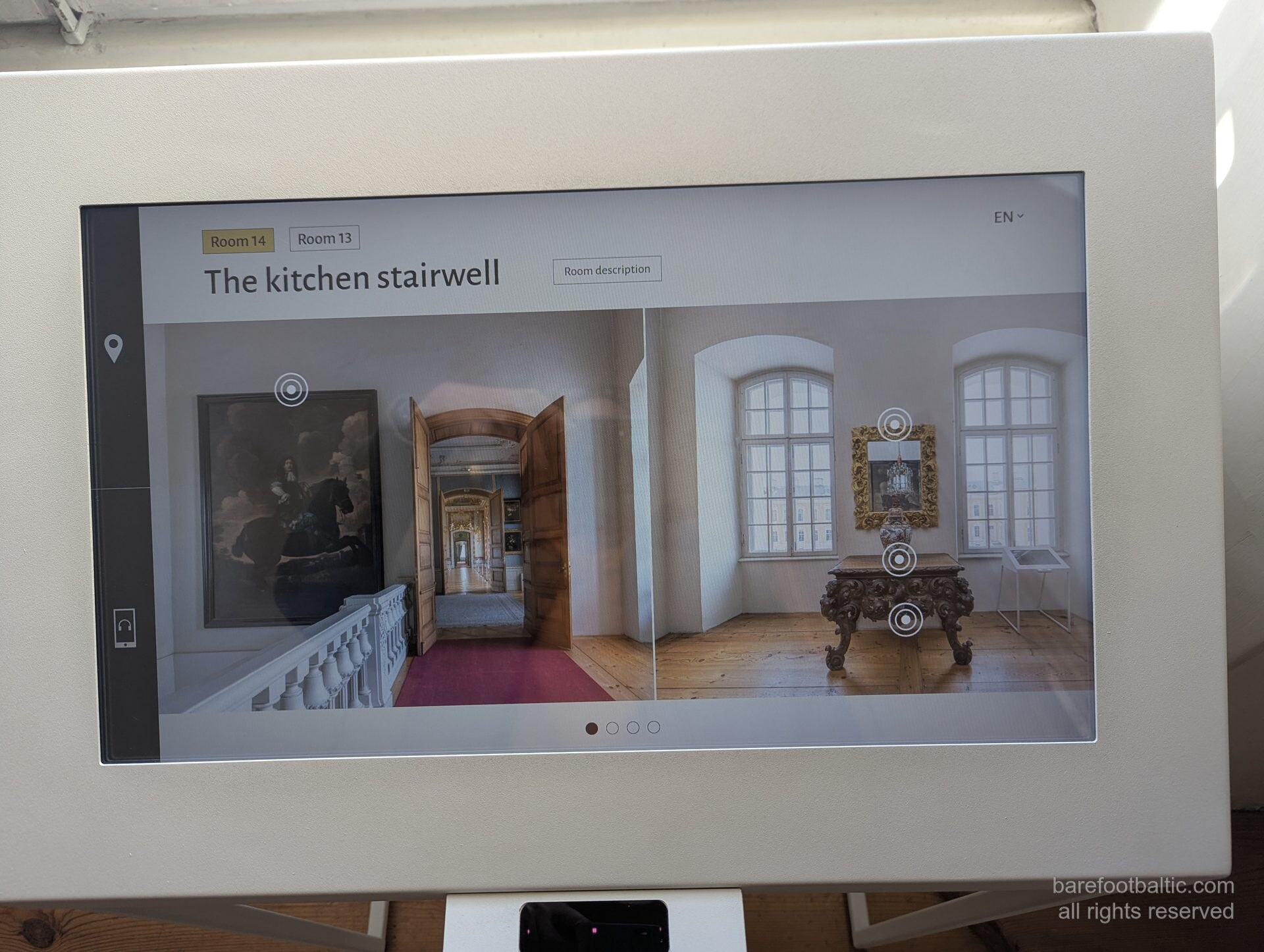
Functionally, this stairwell was the lifeline that connected the kitchen on the ground floor with the state rooms upstairs. It provided the best opportunity to serve the Duke's guests in the Grand Gallery.
You'll see a wood-carved console table made in Germany at the beginning of the eighteenth century, and paintings from the Museum's collection. Among them are portraits of unknown Spanish military leaders, painted by a Flemish artist around 1660.
Next, the Blue Room.
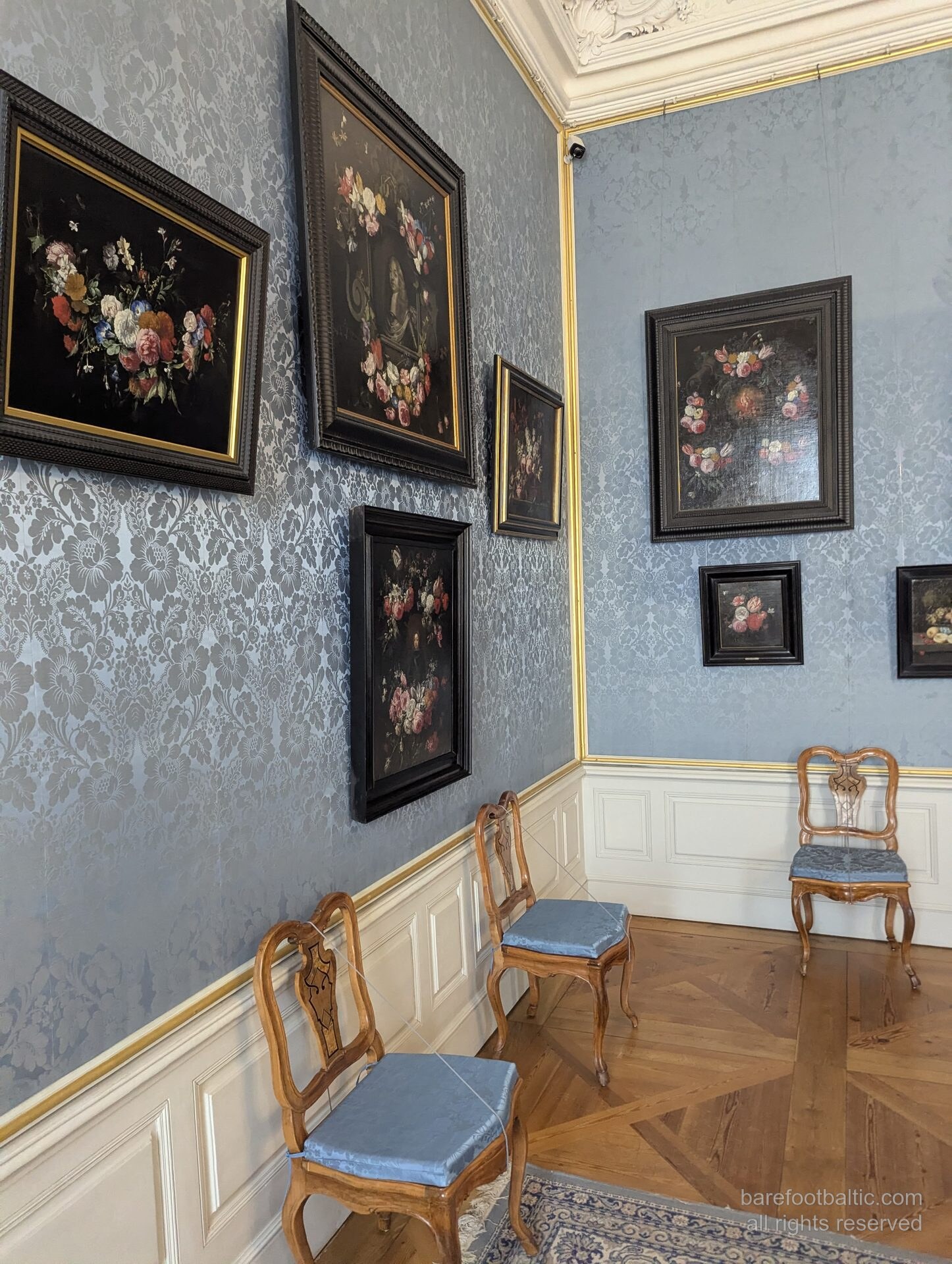
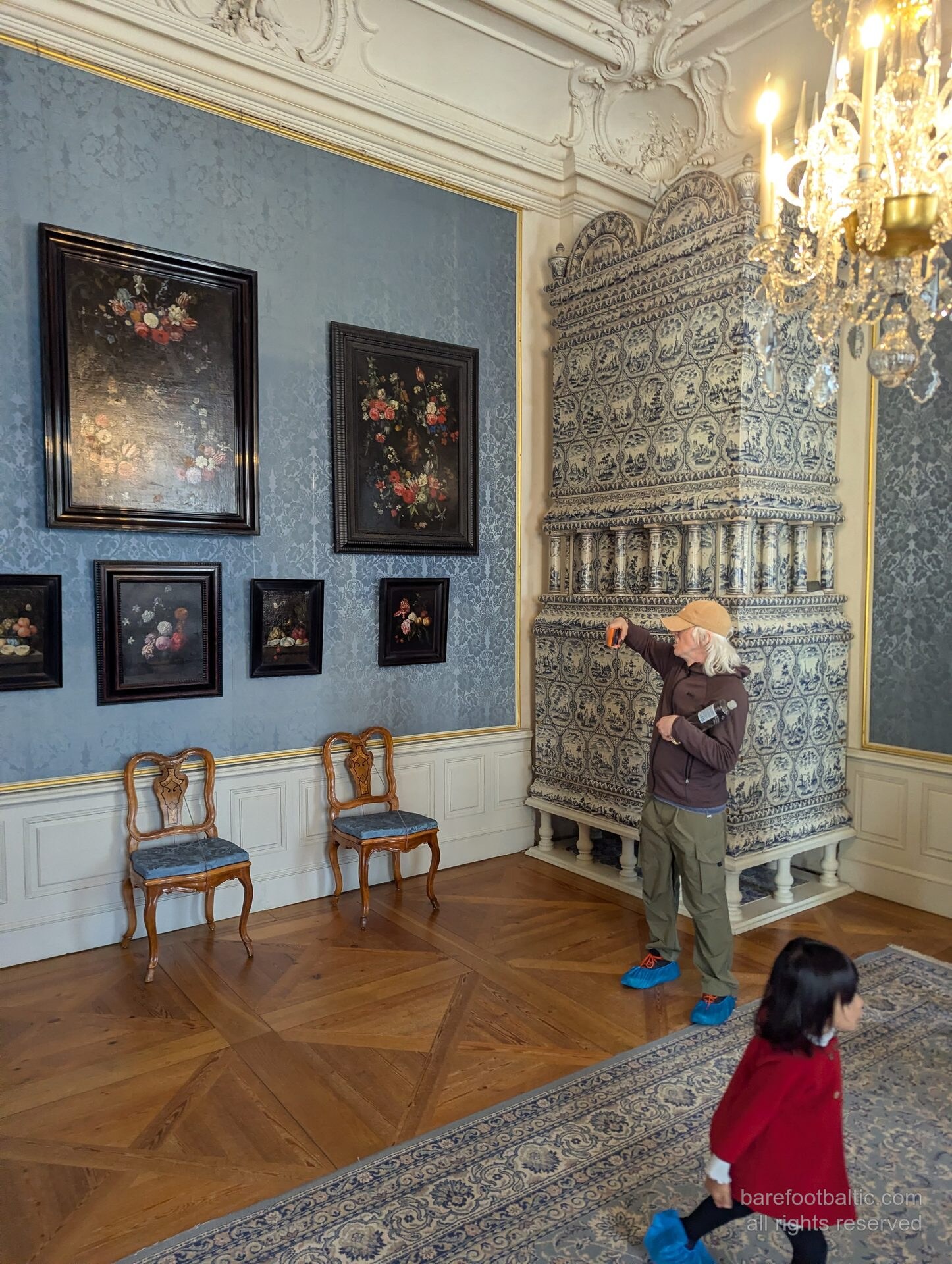
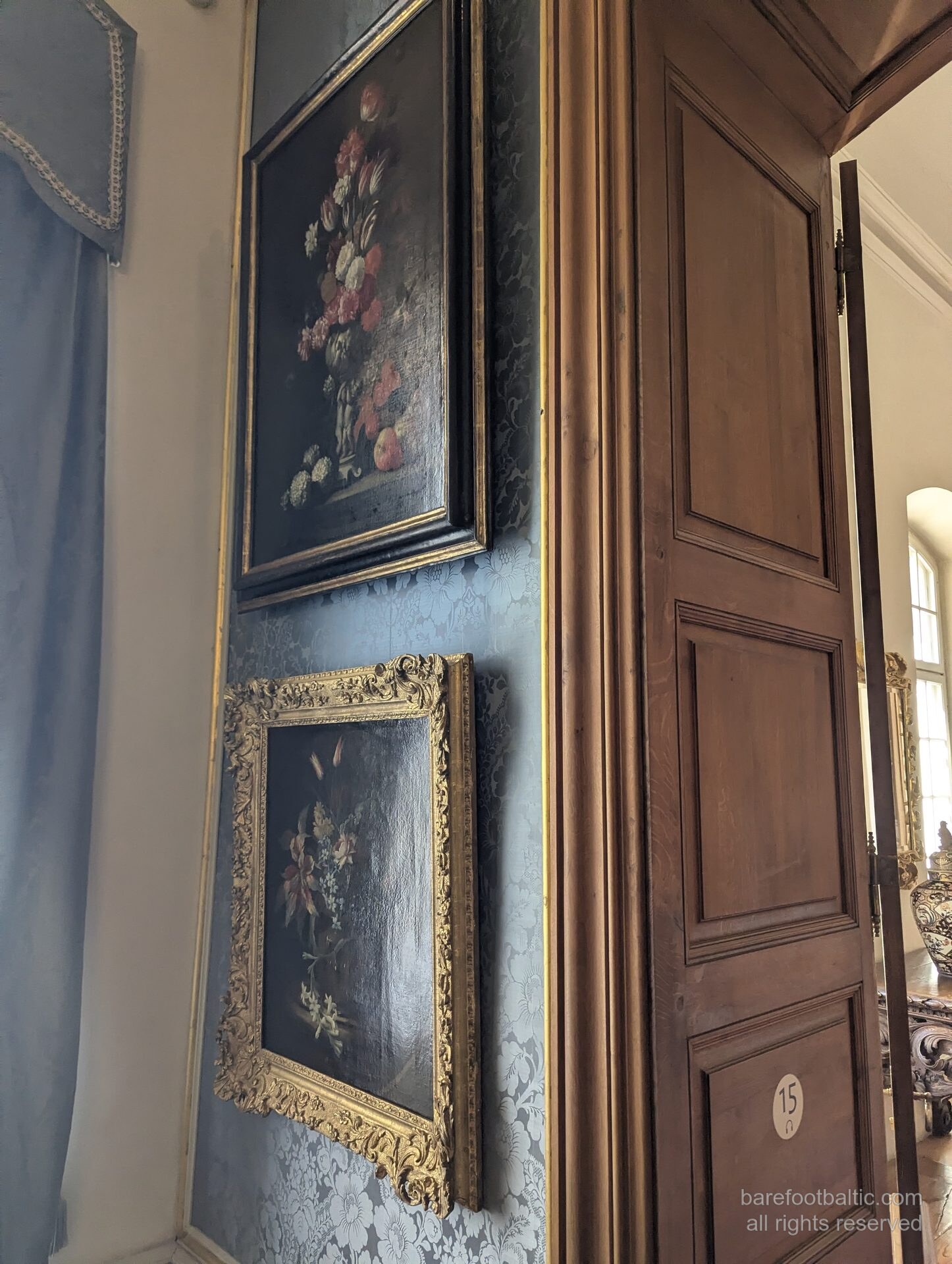
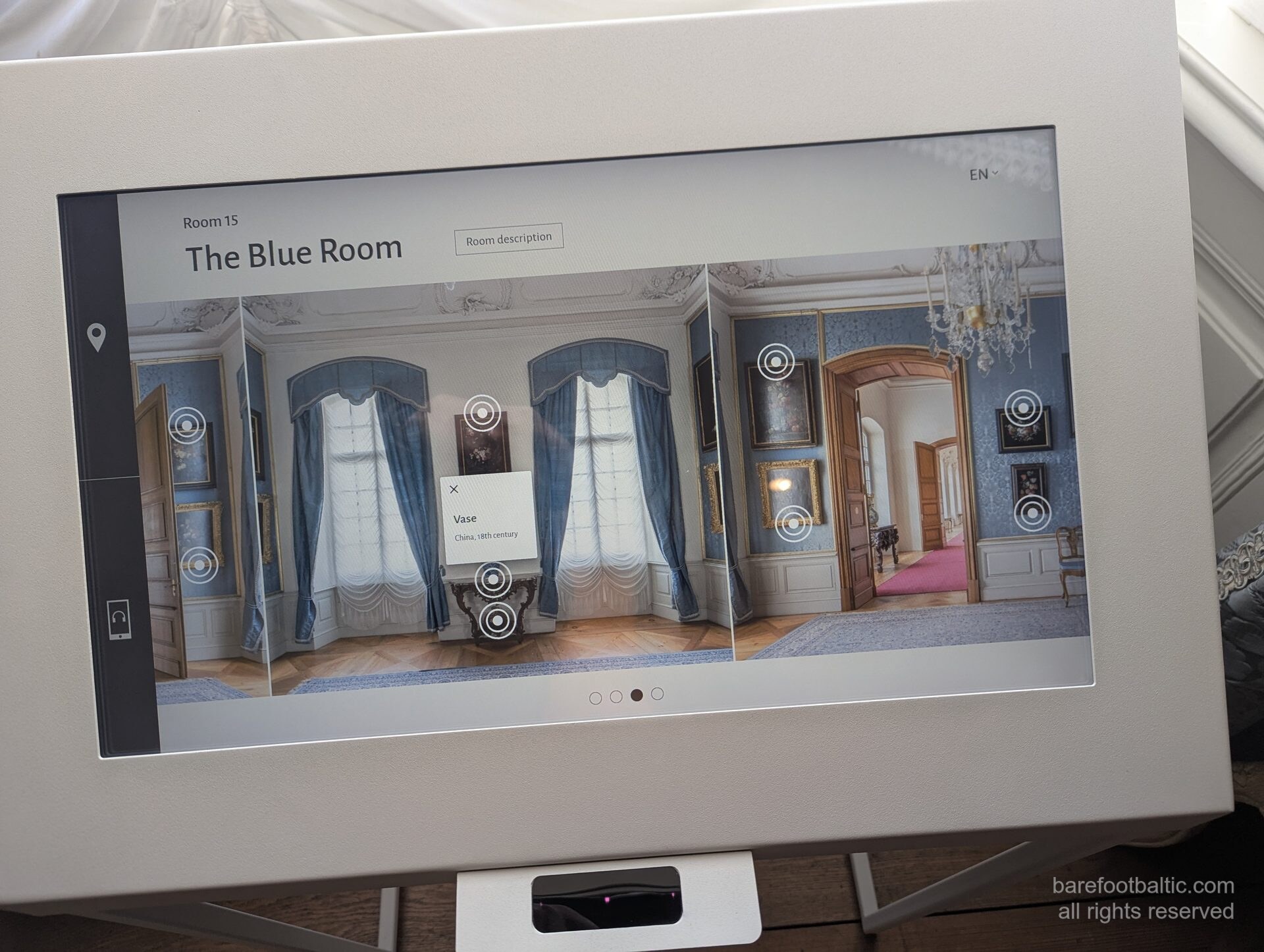
The Blue Room
The original function of this room is not exactly known. It may have served the Duke as a space to talk uninterrupted with important guests. The relatively luxurious décor of the ceiling cove decorations, and the location right next to the Gold Hall and behind the Duke's throne, point to that.
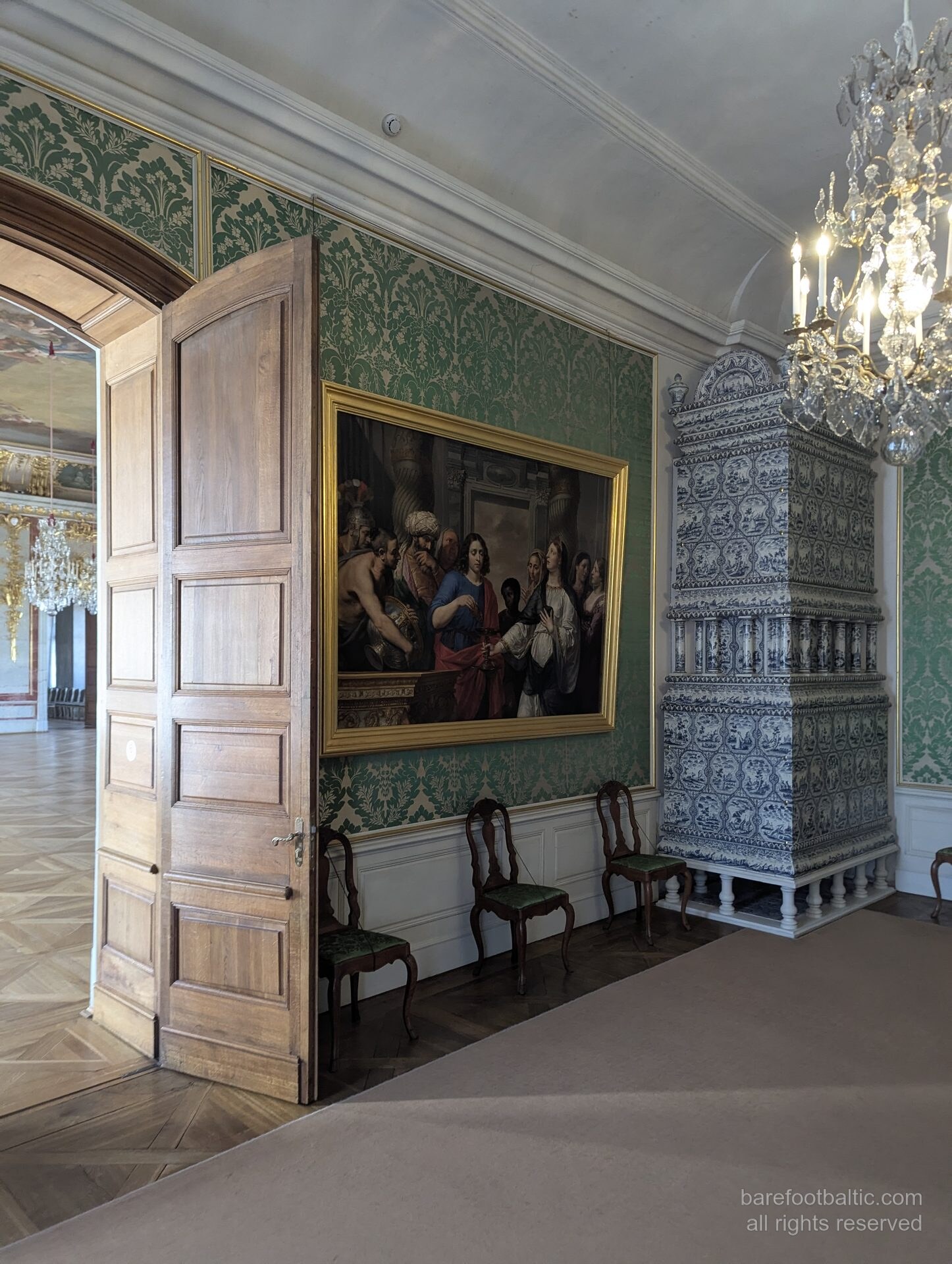
Currently, the Blue Room is set up as a salon, with silk damask wallcoverings woven in Moscow after a sample from the eighteenth century. The room contains furniture from the mid-eighteenth century and a remarkable collection of paintings. Duke Peter was a passionate art collector, who owned many Dutch, Flemish, German and Italian masterpieces, kept in his palaces at Svēte and Rundāle. So when the Museum was supplementing its collection, works of art by artists representing these painting schools were purposefully purchased.
You'll see gorgeous still lifes with flowers painted mostly by seventeenth-century Flemish artists.
First, look at the paintings in the top row on the wall opposite the windows. They're characterised by a composition popular in Flanders at the beginning of the seventeenth century, where the central part depicts a religious scene enclosed by a colourful wreath of flowers or fruits. The central painting is a typical example. The scene of the mourning of Christ was painted by Flemish artist Erasmus Quellinus, while the flowers were painted by his brother-in-law Jan Philip van Thielen, whose mastery can be appreciated in other paintings here. This kind of collaboration was common practice. Each artist specialised in one narrow field.
Mythological scenes and specific individuals were also painted in a wreath of flowers or fruits. To the left of the end wall below the middle painting is a portrait by Johannes Lotyn of Philip V, King of Spain. Above it is a portrait of an officer by a collaborator of Daniel Seghers. The depicted flowers, like snowdrops, hyacinths, tulips, carnations, roses, marigolds and forget-me-nots, bloom in nature in different seasons. These compositions are both decorative and symbolic, reminiscent of the short-lived nature of life.
Classic still lifes, such as flower arrangements in glass or ceramic vases, are also displayed in the Blue Room. Several paintings here are examples of pair paintings popular at the time, allowing the principle of symmetry in interior design. There are pair paintings of still lifes with flowers by Nicola van Houbraken in the bottom row on both sides of the windows, as well as still lifes with fruits, like the two smaller paintings by Frans van Everbroeck in the bottom row of the wall opposite the windows.
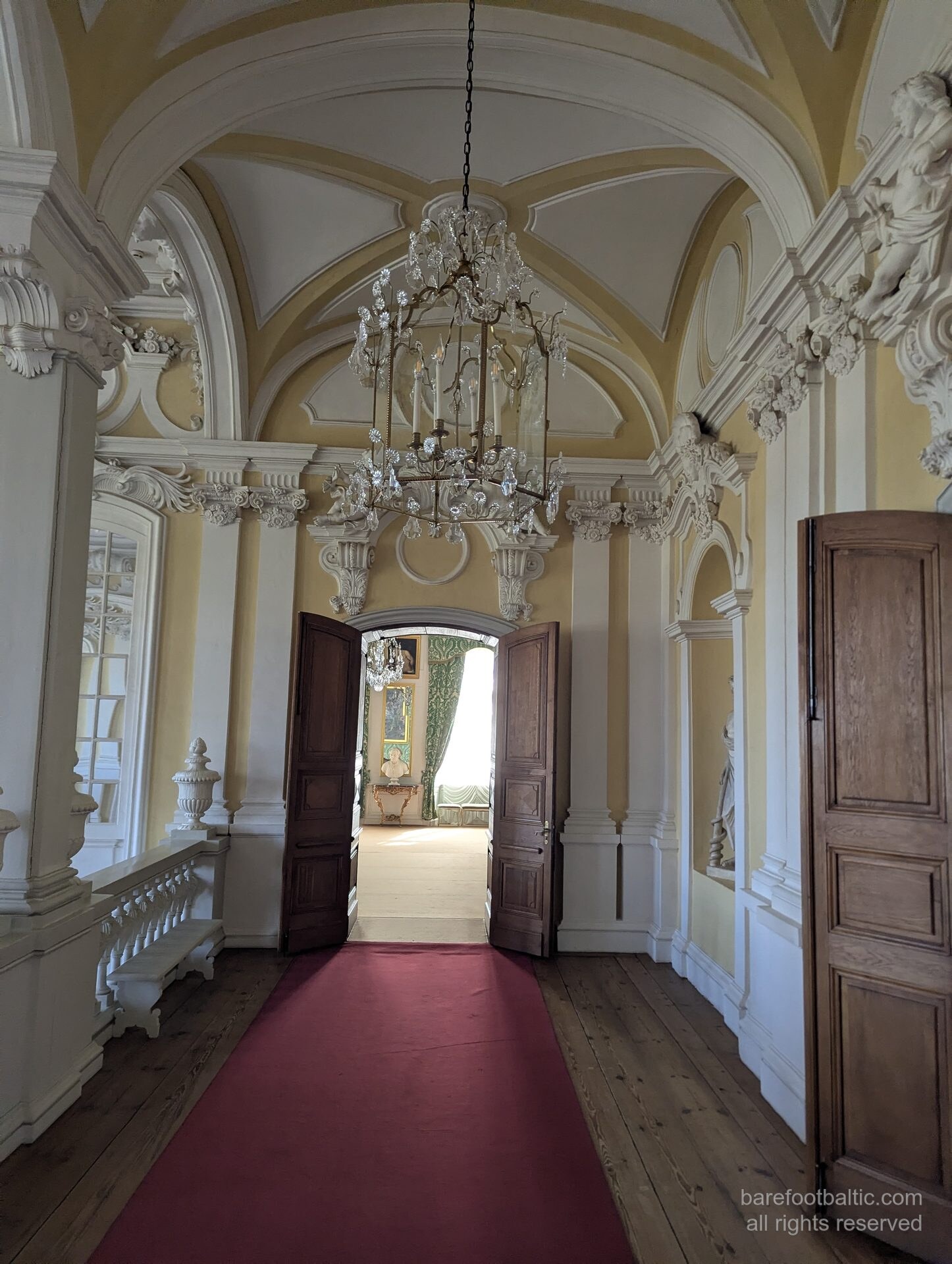
To complete the tour of the state rooms, we cross the Gold Hall and its Antechamber once more and return to the state staircase. Continuing on the first floor, we now visit the Duke's apartments. In the stairwell on the right is the entrance to the Duke's private apartments.
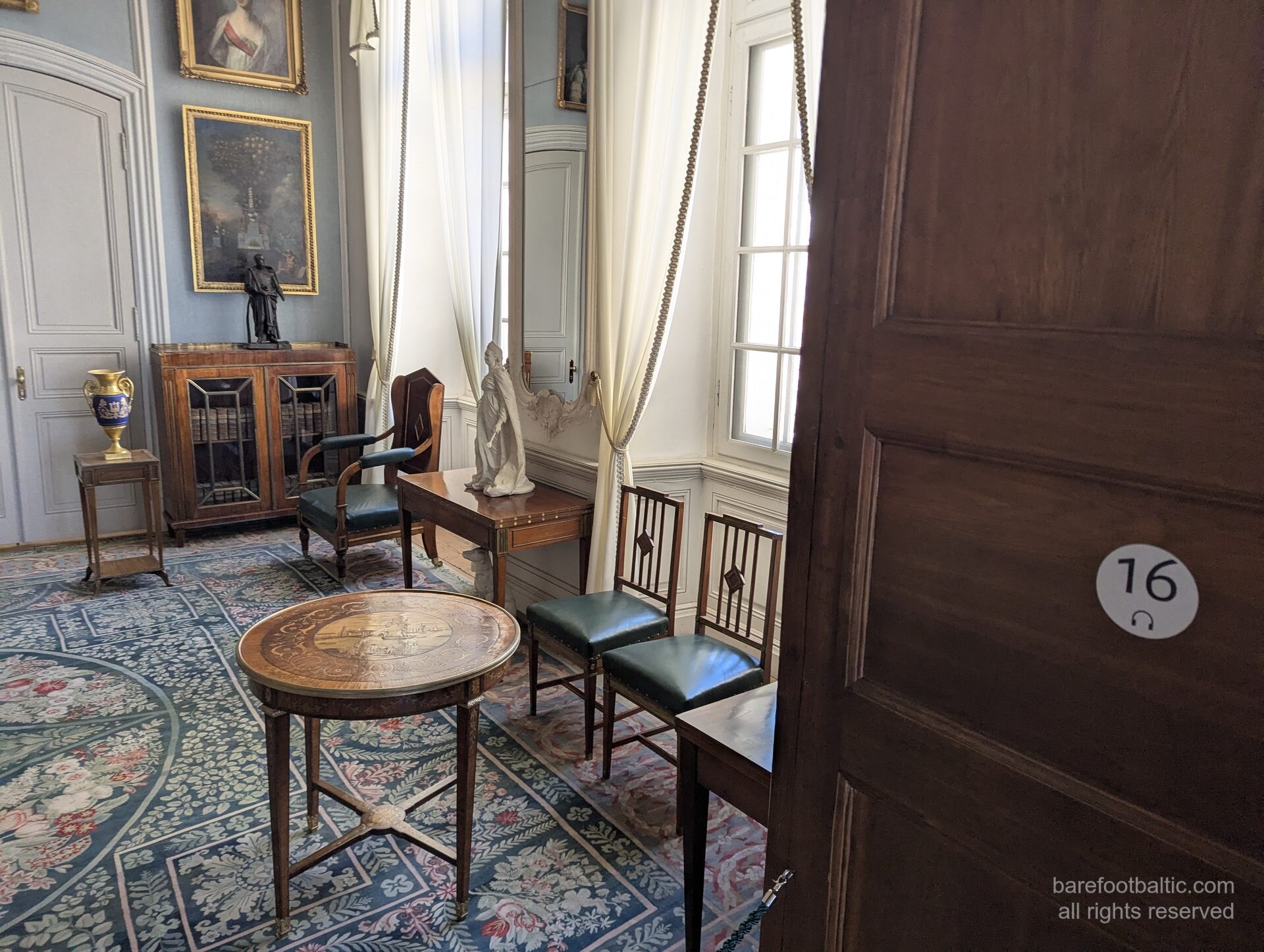
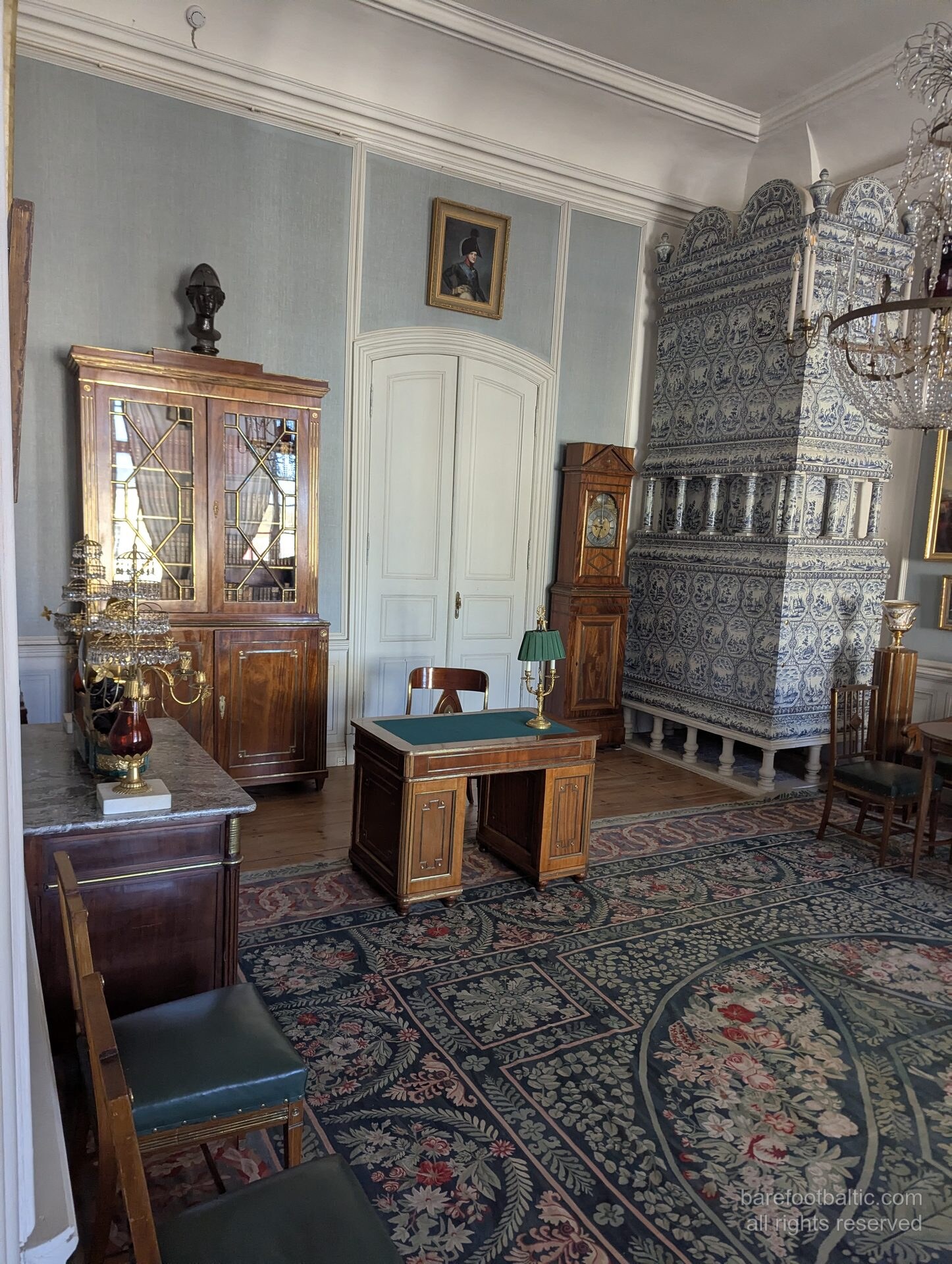
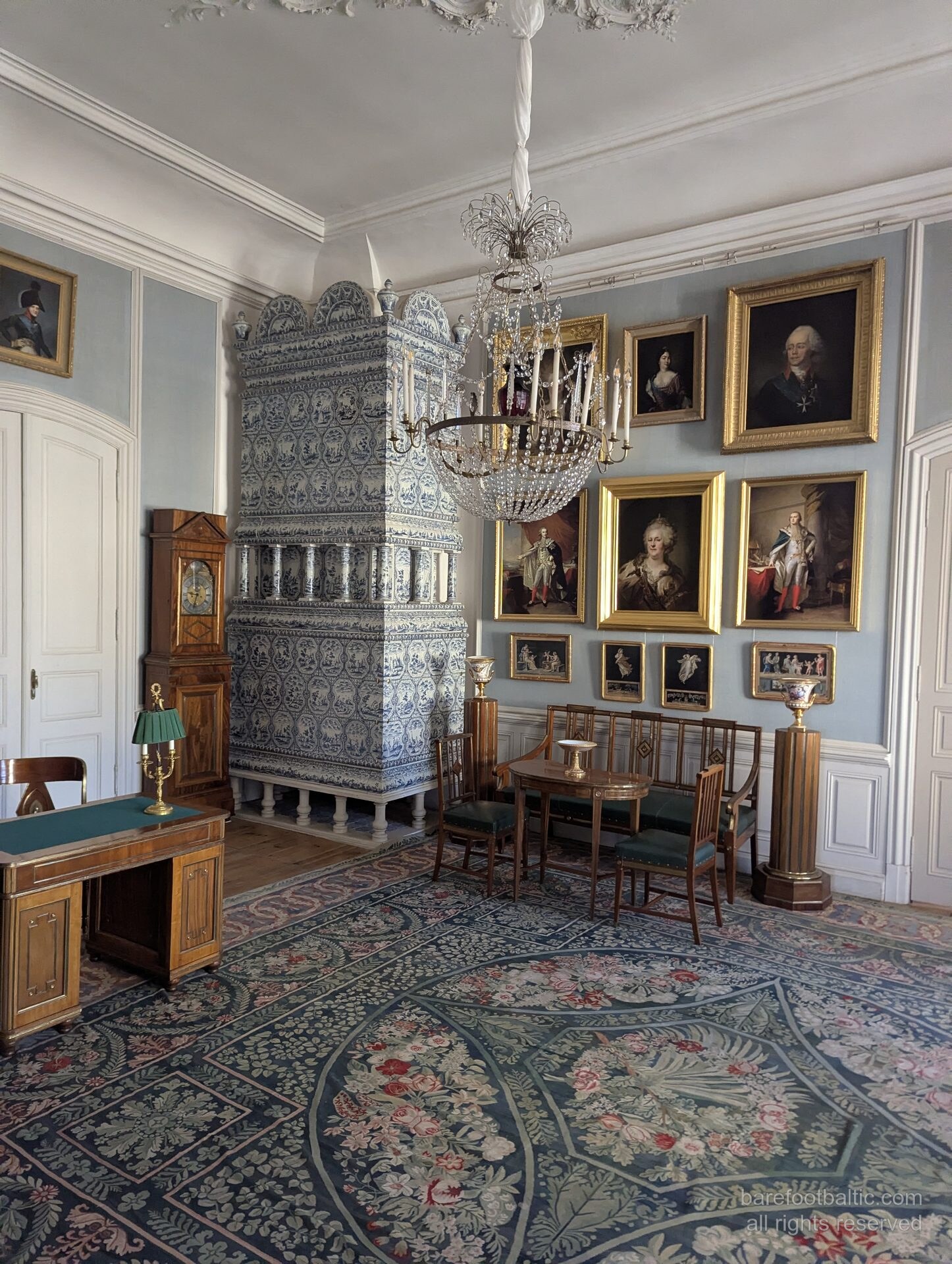
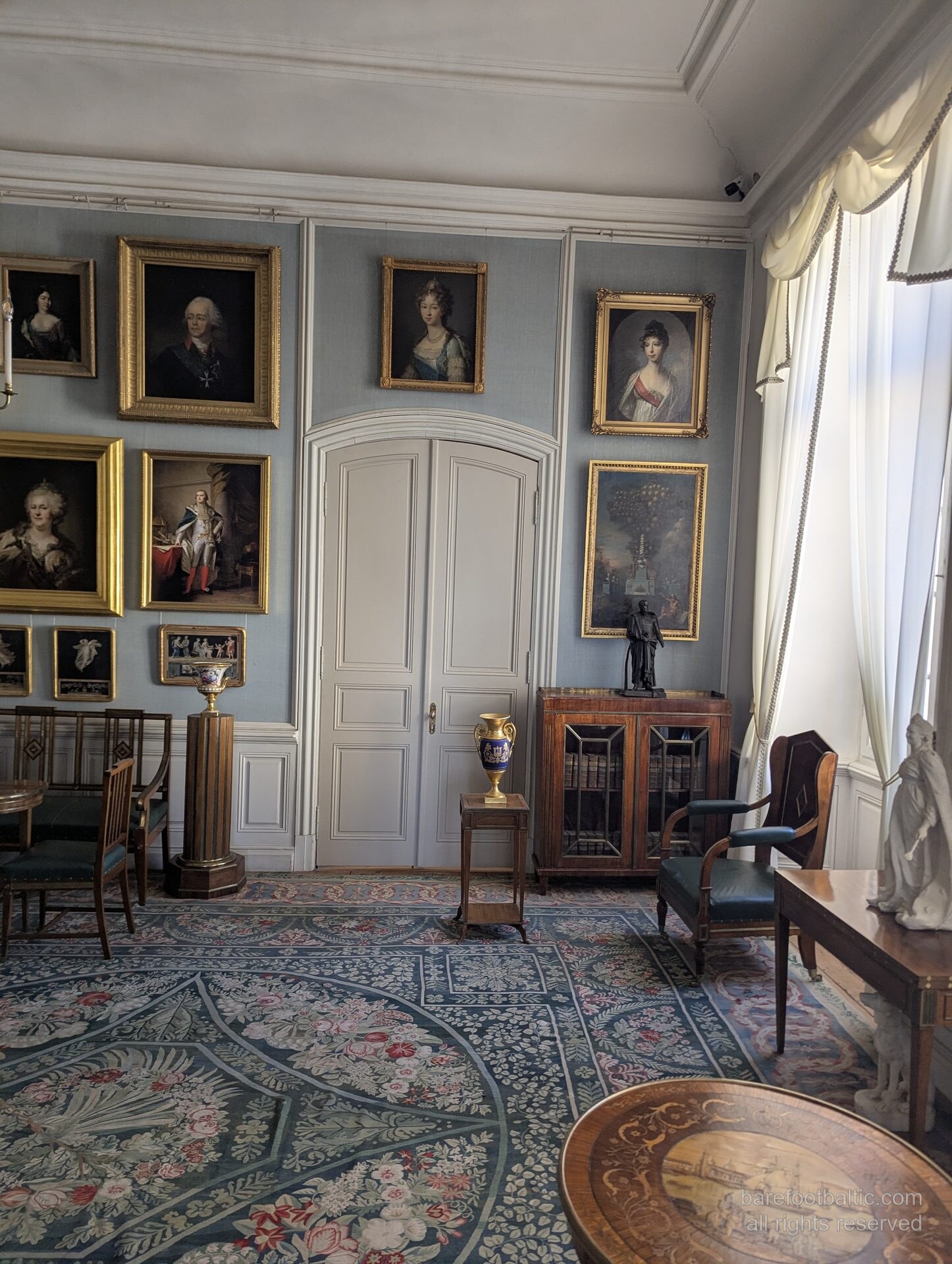
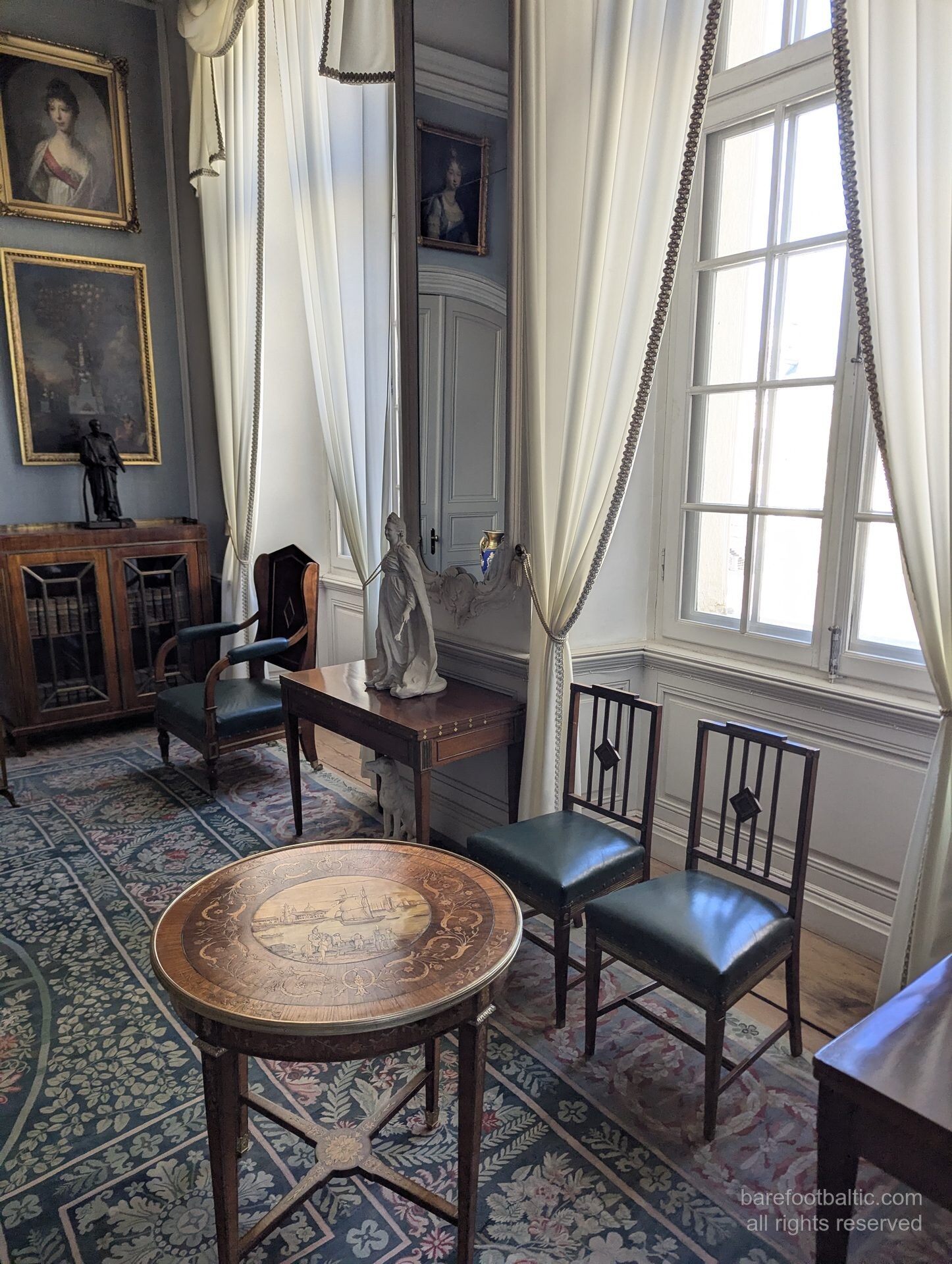
The Zubovs' Room
The Duke's private apartments occupy ten rooms on the north side of the central building. This group of rooms includes the Duke's Dressing Room, two studies, and rooms for hygiene, which we'll visit later. For now, we look at the antechamber of the private apartments, which was to some extent publicly accessible (for example, to courtiers).
The room has been set up to reflect the era of the Zubov brothers. In 1795, the Duchy of Courland and Semigallia was liquidated and annexed to Russia, and Duke Peter moved to his estates in Silesia and Bohemia. Empress Catherine the Great gave Rundāle Palace to Count Valerian Zubov as a present. After the Count's death, the palace was inherited by his brother, Prince Platon Zubov, the last favourite of Catherine the Great.
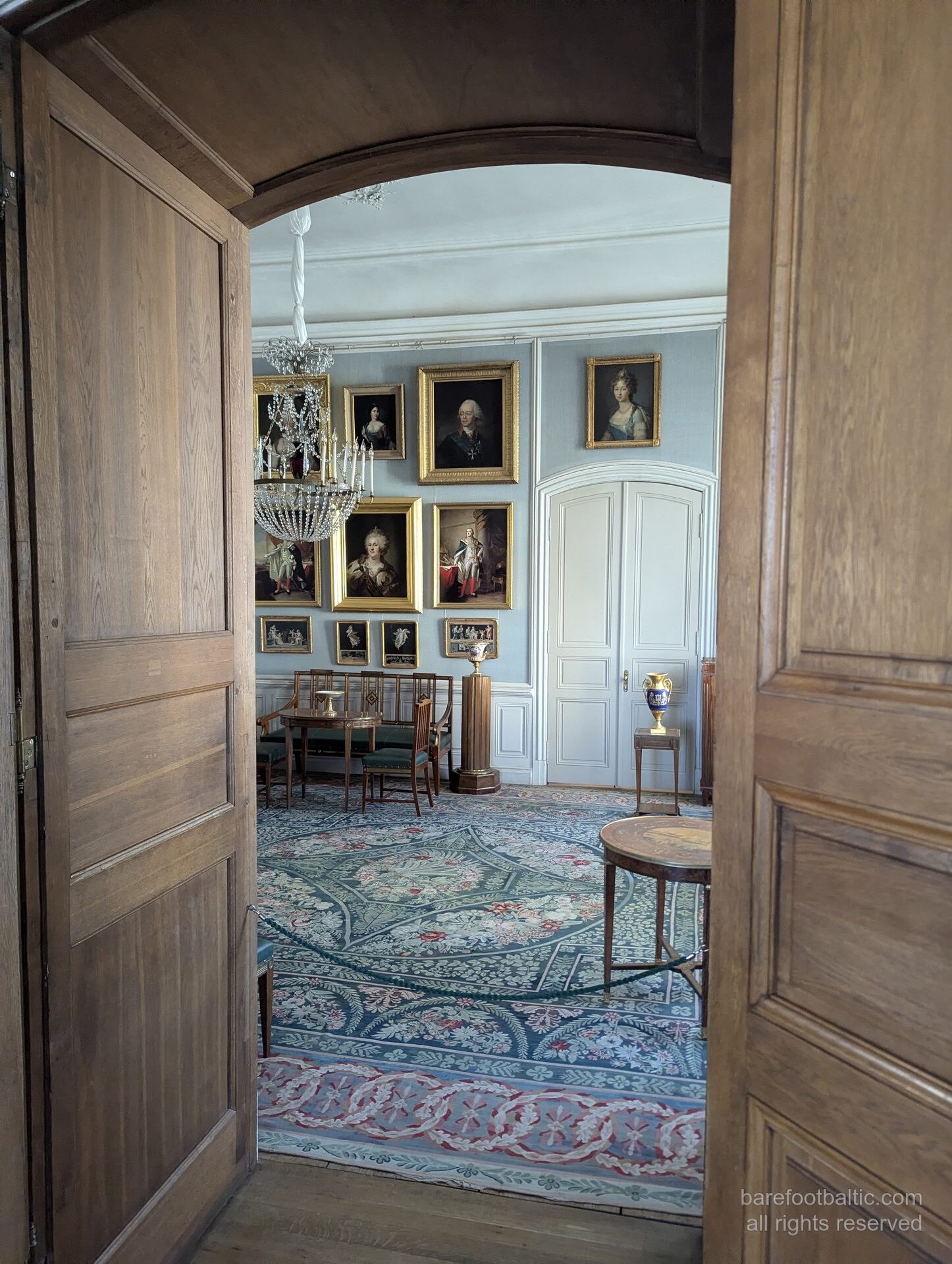
During the Zubov period, the decorative finish of the palace remained unchanged while empty rooms vacated by the Duke were filled with interior items corresponding to the fashion of the era and the tastes of the new owners. In this room arranged as a study, you'll see Count Valerian's favourite type of mahogany furniture with brass slats, a Russian Neoclassicism style. Wooden floorboards are covered with a carpet from the Aubusson Manufactory in France. It was made in the early nineteenth century as a special commission by the Russian Empire.
On the opposite wall, photocopies of portraits of the palace owners the Zubovs, and among them a portrait of their benefactor Catherine the Great, painted by the Austro-Italian artist Johann Baptist von Lampi who worked in St Petersburg. The top row features portraits of the Russian ruling elite at the time, painted by unknown artists. From the stove are portraits of the Grand Duchess of Russia Maria Feodorovna, Empress Catherine I of Russia, and Emperor Paul I of Russia. Above the door is Empress Elizabeth Alexeievna. Next to the window is the Grand Duchess Maria Pavlovna of Russia. A sculpture of Catherine the Great has been placed by the mirror, and under the table, a depiction of her beloved greyhound in marble.
Next, the antechamber of the Duke's state apartments.
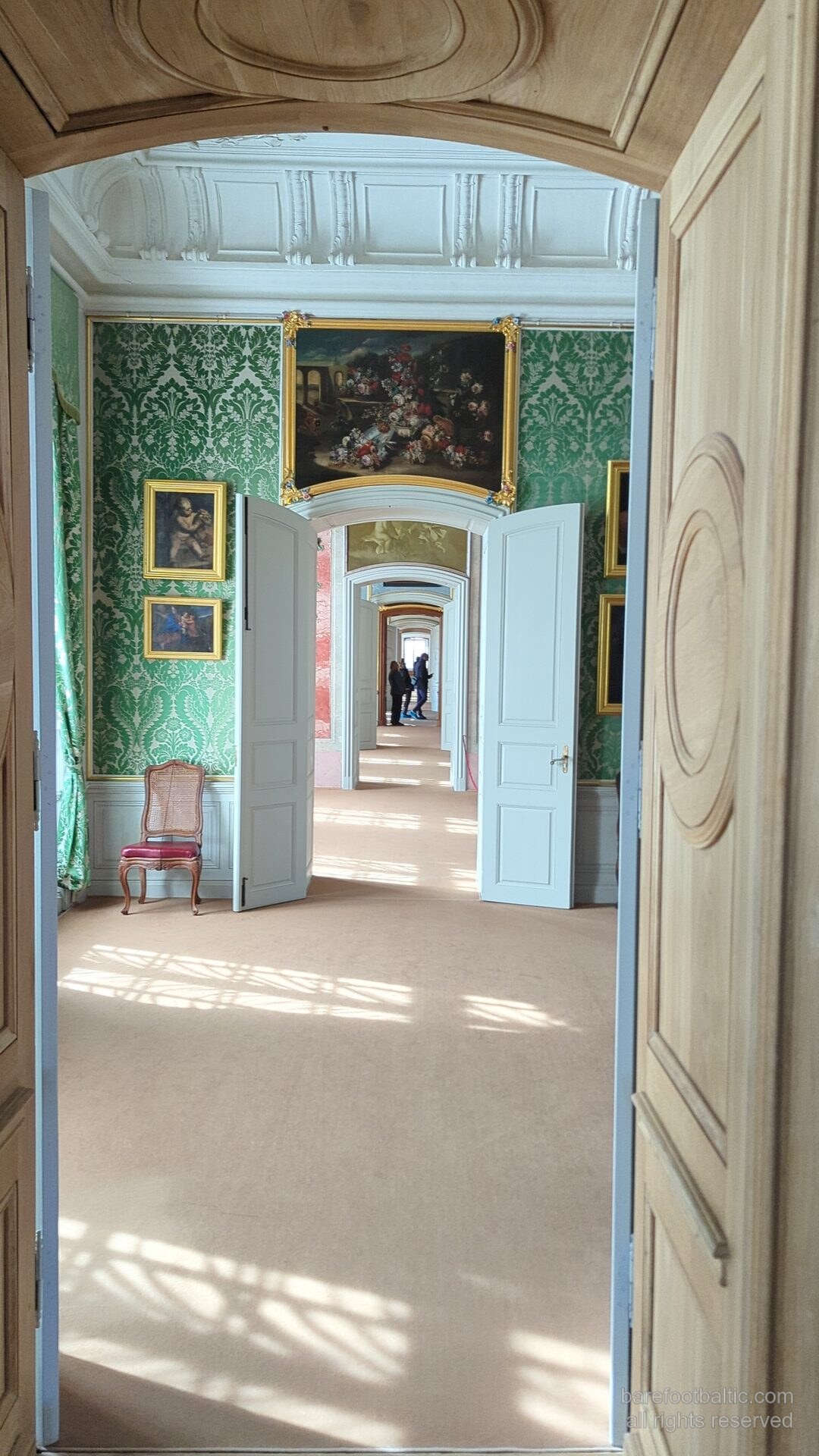
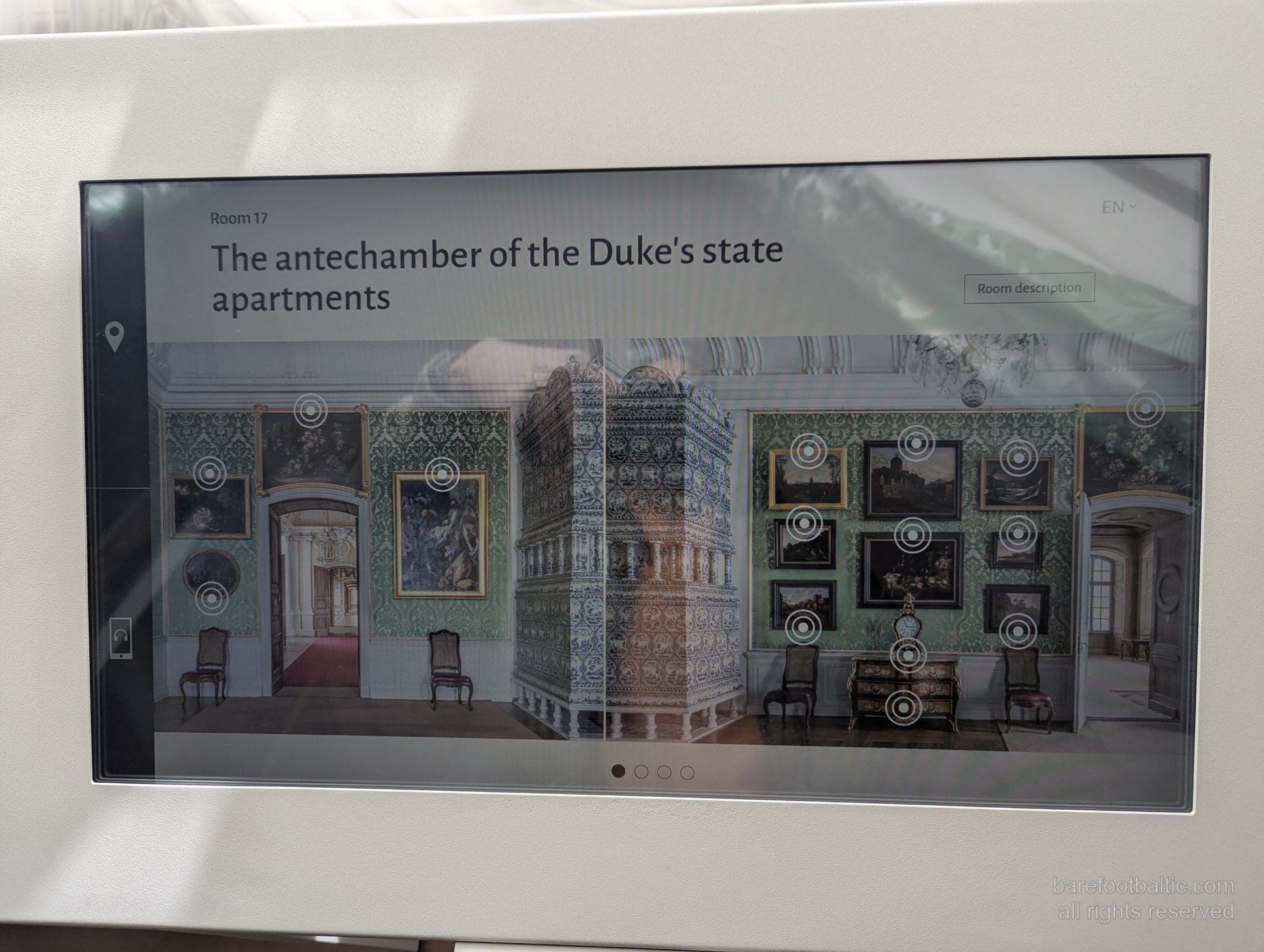
The Antechamber of the Duke's State Apartments
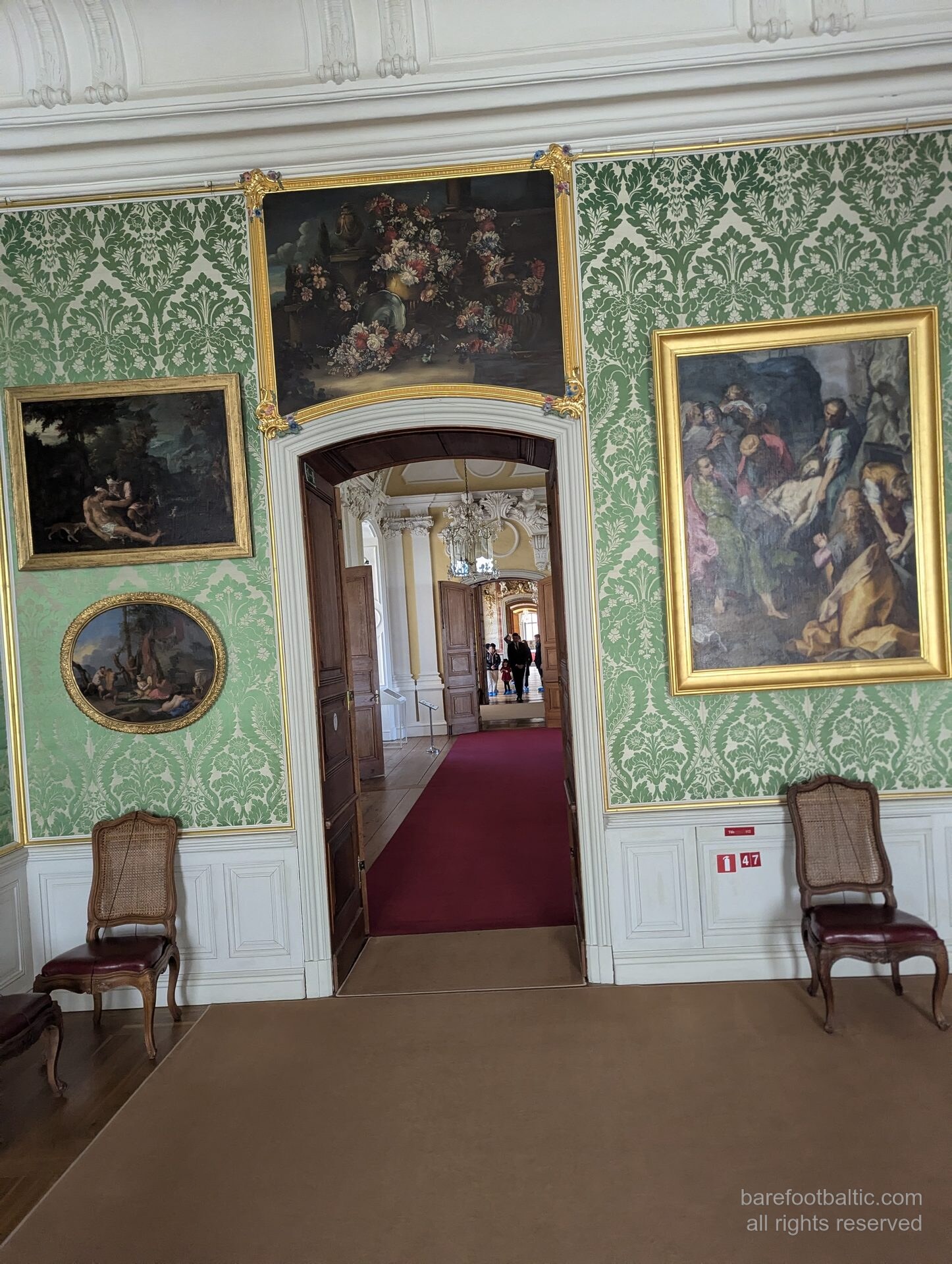
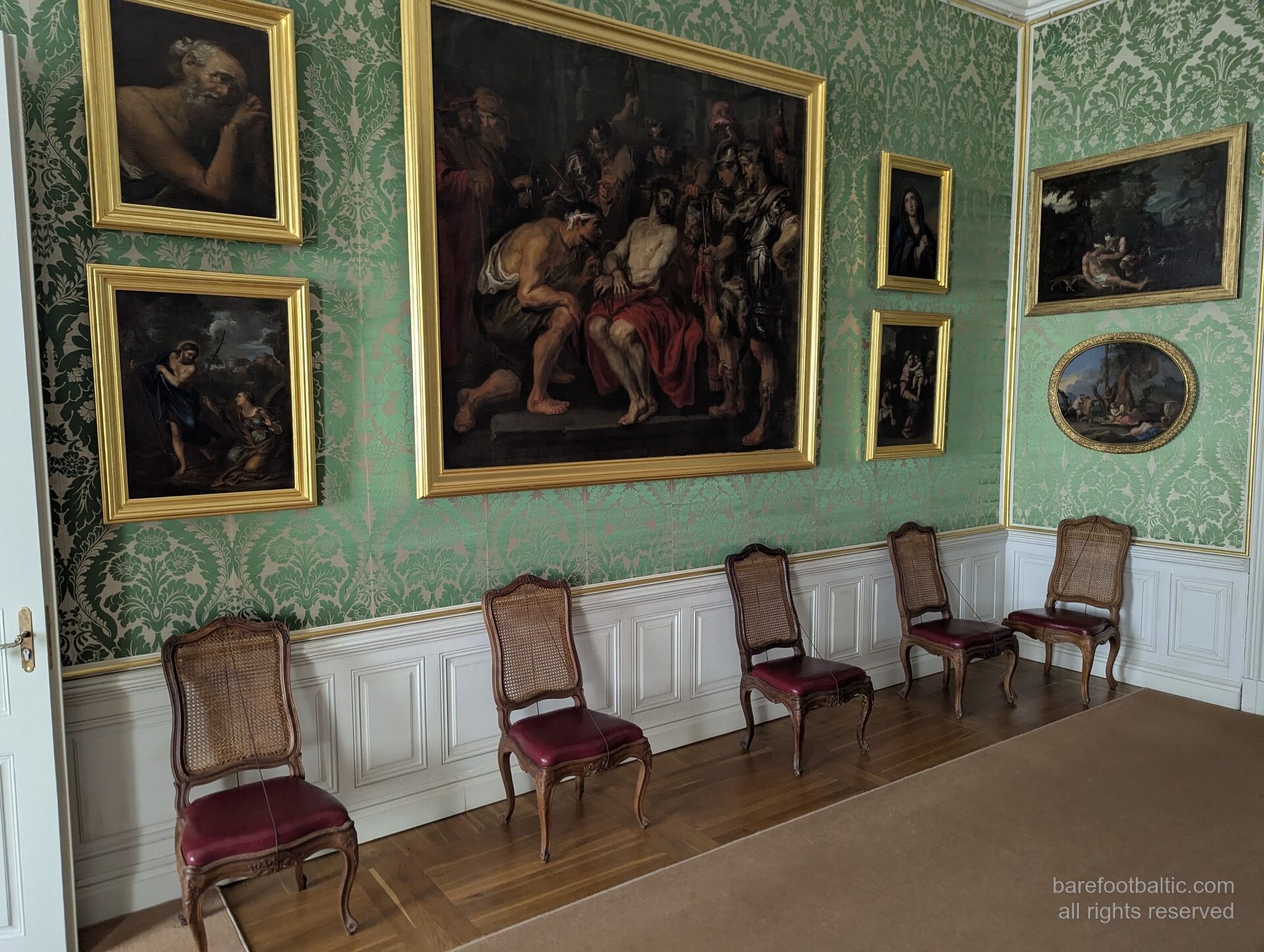
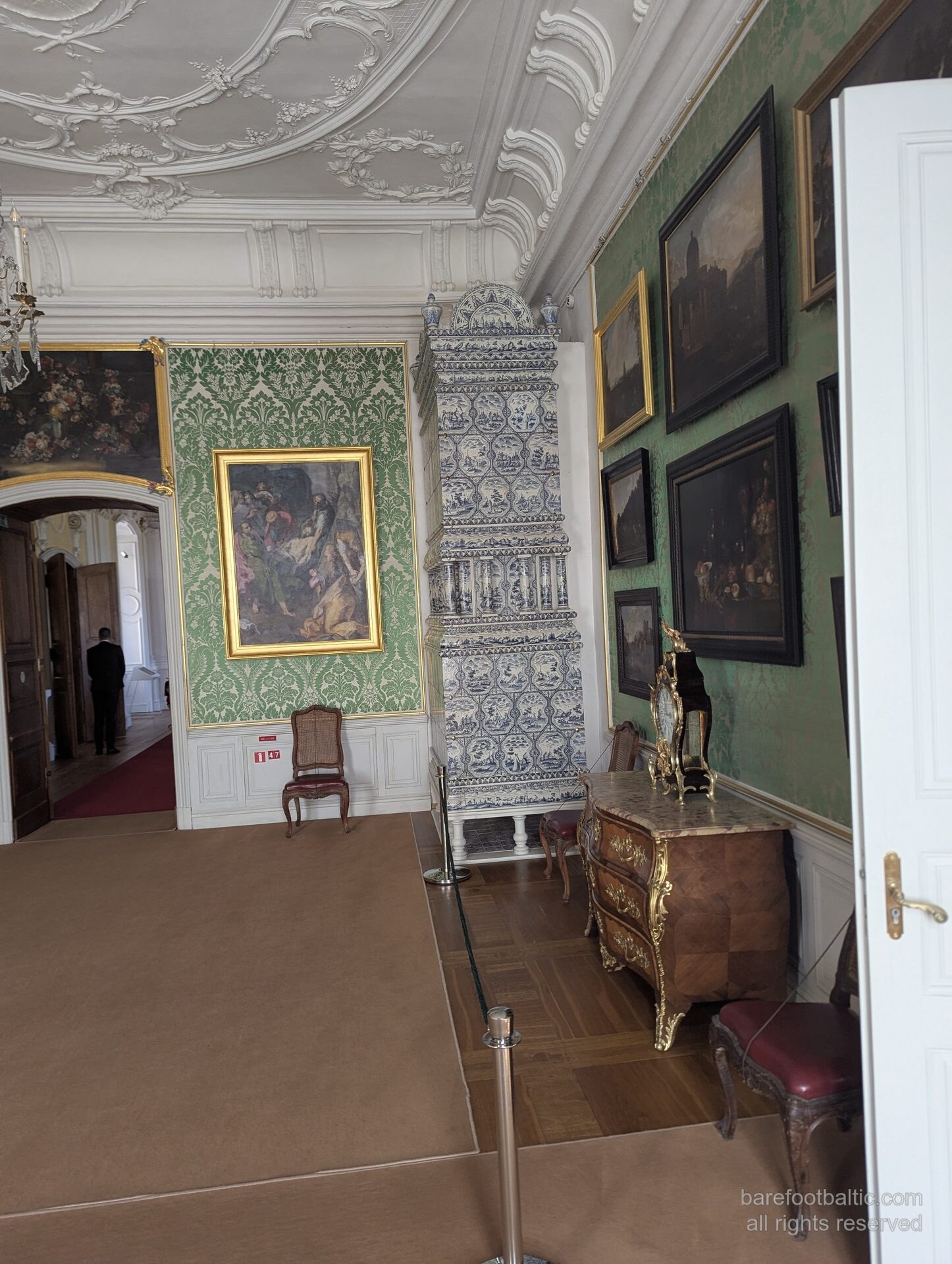
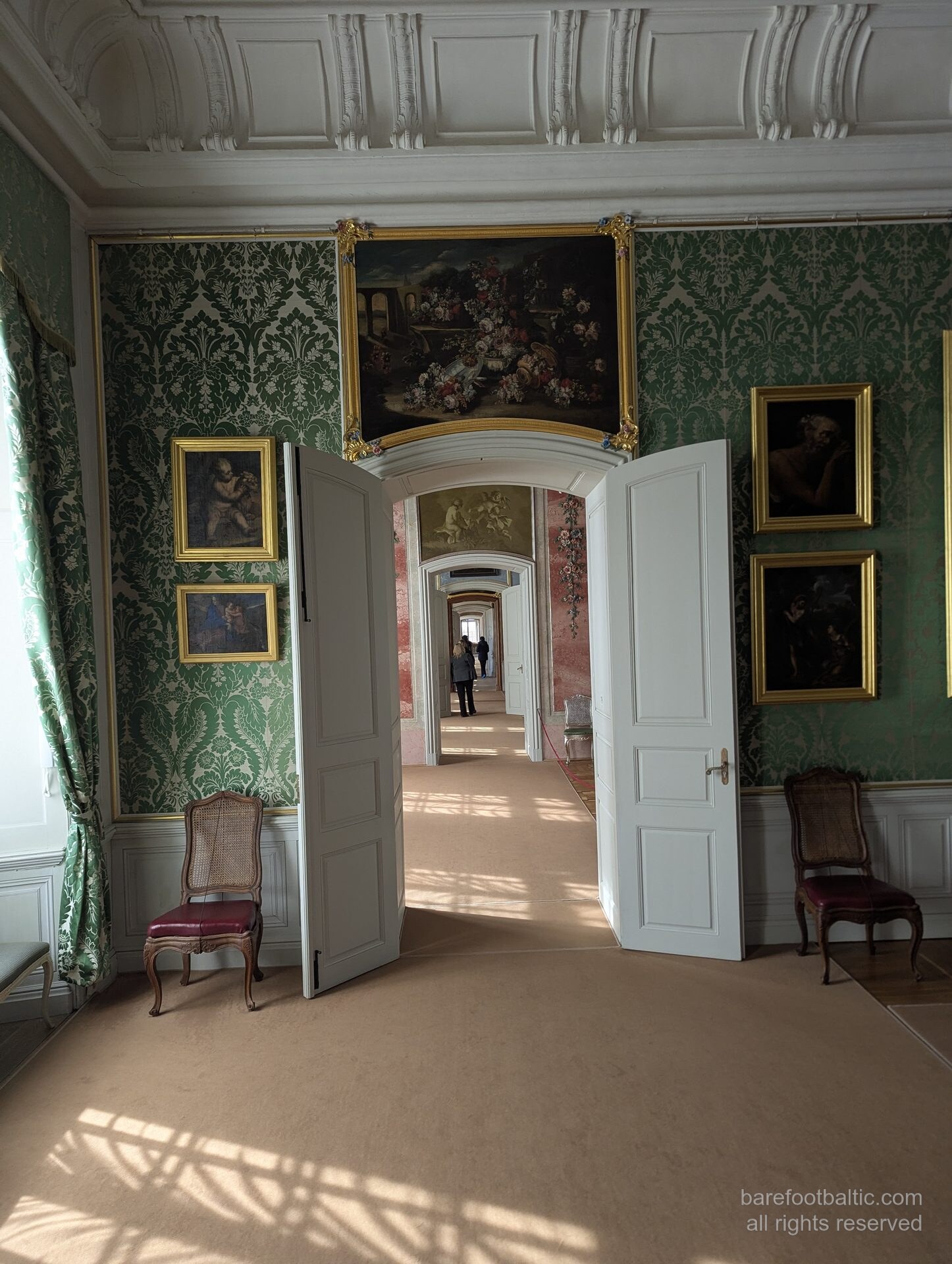
Guests and courtiers lingered here, waiting for a visit to the Duke. The room's finish is at once appropriately solemn and restrained. Its stucco décor, more than elsewhere in Rundāle, exhibits features typical of the early Neoclassicism period, with firmly shaped crowns and garlands of laurel and palm branches. The walls are upholstered with green silk and linen brocatelle, a durable fabric mentioned in descriptions of the palace inventory.
The interior features French Rococo furniture and themed paintings. Look at the Italian paintings first. The large-scale The Descent from the Cross between the entrance door and the stove was created in the sixteenth century in Federico Barocci's workshop. On the other side of the door is Fauns and Bacchantes by the seventeenth-century painter Giulio Carpioni. To the left is a copy of Annibale Carracci's The Holy Family by Benedetto Luti, an Italian painter of the same period.
The opposite wall is dedicated to landscapes, still lifes and genre paintings by seventeenth- and eighteenth-century Dutch and Flemish masters. The standout is Still Life with Fruit, painted in the third quarter of the seventeenth century by the Flemish Baroque master Alexander Coosemans. In the bottom left corner is Joost Cornelis Droochsloot's painting Bustle on the Main Road of the Village, and in the bottom right corner is Farmers Feast by his son Cornelis Droochsloot. Above is a small composition with a church by the prominent Dutch landscape painter Jan van Goyen.
Next, the Duke's Library.
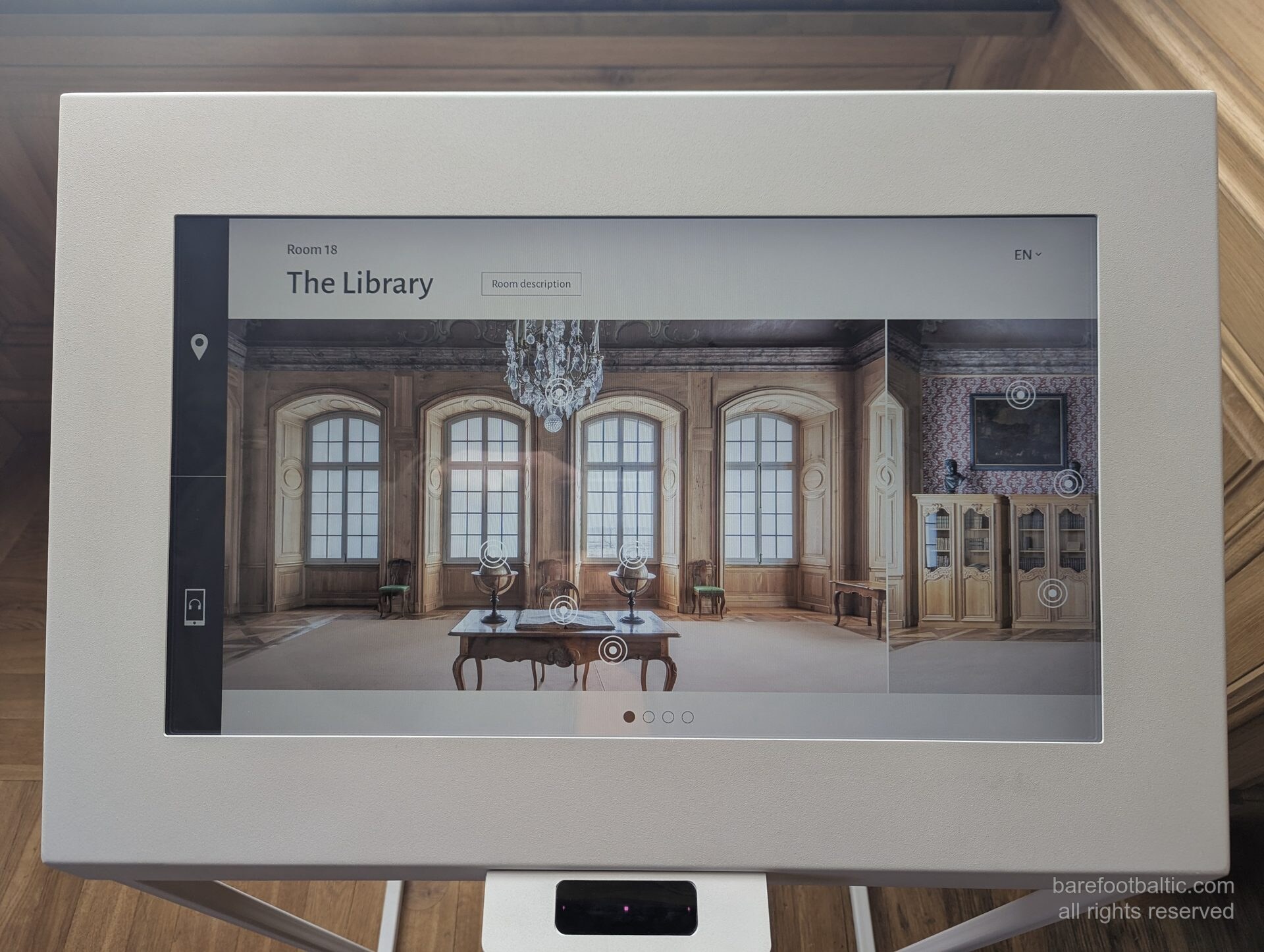
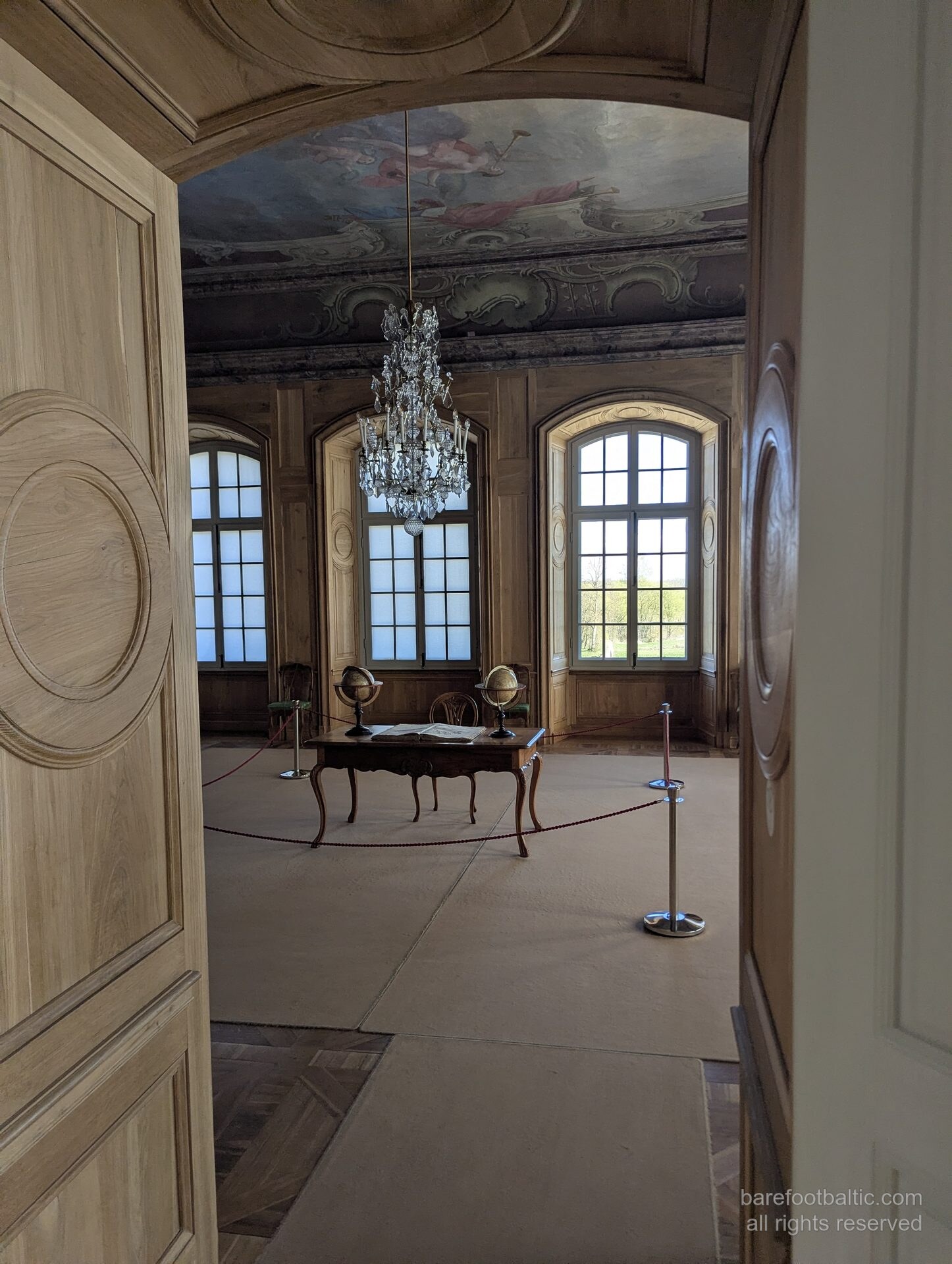
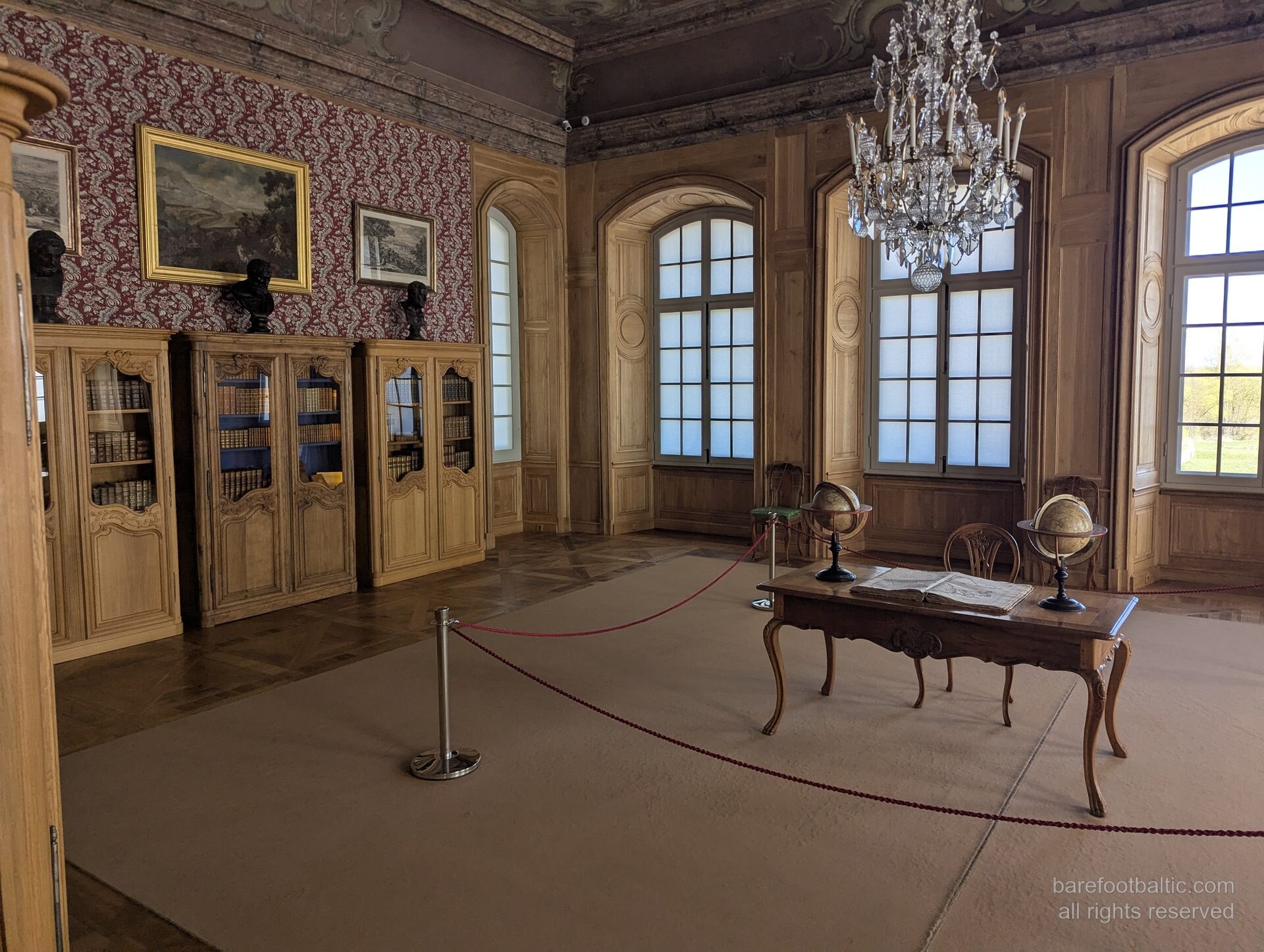
The Library
The Library was set up here in the eighteenth century, although the function of the room changed later.
The allegorical content of the plafond is elucidated by a quote in Latin on the shield in the centre of the painting. Laborem in victoria nemo sentit means "In victory nobody feels endeavour." The shield is supported by an allegorical figure of Victory with Peace and Plenitude depicted next to it. Along the edge of the plafond are depicted the opposites of the central figures. Quarrel carries a burning torch, and Revenge carries a coal pot and bellows inflating the flames of hatred.
The walls are decorated with oak panels, restored according to old photographs, and printed cotton fabric wall-hangings made after an eighteenth-century sample at the Kreenholm Textile Factory in Narva, Estonia. From the library's original furnishings, an oak bookcase has been preserved. It was used as a model for the replicas on view in the room and now stands against the north wall.
The original bookcase contains over a hundred books related to the history of the Biron family library. More than sixty of them are originally from Duke Peter's library at Jelgava Palace. In 1795, part of them were taken to Sagan Palace in Silesia, and later to the Courland princesses Wilhelmine and Pauline. Many of Duke Peter's books are decorated with a golden coat of arms, a sign of ownership, or supralibros.
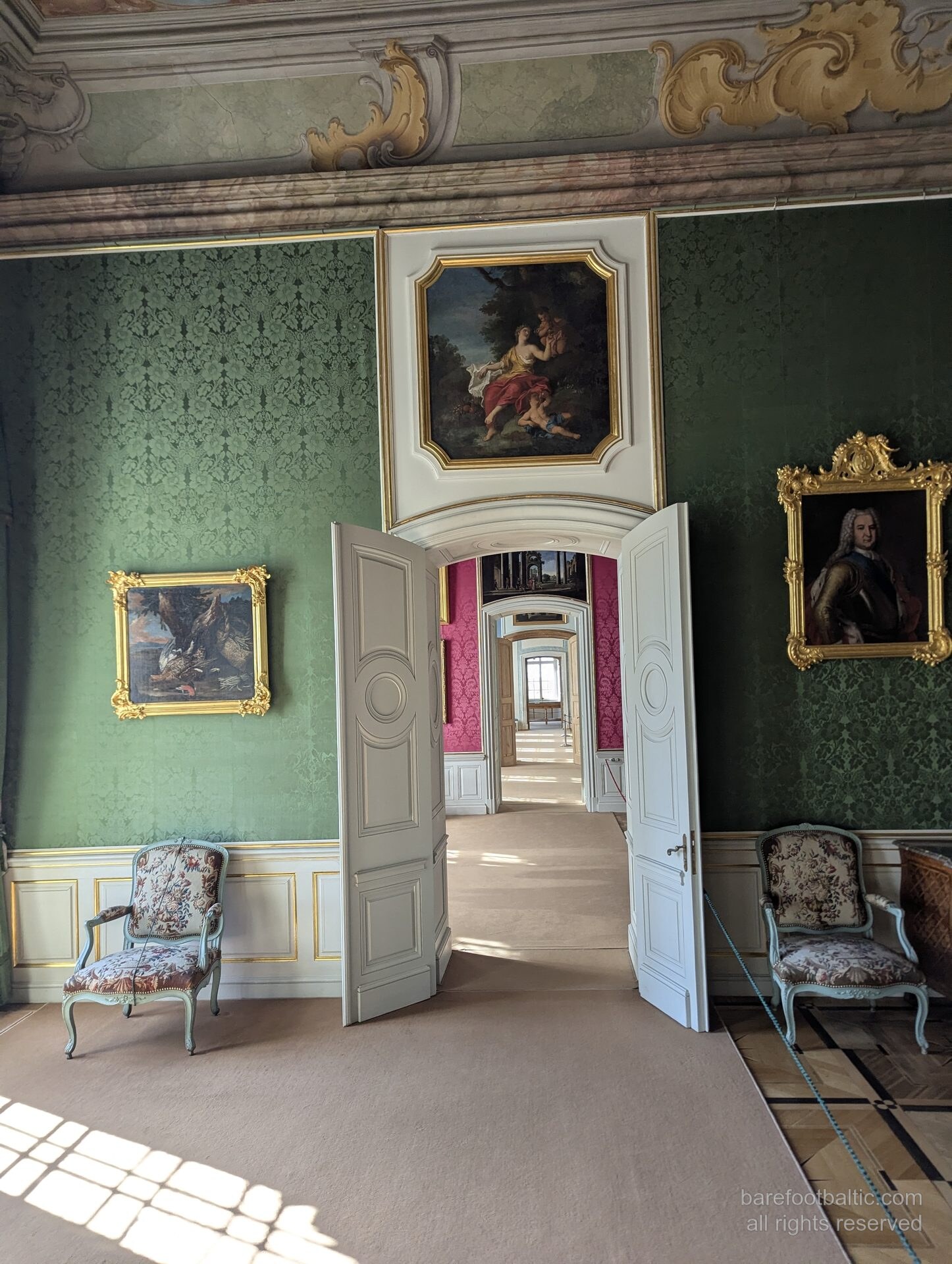
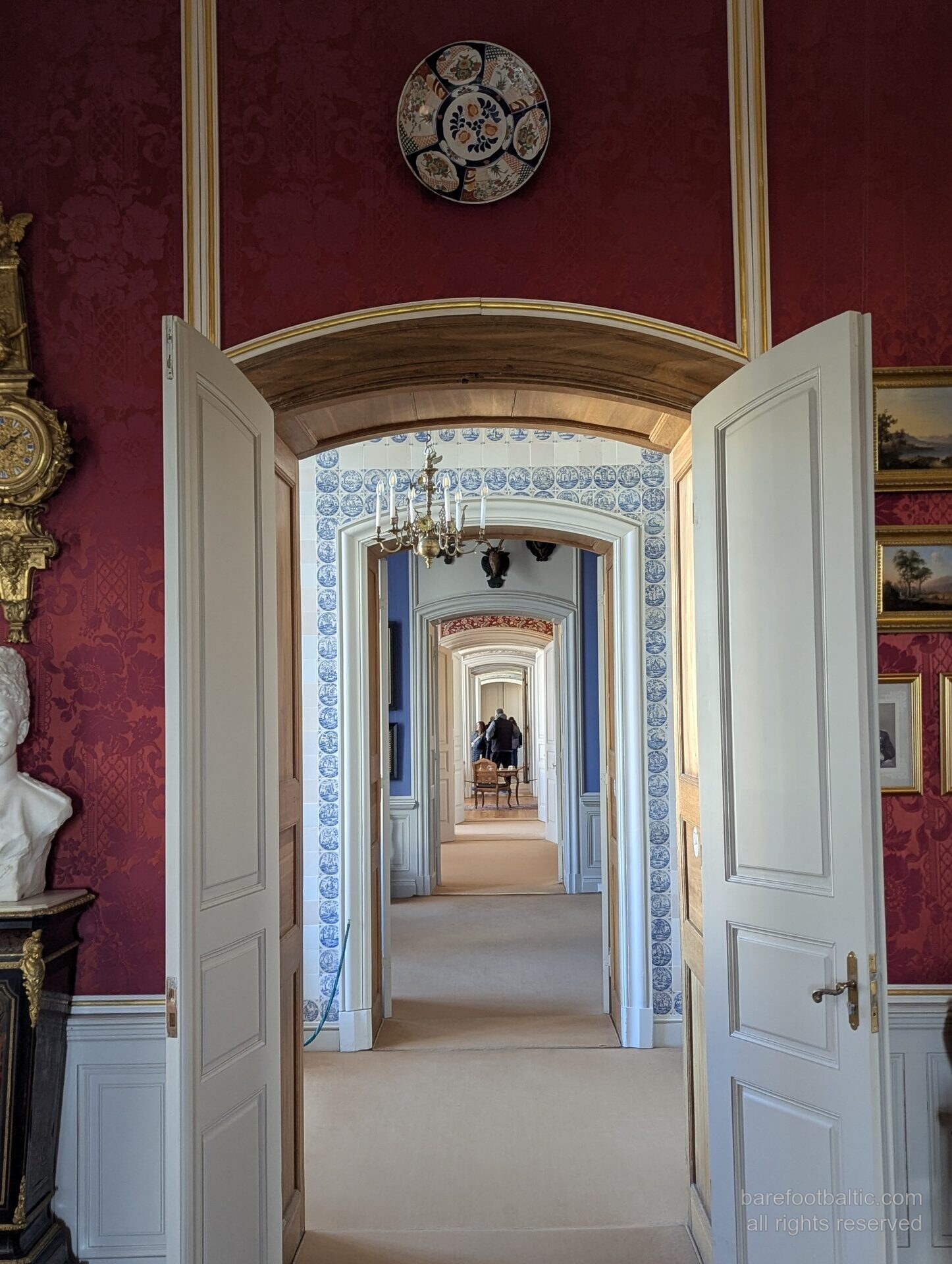
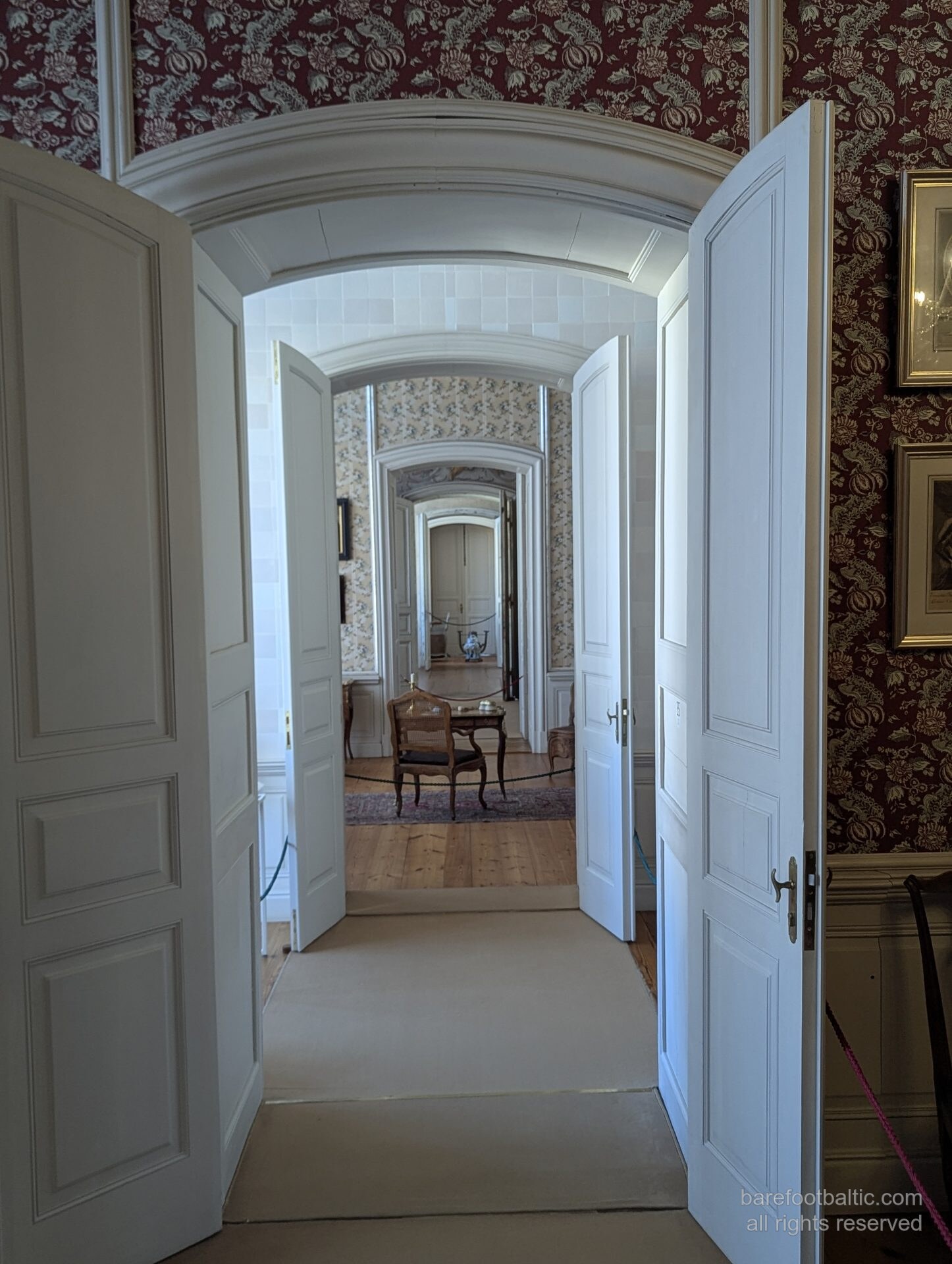
We're now in the eastern end of the central building, and the library door offers a long view of the 86-metre-long row or enfilade of the Duke's state apartments. This arrangement of rooms on one axis is typical of Baroque architecture and creates an effect of infinity with windows at both ends of the enfilade. The luxurious décor is designed to surprise and delight. Contrasting colours have been chosen for the adjoining rooms, silk wallcoverings alternate with stucco marble and colourful ceiling paintings with white stucco decorations.
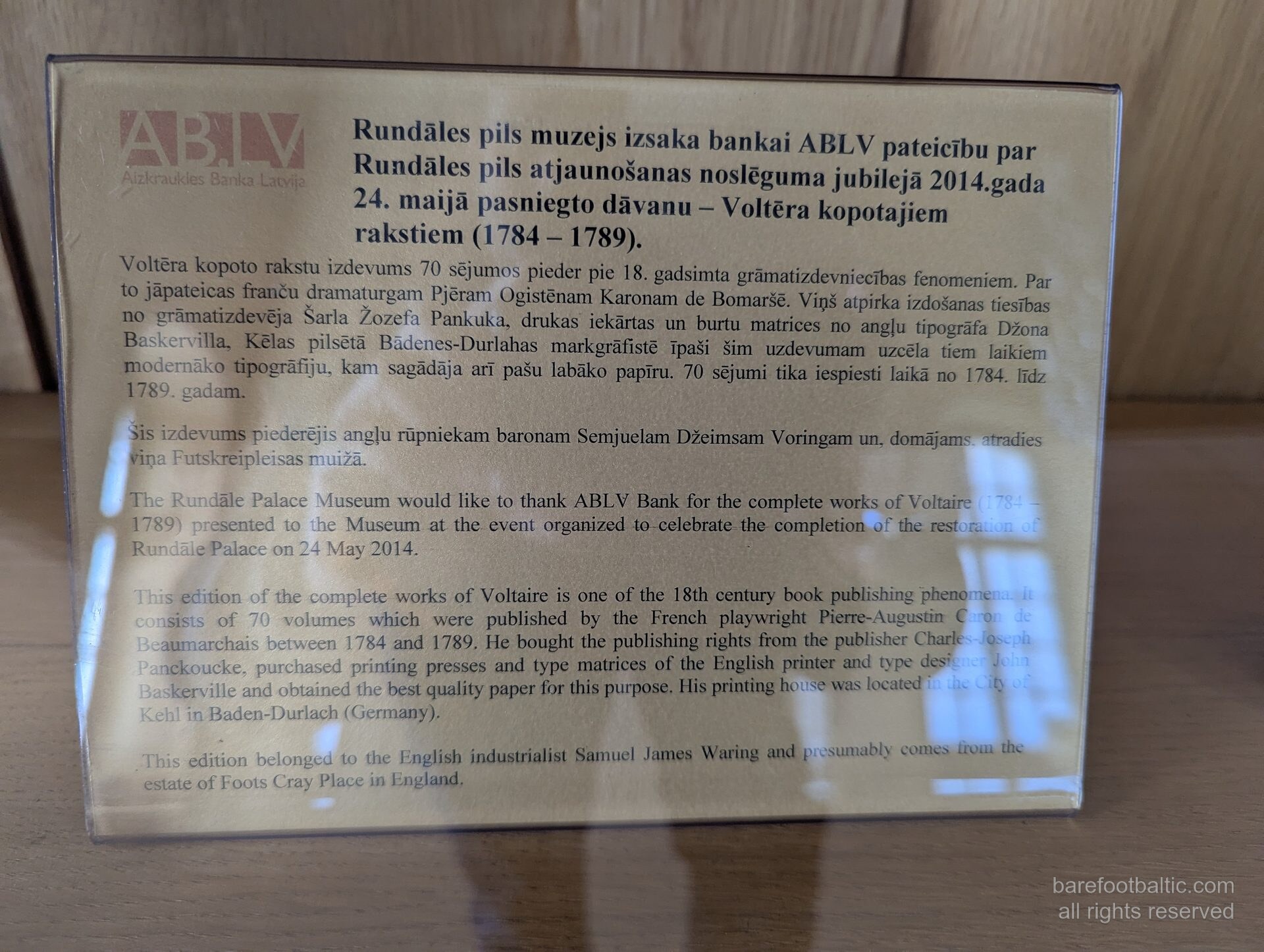
Unfortunately, the fabric wallcoverings were destroyed in 1812, unlike the paintings and stucco decorations, which had survived relatively well until restoration. Exact copies of historical fabrics have been manufactured since 1972 at the scientific restoration workshops in Moscow. The required wallcoverings were woven over 19 years. They include 13 different types and patterns of silk and semi-silk fabrics half a metre wide and almost four and a half kilometres long.
The next room behind the antechamber is the Rose Room.
The Rose Room
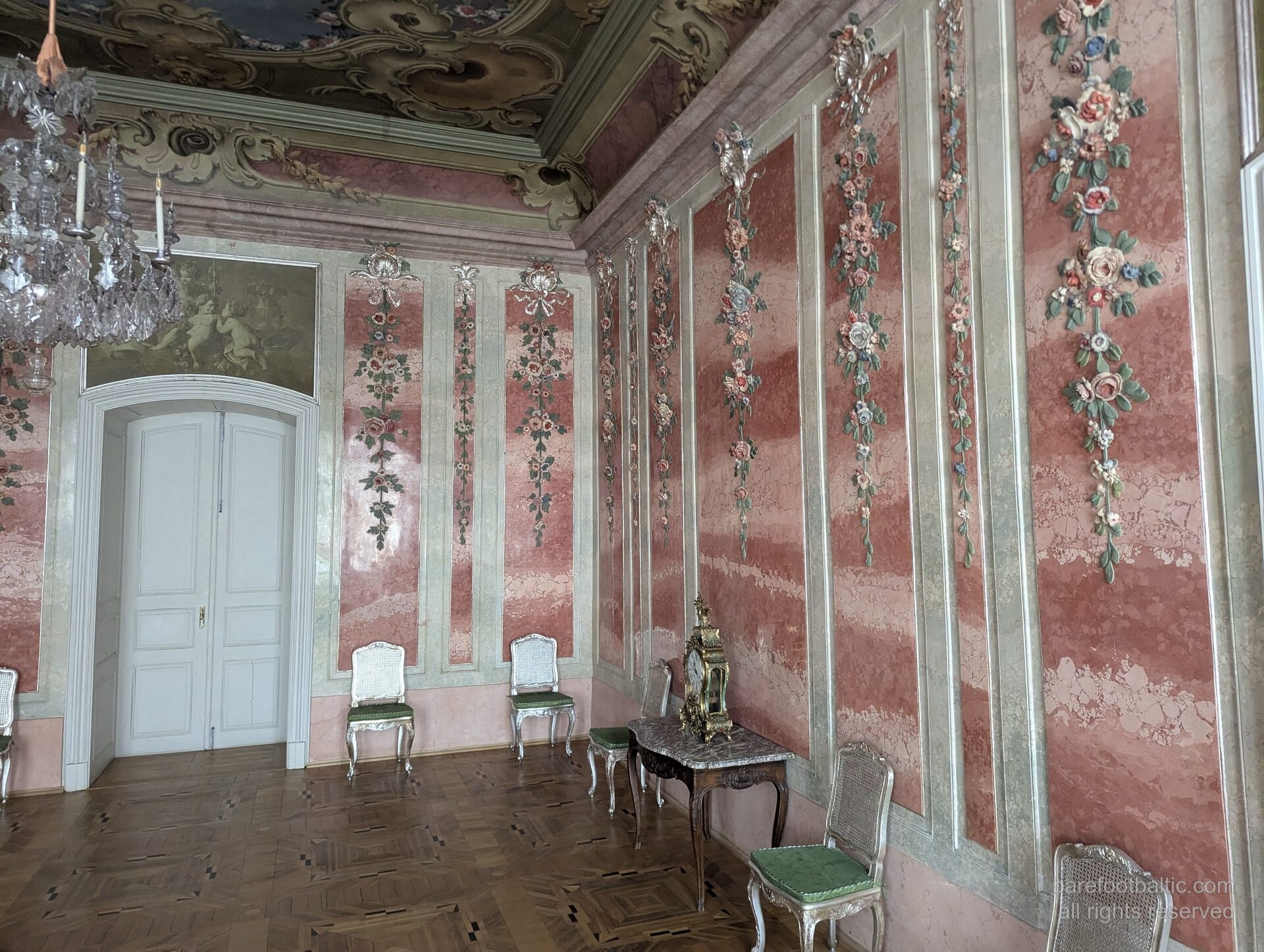
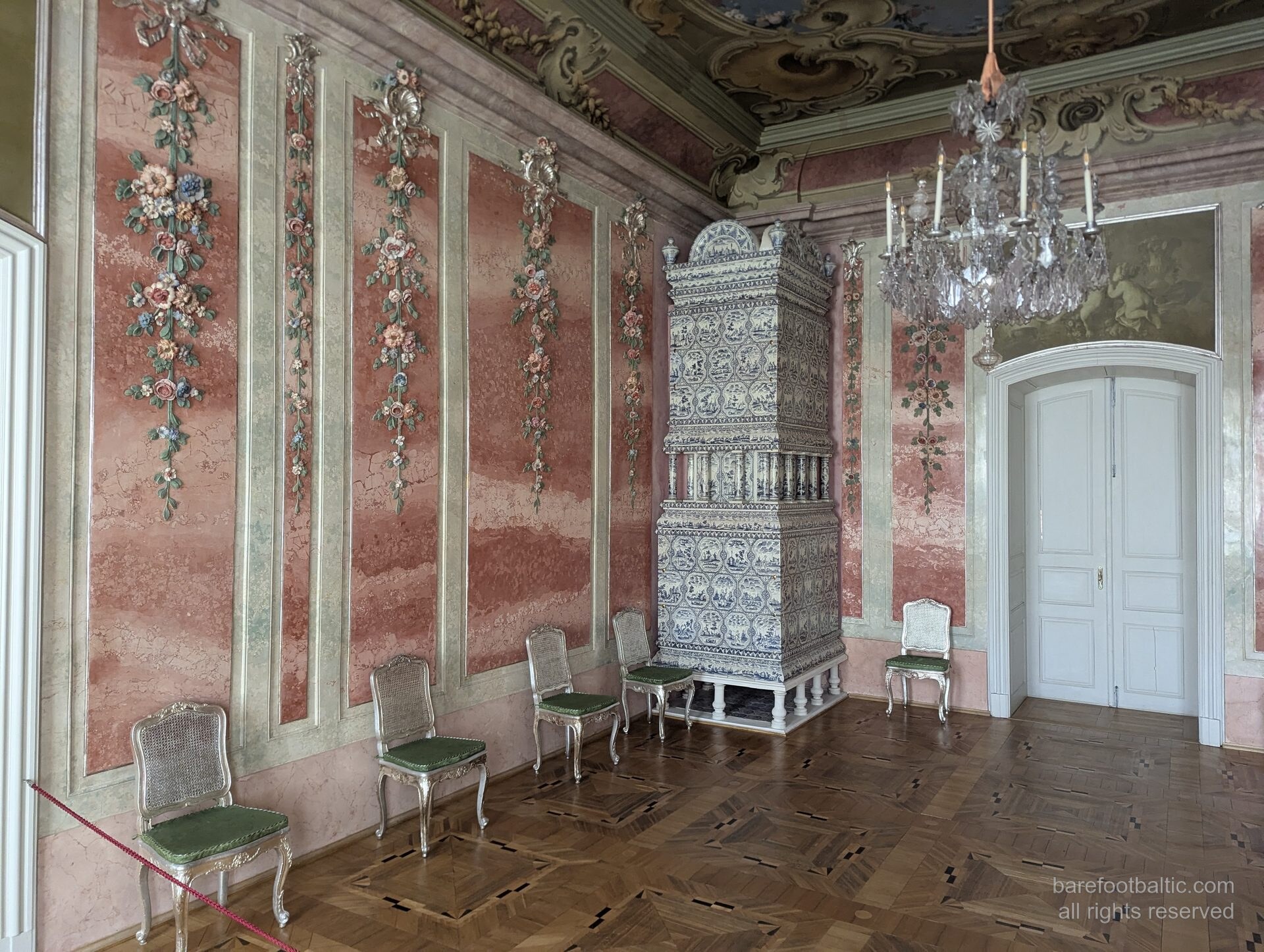
One of the more decorative salons in the Duke's state apartments, dominated by a floral theme.
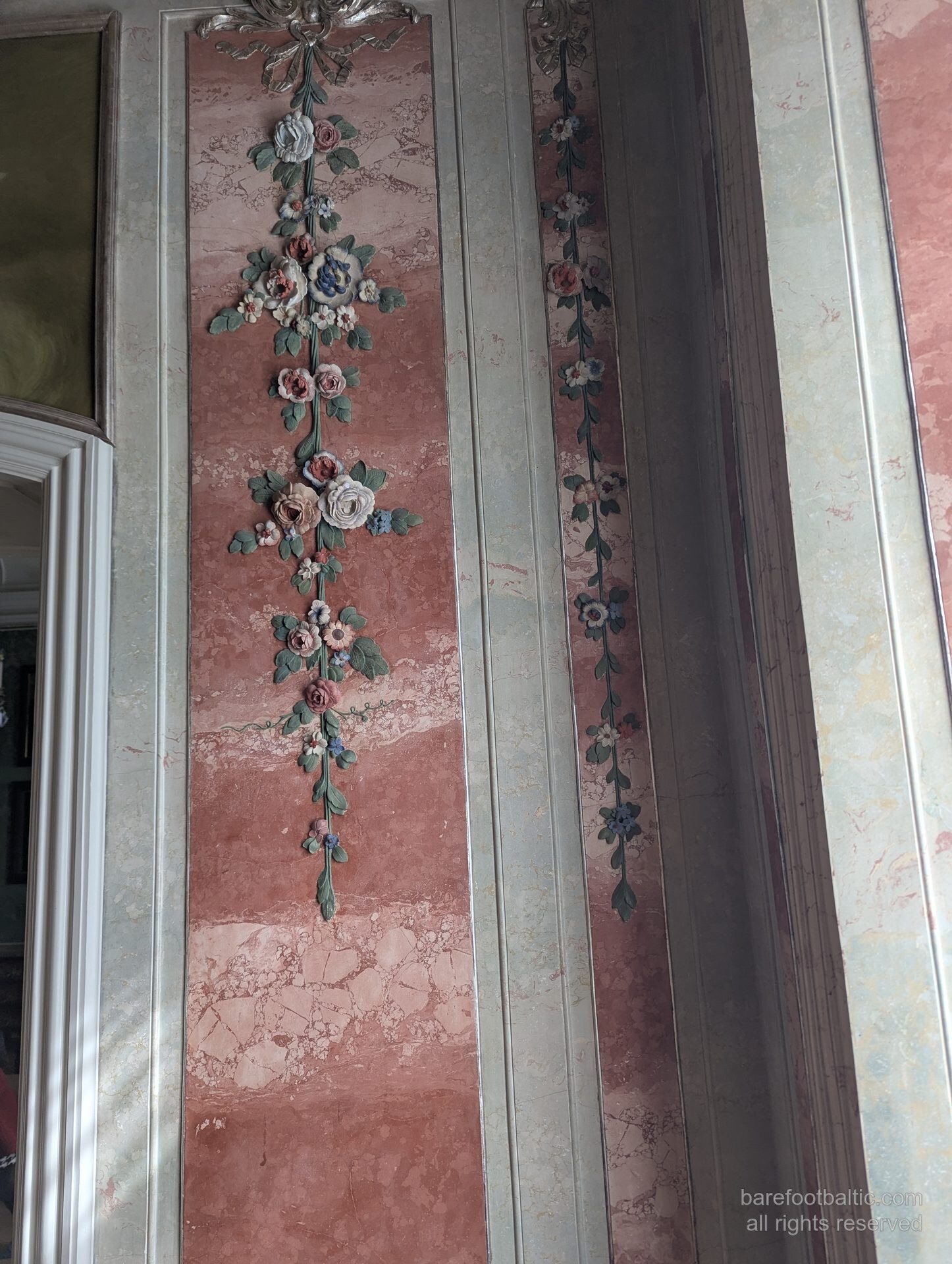
The ceiling painting depicts Flora, the ancient Roman goddess of spring and flowers, and her companions. The wall décor, set on stucco marble, features multi-coloured (polychrome) garlands of roses, sunflowers and anemones. Although the colour of the flowers doesn't correspond to their natural appearance, it perfectly matches the shades of artificial marble. You can note the influence of Rococo palaces in Berlin and Potsdam here. The stucco marble and polychrome flower décor with silver was popular in the family properties of King Friedrich II of Prussia, where sculptor Johann Michael Graff worked before he arrived in Courland.
The parquet flooring should also be remarked on. In this room and in the Duke's State Bedroom, these floors are the only samples that have survived from the first construction period of Rundāle Palace, testifying to the splendour of wooden décor intended by Rastrelli. The parquet was made in the workshop of joiner Johann Baptist Eger in 1738 and 1739, from oak, black oak, walnut, palm and maple wood.
The silver French Rococo style chairs and the console table below the trumeau mirror match the décor. The chandelier with a tinned metal frame and cut crystal glass pendants is one of the few variants of French type chandeliers made in Latvia. Its fragments were found in Jamaiķi Church in Courland and restored in the Museum by reproducing the missing parts.
Next, the Dutch Salon.
The Dutch Salon
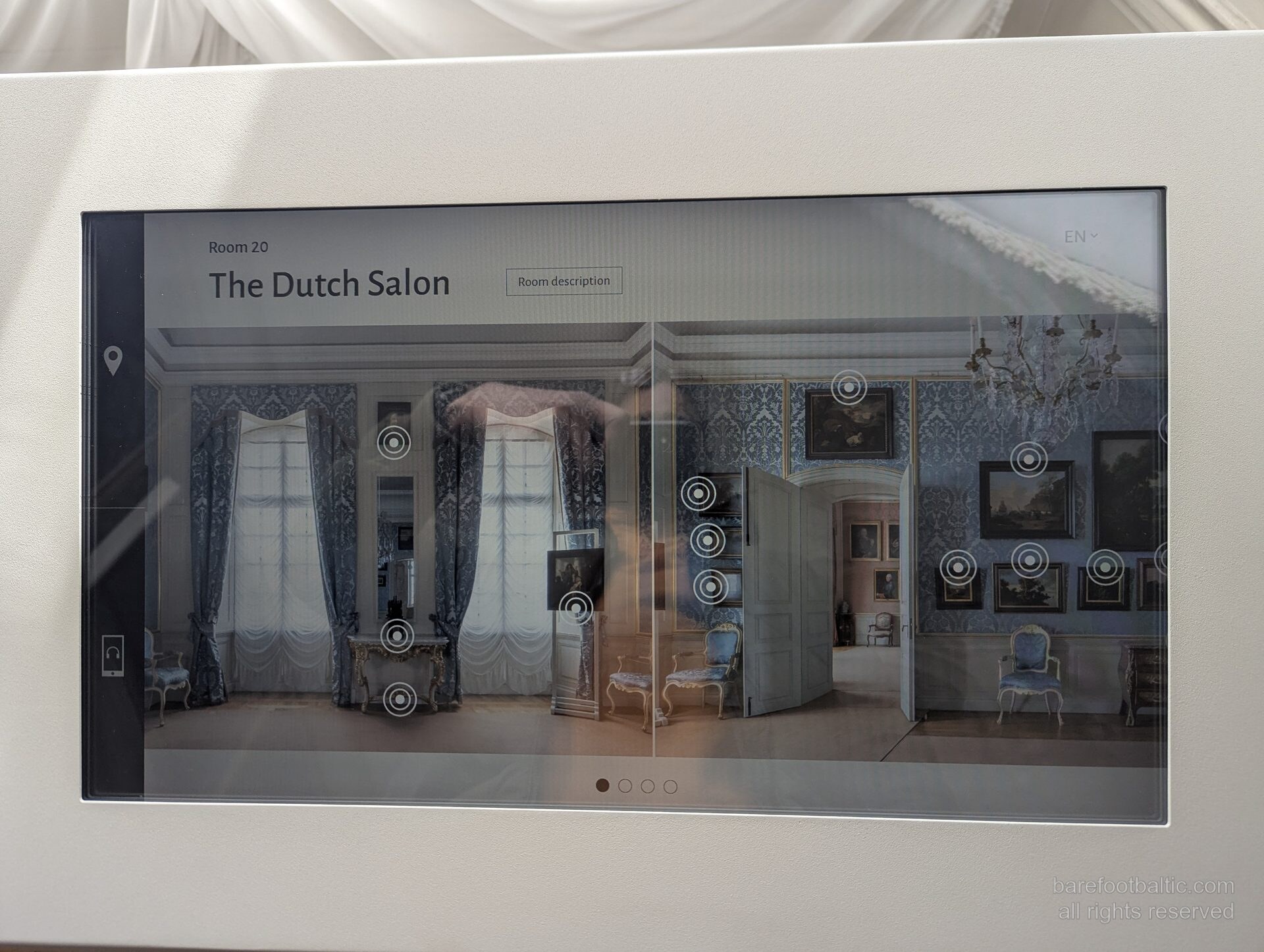
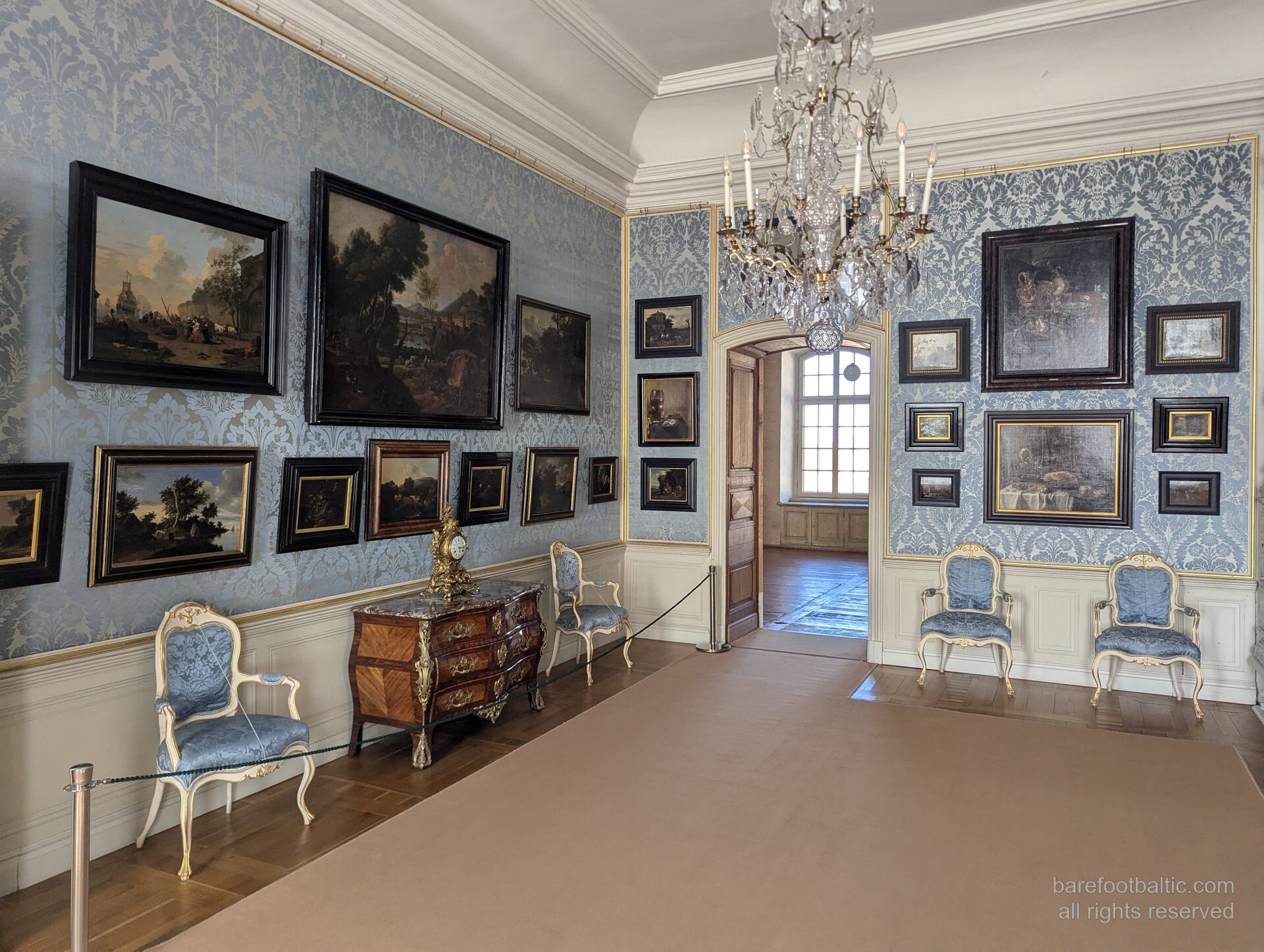
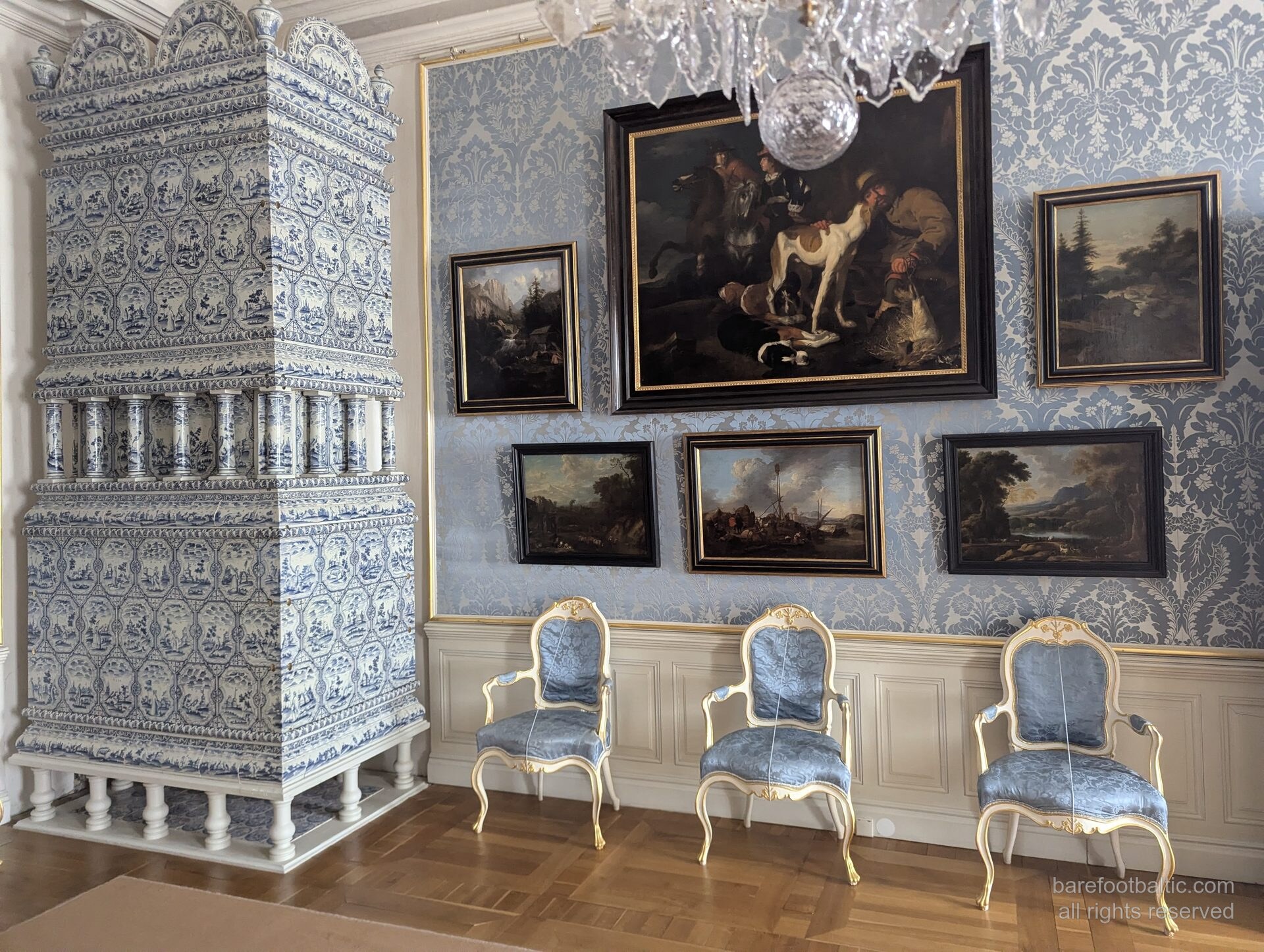
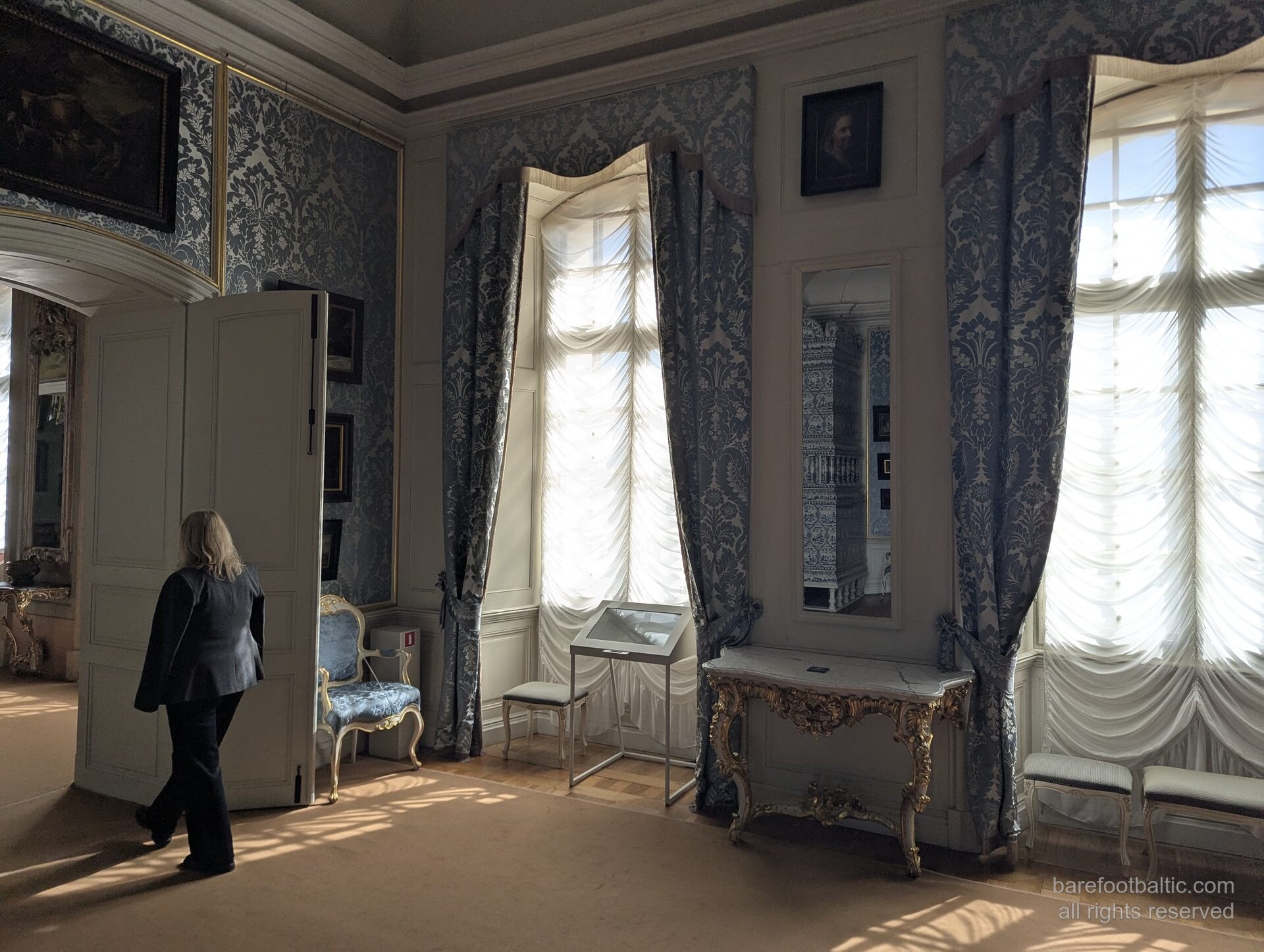
This room, once a salon or guest room of the Duke, now houses a collection of Dutch Golden Age paintings (seventeenth century).
It echoes the art collection of Duke Peter, which in the second half of the eighteenth century was the most outstanding collection in the territory of present-day Latvia. After the annexation of the Duchy of Courland and Semigallia to the Russian Empire, the collection was transported to Sagan Palace in Silesia, later divided among the heirs and partially sold.
Johann Bernoulli, a Swiss scientist from Berlin, wrote this after visiting the Duke's palaces in Jelgava and Svēte. "This sovereign has a couple of other summer residences, which are highly praised, especially one of them, Rundāle where he has commissioned a magnificent painting gallery, mainly of the works by Dutch masters."
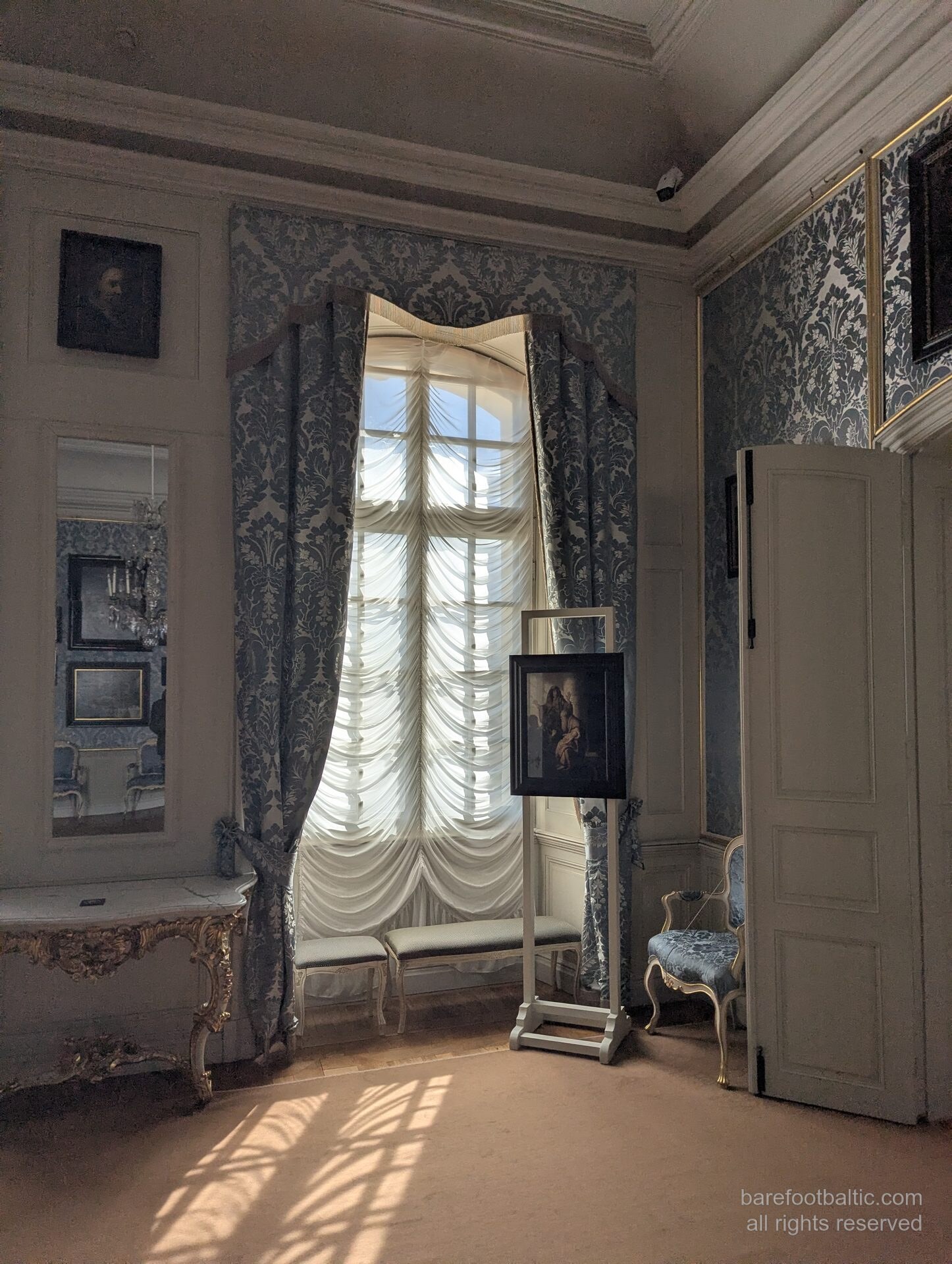
Here, displayed on the easel by the window, is a photo reproduction of the painting Simeon and Anna in the Temple by the outstanding Dutch artist Rembrandt van Rijn, yet once the original painting, which the Duke had bought at an auction in Amsterdam in 1777, was exhibited in the palace. It remained in the property of the descendants of the family until the middle of the nineteenth century and now belongs to the Hamburger Kunsthalle in Germany.
The seventeenth-century art market in the Netherlands was very active. Many painters, called the Lesser Dutch Masters, created still lifes, landscapes and genre paintings. Their works were widely represented in the collection of Duke Peter and now form part of Rundāle Palace Museum's collection. In the centre of the wall opposite the window is Still Life with Ham by Willem Heda, one of the so-called "breakfast scene painters", and Meindert Hobbema's Stormy River Landscape with a Tower. To the left of the door is the outstanding Still Life with Bread and a Glass by Pieter Claesz, while to the left in the bottom row, next to the commode and above the chair, is Jacob van Ruisdael's Landscape with Cattle. The exact list of all the artists represented in Duke Peter's collection isn't known. The Museum has, however, managed to acquire works by artists named in historical sources, such as Hobbema, Neefs and Ruisdael.
The chairs in the room, bearing the monogram of Duke Peter of Courland on their backrests, are rare examples of Rococo-style furniture made in Courland. They were crafted for the Duke's box at Sāti Church.
To the right, we find a room with plain floorboards that haven't been restored. Why? The name of the room answers that. It is the Room for the Palace History Studies.
The Room for the Palace History Studies
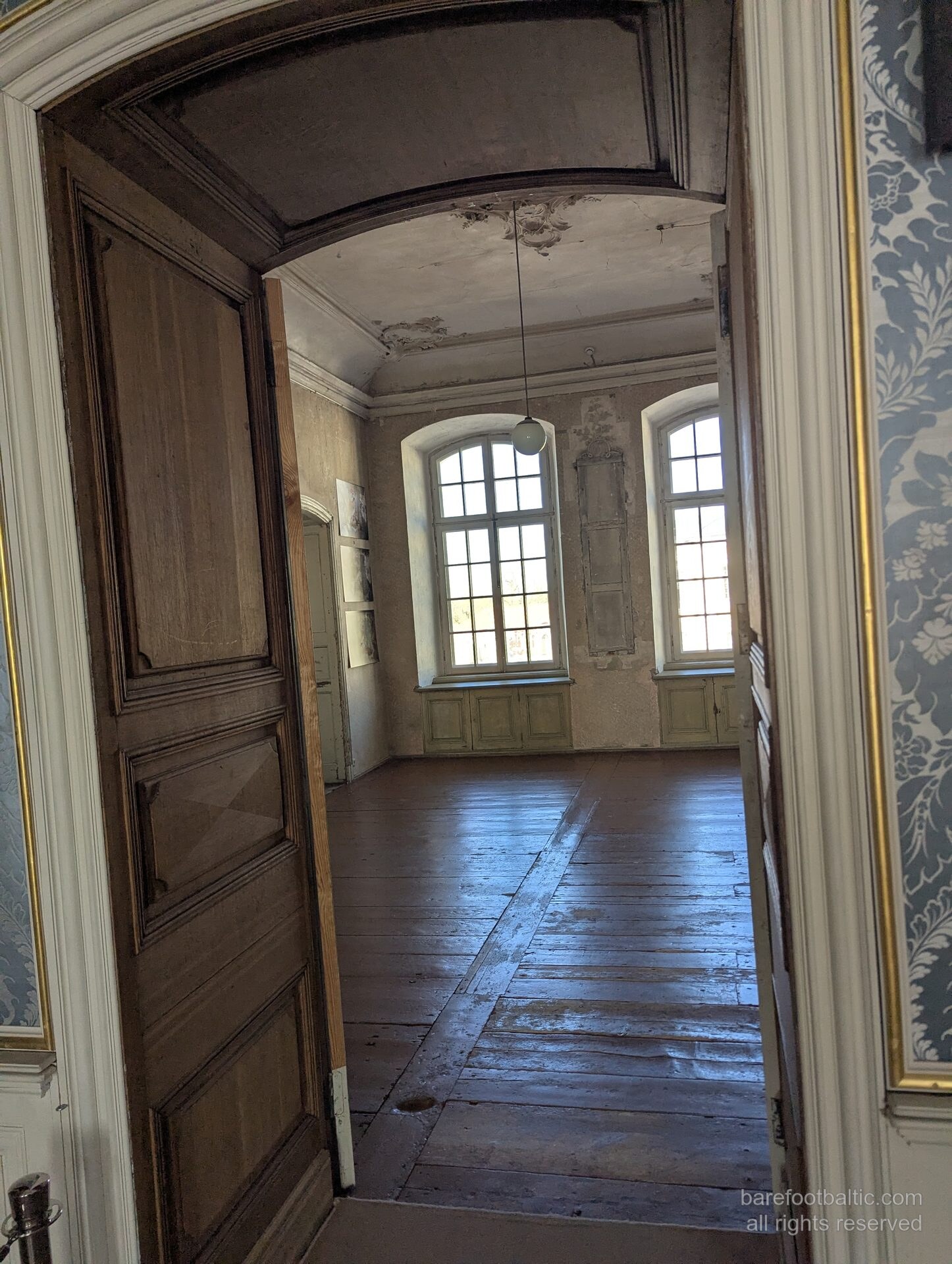
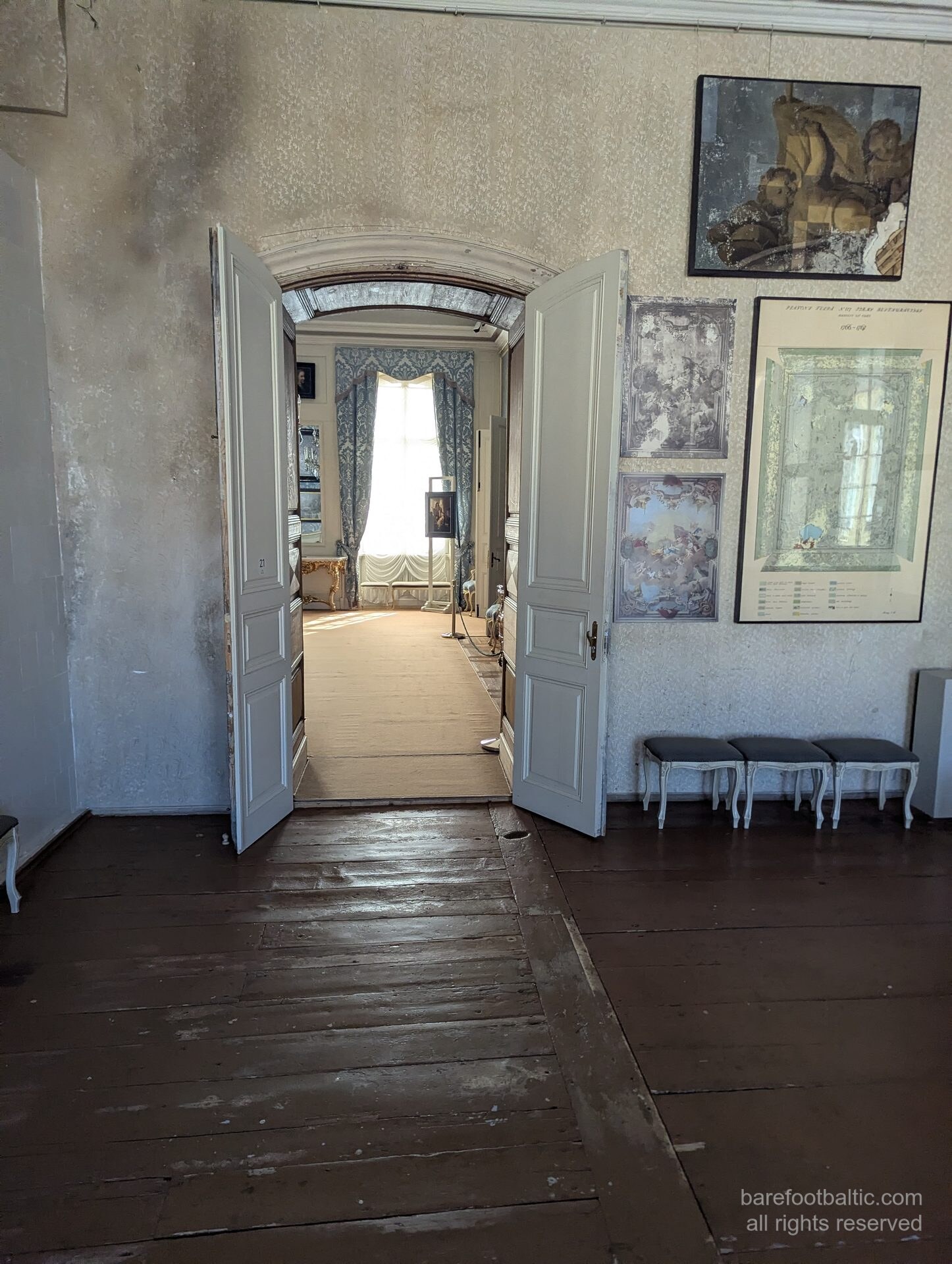
This room in the Duke's private apartments, parallel to the state apartments we've just visited, has been left in the condition it was found before restoration.
Its stucco décor has been preserved relatively well, with most losses in the lower part of the trumeau mirror. However, multiple layers of whitewash interfere with the perception of the quality of the décor when repairs were carried out while the premises were still managed by the school. Some fragments of wall panels, which still existed at that time, were used to create wall cabinets under the windows. As in the other rooms of the Duke's private apartments, there is glued double-width wood plank flooring, which at first was waxed and later regularly painted. A white-glazed tile stove for the needs of the school was built in. The door leaves have been worn out from frequent use.
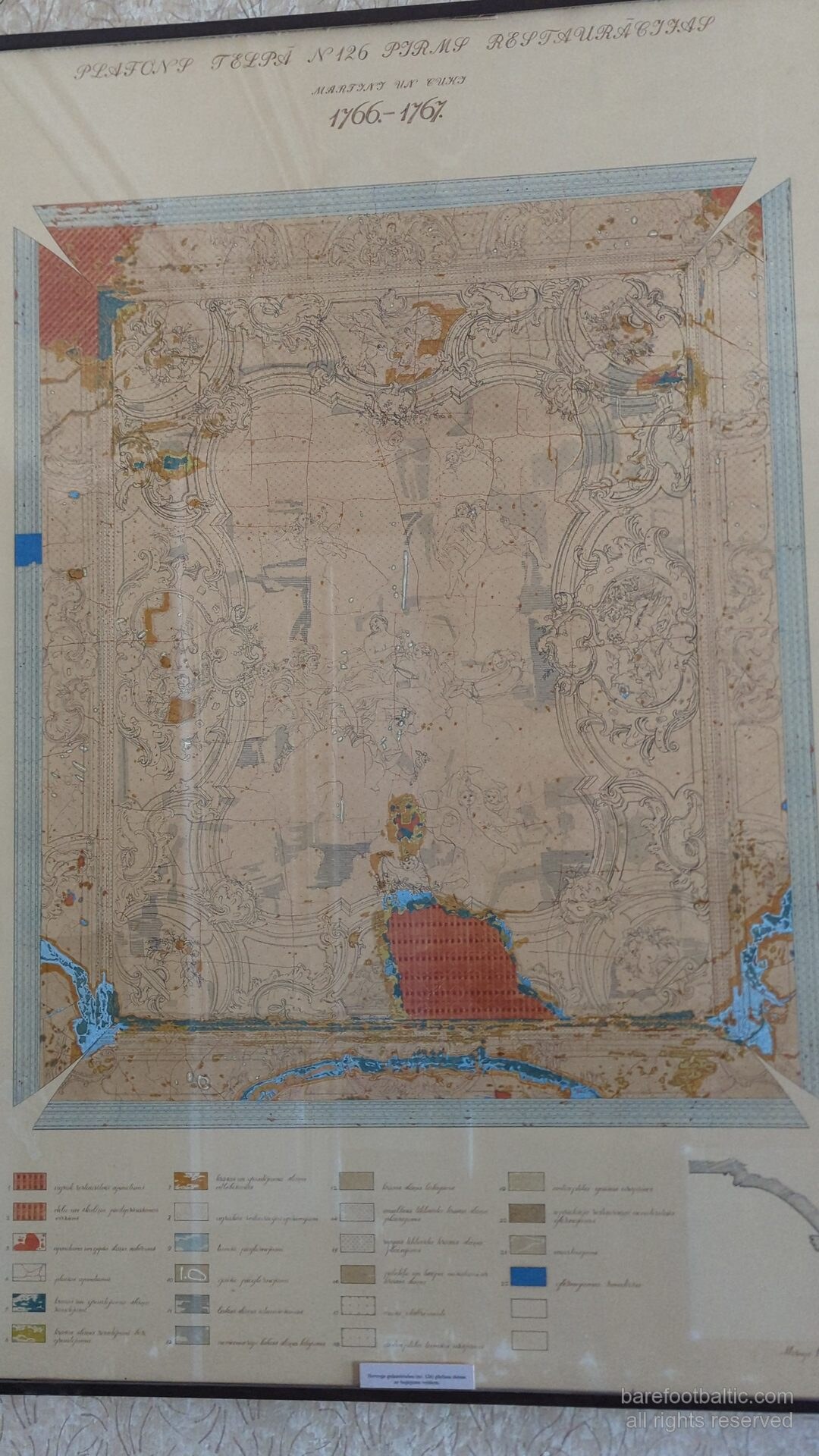
This room is included on the visitor route specifically as a teaching aid. To give an idea of the palace restoration processes, large-format photographs and restoration condition documentation schemes are displayed. They illustrate the condition of ceiling paintings in seven rooms before and after restoration, allowing you to assess the level of preservation and see the lost areas.
The biggest damage was caused by the leaking roof. However, in general, Rundāle has been well preserved. There are a few reasons. Since the time of the Duchy, the palace had been inhabited and used only temporarily, so no significant reconstruction has taken place. Wars caused most of the damage. In 1812, wallcoverings were torn off and the mirrors shattered, which were not restored later, and the mirror frames in several rooms were chiselled off and the walls were repainted. The next demolition was in 1919, when the soldiers of the Bermondt-Avalov Army destroyed part of the wooden panels and demolished three stoves. The use of palace premises for school purposes from 1921 onward had the greatest impact on the Duchess's apartments in the west wing. In 1934, the wood-carved staircase in the centre of the wing and several walls were demolished to create an assembly hall, and ceiling decorations of the Duchess's Toilet Cabinet were dismantled. However, the renovations carried out for the school requirements partially ensured the overall maintenance of the building for more than 50 years. The school moved to new premises in 1979, vacating seven rooms in the central building and the entire west wing, which freed it for the Museum's exhibitions.
Behind the door, to the right, is the antechamber of the Duke's second toilet-room.
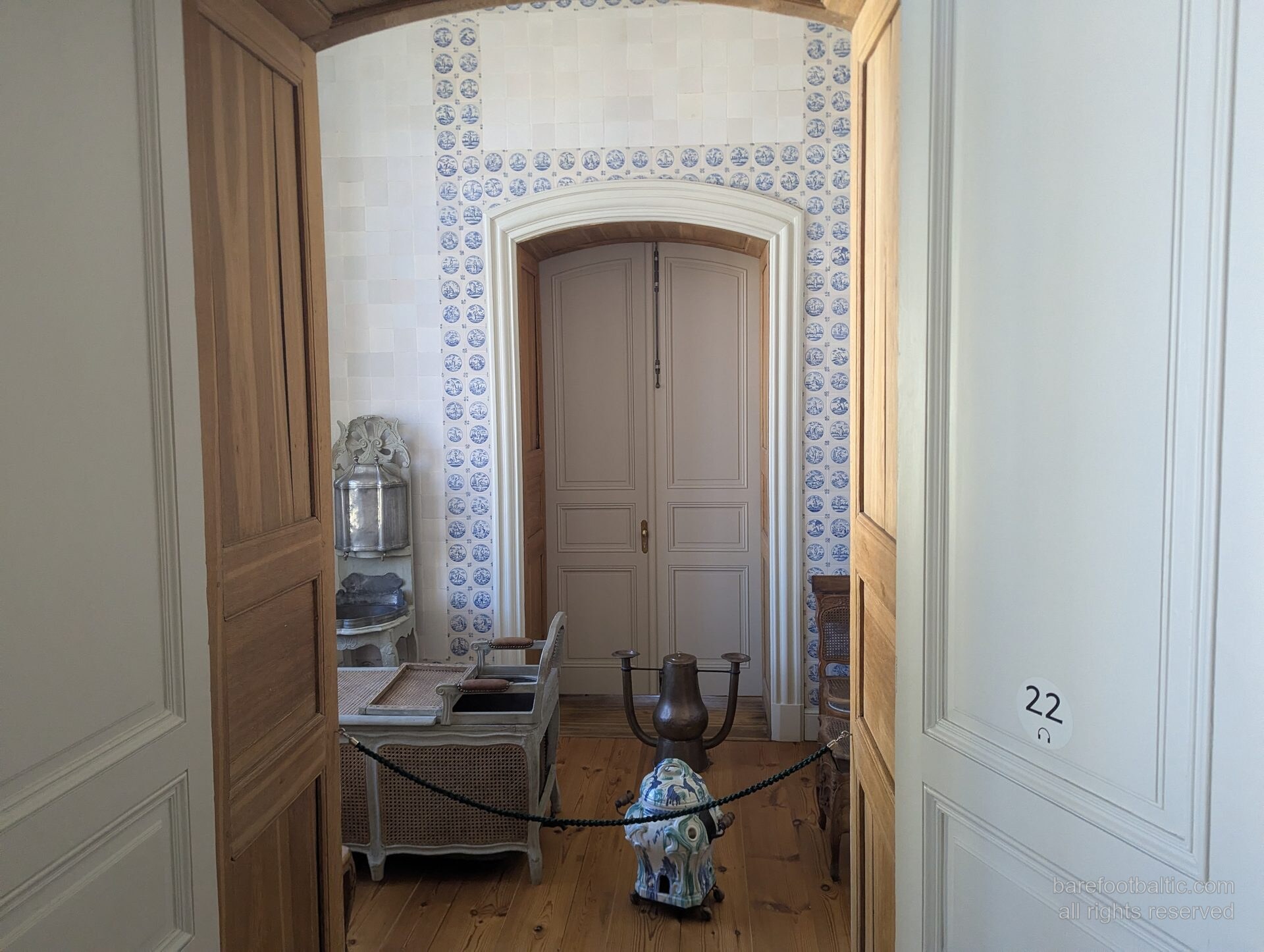
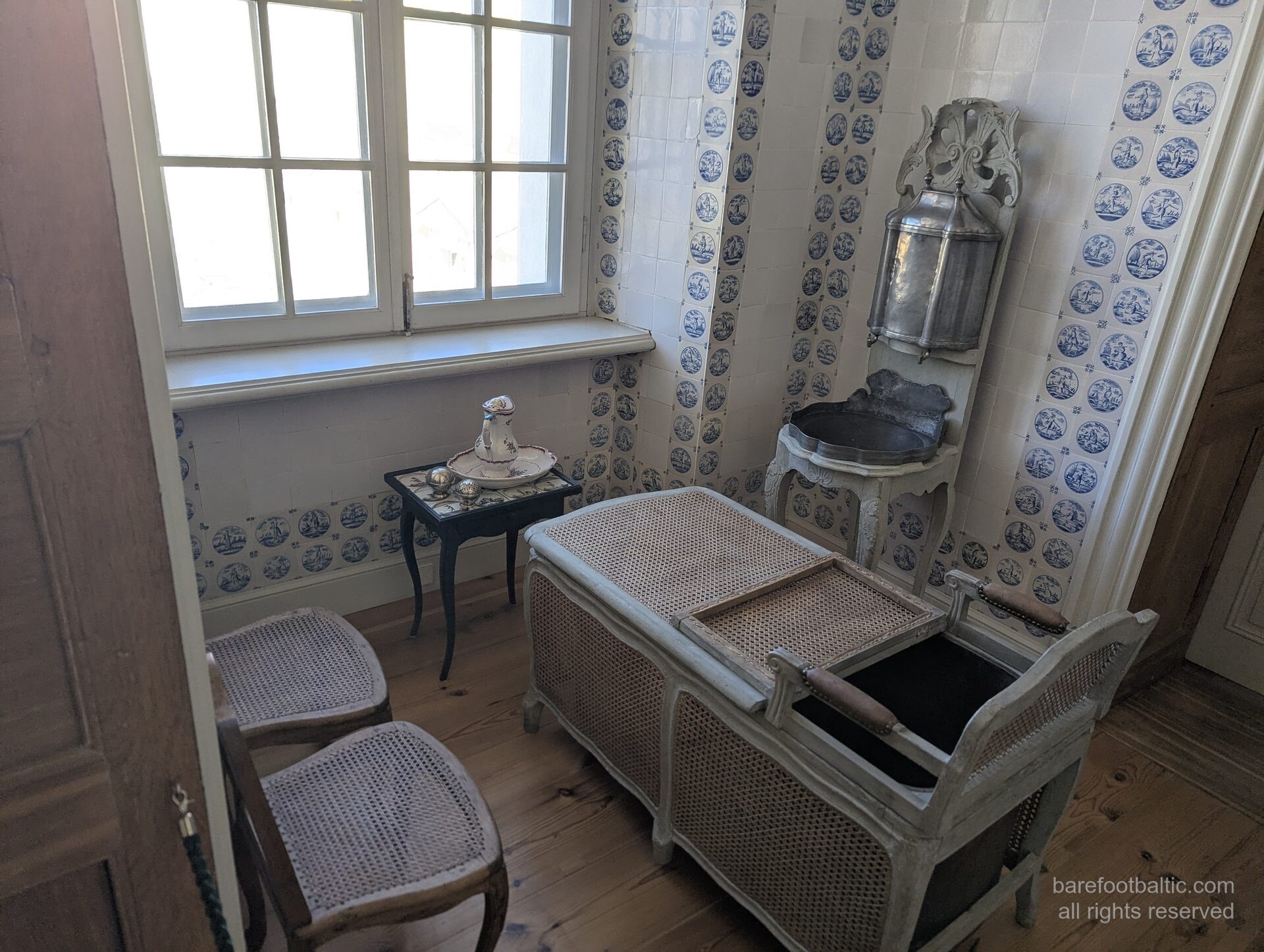
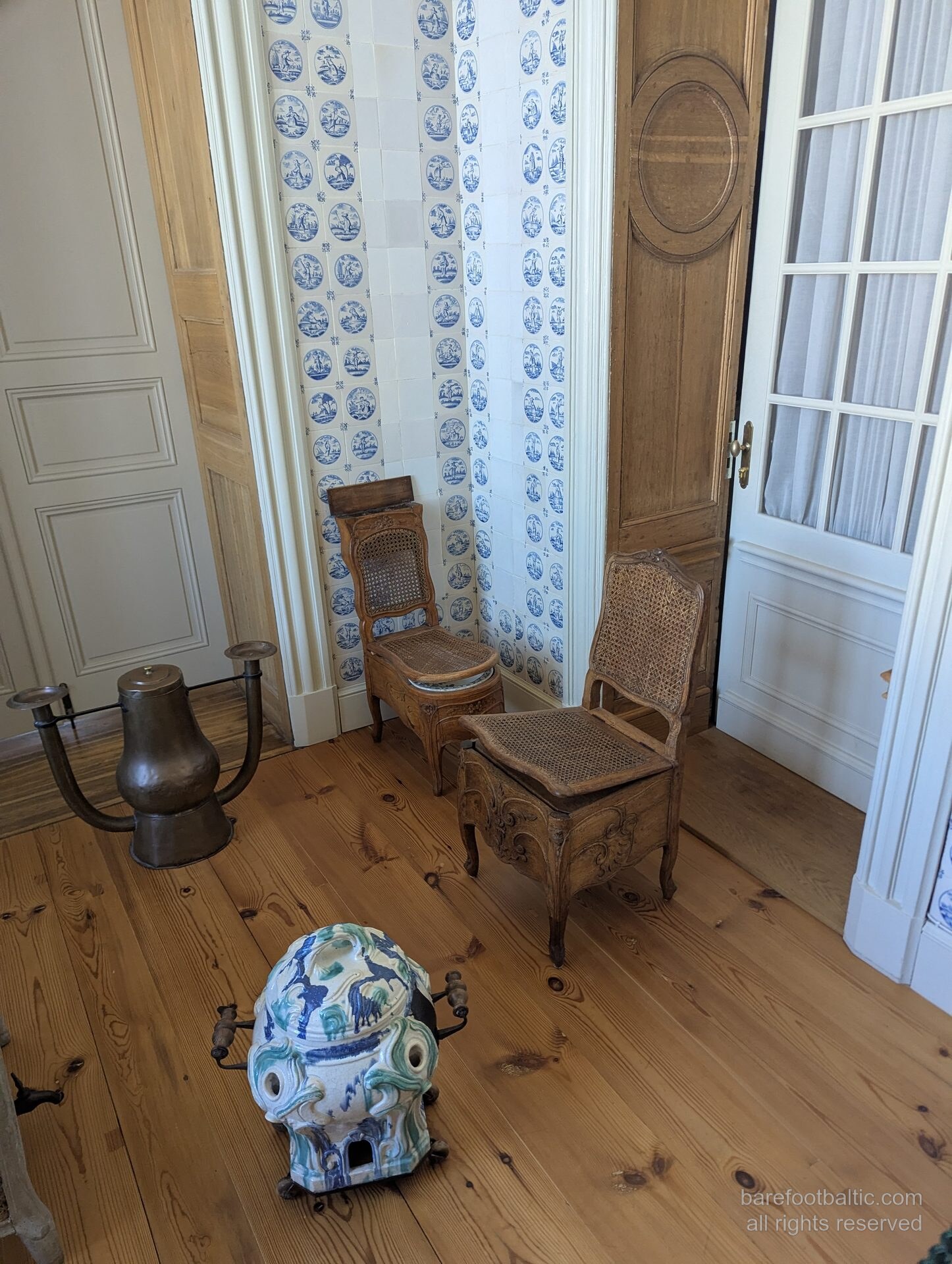
The Antechamber of the Duke's Second Toilet-Room
The Duke's private apartments show the attitude towards hygiene in the second half of the eighteenth century. Of the twelve rooms, two are toilets and three are bathrooms.
The function of the room is indicated by the painted blue tiles made in Utrecht around 1739. Note the luxurious ceiling decoration. A set of French furniture, consisting of a sitz-bath, a bidet and a toilet chair, shows a typical eighteenth-century bathroom design, complemented by a special tin device for handwashing called a fountain on a wood-carved pedestal. There are two charcoal-heated items on display. One is a portable ceramic heater on wheels, the other a bathwater heater made of copper tin.
Directly opposite is one of the two studies of the Duke.
The Second Study of the Duke
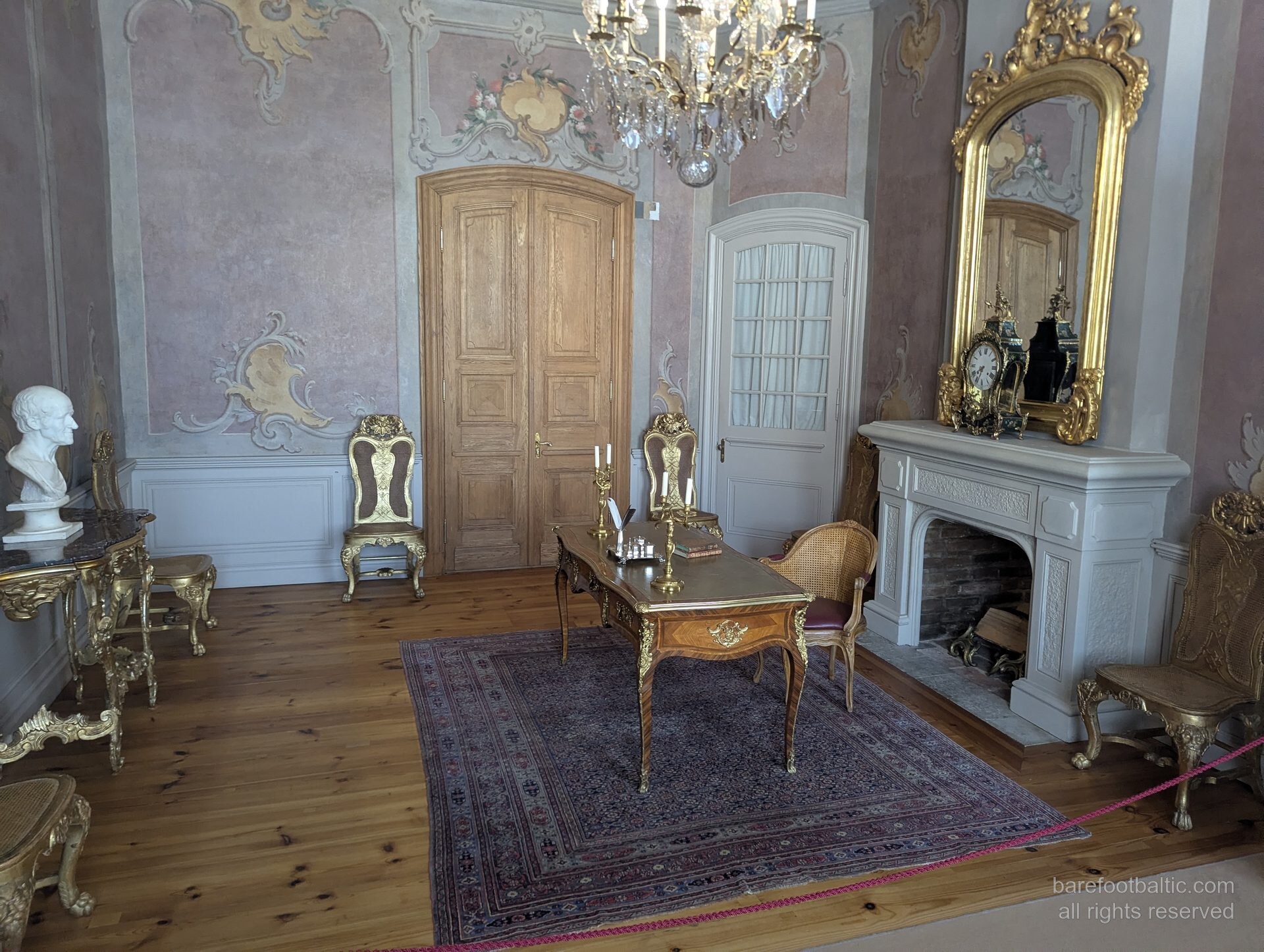
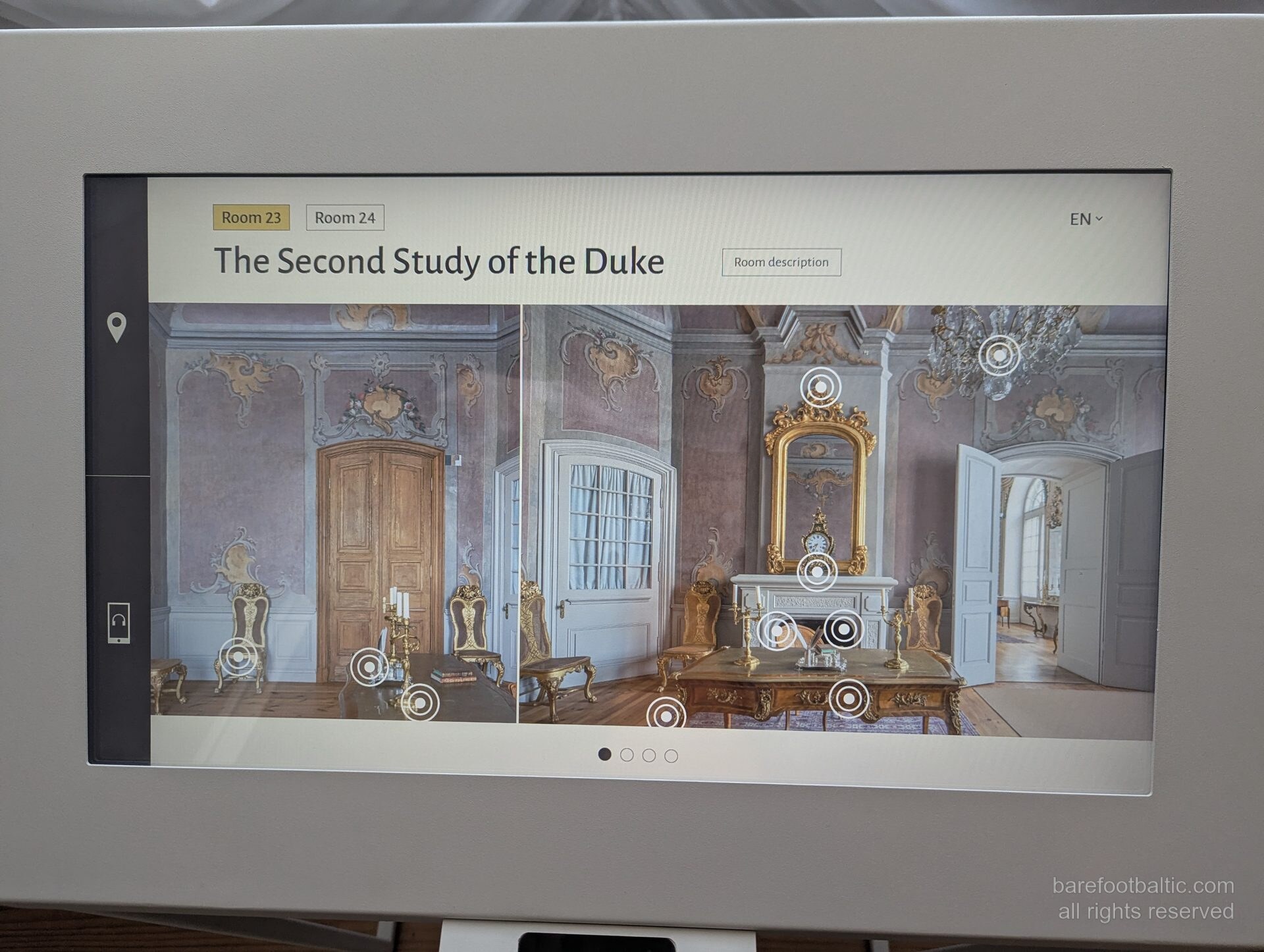
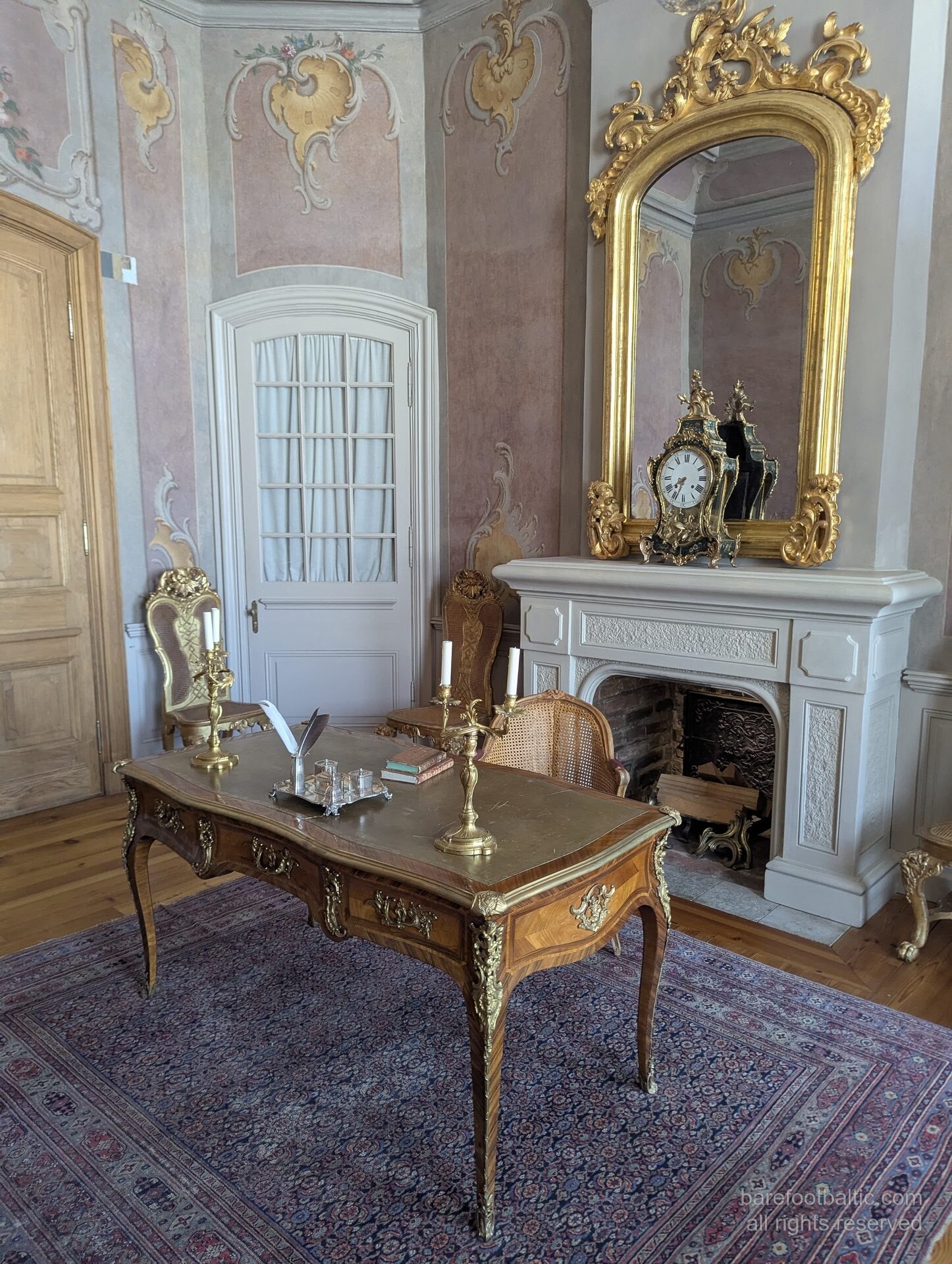
The wall décor in this study isn't typical of living rooms (remember, we're in the Duke's private apartments). The Rococo-style wall painting by Francesco Antonio Martini was discovered during restoration under four coats of oil paint. Presumably, the ceiling had also been painted but must have been destroyed during re-plastering.
It's characteristic of a study to have a fireplace, which allowed the room to be heated faster, for example when the Duke wished to write a letter. Since the Duke arrived at his summer residence in May and sometimes left only in December, having a fireplace was very useful. However, as the fireplace couldn't heat the room for prolonged periods, it was replaced with a stove in the nineteenth century. The decorative cast iron plate on the back of the fireplace was found broken, discarded near the palace, and it was essential for the restoration process. The corner next to the fireplace has been separated by a glazed door. Behind it are the furnaces of the stoves in adjacent rooms.
The function of the room is emphasized by a Rococo-style desk made in the middle of the eighteenth century by the Parisian master Antoine-Mathieu Criard, who met the sophisticated requirements of the Duke. On the desk is a stationery set made by Roman master Antonio Fornari consisting of a tray, a quill holder, an inkwell, an ink sander, a wafer box and a bell. The Italian Late Baroque chairs with massive, gilded ornament match the size and colour of the room.
Next, the Duke's Dressing Room, which can be viewed from two sides.
The Duke's Dressing Room
The decorative finish here is the work of sculptor Johann Michael Graff. In the centre of the ceiling is a silver sun in a wreath of flowers, while birds, flowers and silver rocaille ornaments adorn the ceiling cove. The overall colour palette is broader than in the Rose Room, but muted and softer.
The function of the room is illustrated by its furniture and objects. On the table in the middle of the room is a clothes brush and a Chinese porcelain spittoon for spitting chewing tobacco. The opposite wall is a triangular shaving table, on top of it a barber bowl made in China with a semi-circular groove for the chin. There's a "commode chair" in the room. It looks like an ordinary chair with wood carving and wickerwork, but it's possible to place a chamber pot under the seat. This furniture was made by Parisian master Pierre-Claude Turcot. Next to it on the floor is a painted chamber pot made in China. The other chairs with wickerwork were also made in France.
The function of these easy-to-clean furnishings made sense in rooms where liquids and powders were used. The seat upholstery is protected by a leather cushion. Examine the commode with Chinese lacquer and French lacquer paintings, made skilfully in the eighteenth century by French master Daniel de Loose.
Paintings in this room depict hunting and everyday scenes, landscapes, as well as battle sights, the so-called battle genre. For example, above the commode is Battle Scene with Horsemen by the Dutch-born horse and battle painter Jan van Huchtenburgh. He was a prominent representative of this genre, and several of his works were in Duke Peter's collection.
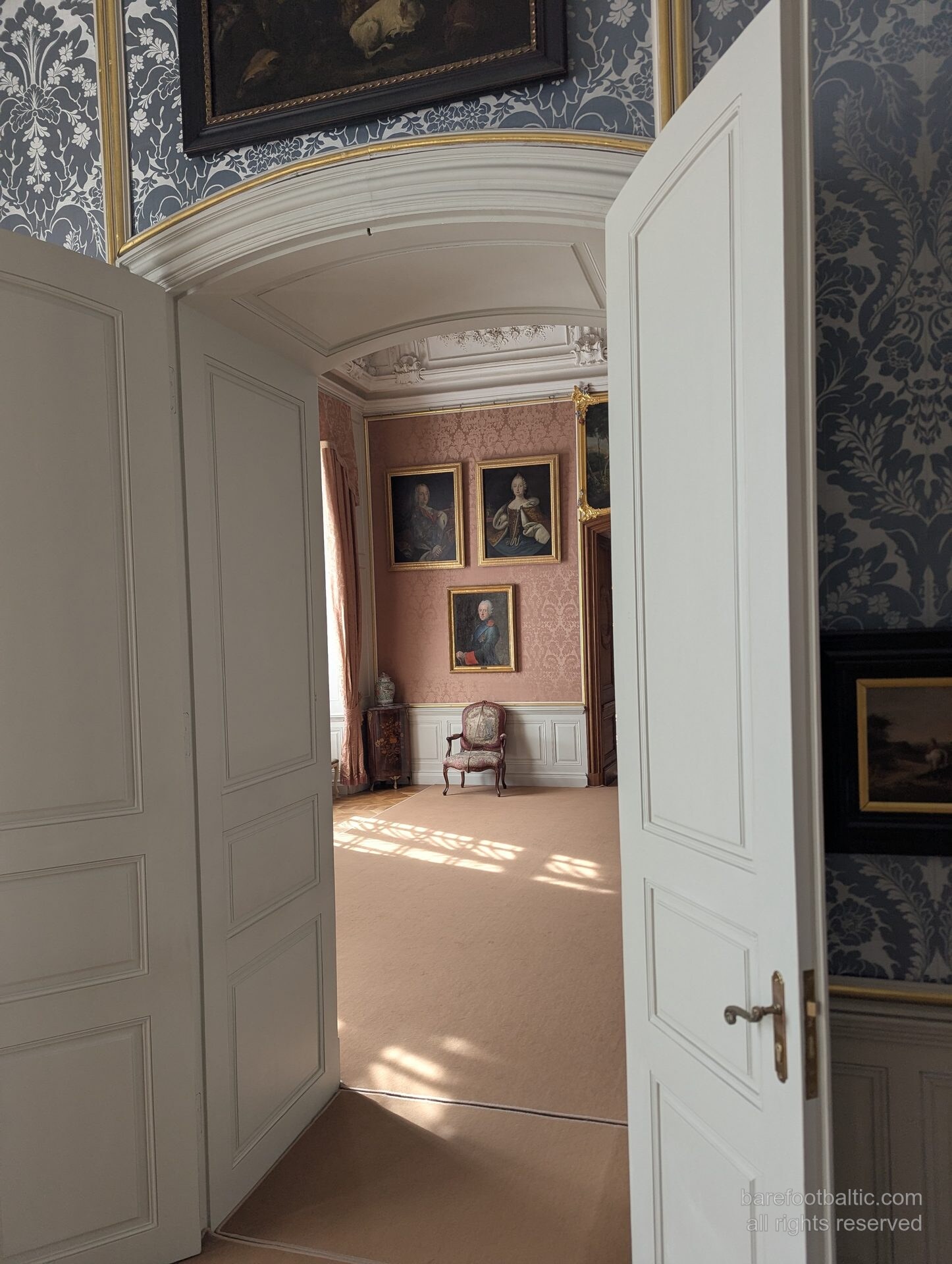
Now we walk through the unrestored room and the Dutch Salon, and on to the Room with Rulers' Portraits.
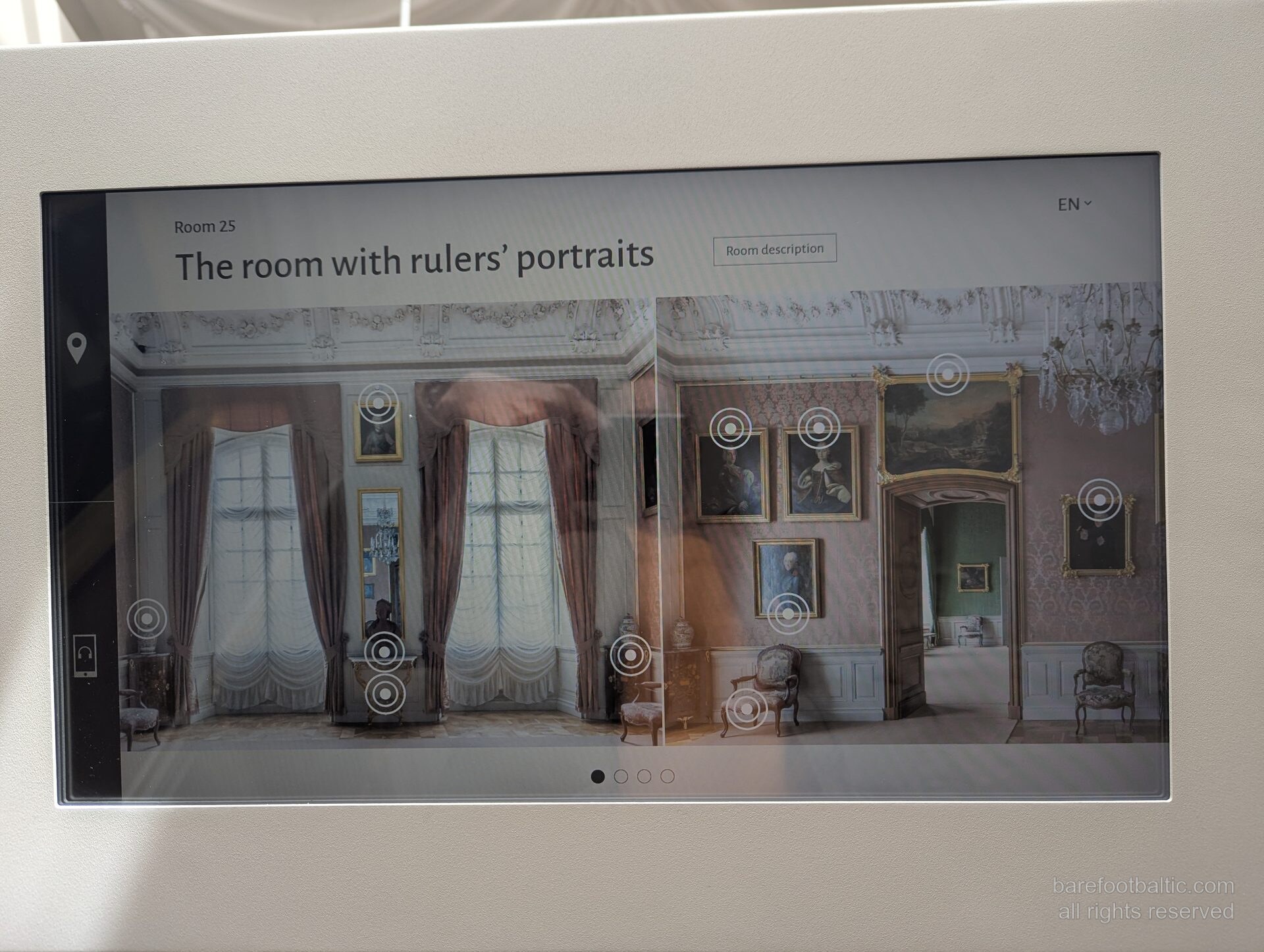
The Room with Ruler's Portraits
One of two reception rooms in the Duke's state apartments. Presumably, short business visits took place here.
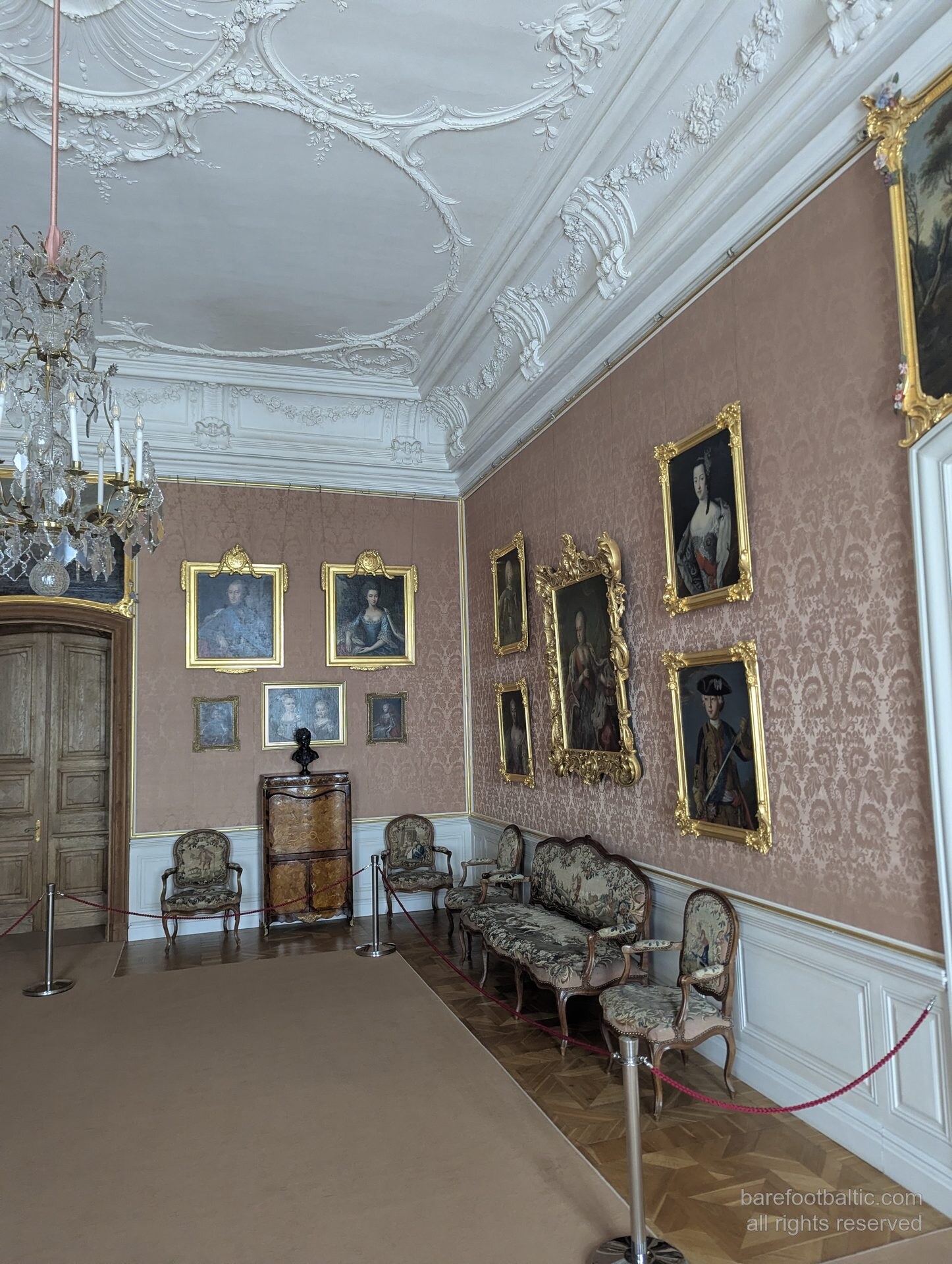
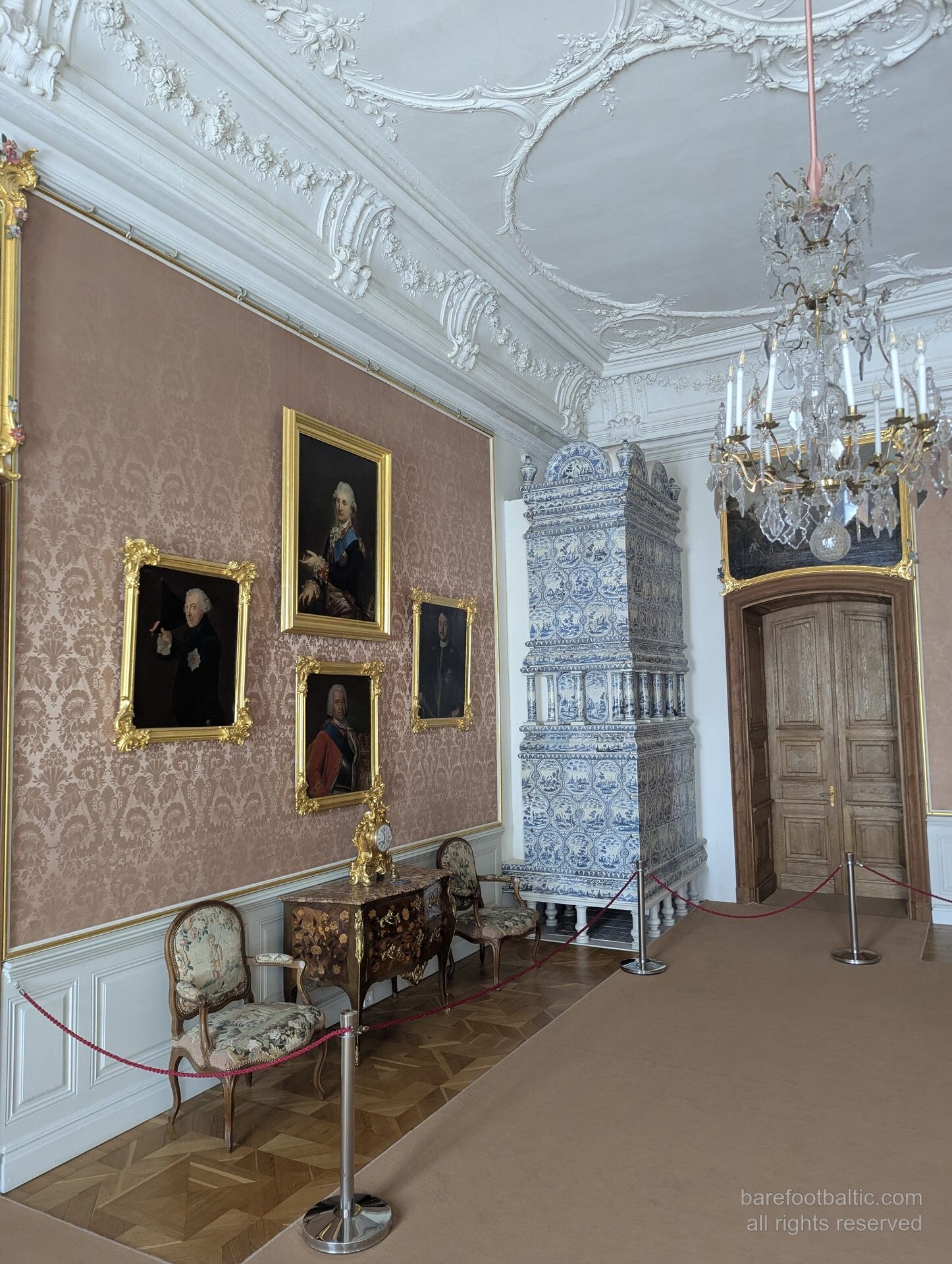
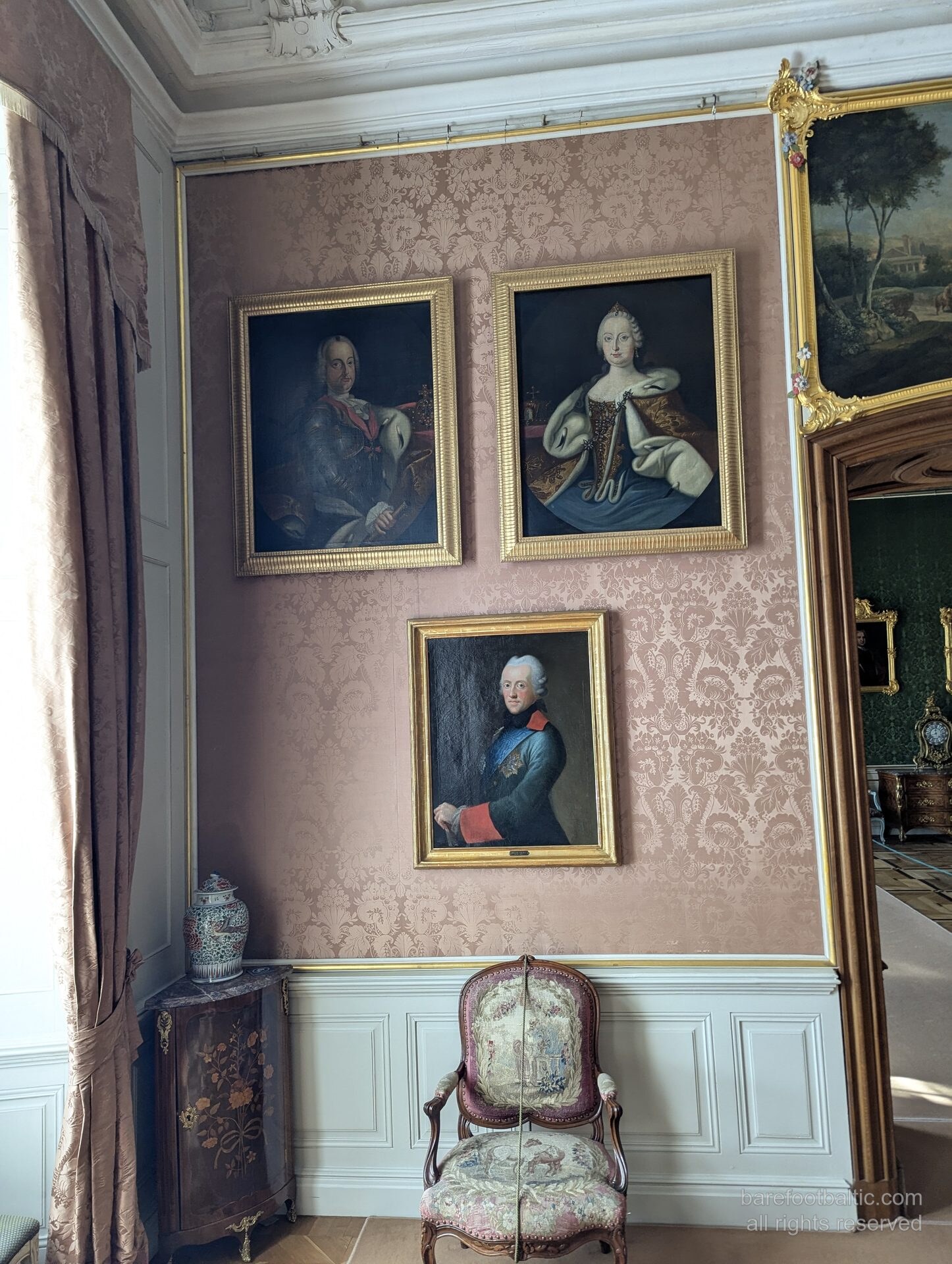
The current name of the room indicates that portraits of important rulers in the history of the Duchy of Courland-Semigallia are displayed here. They include members of the Biron family, as well as the monarchs of European countries whose political interests related to Courland.
To the left of the stove in the centre on the bottom is a portrait of Duke Ernst Johann, the builder of Rundāle Palace. It was painted a year after the Duke's death by Jelgava-based artist Leonhard Schorer. Above the portrait of Ernst Johann is the ruler of Poland, Stanisław August Poniatowski, who confirmed Biron's return to the throne of the Duchy of Courland after the exile. The portrait to the right of Ernst Johann depicts Tsar Peter the Great, who married his niece Anna Ioannovna to the Duke Friedrich Wilhelm of Courland. To the left of Ernst Johann's portrait is the image of King Friedrich II of Prussia, whose family had a particularly friendly relationship with Duke Peter and Duchess Dorothea.
In the centre on the opposite wall is a portrait of Duke Ernst Johann's wife, Benigna Gottlieb, born von Trotta-Treyden, in mourning dress painted by the Courland court painter Friedrich Hartmann Barisien. To the right of her is a portrait of the heir to the throne, fifteen-year-old Prince Peter, painted by Louis Caravaque. Other portraits around the Duchess depict the rulers of Russia. The top row displays the Biron's benefactors. On the left is a portrait of Grand Duke Peter Fyodorovich, the later Emperor Peter III of Russia, and to the right is his wife the Princess of Anhalt-Zerbst, born Sophie Friederike Auguste, who adopted the name of Catherine in Russia and later became Catherine the Great, Empress of Russia. In the bottom row to the left is a portrait of Empress Elizabeth Petrovna. During her reign the Birons were forced to live in exile.
On the left in the top row of the far end wall is Barisien's painting of the last Duke of Courland Peter, and next to him a portrait of the beautiful Duchess Dorothea (born von Medem). In the centre on the bottom row is a portrait of their eldest daughters Wilhelmine and Pauline. On either side of their granddaughters are portraits of Duke Ernst Johann and Duchess Benigna Gottlieb.
The portrait to the left of the windows shows Anna Ioannovna, the benefactor of Ernst Johann Biron, depicted here as the ruler of Russia. Their destinies and political careers were inextricably linked. Before her death, Anna Ioannovna appointed her favourite as a regent of the Russian Empire during the minor years of Emperor Ivan Antonovich, but Ernst Johann's triumph lasted only 22 days. He was charged with a crime, arrested and convicted, and the Biron family spent the next 22 years in exile.
Below the portrait of Anna Ioannovna you can see another offspring of the Polish Royal Family, Maurice, Count of Saxony, who tried to seduce the young widowed Duchess's Anna to gain power. In 1726, the nobles of Courland did elect Maurice as the Duke. The King of Poland, however, did not recognize his appointment and Count Maurice was forced to leave Courland.
To the right of the windows on the bottom is a portrait of Charles of Saxony, the son of Augustus III of Poland, who was appointed the Duke of Courland during Ernst Johann's exile from 1758 to 1763. When Biron returned to the throne, some members of the Courland nobility remained loyal to Duke Charles, thus deepening the fissure between the ruling Duke and the local nobility.
As we continue the tour, please note the overdoor paintings. It is believed that overdoor paintings were in all rooms of the Duke's state apartments. The frame of the overdoor was reconstructed according to a photograph of 1880, and after fragments of the original frame were found under the floorboards.
The walls in this room are upholstered with silk damask in the so-called mirabelle colour. The stove was rebuilt using original tiles. The furniture corresponding to the function of a salon was made in France in the 1760s. The sofa and chairs are upholstered with tapestry fabric depicting well-known scenes from the fables of French writer Jean de La Fontaine.
Next, the Duke's State Bedroom.
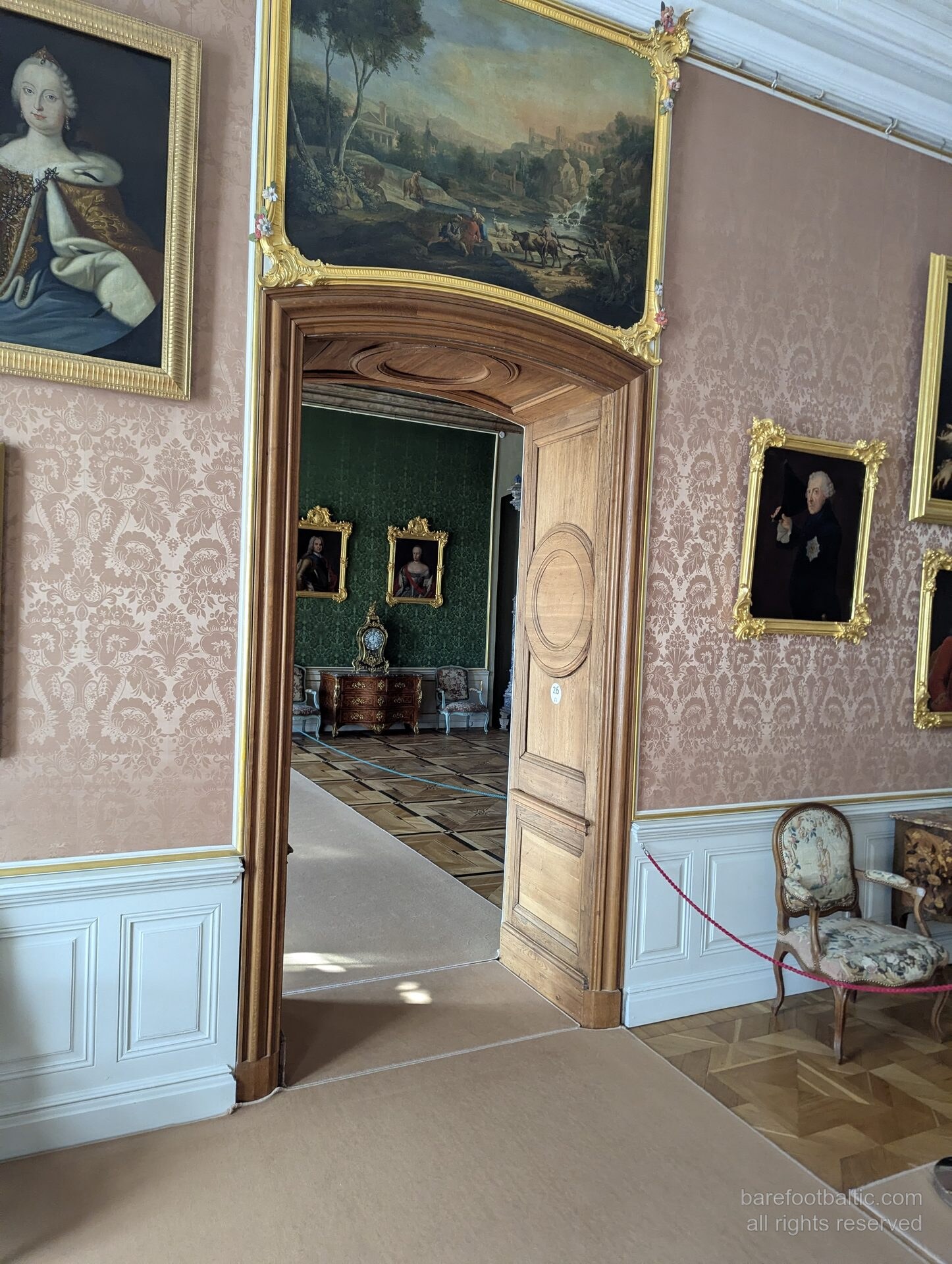
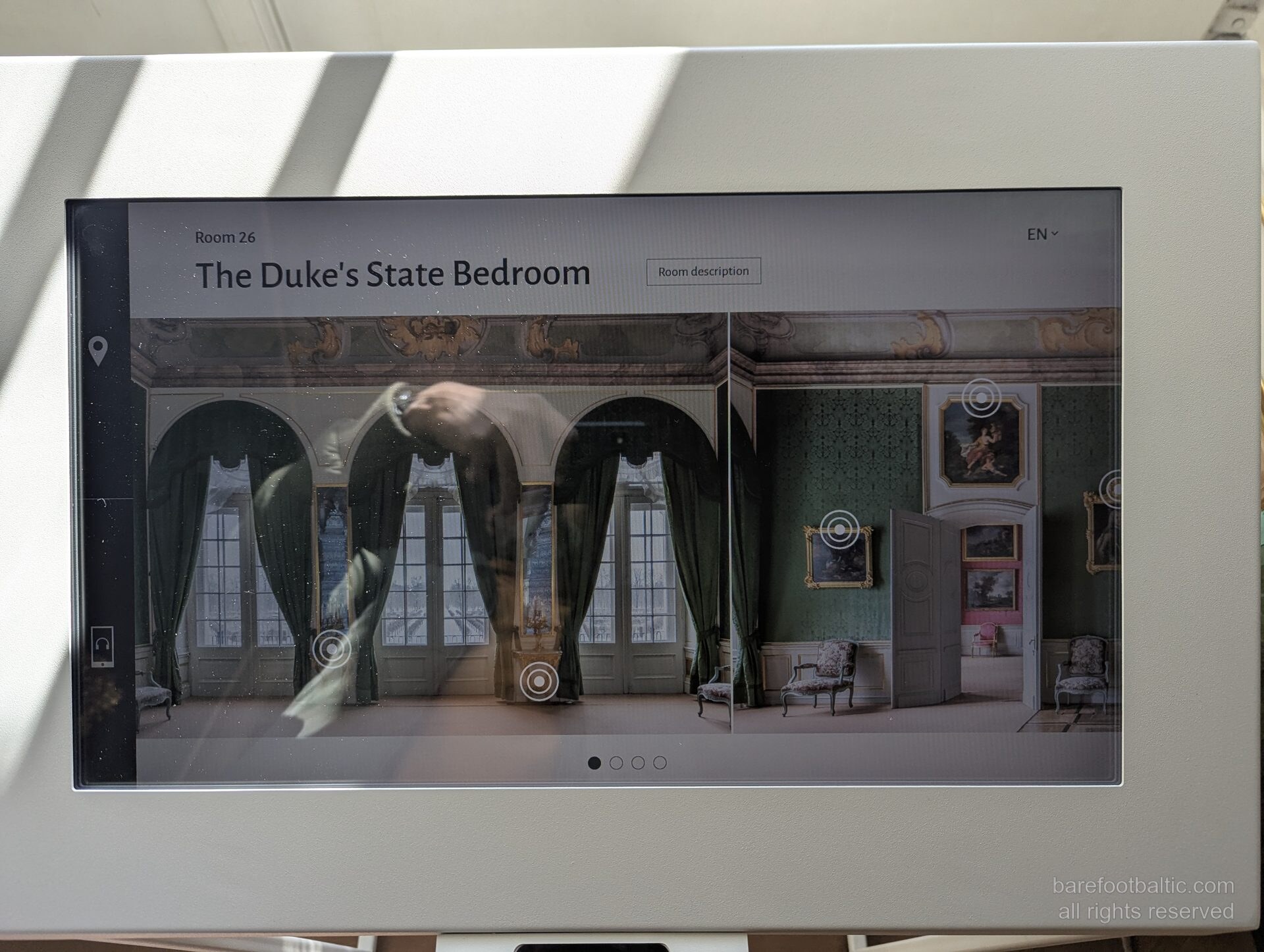
The Duke's State Bedroom
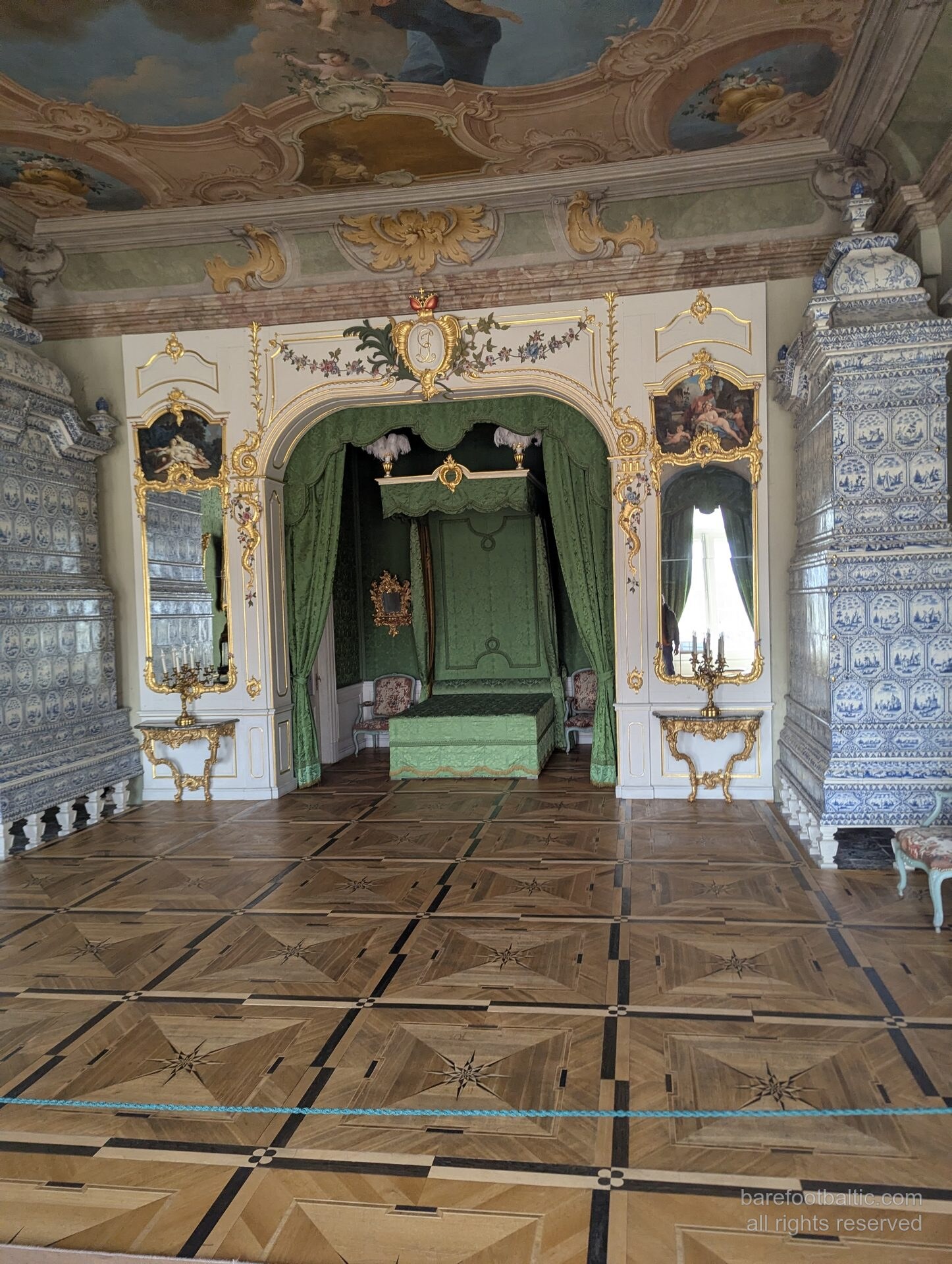
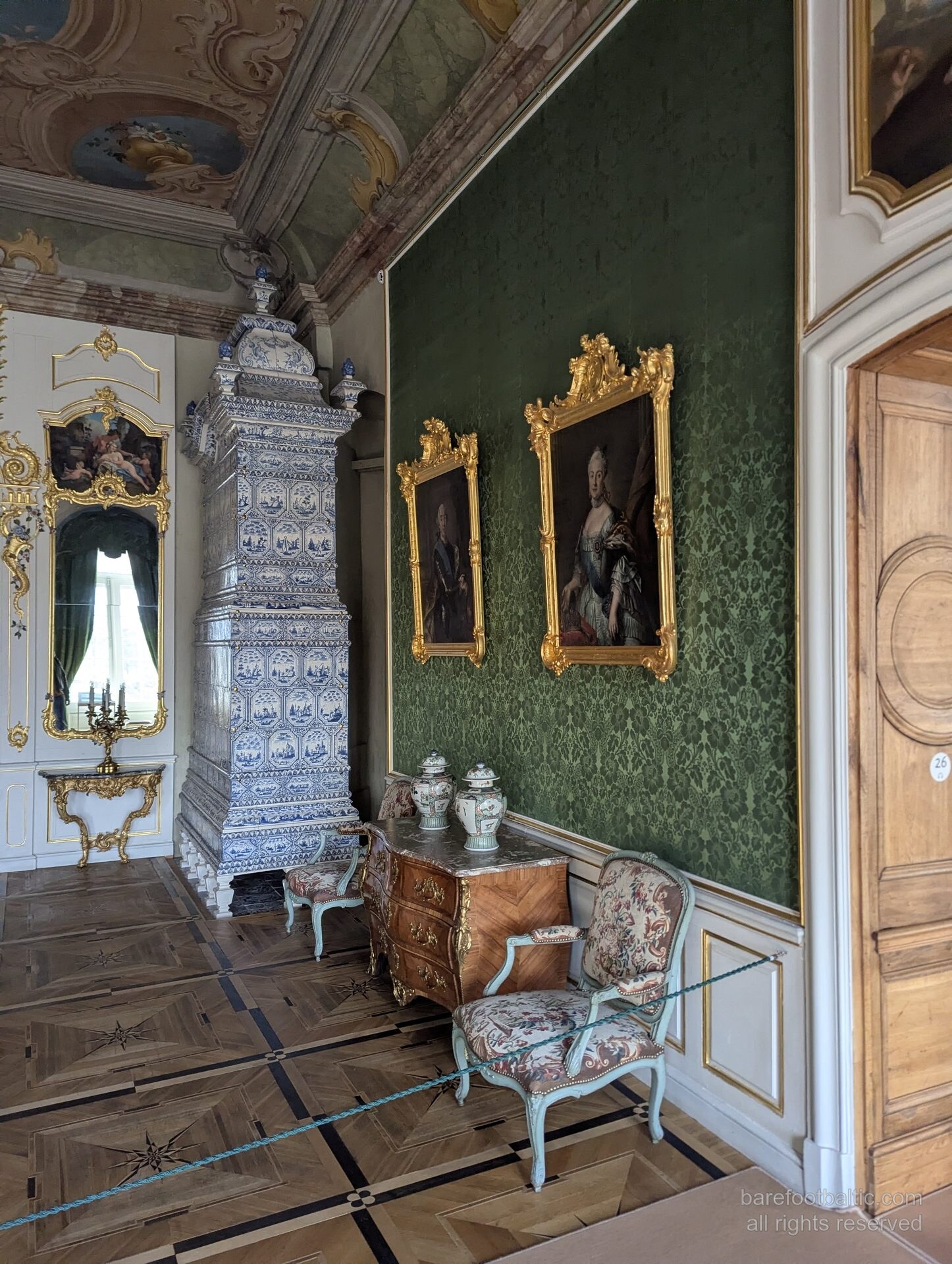
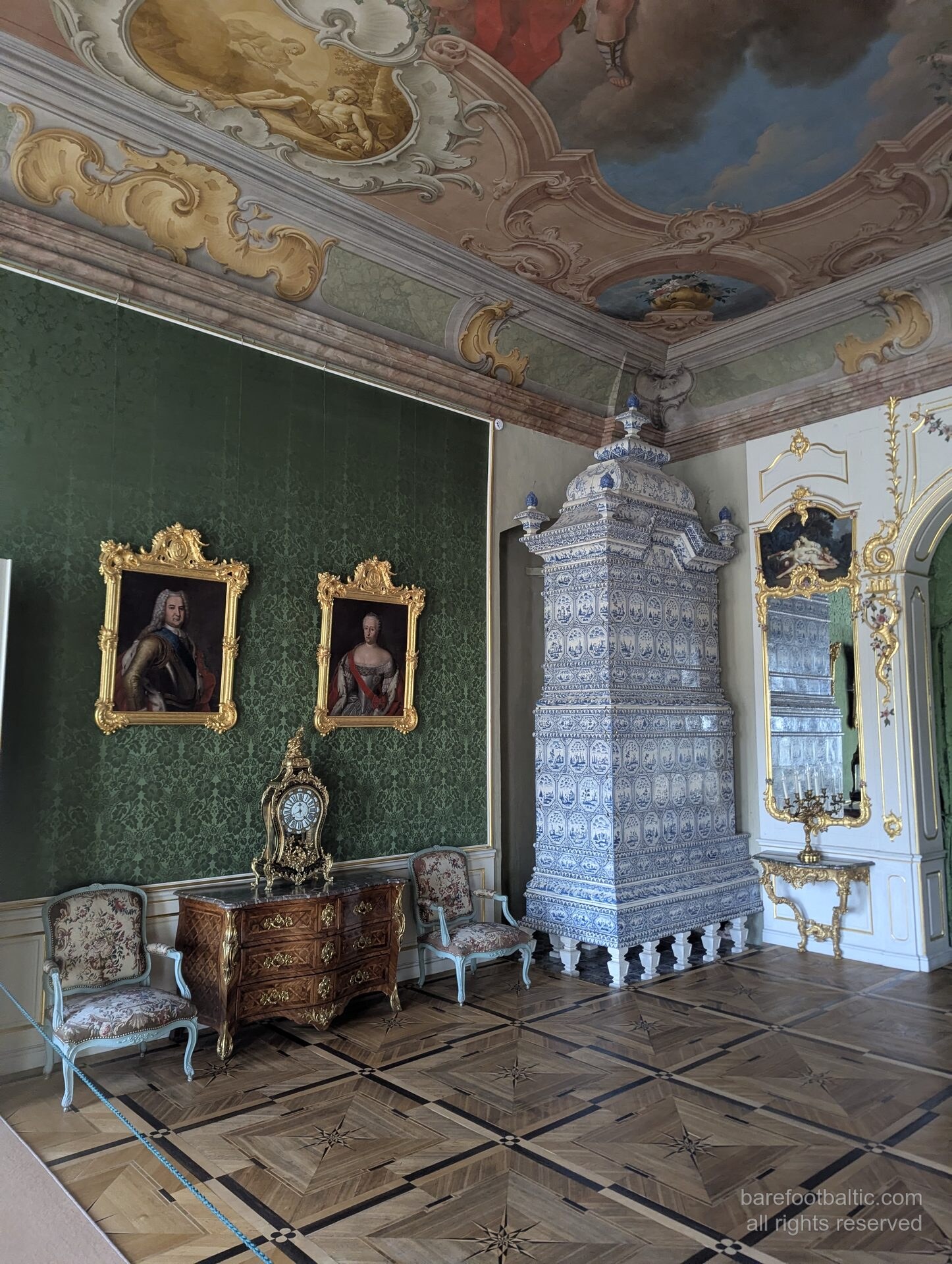
The location of the Duke's bedroom in the centre of the state apartments reflects the tradition that began at the Palace of Versailles, and Francesco Rastrelli carried it into the design of Rundāle Palace. During the reign of King Louis XIV of France, raising and bedtime ceremonies took place in the presence of courtiers. However, during the reign of Duke Ernst Johann and Duke Peter, this ritual had already become obsolete.
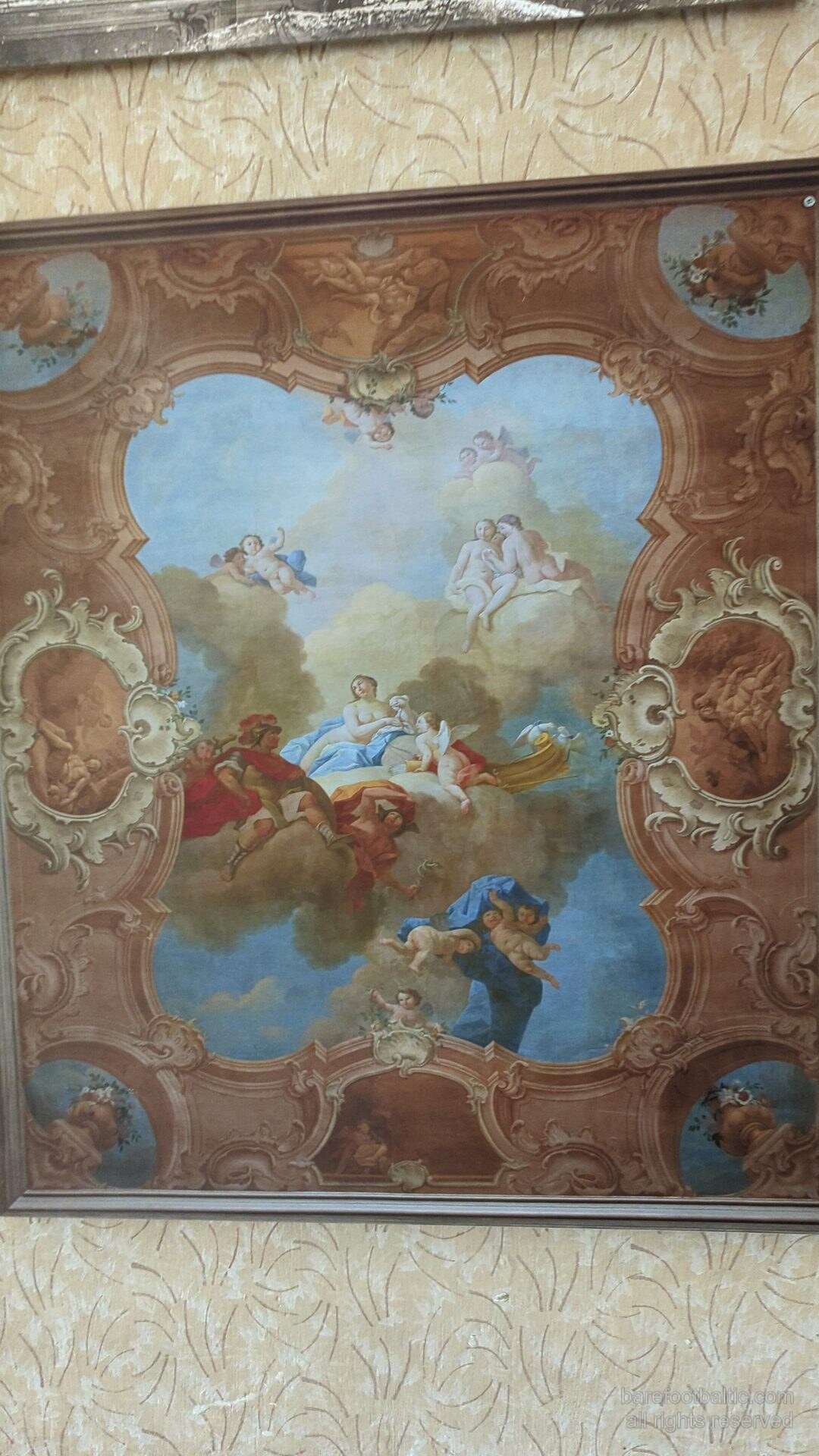
The ceiling painting The Education of Cupid is a collaboration between Francesco Antonio Martini and Carlo Zucchi. The plafond depicts the Roman god of war Mars, the goddess Venus and their son Cupid, whose teacher is Mercury, the nimble messenger of the gods. The composition is complemented by four medallions with erotic overtones. Above the window is Leda and the Swan. To the left of the bed is Luna and Endymion. To the right of the bed is Jupiter, Disguised as Diana, Seducing the Nymph Callisto. Directly above the bed is Venus with a Mirror, which has been partially lost and cannot be restored.
By looking at the ceiling, you'll note there was no space for a chandelier. As in most rooms of the palace, wall candelabras or portable candleholders were used instead, placed next to mirrors so their light would reflect in the room.
A canopy bed has been placed in a niche or alcove and was made to match the size of the historical bed. There are small doors on both sides of the bed. The door to the left leads to the bathroom while the one to the right leads to the Duke's Dressing Room, which we have already visited.
Both bedroom stoves date back to 1740, when Gottfried Kater, a potter from Danzig, worked in Rundāle repairing and rebuilding the stoves originally built by Russian potters. The stoves in the Duke's bedroom have remained in their place since they were erected. Kater's tile stoves are characterised by excellent quality, and their metal support construction proved highly durable. One of the stoves was still used in 1964.
The parquet flooring made by Johann Baptist Eger has been restored in most parts of the room. The tall trees of the forest park form an impressive backdrop for the ten-hectare large typical French garden. The craftsman's report of 1739 stated that he had made 170 parquet shields for the bedroom in a "star pattern" from oak, mahogany, black oak, palm and maple wood. This is the most complicated parquet at Rundāle Palace and the most important example of the Baroque parquet in Latvia.
Fragments of intarsia wall panels found under several coats of paint on the balcony door openings, indicate the original intention to use intarsia panels as a wall finish. Décor in the second construction period included all decoration elements that had not been destroyed or removed. Wooden parts were painted white and supplemented with gilding matching the alcove.
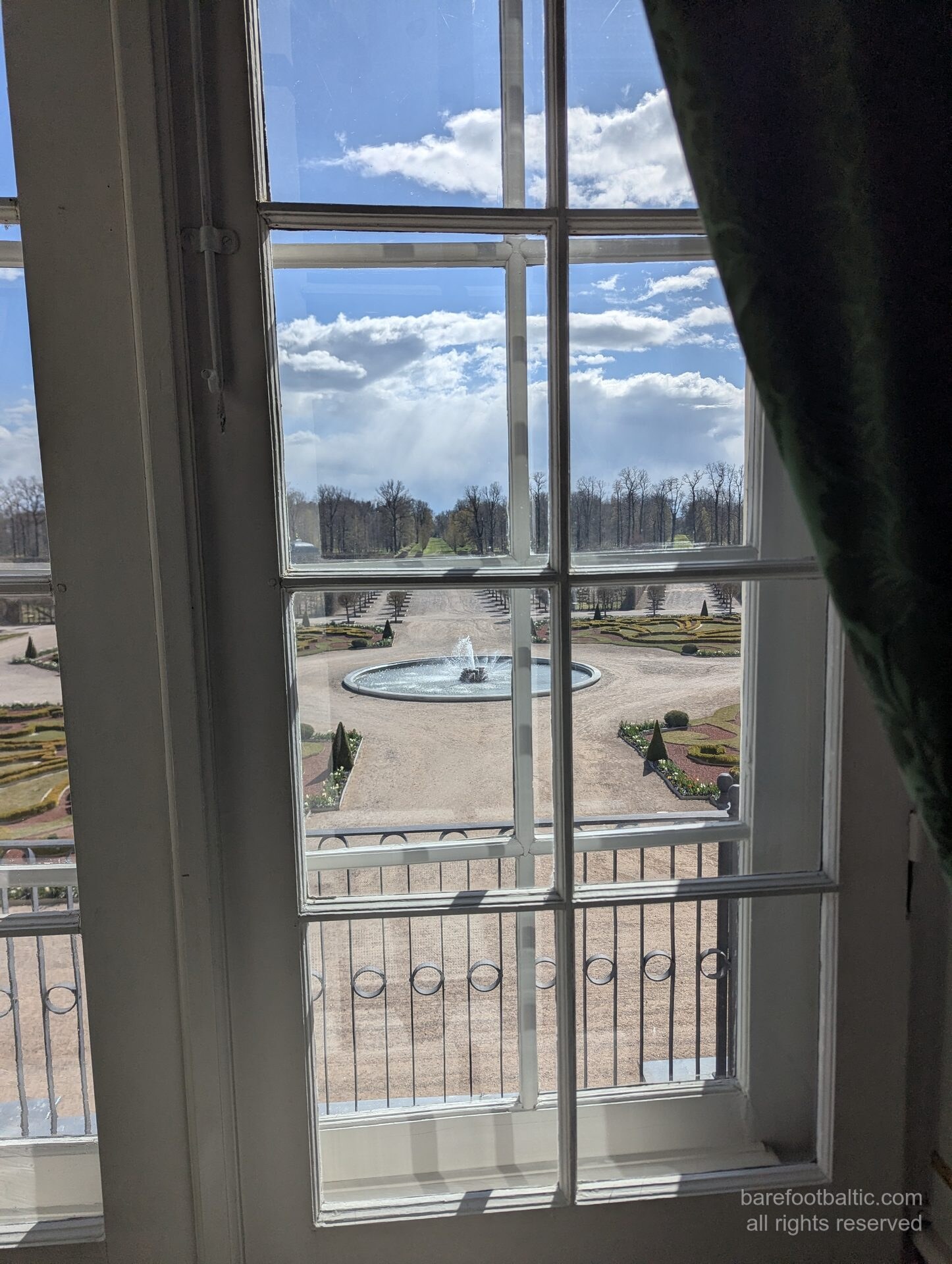
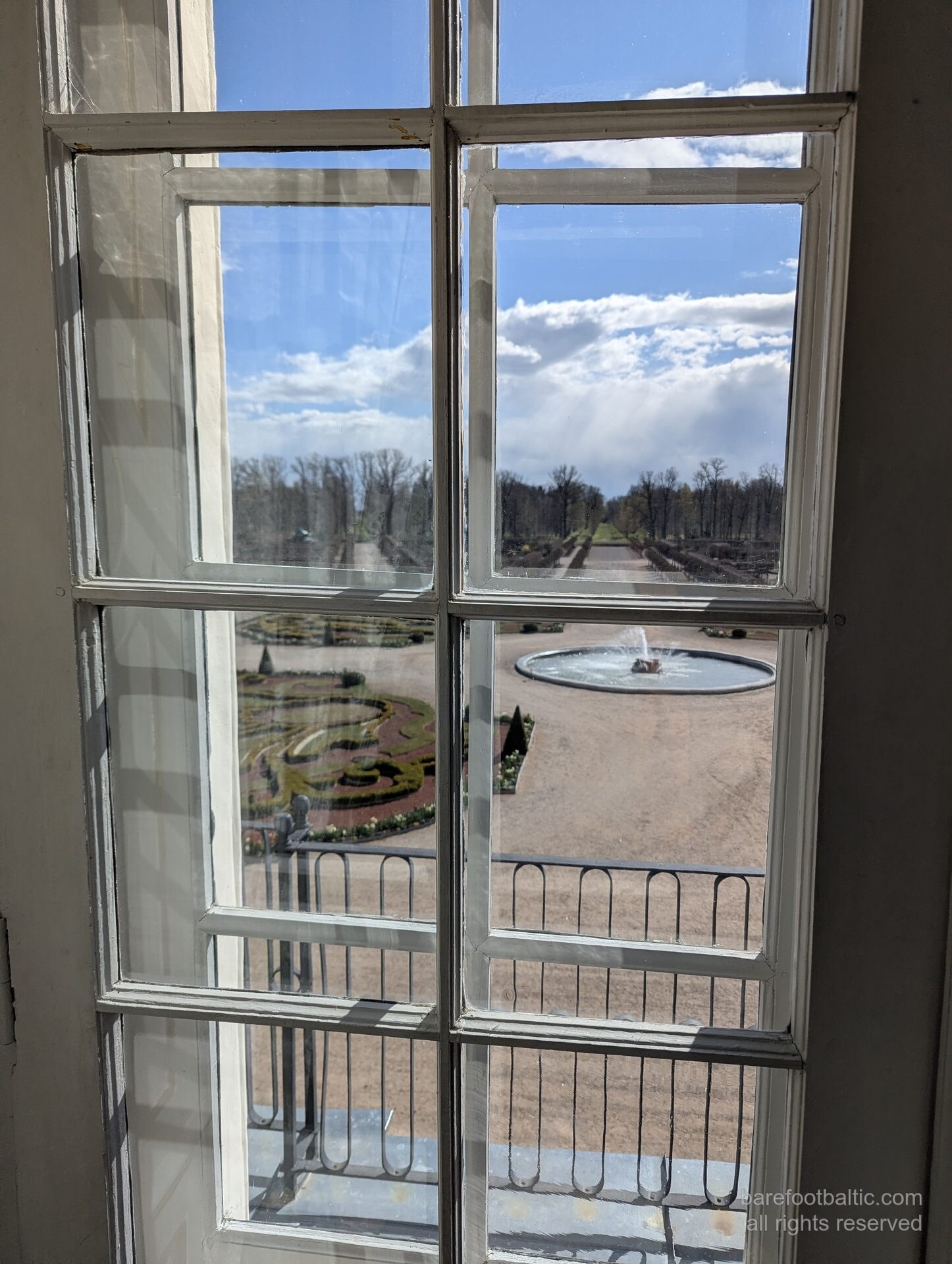
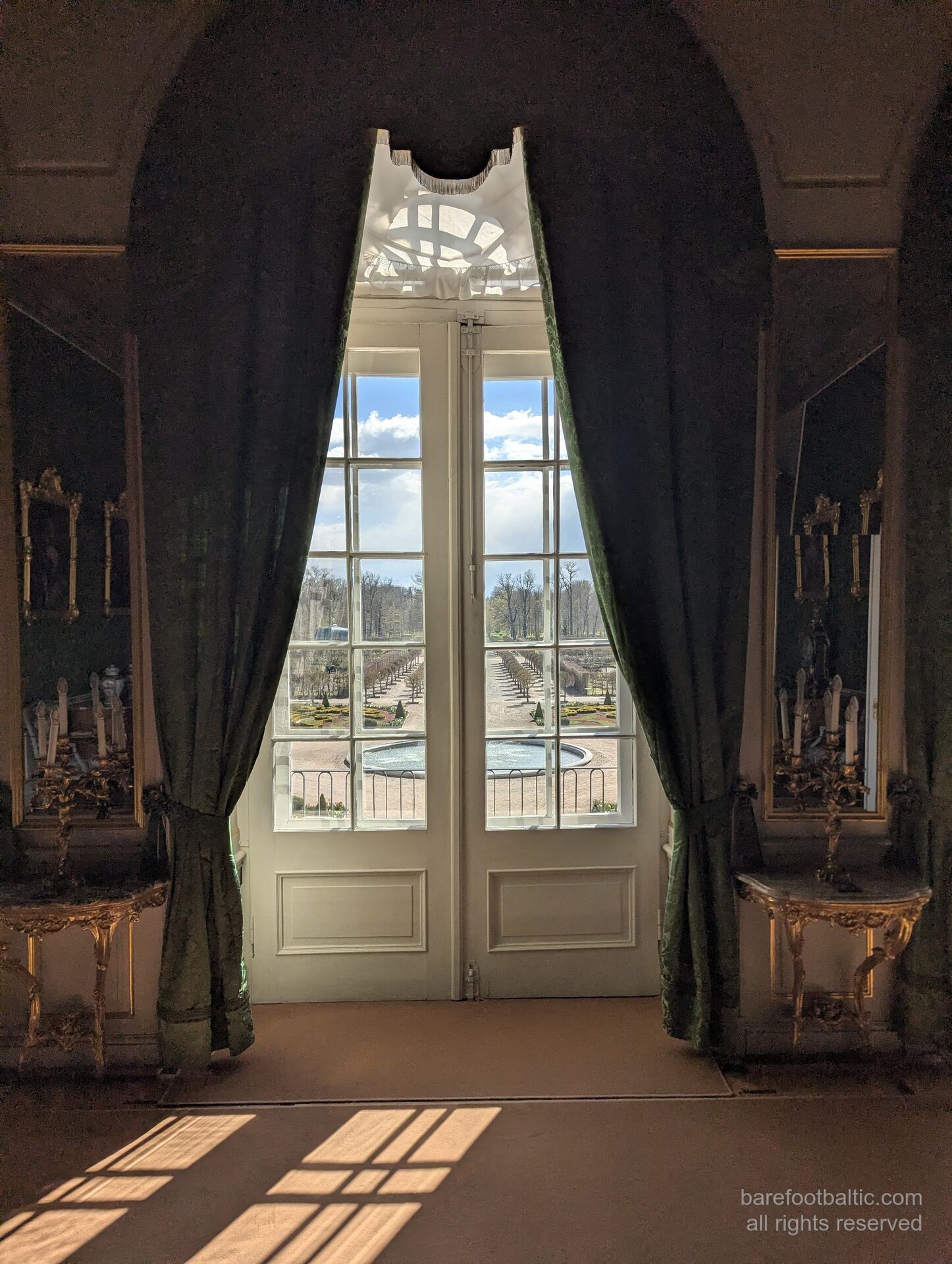
Through the windows you see the Baroque-style garden and forest park. In these types of palaces, the layout of the garden was always designed to ensure the ruler had a perfect view from the bedroom balcony. The park on the south side of the palace also includes the nearby forest, which now covers 32 hectares but used to be larger. The Duke's summer residence was also a hunting palace. The tall trees of the forest park form an impressive backdrop to the ten-hectare large typical French garden with an ornamental parterre and an intricate network of alleys, bosquets and pergolas. On both sides of the parterre is a one-hectare large cultivated rose garden. During the reign of the Dukes, the garden was adorned with potted roses, whereas now more than two thousand rose varieties grow beside Rundāle Palace. Almost six hundred are historical roses, which were popular during the reign of the Dukes and the later owners, Counts Zubov and Shuvalov.
Next, the Reception Room.
The Reception Room
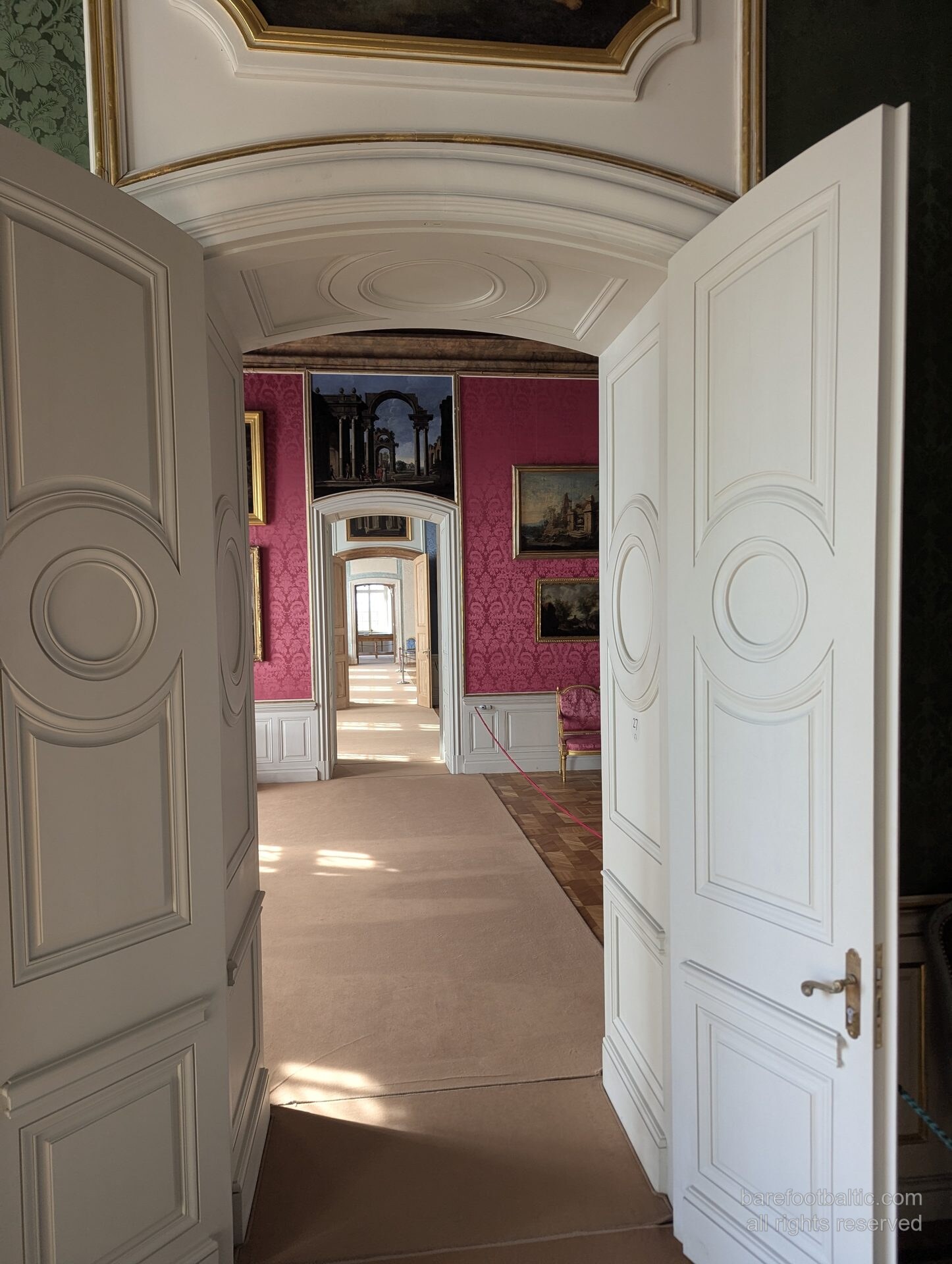
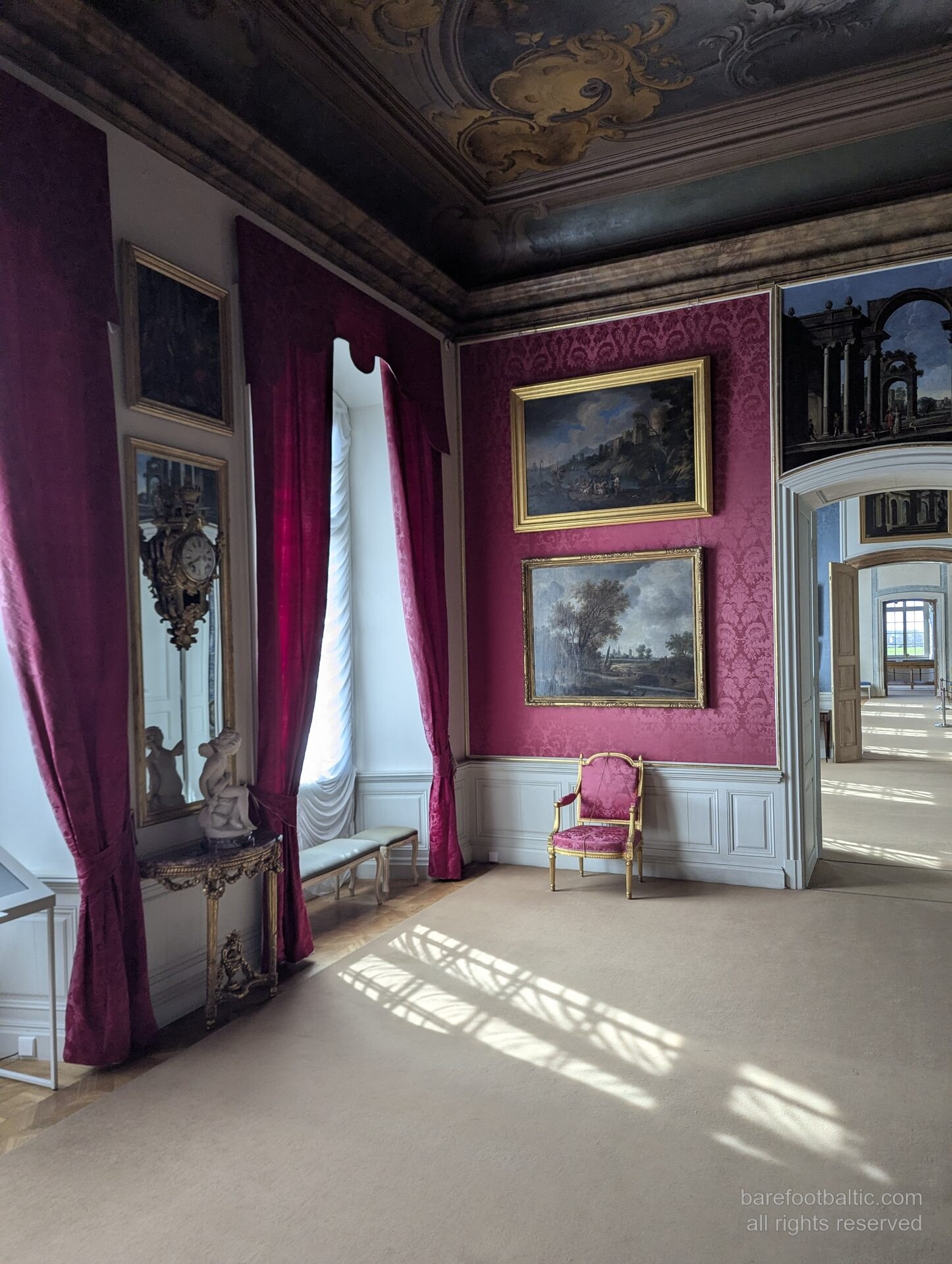
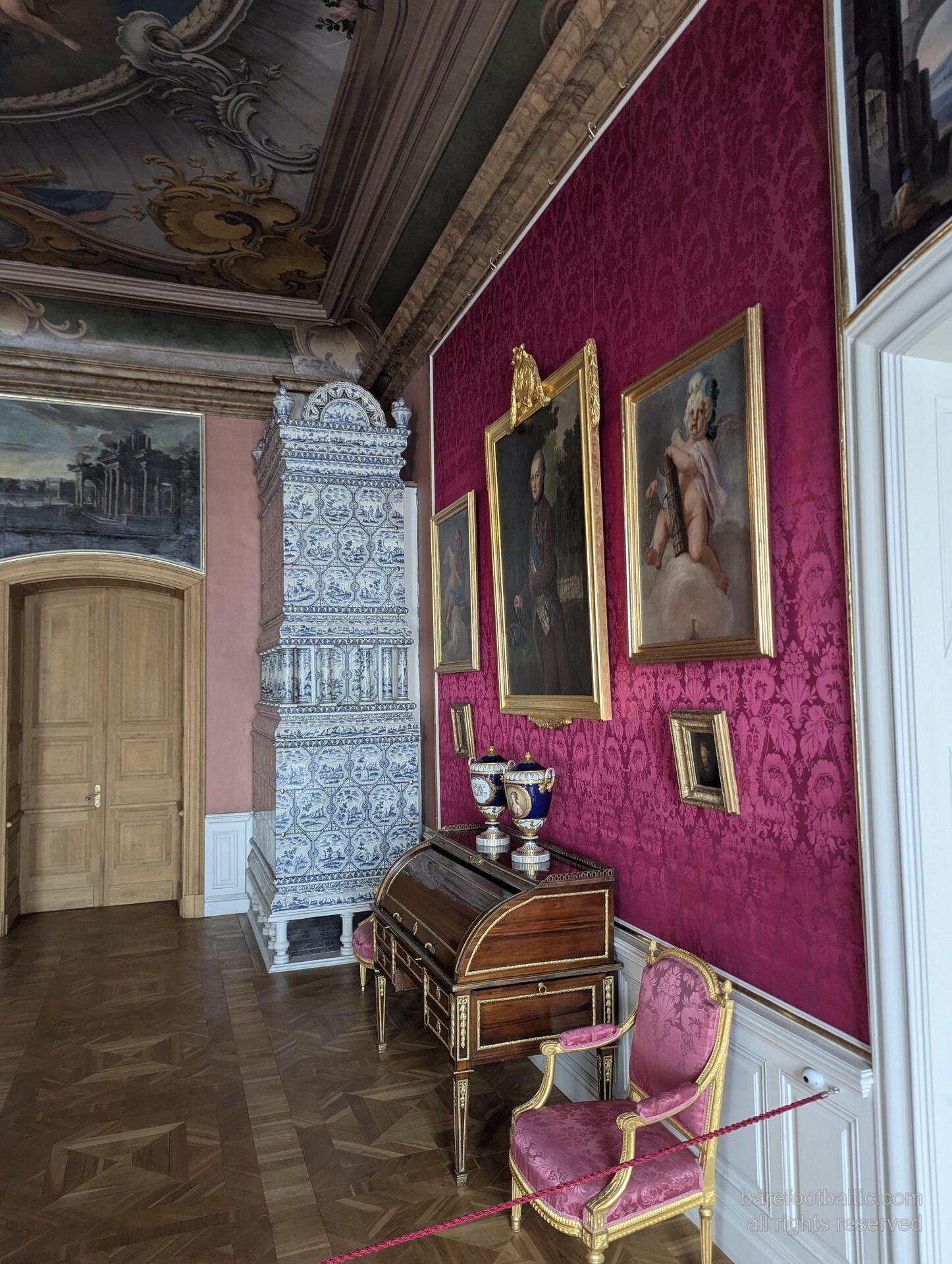
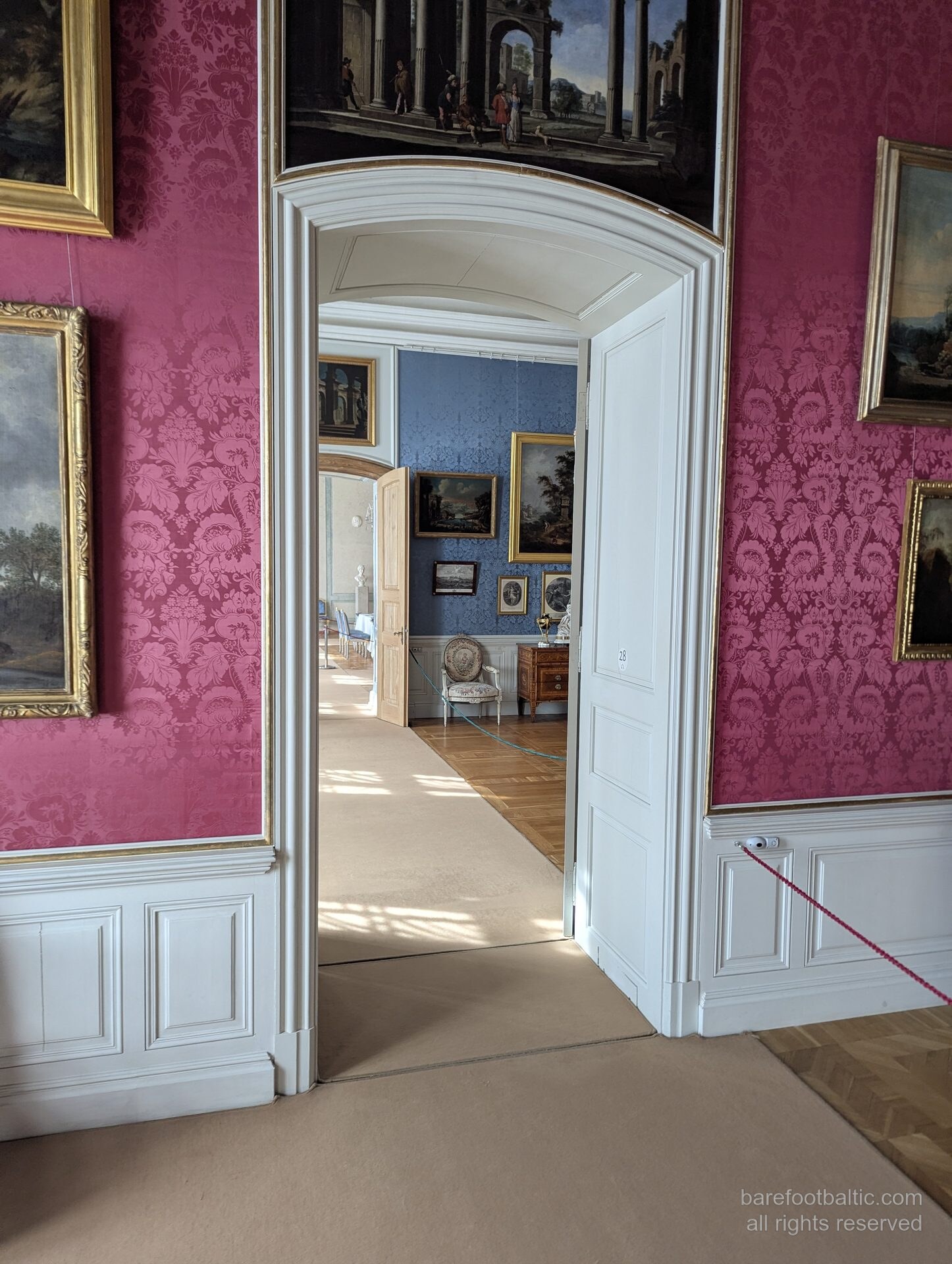
The Reception Room is in a row of private apartments next to the Duke's Bedroom and one of the two Studies of the Duke. Here, the Duke presumably received the most important and closest guests. They arrived from the west side state staircase and could also visit the Duke's Dining Room and the Billiard Room.
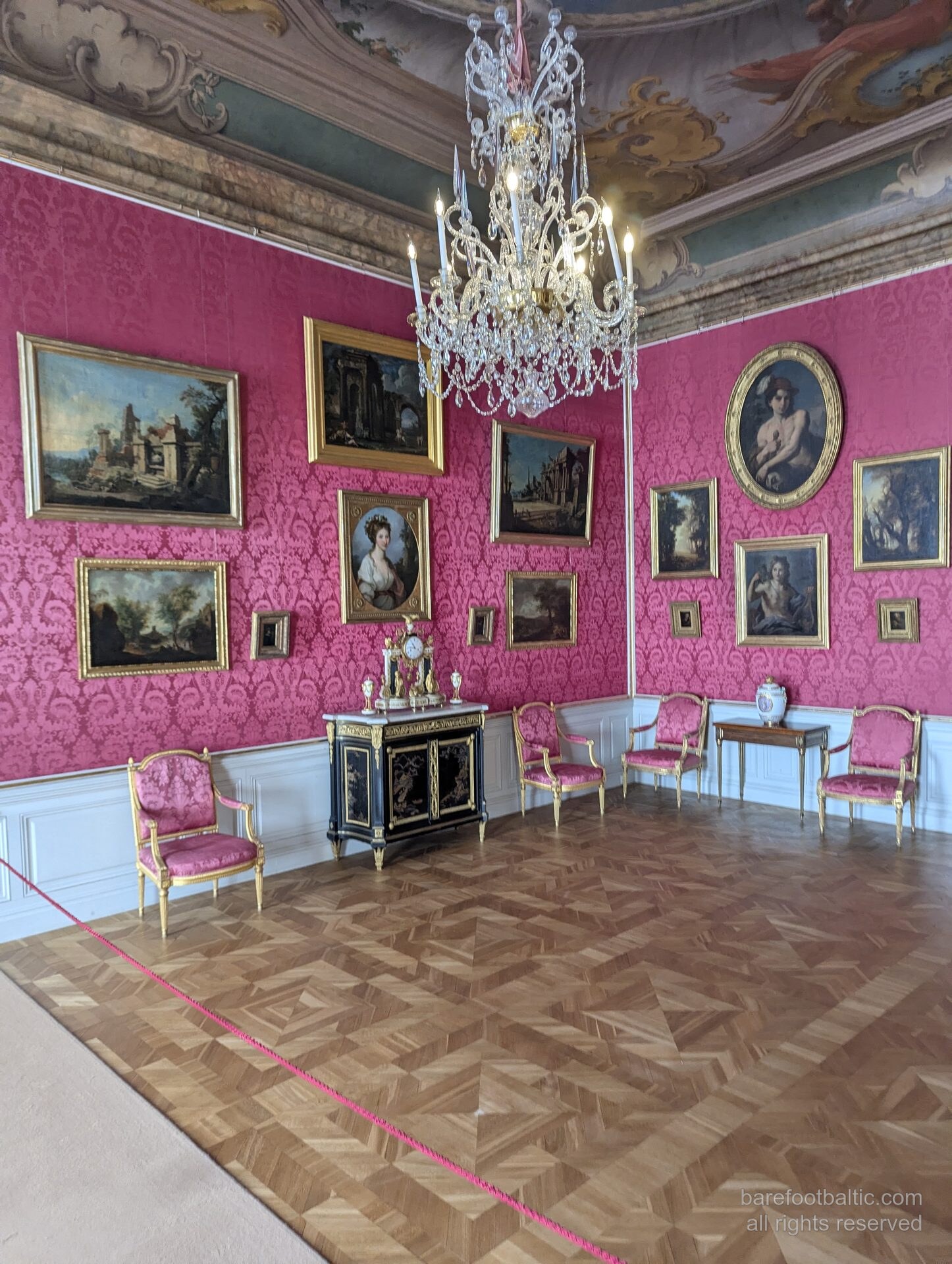
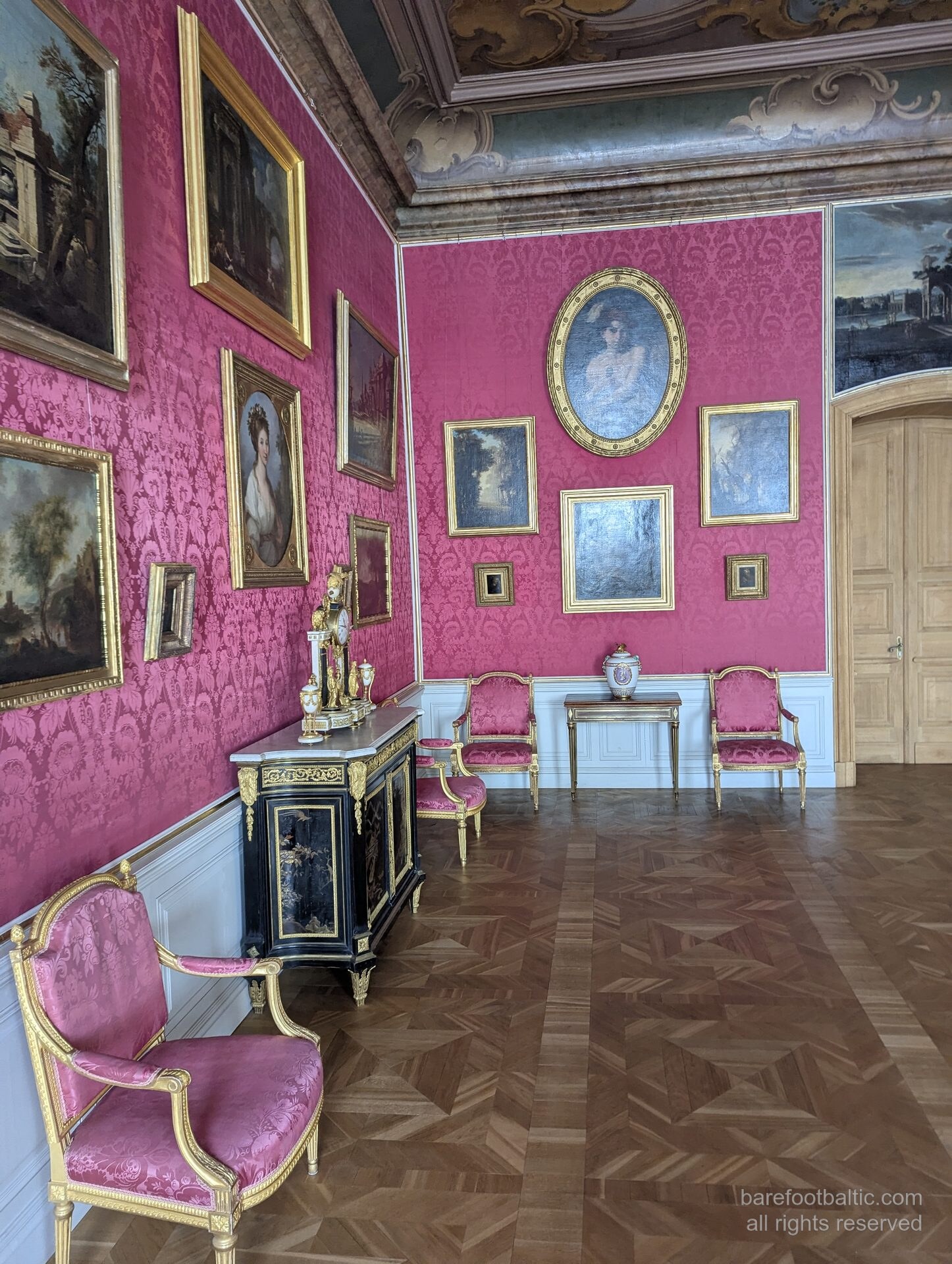
The solemnity of the room is achieved with dark red silk damask wallcoverings and Francesco Antonio Martini's ceiling painting. It depicts the Roman goddess Venus and her beloved Adonis who is preparing for a hunt.
Starting from this room, the interior design of the state apartments reflects the reign of Duke Peter, with Neoclassicism furniture and works of art. A black commode with bronze fittings and panels painted in Japanese lacquer technique is the most valuable item in the Museum's collection. It was made by Jean-Henri Riesener, the favourite furniture master of Queen Marie-Antoinette of France. Above the commode, we see a portrait of Duchess Dorothea in a light dress with flowers in her hair. This portrait was created by German painter Johann Friedrich Riedel after the work of Swiss artist Angelica Kauffman. The original was painted in Rome in 1785, and after its completion, the Duchess ordered three copies to give to her brothers and half-sister. This painting belonged to the Duchess's brother Karl von Medem.
On the opposite wall is a portrait of Duke Peter depicted in the garden of Vircava Palace. This painting, made by Friedrich Hartmann Barisien in 1781, has an interesting history. Duke Peter presented it to his founded education institution, the Academia Petrina in Jelgava, but in 1791 it was cut with a knife by a student Ulrich von Schlippenbach, who was influenced by the French Revolution. The offended Duke took the painting back and gifted it to his private doctor.
On top of the cylindrical bureau below the portrait of Duke Peter are two special vases, one with a portrait of Duchess Dorothea, the other with a monogram of Duke Peter. They were made at the Royal Porcelain Manufactory in Berlin in 1791 and were part of a set of five vases presented to Duchess Dorothea by King Friedrich Wilhelm II of Prussia. Their style corresponds to the early Neoclassicism period and is known as the "Weimar vase". Another vase made in Berlin has been placed on the card table by the wall opposite the window.
On both sides of the portrait of Duke Peter are allegories of Moderation and Justice painted by an unknown French artist in the middle of the eighteenth century. Closer to the window is the allegory of Abundance painted by the same author. All three paintings were once in the collection of Paul von Transehe-Roseneck, proprietor of Jaungulbene Manor House. Other paintings represent the work of eighteenth-century French and German artists.
Next, the Italian Salon.
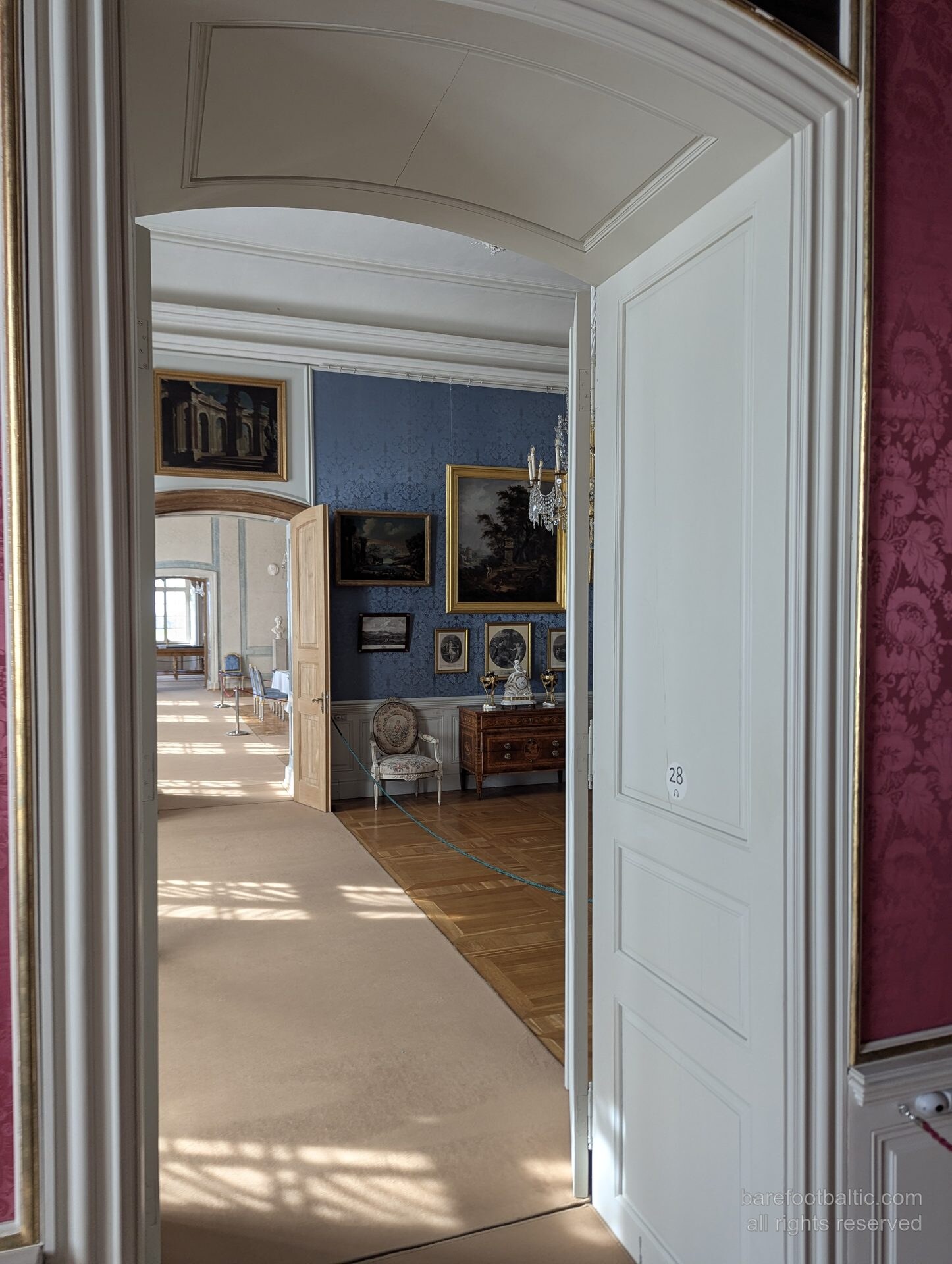
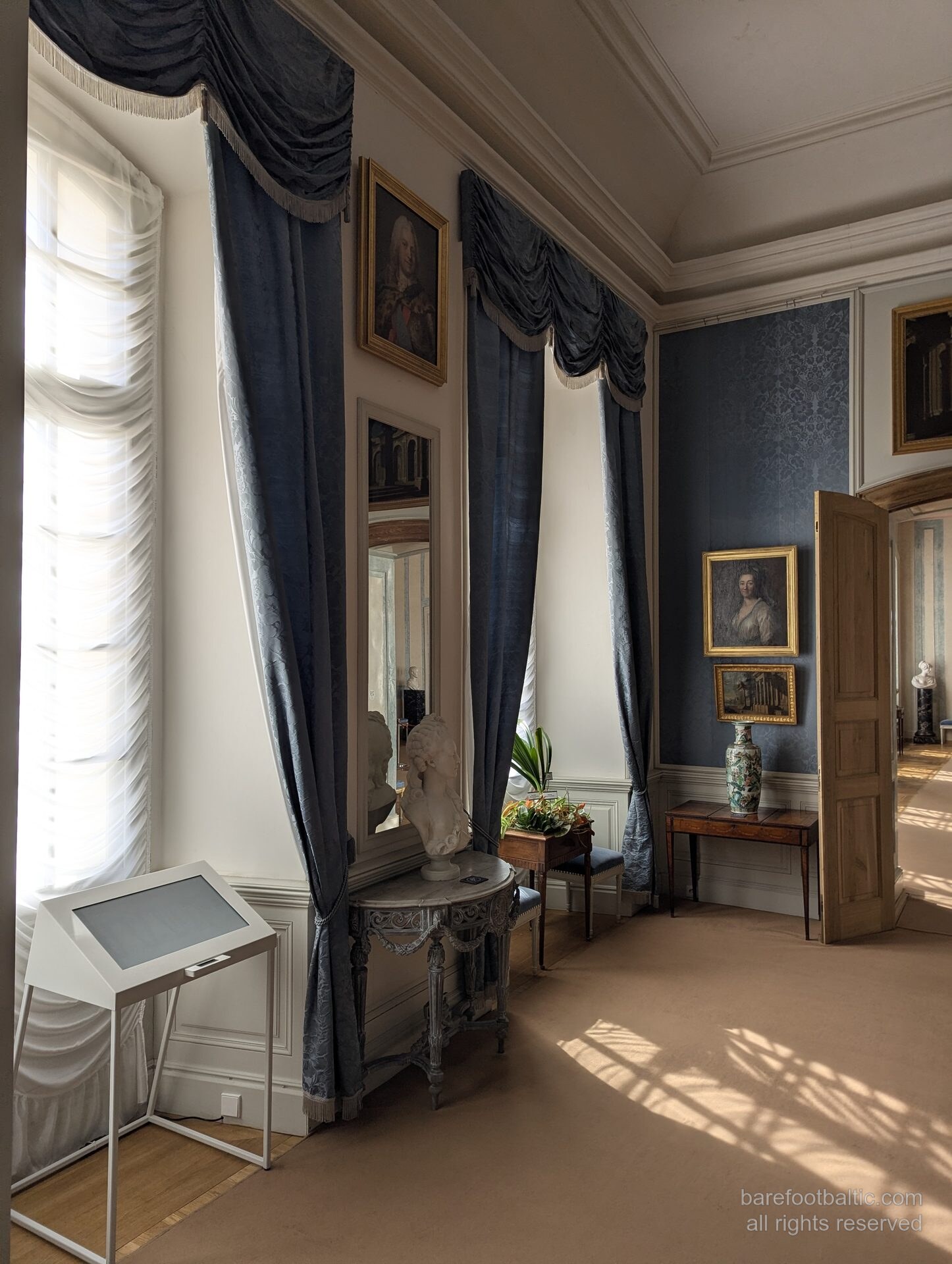
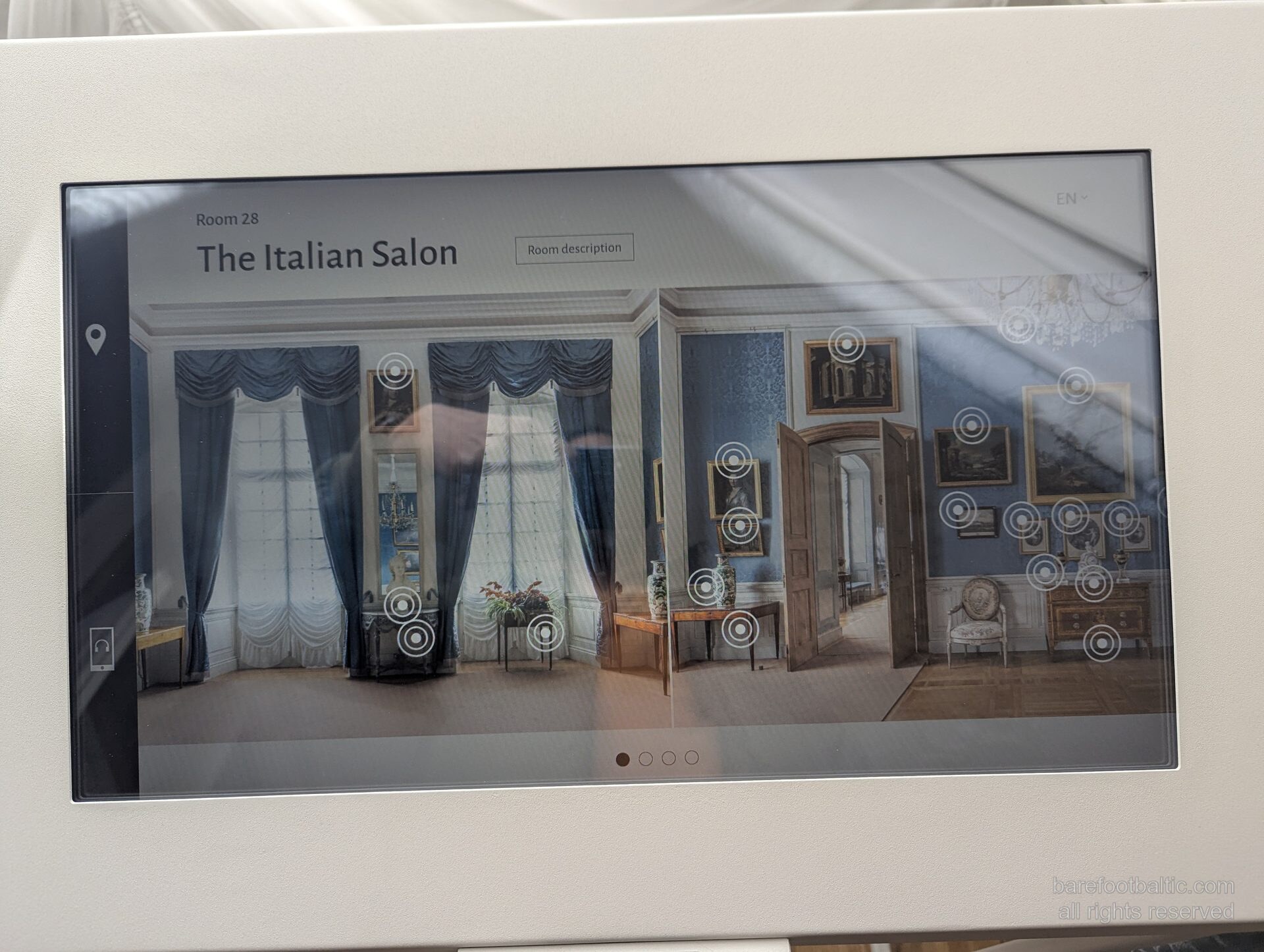
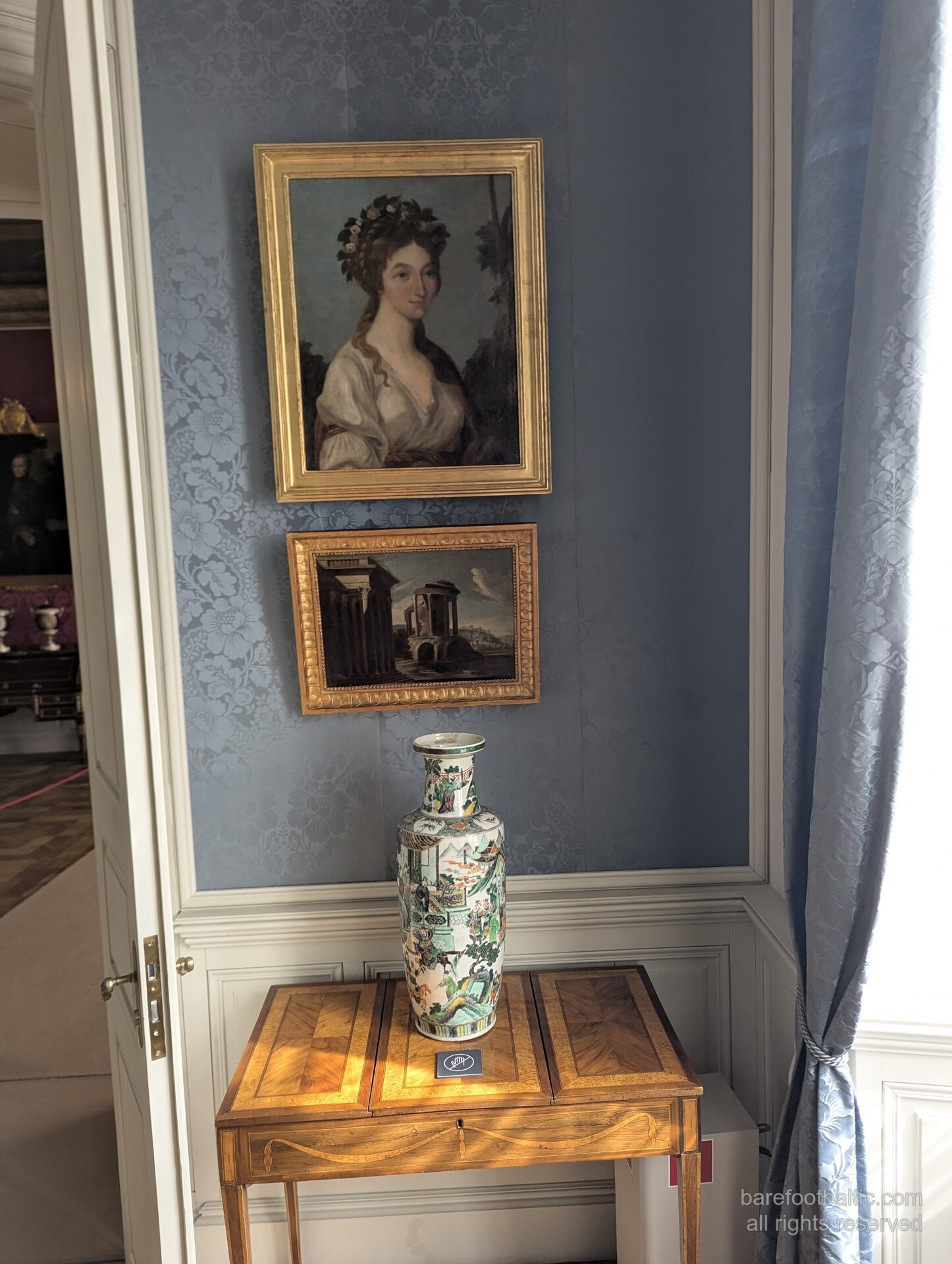
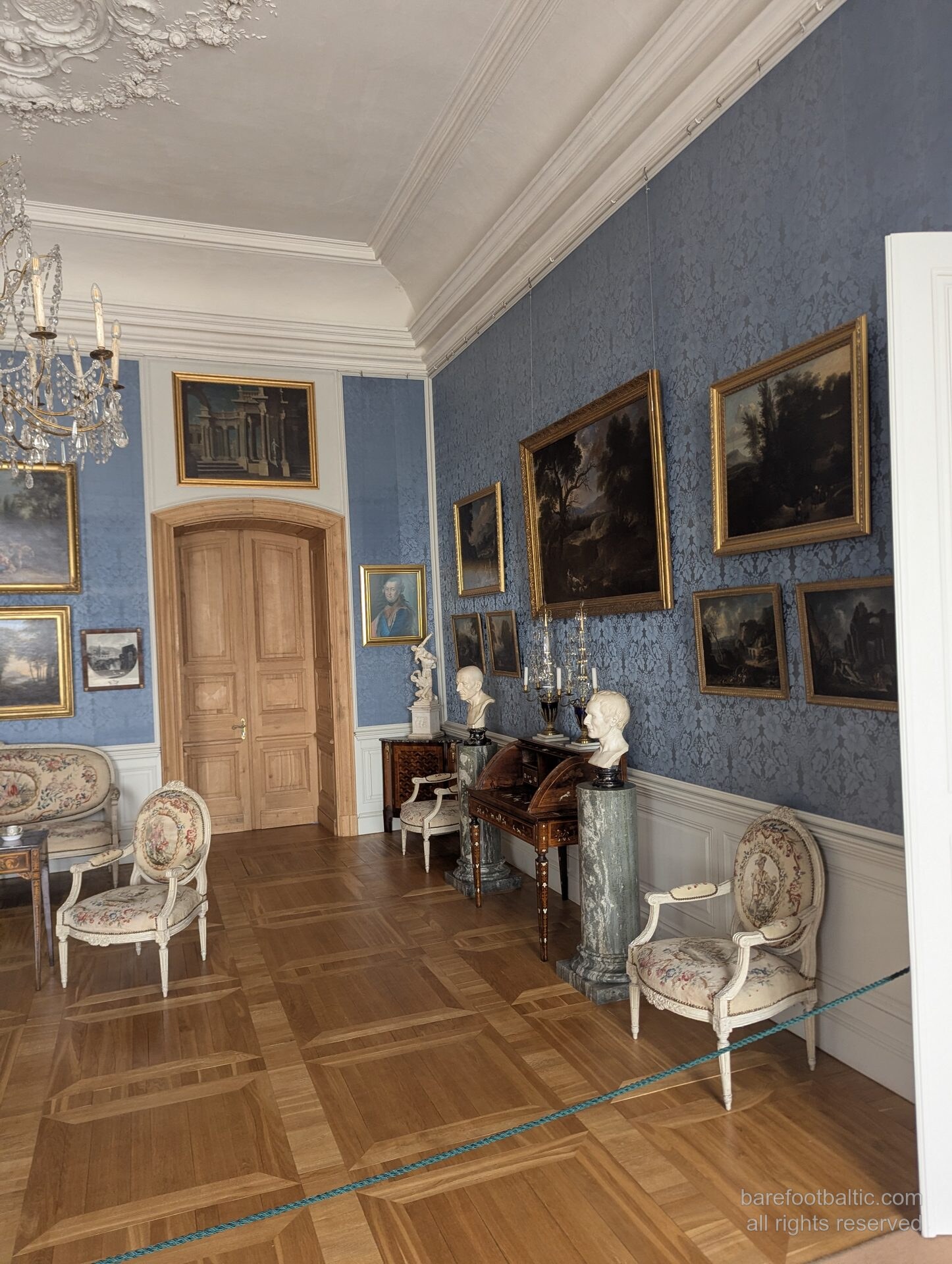
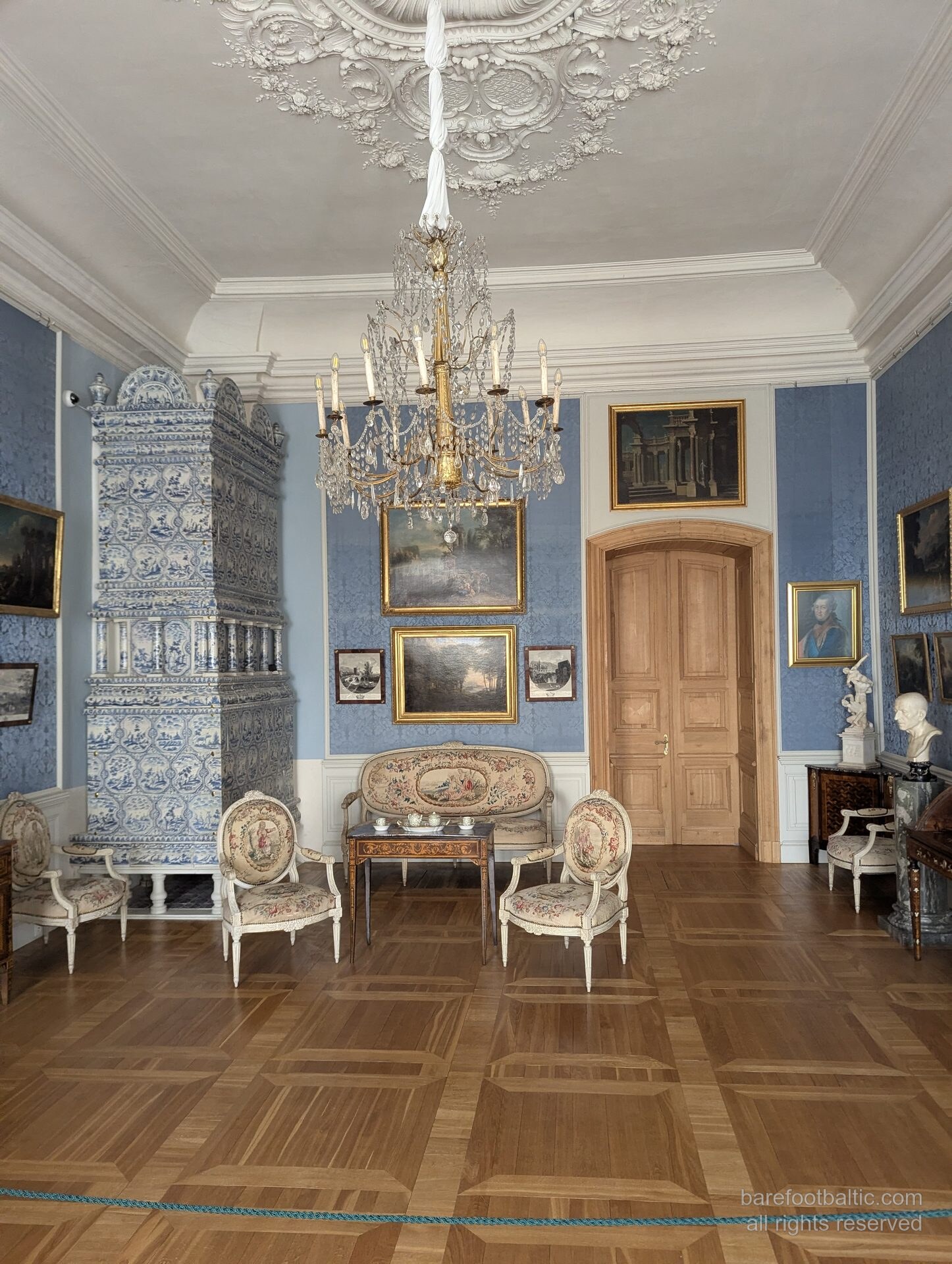
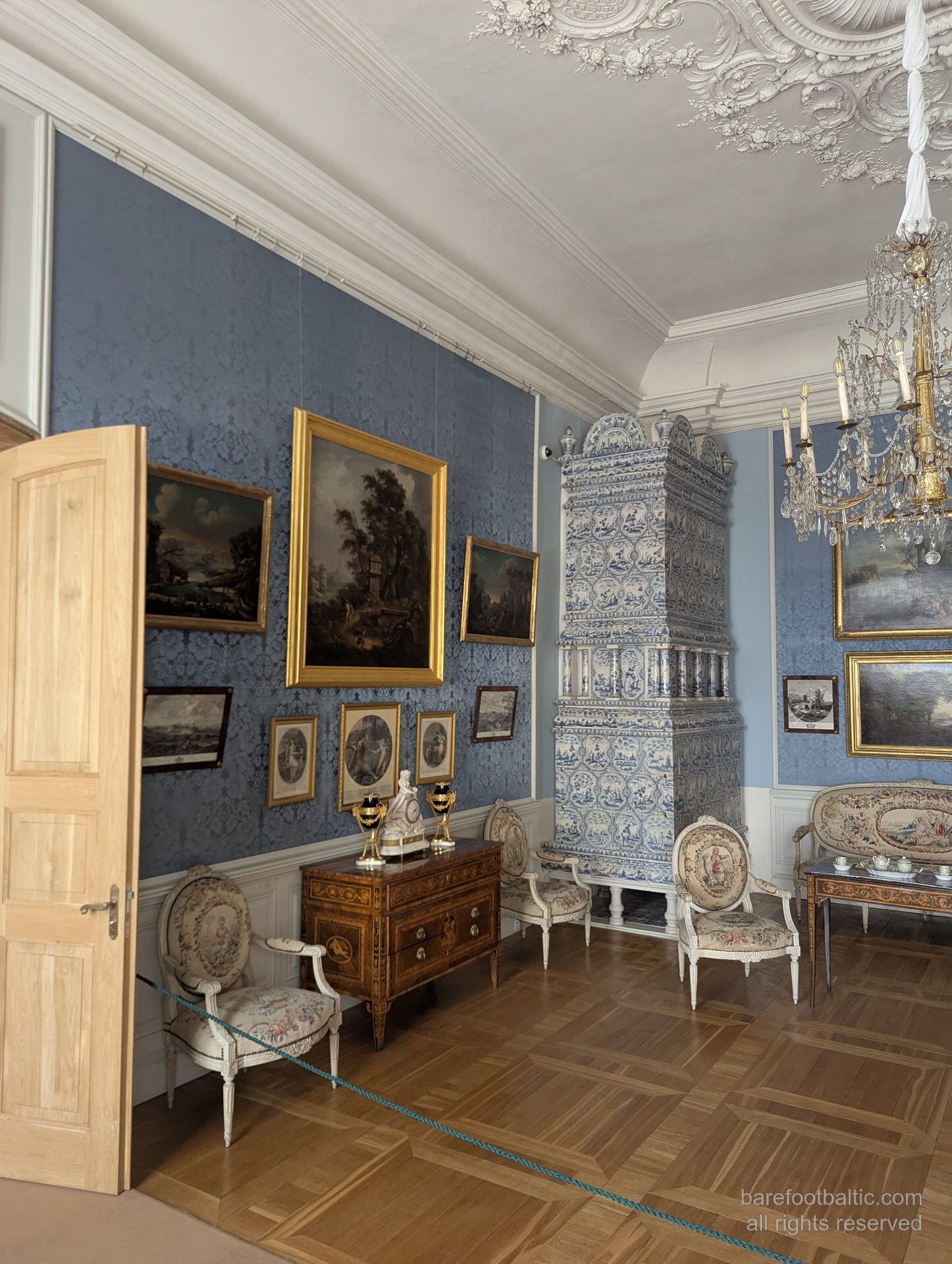
The Italian Salon
The layout of this room corresponds to the Neoclassicism style, although its name is reminiscent of the land Duke Peter had grown to love. During a trip abroad, Duke Peter spent almost a year in Italy with his wife Dorothea and eldest daughter Wilhelmine, visiting Florence and Vicenza, Venice and Verona where a plaque was erected in Giusti Garden in honour of the visit of Duchess Dorothea. Duke Peter even established a scholarship at the Accademia Clementina in Bologna.
In Rome, Duke Peter supplemented his art collection, while Duchess Dorothea and Princess Wilhelmine posed for the renowned painter Angelica Kauffman. A photocopy of the Duke's portrait displayed opposite the window was also made in Rome. Painter Jacob Philipp Hackert, the author of the Arcadian landscape displayed above the sofa, introduced the Duke's family to Naples and became his mediator in purchasing works of art.
Paintings, graphic drawings and sculptures by Italian artists create an atmosphere of Neoclassicism. A painting by the outstanding portraitist Anton Graff of Duchess Dorothea's half-sister, the writer Elisa von der Recke, is displayed by the window.
While admiring the furniture, you should also note a table with luxurious intarsia designed by Italian cabinetmaker Giuseppe Maggiolini. The Milan commode was also made in the manner of this master. An eighteenth-century plant table or jardinière, now a rarity, is displayed in the window opening. The upholstery of the seating furniture was crafted by French artisans using tapestries woven at the Aubusson Manufactory with themes from La Fontaine's fables. The room features a typical Italian chandelier with a metal baluster in the centre and a stove restored from the original tiles of Rundāle Palace.
Next, the Duke's Dining Room.
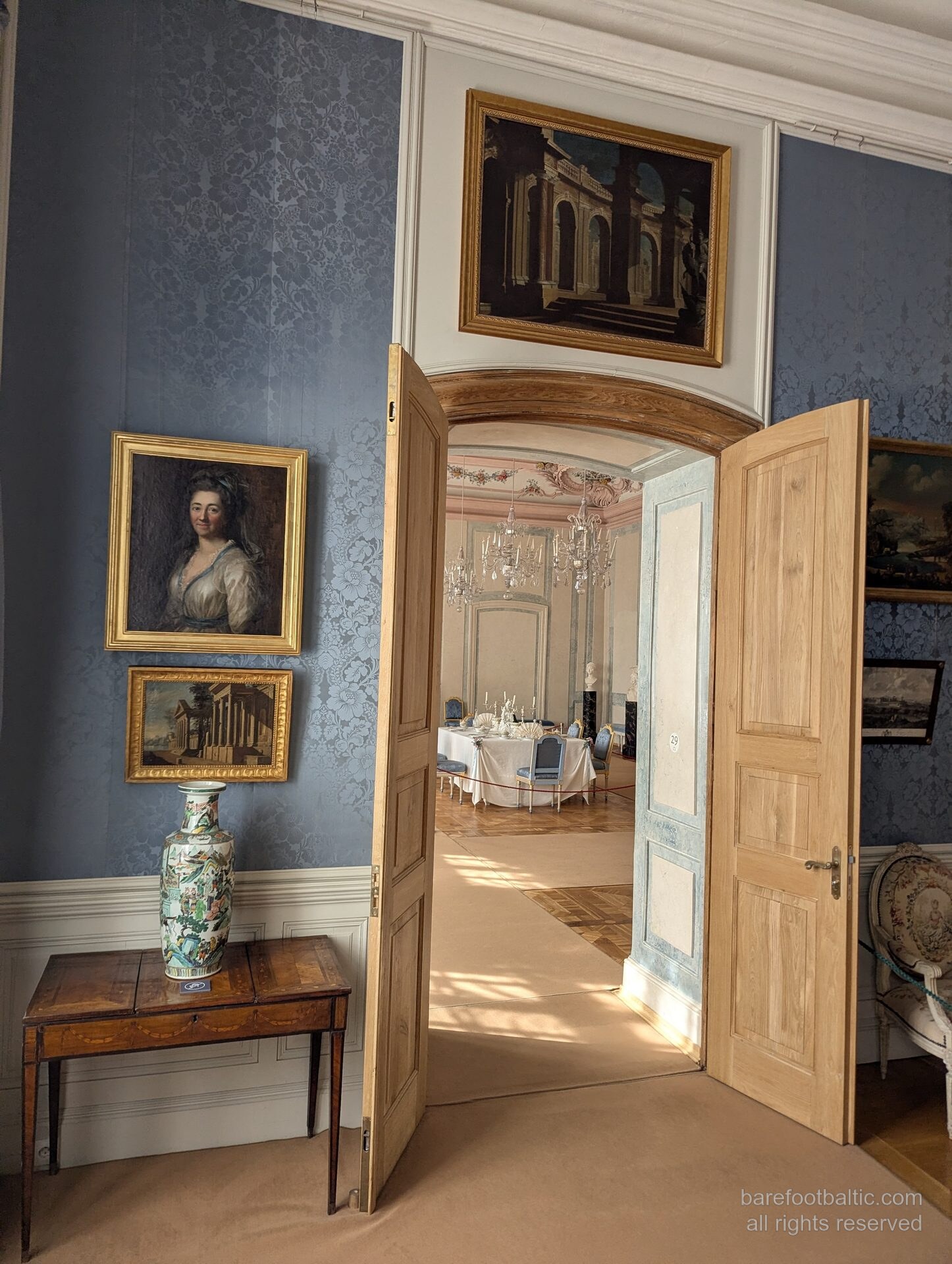
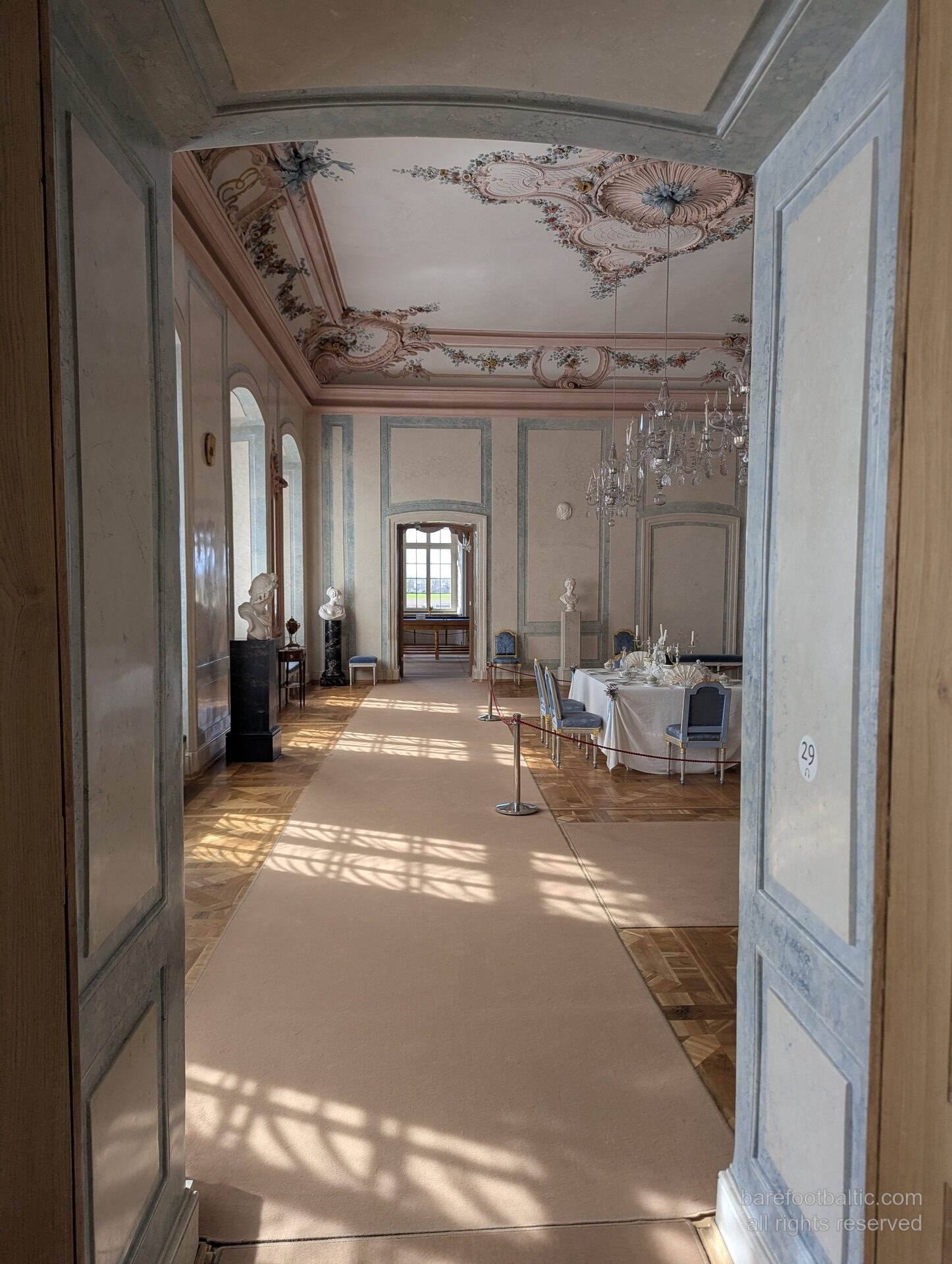
The Duke's Dining Room
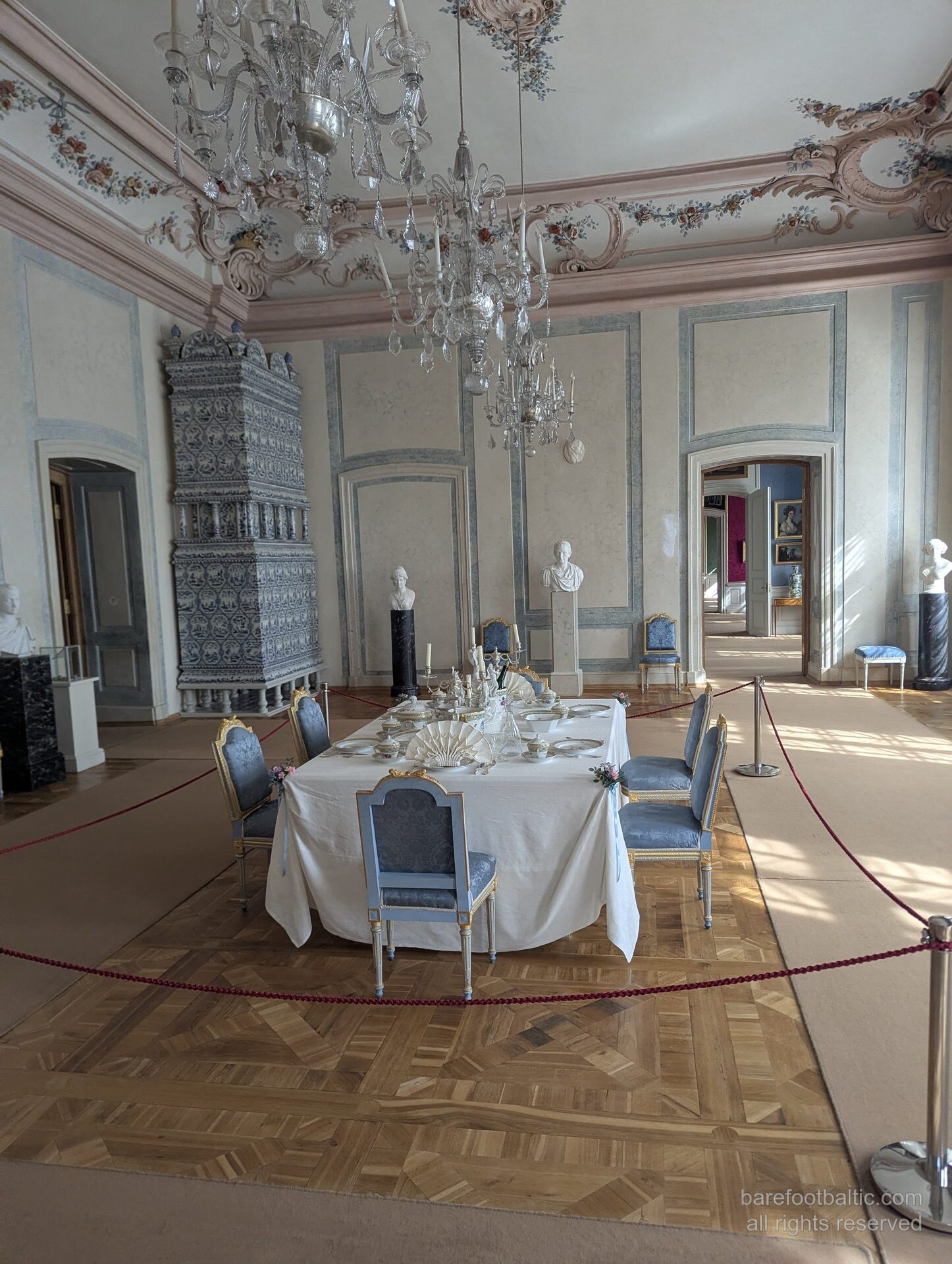
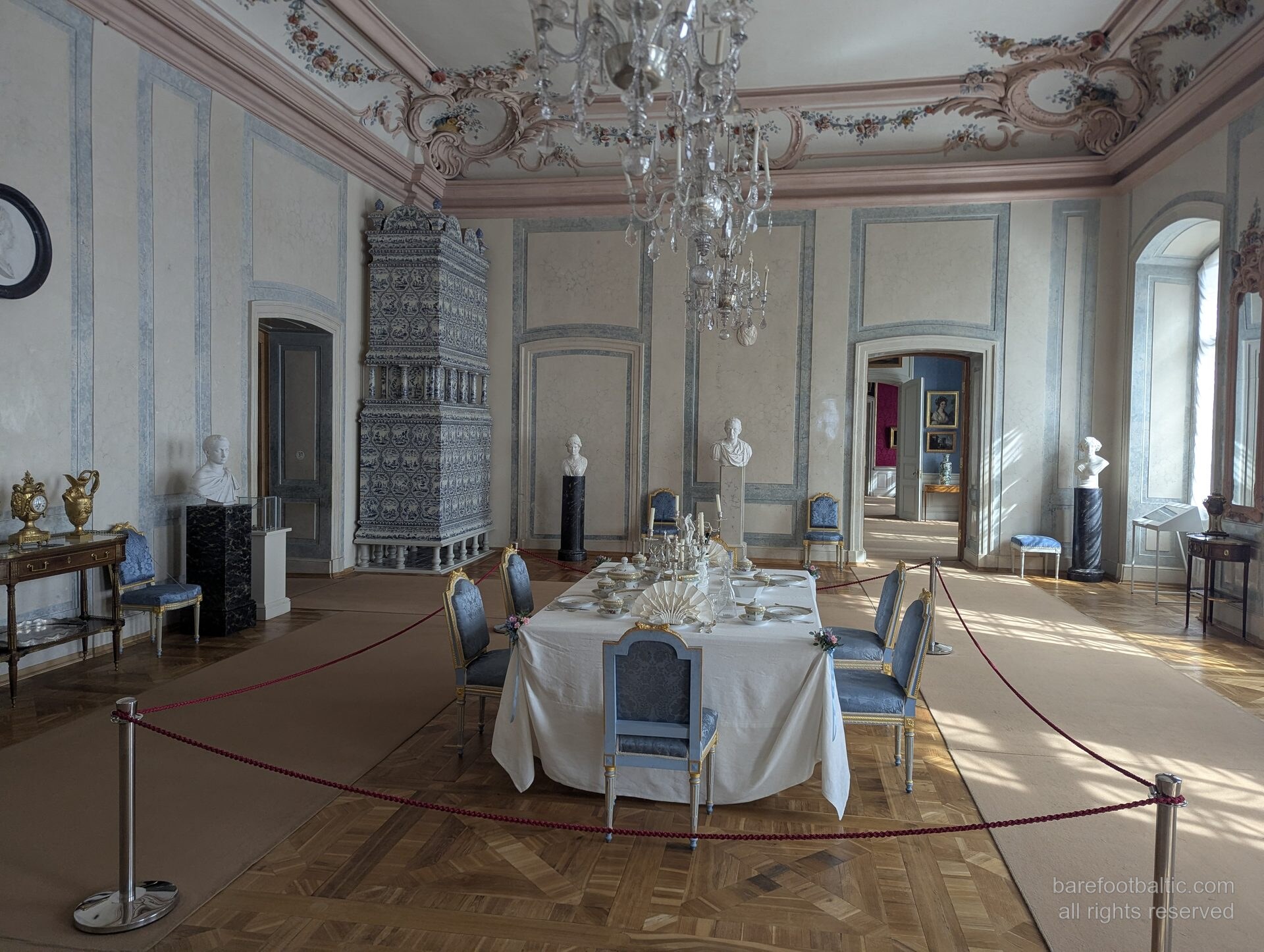
The largest room in the central building was the dining room for the Duke's family and a few guests. It was served from the kitchen, the hearths of which can now be seen in the decorative art exhibition on the ground floor of the palace. The room retained its original function throughout the eighteenth and nineteenth centuries.
Walls in the Duke's Dining Room are covered with stucco marble in shades of grey and blue. It contrasts the elaborate ceiling design with a monogram of Duke Ernst Johann on the ceiling cove enveloped in flowers. Unusual rosy and bluish colours have been chosen for the ceiling décor, perfectly complementing the artificial marble finish.
The layout of the room illustrates the reign of Duke Peter. The table in the middle is served for six people with a modern-day dinner set "Kurland", a well-known Neoclassicism model of the Royal Porcelain Manufactory in Berlin. It was commissioned around 1790 by Duke Peter for Friedrichsfelde Palace and is still in the assortment of this factory.
The chairs placed around the table were in Rundāle Palace during the reign of Duke Peter. These are copies made after the only original found broken in Pilsrundāle Mill. The original chair has been restored and is exhibited in the decorative art exhibition on the ground floor of the palace.
The set of chandeliers has been restored and reconstructed from fragments of chandeliers from Spāre Church. These are Bohemian-type chandeliers with glass arms and cut crystal glass pendants made around 1790.
Plaster casts or a glyptothek of sculptural portraits of the Duke's family are displayed in the Dining Room. On the right upon entering the room from the Italian Salon is a bust of Duke Peter. It is a cast made from the monument placed at the Academy of Fine Arts of Bologna Accademia Clementina in honour of Duke Peter when he established the scholarship in 1785. Until 1870, the scholarship was only awarded to the winners of a painting competition, but since then and until 1946 it was awarded without the competition. On the other side of the door, in the corner by the window, is a copy of the bust of Duke Peter's youngest daughter Dorothea. Its original was created by German sculptor Bernhardt Afinger. At the other end of the room, opposite Duke Peter, is a bust of Duchess Dorothea, the original of which was once in Remte Palace in Courland and is now in a private collection in Finland. In the corners by the same wall are busts of Wilhelmine, the eldest daughter of Duke Peter and Duchess Dorothea. The exact copy is of German sculptor Daniel Rauch's work, and on the other side is a copy of the work of Danish sculptor Bertel Thorvaldsen. By the window is a copy of the bust of Duchess Dorothea, the original of which was once in Chateau des Marais in France. The wall opposite the windows is a relief in a black frame. It is a cast from the original, which was made for Duke Peter's mausoleum in Sagan, but is now located in Chateau des Marais in France. Other sculptures are eighteenth-century marble replicas of Roman sculptures.
Next, the Billiard Room.
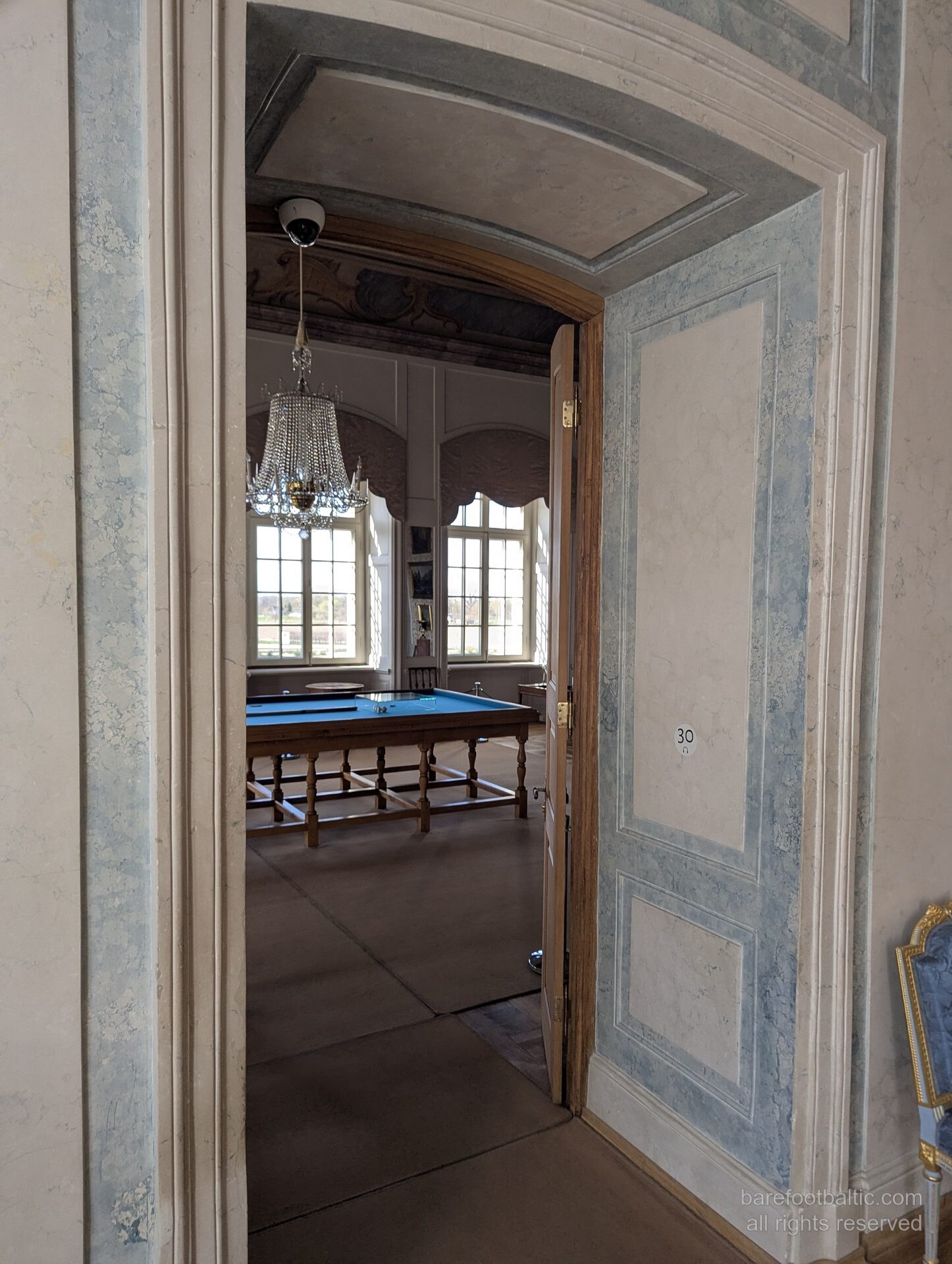
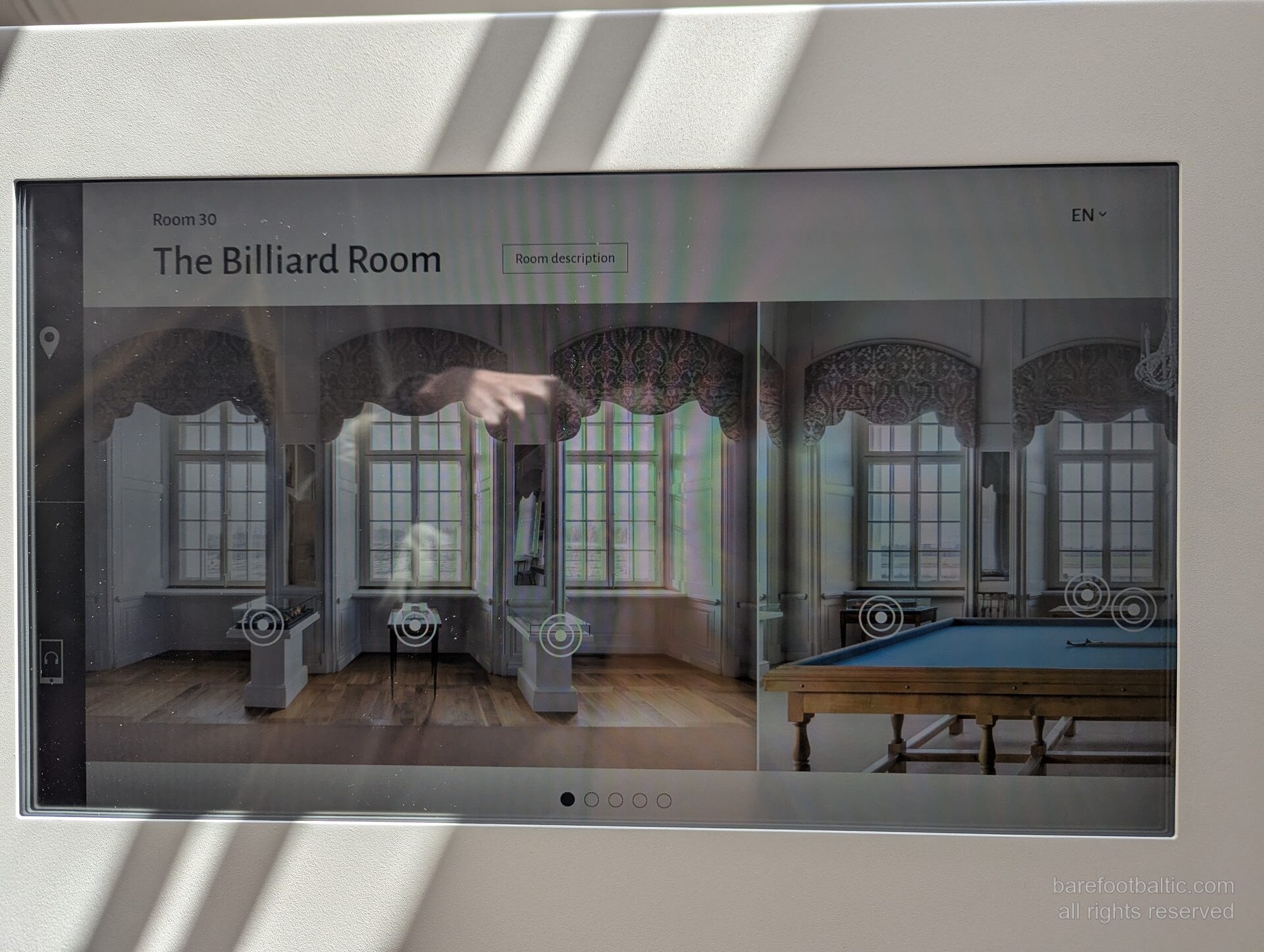
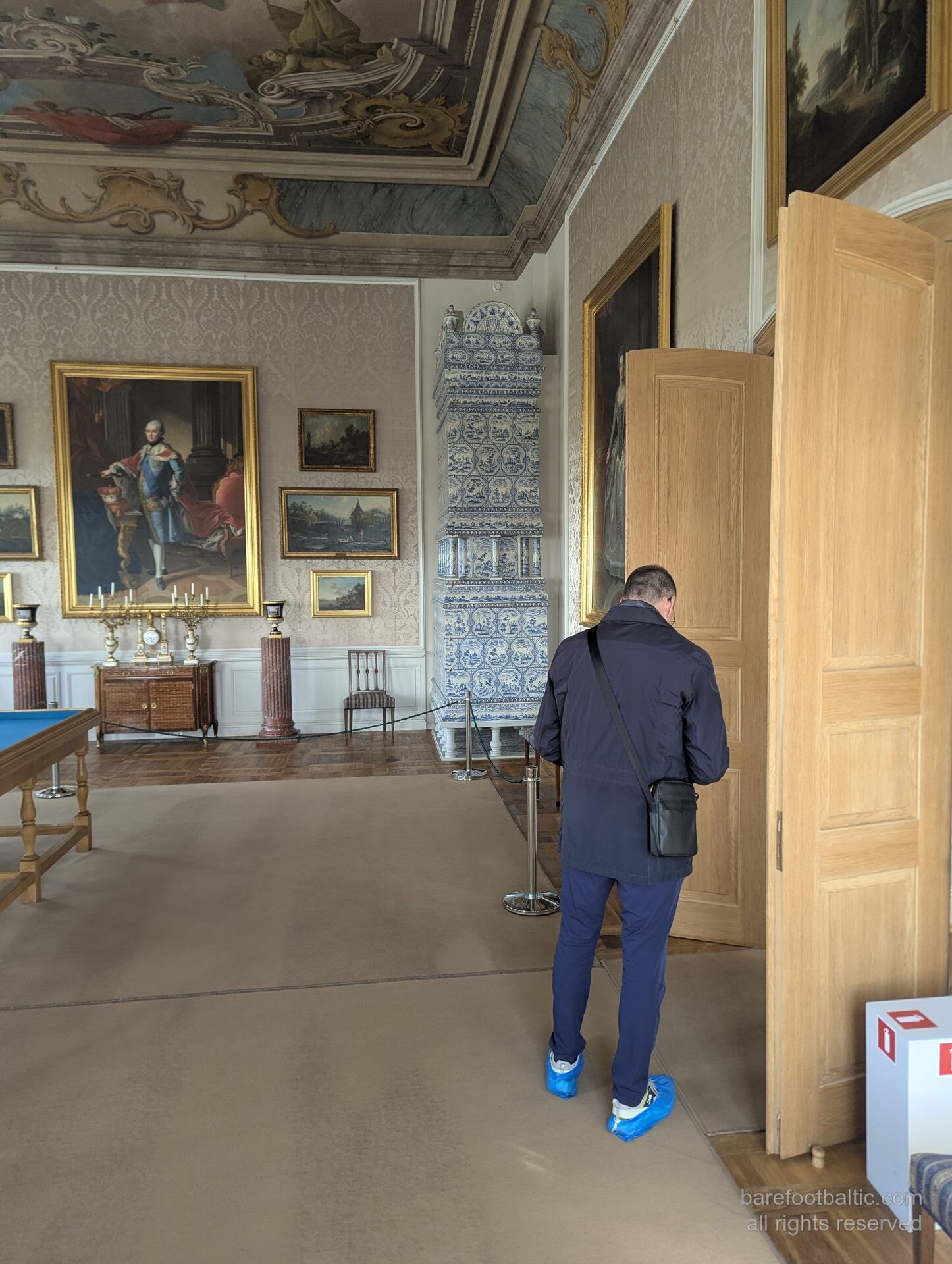
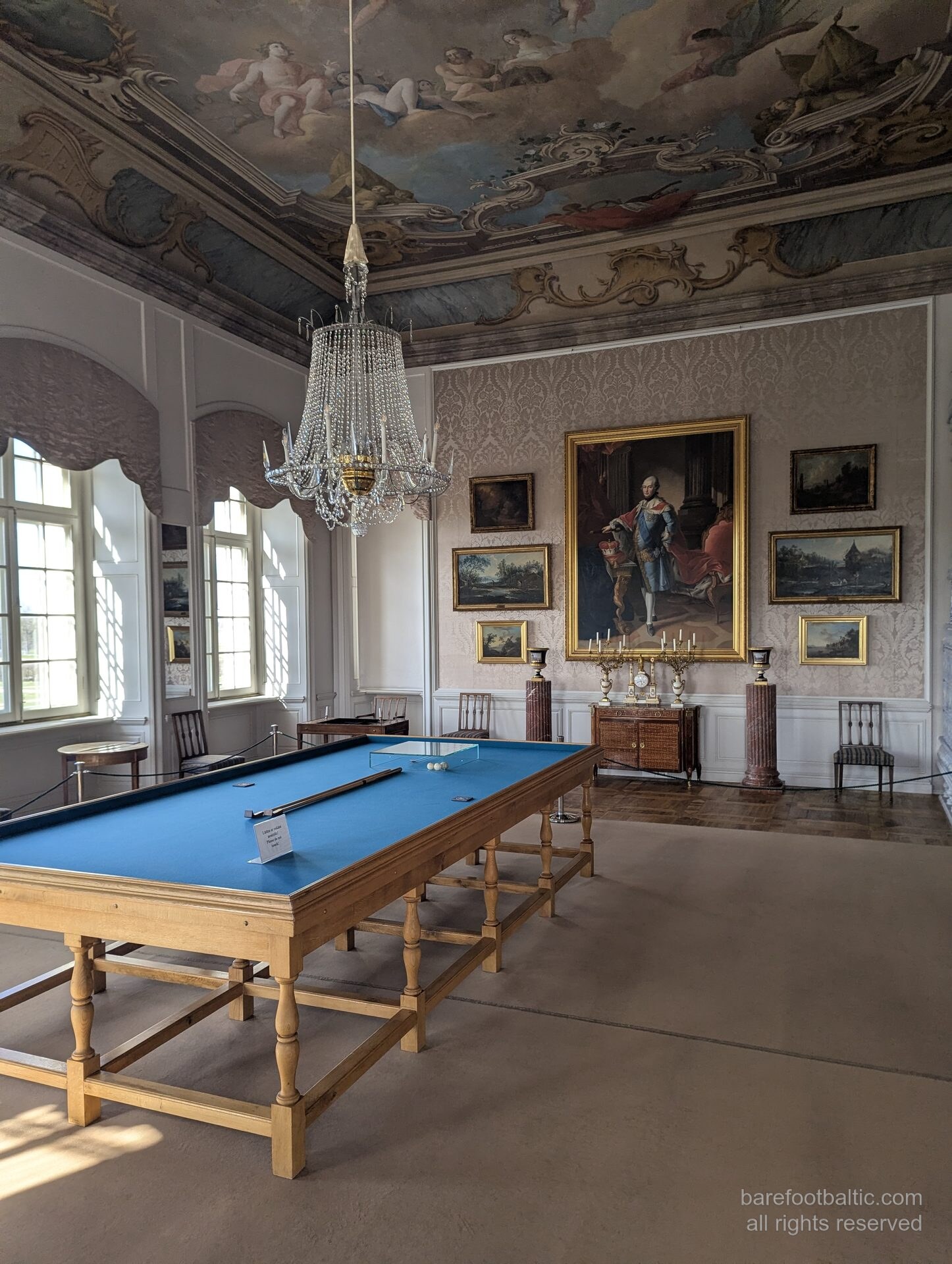
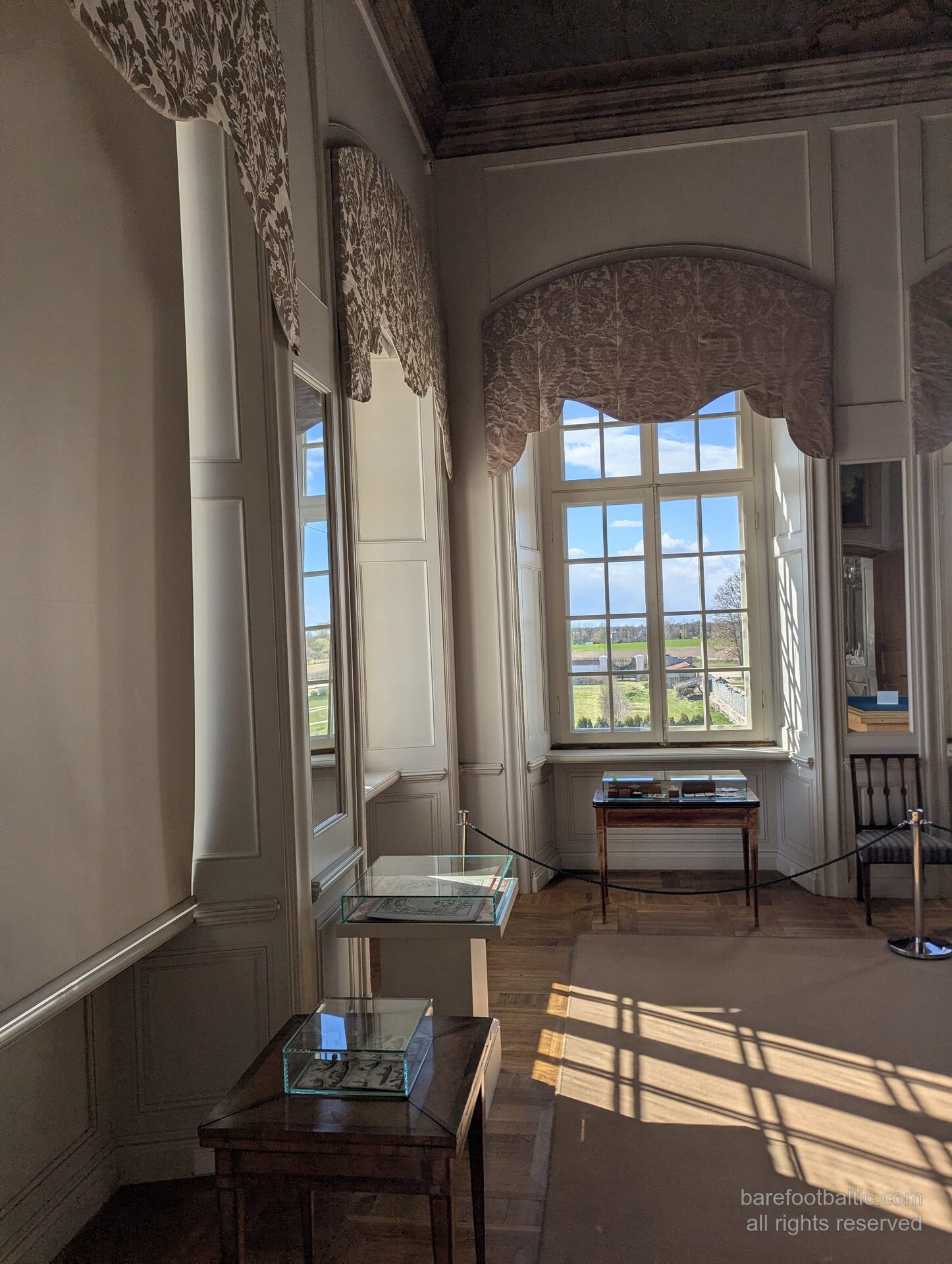
The Billiard Room
The plafond depicts the myth of the apple of discord, executed by Francesco Antonio Martini. An apple inscribed "To the most beautiful" is tossed by the goddess of discord Eris. It is contested by Minerva, Venus, and Juno while the king of the gods Jupiter refuses to get involved in the dispute and hands the apple to Mercury, the ambassador of the gods, who chooses the king's son Paris as a judge.
Games were a favourite pastime among aristocrats and in royal courts. In the beginning, billiards was a game of the nobles, although in the seventeenth century it became so popular that it was played everywhere, from royal households to pubs. According to written sources, in the eighteenth century billiard tables were in the palaces of the Dukes of Courland in Rundāle and Jelgava.
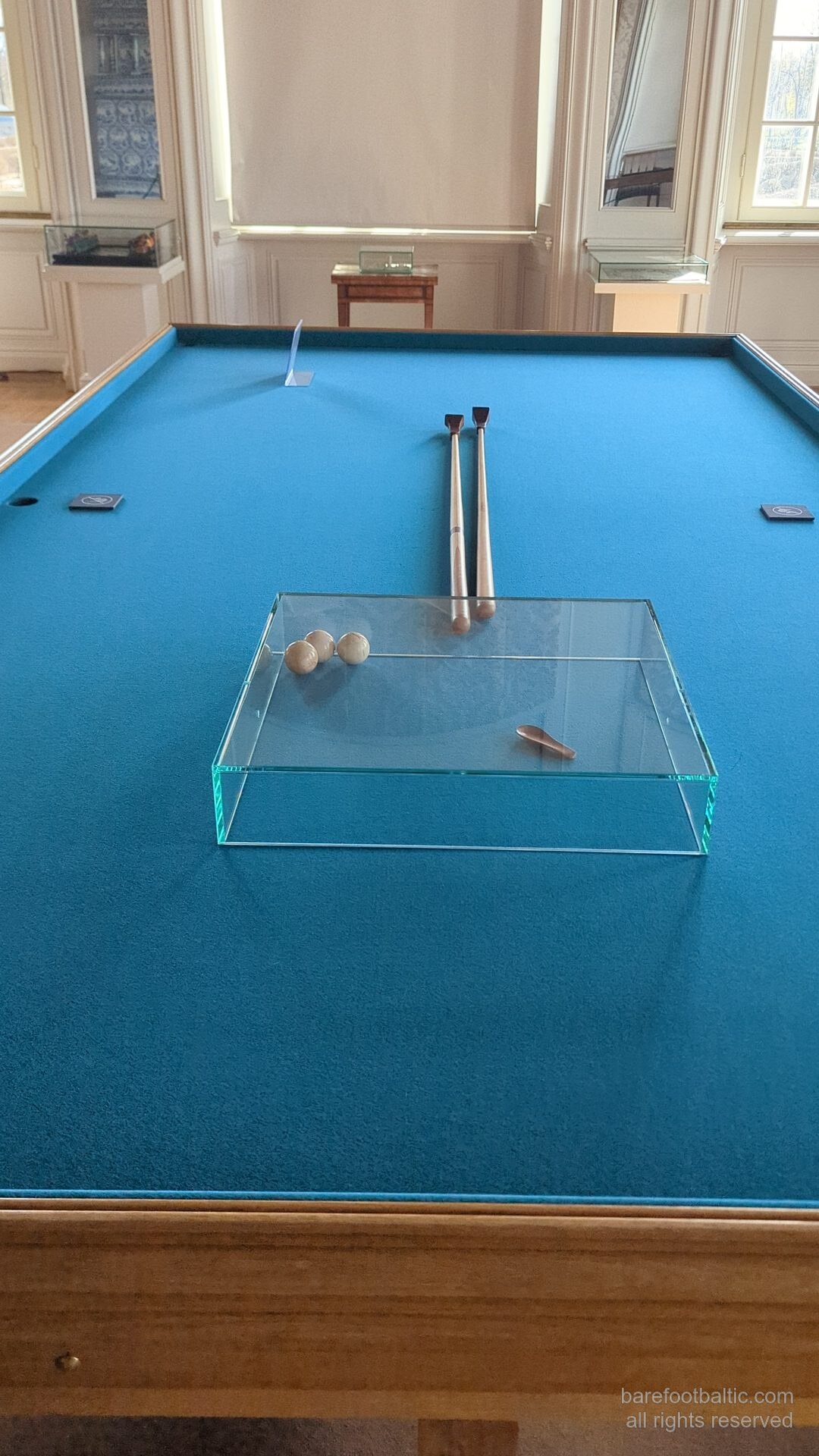
The oak billiard table placed in this room is newly made after a furniture sample book published by French carpenter André Jacques Roubo around 1770. Ivory balls and wooden maces with a widened tip rest on the table. Nowadays such maces are no longer used. This game has also changed a lot in other respects.
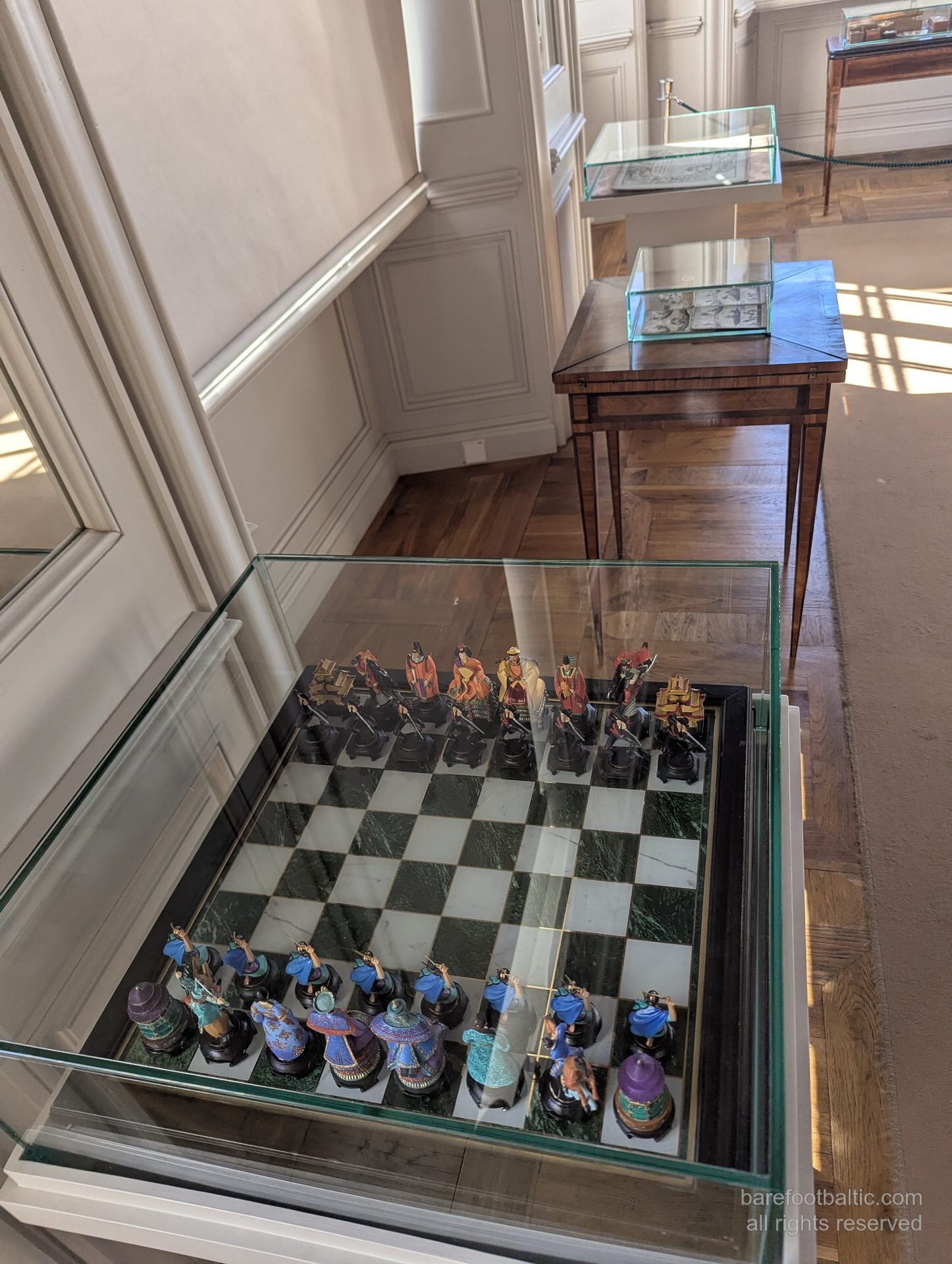
The exhibition is complemented by other popular board games of the time, often played at high stakes. There are several card tables made at the end of the eighteenth century. Opposite the window, behind the billiard table, you can see a round table for the dice game "The House of Fortune" built in Germany around 1800. In the corner of the room is an eighteenth-century French Backgammon table. Display cases in the room present the attributes of different games.
The Billiard Room is adorned with three large portraits by painter Friedrich Hartmann Barisien. He studied painting in Dresden and came to Courland from Russia. Barisien arrived at the Duke's court in 1770 and for fourteen years was the court artist painting state portraits corresponding to the grandeur of the Baroque style, mainly members of the Duke's family and the nobles of Courland and Polish Livonia. The large state portrait of Duke Peter is a copy. The original was painted in 1775 for the Duke's throne hall in Jelgava and is now in the collection of the National Museum in Wrocław, Poland. Similar in size and composition is a portrait made in 1784 of Duchess Dorothea with her daughters Wilhelmine and Pauline. By the window is a portrait of the sister of Duchess Benigna Gottlieb, Catherine von Bismarck.
The arrangement is complemented with a chandelier with glass beads made in the first half of the nineteenth century in Bohemia and recovered by the Rundāle Palace Museum from Lutriņi Lutheran Church.
Continuing the tour of the palace, we'll rest on the Duke's Dining Room and veer left to enter the Duke's private apartments.
The Shuvalov's Room
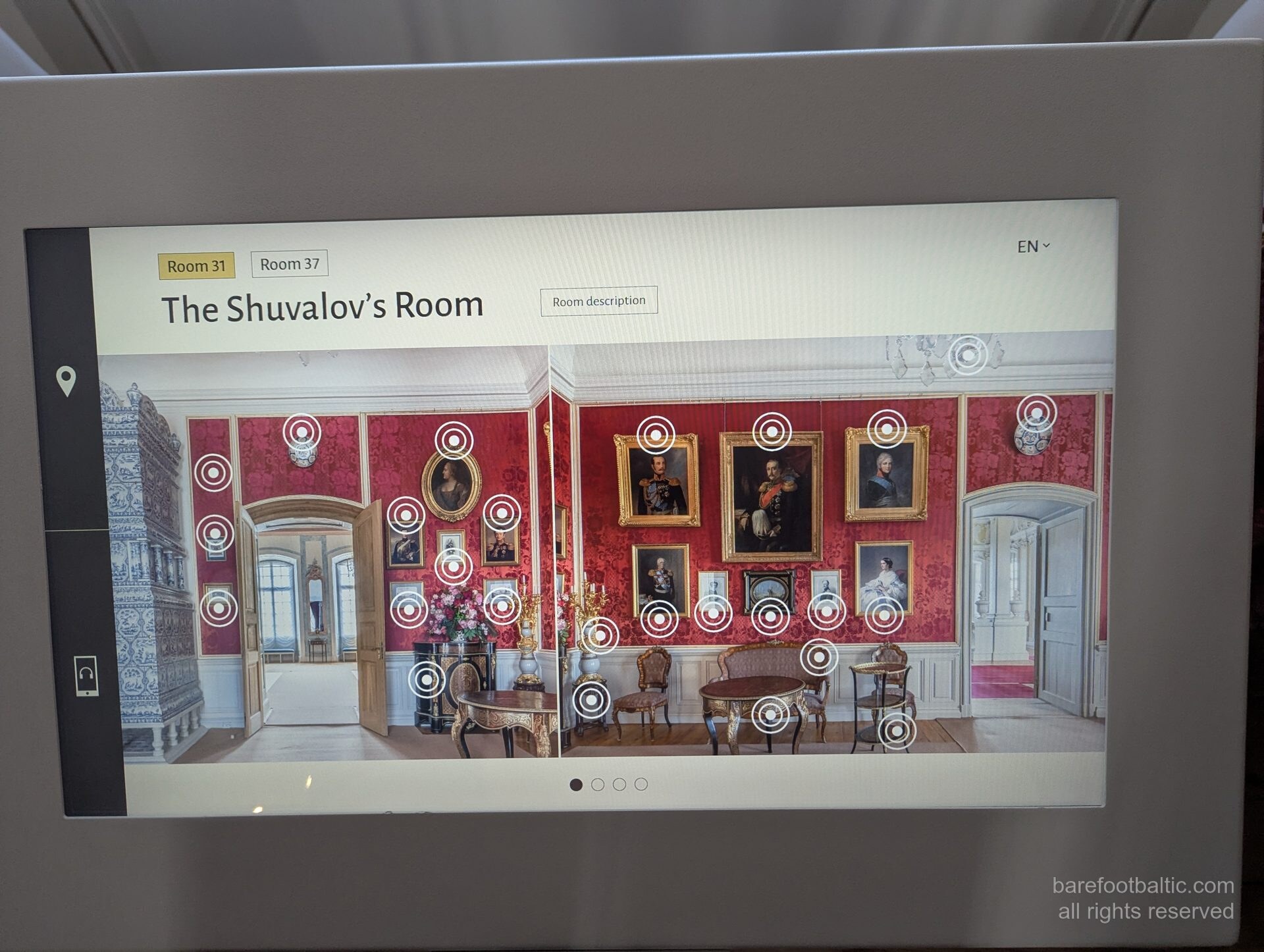
This antechamber in the west end of the Duke's private apartments is dedicated to the former owners of the palace, the Counts Shuvalov.
The palace became the property of the Shuvalov family when Platon Zubov's widow Princess Thekla married Count Andrey Shuvalov in 1824. The Shuvalovs owned Rundāle Palace for almost 100 years, until 1920, when Rundāle Manor came under the jurisdiction of the state of Latvia during the implementation of the Agrarian Reform Law. The layout of the room reflects the trends of the second half of the nineteenth century. In 1864, the son of Count Andrey, Pyotr Shuvalov, was appointed the Governor-General of the Baltic region and chose Rundāle Palace as his official summer residence. He modernized the interiors choosing furniture and works of art in the then-dominant Historicism style. The artistic décor of the rooms was not changed during the Shuvalov era and the sculptural décor of the eighteenth century has been preserved.
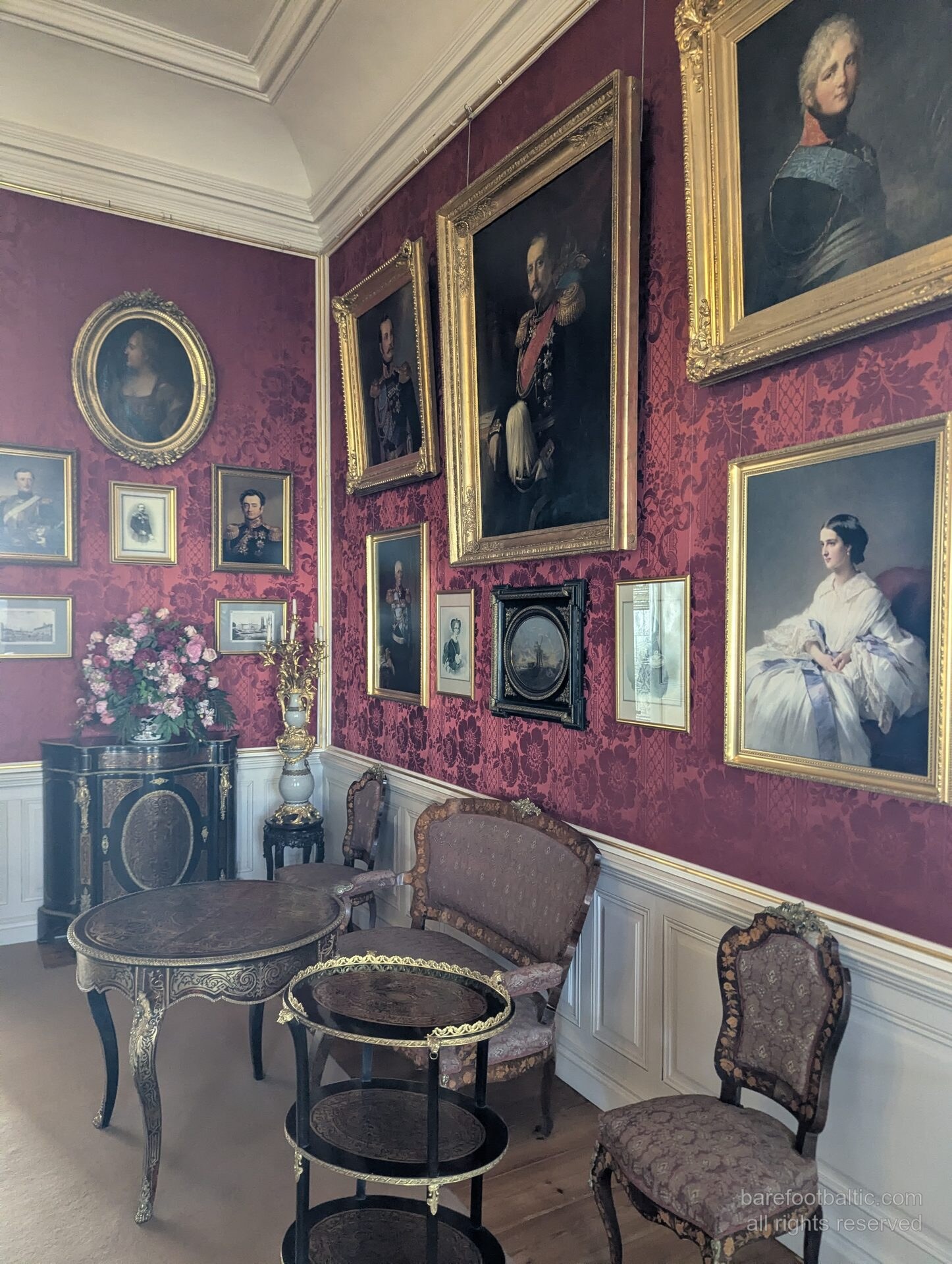
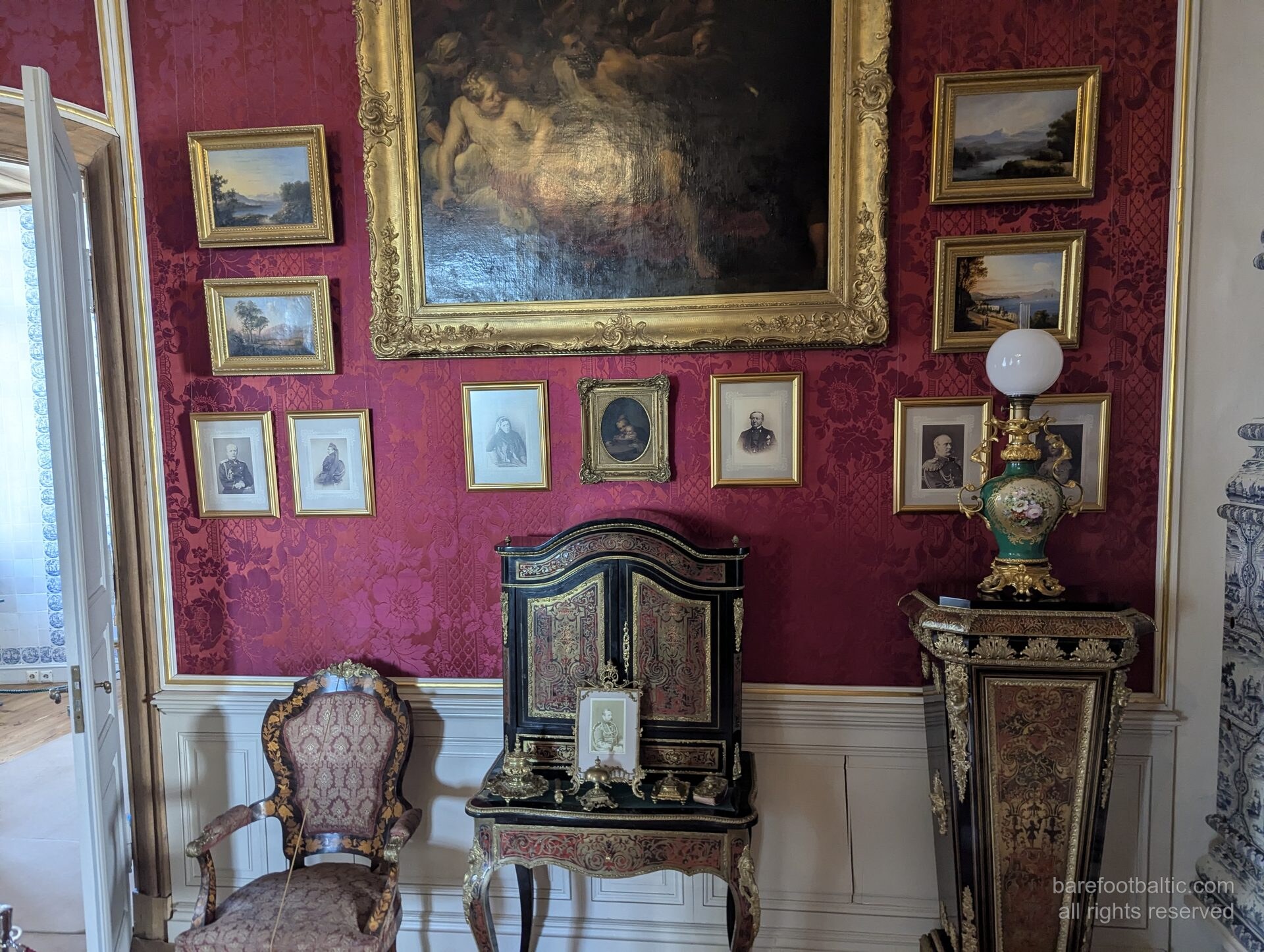
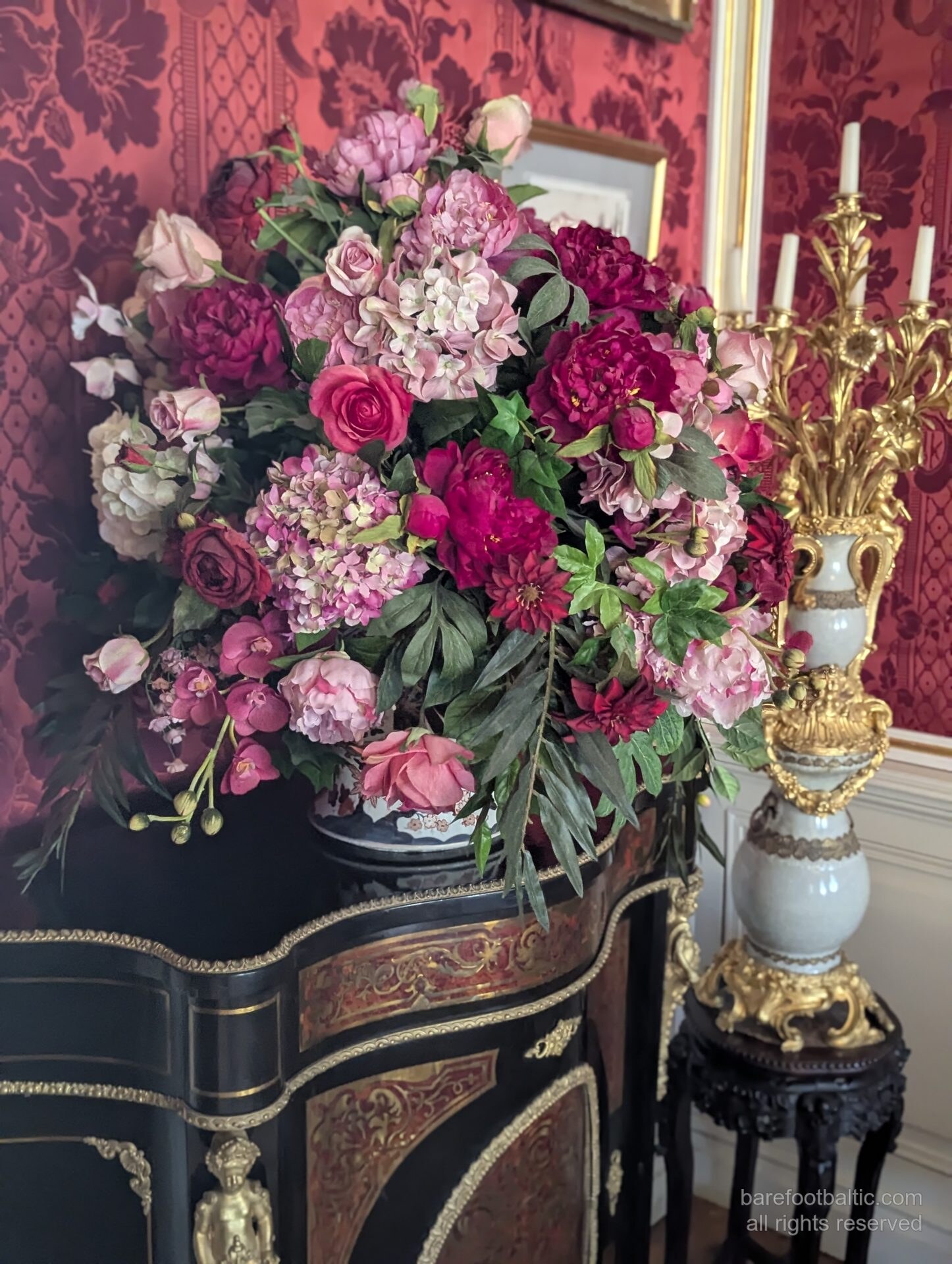
Most of the furniture illustrates the neo-Rococo style popular at the time. The furniture inlaid with tortoiseshell pieces and brass, the so-called "Boulle work" technique, was introduced by the cabinetmaker of King Louis XIV of France, André Charles Boulle. This furniture was made in nineteenth-century France. The red silk brocade wallcoverings were woven from a mid-nineteenth-century sample.
Above the secretaire and below the large painting are portraits of the first owners of Rundāle Palace from the Shuvalov family, Thekla Ignatievna and Andrey Petrovich. Closer to the stove and above the Boulle-work pedestal from Mežotne Palace, you can see copies of photographs of Thekla and Andrey's son Pyotr Andreyevich and his wife Elena Ivanovna. A marble bust is placed by the door leading to the Duke's private apartments. It depicts the last owner of Rundāle Palace in the Shuvalov family, Andrey, son of Pyotr Andreyevich. The bust was signed by his wife Vera Shuvalova who is said to have been artistically gifted, a ballet dancer and passionate about sculpture.
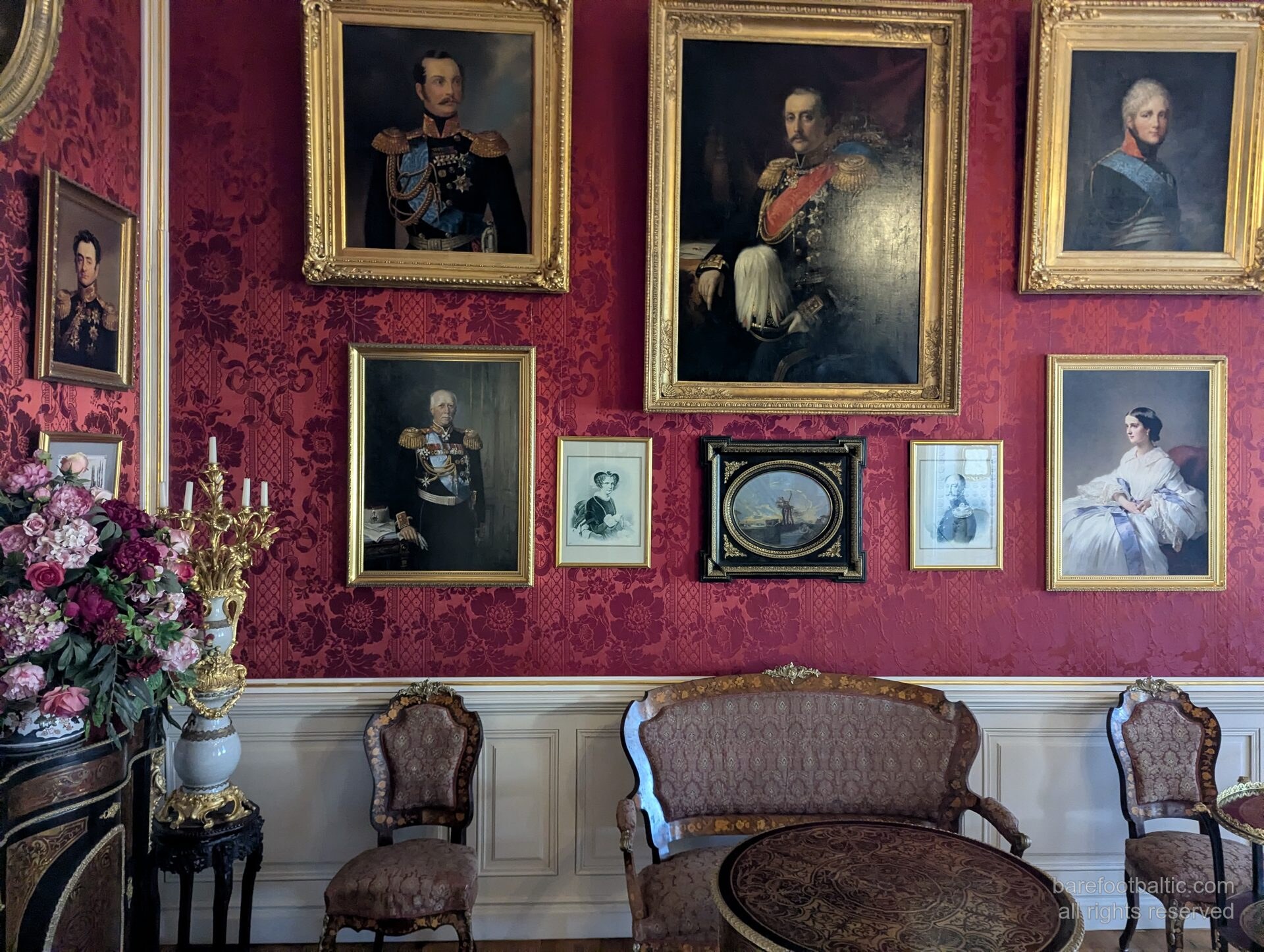
The room also displays portraits of Russian rulers, namely Catherine the Great, Alexander I, Nicholas I and Alexander II. Alexander II is also here as a bust and a photograph. Above the sofa is a portrait of the Governor-General of the Baltic Provinces, Prince Alexander Suvorov-Rymniksky, painted in 1862 by the Russian court artist of German-Baltic origin Carl Timoleon von Neff.
We now continue the tour in the Duke's private apartments.
The Antechamber of the First Toilet-Room of the Duke
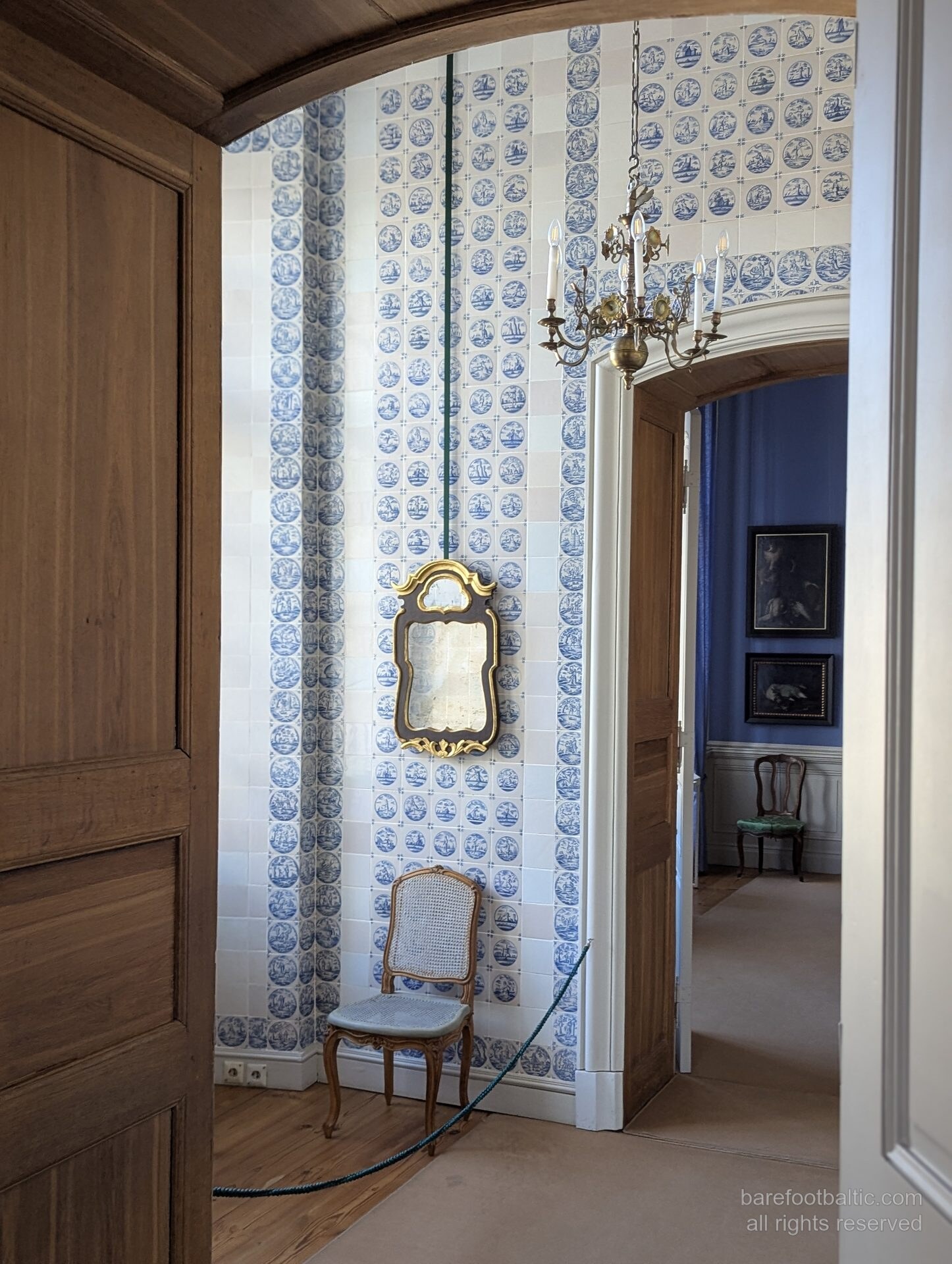
This small room in the Duke's private apartments is the bathroom. Its walls are tiled with two types of Dutch tiles made in Utrecht around 1739. Areas of white tiles are enclosed with strips of painted cobalt tiles depicting Biblical scenes, while the centre of each area is filled with tiles depicting landscapes as well as shepherds and shepherdesses.
Oak doorway panels in this room have been preserved from the first construction period. There are two types of original glass in the door to the right leading to the toilet-room. The panes with curves were made by blowing the glass, while the uneven panes with air bubbles were made by casting and pressing the glass. The tiled walls are easy to clean, and the chairs made by chairmaker Jean Boucault with rattan strip wicker are just as easy to maintain.
Next, the Hunting Room.
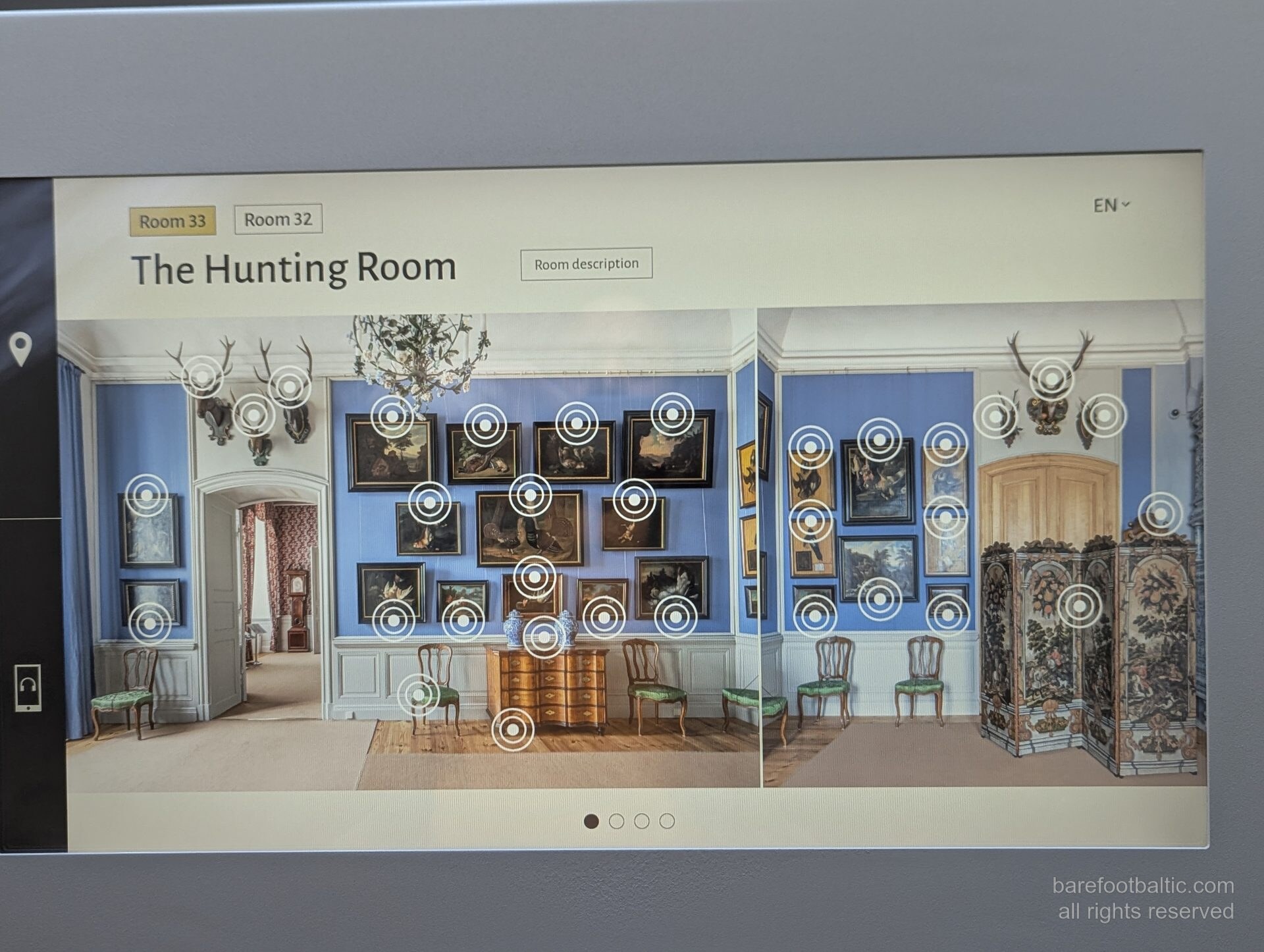
The Hunting Room
Duke Ernst Johann and Duke Peter were passionate hunters, and since their residence in Rundāle was also a hunting palace, a room in the enfilade of the Duke's private apartments is dedicated to the theme of hunting.
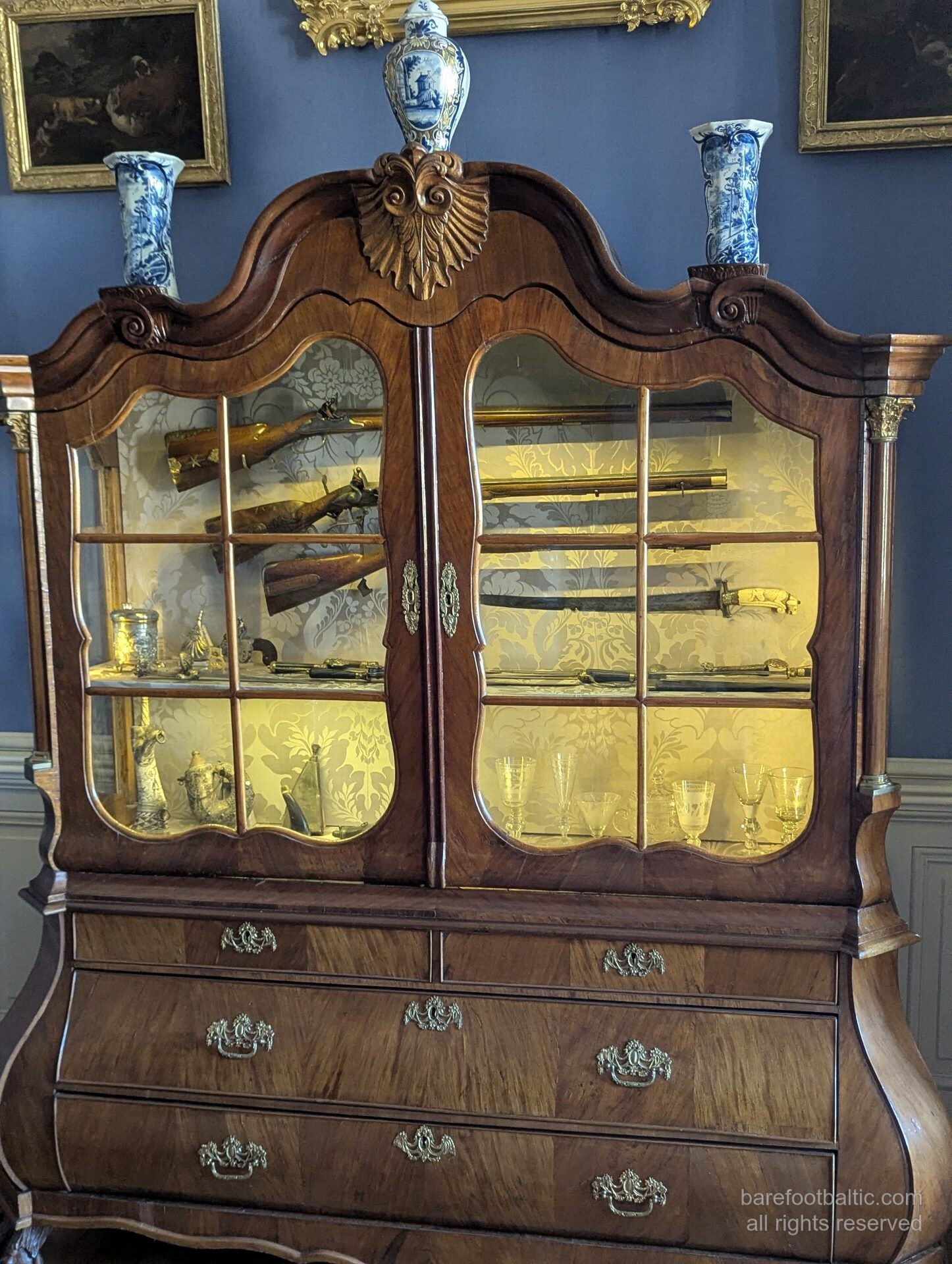
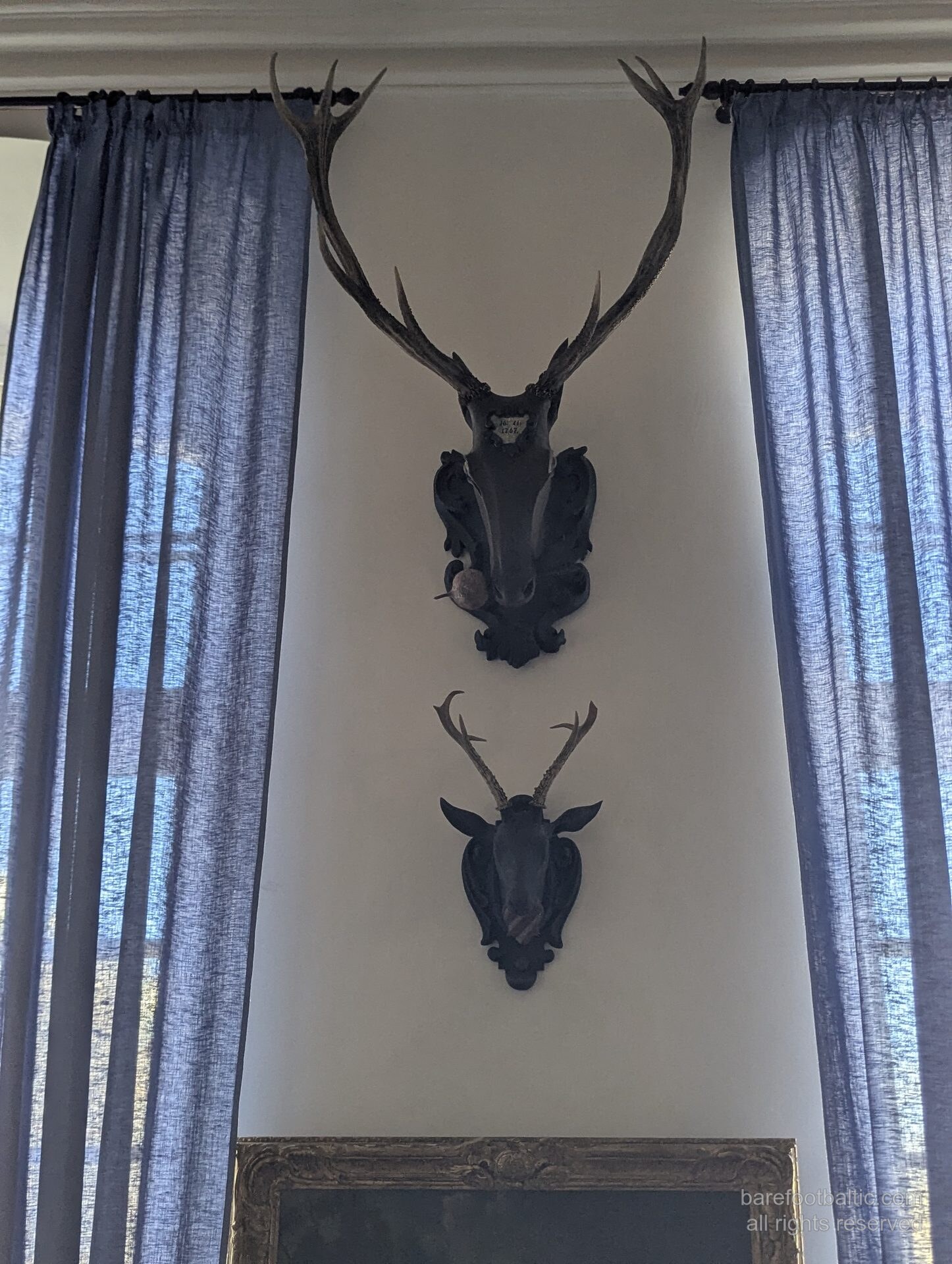
Above the door and on the wall between the windows we see sets of stag and deer antlers with carved animal heads and base cartouches. They were made in Germany and Austria in the late seventeenth and eighteenth centuries. The display case features hunting swords and knives, shotguns, powder horns and glass goblets with hunting scenes from the same period.
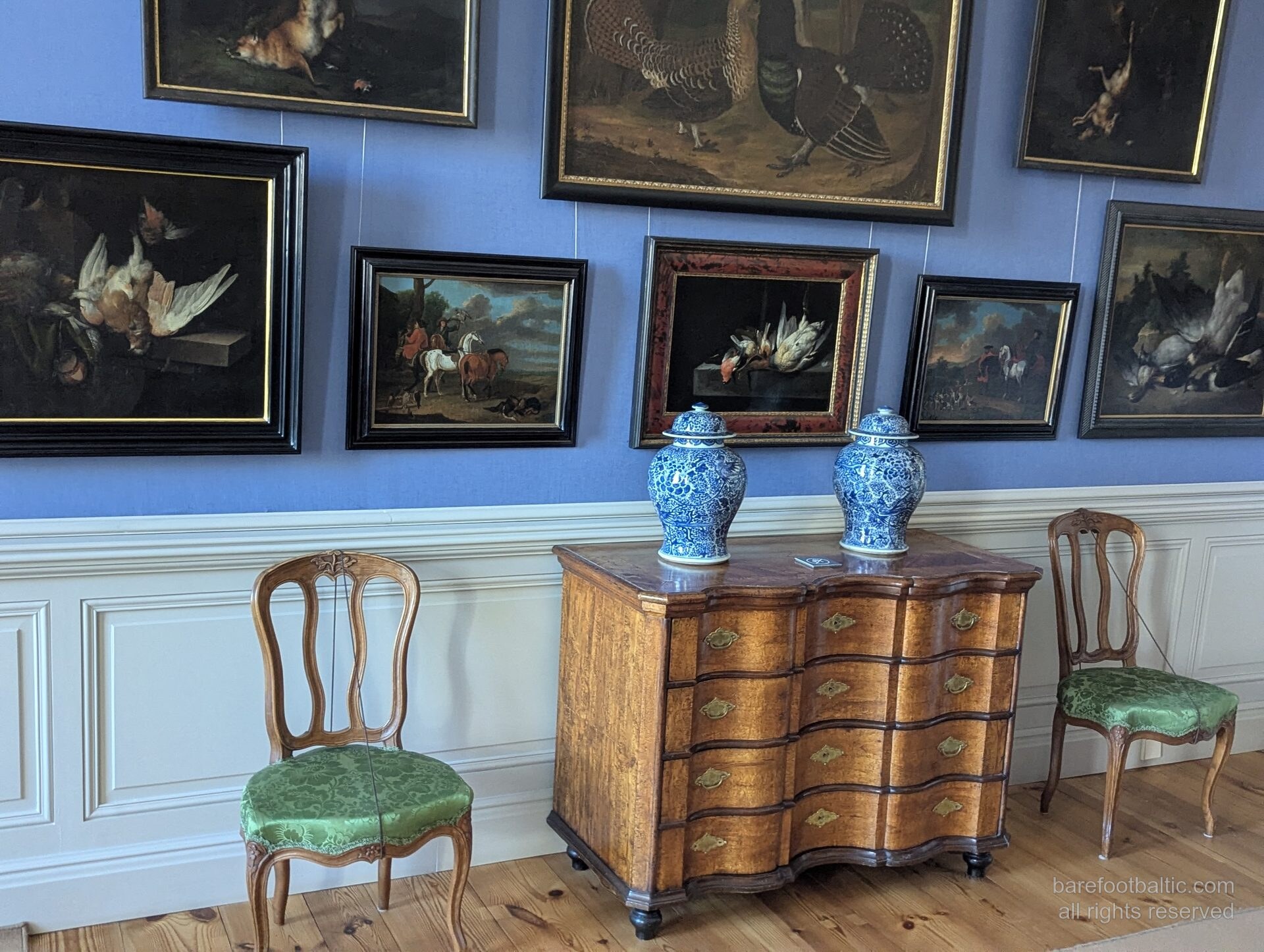
Almost all the most notable seventeenth-century Dutch and Flemish painters of hunting scenes and still lifes, as well as eighteenth-century German painters, are represented here. In the centre of the wall opposite the display case is a painting Capercaillies in the Forest by German-Baltic artist Johann Heinrich Baumann in 1795. Baumann was a passionate hunter and a prolific painter of hunting scenes. The painting in the top row with a hunted pheasant and a duck is by Baumann's teacher German painter Jakob Samuel Beck. The bottom row displays paintings with hunted birds by three important Dutch masters of the second half of the seventeenth century, Melchior d'Hondecoeter, Jan Vonck and Jan Weenix. On the wall opposite the window in the centre is a still life with a hunted hare, birds and animal guts. Its author is a seventeenth-century Dutch painter Juriaen van Streeck. It is surrounded by four paintings with optical illusion or trompe l'oeil effect by eighteenth-century German artist Johann Michael Codomann. The only portrait of a hunter in this room is exhibited above the display case. It shows the Chief Chamberlain Koyev of the Russian Court in a hunter's suit, painted in the second half of the eighteenth century by an unknown Russian artist. On both sides are paintings that depict hunting dogs attacking the game, painted by a Flemish painter of the first half of the seventeenth century, Abraham Hondius.
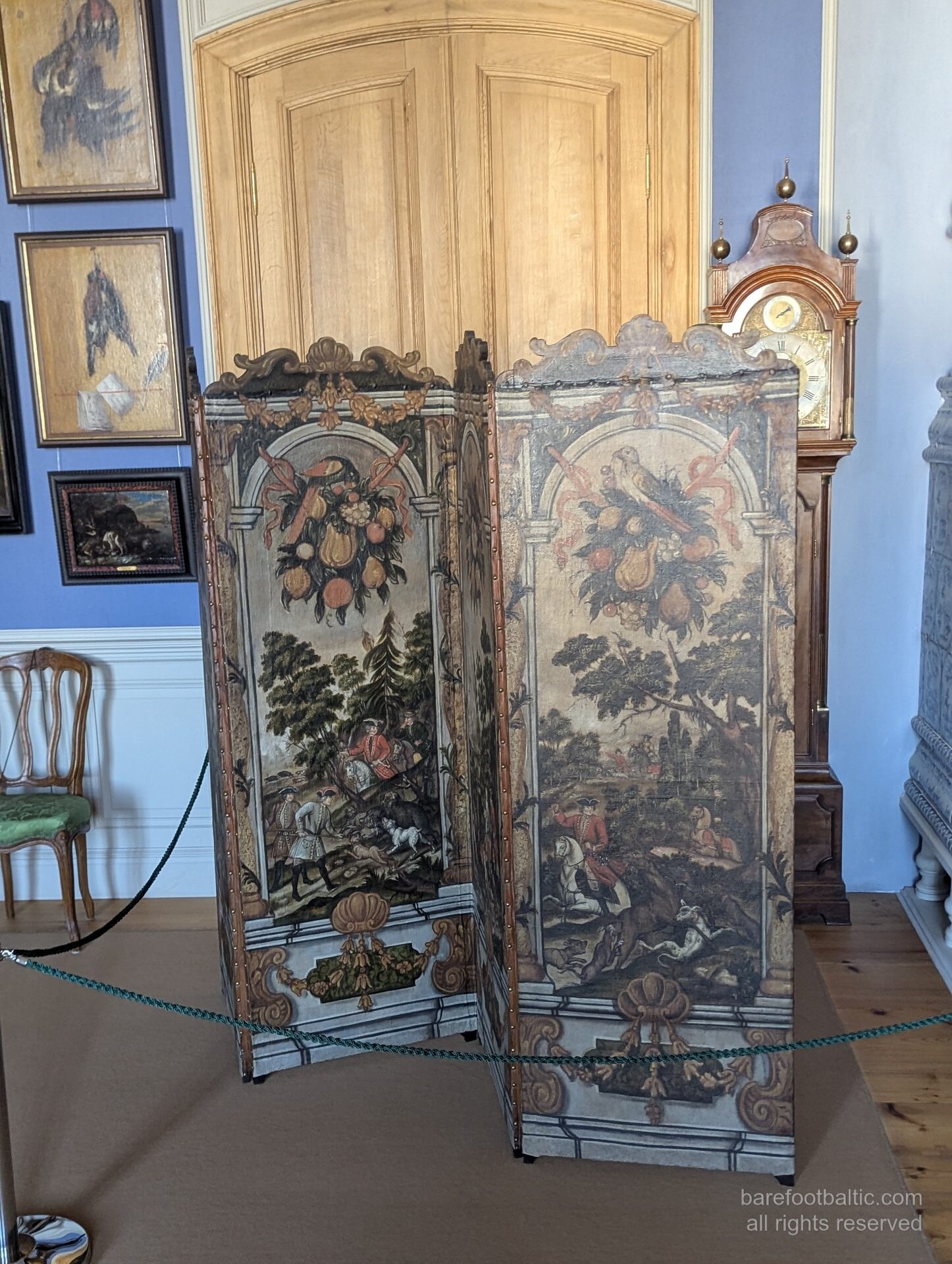
The screen is painted with beautiful hunting scenes depicting riders, dogs and hunted animals. This work of art was created by an unknown German master in the early eighteenth century.
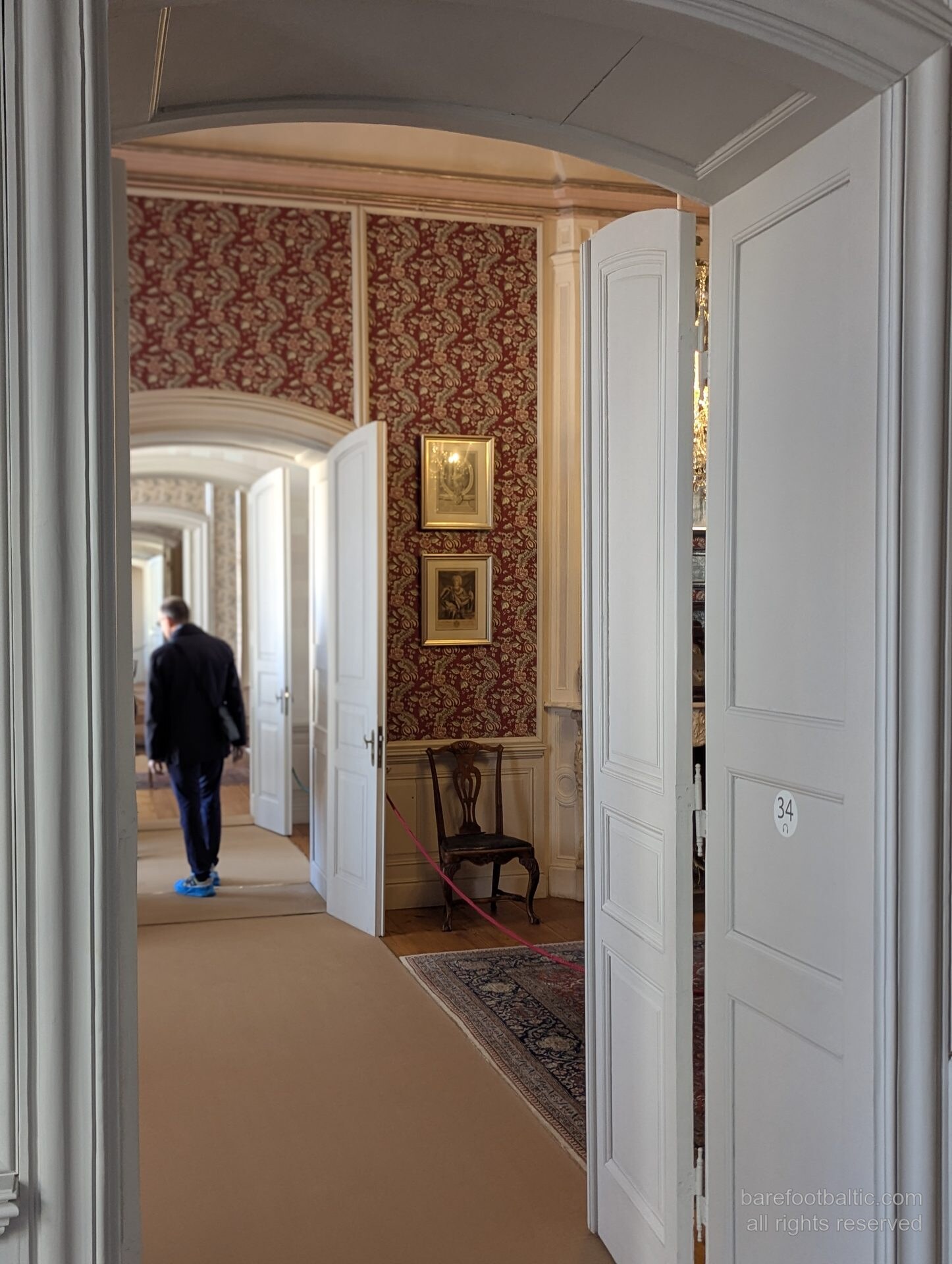
Next, the First Study of the Duke.
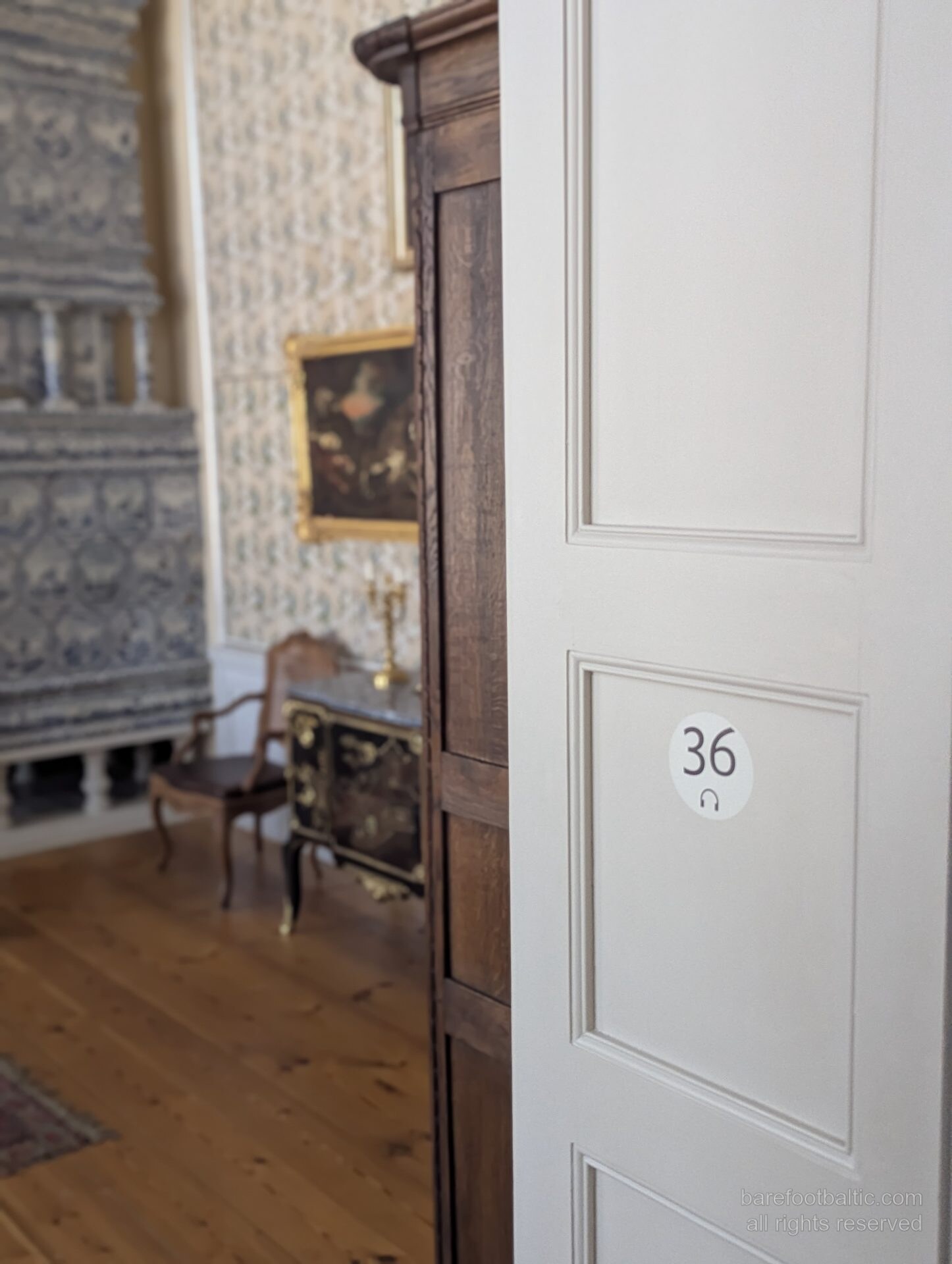
The First Study of the Duke
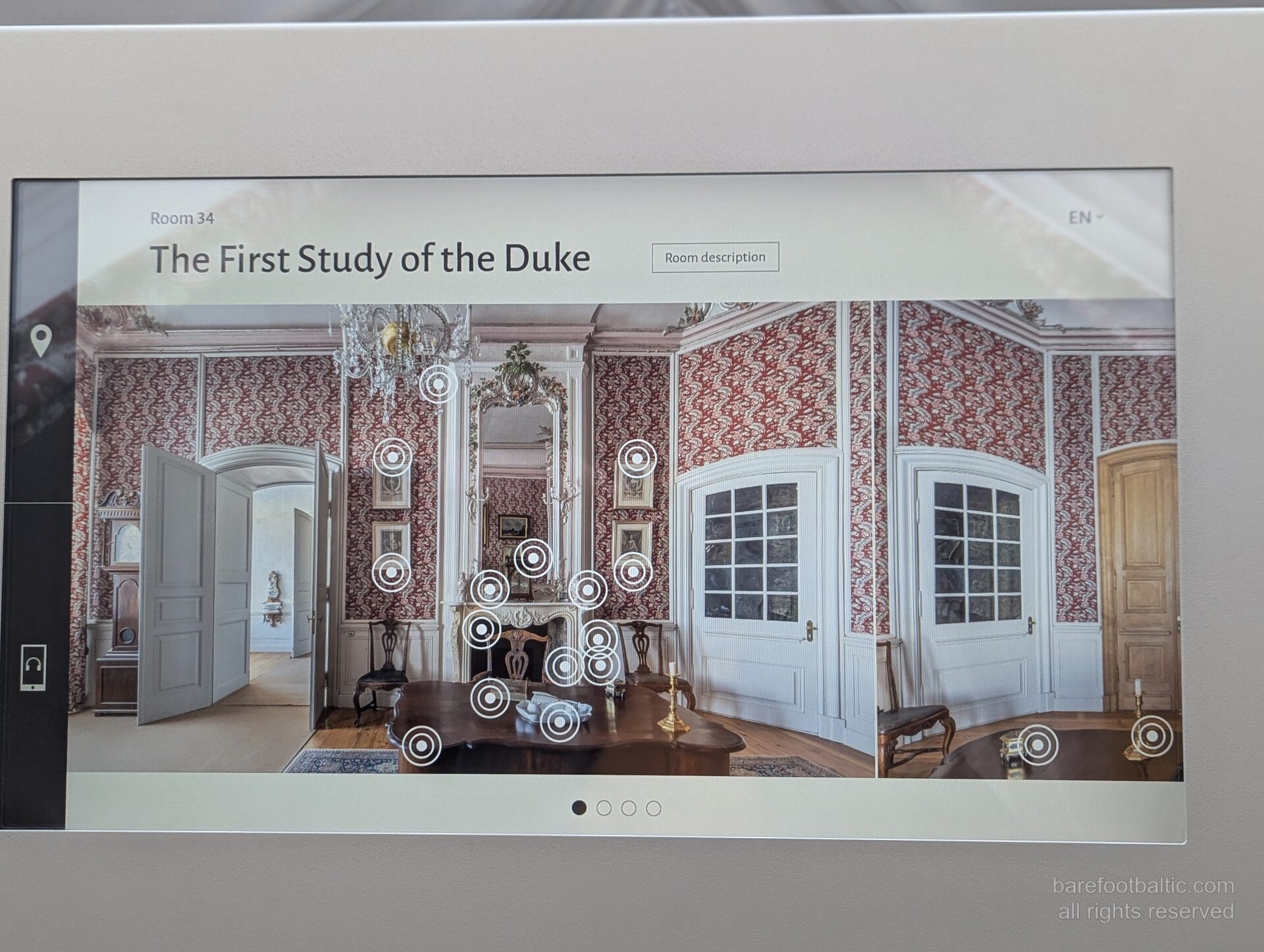
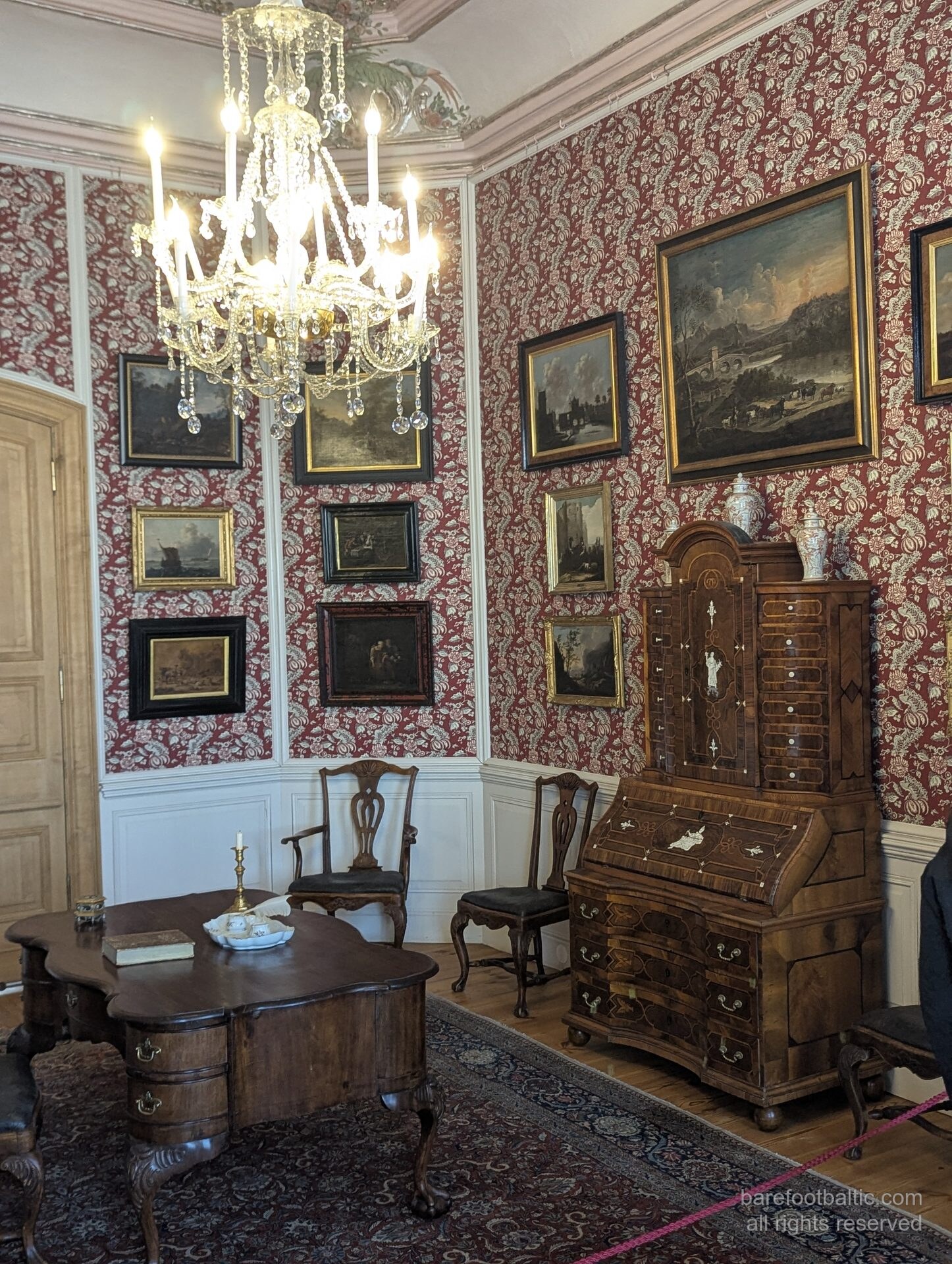
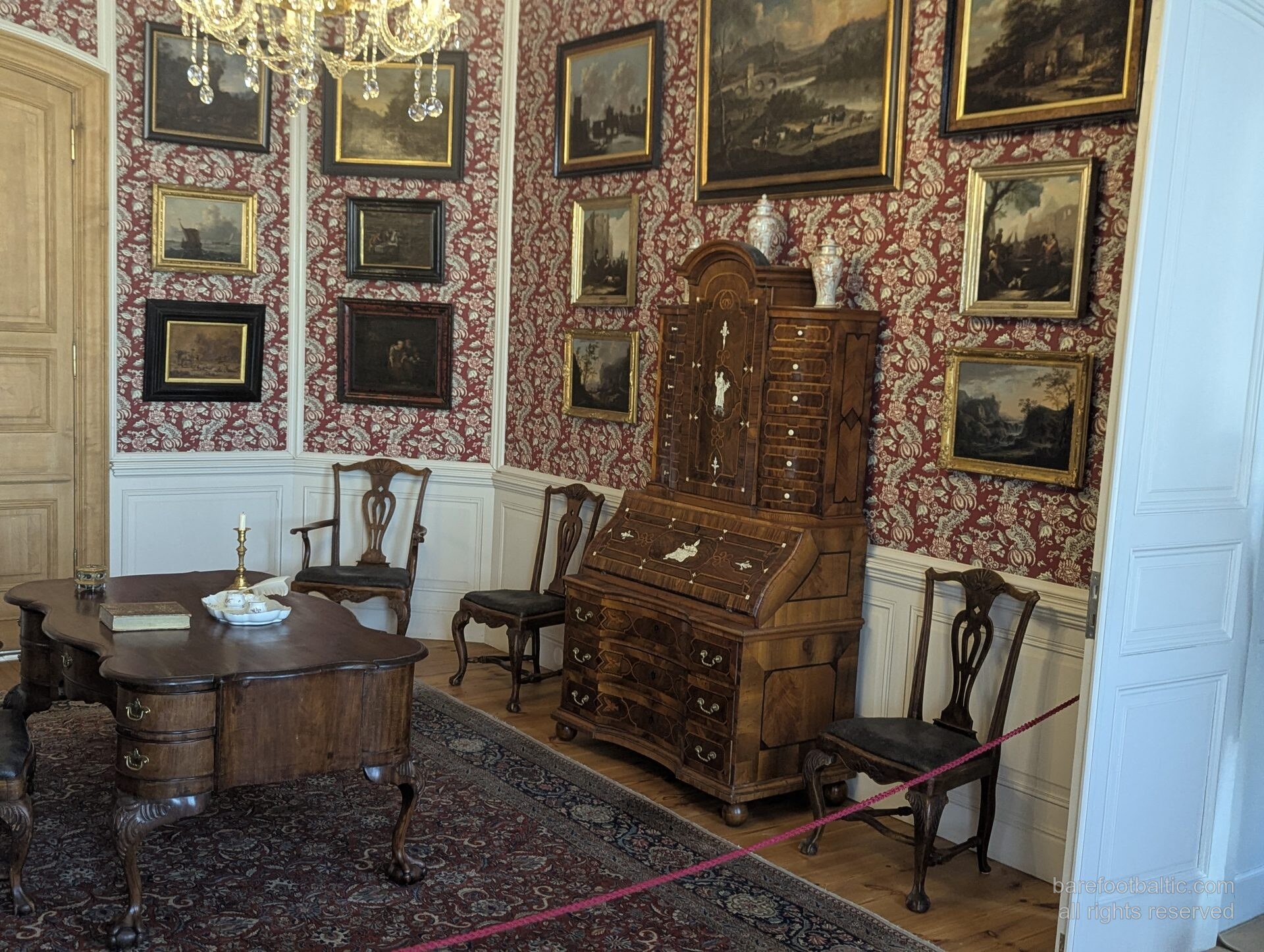
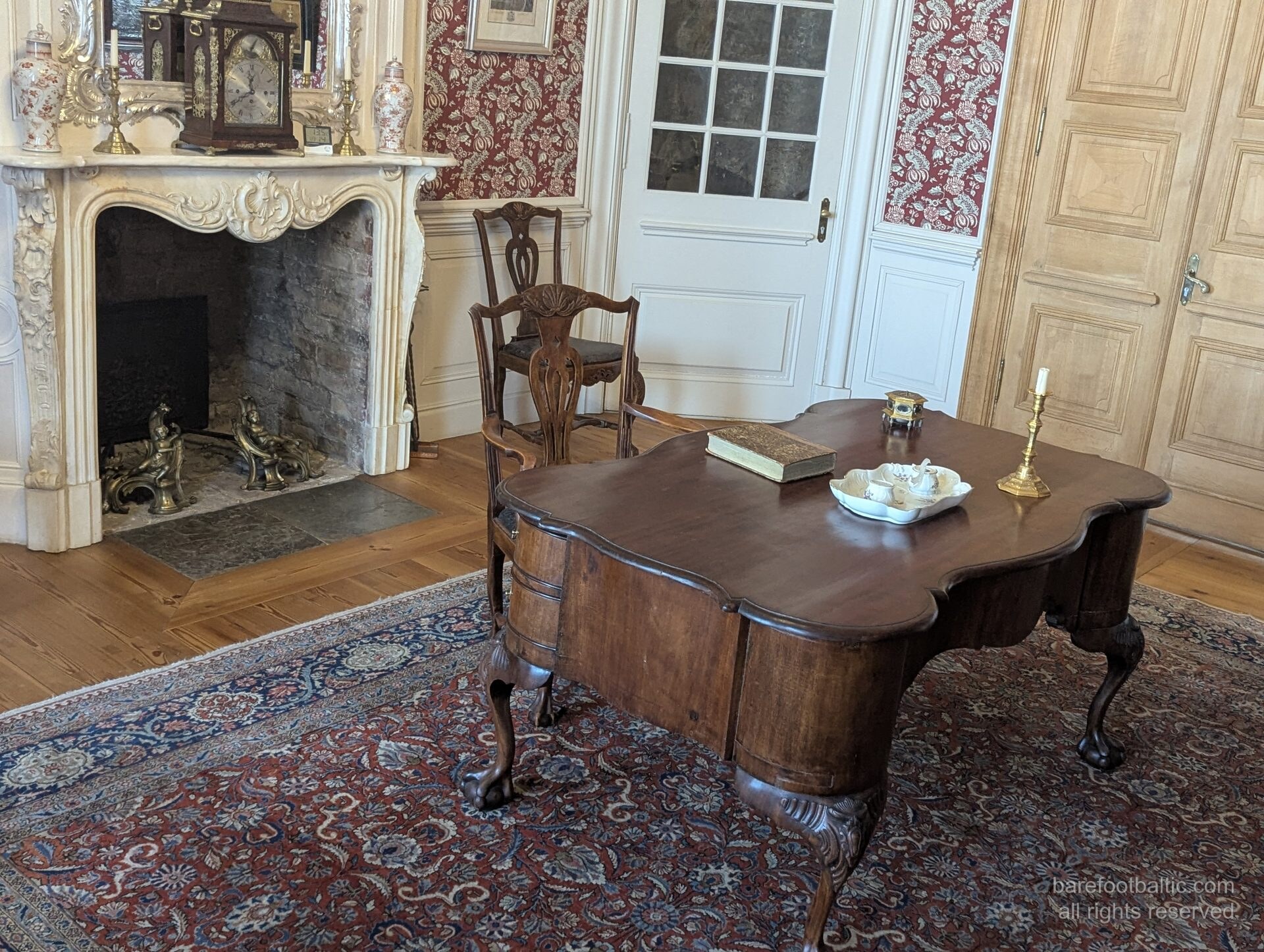
This was probably the main study of the Duke's two studies, since it was next to the Reception Room where the most important guests were received. It is supposed that this is where the development and adoption of nationally important documents and decisions took place. The room retained a similar function in the nineteenth century.
One of the walls of the room has bevelled corners. The corner with the glazed door was already marked in Rastrelli's design as the place for the furnace, while the slant on the opposite side was created in the second construction period to achieve symmetry.
In the ceiling composition, we see an elongated rosette with flowers and birds, but in the centre of the corner decorations are silver rocaille shells. The fireplace with a mirror matches the sculptural and colourful ceiling ensemble. The fireplace was remodelled in the nineteenth century and has now been reconstructed from the found marble fragments.
The layout of the room corresponds to the taste of Duke Ernst Johann. Chippendale chairs were made in the 1780s in the workshop of Augustus Heibel, a craftsman from Limbaži. The longcase clock seen by the window was made by Kuldīga craftsman Rudolpf Guisy. Also, pay attention to the inlaid Braunschweig bookcase with ivory inlays. The interior includes paintings and engravings by Dutch and German artists.
An English-style chandelier with glass arms and chains of almond-shaped drops was made in the late eighteenth century, probably in Germany, and was installed in Asare Lutheran Church.
Next, the Duke's bathroom.
The Duke's Bathroom
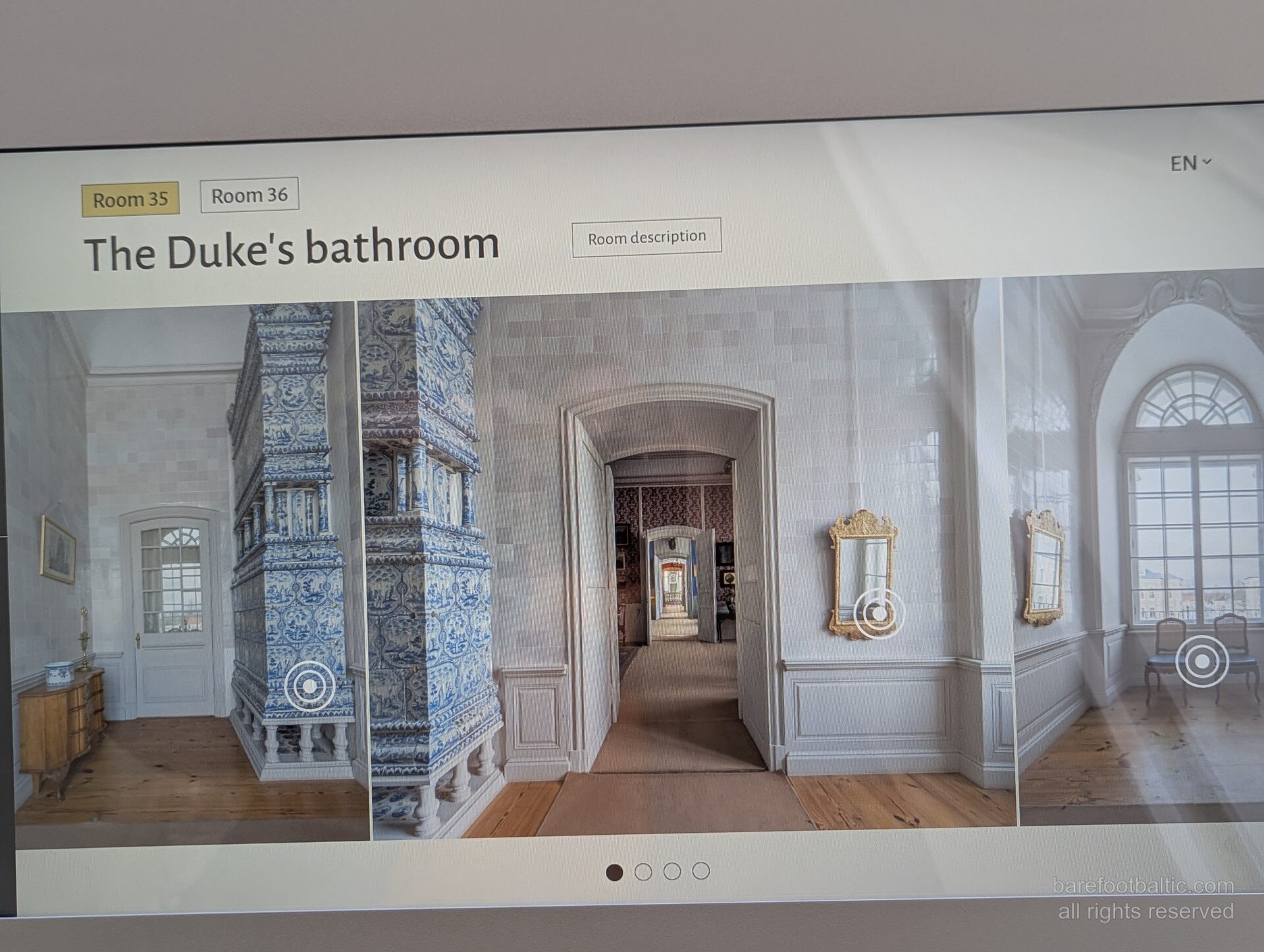
This bathroom is next to the Duke's Dressing Room, and behind a small glazed door is his bedroom. The room is decorated with glazed Dutch tiles in different shades of white, from greenish to purple. Unlike in all other bathrooms, the lower parts of the walls in this room are lined with wood panelling. In the room, you can see a thin tile stove made from the original palace tiles, which is heated through the fireplace opening in the first study.
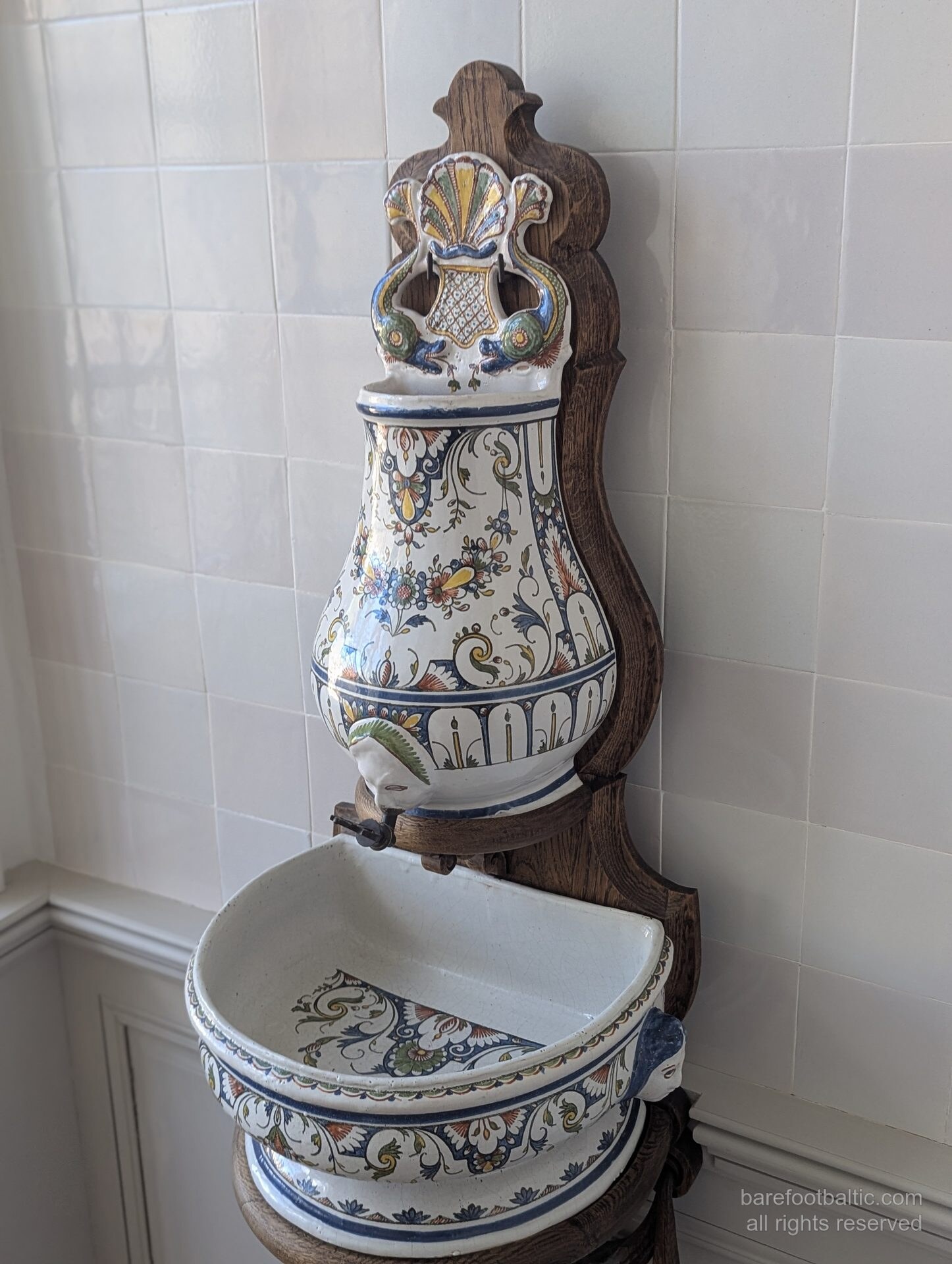
The function of the room is illustrated by a typical faience handwashing device, the so-called wash fountain, with a water tank and a bowl made in Rouen in the eighteenth century.
Now let's take another look at the Duke's Dressing Room, this time from the other side.
The Duke's Dressing Room (Re-View)
The Duke's Dressing Room is right next to his bedroom, and the two rooms are connected by a wallcovering-masked door. From this angle, you can better observe the stove, which was demolished in 1938 and transferred to the Ethnographic Open-Air Museum in Riga. The recovered tiles were identified from a 1932 photograph, so the stove could be re-built.
Against the opposite wall to the left of the door is a hairdressing table with a large drawer and a marble surface. On the table is a box decorated with the imitation of a tortoiseshell, for storing a wig.
From the bathroom, we now go back to the staircase.
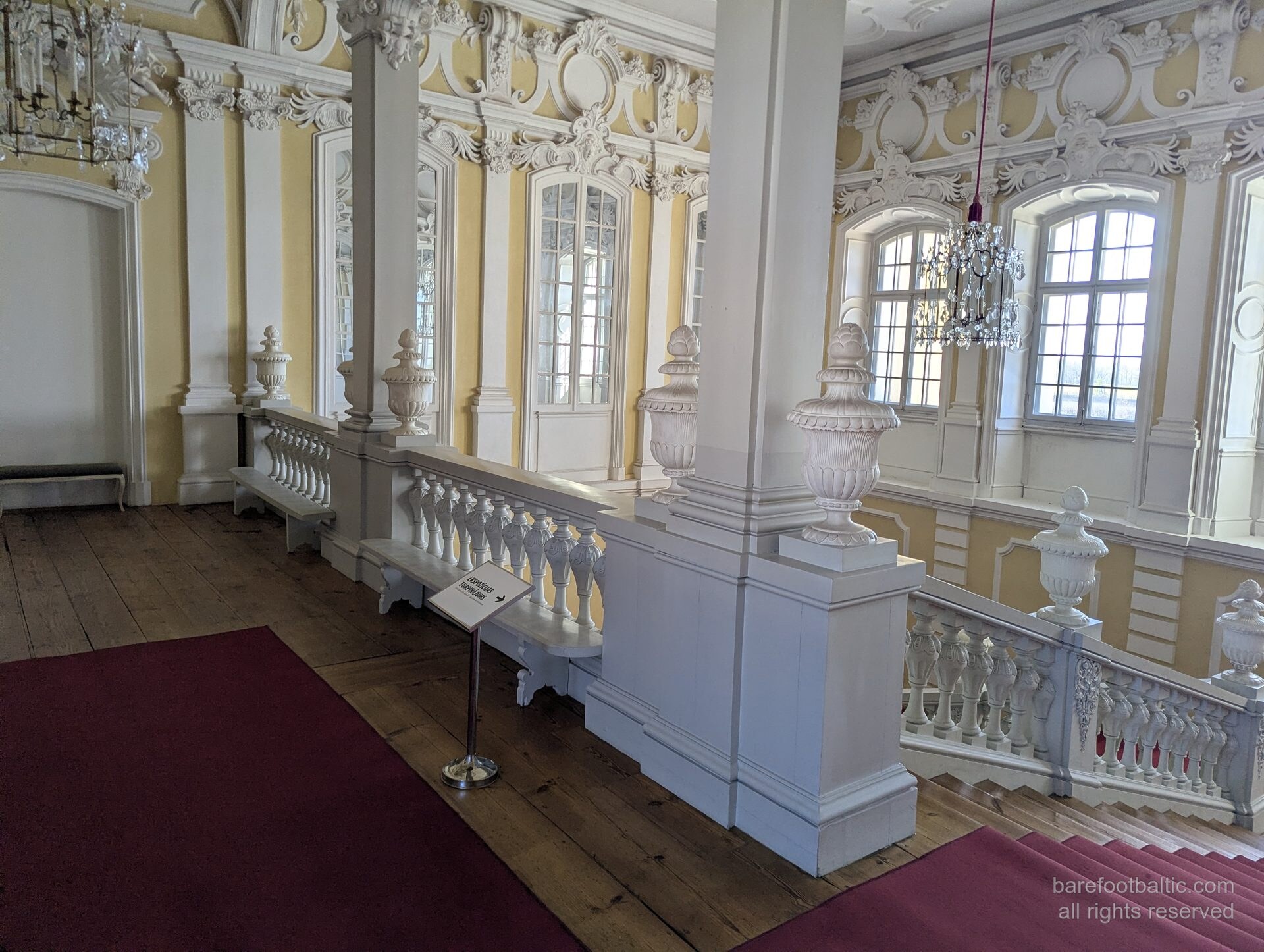
The West-Side State Staircase
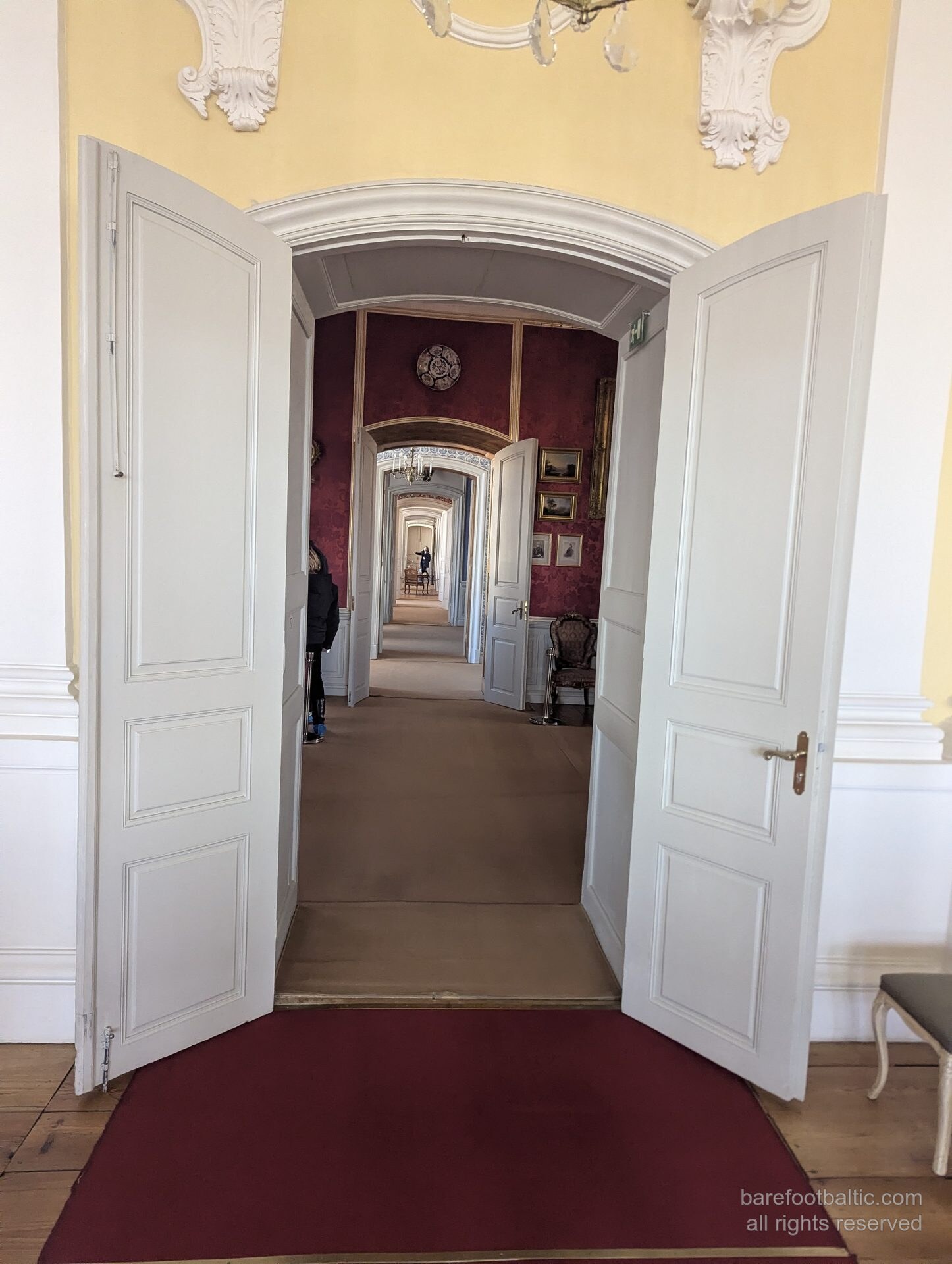
The west-side staircase, where we are now, is similar in size, composition and décor to the east-side staircase, although it had been damaged more over time. Continuing the tour, we'll now visit the Duchess's apartments.
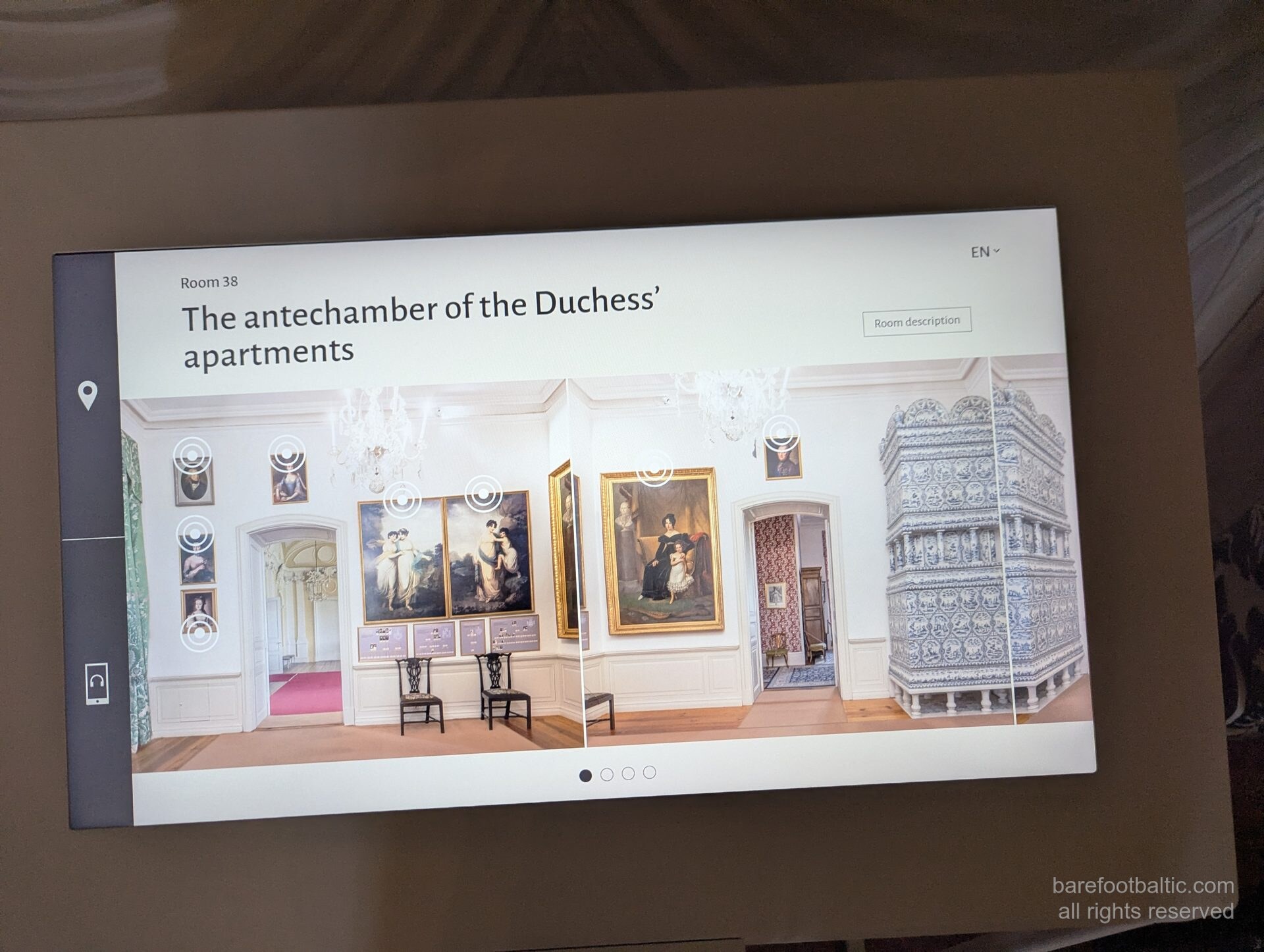
The Antechamber of the Duchess's Apartments
In the eighteenth century, the Duchess's apartments, as well as the private rooms of other family members and guest living rooms, were in the West Wing of the palace. Now some of these premises house thematic exhibitions.
The Duchess's rooms were smaller and simpler than those of the Duke. Almost all rooms have a smooth, white ceiling with a simple profiled ceiling cove, upholstered walls with a wooden panel along the bottom, and glued floorboards. Only the Duchess's Boudoir and the toilet room feature a rich decorative finish.
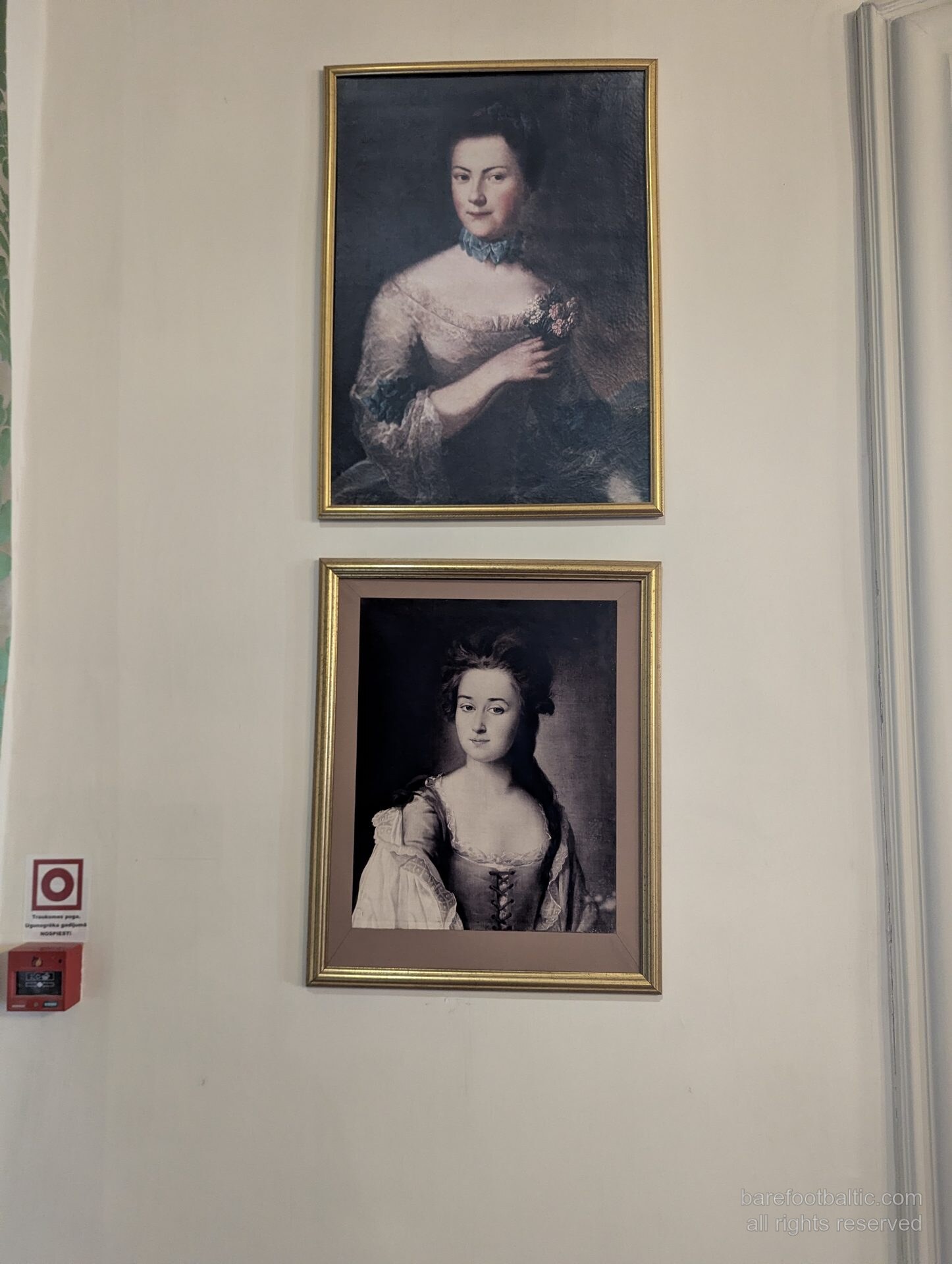
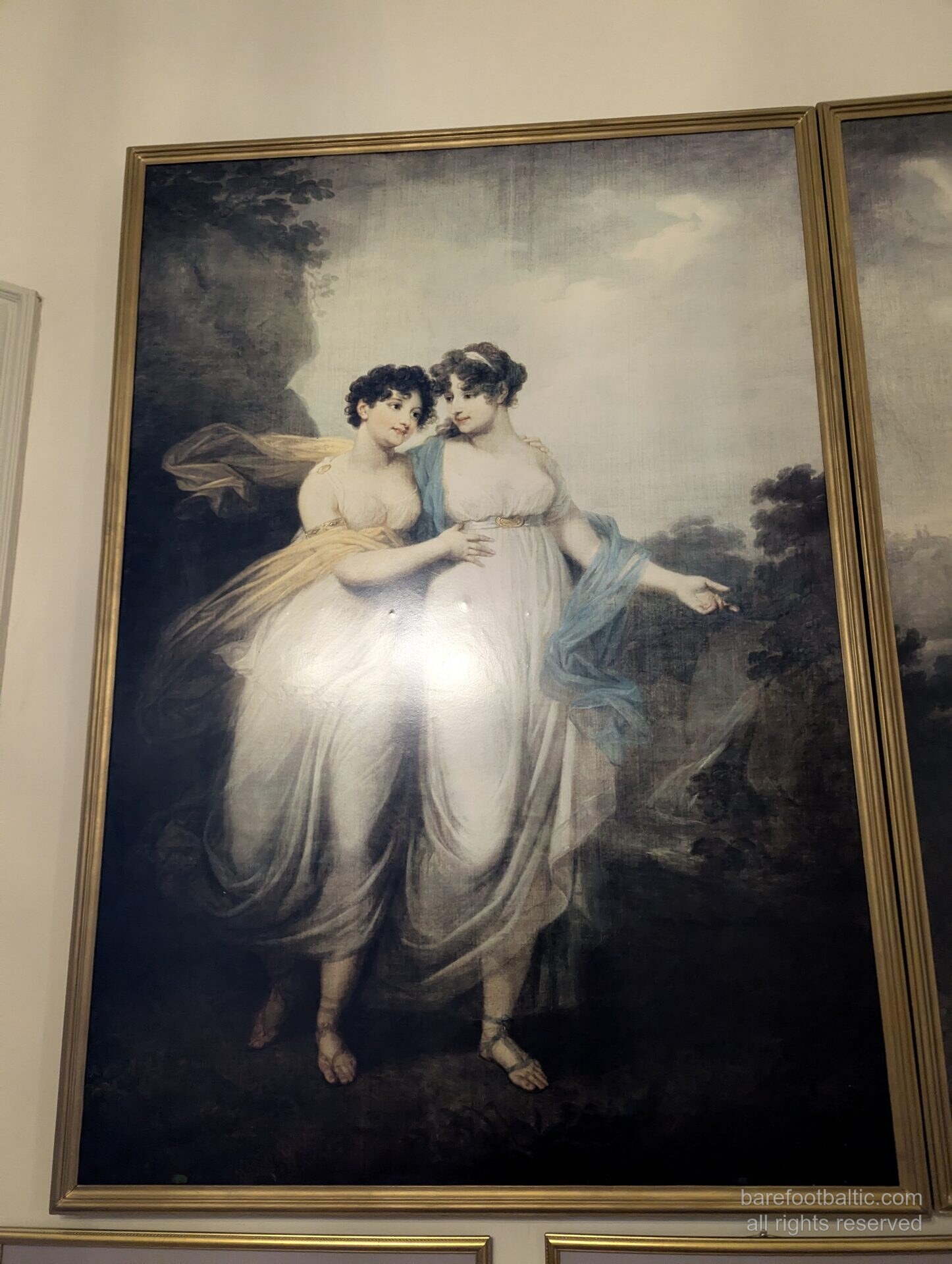
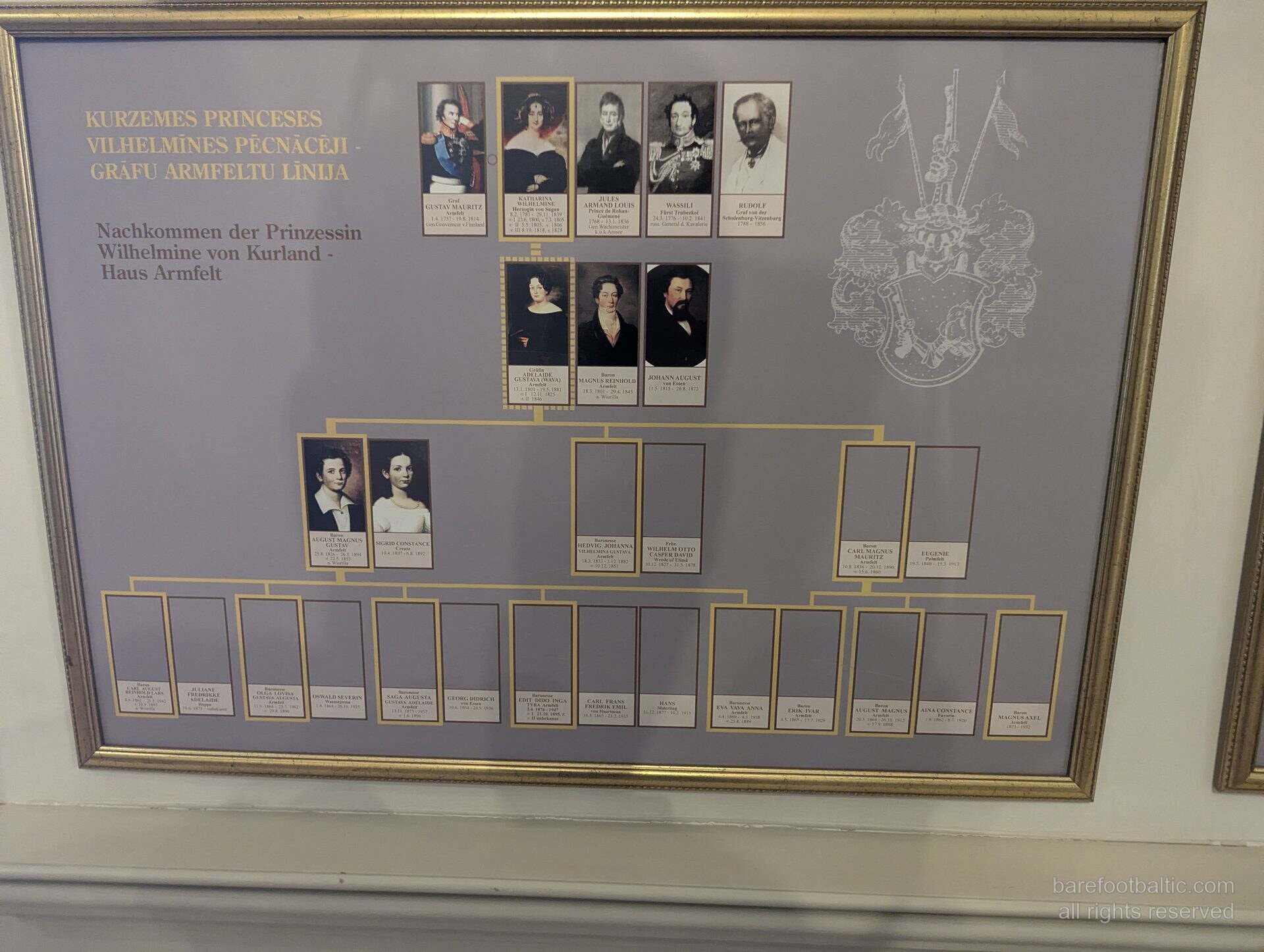
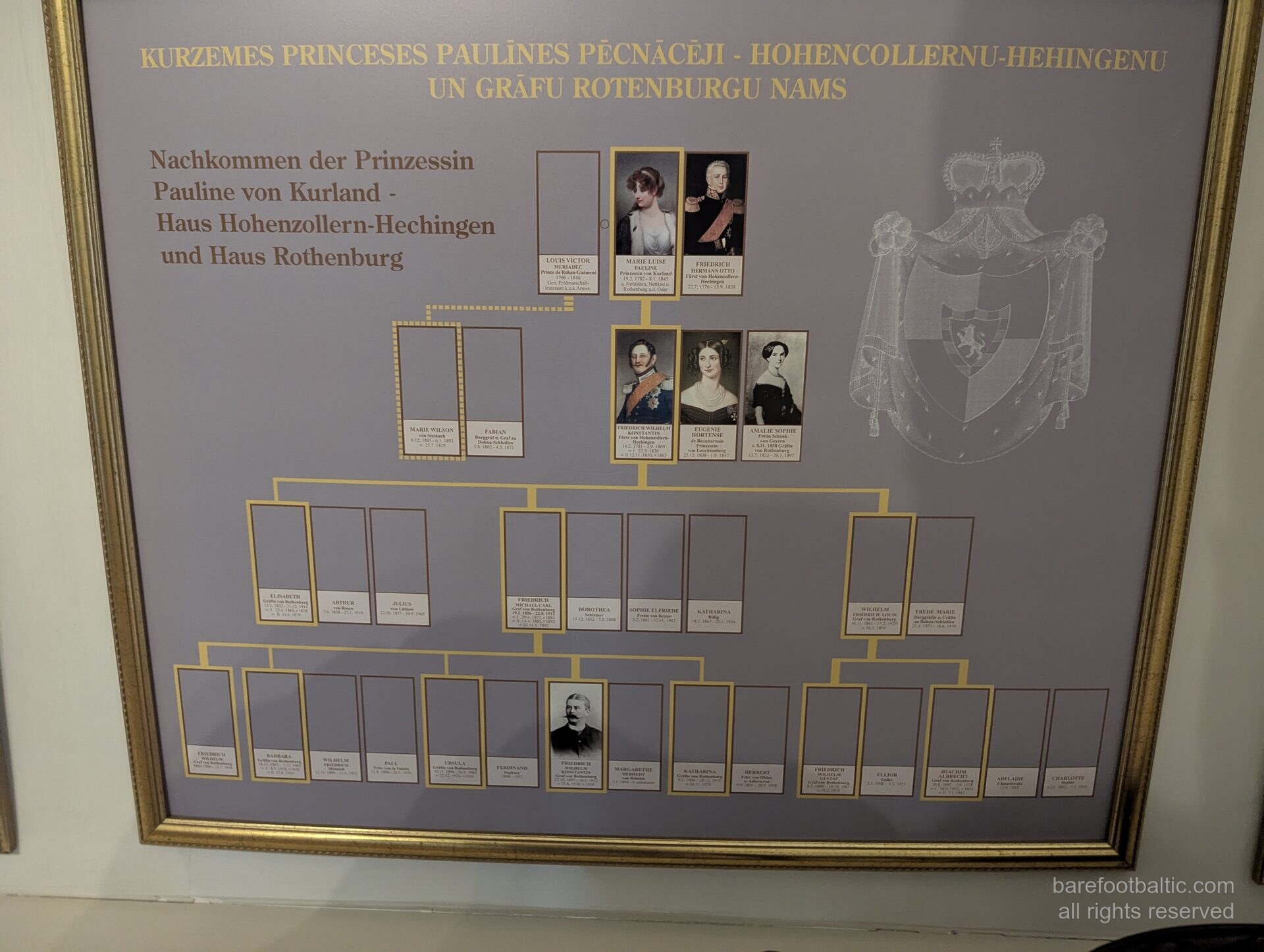
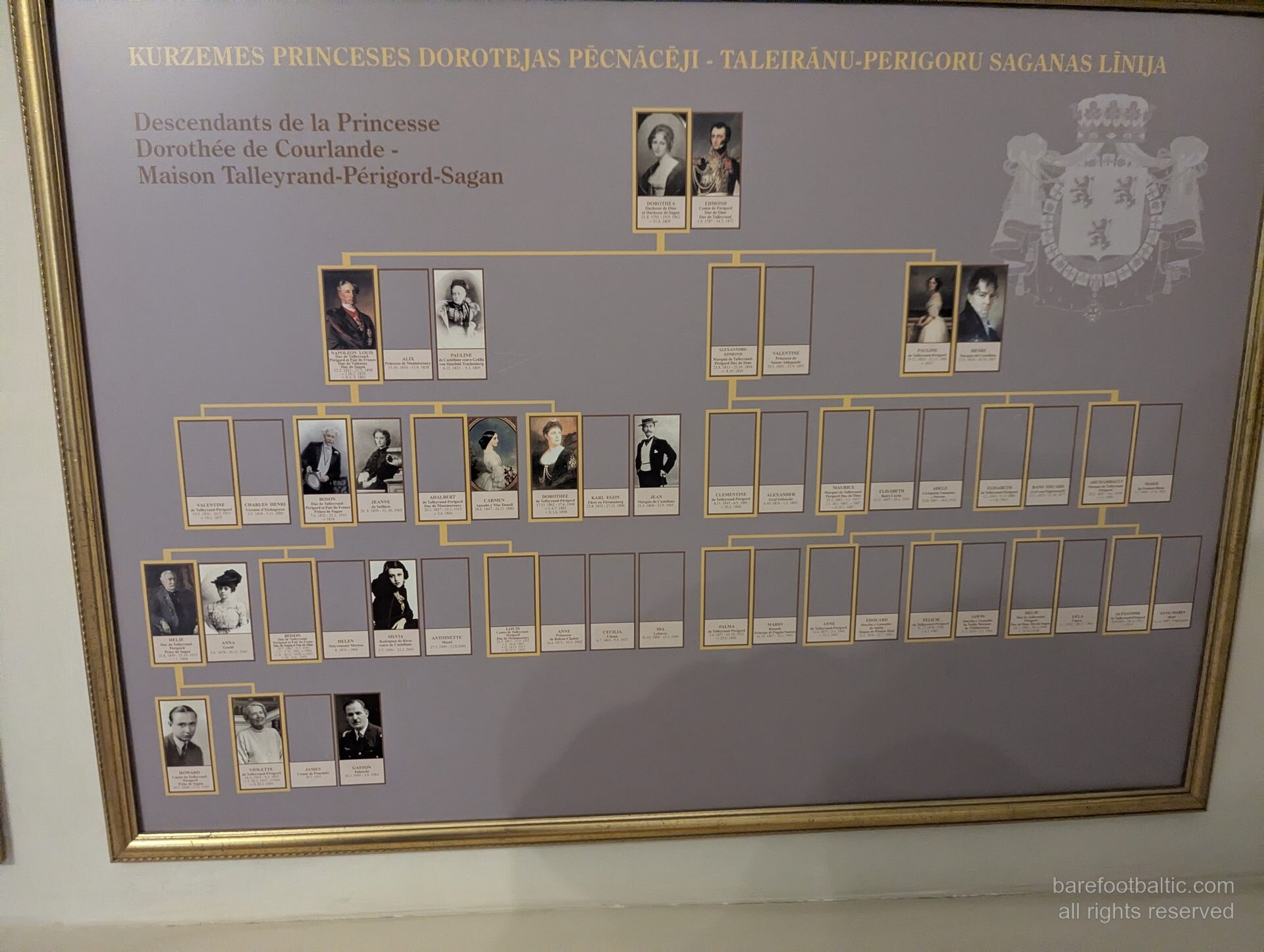
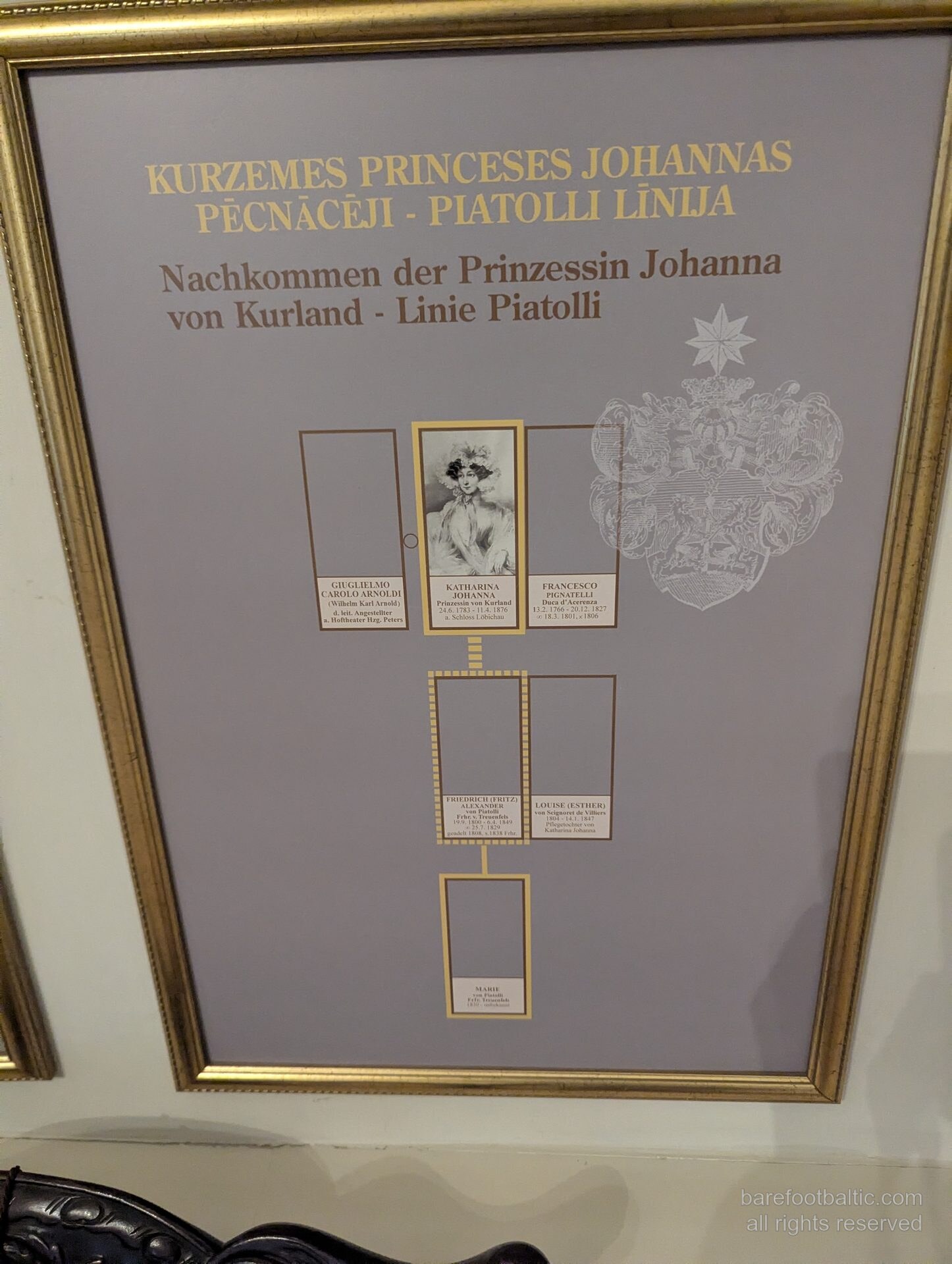
Initially, this antechamber did not have fabric wallcoverings but plastered and whitewashed walls. Now you can see photo reproductions and genealogy tables that help in getting to know the Biron family and explore its history.
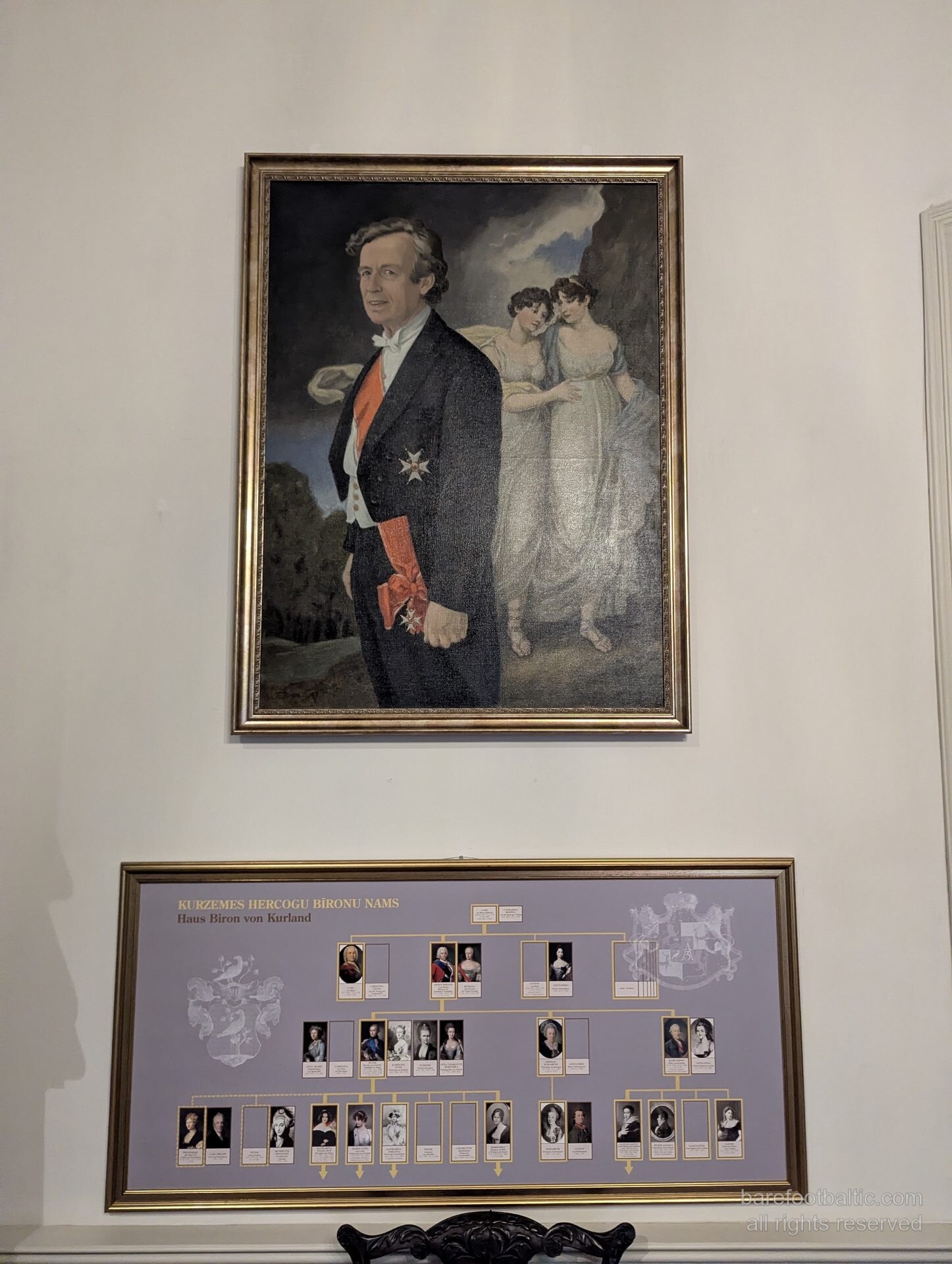
On the left, by the stove, are ceremonial portraits of the current head of the family, Prince Ernst Johann Biron of Courland, born in 1940, and his wife Princess Elisabeth Biron. Below the portraits, a genealogical table shows the branch of the duke's youngest son, Prince Karl Ernst, or the Wartenberg lineage. To the right of the door are the portraits of Duke Ernst Johann and Duchess Benigna Gottlieb.
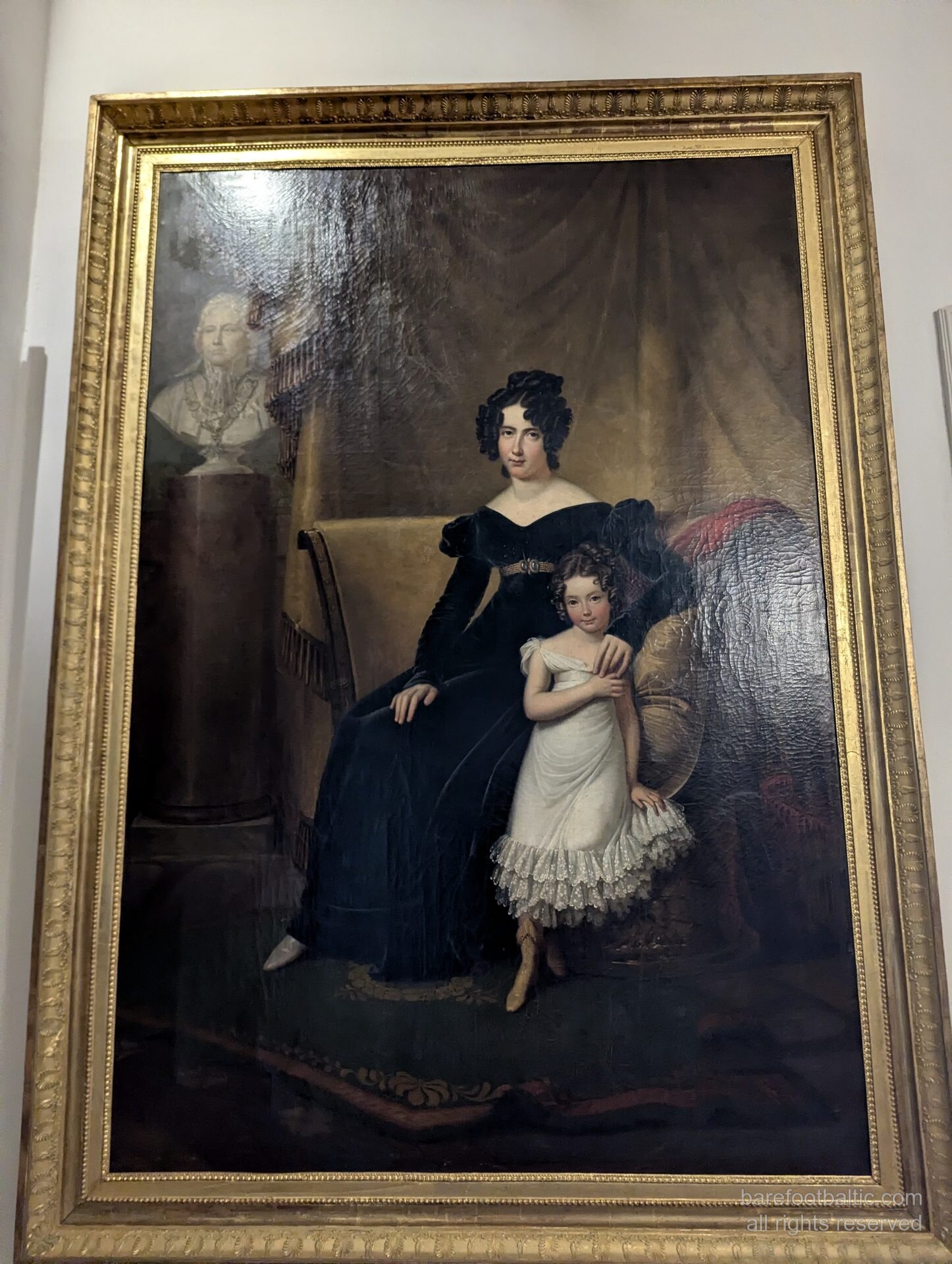
On the opposite wall, above the door leading to the staircase, hangs a portrait of Duchess Dorothea, while to the left of the door are portraits of Duke Peter's first two wives, Princess Caroline Louise of Waldeck and Princess Yevdokiya Yusupova. Duke Peter's first two marriages ended in divorce. His third marriage to Dorothea produced six children, but two of them, daughter Charlotte Friderike and son Peter, died in early childhood. Four daughters, Wilhelmine, Pauline, Johanna and Dorothea, were painted by Joseph Grasy in 1803. Photographic reproductions of these paintings can be seen to the right of the door. In the portrait on the adjacent wall, Dorothea is depicted as Duchess of Dino together with her daughter Pauline.
After leaving Courland, Duchess Dorothea and her daughters became actively involved in European social and political life. The eldest daughter Wilhelmine and the youngest daughter Dorothea, who was married to the nephew of the famous French statesman Charles-Maurice de Talleyrand, attracted the most attention. In the portrait above the display case, Wilhelmine is depicted together with Swedish Count Gustaf Mauritz Armfelt and their daughter Adelaide Gustava. The genealogy tables show the family lines of all four daughters. The display case contains relics of the Biron family.
Next, we'll walk towards the door to the left of the stove, which will lead us to the Duchess's Dressing Room.
The Duchess's Dressing Room
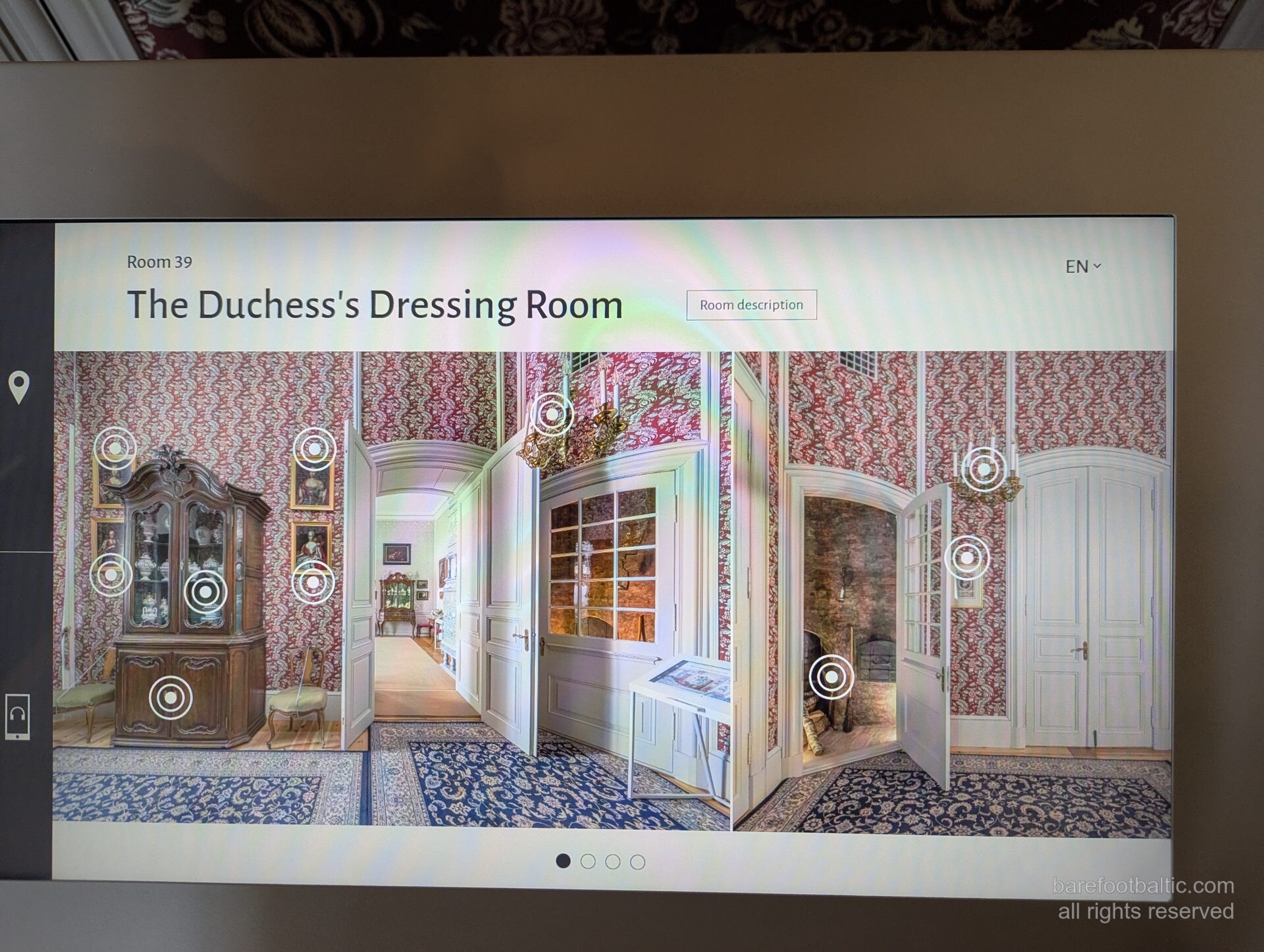
This is the first room in a group of six rooms which, in the Museum's exhibition, has been set up as the Duchess's private apartments. Although the exact function of these rooms isn't known, it was assumed from the traditional layout of the premises in the eighteenth century.
The function of the Duchess's Dressing Room is illustrated by a large Normandy wardrobe. Presumably, no one stayed in this room too long. In the corner is a place for heating the stoves, where servants brought firewood for the furnaces to heat the three adjoining rooms.
The stove is composed of original tiles and next to it is an eighteenth-century display case, which exhibits samples from the Museum's collection of perfume vases or potpourri.
These are porcelain dishes with perforated lids, which contained a specially prepared mixture of herbs that produced a pleasant aroma during fermentation. Of course, these dishes also had to look beautiful. On the upper shelf are Far Eastern porcelain wares that have been adapted for their new function as perfume vases, while on the lower shelf are porcelain wares made at the Saint-Cloud Porcelain Manufactory in France. In the second display case opposite the wardrobe are faience perfume wares from various European manufactories.
To assess the effectiveness of potpourri, we invite you to smell the white clay pot by the window. Next to it is a recipe for preparing a mixture of herbs.
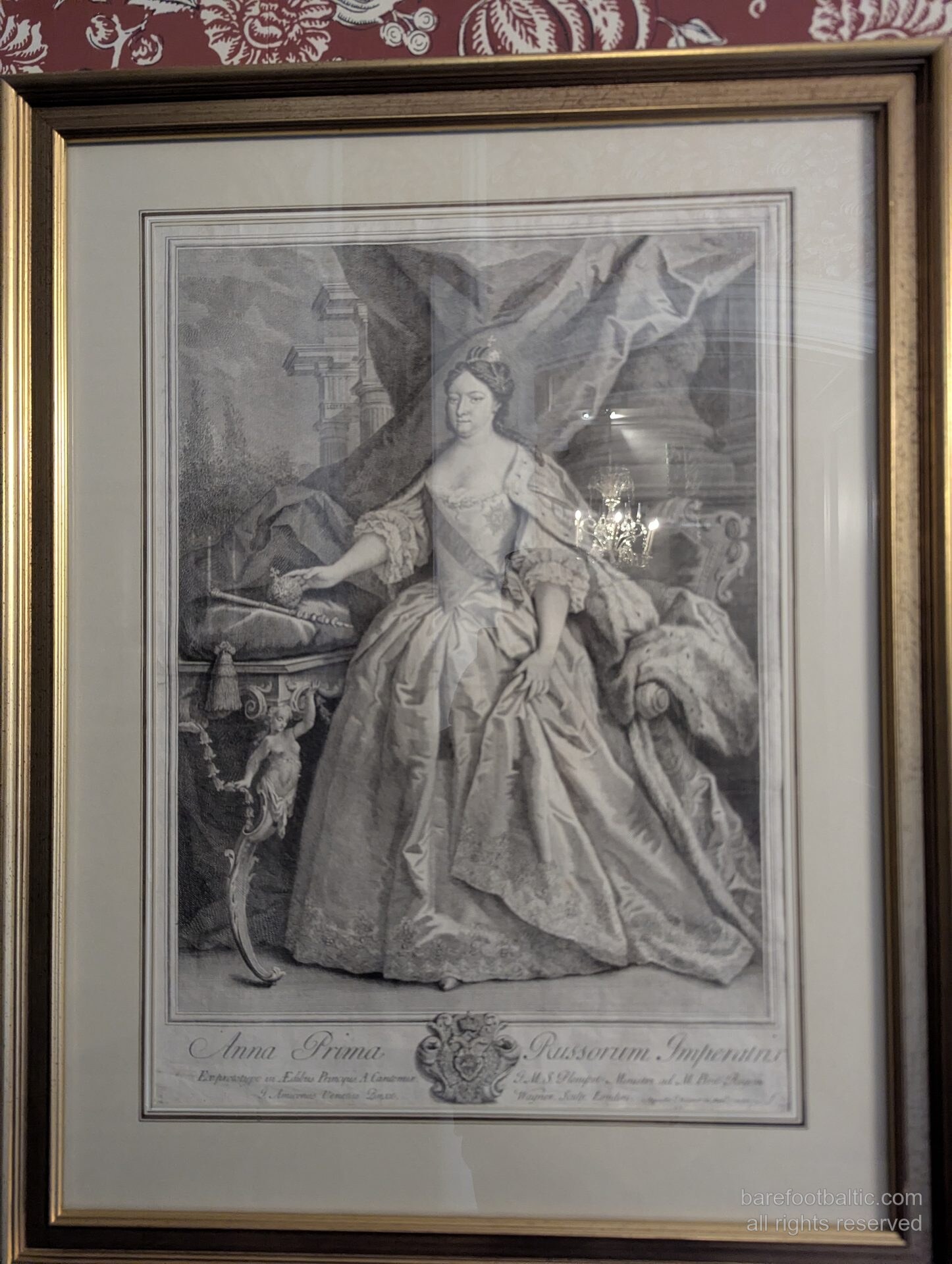
Meanwhile, portraits by various painters created over the years are a testimony to the appearance and character of Duchess Benigna Gottlieb. Here you can see copies of several paintings.
Next, the Duchess's Study.
The Duchess's Study
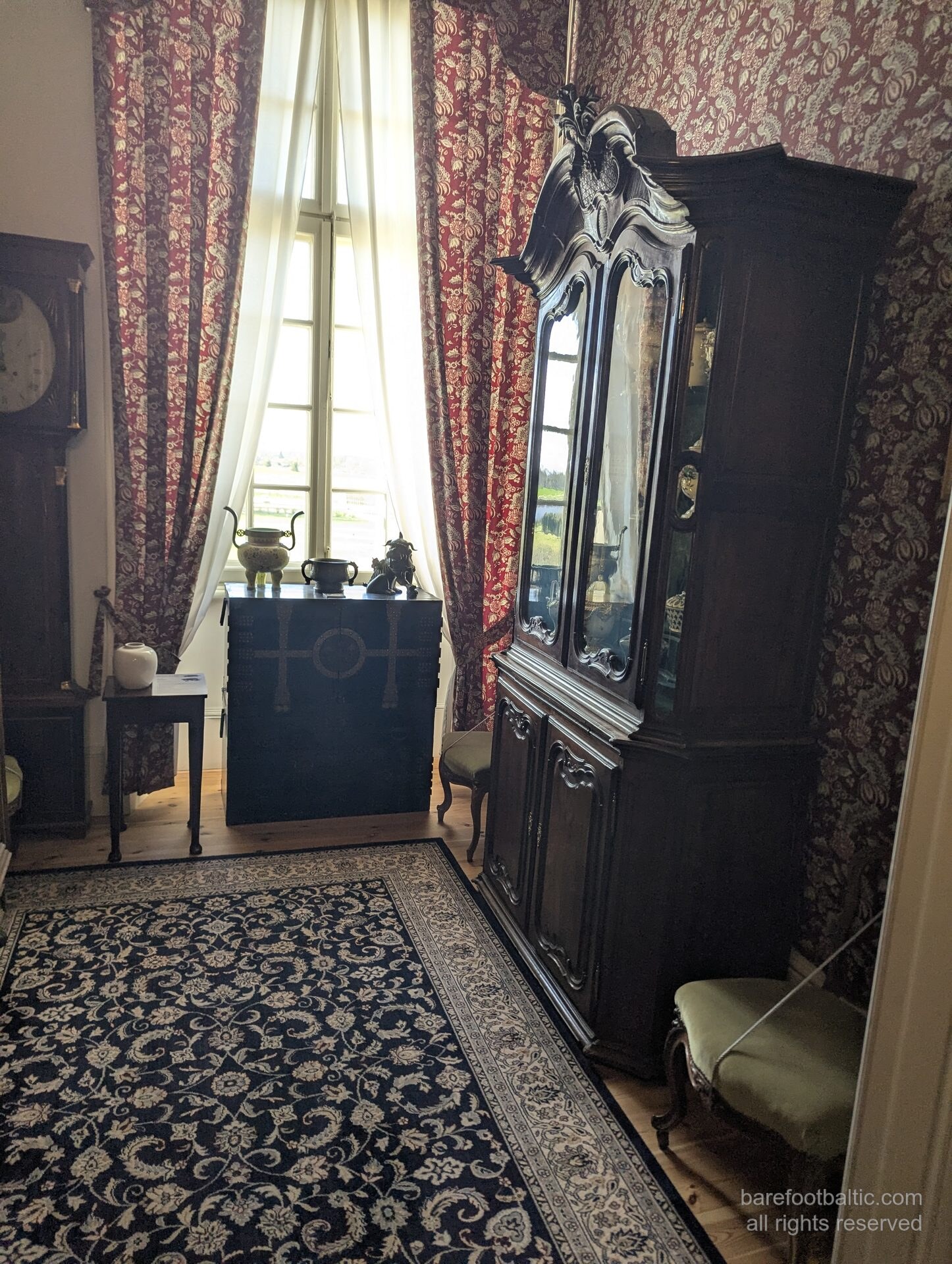
The function of the Duchess's Study is represented by a cabinet to the left of the entrance, the central part of which is decorated with intricate intarsia. It was made in the middle of the eighteenth century in Germany. A clock in the shape of a flowering tree made by French clockmaker Jean Ledoux is placed on the cabinet.
Here, too, you can see typical eighteenth-century wares for aromatising rooms. Special attention is given to potpourris from the manufactories in Meissen and Magdeburg in Germany while the display case shows small Berlin-made perfume vases on a tripod or brûle parfum, which were used differently. The dish was filled with herb oil and heated on a spirit-lamp.
During the summer months, rooms were filled with the aroma of cut flowers. On the card table are vases for fresh flowers, the so-called jardinière and a special vase with holes for arranging tulips.
Duchess Benigna Gottlieb was a nimble needleworker. It is known that for one of the rooms of Jelgava Palace she even embroidered fabric wallcoverings with Chinese motifs. Therefore, an intarsia sewing box has been placed on the table by the window reminding us of the Duchess's passion.
Next, the Duchess's Salon.
The Duchess's Salon
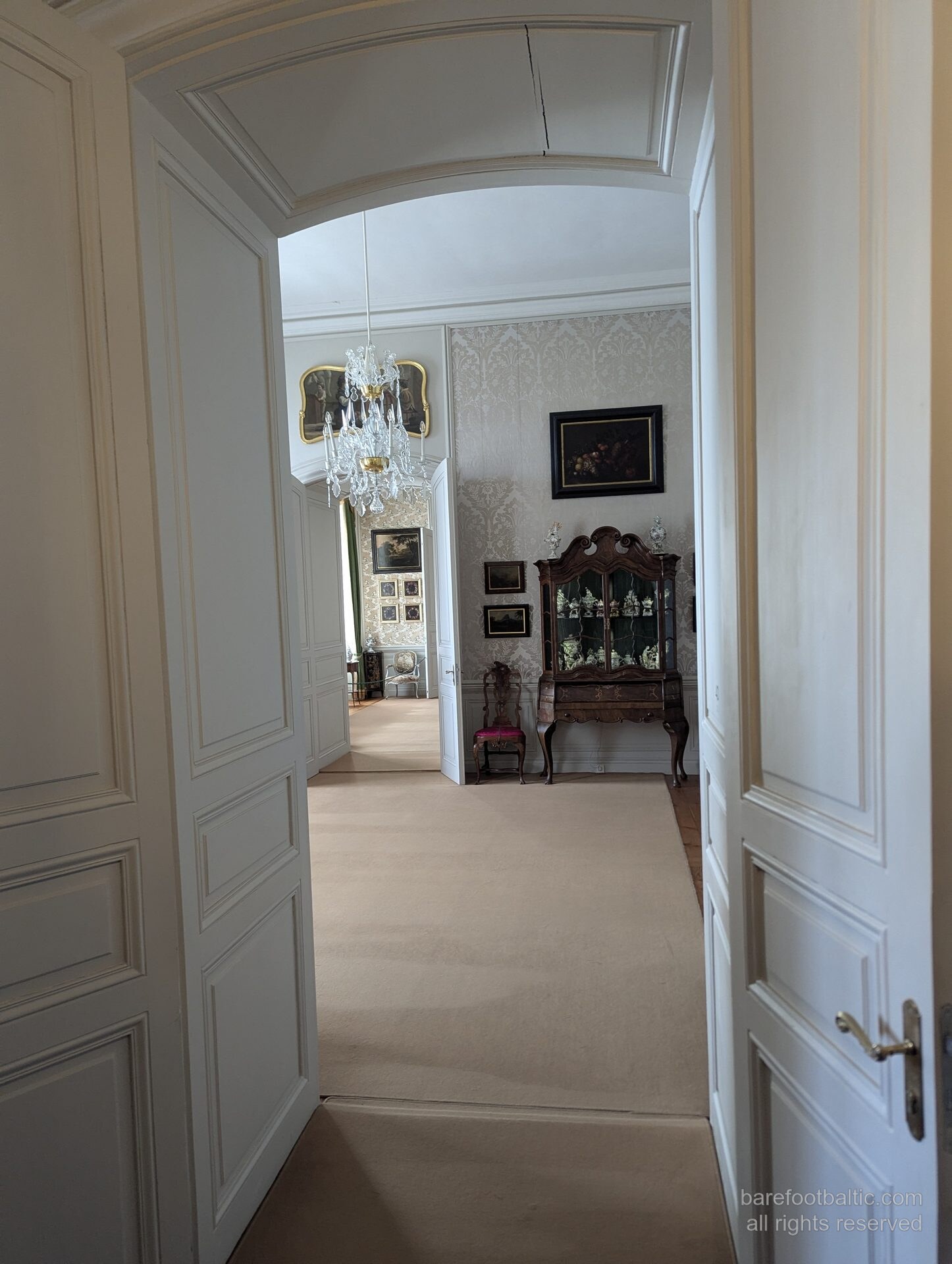
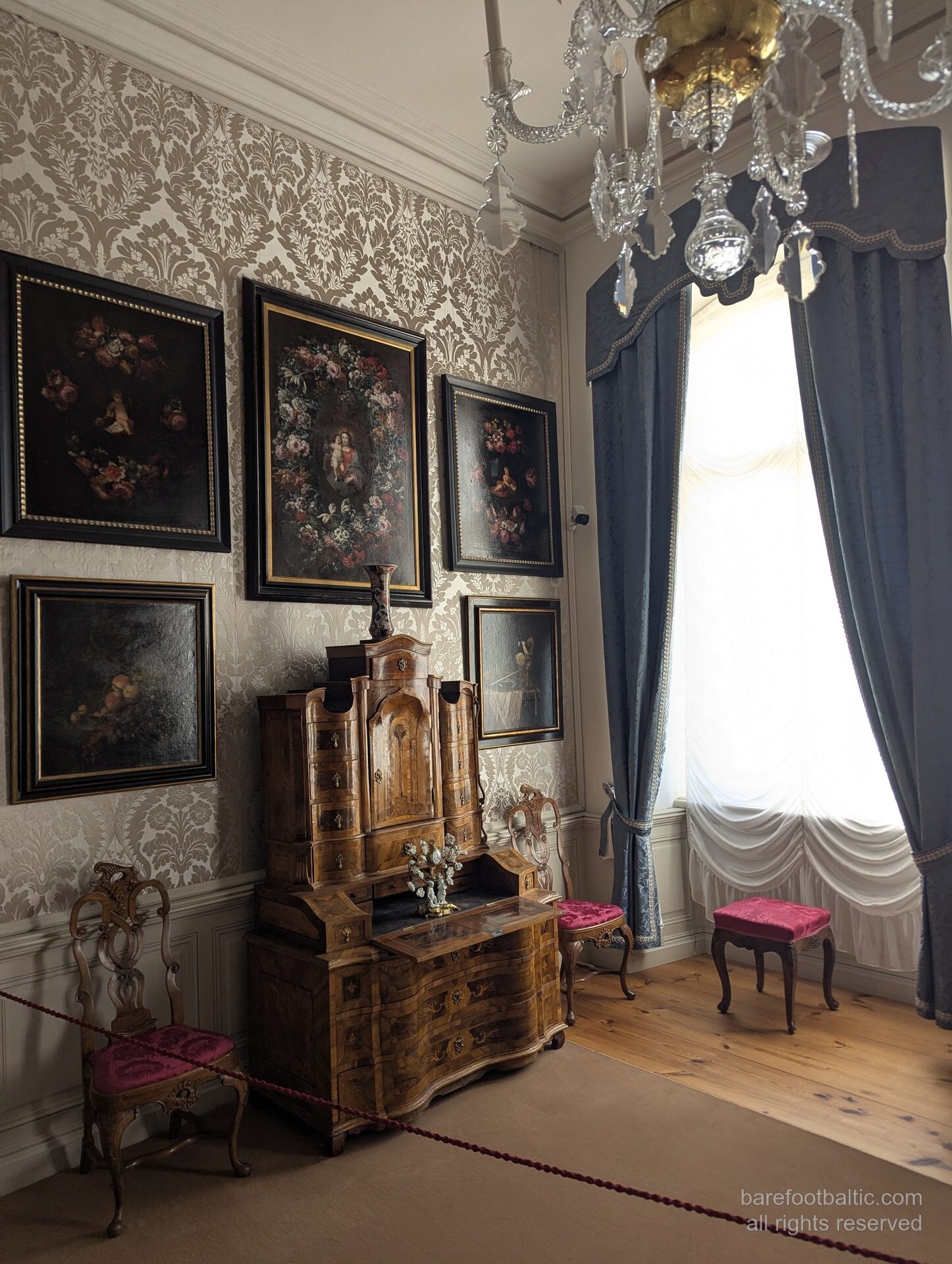
The salon was the Duchess's reception room where she received guests of national importance and courtiers.
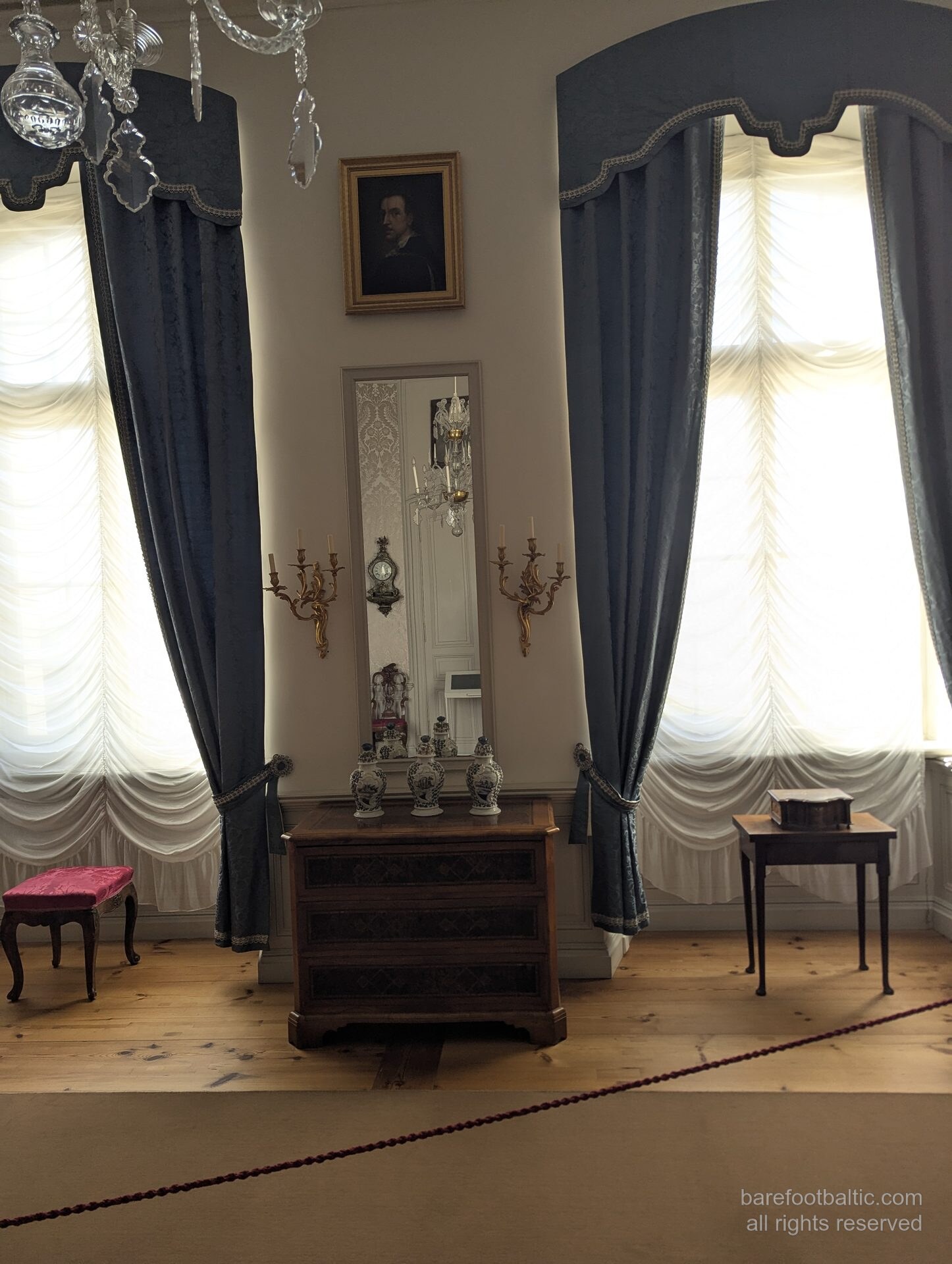
The sofa was a mandatory living room furniture, which formed the centrepiece of soft furnishings. This sofa was made by the renowned eighteenth-century French furniture maker Jacques Boucault, while along the walls are chairs made by another well-known French master Charles-Vincent Bara, with popular scenes from La Fontaine's fables featured on the tapestry woven at the Aubusson Manufactory.
Eighteenth-century perfume vases from the famous German porcelain manufactories in Meissen, Ludwigsburg and Rudolstadt are displayed on top of the furniture by the windows. Pay attention to the eighteenth-century French ladies bureau. The perfume vase and four candleholders symbolising the four seasons, and echoing the allegorical themes of the nearby paintings, are displayed on top of the bureau, all of them made in the Meissen Porcelain Manufactory.
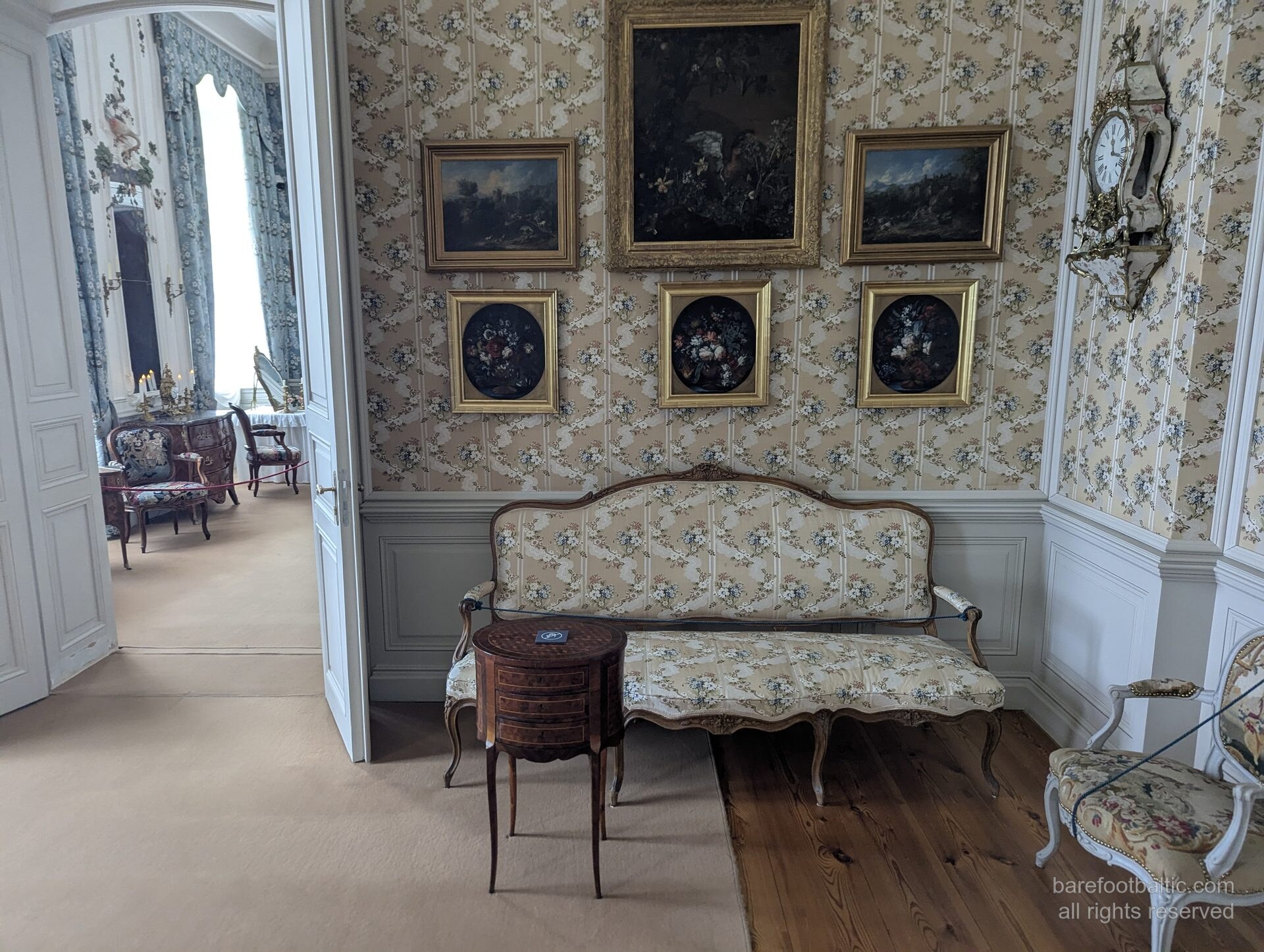
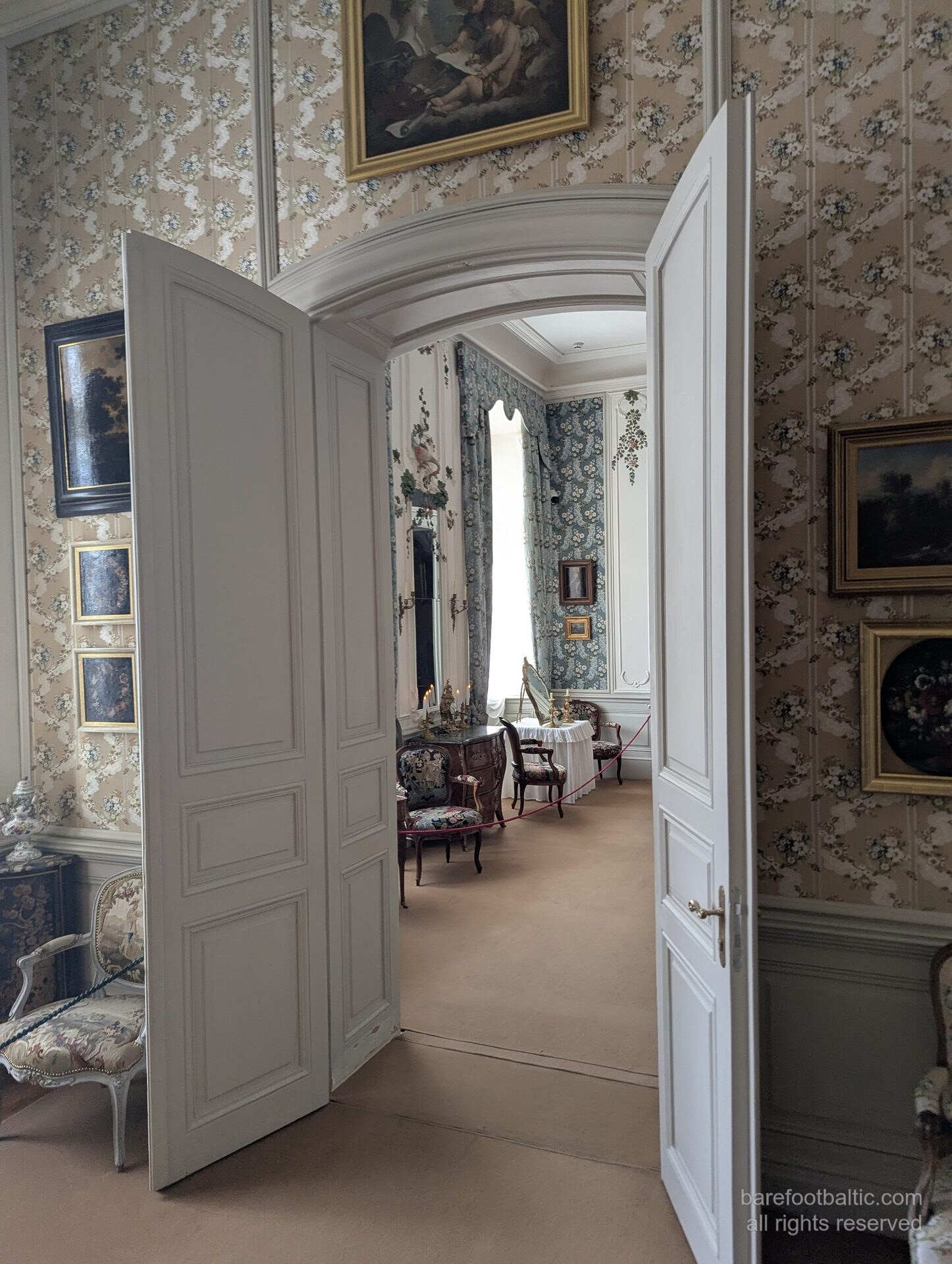
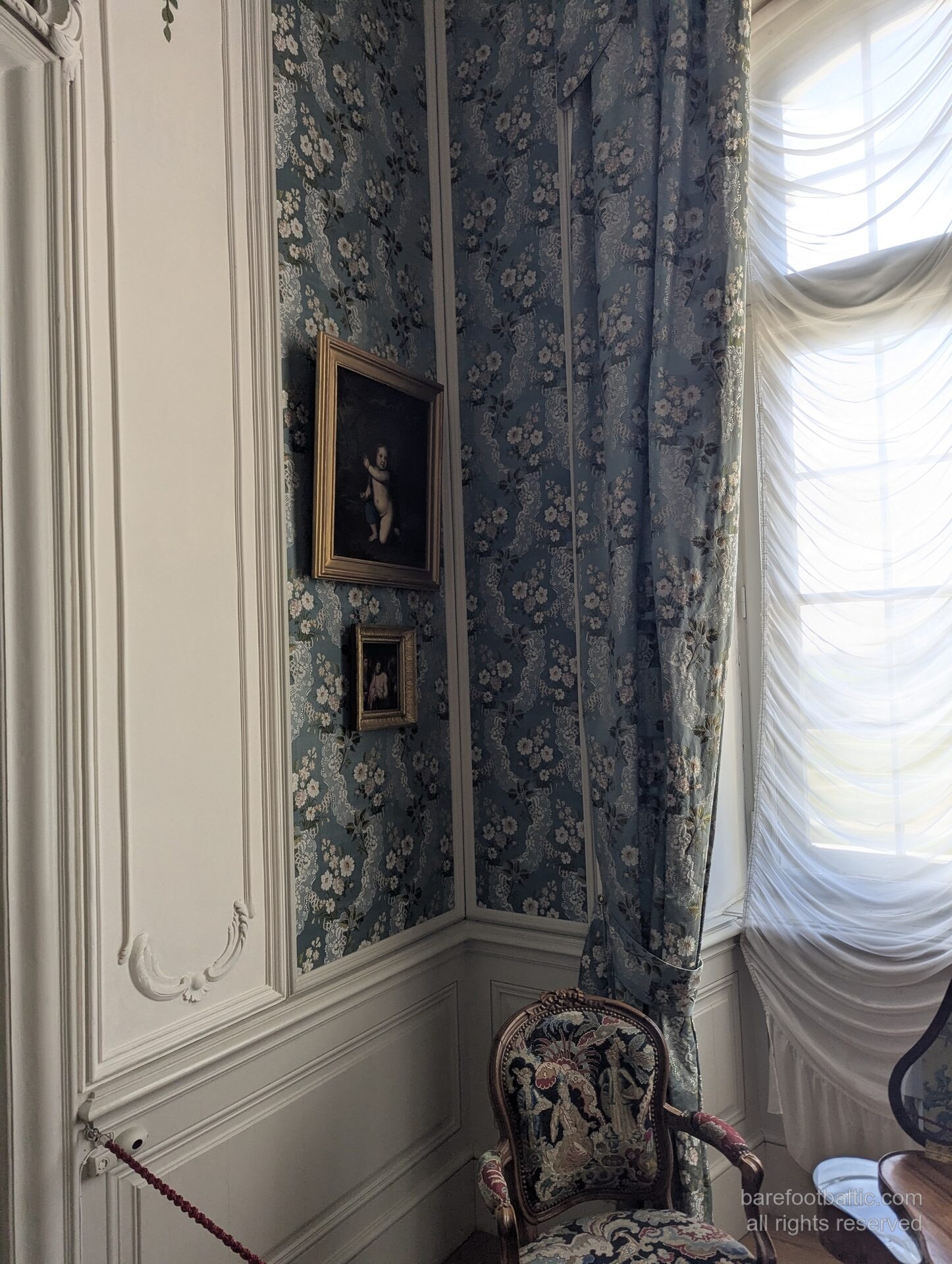
The broché silk wall upholstery is particularly luxurious. The interior is enriched by the landscapes of Flemish, Dutch, Italian, French and German Baroque painters depicting still lifes with flowers, allegories and religious paintings that radiate peace and harmony and allude to the character of Duchess Benigna Gottlieb.
Next, the Duchess's Boudoir.
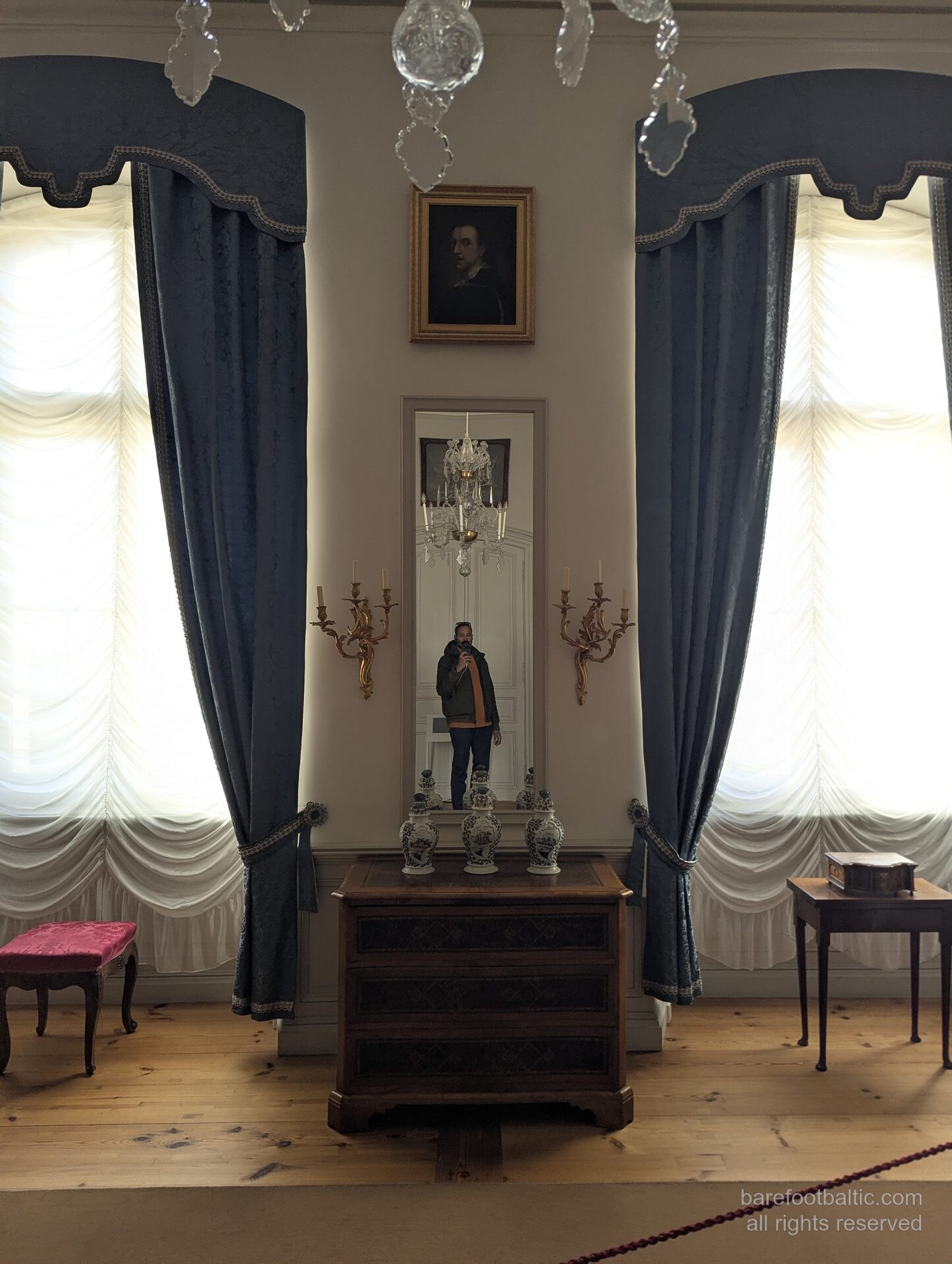
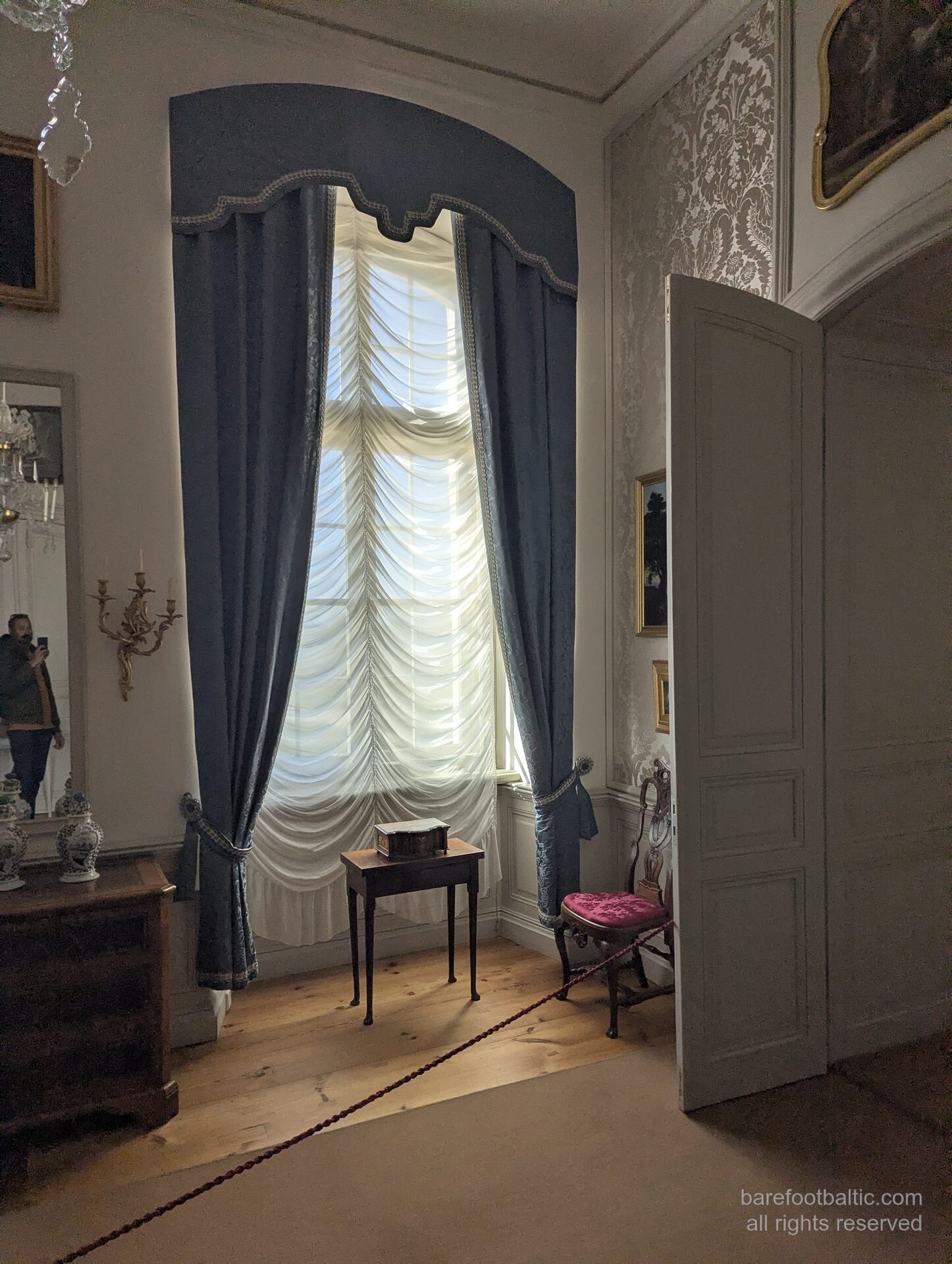
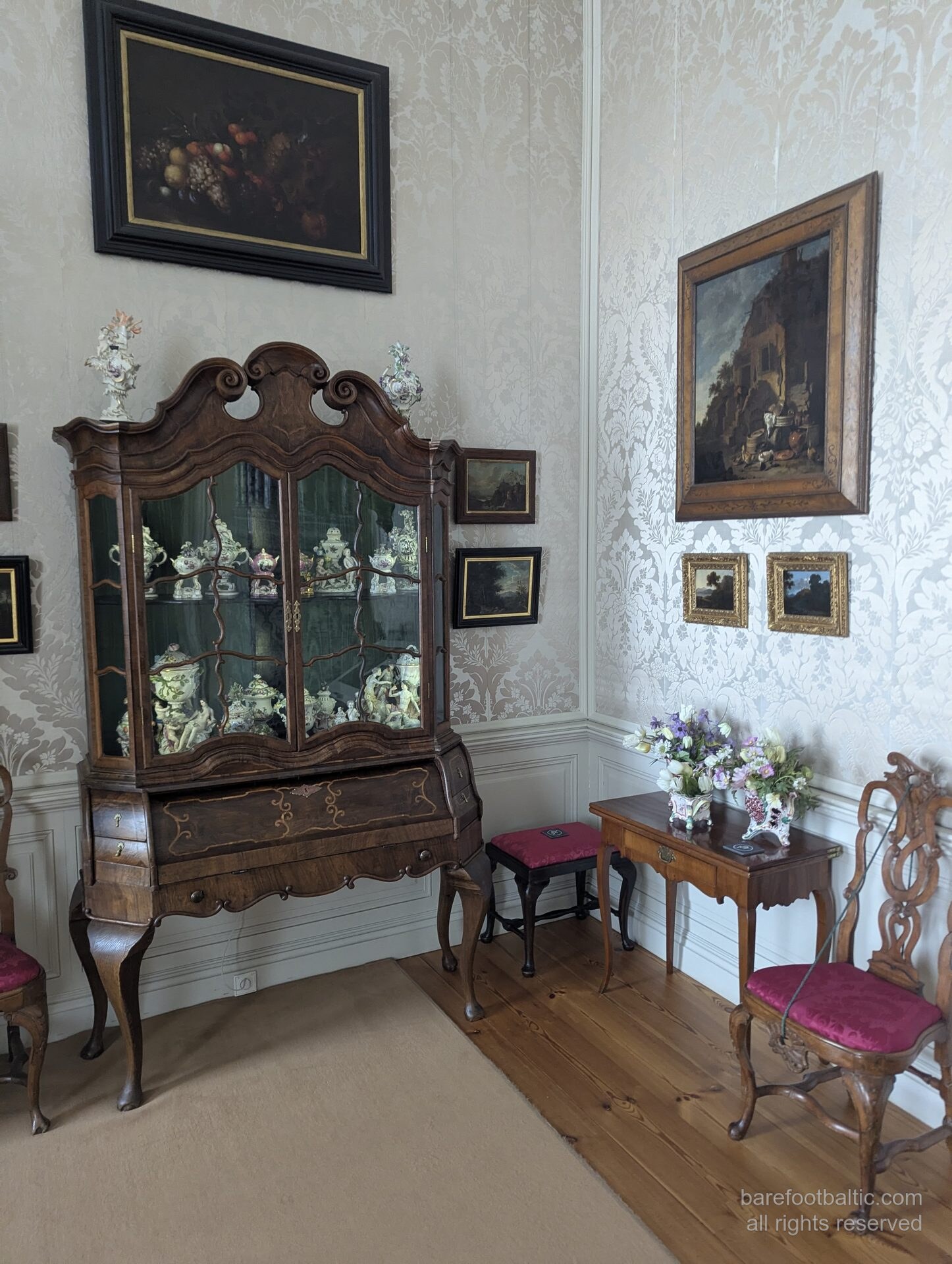
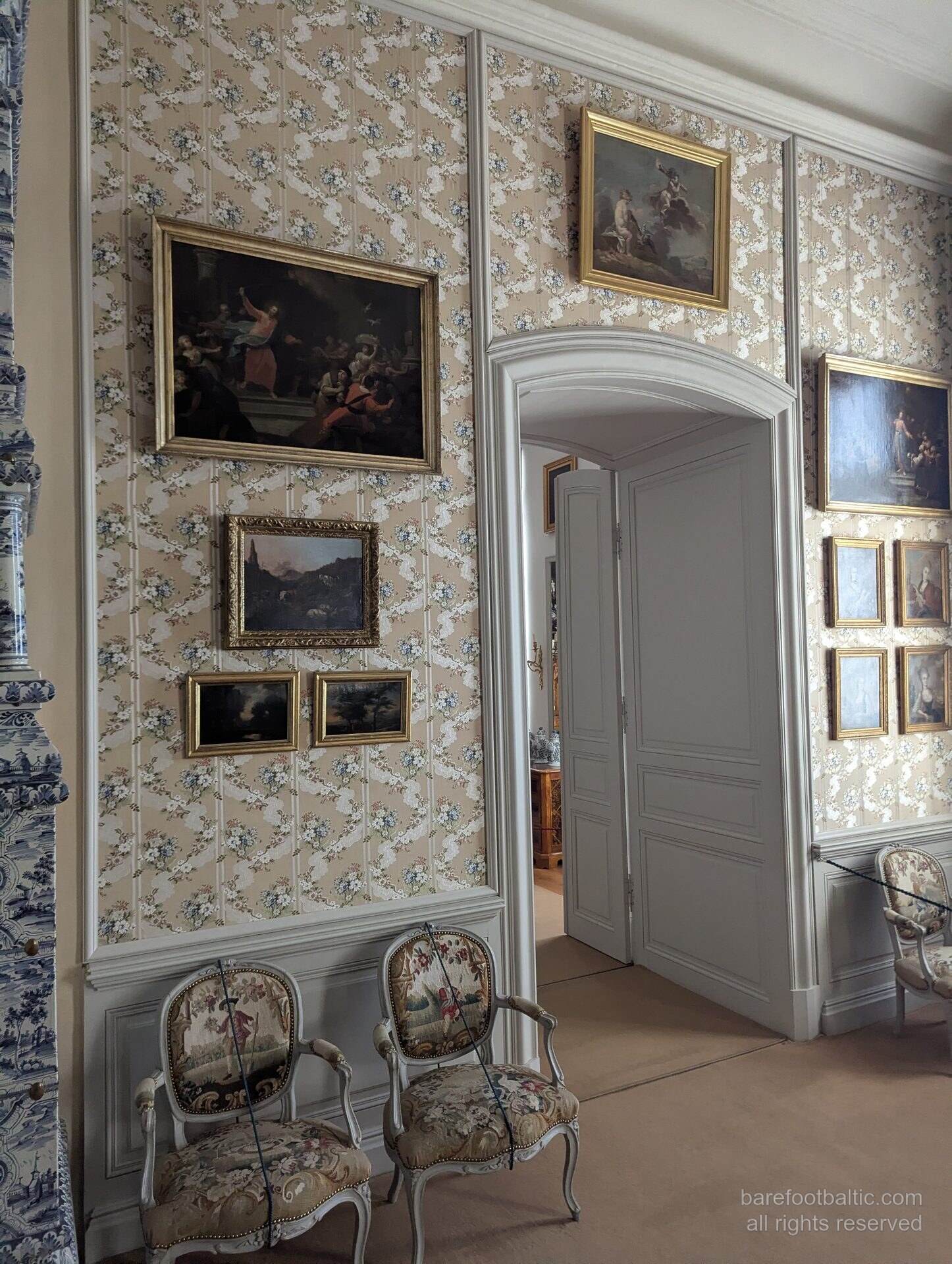
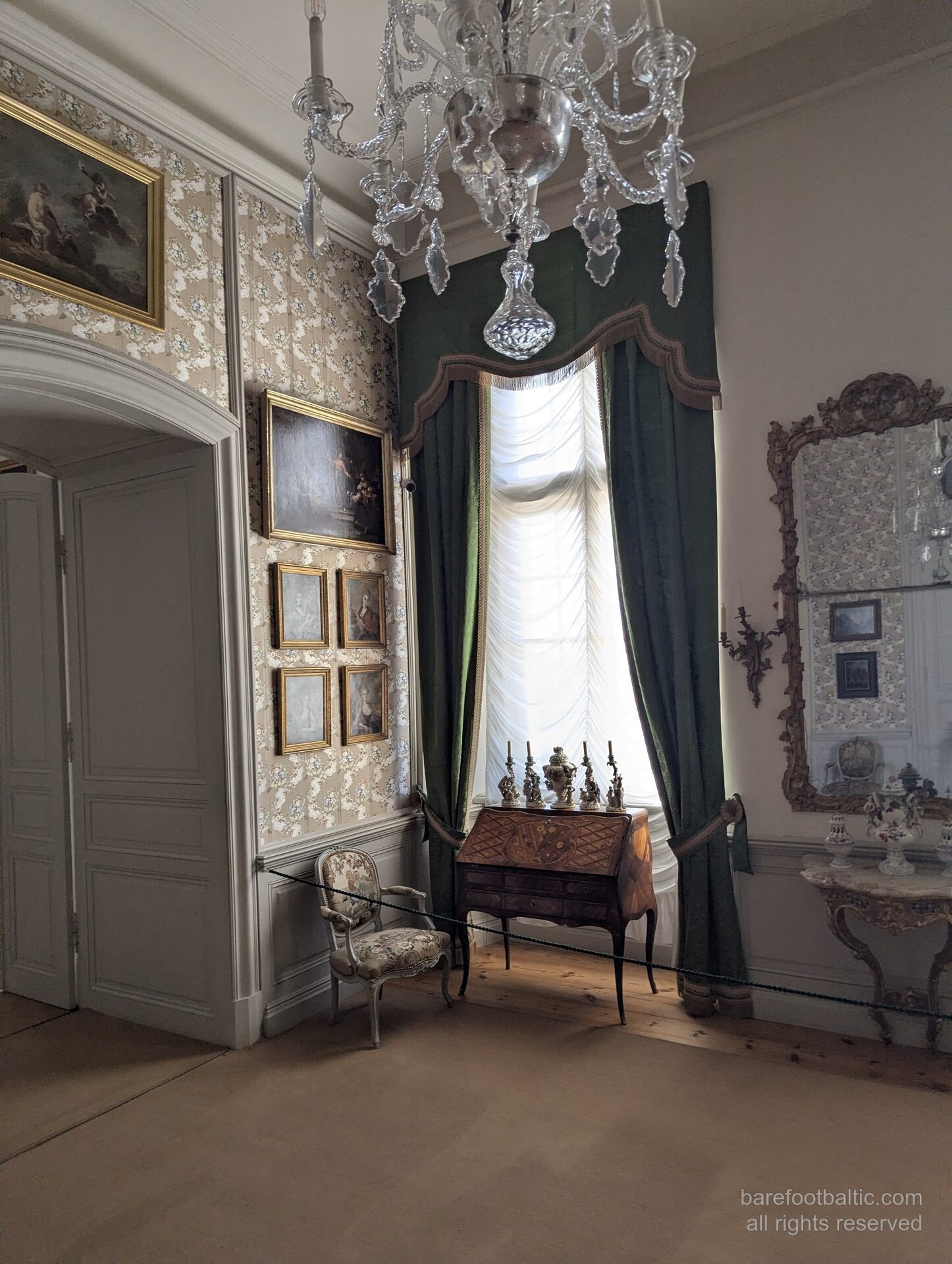
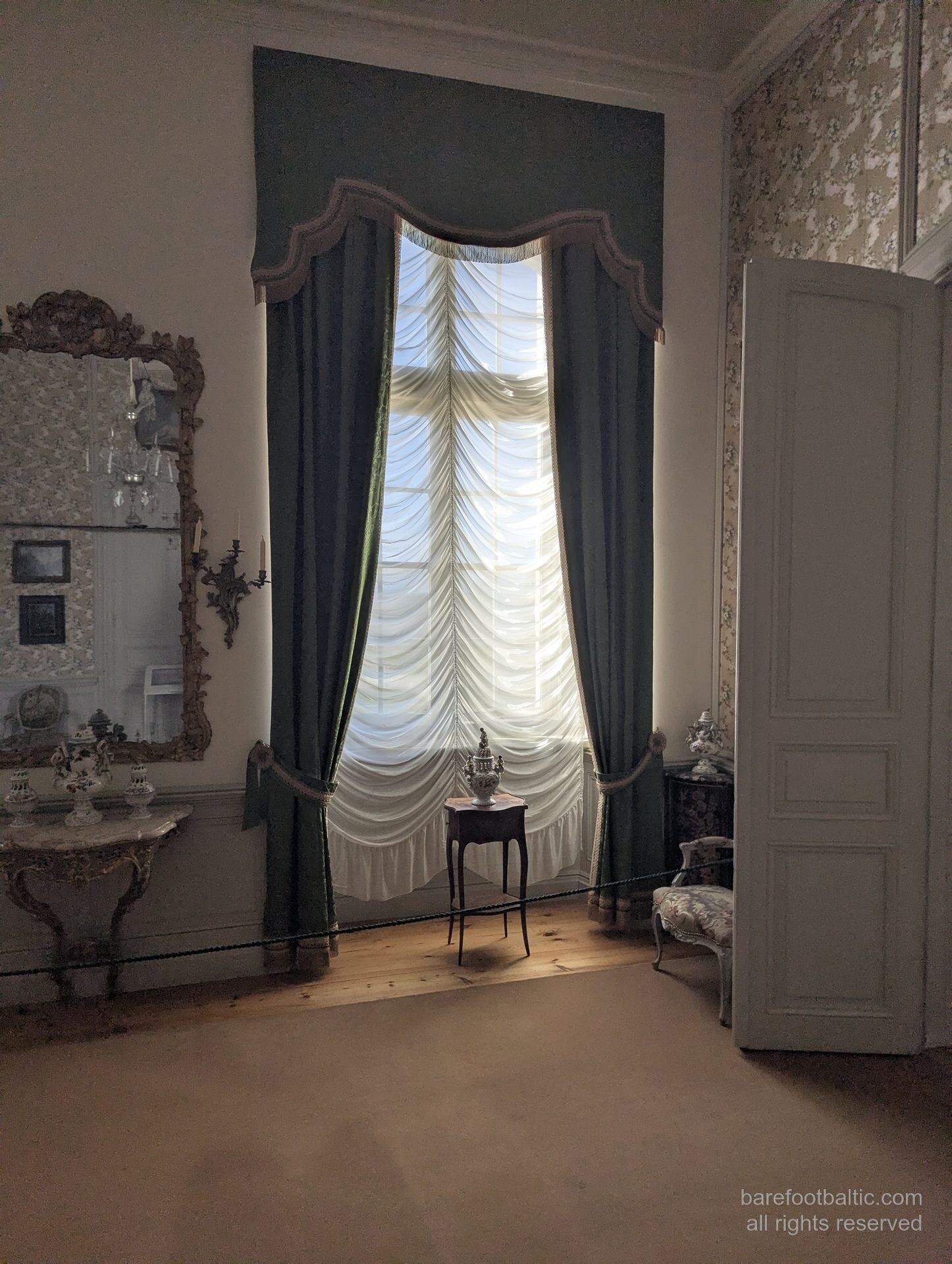
The Duchess's Boudoir
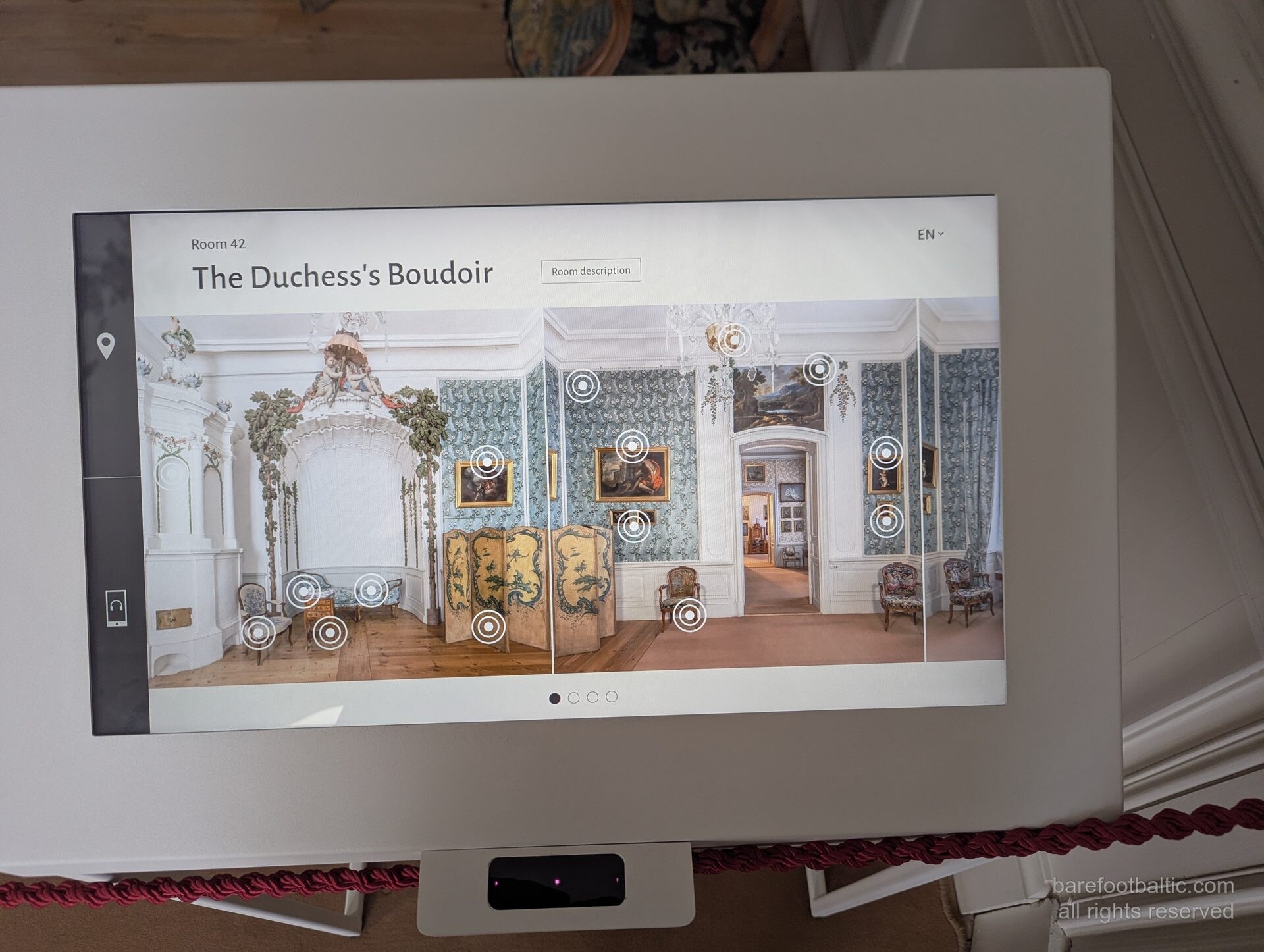
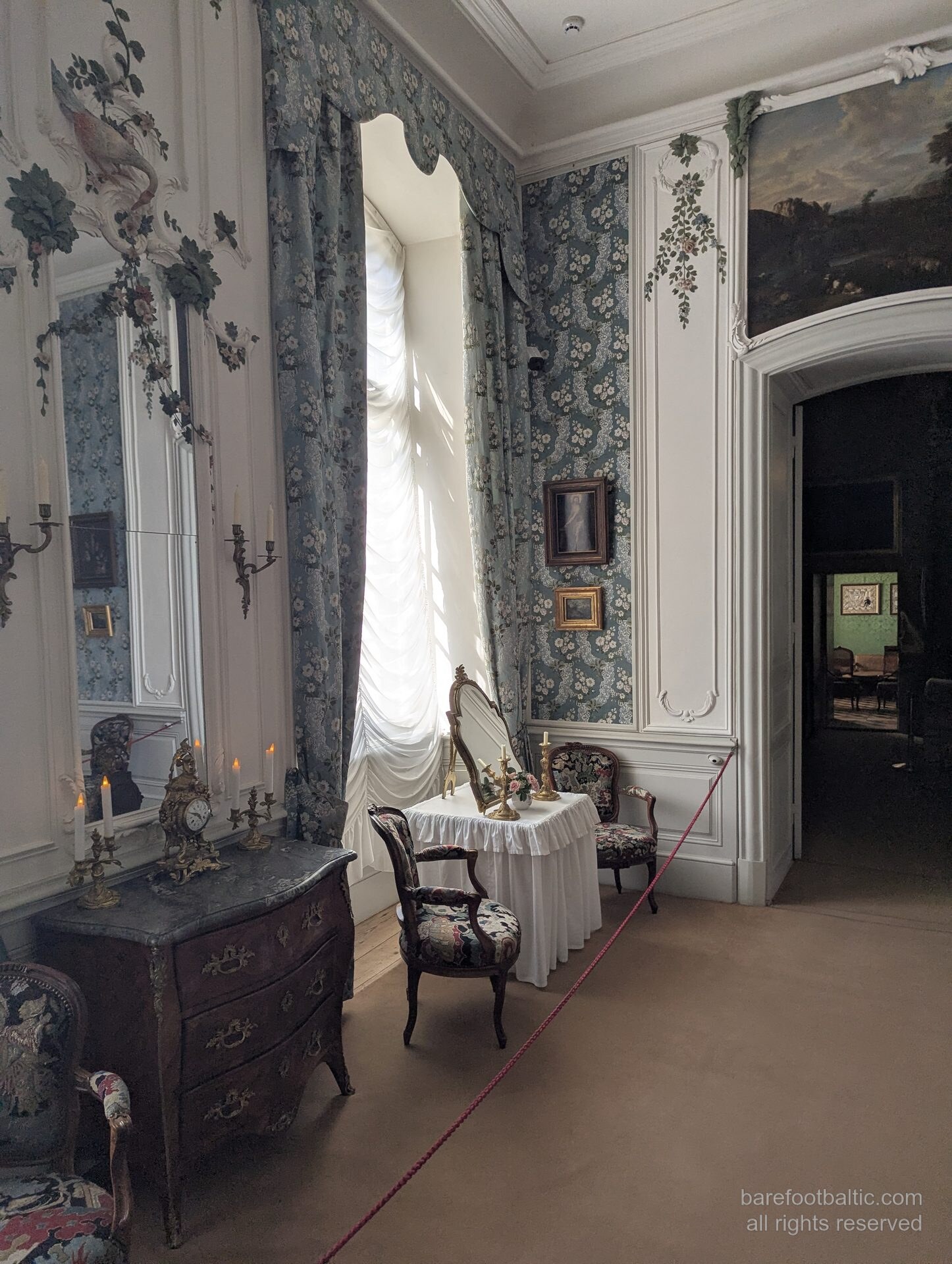
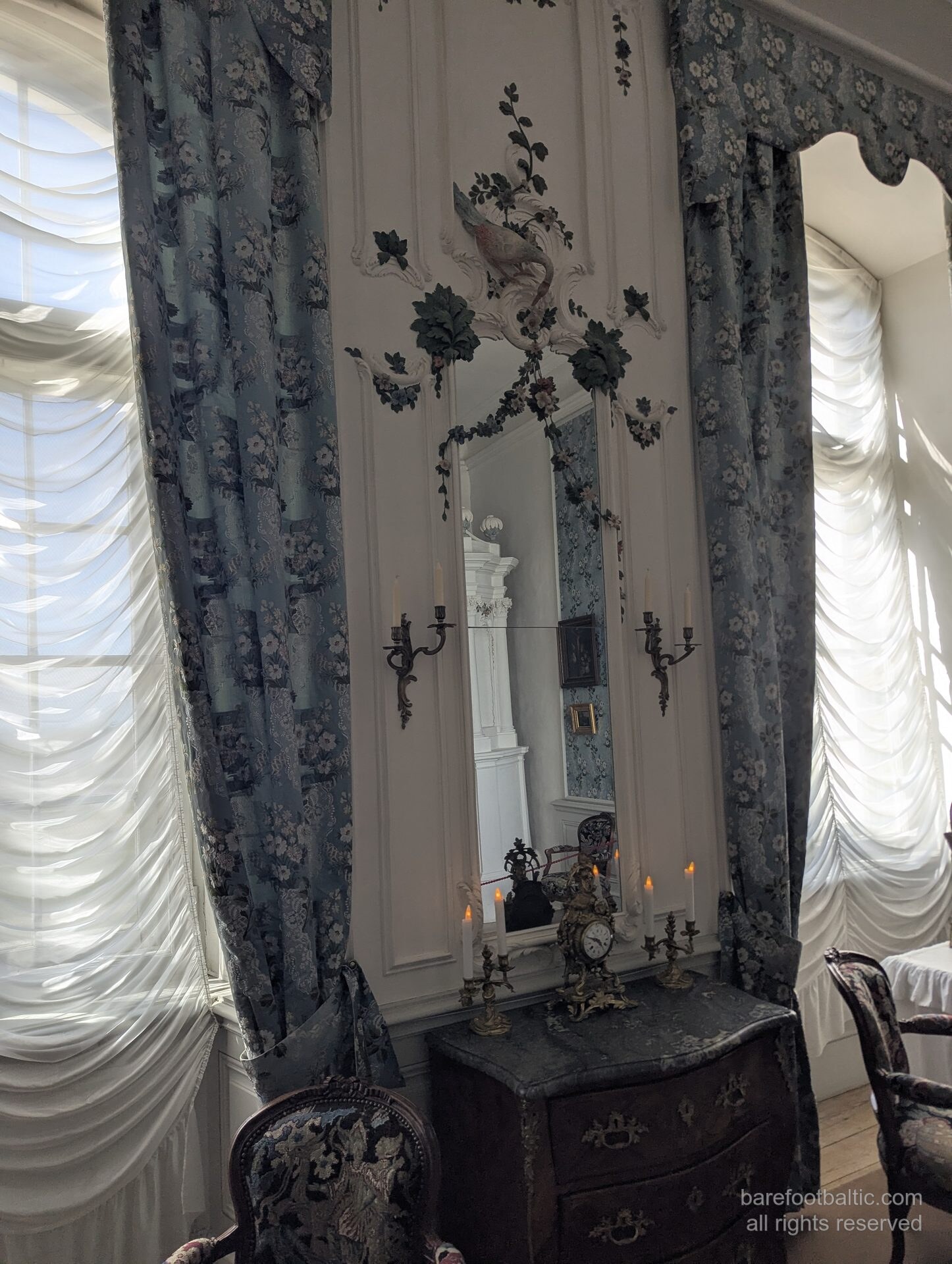
The Duchess's Boudoir served as a resting place and a room for her daily toilet, which could sometimes last several hours because it included dressing, hair styling, grooming and application of make-up to prepare for the day. Here, the Duchess was served morning coffee, a chocolate drink or a cup of tea.
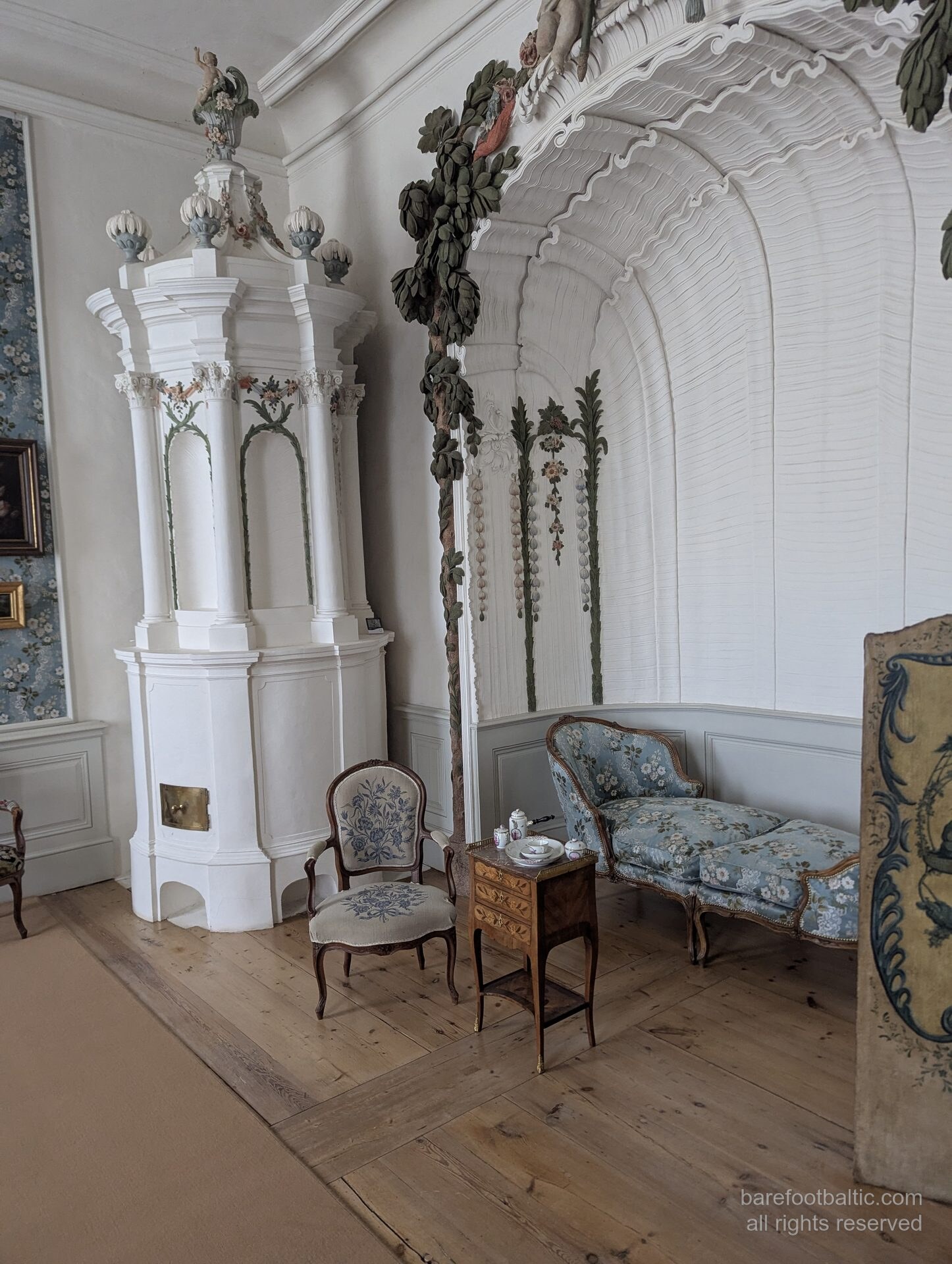
The boudoir is artistically the most significant room in the Duchess's apartments. Its décor constitutes one of the last works of Johann Michael Graff in Rundāle Palace.
The sofa niche is created in the form of a huge shell, while next to it is a stove matching the overall décor of the room. It is the only stove in Rundāle Palace with a stucco finish, and the only one that has survived among several stucco stoves made by Graff for the other palaces of the Duke of Courland.
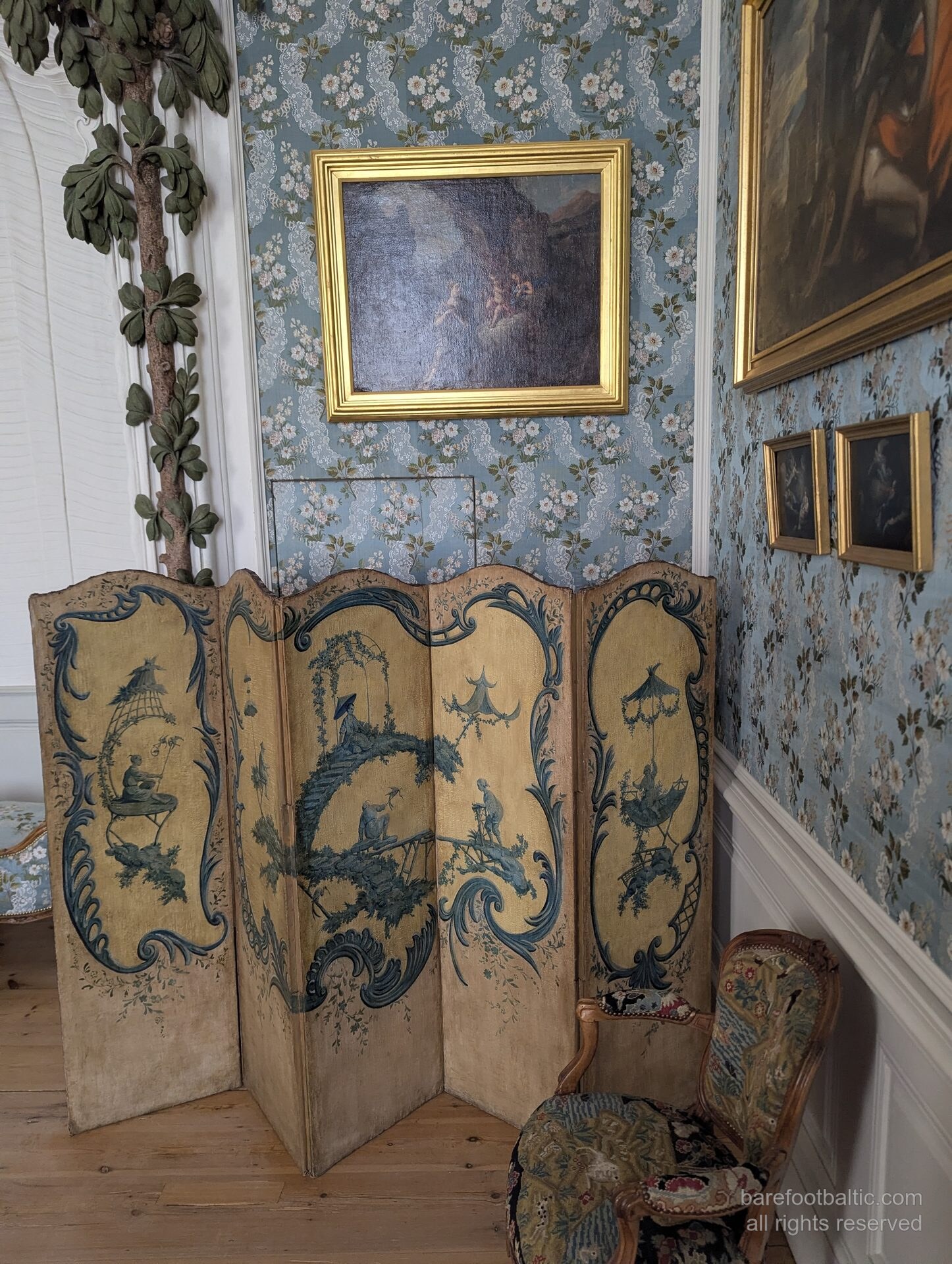
An interesting piece of seating furniture made in the eighteenth century is placed in the niche. It consists of two parts that can be pushed together and in French is called the "broken duchess", or duchesse brisée. This set of chairs was made around 1770 by applying cross-stitch embroidery of the first half of the eighteenth century as upholstery. The screen painting features motifs by Jean-Baptiste Pillement, a prominent French landscape painter from the second half of the eighteenth century, whose motifs influenced the development of Rococo style and fascination with Chinese motifs in the European applied art.
The French furniture in the room corresponds to the functions of the Duchess's Boudoir. By the window is a triangular dressing table with drawers for storing make-up boxes and tools for handicrafts made in the middle of the eighteenth century by French cabinetmaker Pierre Macret. At the other end of the room, you can see a dressing table with a mirror. The pleated, white cover could be frequently and easily changed since the fashion of the time required an abundant use of powder, make-up and perfume.
Seventeenth- and eighteenth-century paintings by Flemish, Dutch, Italian and German artists dedicated to religious themes are reminiscent of the piety of Duchess Benigna Gottlieb.
Next, the Duchess's Bedroom.
The Duchess's Bedroom
The central place in the room is occupied by a state bed with a canopy. It was made recently after an engraving by the Bavarian court artist François de Cuvilliés in the middle of the eighteenth century. The location of the bed is typical of the practice of the second half of the eighteenth century, with doors on both sides of the bed disguised behind the wall-hangings. Behind one door is a toilet-room, and behind the other are the servants' hallway and a mezzanine room.
At the head of the bed is an eighteenth-century ivory crucifix made in Germany. There is a footstool by the bed, since without one it would have been difficult to get in and out of the high bed. A bed warmer was also needed, a charcoal pan with an openwork lid. Next to it, you can see a bedside table with a marble surface made in France in the middle of the eighteenth century, and inside it is a convenient portable glass vessel for urine called a bourdaloue.
An interesting object can be seen in the window opening, a night clock, made in the middle of the eighteenth century in Switzerland. By placing a lit candle behind the clock, it was possible to read the time through the incisions made in the dial.
From the Duchess's Bedroom, we can look at her toilet-room to the left of her bed.
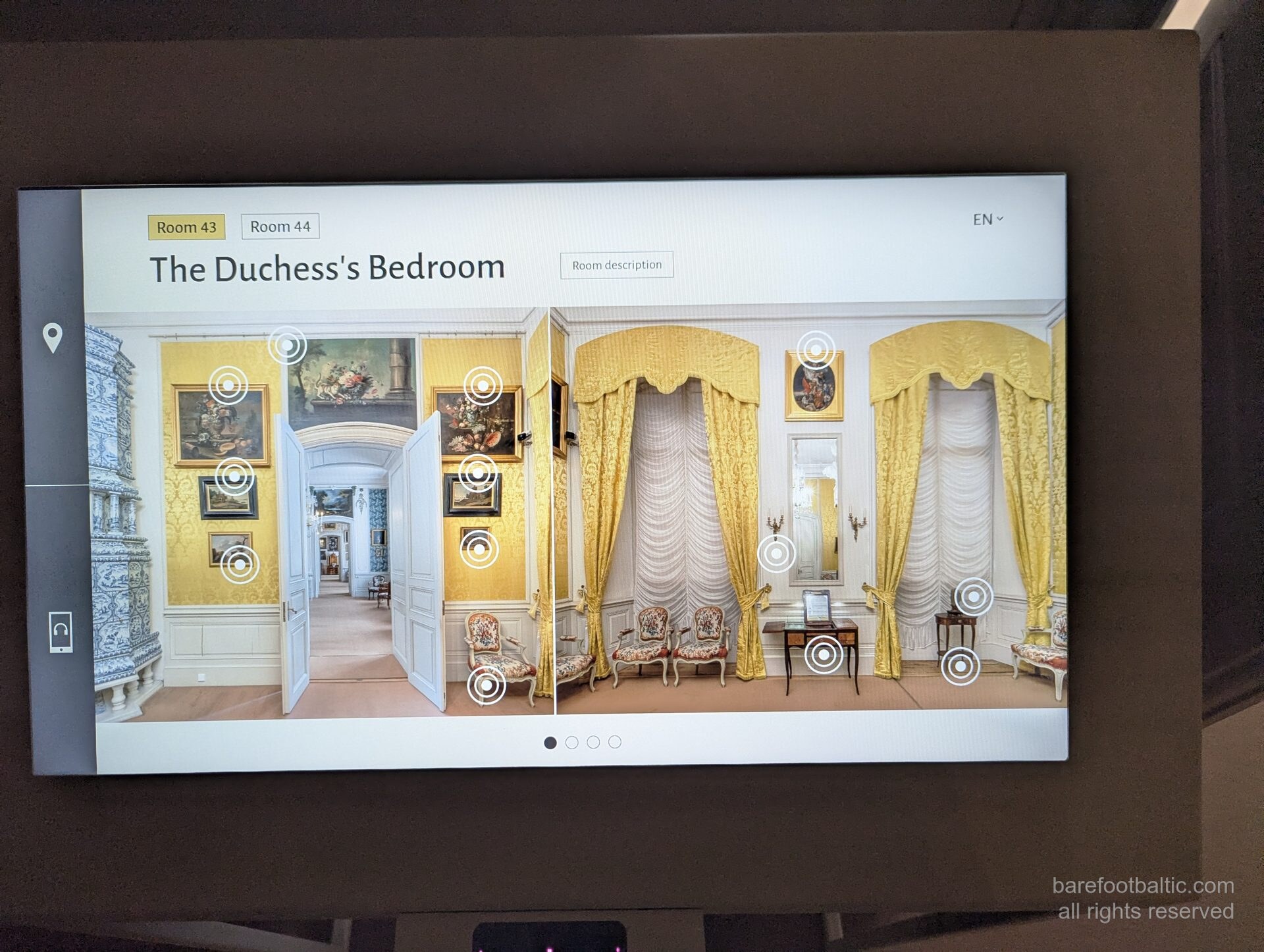
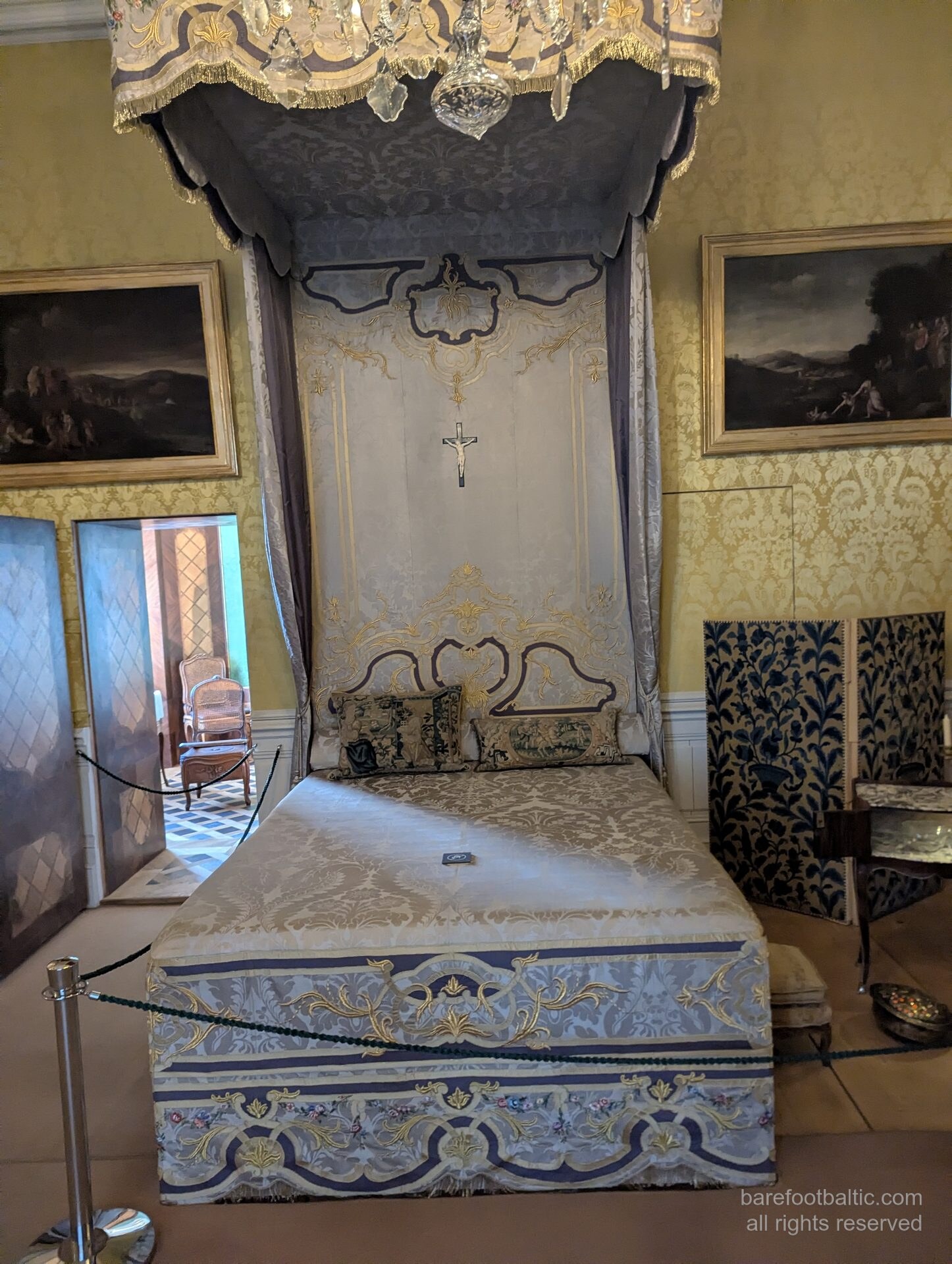
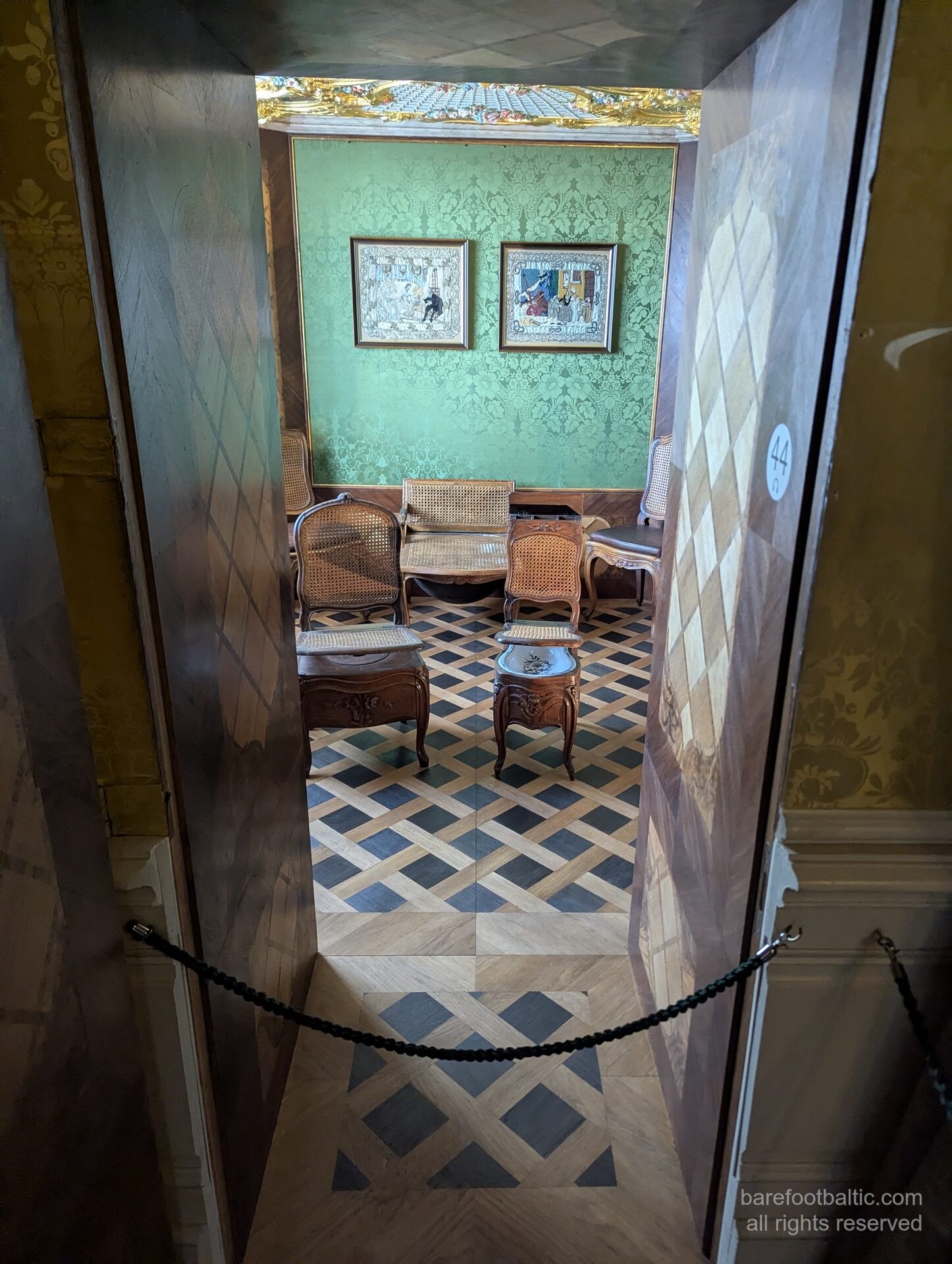
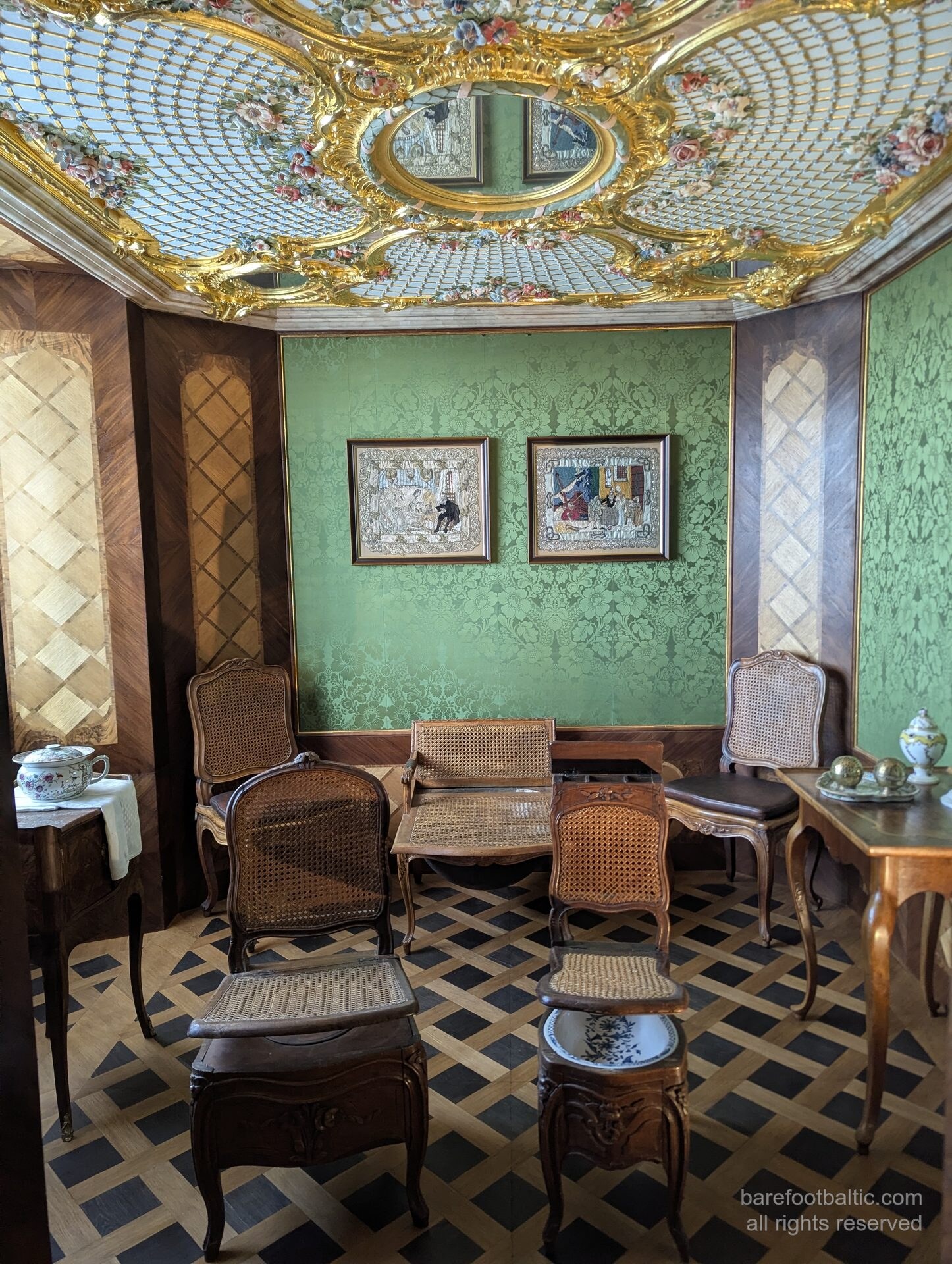
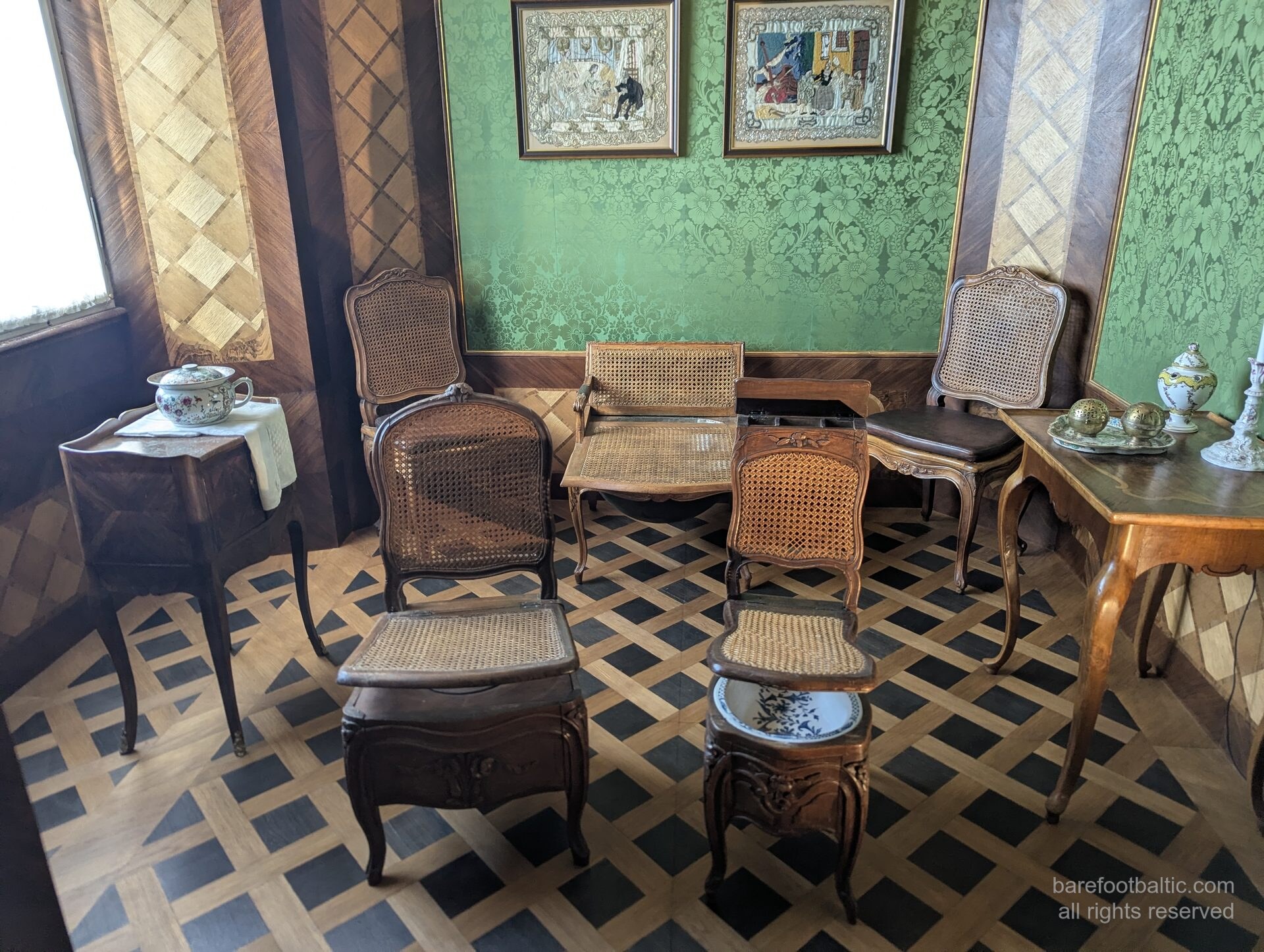
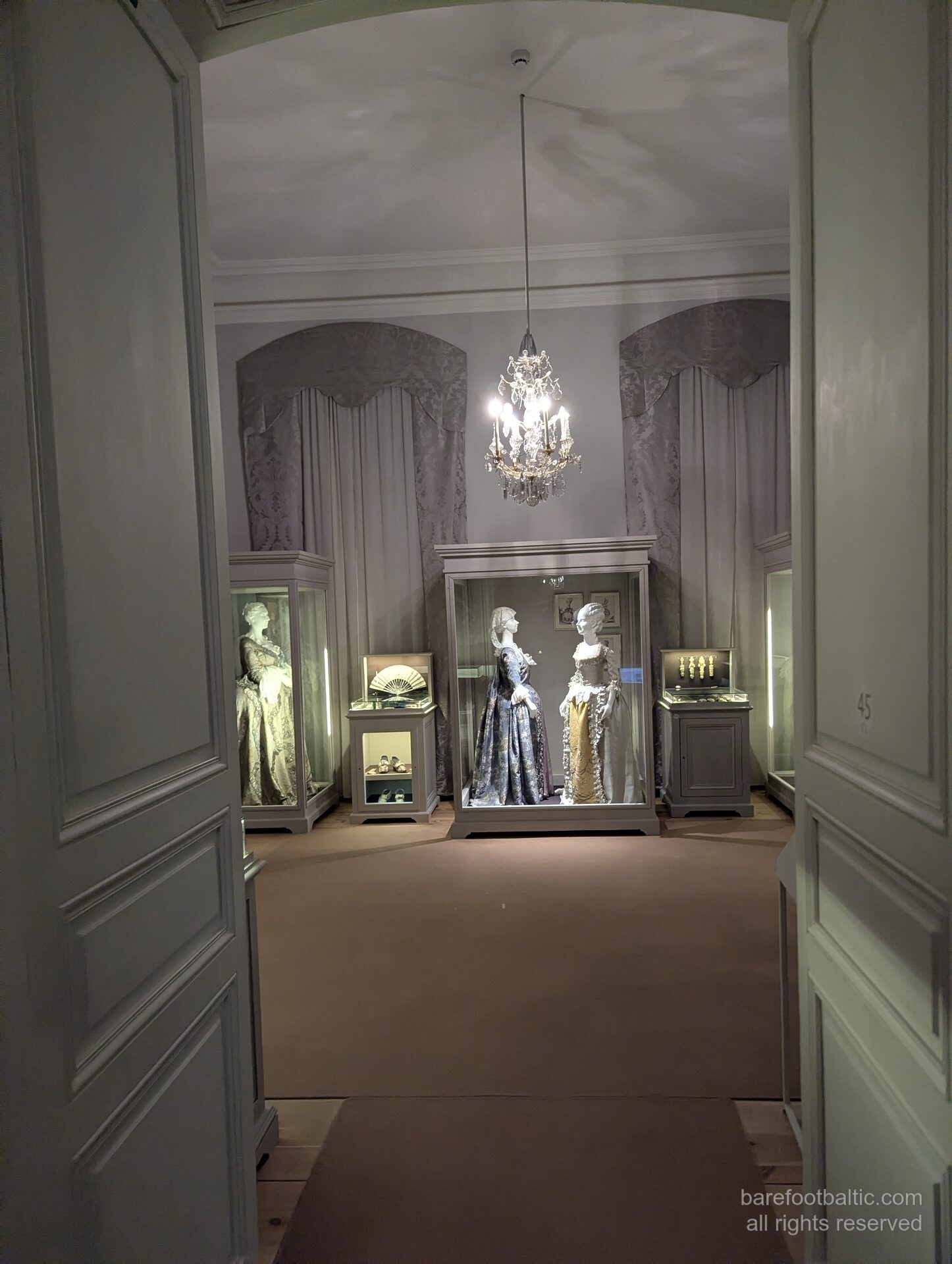
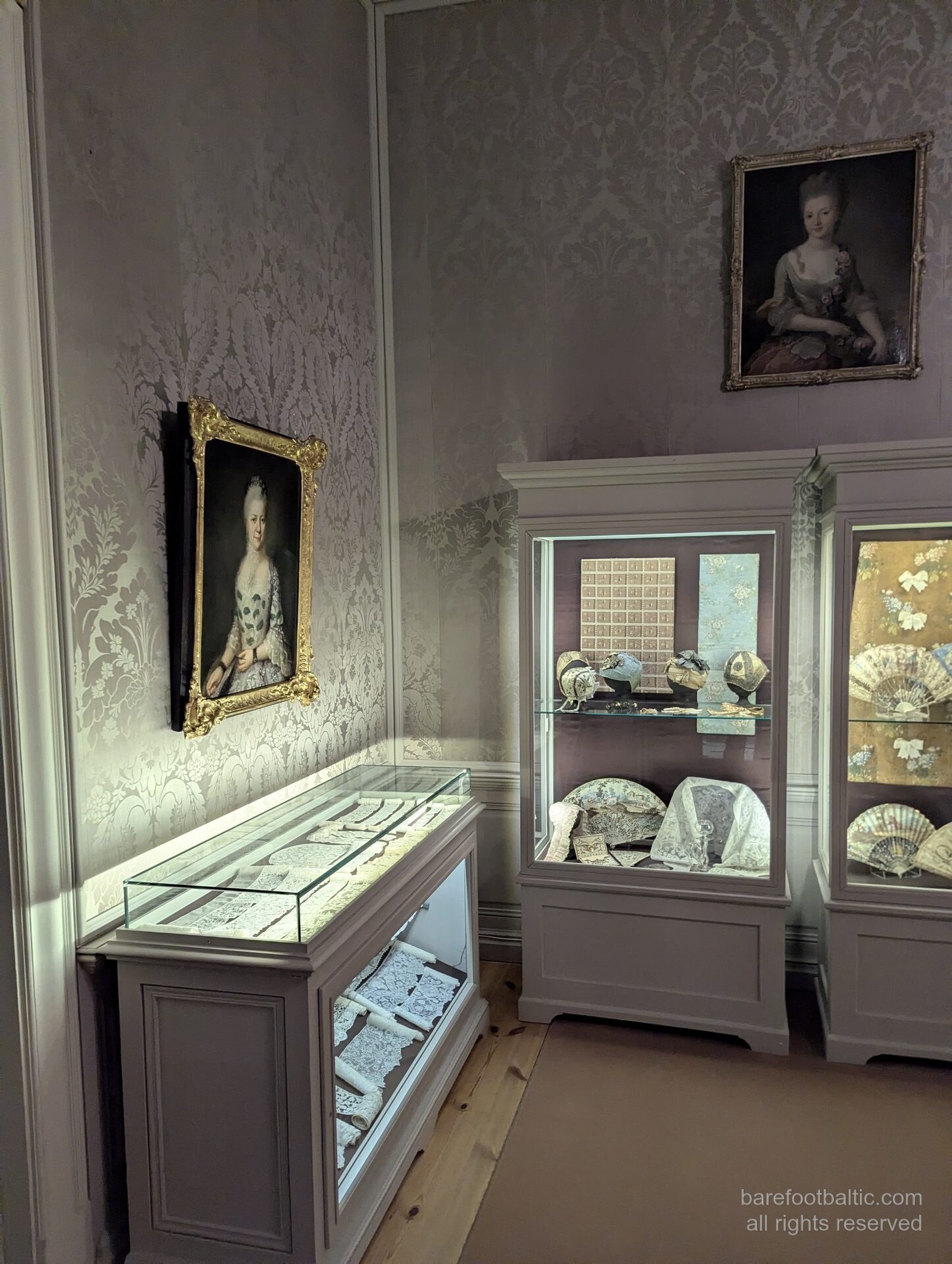
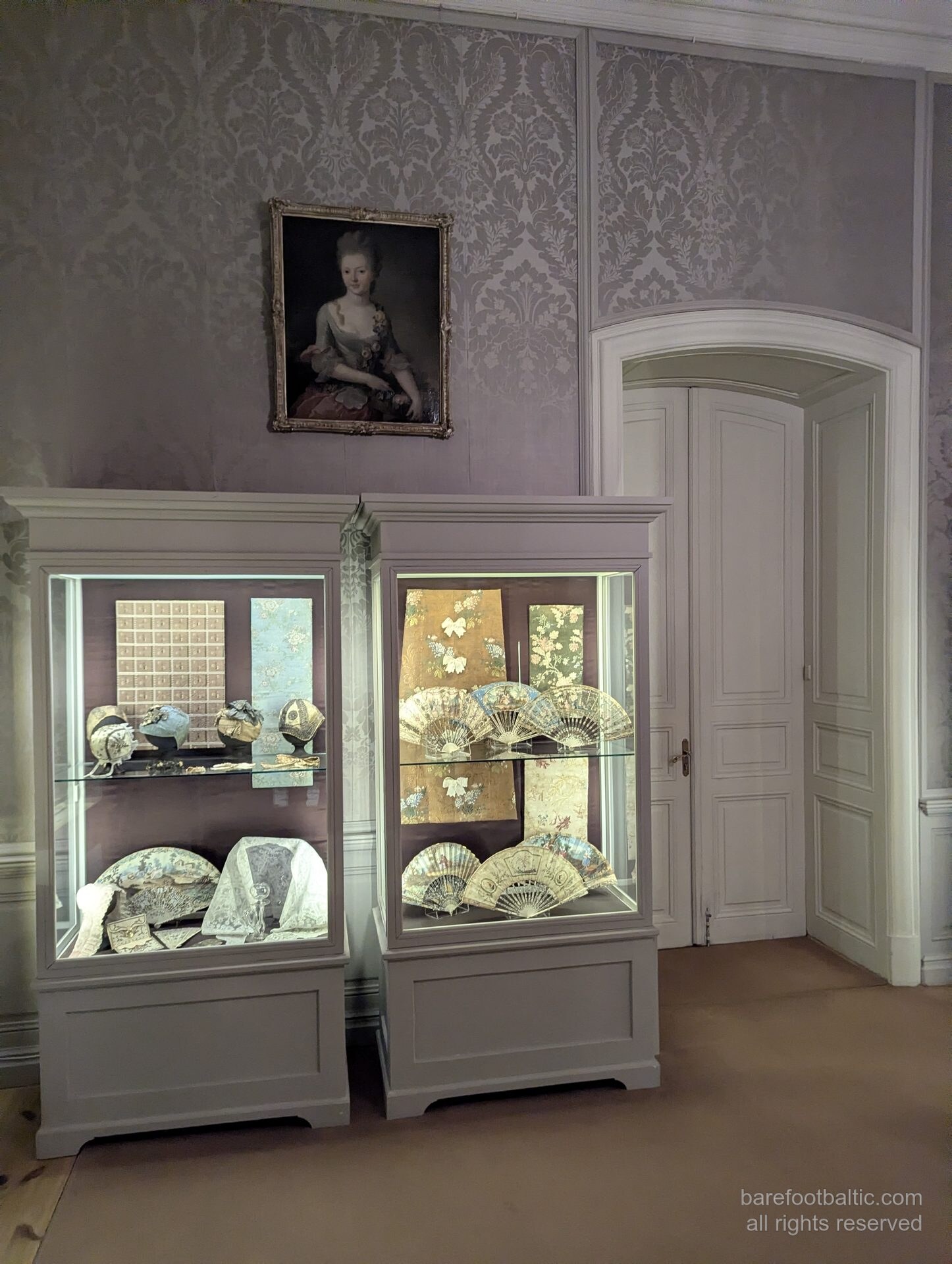
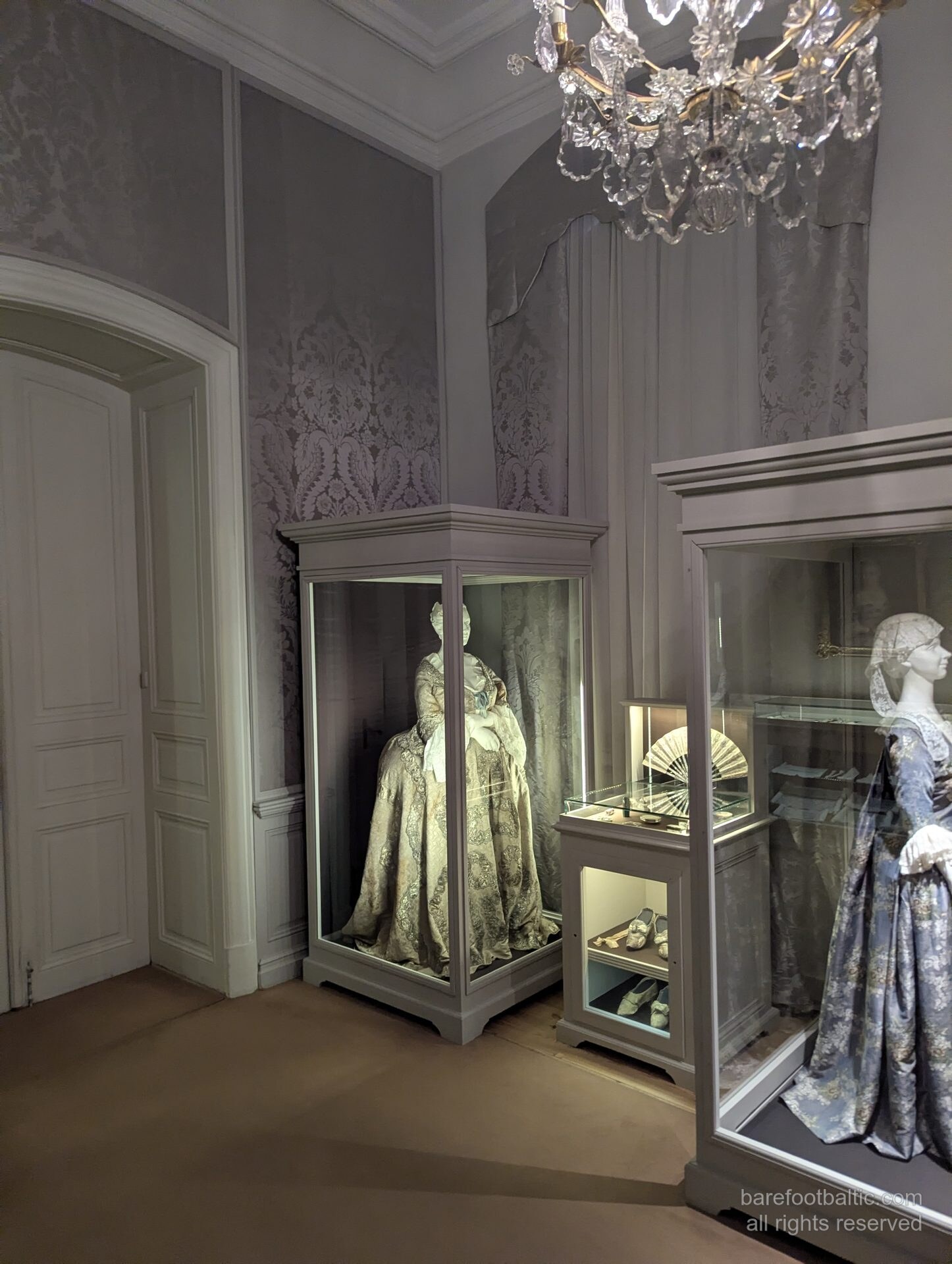
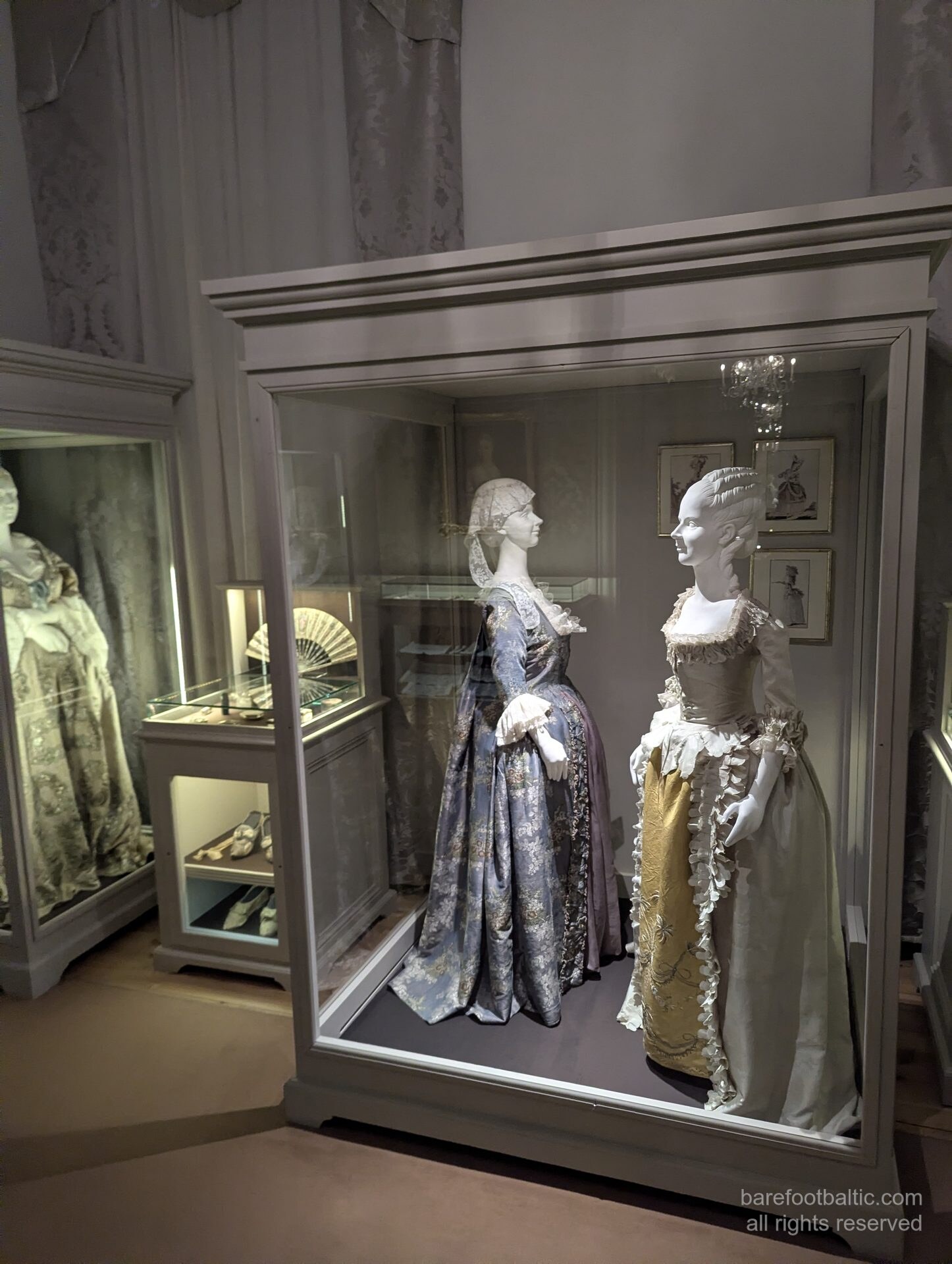
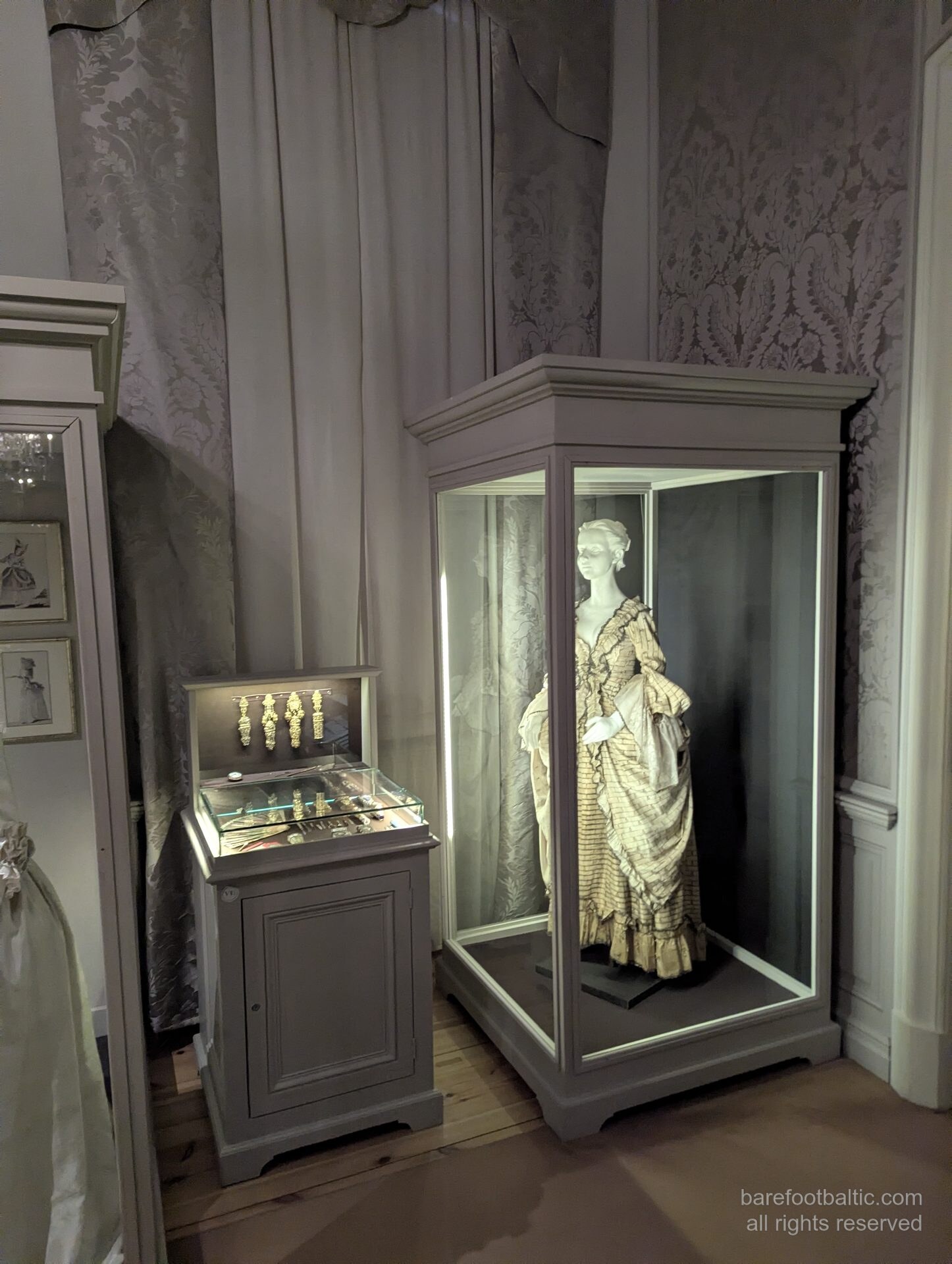
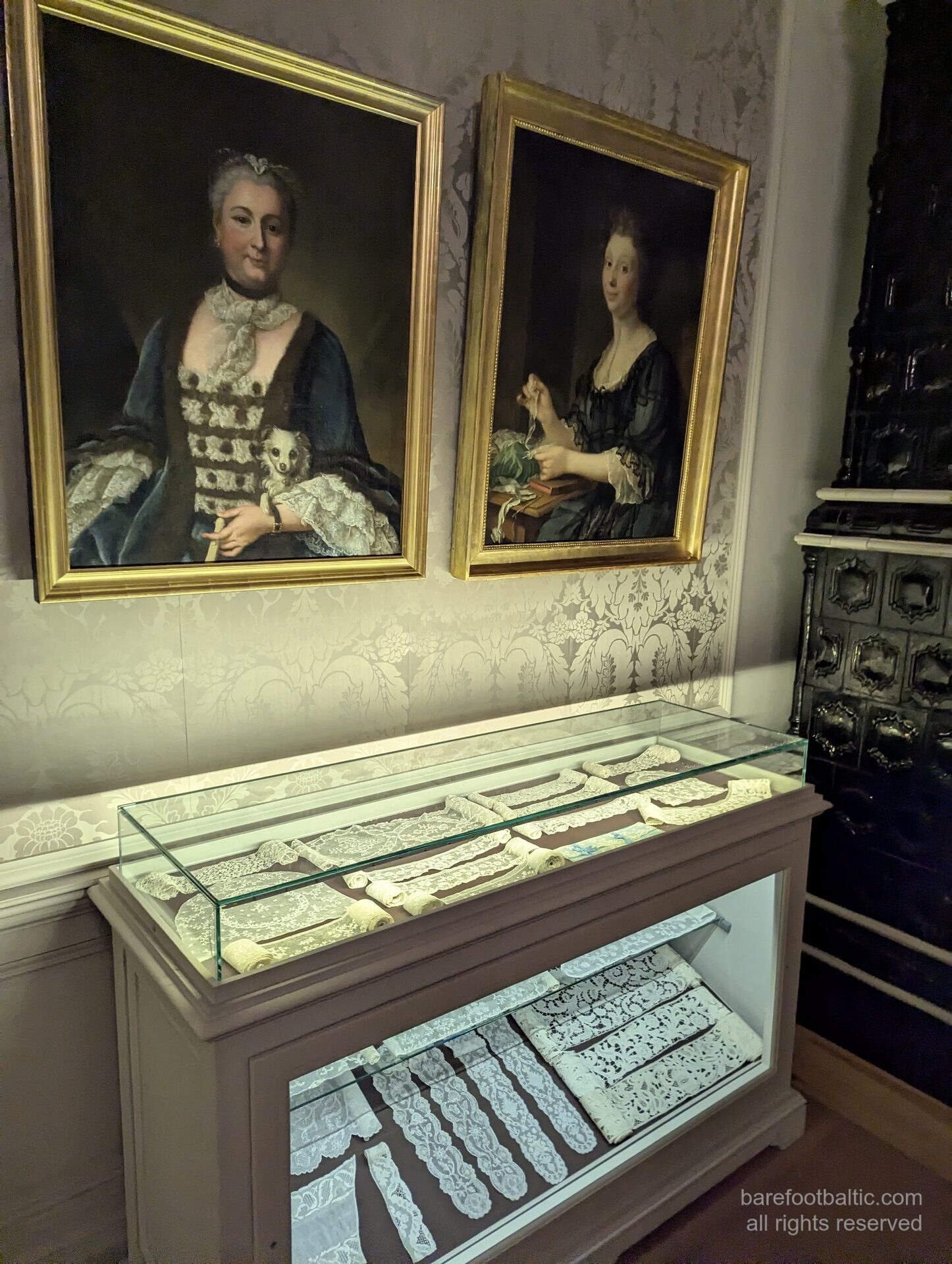
The Duchess's Toilet-Room
The ceiling height of the toilet room is only 2.44 metres because above it a mezzanine room had been set up for the Duchess's maid. The ceiling of the room is designed as an illusory trellis pavilion, with the gilded lattice standing out on the blue background, reminiscent of the sky. In the centre of the ceiling and the four corners is mirror glass, which optically increases the height of the ceiling. The walls are covered with intarsia panels, which in the second construction period were reused from the décor intended for another room.
In the toilet room, we see hygiene items made in France in the eighteenth century, namely a commode chair, a bidet with a washbasin and a hip bath.
On the wall, you can see two interesting embroideries made in Russia in the fourth quarter of the eighteenth century with various silk fabrics and ribbons, as well as fragments from engravings based on paintings by Nicolas Lancret.
We continue the tour in the enfilade of the courtyard side of the Duchess's apartments where her ladies-in-waiting once stayed but which now houses thematic exhibitions.
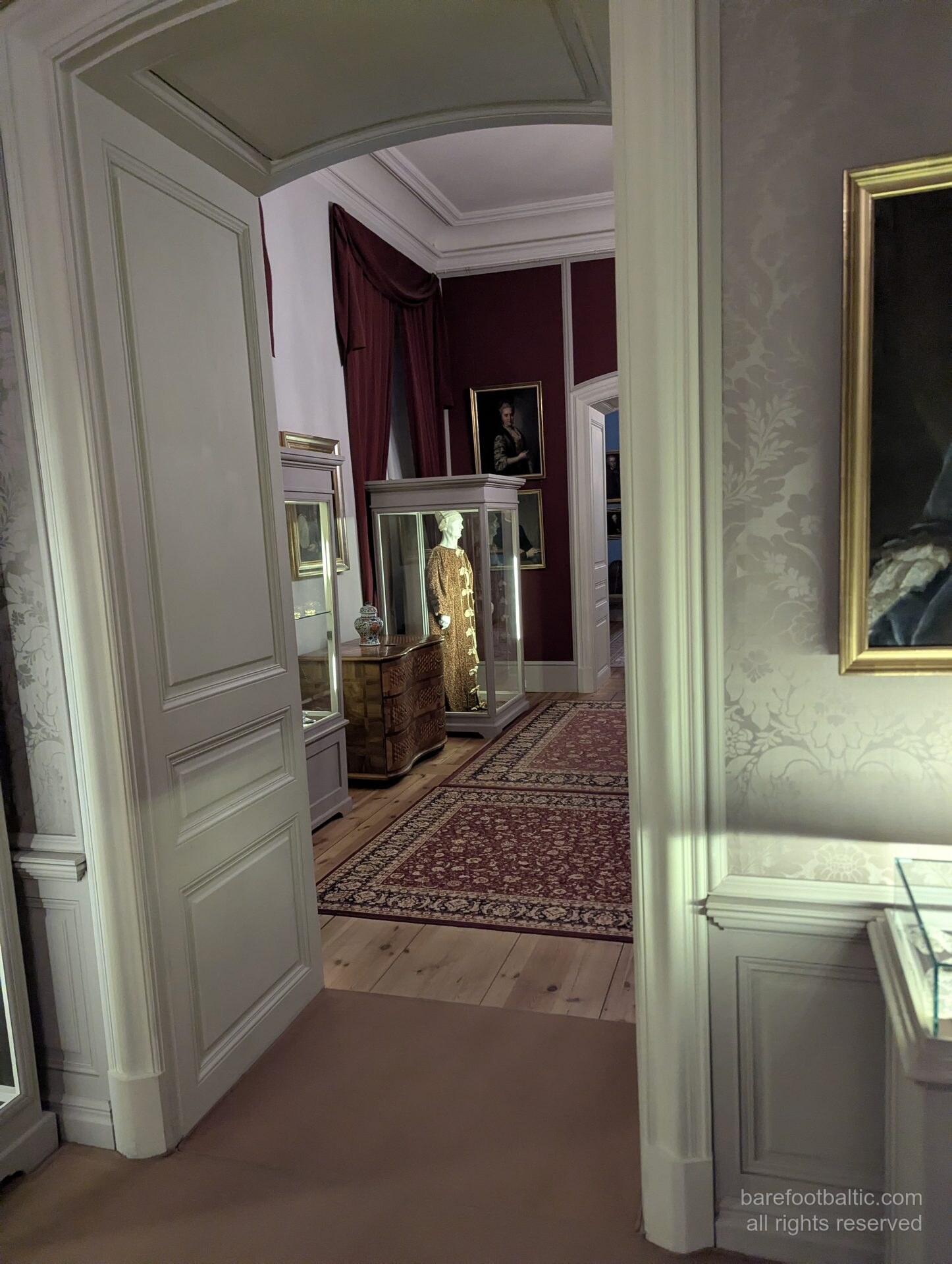
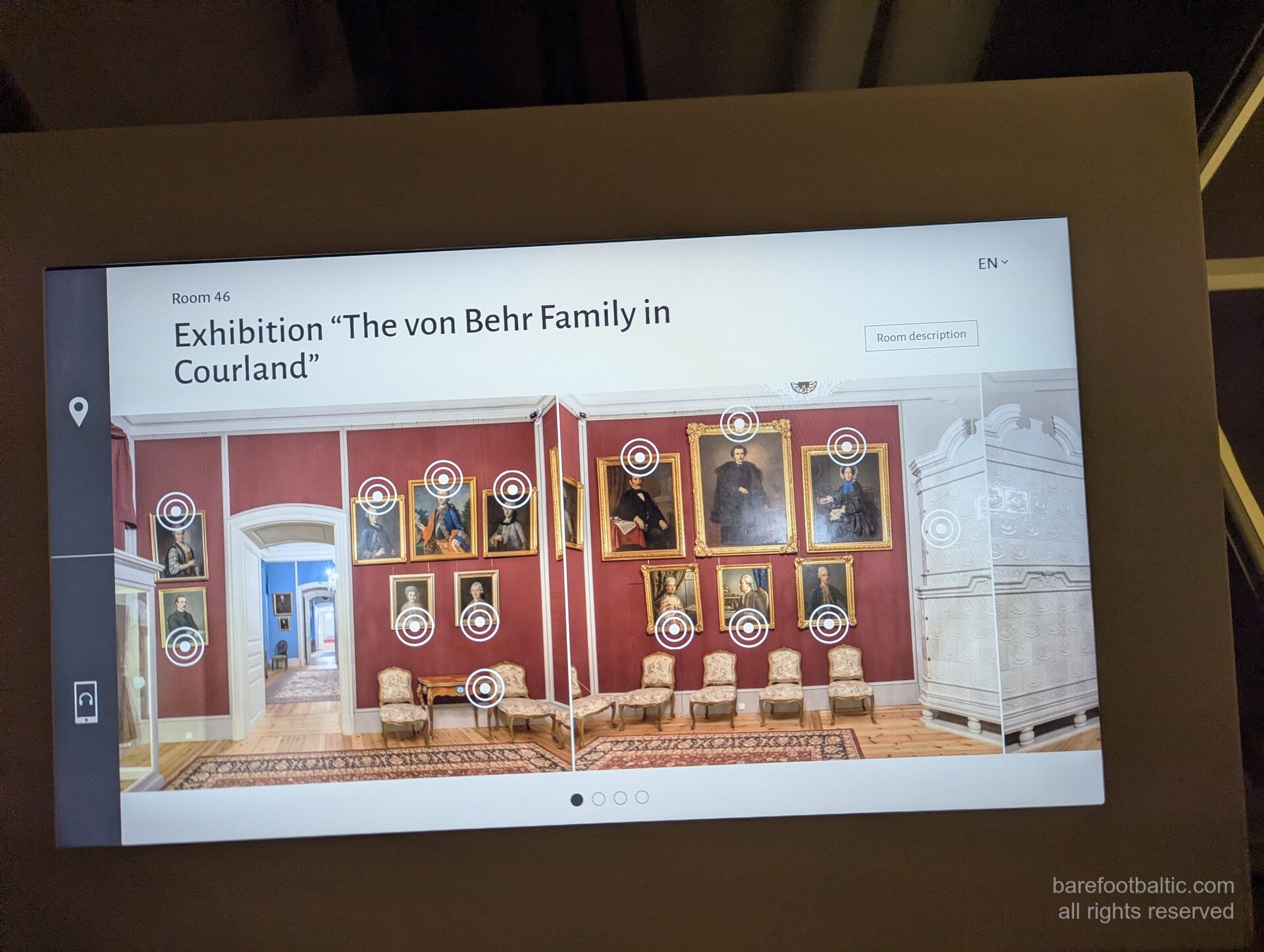
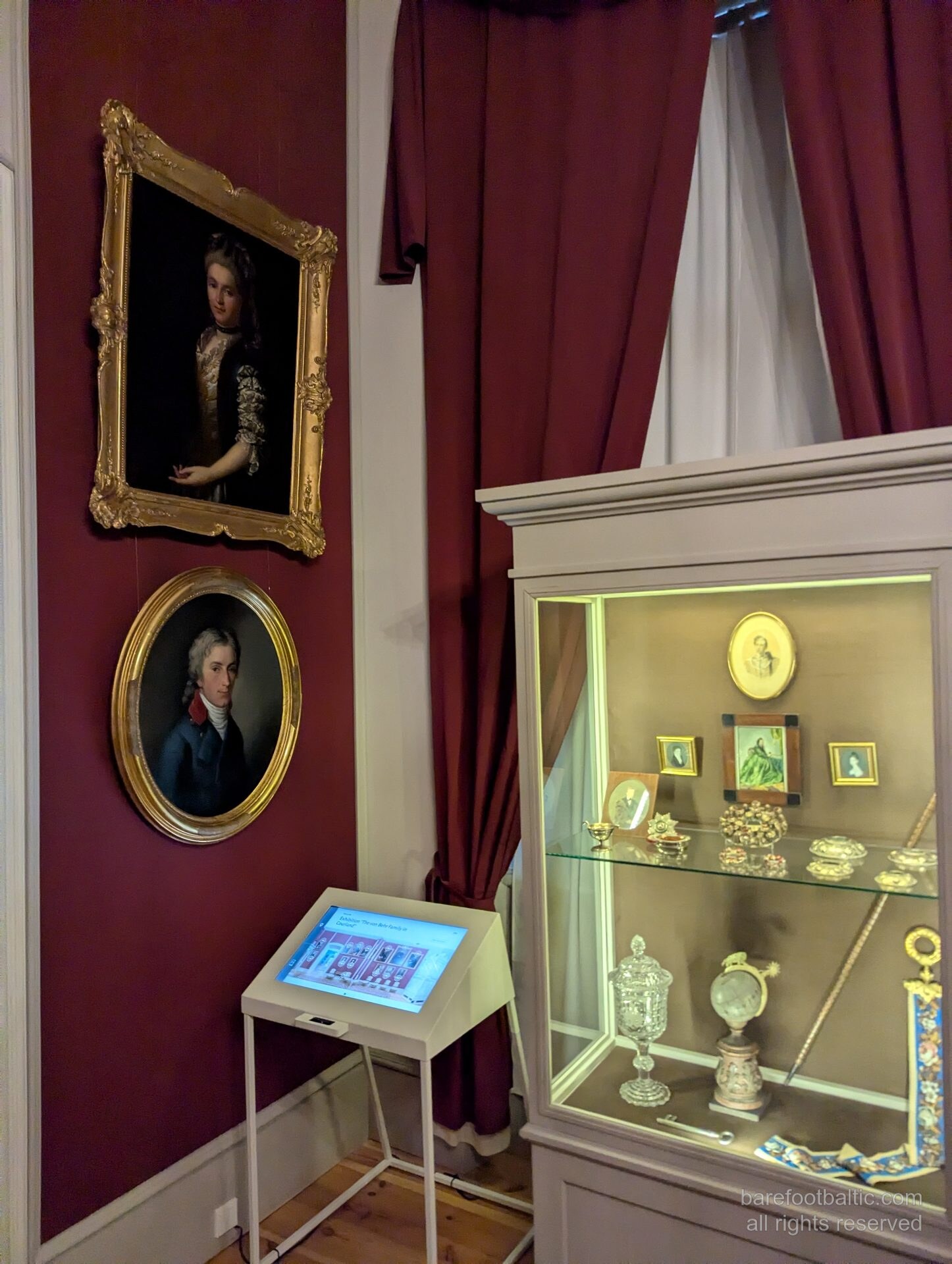
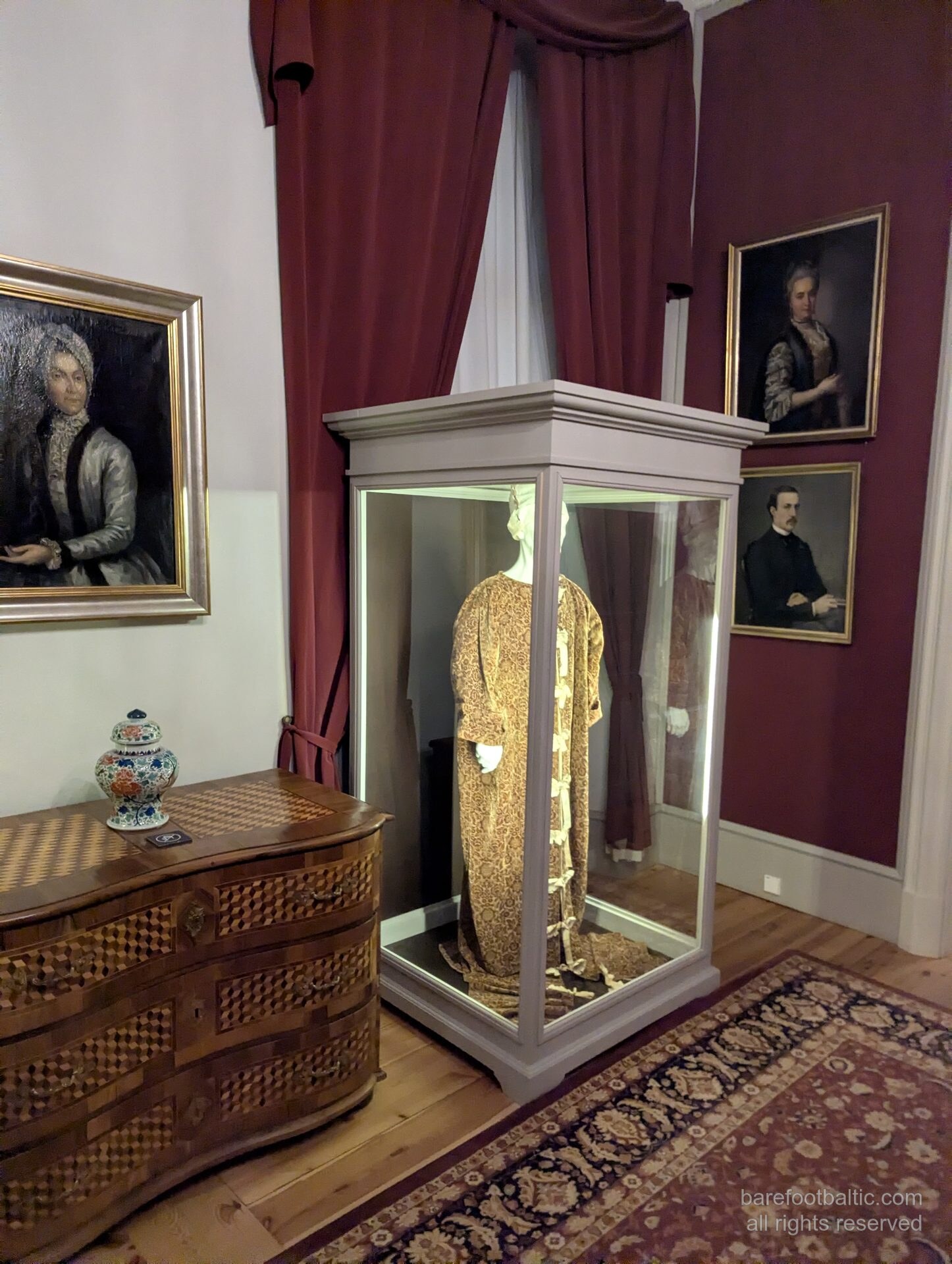
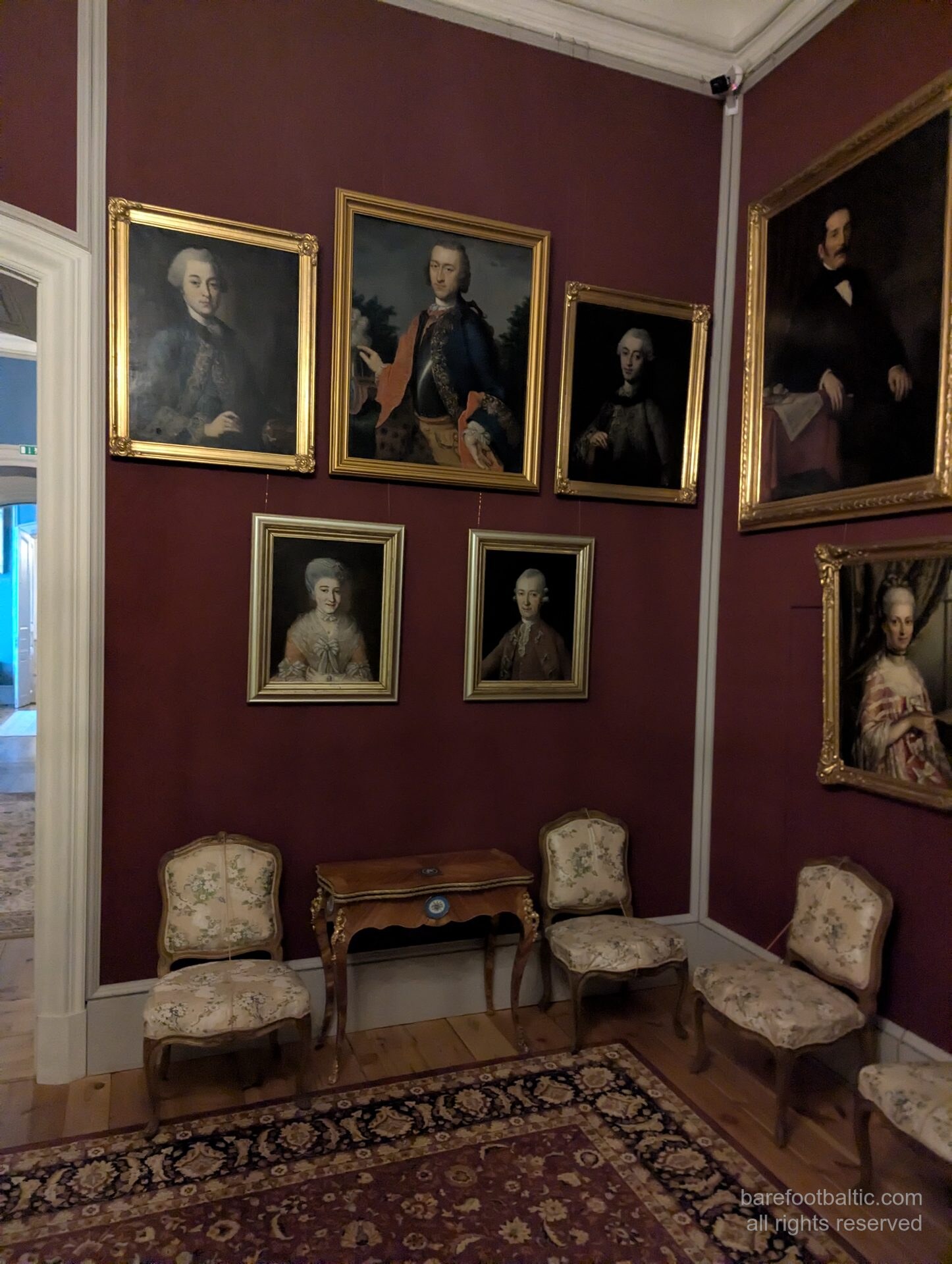
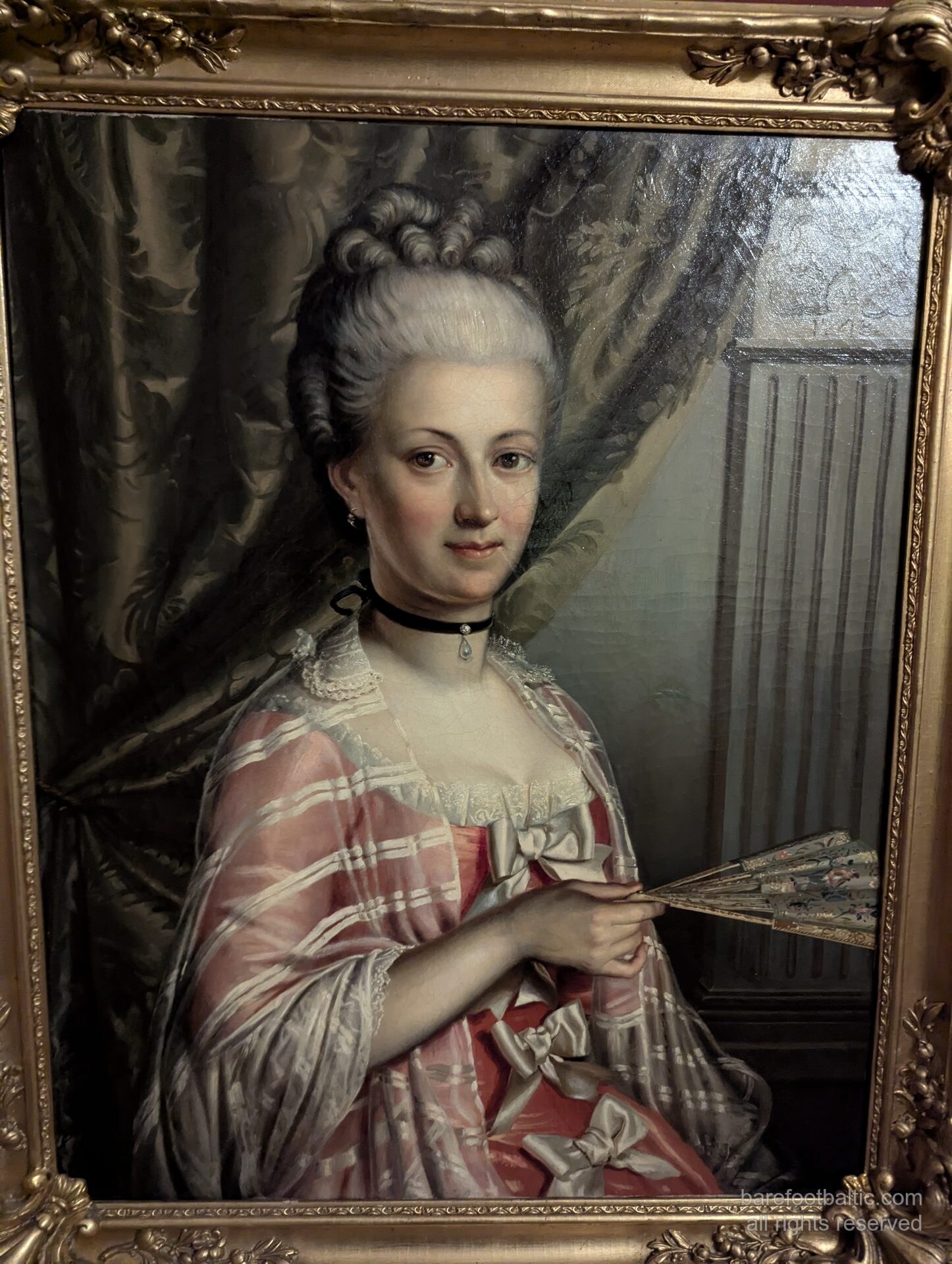
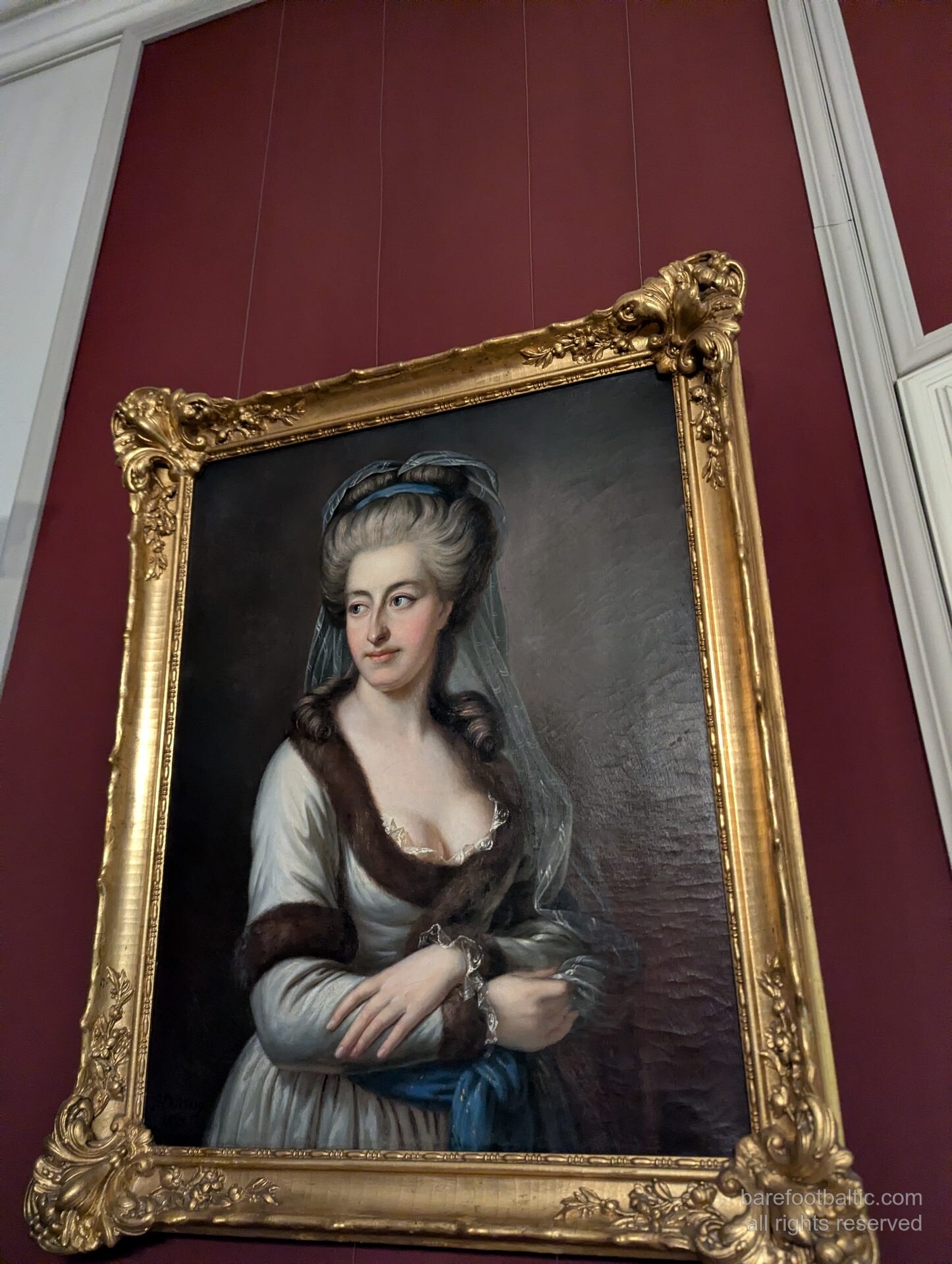
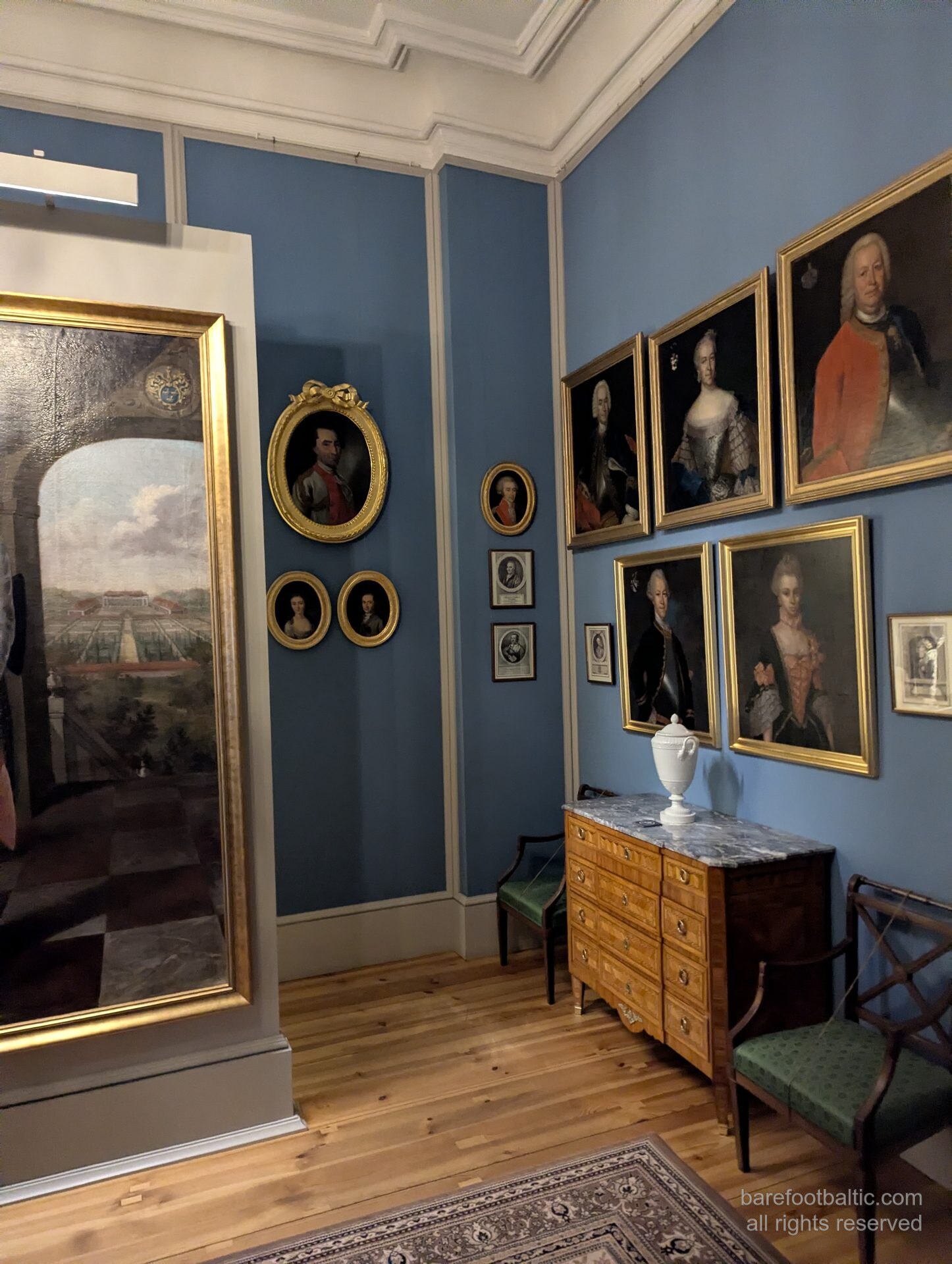
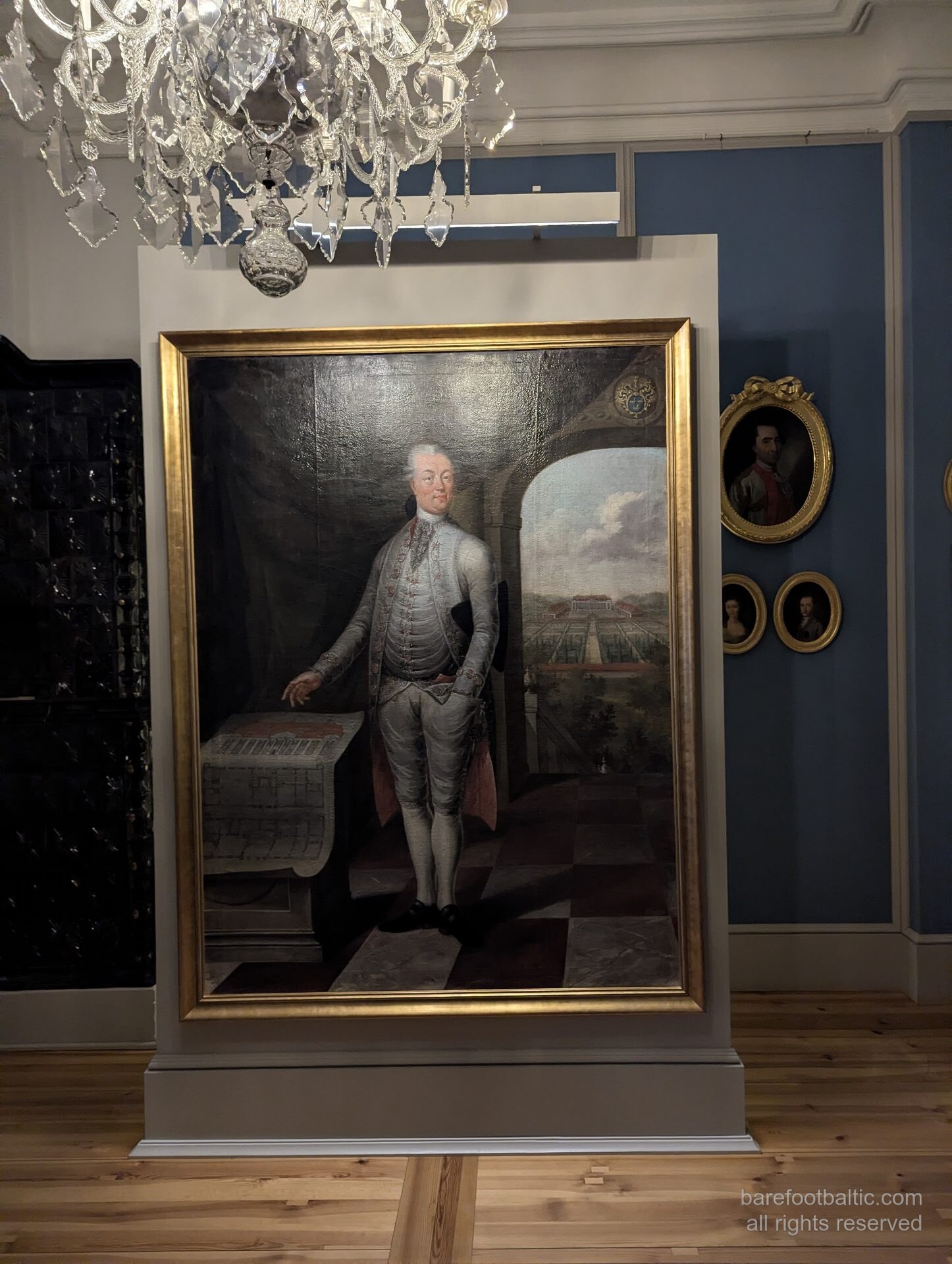
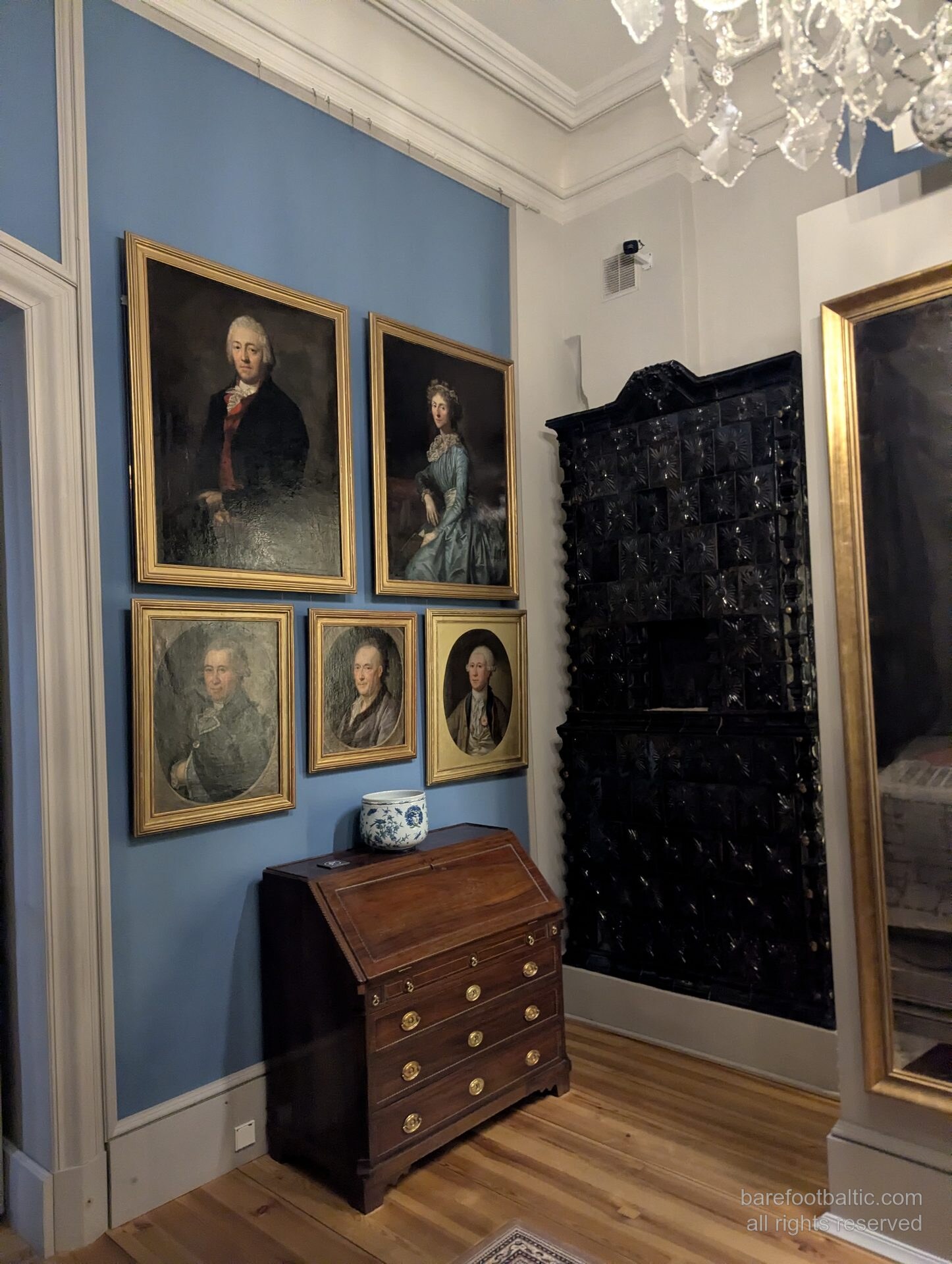
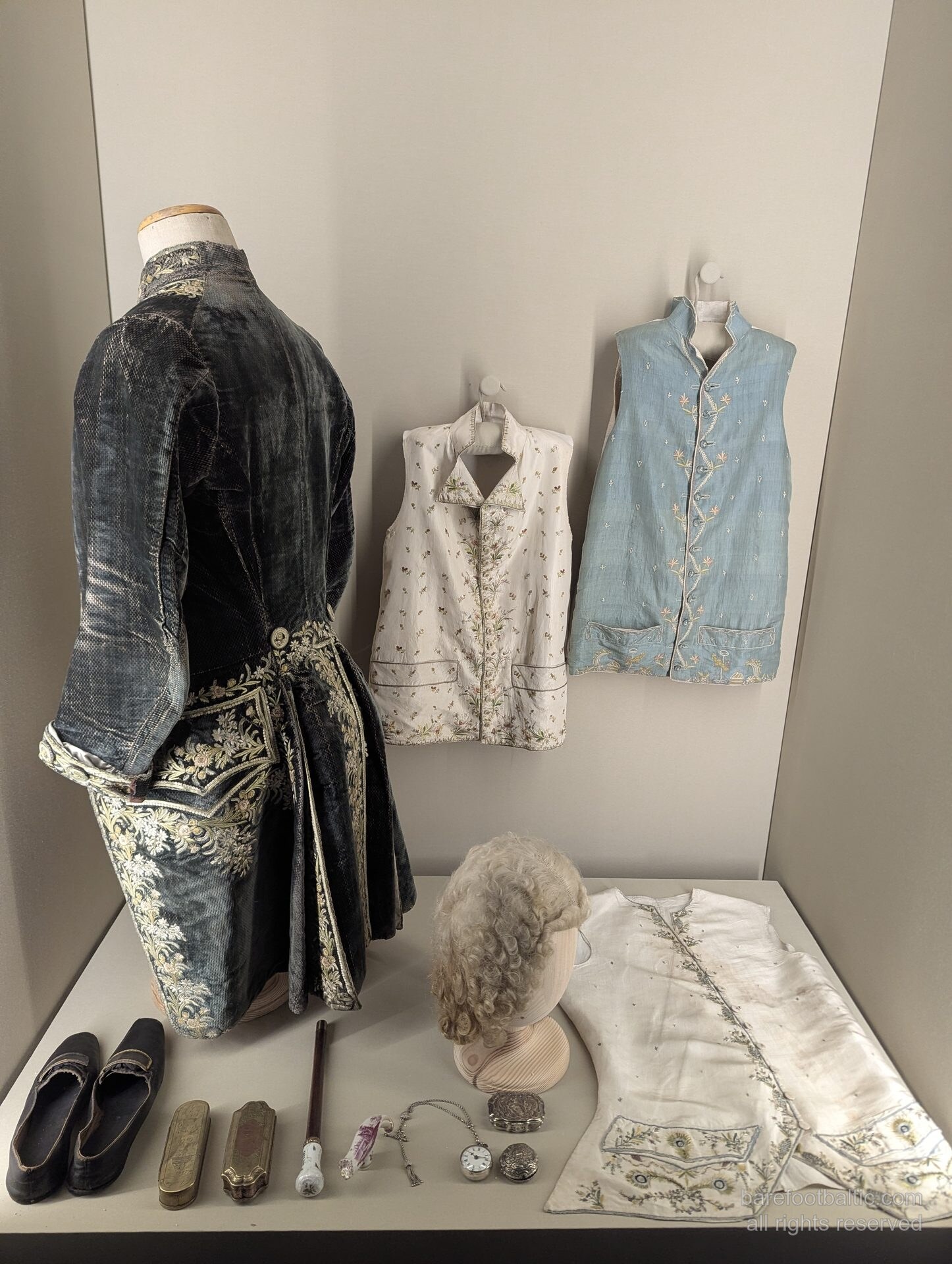
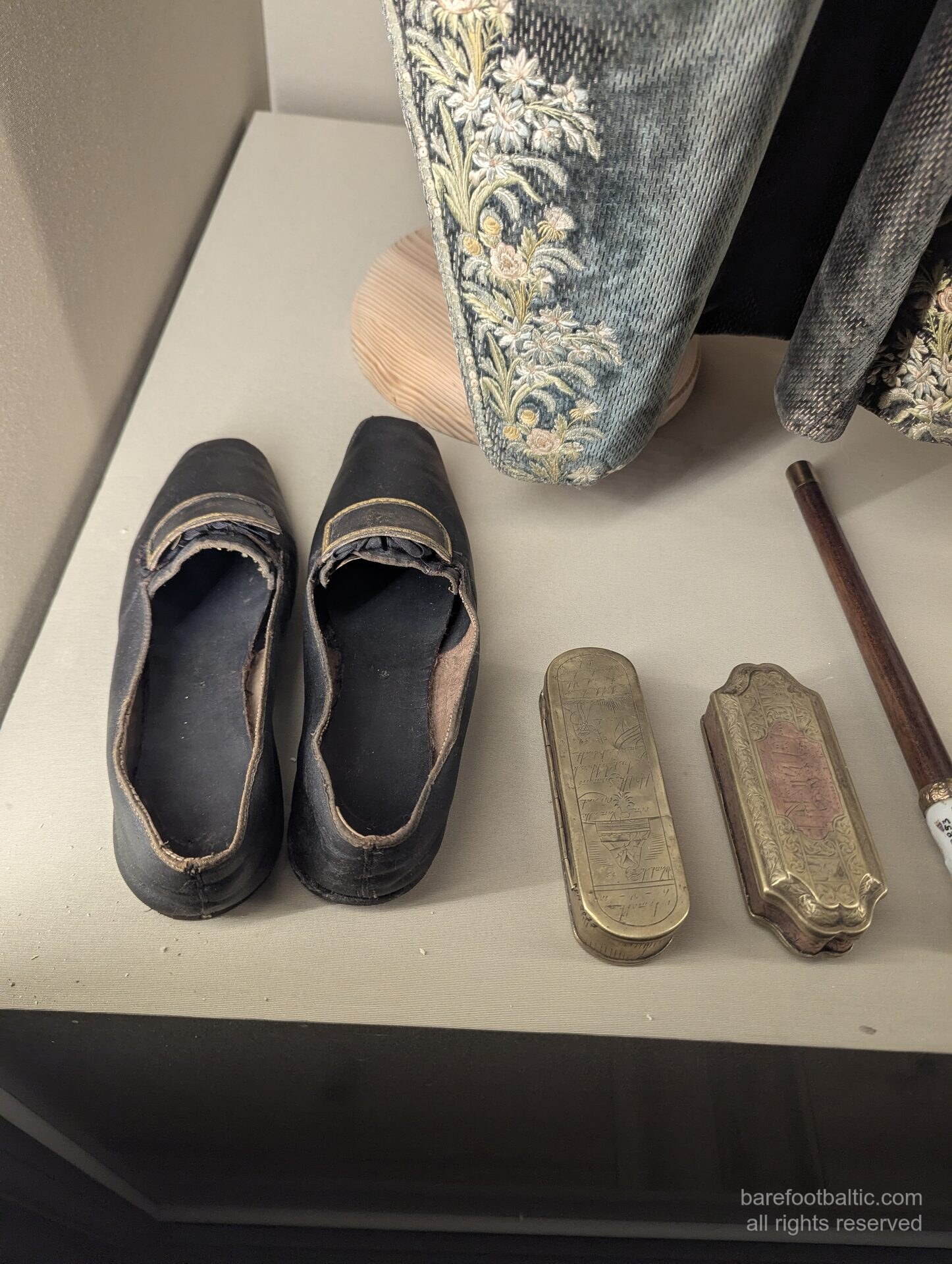
The 18th-Century Fashion Exhibition
The room next to the Duchess's bedroom gives an impression of eighteenth-century women's fashion, with clothes, fabrics, lace and various accessories. However, it does not contain items that belonged to Duchess Benigna Gottlieb.
Display cases exhibit four typical eighteenth-century dress styles. These are the court dress, the sack-back gown or the "French" gown, the close-bodied gown or the "English" gown and the polonaise or the "Polish" gown. The display also includes lace that certainly was part of the Duchess's attire. The collection initially consisted of restored textiles accumulated during various field trips but was later supplemented with selected and purchased lace reflecting the diversity of these products. Here you can see needle lace and bobbin lace, various samples from French, Italian and Flemish manufactories.
The use of lace in clothing is illustrated by portraits of the corresponding era, while Johann Heinrich Wilhelm Tischbein's painting depicts the process of winding lace.
Display cases show samples of fabrics and coifs, shoes and various exquisite items that were useful in beauty care and everyday life, like perfume bottles, snuff and toilet boxes, as well as necessities for storing small household items. You can capture the mood of the era by looking at the fan collection.
The Mujāni Manor stove in the corner of the room shows a type of stove popular in the territory of Latvia with black glazed tiles, featuring Baroque motifs in relief, and white moulding tiles.
Next is an exhibition of one of the noble families of Courland, the von Behr family.
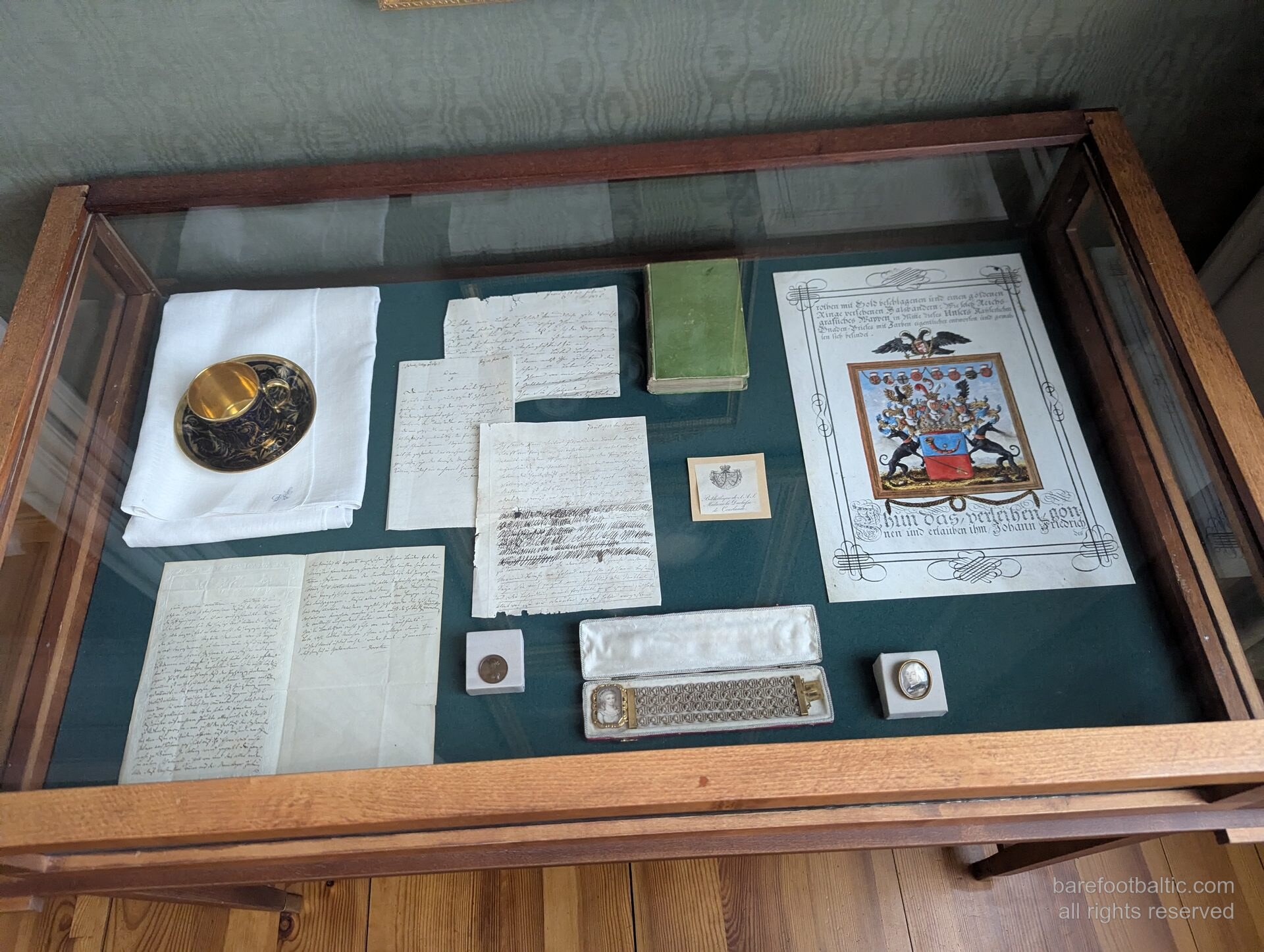
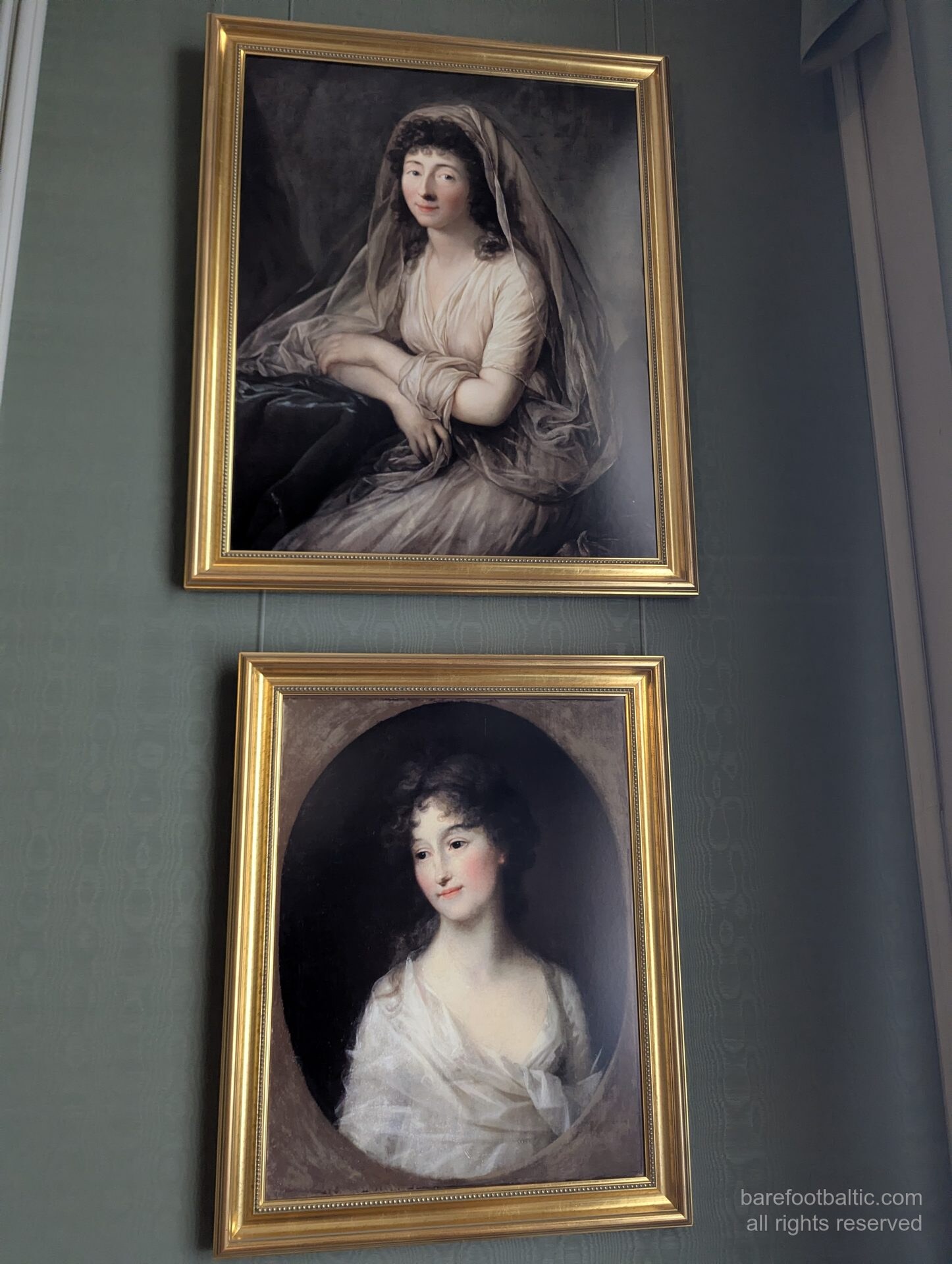
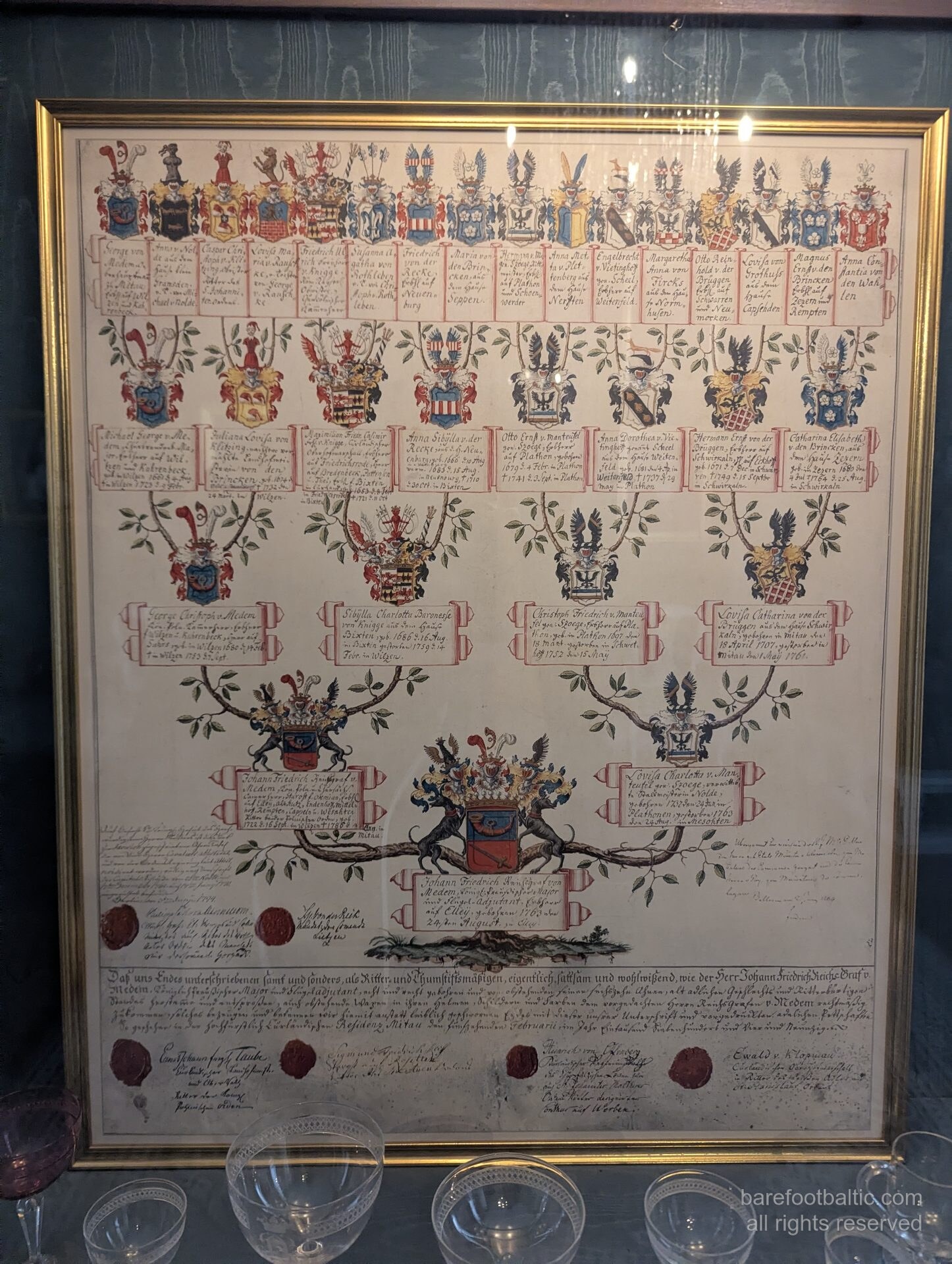
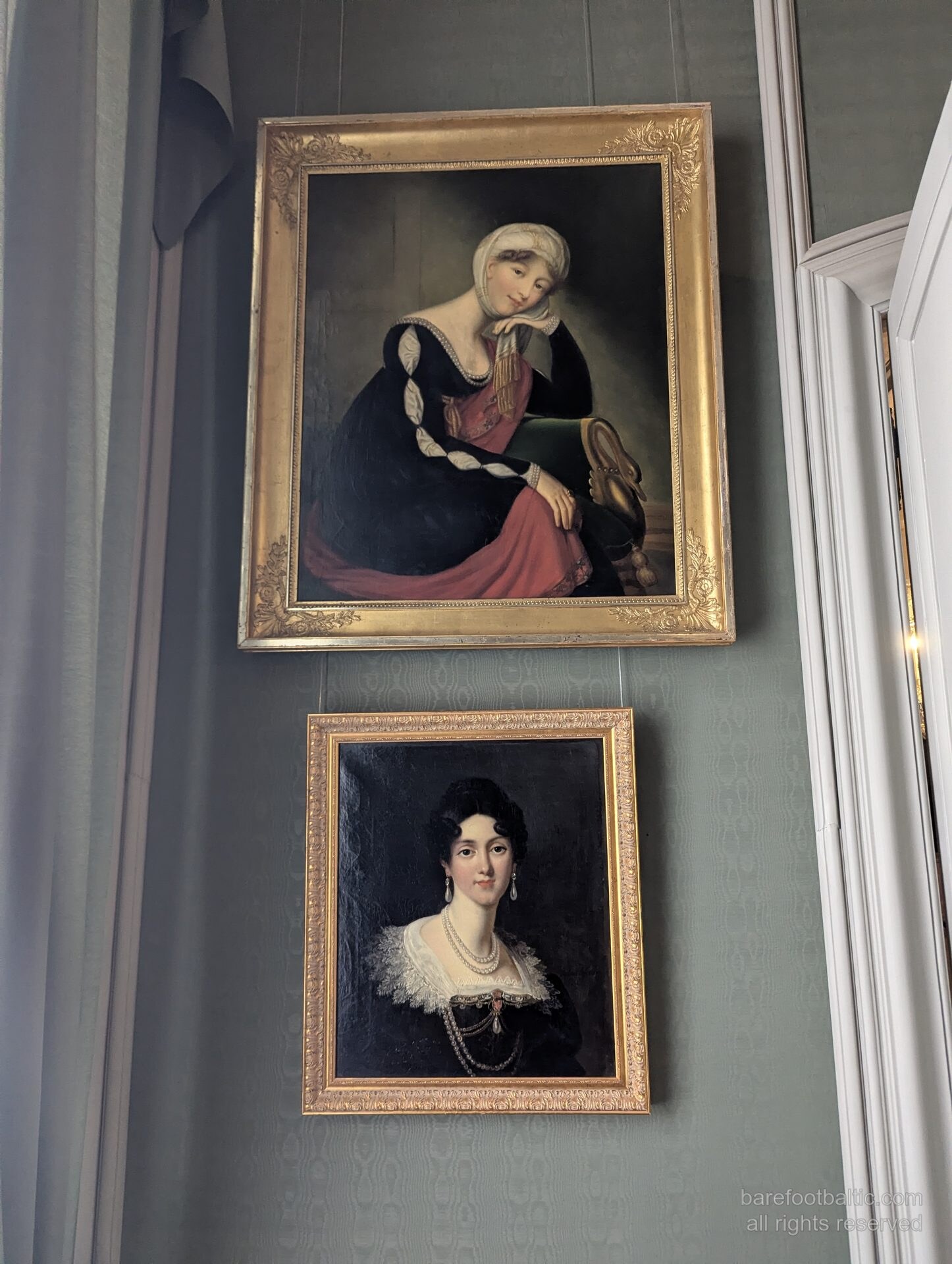
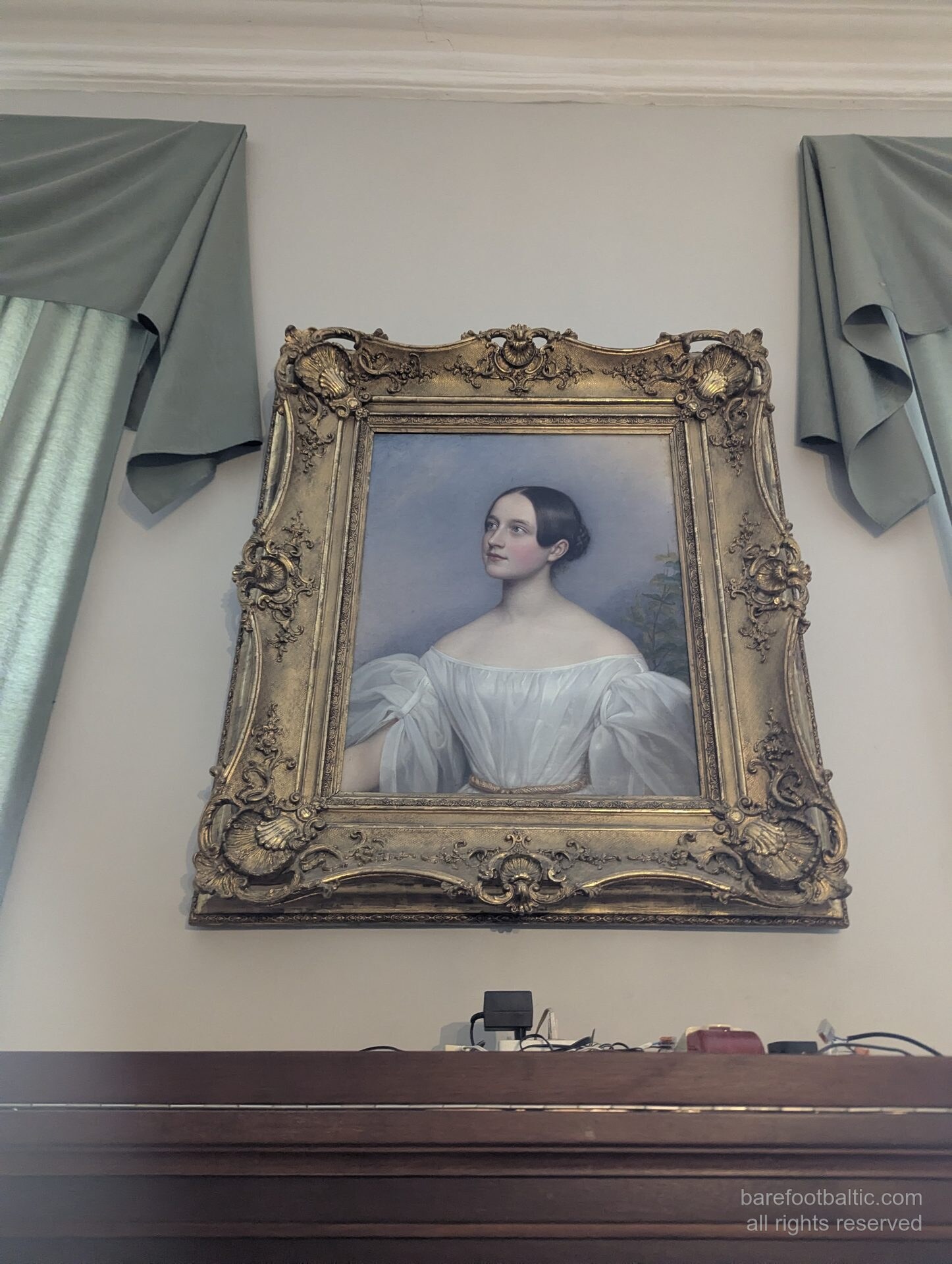
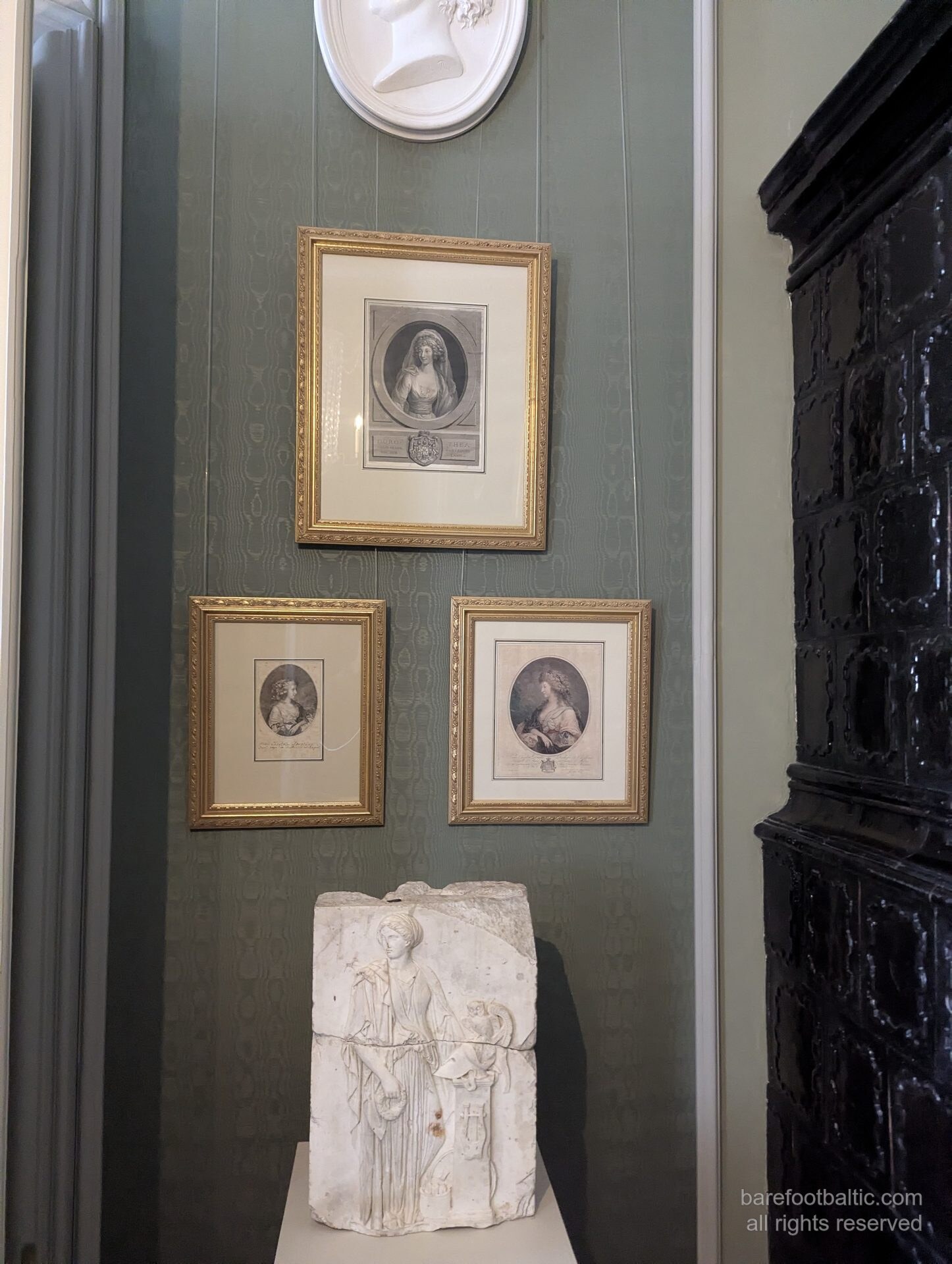
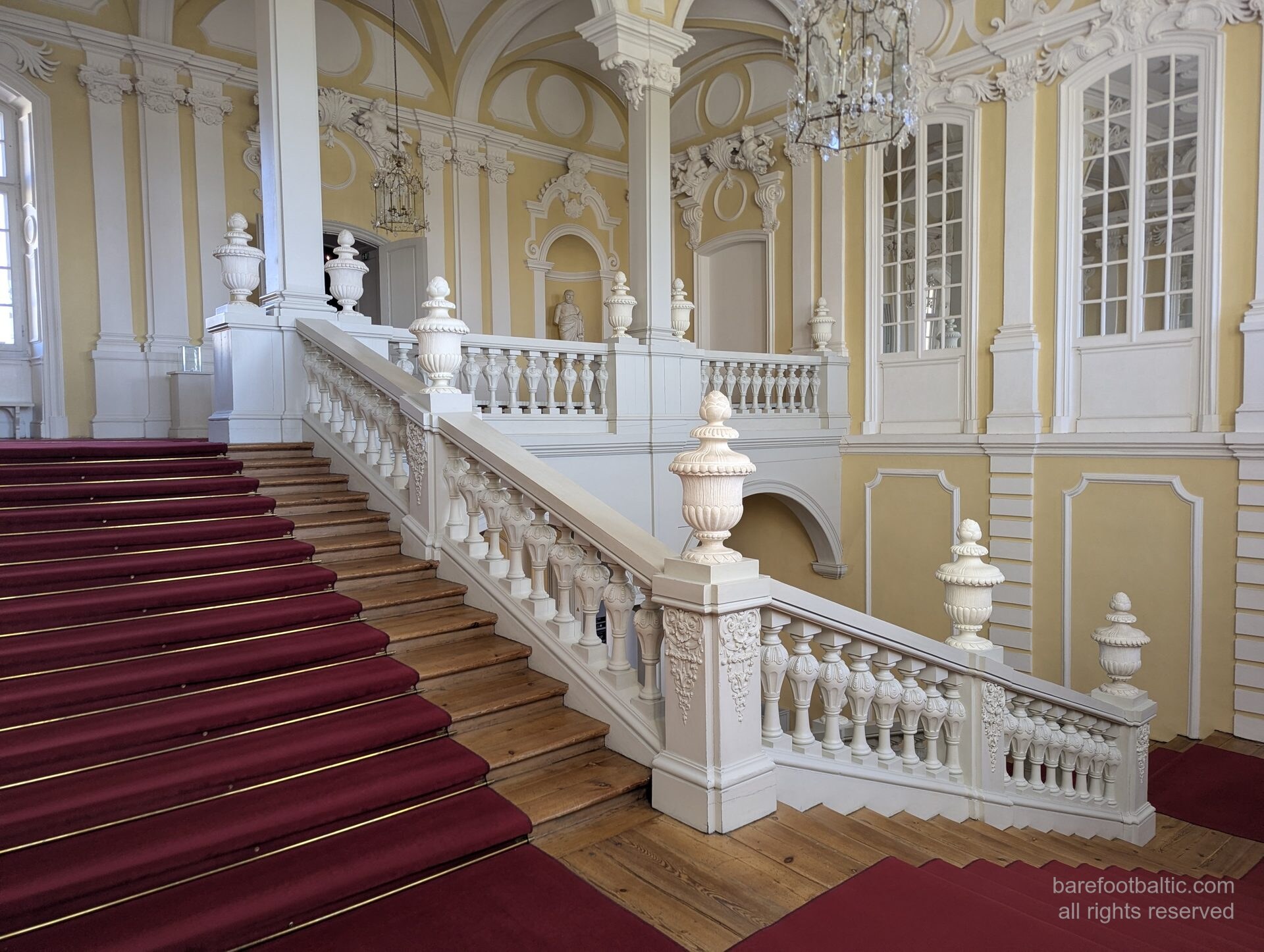
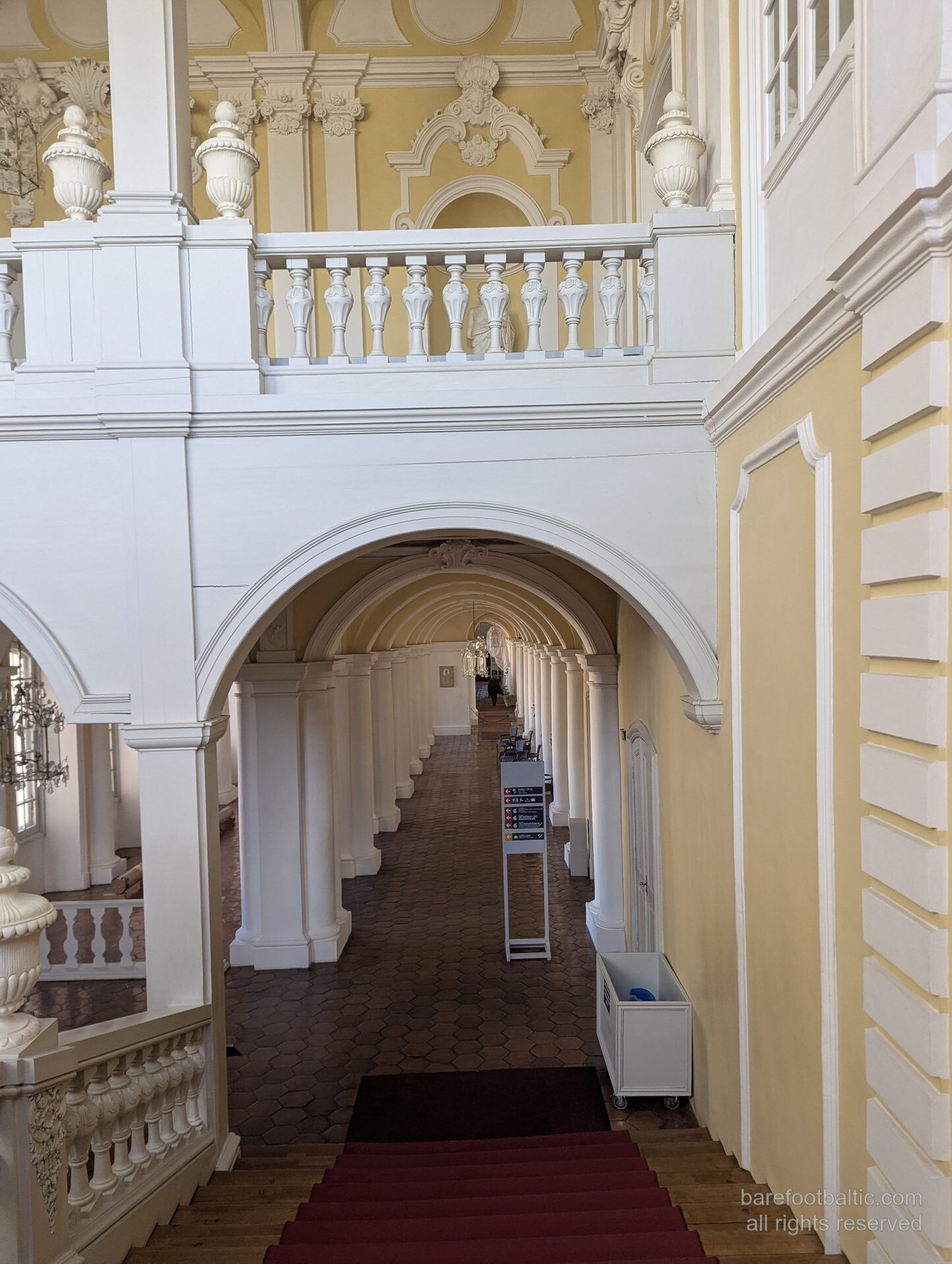
The von Behr Family in Courland Exhibition
The exhibition is dedicated to a prominent family of Courland nobility. Its origins are found in Lower Saxony in the twelfth century. In the territory of Latvia, von Behrs owned the largest land property in Courland, more than 113 thousand hectares. It included the beautiful manors of Edole, Zlēkas, Pope and Ugāle, which excelled with large building complexes, modern architecture and lavish church buildings. At various times von Behrs owned 32 manors in Courland and Semigallia.
The exhibition centres on a gift from Baron Ulrich von Behr and his wife Dorothea. In one of the display cases you can see family relics. There is a travel sundial belonging to the owner of Zlēkas Manor, Ulrich von Behr, a crystal goblet with a lid and the coat of arms of von Behrs, three nineteenth century brooches from Courland gifted to Baroness von Behr by Latvian peasants, and other items. Ulrich von Behr's morning gown is exhibited on the mannequin in the second showcase.
The exhibition is enriched by family portraits painted in the 1760s and up until 1891, which were once located in Pope Manor. The author of six paintings is Jelgava-based artist Julius Döring while in the bottom row next to the display case with a morning gown is the most recent portrait painted by Latvian artist Janis Rozentāls. The room has a Rococo-style stove originally located in Pope Manor and transported to Rundāle Palace in 1964.
In the next room, we'll see eighteenth-century portraits of other remarkable nobles of Courland.
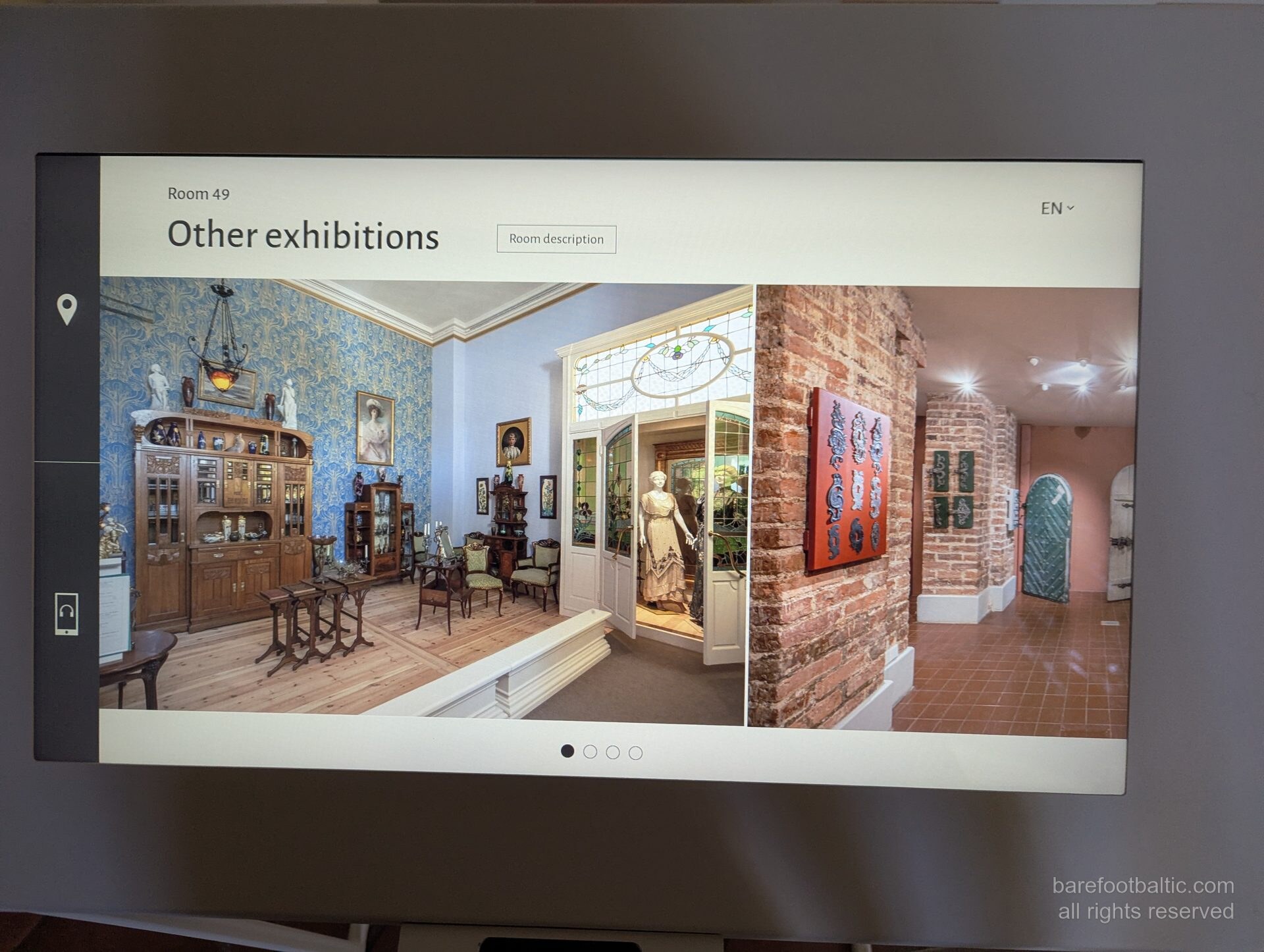
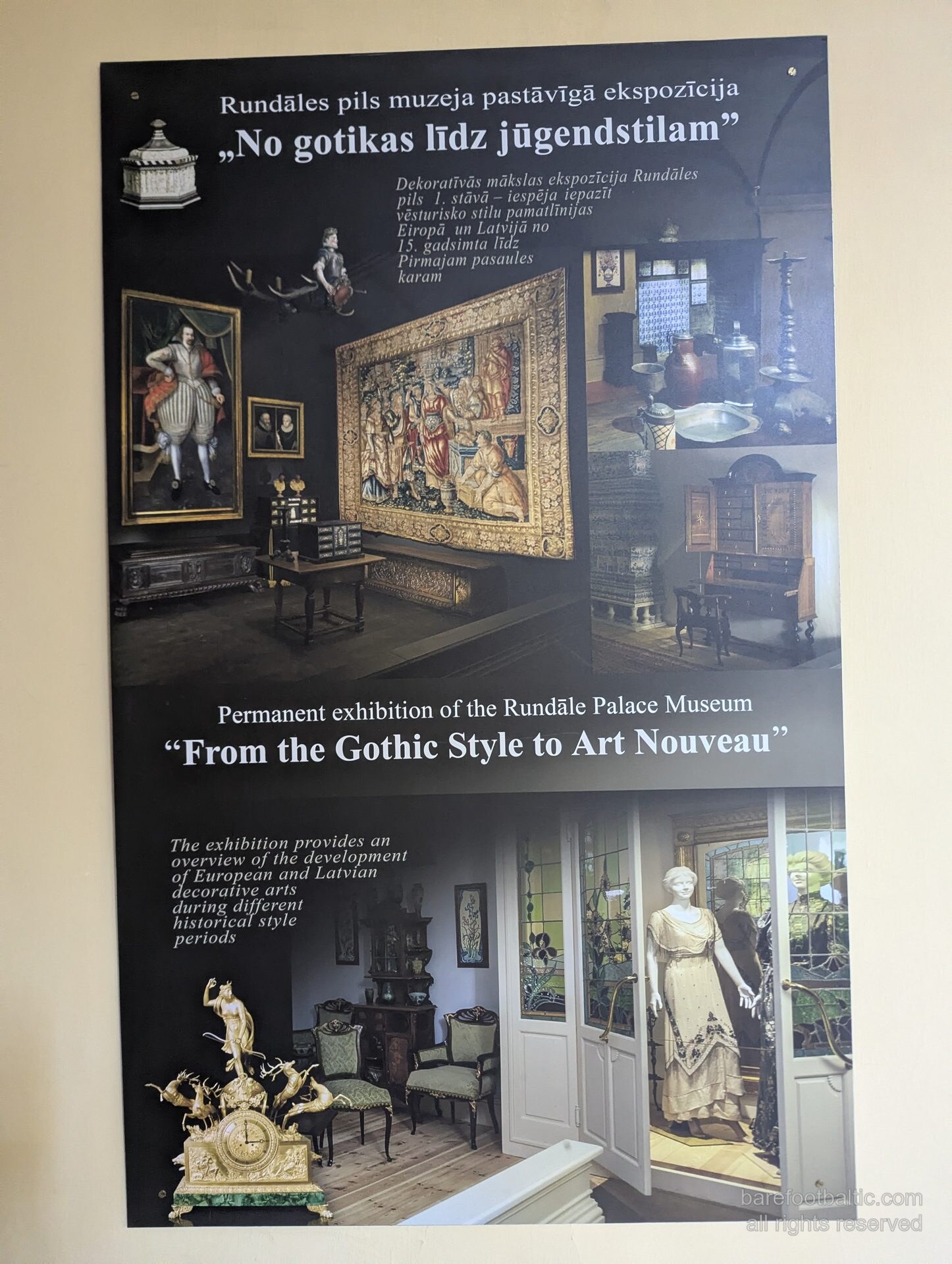
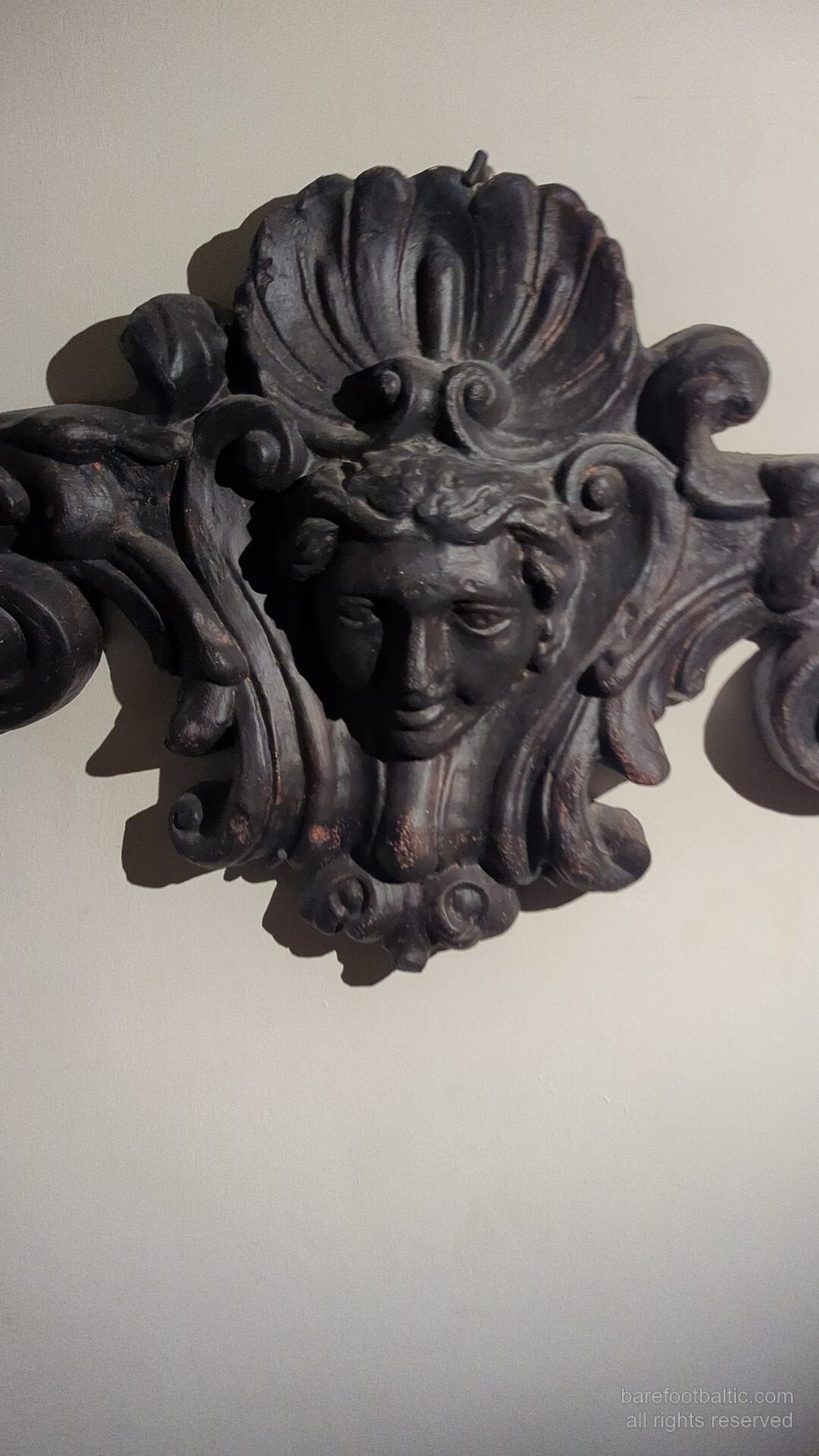
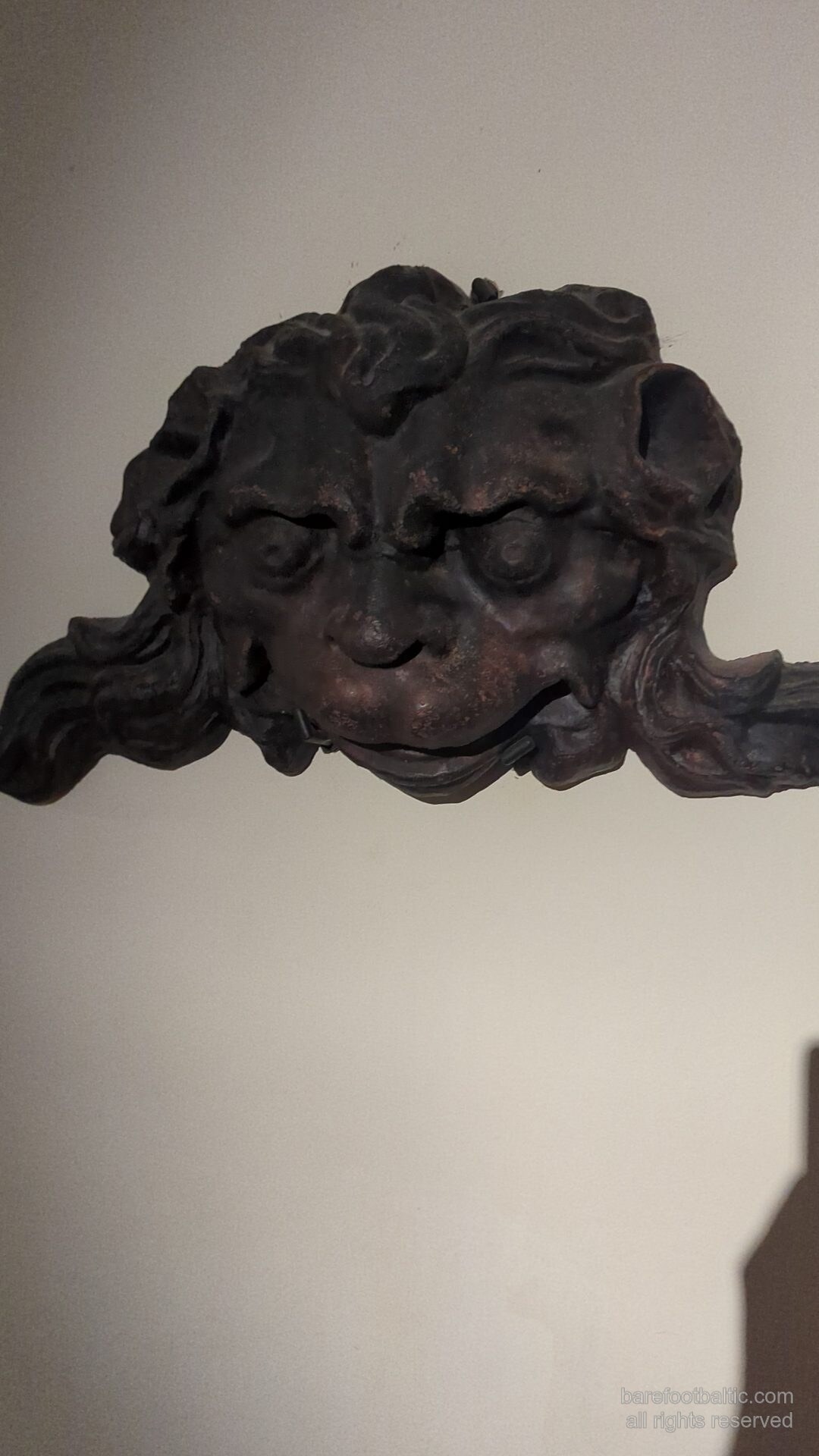
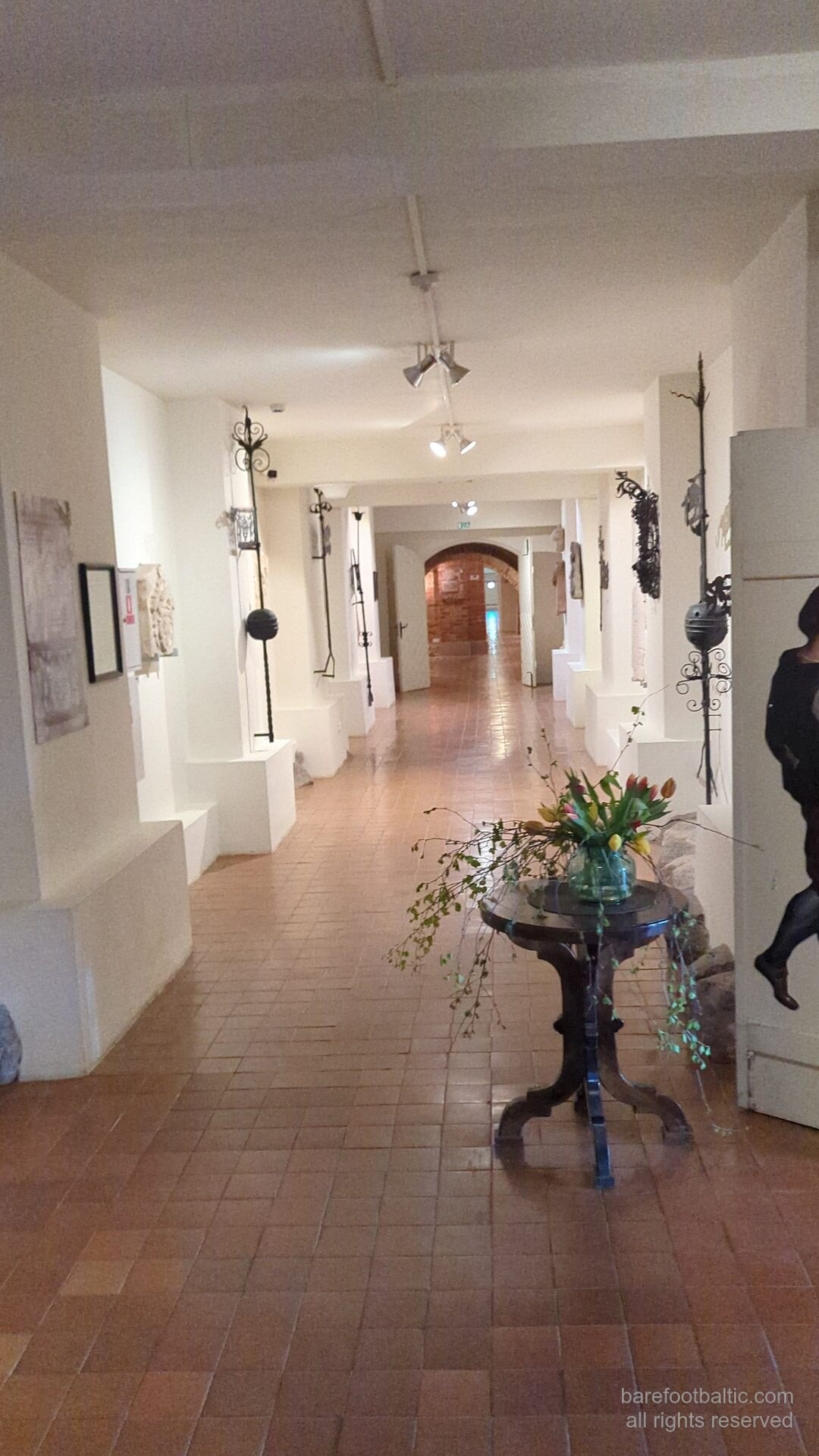
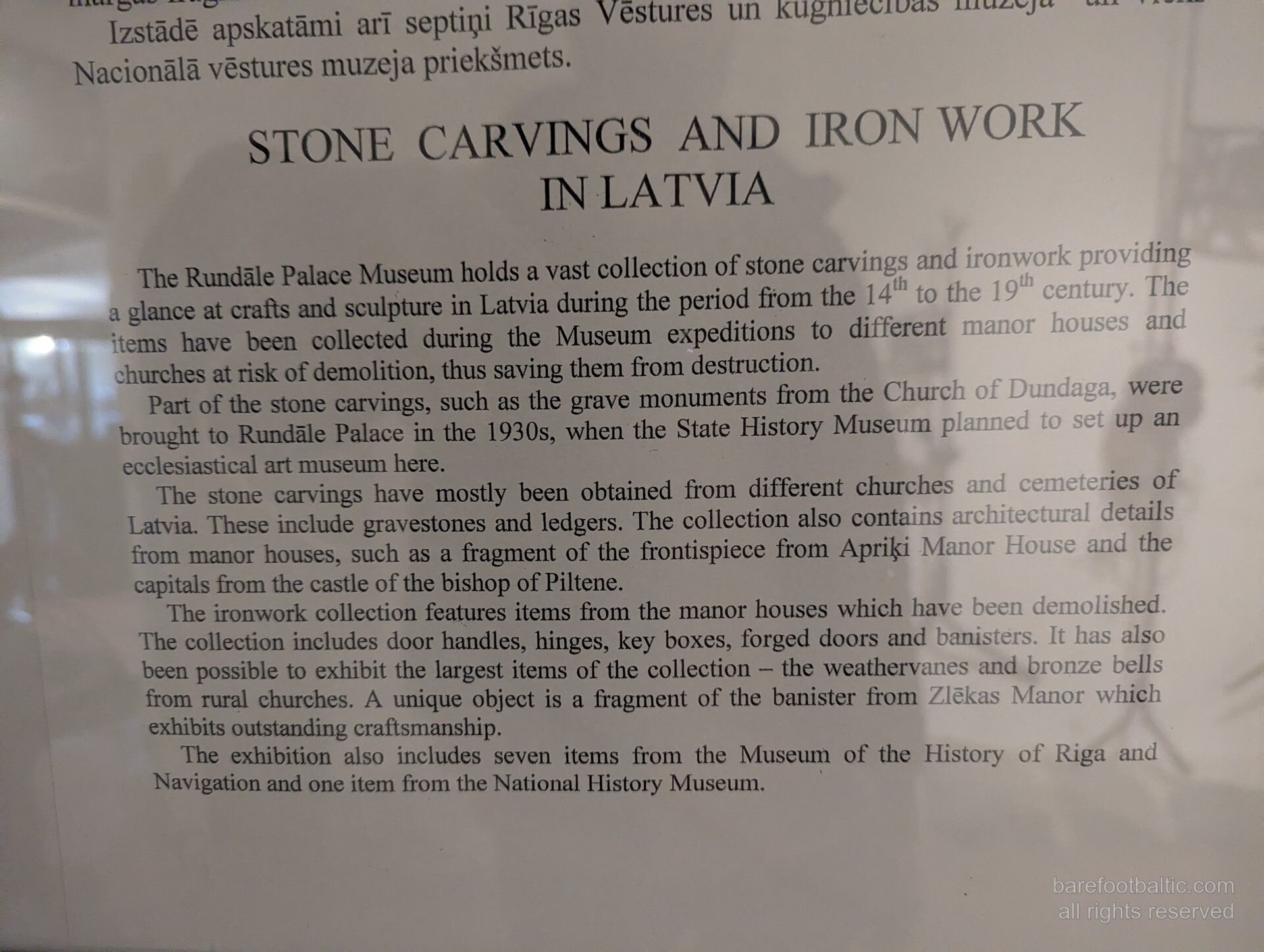
The 18th-Century Portraits of Courlanders Exhibition
The eighteenth-century portrait gallery of Courlanders represents the Duke's supporters and his opponents among the nobility, as well as professors of the Academia Petrina founded by Duke Peter, and other representatives of the intelligentsia and officials. Most of these works were created by artists who lived and worked in the territory of Latvia for a longer or shorter period.
The room is dominated by a portrait of Johann Friedrich von Nolde, proprietor of Gramzda Manor, depicted on the background of a palace surrounded by a French garden. It was painted in 1778 by Copenhagen artist Peter Jessen.
To the right of the large painting are five portraits of local nobility, painted in the 1750s and 1760s by Königsberg-born artist Leonhard Schorer. He represents the Baroque era portraiture that flourished in Latvia during the reign of Duke Ernst Johann and Duke Peter, when Schorer, Friedrich Hartmann Barisien, Johann Gottlieb Becker and others worked in the capital of the Duchy of Courland. On the same wall between the door and the window, we see a portrait painted by Becker of lawyer Sigismund Georg Schwander, adviser in the court of the Duchy of Courland.
Higher up to the right of the windows is another work by Schorer. It depicts Prince Charles of Saxony who was the Duke of Courland during Ernst Johann Biron's exile. A portrait of Otto Hermann von der Howen, member of the Courland Landtag, is displayed further atop between the windows. He remained a zealous supporter of Duke Charles even after the return of Duke Ernst Johann from exile. The author of this portrait is the virtuoso painter Gottlieb Schiffner who usually worked in Dresden and travelled to Courland only for a short period. Below is a portrait of the Governor of Courland, Count Peter Ludwig von der Pahlen, painted by the court painter of the Duchy of Courland Friedrich Hartmann Barisien. To the left of the stove, in the bottom row, are three more works by Barisien painted in the 1780s when he was no longer the Duke's court painter and focused on portraying the local intelligentsia.
Two portraits are exhibited above the work of Barisien. They show Anna Maria Frederike von Taube, a lady-in-waiting in the court of Duchess Dorothea, and her husband Major of the Russian Army, Baron Friedrich Karl von Taube. They were painted in Dresden in the 1780s by the prominent Swiss portraitist Anton Graff.
The layout of the room is complemented by eighteenth-century furniture and a black glazed tile stove with a relief star motif. It was made in Vidzeme and was originally located in Bērzaune Rectory.
Pay attention to the display case behind the portrait of Johann Friedrich von Nolde. It features a group of objects that characterize eighteenth-century men's fashion.
The next room invites you to explore the family history of Counts Medem and the life of Duchess Dorothea of Courland.
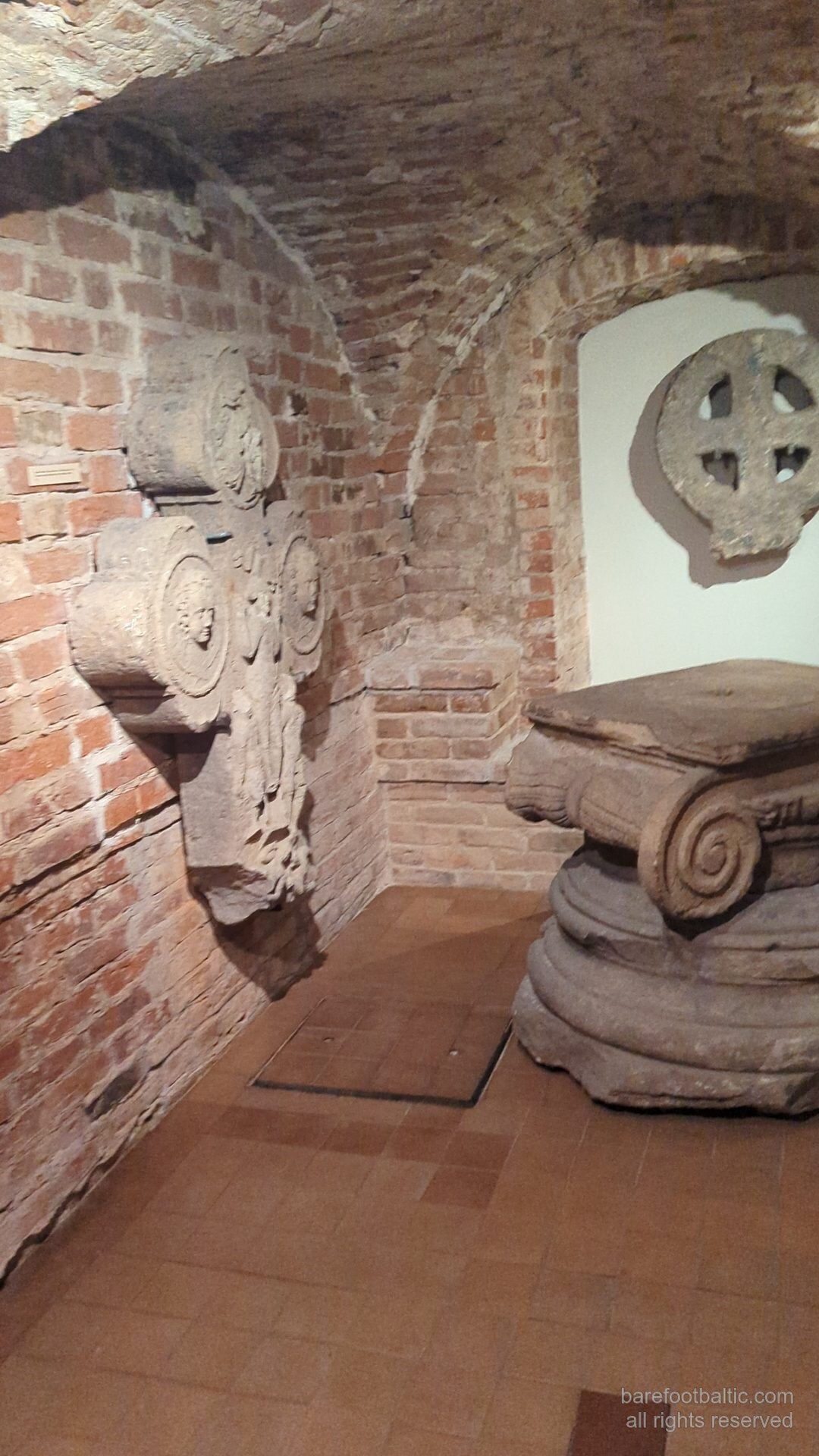
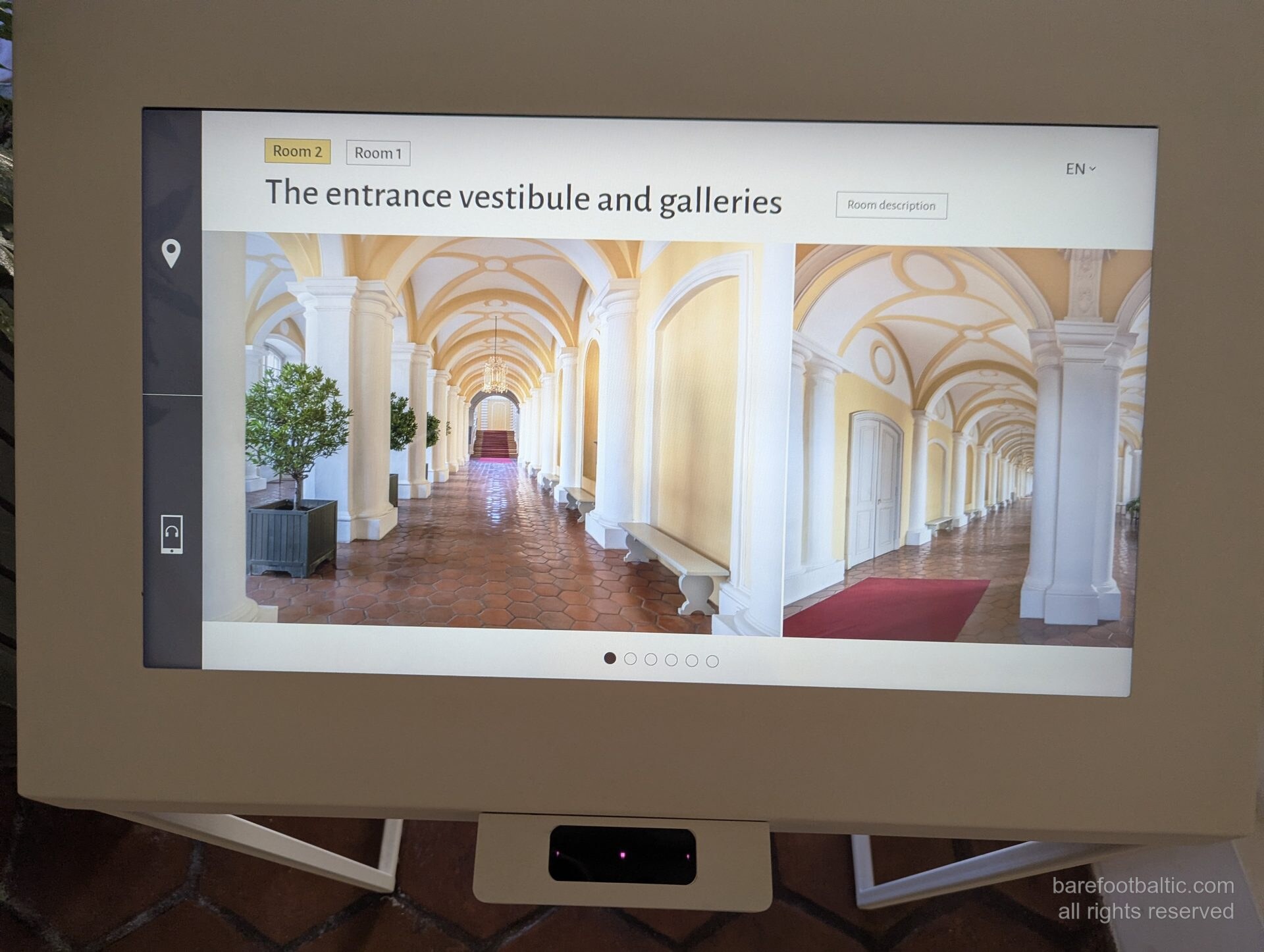
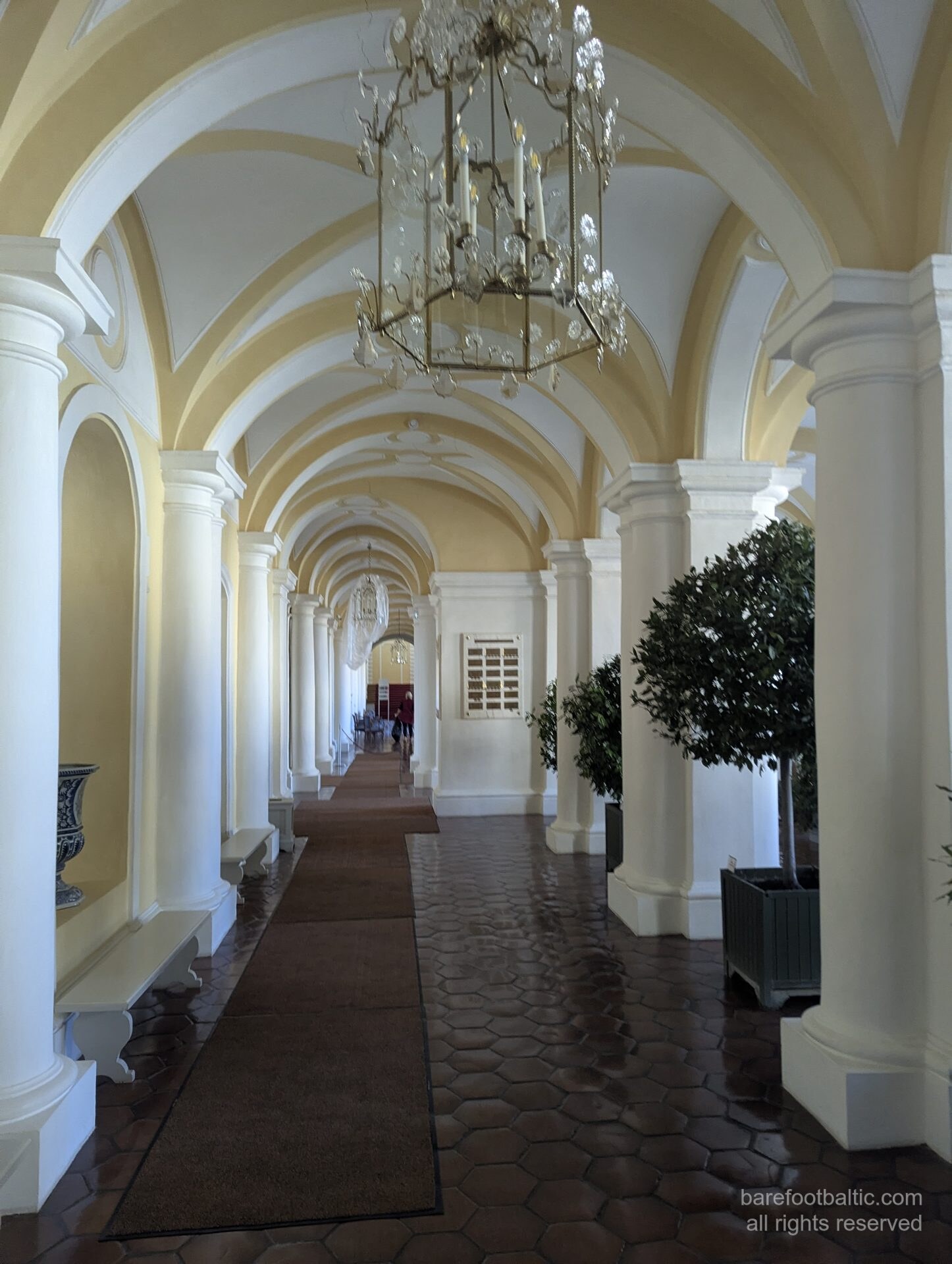
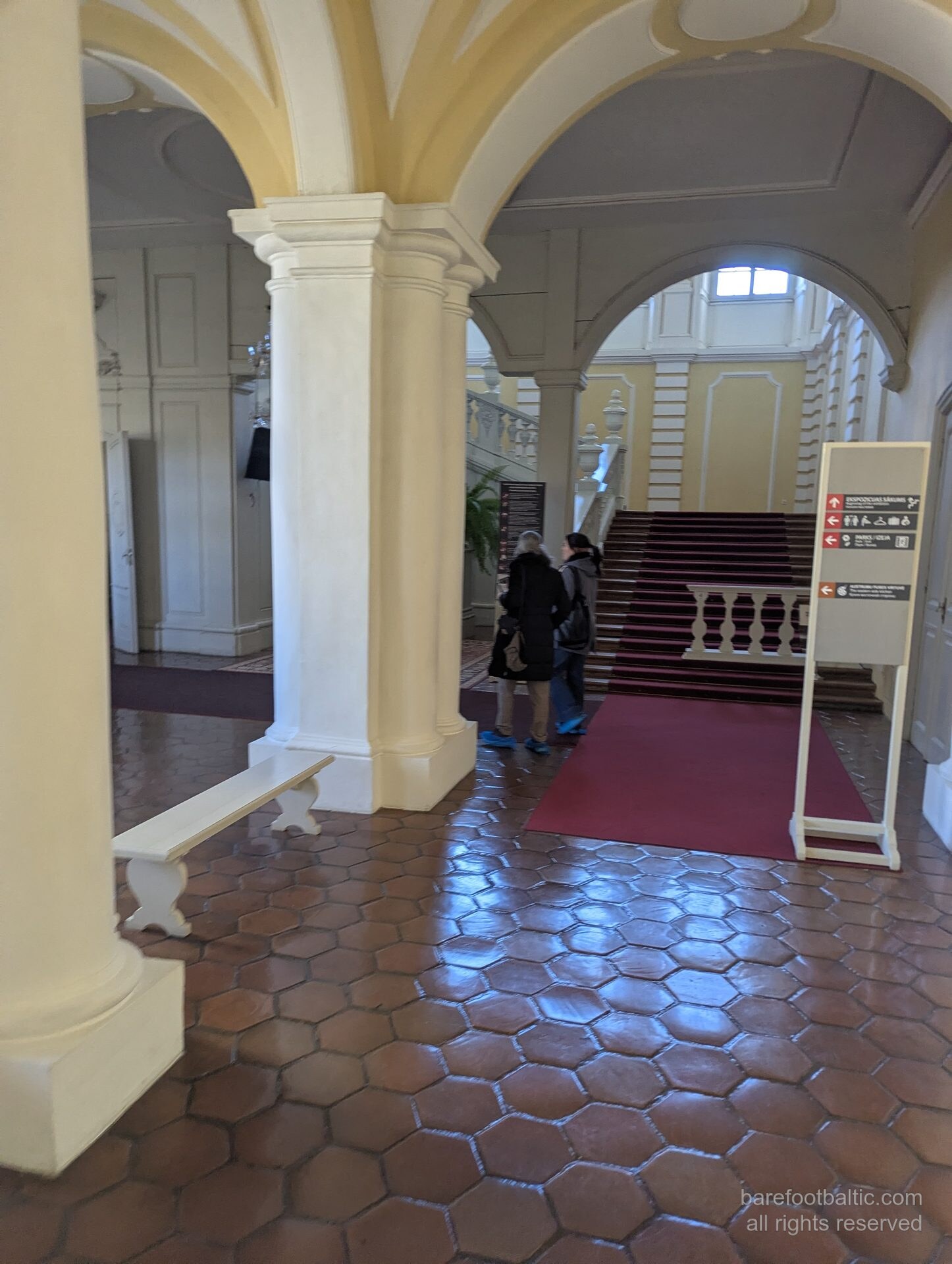
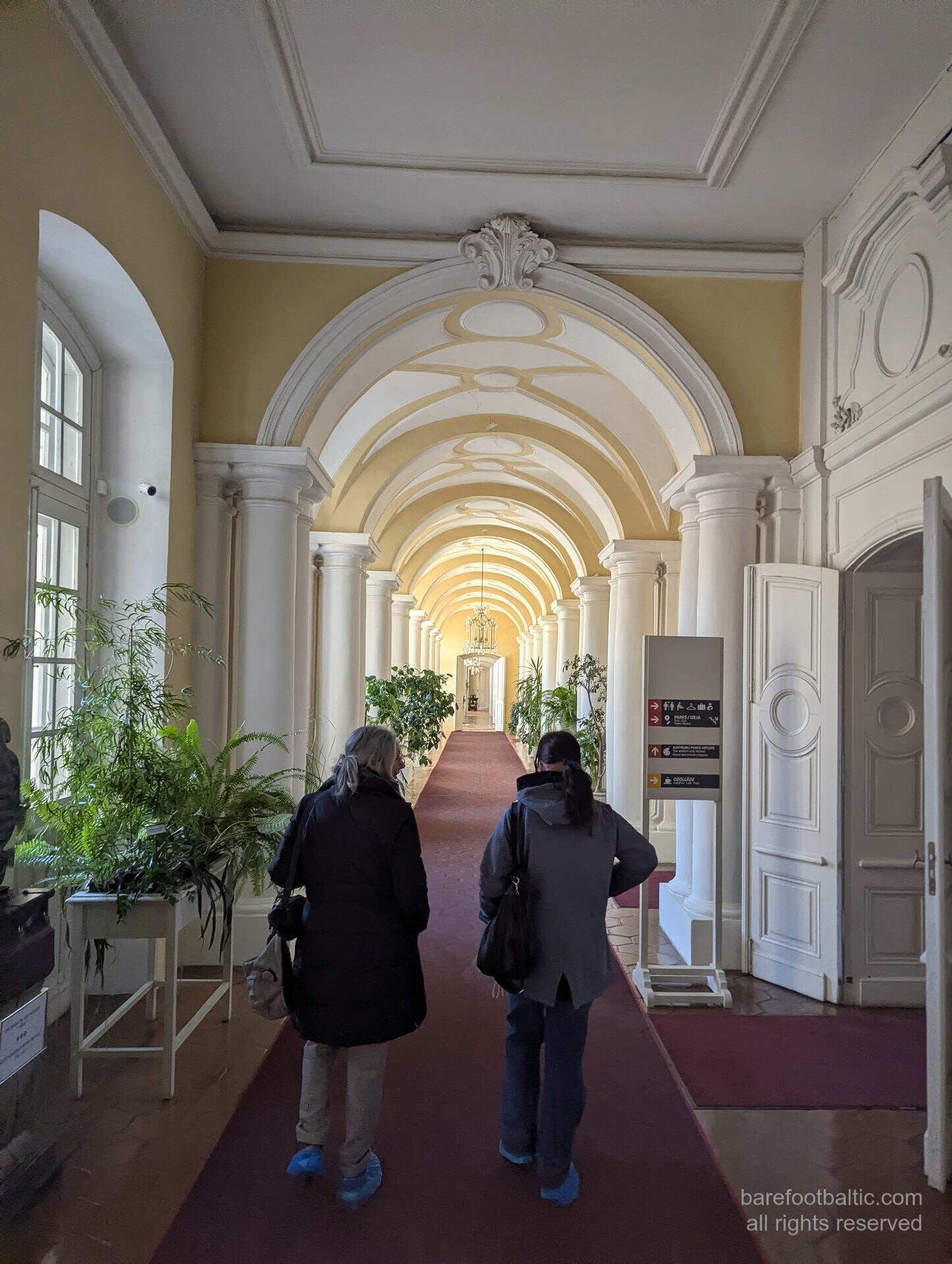
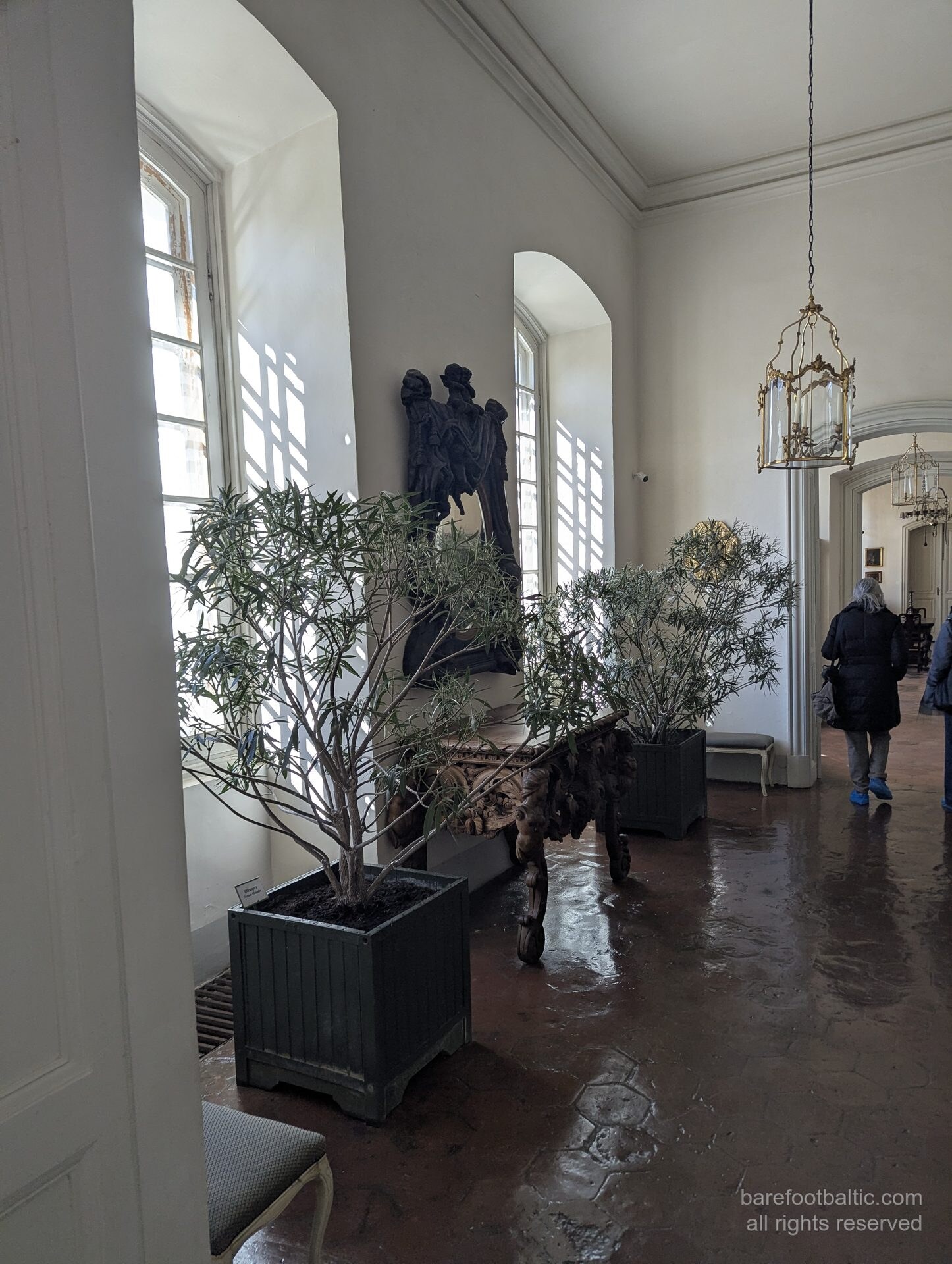
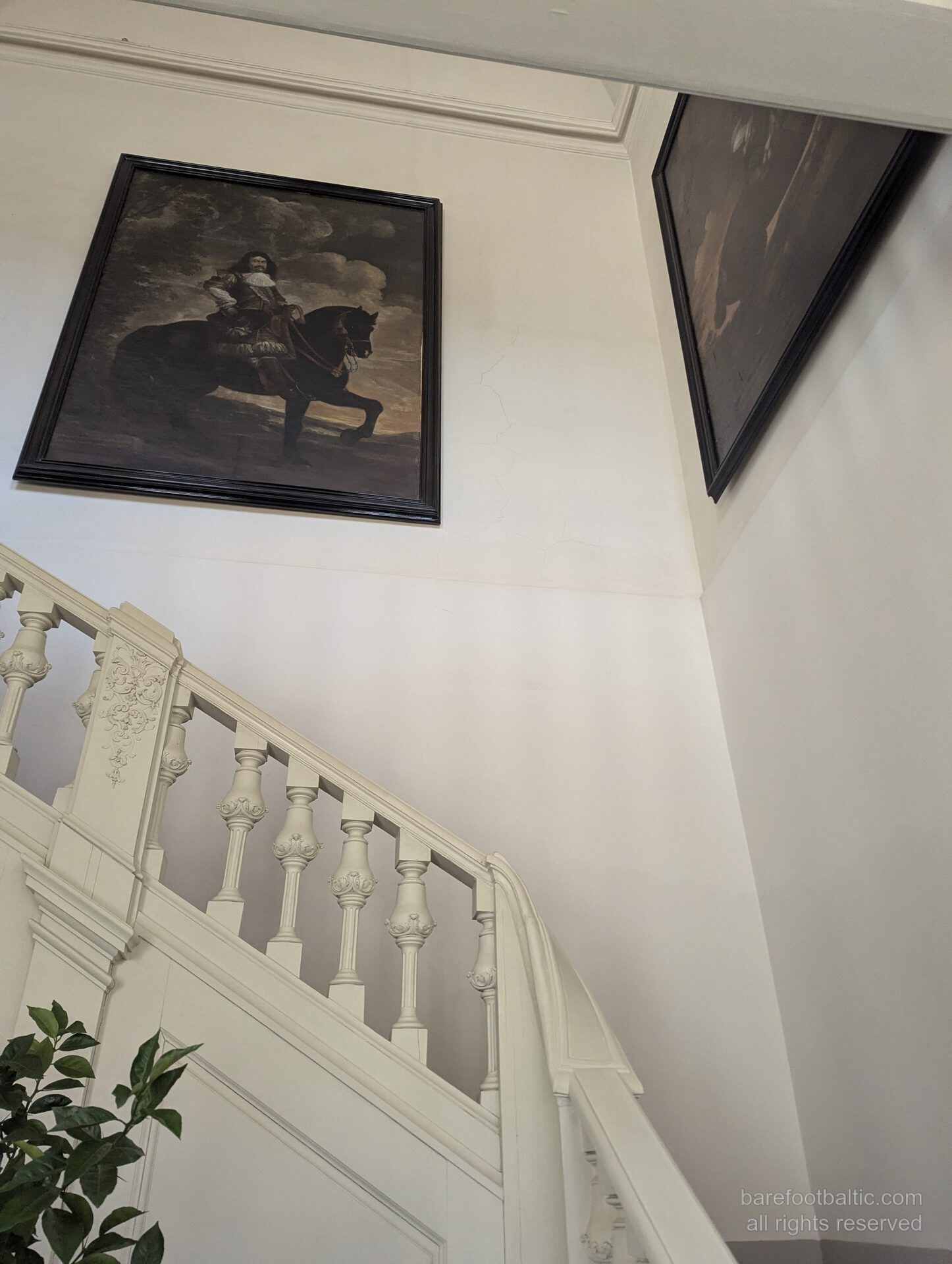
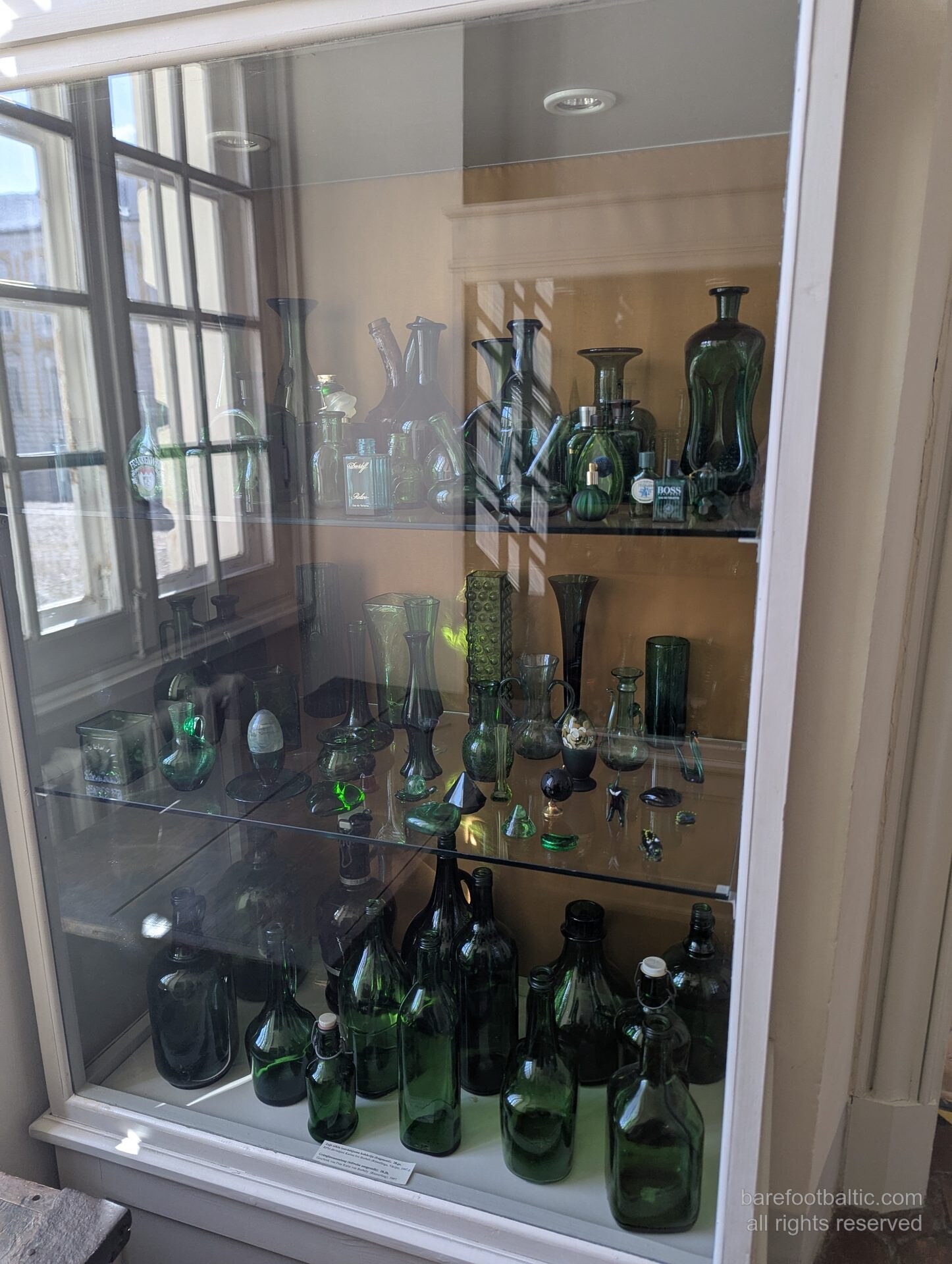
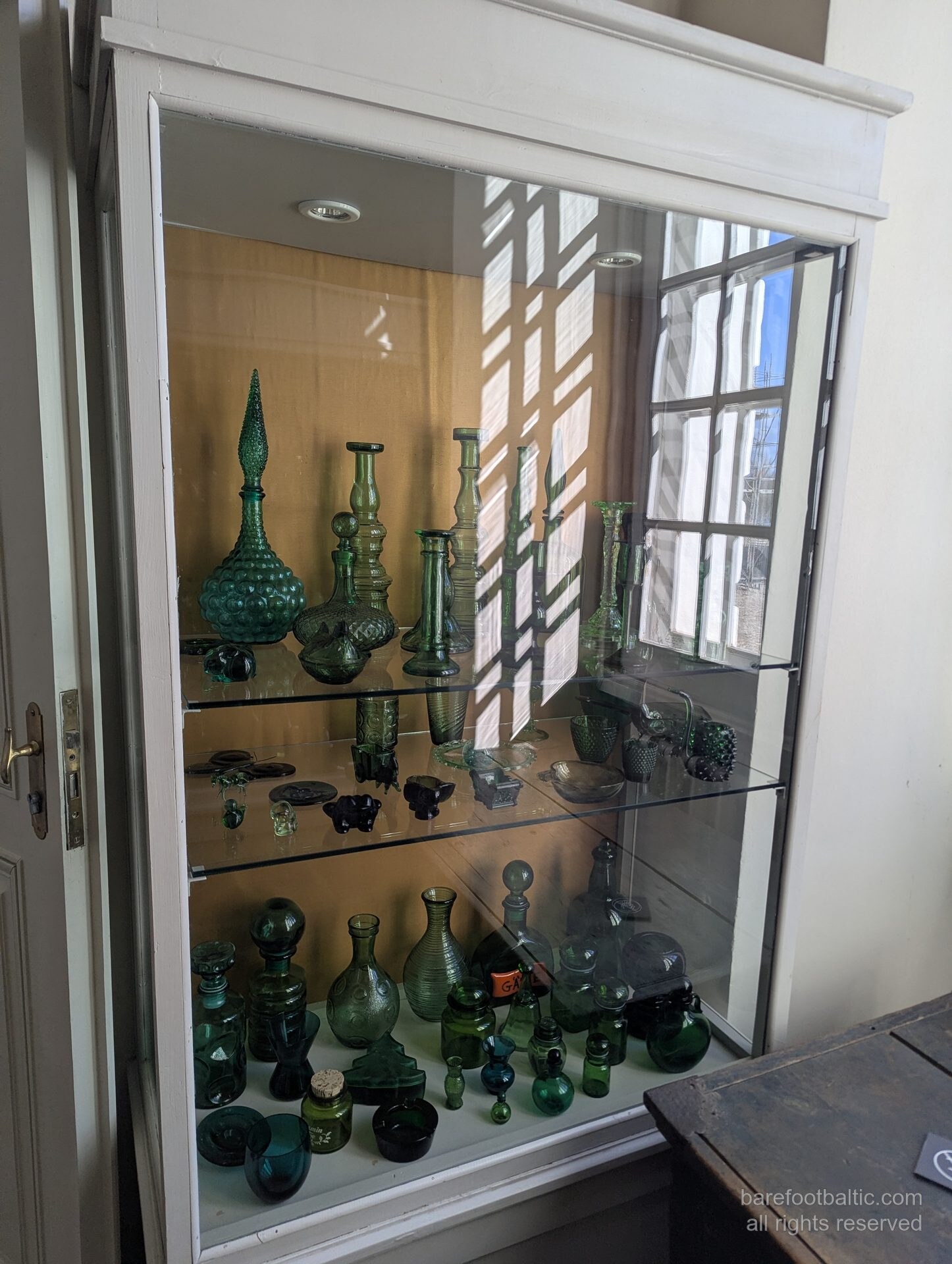
The Duchess Dorothea of Courland and the Family of Counts Medem Exhibition
The display in this room was made possible with support from Count Théodor de Medem, the descendant of Count Jeannot von Medem. He presented the Rundāle Palace Museum with family relics which his grandfather Count Theodor von Medem had transported from his estates in Stukmaņi and Vecauce at the end of World War I. The centrepiece is a cosmetic set that belonged to Duchess Dorothea of Courland. It consists of 22 porcelain items and was made at the Royal Porcelain Manufactory in Berlin around 1784.
The last Duchess of Courland Dorothea, the full name Anna Charlotte Dorothea, is the most famous representative of the Medem family, born and raised in Mežotne Manor. The life of the whole Medem family changed significantly when at the age of eighteen she accepted a marriage offer from Duke of Courland Peter. To make this marriage possible, Dorothea's father was awarded the title of Count. Later her brothers and half-sister often joined the Duchess on trips abroad gaining significant impressions and meeting outstanding personalities. The beauty, charm and wisdom of Duchess Dorothea opened her many doors to the highest society in Europe and allowed her to influence politics informally.
Several portraits of Duchess Dorothea are on display in this room. In the group of paintings to the right of the display case, Duchess Dorothea is depicted by artist Friedrich Hartmann Barisien. Next to the Duchess, there are two portraits of her brother Jeannot and, below, two portraits of the Duchess's half-sister Elisa. To the left of the display case are portraits of the Duchess's father Johann Friedrich von Medem and her brother Karl.
Both Dorothea's brothers were interesting personalities. The eldest, Karl Johann Friedrich, owner of Vecauce and Remte Manors, was a diplomat and held important political positions in Courland, whereas the younger brother Christoph Johann Friedrich, called Jeannot, inherited Eleja Manor from his father and tried to introduce the latest European art and architectural trends in Courland.
Dorothea's half-sister Elisa von der Recke, born Charlotte Constanzia von Medem, was a writer and became known throughout Europe for her unveiling book about the adventurous Cagliostro who stayed in Jelgava in 1779 and abused the trust of the Medem family. For this book, the Russian Empress Catherine II granted a life pension to the author. Elisa's friends and acquaintances included famous European writers, scientists and cultural figures. The two half-sisters remained very close throughout their lives. Elisa was Dorothea's confidant and often accompanied her on various travels.
The exhibition also includes portraits of other members of the Medem family.
Crossing the hallway of the Duchess's apartment one more time, we arrive again at the western state staircase.
Other Exhibitions Worth Your Time
If you've made it this far, you've completed the main first-floor route. But Rundāle has more to offer if your day allows for it.
On the ground floor, you can visit the decorative art exhibition "From the Gothic Style to Art Nouveau", where historical styles ranging from the fifteenth century to World War I are represented in 15 rooms outlining the development of each style in Western Europe and its manifestations in Latvia.
In the palace basement, several more exhibitions await. - "The History of Rundāle Palace Construction" introduces the palace's story based on discoveries in its surrounding area and on the palace premises, archive documents and historical photo documentation. - "Stone Carvings and Ironwork in Latvia" features stone carvings of façades and various ironwork from Latvian manors, as well as tombstones and plaques. - "Door and window fittings in Latvia in the 18th and 19th centuries" continues the same theme. - "Pompa funebris" invites visitors to get acquainted with funerary art. The sarcophagi and decorative coffin plaques in the collection of Rundāle Palace Museum have been acquired from various Latvian churches and the Great Cemetery in Riga. Another Rundāle Palace Museum exhibition dedicated to funerary art is available in the Vault of the Dukes of Courland in Jelgava Palace.
Planning Your Visit, Practical Notes
If you've read this far, you know roughly what's coming. A few things to factor in before you book.
The full visitor route covers nearly forty rooms across the central building and both wings, plus exhibitions on the ground floor and basement. Plan a minimum of 90 minutes for a focused walkthrough, and two and a half hours if you want to actually look at the paintings and read the labels. The gardens cover over 32 hectares, including a one-hectare formal rose garden with more than 2,000 rose varieties, and deserve their own additional hour, especially in summer.
Rundāle is a one-hour drive south of Riga. We include it on our Rundāle Palace, Bauska Castle & Ķemeri Bog Boardwalk day tour from Riga, where the palace is the centrepiece of a longer day in the Zemgale region.
If you'd rather do it independently, the Museum is open year-round (with reduced winter hours), and the gardens reach peak bloom in late June and early July when the historical roses begin to flower.
A Final Word
Rundāle Palace works on you slowly. The Gold Hall is the Instagram moment, but the rooms visitors tend to remember are the smaller ones. The Duchess's Boudoir with its huge shell-shaped sofa niche. The Hunting Room with its wall of antlers. The unrestored Room for the Palace History Studies, which explains with photographs and stripped-back walls how much human effort went into bringing all of the rest back from ruin.
Bring comfortable shoes. The east wing alone takes you through nearly a kilometre of walking once you account for doubling back. Bring a friend who likes to stop and look. And if you're doing it as part of a guided tour, ask your guide about the parquet in the Duke's State Bedroom. That floor is 170 star-pattern shields in oak, mahogany, black oak, palm and maple, made by Johann Baptist Eger between 1738 and 1739, and the most important example of Baroque parquet in Latvia. The floor there is worth as much attention as the ceiling.
We'll see you at the gate.
This article is part of an ongoing series on Rundāle Palace published by Barefoot Baltic. Future entries will go deeper on individual rooms, the Rastrelli design lineage, the parallel construction of Jelgava Palace, the gardens through the seasons, and the people who lived here. If you'd like us to take you through Rundāle Palace in person, our small-group day tours from Riga include the palace as the anchor of a longer day in the Zemgale region, alongside Bauska Castle and a gentle Ķemeri Bog boardwalk visit.