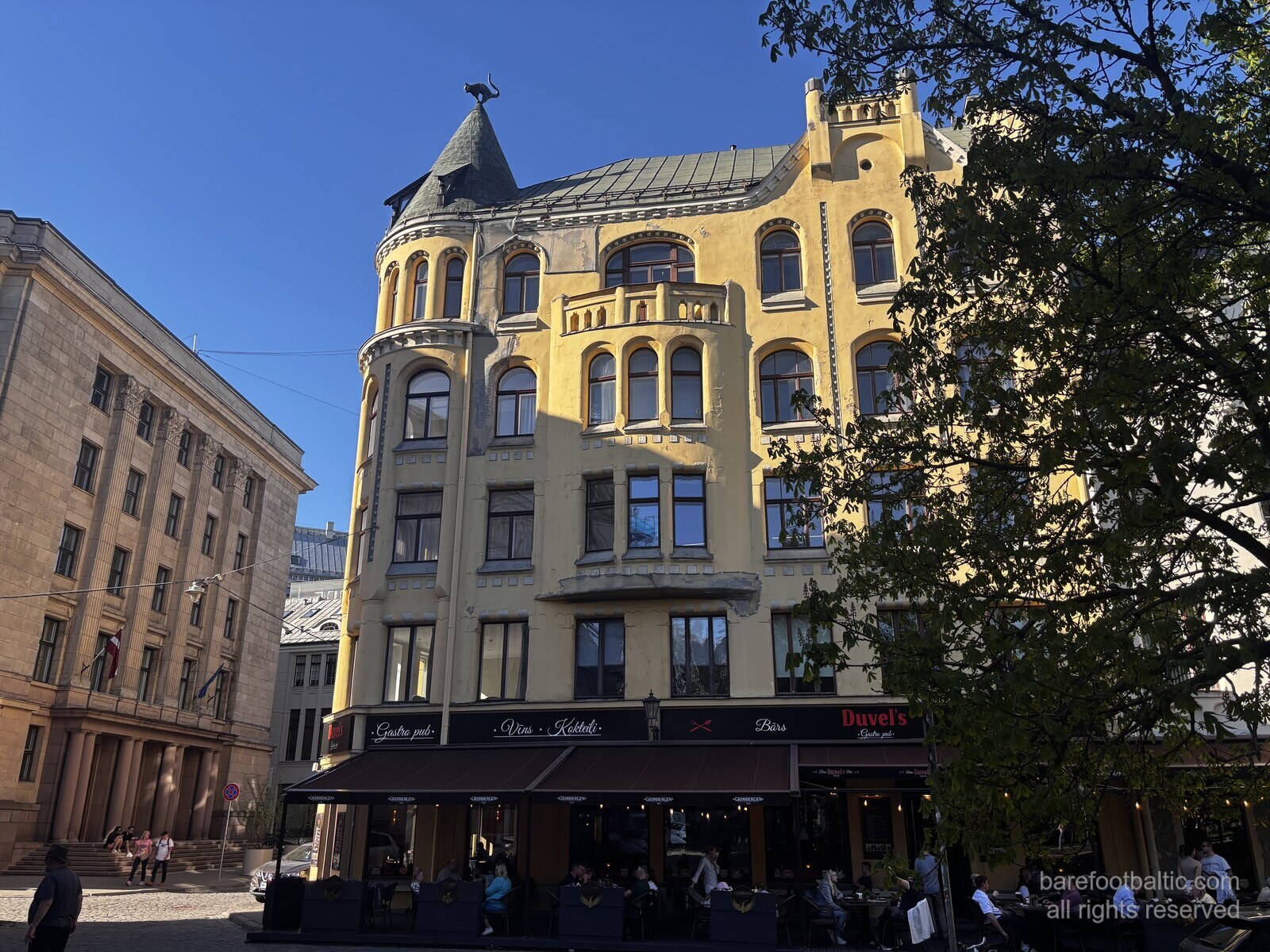
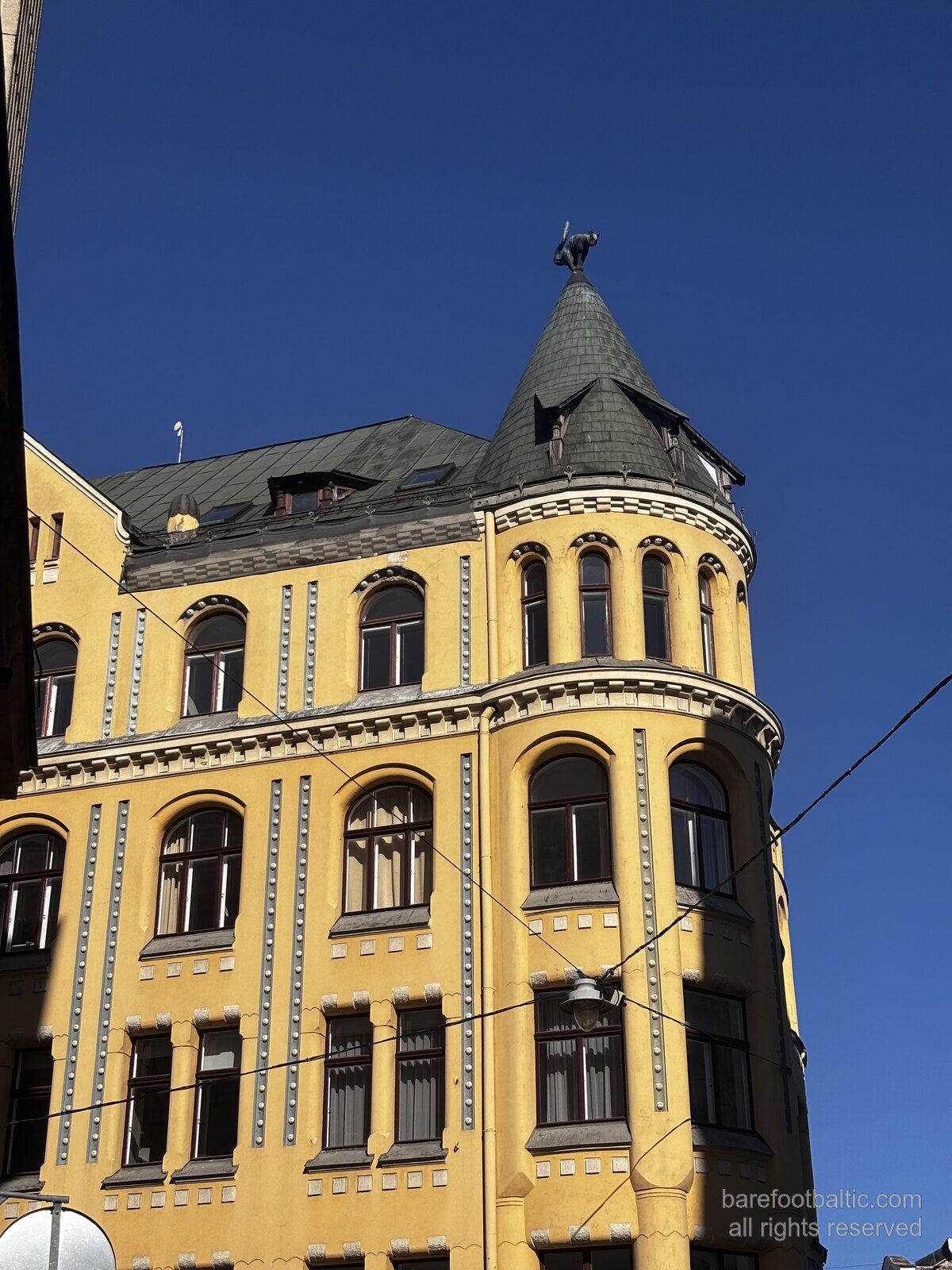
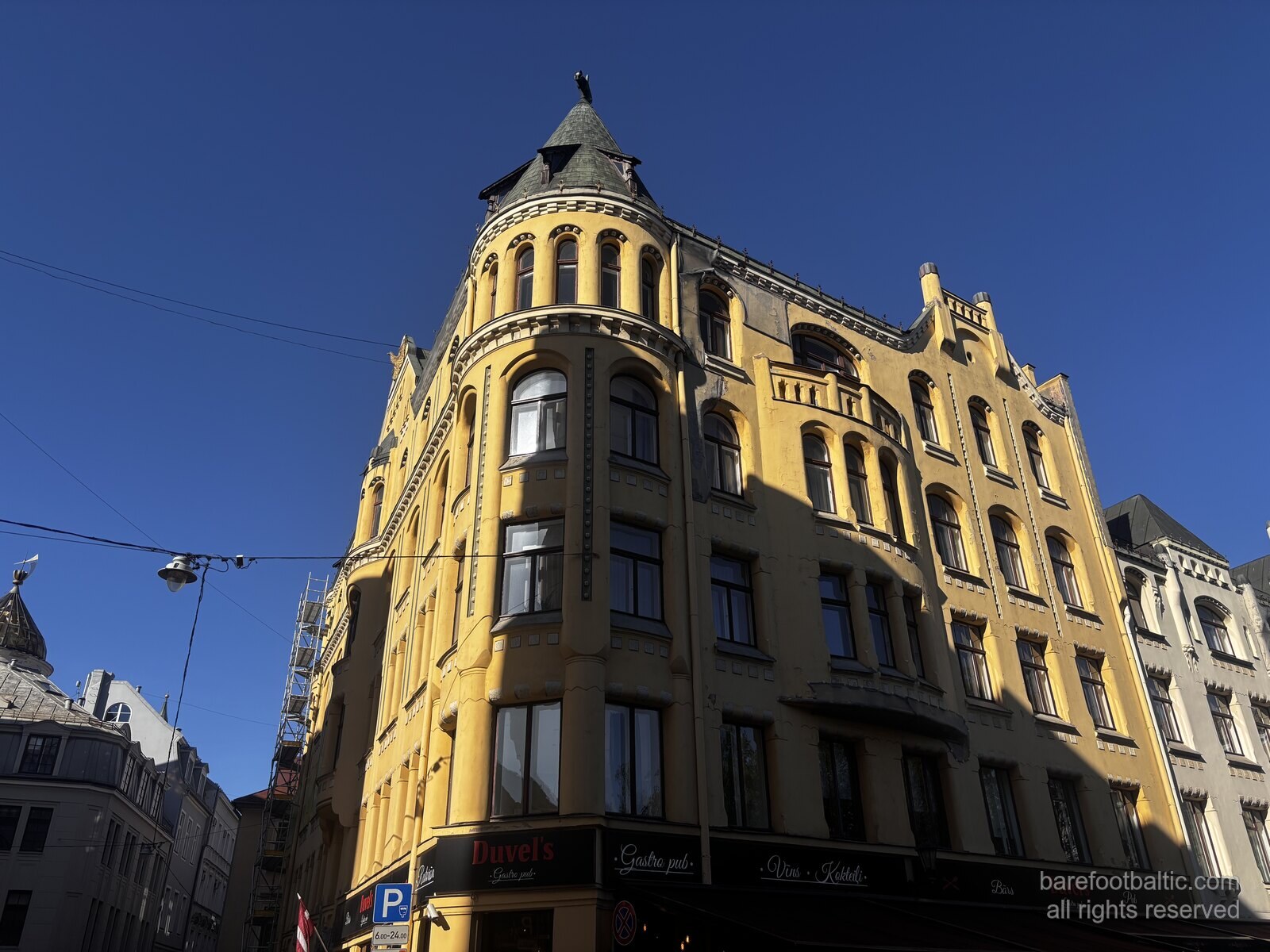
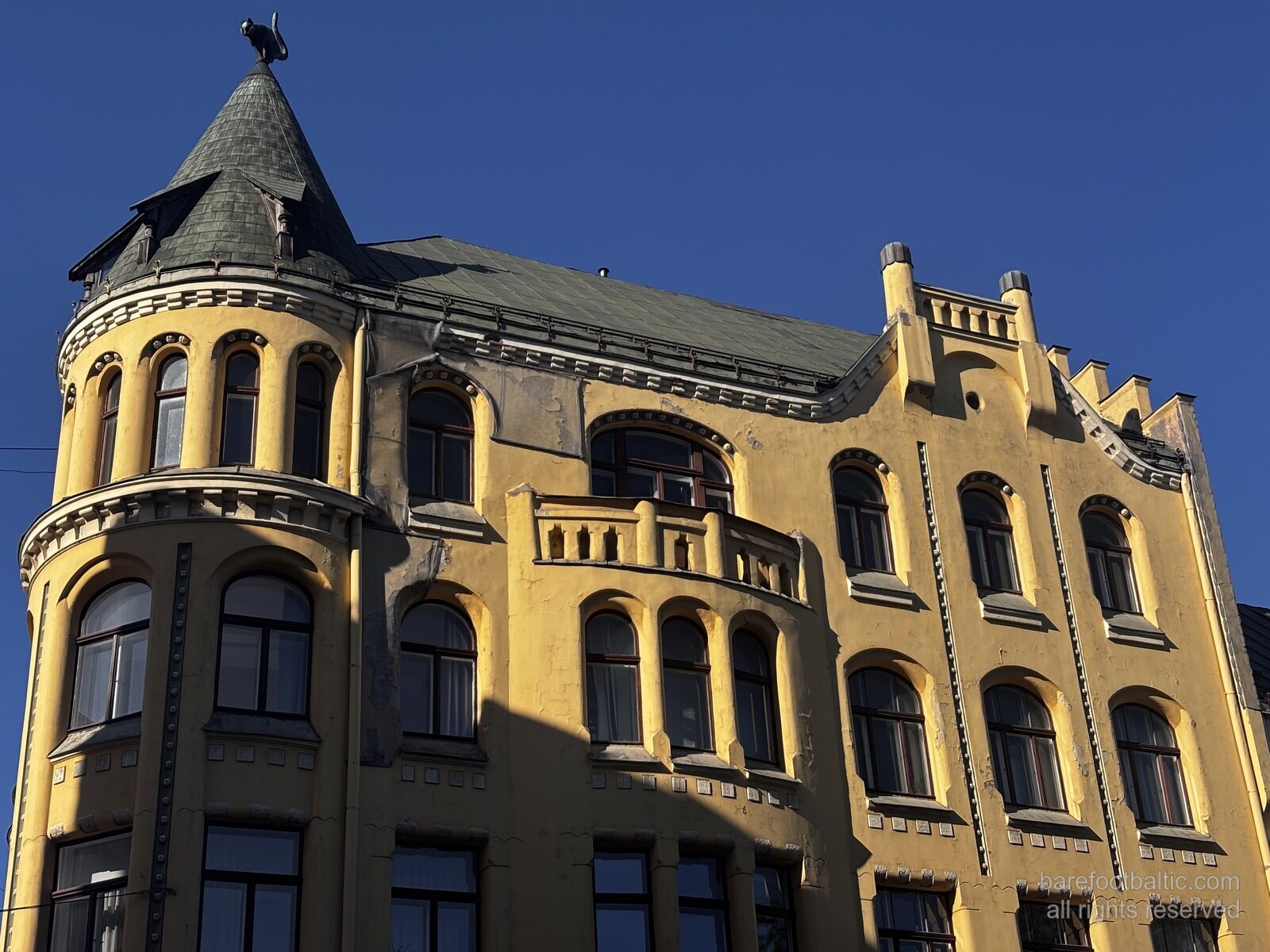
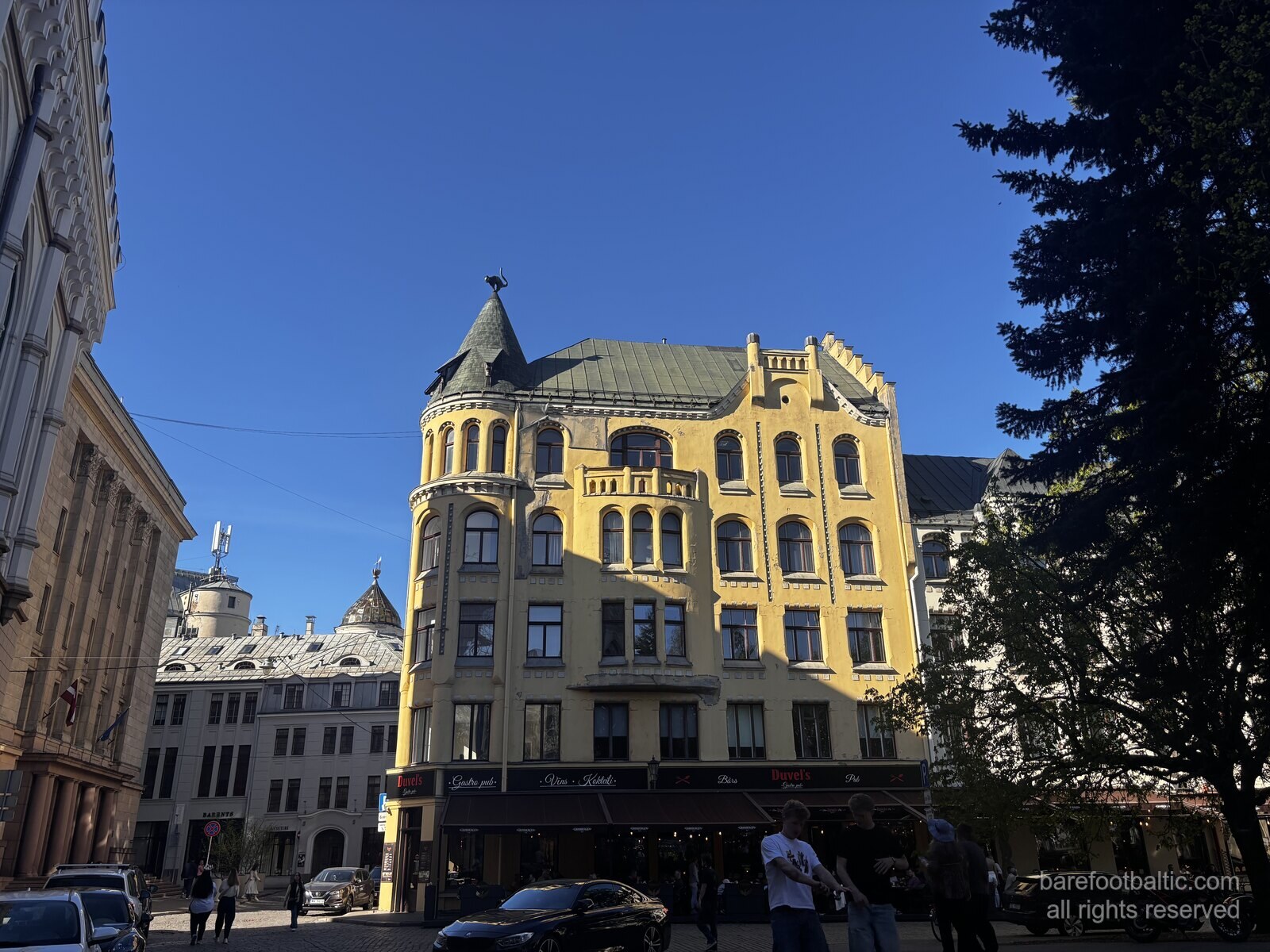
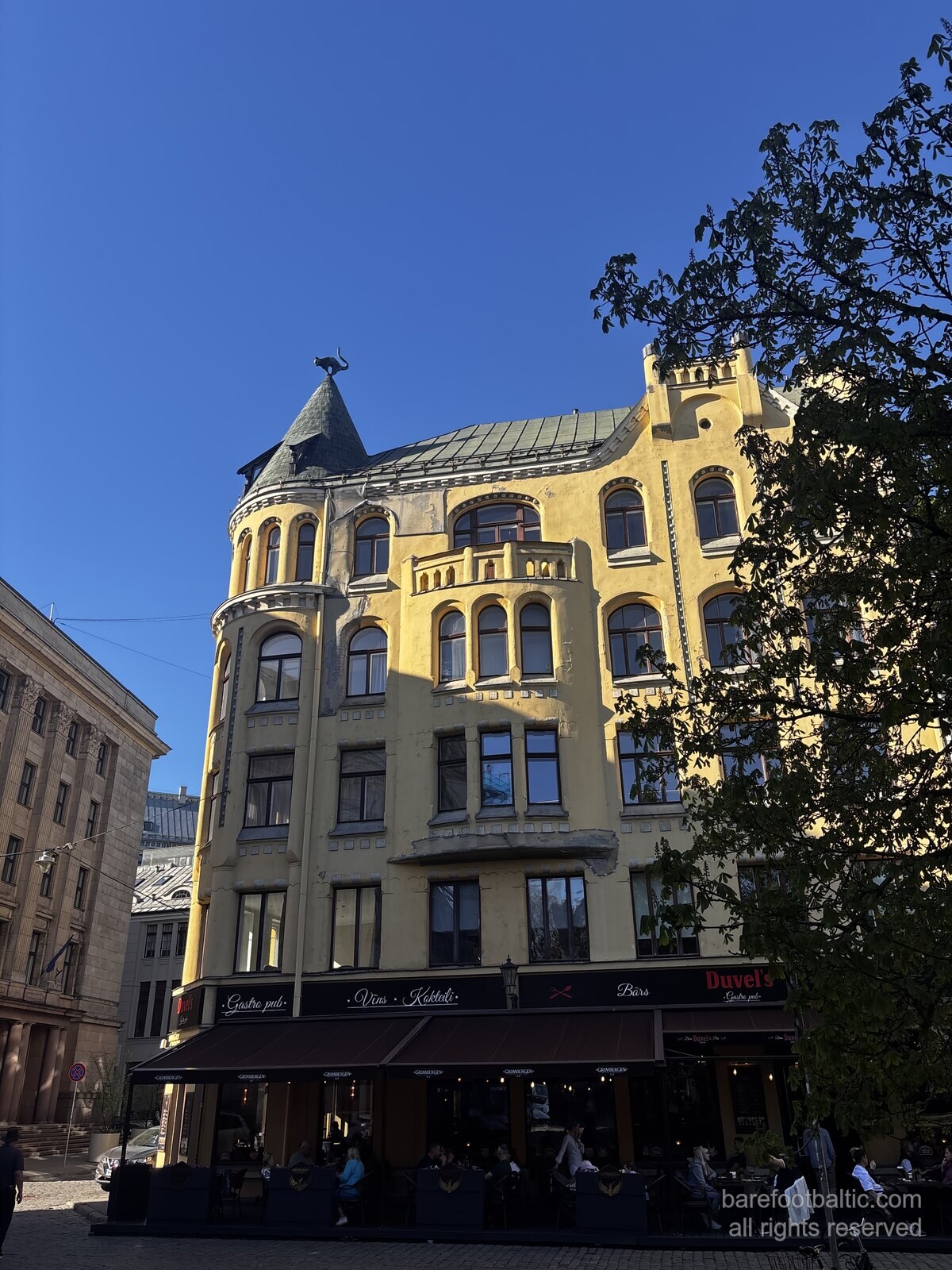
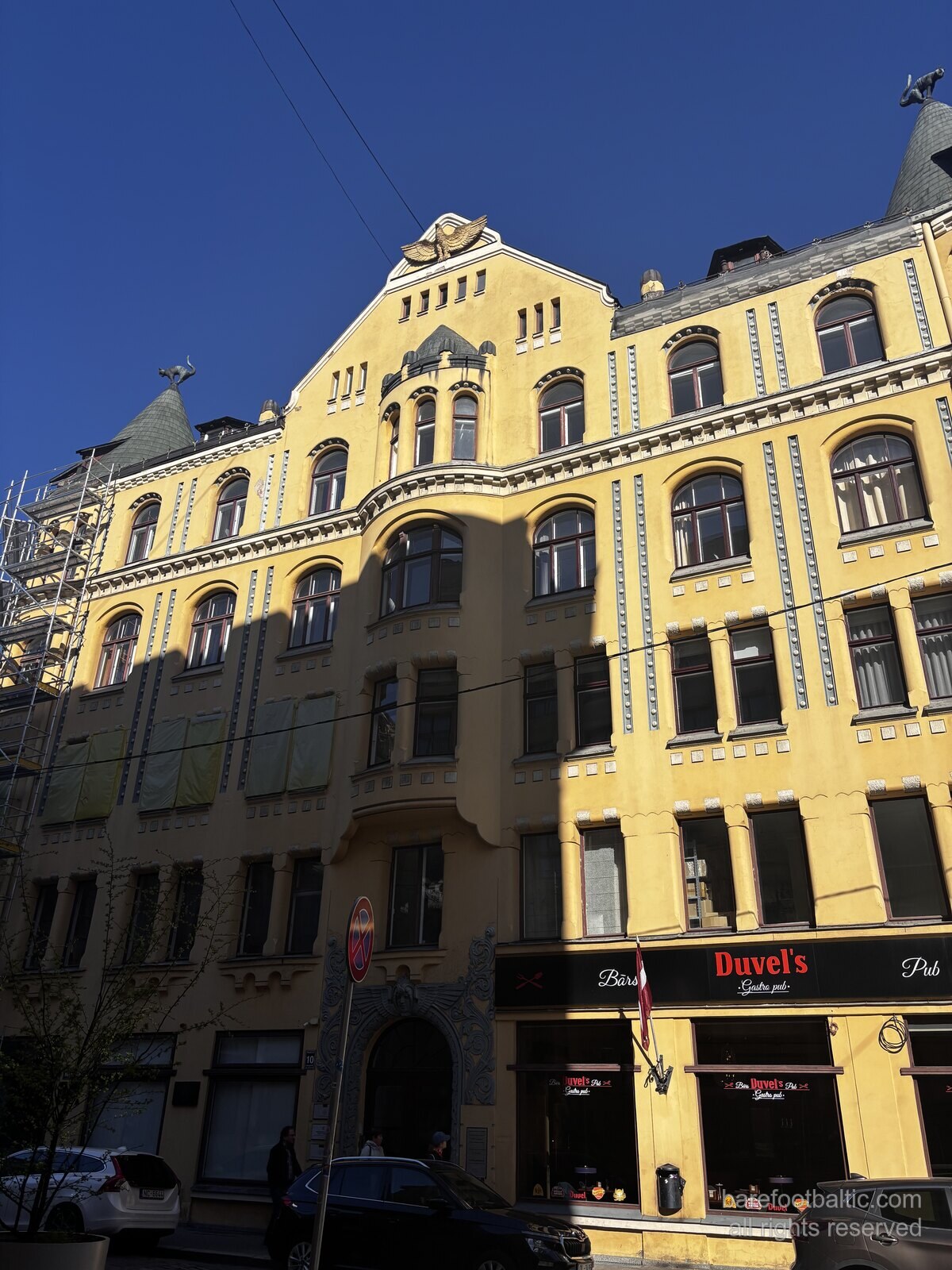
The Cat House from a few angles. Click any image for the full-size view.
Short answer, what the Cat House is
The Cat House (in Latvian, Kaķu nams) is a yellow Art Nouveau apartment building at Meistaru iela 10/12, in the centre of Riga’s Old Town. It was built in 1909 by the Baltic German architect Friedrich Scheffel for a wealthy Latvian merchant. On the roof are two black bronze cats, with arched backs and lifted tails, placed on different parts of the roofline. The house gets its nickname from these cats, and from the much-told story of why they’re there.
It is free to look at. You stand on the cobbles and look up, and most Old Town walks pass it anyway. Three minutes south of Riga Cathedral, two minutes north of the House of the Blackheads, and directly across the street from one of the buildings most central to the cats’ story.
The story Riga tells about the cats
Every Riga guide tells this one. The version I tell goes like this.
In the early 1900s, the merchant who built the Cat House applied to join the Great Guild of Riga (Lielā Ģilde), the powerful association of Riga’s German-Baltic merchants whose hall stood directly across the street. The Guild refused him. He was Latvian, the Guild took only Germans, and it had been a German institution for some six centuries. Insulted, the merchant commissioned the bronze cats and had them placed on the roof of his new house with their tails turned pointedly toward the windows of the Guild building opposite. A cat’s raised tail, in the language Riga merchants would have understood, said exactly what it looks like it says.
The Guild took the merchant to court. The courts agreed the cats were a deliberate insult. The cats were ordered turned around. The Guild relented, the merchant was admitted, and the cats were quietly rotated to face the building ‘properly’.
That’s the story. Whether all of it is strictly true is another question, which I’ll come back to.
The building itself
The Cat House gets the headlines for the cats, which is fair. But the building under them is also worth a minute. Meistaru iela 10/12 is a strong example of National Romantic Art Nouveau, the Latvian variant of Jugendstil, the European style sweeping the city between roughly 1899 and 1914. It’s an early piece in that style. The year 1909 sits solidly within the National Romantic phase, and the building shares a vocabulary with the better-known facades on Alberta iela in the Quiet Centre that everyone visits for the Art Nouveau walk.
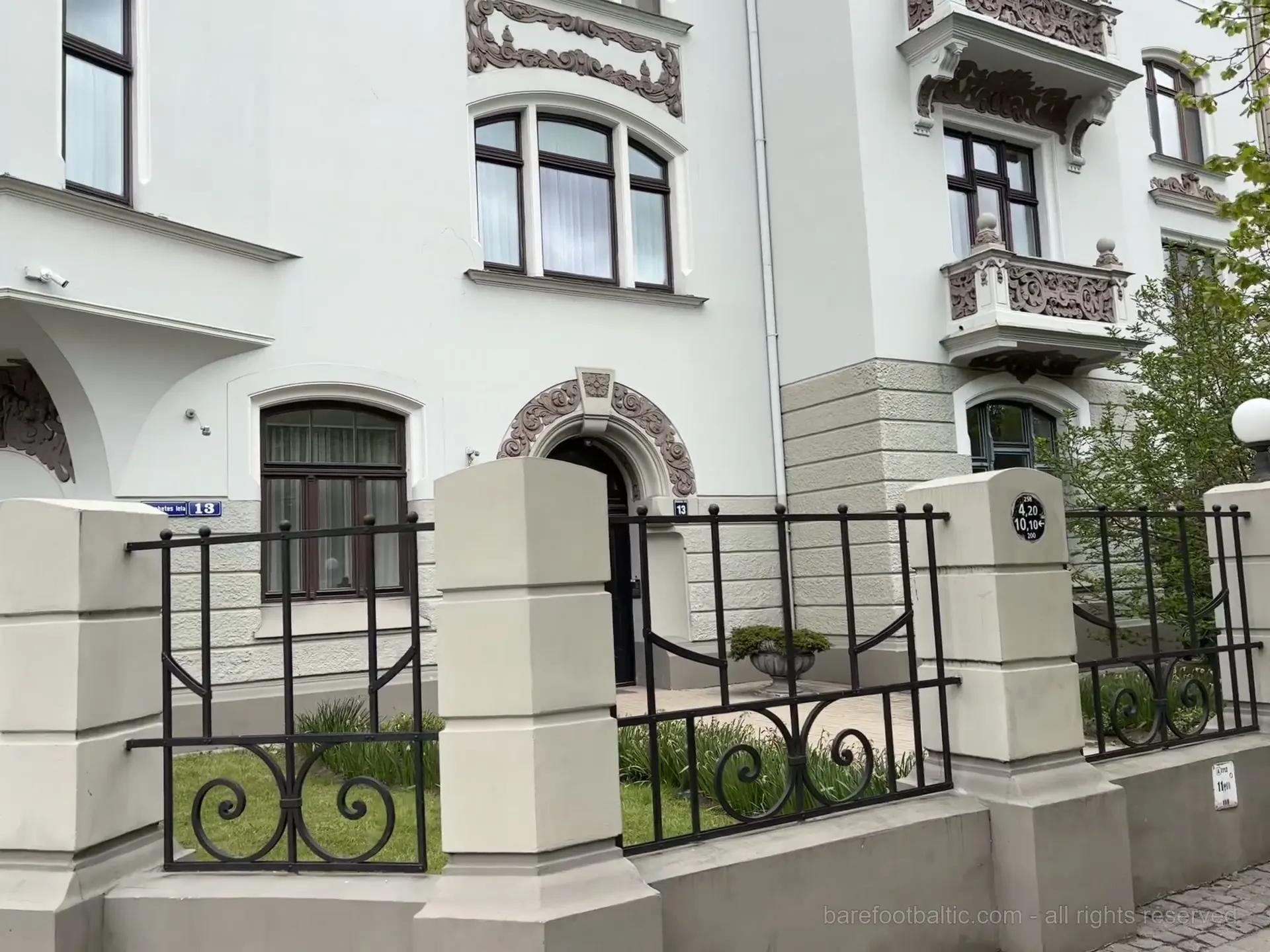
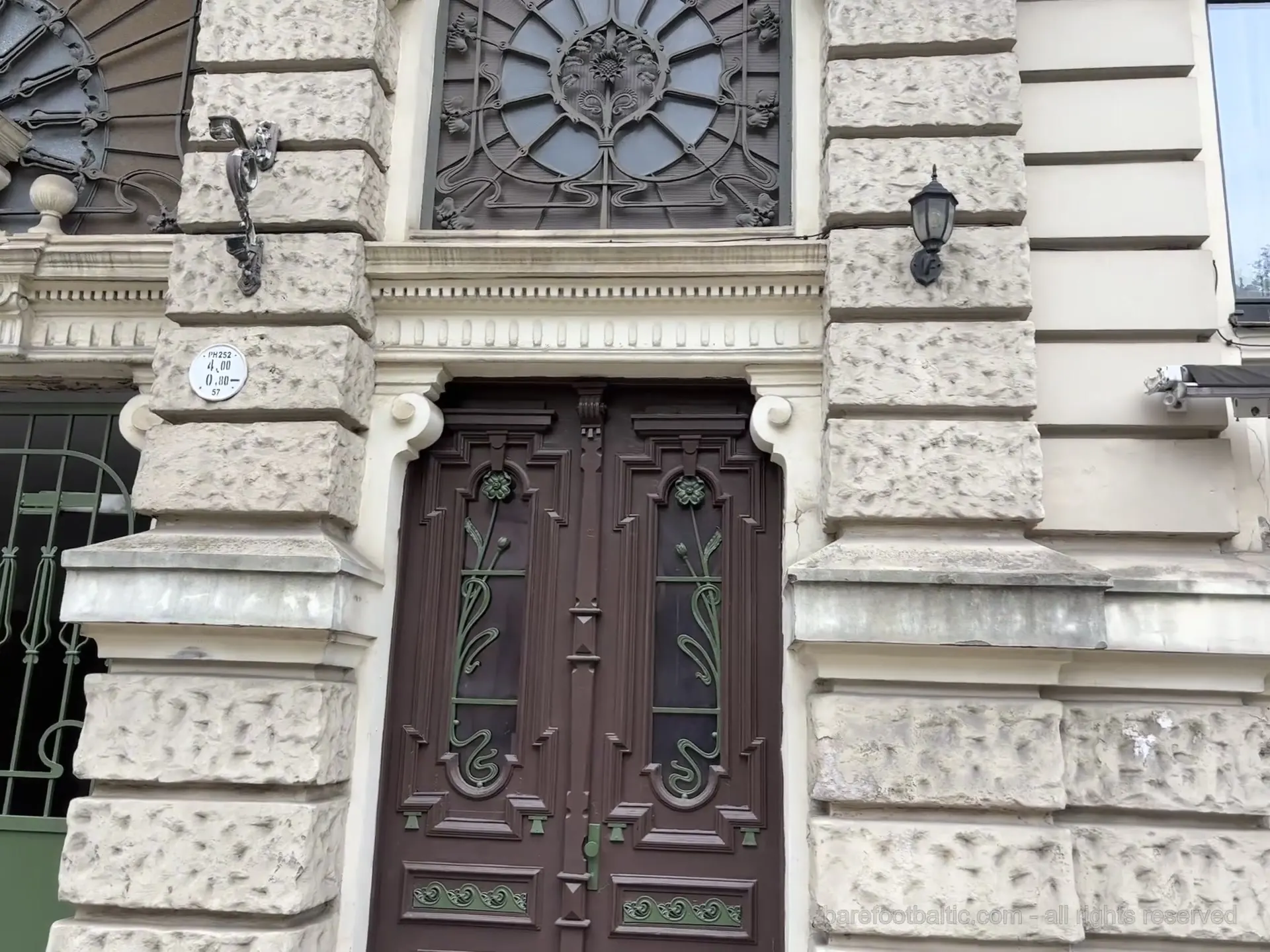
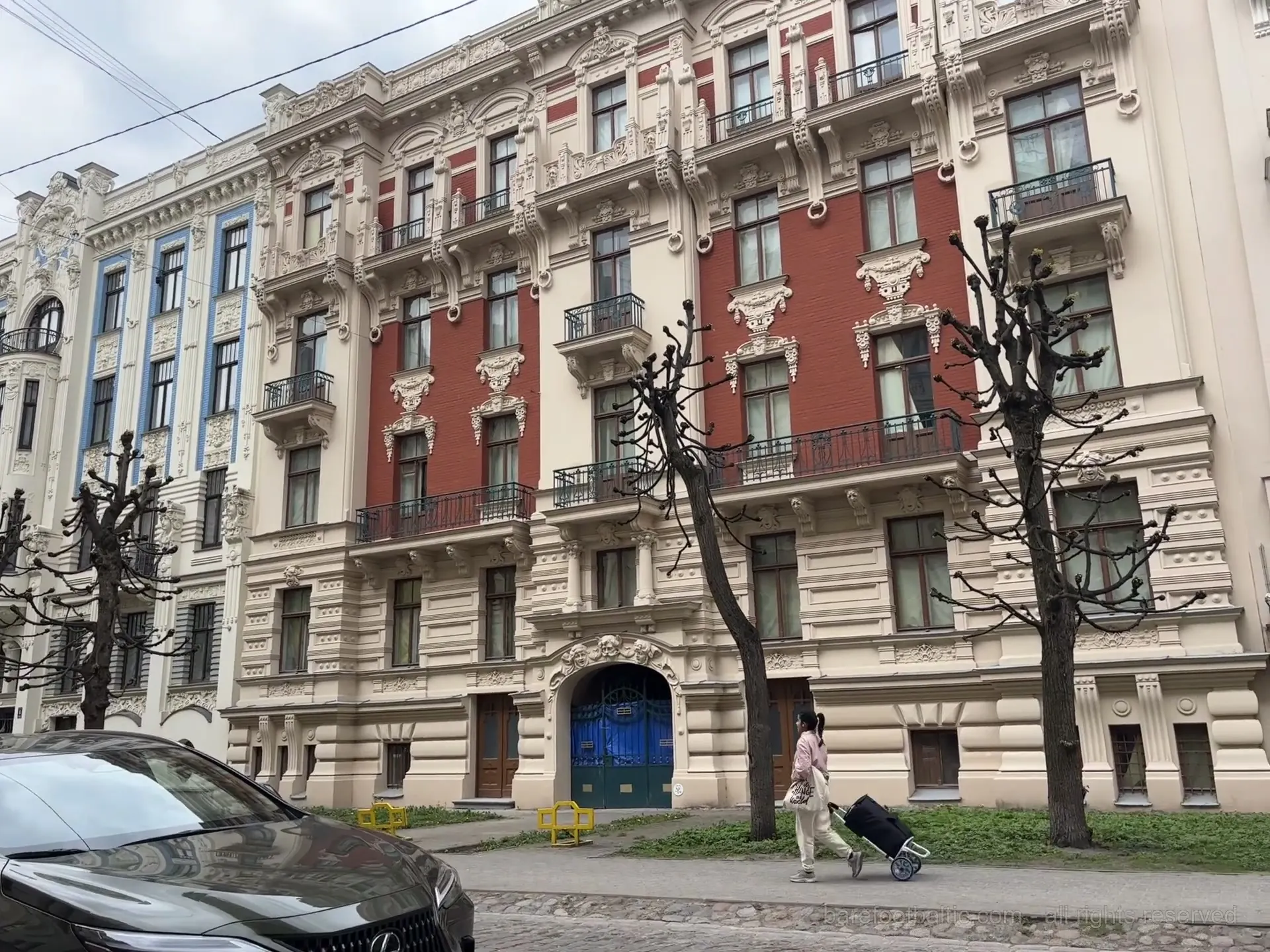
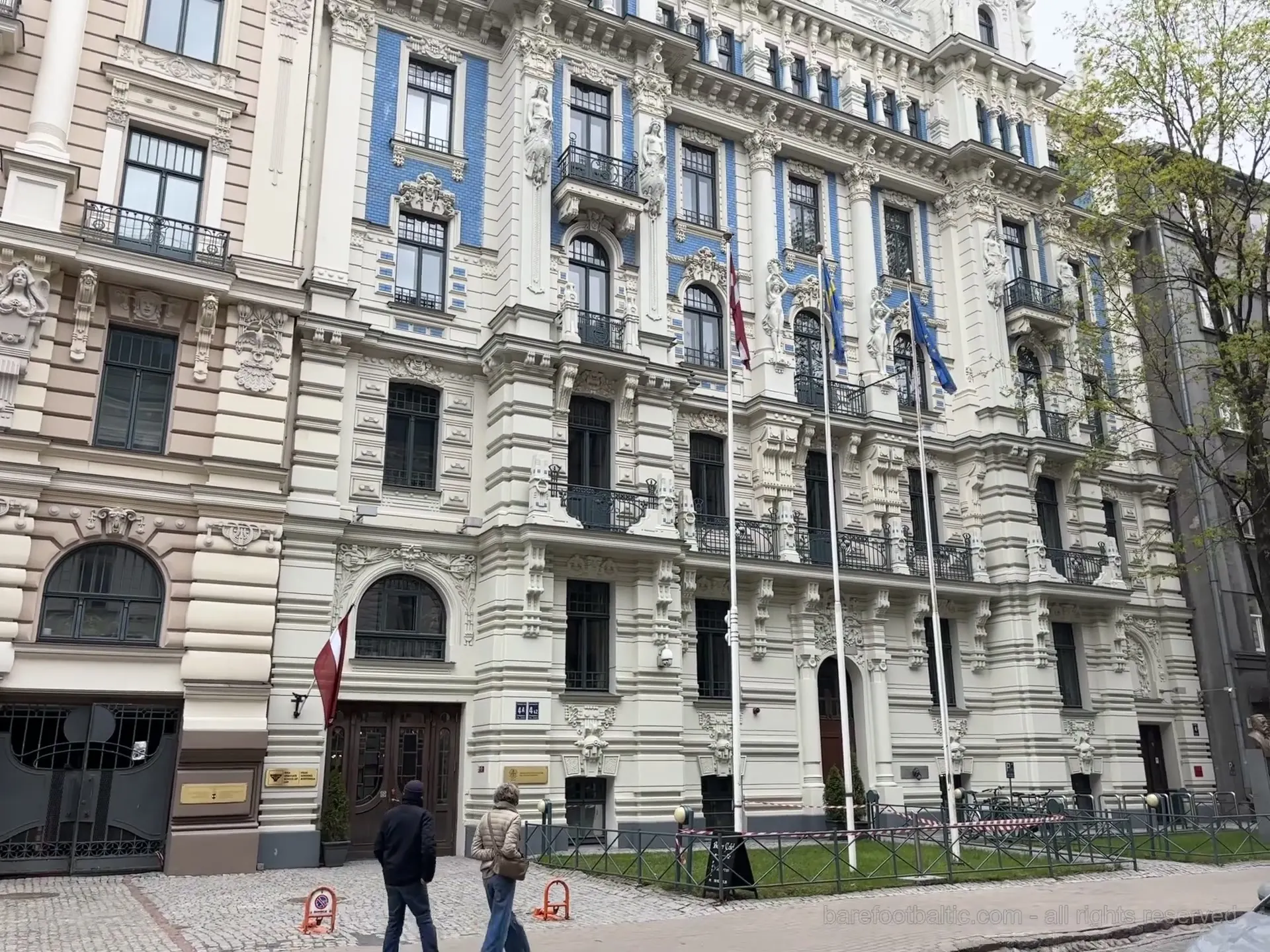
From the cobbles, look up. The yellow stuccoed facade has rhythmic windows and small balconies, with three-storey-high stuccoed pilasters framing the bays. The conical green-roofed corner turret is the one carrying the more famous of the two cats. Decorative brickwork above the windows is picked out in a slightly darker tone, and the smaller balconies have wrought-iron details around the rails. None of it is shouting. It is the work of an architect with a small budget and a clear plan, and it holds its own against the bigger names on Alberta iela.
The building is also lived-in. Some apartments are private homes, others have been converted into offices, and the ground floor houses a restaurant and a wine bar. The cobbles in front are part of the small open space that sits in front of the Great Guild building, which means there are always people stood here looking up.
The two cats, the Guild building, and what’s actually true
A few things are worth pinning down. The Cat House story is one of those Riga set-pieces that has been polished into something neater than the documentary record probably supports. The cats are real and on the building. The merchant’s frustration with the Great Guild was probably real. The court case is plausible, and the rotation of the cats is the kind of detail that has to come from somewhere. But the version told to tour groups assumes the merchant was Latvian. Older historians have suggested he may have been German-Baltic but from the wrong family, or simply too newly rich for the Guild’s taste. The exact dates, the exact court ruling, even the question of how many times the cats have been physically rotated. All of that is foggier than the polished version admits.
Here is what is documented and certain. The building is from 1909, designed by Friedrich Scheffel. The Great Guild building (Lielā Ģilde) directly opposite was built between 1854 and 1860 in a romantic medieval-revival style and is itself a major Riga landmark, today the home of the Latvian National Symphony Orchestra. The Small Guild (Mazā Ģilde) is around the corner. The Cat House sits squarely in the middle of the historical heart of Riga’s German merchant class, which is why the story works at all. A sculpture of a cat with a raised tail on a brand-new National Romantic building, looking down on the windows of an institution six centuries old, would have been read in 1909 exactly the way the story says.
So the cats are doing what the story says they’re doing, even if the precise legal proceedings are blurrier. That’s usually the way with Riga stories.
Viens tirgotājs, viens Lielās Ģildes lēmums un divi melni kaķi uz jumta. Visi pārējie sīkumi paliek atvērti.
A Latvian summary. “One merchant, one Guild decision, two black cats on the roof. Every other detail stays open.”Practical answers
Where it is
Meistaru iela 10/12, in the centre of Riga’s Old Town. Three minutes south of Riga Cathedral, two minutes north of Town Hall Square and the House of the Blackheads, directly opposite the Great Guild building. There’s a small open square in front of the Cat House where you can stand with a clear line of sight to the cats.
Hours, costs, getting in
The exterior is on a public street, free, 24/7. The building is not open to the public. The apartments are private and the offices aren’t for visitors. The ground-floor restaurant and wine bar are open to anyone. Opening hours and menus change, so walk past and check. There is no ‘Cat House Museum’. You stand on the cobbles, you look up, you take the photograph, you walk on. Five minutes is plenty.
Best time to photograph the cats
Late morning to early afternoon, when the sun is high enough to clear the surrounding rooflines and put light on the yellow facade. The corner turret faces roughly south-east, so morning gives you the best three-quarter side light on the famous cat. Step back to the centre of the small square in front of the Great Guild for a clear angle that catches both cats in the same frame. Avoid mid-summer noon. The cats are silhouetted against bright sky and lose detail.
Combining with the rest of the Old Town
The Cat House is a one-stop, five-minute detail, not a destination. It pairs with the cathedral three minutes north, the Three Brothers seven minutes north-west, and the House of the Blackheads two minutes south. The full route through the Old Town is in the Old Town pillar guide.
My take
The Cat House is one of the small set-pieces that gives the Old Town its character. It is a five-minute detail with a story behind it that is part petty and part funny, and rather older than the cats themselves. The building is its own piece of the wider Riga Art Nouveau story. Worth looking up.
How much of the story is documented and how much has been polished by retelling, nobody really knows. I think it’s worth telling either way.
Frequently asked questions about the Cat House
Daiga Taurīte is a licensed Latvian tour guide and co-founder of Barefoot Baltic, which runs small-group day excursions from Riga. She grew up in Riga, spent two decades working in London, and came home in 2024. Barefoot Baltic is licensed by Latvia’s Consumer Rights Protection Centre (PTAC), holds ATD passenger transport licence PS-01995, and is insured by BTA Baltic for civil liability.
The Cat House is one of the stops on every Old Town walk we run. If you’d like the half-day Old Town with a licensed Latvian guide, including the cats, the cathedral, the Three Brothers, and the House of the Blackheads in one route, get in touch.