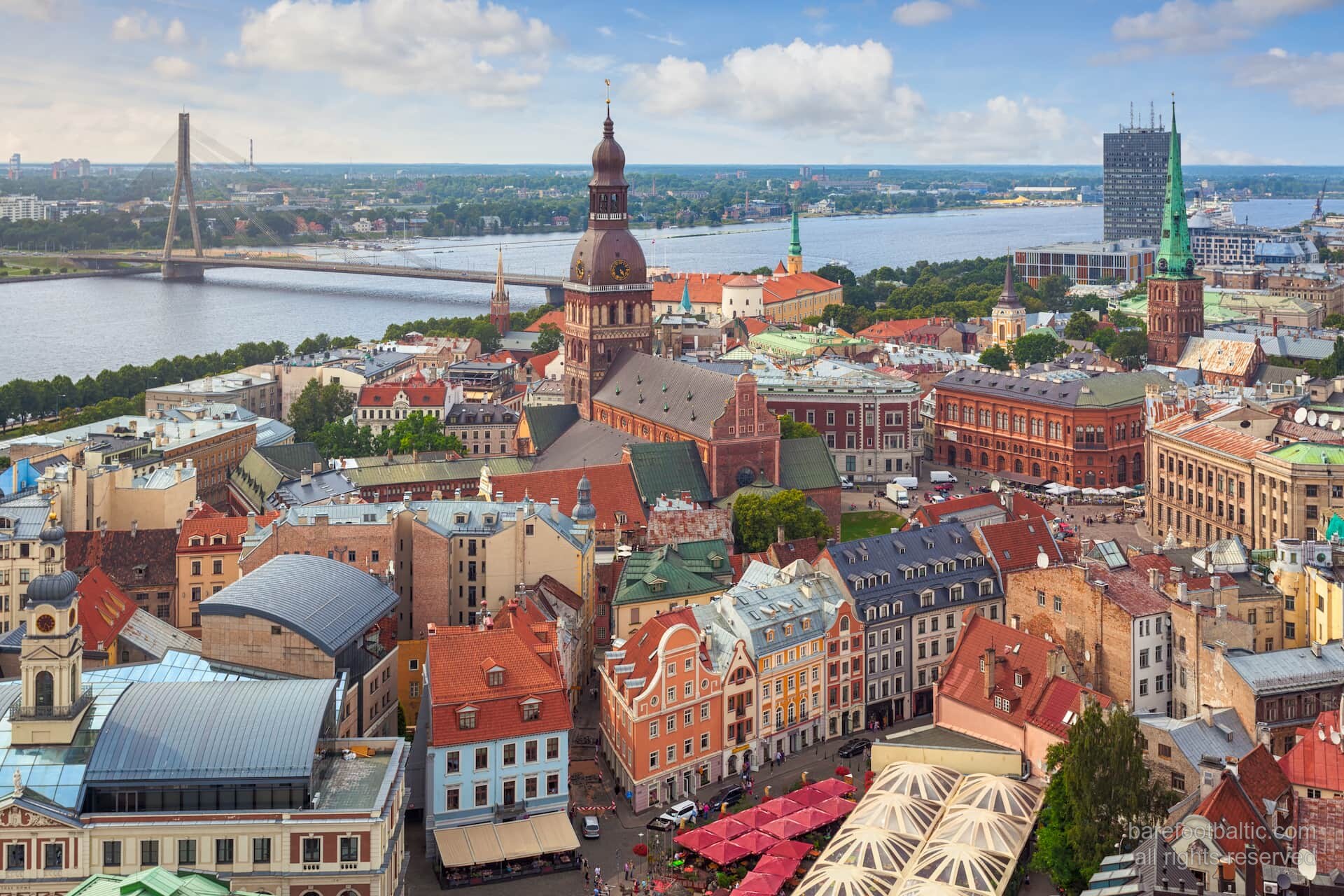
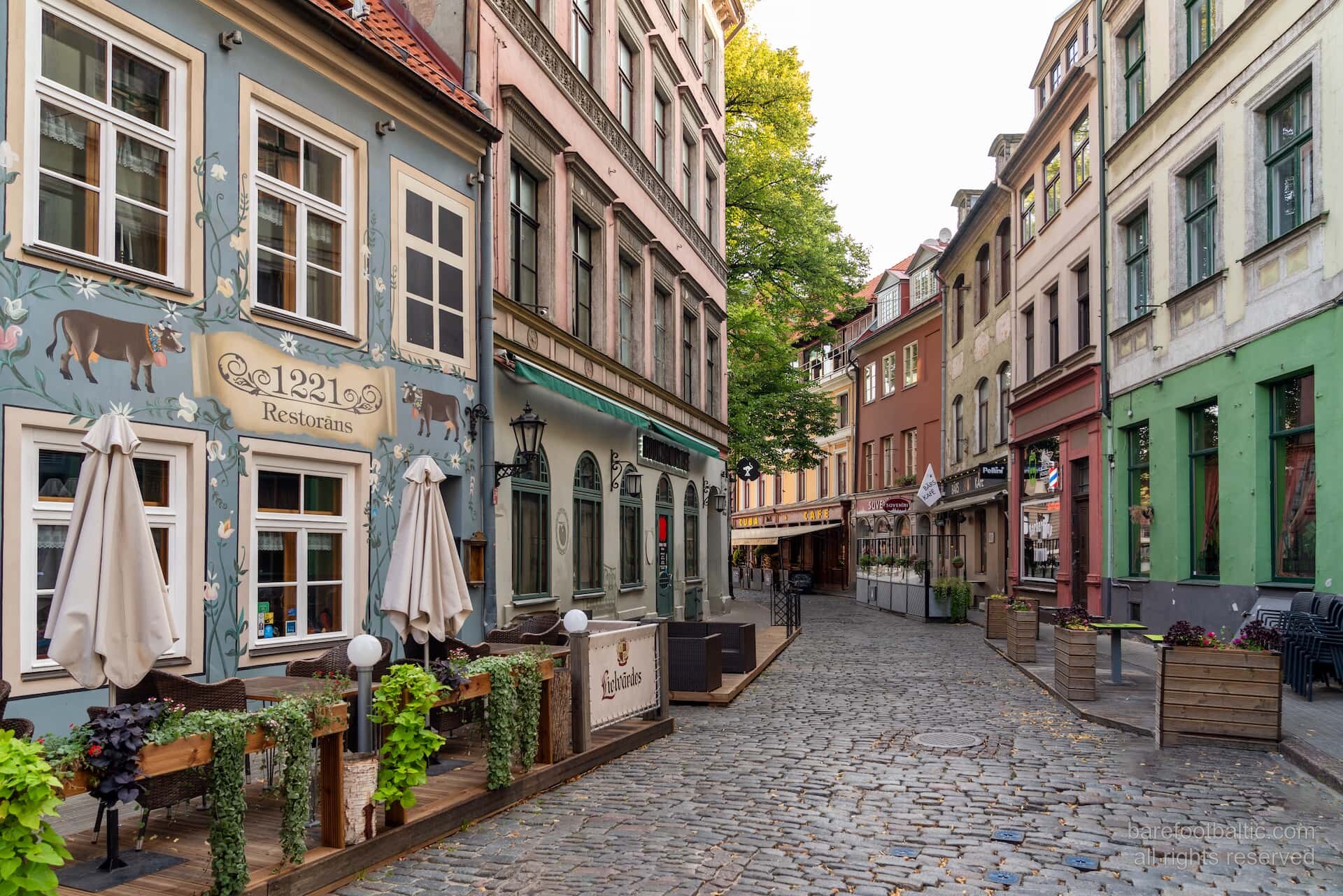
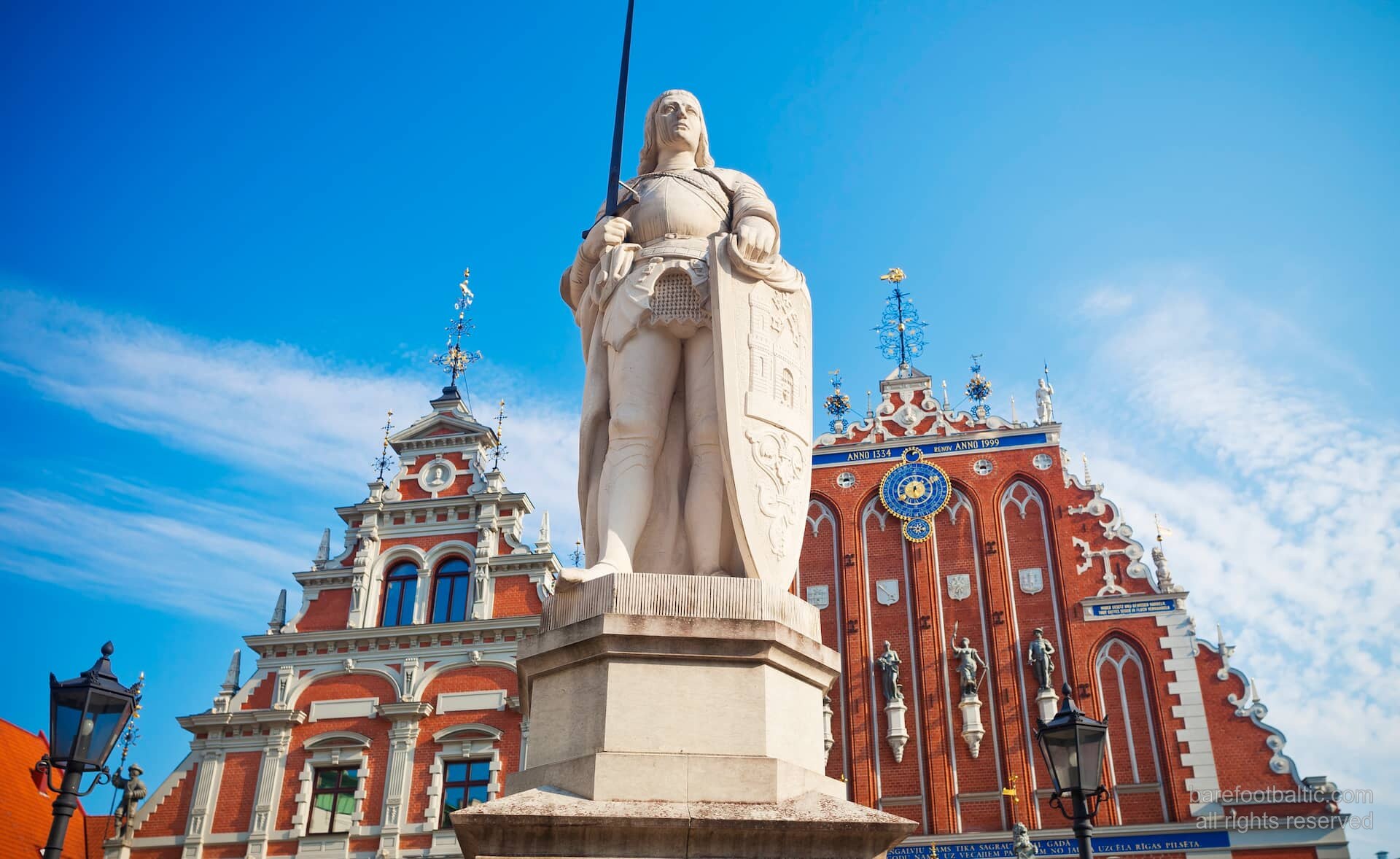
A few of the things you'll recognise as you walk Vecrīga. The aerial view, the cobblestone streets, the Roland statue, the Daugava.
Short answer, what Riga Old Town actually is
Riga Old Town (Vecrīga in Latvian) is the medieval and Hanseatic core of the Latvian capital, founded in 1201 by the German Bishop Albert. It is UNESCO-listed, 438 hectares in size (the biggest Old Town of the three Baltic capitals), and it sits on the right bank of the Daugava river. You can walk the whole thing slowly in one day, see the headline sights in half a day, and lose a satisfying weekend in the side streets if you want to.
If you only have a few hours, here is the order I would do it in.
- Start at the Freedom Monument, walk south into the Old Town past the Powder Tower.
- Cathedral Square, House of the Blackheads, the Three Brothers, Riga Castle from the outside.
- Climb the St Peter’s Church tower for the best panorama of the city.
- Lunch at the Central Market (technically just outside the Old Town walls but a 5-minute walk south).
- Walk back through the Old Town in the late afternoon when the light is golden and the day-trippers are leaving.
The rest of this guide is the longer version. It covers the practical things travellers ask me about, the best walking routes, where to actually eat, what to skip, how to avoid the bar scams, and what changes in winter. If you want broader Riga planning, see the 48-hour Riga planning piece. For food specifically, the Latvian food guide is the deeper read.
How big is the Old Town, and how to think about its layout
Vecrīga is roughly L-shaped, bounded by the Daugava river to the west and the Pilsētas Kanāls (a curving canal that was once the city moat) to the east. From the Freedom Monument at the northern edge to St Peter’s Church at the southern edge is a 15-minute slow walk. From the river edge to the canal is a 10-minute walk. You cannot get truly lost. If in doubt, walk towards the spires (St Peter’s, the Cathedral, St Jacob’s) or towards the river.
The Old Town breaks down into four loose neighbourhoods. Locals don’t name them, but a visitor feels them.
- The Cathedral quarter in the north-centre, around Doma laukums (Cathedral Square). This is the most photographed area, the most crowded in summer, and the most architecturally layered. Expect tourist crowds 11 AM to 4 PM in season.
- The Town Hall and Blackheads quarter in the south-west, around Rātslaukums (Town Hall Square). Home to the famous reconstructed House of the Blackheads, the statue of Roland, and Riga’s most-photographed building.
- The Convent quarter in the east-centre, behind the Cathedral, full of small lanes and quiet small restaurants. The best evening dining is here.
- The Castle quarter in the north-west, towards the river, where Riga Castle (the President’s residence) sits. Quietest area. A nice late-afternoon walk along the Daugava.
The headline things to see
The Cathedral and Cathedral Square (Doma baznīca)
Riga Cathedral is the oldest medieval building in the Baltic states still in use, founded in 1211, expanded over six centuries. The interior is more austere than you might expect (the Reformation stripped most of the original Catholic decoration in 1524), but the famous attraction is the organ. It was built in 1884 by Walcker of Ludwigsburg, has 6,718 pipes, and is one of the largest in the world. Lunchtime organ recitals run several times a week. Check the schedule on the door. Cathedral Square outside is the best place in Riga for a coffee and people-watching. Full deep dive on Riga Cathedral →
St Peter’s Church and the tower (Sv. Pētera baznīca)
The most distinctive Old Town landmark. A red-brick Gothic church first mentioned in 1209, with a 123-metre tower that is the city’s defining silhouette. The tower was destroyed twice (lightning in 1721, German artillery in 1941) and most recently rebuilt in concrete-and-steel in 1973, but the lift to the viewing platform takes you up in two stages and the panorama is the best in the city. You can see the entire Old Town in red rooftops, the curve of the Daugava, the Art Nouveau quarter to the north, and on a clear day all the way to Jūrmala on the coast. Tickets are around €9, no need to book ahead. Best at golden hour (one hour before sunset). Full deep dive on St Peter’s tower →
The House of the Blackheads (Melngalvju nams)
The most photographed building in Riga, on Rātslaukums. The original was built in 1334 for the Brotherhood of Blackheads (an unmarried German merchants’ guild), destroyed by German shelling in 1941, and meticulously reconstructed between 1995 and 1999 using historical drawings. The exterior is an absurdly elaborate Dutch Renaissance facade in red, gold, and white. The interior is a museum and event space, worth a visit if you have time. The square it stands on holds the Christmas market in December and is where most of Riga’s public events happen. Full deep dive on the House of the Blackheads →
The Three Brothers (Trīs brāļi)
Three medieval houses standing side by side at Mazā Pils iela 17, 19, and 21. The oldest (number 17) is the oldest stone dwelling house in Riga, dating to around 1490. The middle (number 19) is from the 17th century. The youngest (number 21) is from the late 17th century. Each has a different facade, and together they form one of the most photographed corners of the Old Town. The middle house contains the small Latvian Museum of Architecture. Even if you don’t go in, the courtyard behind is open and worth a look. Full deep dive on the Three Brothers →
Riga Castle (Rīgas pils)
On the riverfront at the north-western edge of the Old Town. Built in 1330 by the Livonian Order, expanded by successive rulers, and now the official residence of the President of Latvia. You cannot tour the interior (it’s a working presidential office), but the exterior is impressive in late-afternoon light and the riverside walk along the Daugava in front of it is one of the prettiest short walks in Riga. Full deep dive on Riga Castle →
The Powder Tower (Pulvertornis)
The only surviving tower of the medieval city walls. Now houses the Latvian War Museum, which is free, well-organised, and a thorough overview of Latvia’s 20th-century military history (the World Wars, the Soviet occupations, the road to independence). Allow an hour. Worth it even if military history isn’t your usual interest. Full deep dive on the Powder Tower & War Museum →
The Swedish Gate (Zviedru vārti)
The only surviving city gate, cut through the medieval wall in 1698 during the Swedish period to give one merchant private access to his warehouse outside the walls. Tiny, easy to miss, on Torņa iela. The narrow lane on both sides of the gate (Torņa iela) is one of the best preserved medieval streets in the Old Town. Full deep dive on the Swedish Gate →
St Jacob’s Cathedral (Sv. Jēkaba katedrāle)
The Catholic cathedral of Riga, smaller and quieter than the Lutheran Doma baznīca. Sits beside the Latvian Parliament building (the Saeima). Worth a stop for the contrast. Austere Gothic exterior, gilded Baroque interior, very different from the Lutheran cathedrals around it. Full deep dive on St James’s Cathedral →
The Freedom Monument (Brīvības piemineklis)
At the eastern edge of the Old Town, where Brīvības iela crosses the canal. A 42-metre limestone column from 1935, designed by Kārlis Zāle, with a copper figure of a woman (Milda) holding three gold-plated stars representing Latvia’s three historic regions. Built entirely from public donations during Latvia’s first independence. Survived the Soviet occupation, and still hosts every state ceremony, protest, and flower-laying. The Honour Guard ceremony runs daily in the warm months. Full deep dive on the Freedom Monument →
The Cat House (Kaķu nams)
A yellow Art Nouveau building on Meistaru iela with two black bronze cats on the roof. The story changes depending on which version a guide tells you. The merchant who built the house was refused membership of the Great Guild across the street, so he placed the cats on his roof with their tails turned towards the Guild’s windows in protest. The Guild eventually relented, the cats were turned around to face the building properly, and everyone got along. A small thing, but every Old Town walk passes it and every Latvian knows the story. Full deep dive on the Cat House →
Vērmanes dārzs, Riga’s oldest park
Just east of the Freedom Monument, in the Quiet Centre, is Vērmanes dārzs. It is Riga’s oldest public park, founded 1817. Not on the standard Old Town route, but the right place to sit for twenty minutes between sights, especially in May when the Japanese cherries are out and the city decides summer has begun. Full deep dive on Vērmanes dārzs →
Three walking routes, depending on how much time you have
The 1-hour highlights walk
Start at the Freedom Monument. Walk south down Brīvības iela into the Old Town. Powder Tower (look at the cannonball still embedded in the wall). Pop into the War Museum if you have 30 minutes. Otherwise continue along Torņa iela, through the Swedish Gate, past the Three Brothers, to the Cathedral. Quick walk around Cathedral Square. South down Šķūņu iela to the Cat House on Meistaru. South-west to Town Hall Square and the House of the Blackheads. End at St Peter’s tower (the lift up is worth the €9 even if you’re short on time). About 2 km of walking in total.
The half-day slow walk (3-4 hours)
Same route as above, with a few additions. Thirty minutes inside Riga Cathedral (try to time it for an organ recital), 30 minutes in the small Museum of the Occupation of Latvia near Town Hall Square (which covers the Soviet and Nazi occupations and is short, sharp, and important context), and a coffee in one of the cafés on Mazā Pils iela near the Three Brothers. Add a 20-minute walk down to the river along Pils iela, past Riga Castle, for the Daugava view.
The full-day slow walk (with lunch and detours)
In the morning, do the half-day walk above, ending at the Central Market for lunch (graze across the five Zeppelin-hangar food halls, 90 minutes is plenty). In the afternoon, walk back into the Old Town and lose yourself in the small lanes behind the Cathedral and around the Convent Yard (Konventa sēta), the prettiest and quietest part of the Old Town. End at St Peter’s tower at golden hour (90 minutes before sunset). Dinner in one of the Convent quarter restaurants.
Where to actually eat in the Old Town
This is the section where I have the most opinions. The Old Town has roughly 200 restaurants and cafés. Most cluster along Kaļķu iela, the main pedestrian street, and around Cathedral and Town Hall Squares. Here is the rule. The more aggressively a menu is shouted at you in five languages from the street, the worse the food and the higher the price. Walk one street back from the tourist arteries. Quality goes up sharply.
Here is where I send people.
- Vincents. The most ambitious modern Latvian restaurant in Riga, on the edge of the Old Town. Tasting menu around €75 to 90 per person, à la carte from €40. Reservations needed.
- Bibliotēka N°1. Modern Latvian, relaxed, excellent wine list, around €35 to 50 per person. On Tērbatas (just outside the Old Town to the north).
- 3 Pavāru Restorāns. The chef-led tasting menu option that locals know about. €60 to 80 per person, open kitchen, around 12 seats.
- Folkklubs Ala Pagrabs. A cellar tavern off Peldu iela, traditional Latvian dishes done well, very Latvian crowd, live folk music some evenings. The casual end of the spectrum, around €15 to 25 per person with a beer.
- Riga Central Market. Not in the Old Town strictly but a 5-minute walk south. The single best food experience in Riga. Lunch for two for €15 to 20 across the food halls.
- Lido (Vērmanes Garden branch). The Latvian self-service chain, classic dishes done properly at €8 to 15 per plate. A few minutes’ walk from the Old Town along Elizabetes iela.
What to skip and what to watch out for
Three warnings.
Skip the medieval-themed tourist restaurants with serving staff in costume and "wild boar" on the menu. The food is mediocre, the prices are double the local equivalent, and the "authentic medieval Latvian recipe" is invented for tourists. You’ll spot them on Kaļķu iela and around the Town Hall Square.
The Kaļķu iela bar scam. This is the long-standing one. An attractive young woman approaches a male tourist (often a solo traveller or a stag party) on the street and invites him to a "great bar" she knows nearby. Once inside the bar, the drinks bill becomes €200 to 500 instead of the €20 it should be, and large bouncers explain that yes, this is the bill. The scam still operates. Do not follow strangers from the street into bars you have not chosen yourself. If you want a drink, walk into a place that obviously has locals in it.
Old Town nightlife on weekend evenings can attract loud stag-party groups, mostly British. Some streets (especially Kaļķu and parts of Tirgoņu) get rowdy after 10 PM on Friday and Saturday. If this isn’t your scene, the Convent quarter and the area around Cathedral Square stay calm.
The Old Town in different seasons
Summer (June to August)
Long days. Sunset around 10:30 PM in late June, warm weather, packed cafés and outdoor seating in every square. Cruise day-trippers flood in mid-morning and leave by mid-afternoon, so early mornings (before 9 AM) and evenings are when the Old Town is at its best. At Midsummer, Jāņi on June 23 and 24, the city empties out as Latvians head to the countryside. Restaurants run reduced hours.
Autumn (September to October)
The best season for Old Town walking. Cool weather, golden light on the red brickwork, fewer tourists, restaurants properly themselves again. Pīrāgi season at the bakeries. The mushroom-foraging cult is in full swing in the surrounding forests, and many restaurants put fresh chanterelles on the menu.
Winter (November to February)
Short days (sunrise 9 AM, sunset 4 PM in December) and cold, often -5°C to -15°C. The Old Town in snow with the Christmas lights up is one of Northern Europe’s best winter sights. The Christmas market on Cathedral Square runs late November to early January and was voted third best in Europe for 2025 to 2026. Hotel prices are at their lowest and the restaurants fill up with locals again. See the Riga in Winter post for the deeper take.
Spring (March to May)
The shoulder season. March is still cold and grey. By mid-April the city is properly warm and the cafés put their outdoor seating back. May is excellent, with long days returning, blossom in the parks, and summer prices not yet kicked in. The first proper week of Old Town terrace-drinking is usually the second week of May.
Where to stay in the Old Town
The Old Town has roughly 30 hotels, ranging from €60-a-night guesthouses to €400 boutique places. Three rough categories.
Quiet, central, mid-range. Neiburgs Hotel (a beautiful Art Nouveau-revival building), Hotel Justus (small, family-run, in a 16th-century merchant’s house), Dome Hotel (on Cathedral Square, 5-star, romantic).
Boutique with character. Pullman Riga Old Town, Wellton Old Riga Palace, Konventa Sēta (in the historic Convent Yard).
What to avoid. The budget hotels along Kaļķu iela (above the noisiest bars). The room is fine. The noise after 11 PM on a Friday is not.
If you’re here for more than three nights and want quiet without sacrificing walkability, the Quiet Centre (Klusais centrs) just north of the Old Town is the better choice. Think Elizabetes, Antonijas, and Strēlnieku. Equally beautiful Art Nouveau buildings, much less weekend nightlife noise, 10-minute walk into the Old Town.
Practical things travellers ask about Old Town Riga
How to get there from the airport
Bus 22 from Riga Airport runs to the city centre every 10 to 30 minutes, €2 from the kiosk and €3 from the driver, terminating at the central market and the Old Town. Bolt (the local taxi app) costs €10 to 15 to anywhere in the Old Town and is the easiest option with luggage. Avoid unmarked "helpers" offering rides in arrivals. That is the one consistent airport scam.
Cobblestones, mobility, and accessibility
The Old Town is cobblestoned, almost throughout. This is part of its character but is also a real challenge for wheelchairs, mobility aids, pushchairs, and high heels. Some streets (Kaļķu iela, around Cathedral Square) have smoother paving. Others (the lanes around the Three Brothers and Swedish Gate) are aggressively medieval. If you have specific mobility needs, the Quiet Centre and the area around Vērmanes Garden are easier to navigate than the Old Town interior.
Public transport in and around the Old Town
The Old Town itself is small enough to walk. You don’t need transport inside it. Trams, trolleybuses, and city buses skirt the Old Town perimeter. The two most useful stops for visitors are Stacijas Laukums (Central Station, also Central Market) at the south and Brīvības Piemineklis (Freedom Monument) at the north. A single ticket is €1.50 from the Mobilly app or kiosks, €2 from the driver. The Mobilly app is the best way to pay for any urban transport in Latvia.
Cash, cards, and tipping in the Old Town
Contactless payment is accepted essentially everywhere, including restaurants, cafés, supermarkets, and taxis. You can have a perfectly normal week in the Old Town without drawing cash. Tipping is not the American 20%. Five to 10% for good restaurant service is generous and appreciated. Round up taxi fares, and leave small change for a coffee. Service workers are properly paid here.
Public toilets
Sparse and often pay-to-enter (€0.50 to €1). The reliable ones are at the Central Market, at the Riga Central Station, in the larger cafés around Cathedral Square (free if you’ve bought a coffee), and in any of the larger hotels (their lobby toilets are accessible without a room key). McDonald’s on Kaļķu iela has free clean toilets if all else fails.
What the Old Town is, and isn’t
One last thing, because this guide has been long. Riga Old Town is not Tallinn, and it is not a perfectly preserved single-era medieval set-piece. It is a layered, lived-in, working European old town. Medieval bones, Hanseatic merchant houses, Tsarist-era boulevards bordering it, Art Nouveau just outside the walls, Soviet-era reconstructions sitting alongside genuine 14th-century stonework. The result is messier and more interesting than Tallinn’s, but it doesn’t deliver the single Disney-photograph moment some visitors expect.
What it does deliver, if you walk it slowly, is a Northern European capital that’s small, affordable, and real, with serious food, working culture, and a population that lives inside the medieval walls. Guests come home thinking about it later. That’s why we built this whole business around it.
Frequently asked questions about Riga Old Town
Daiga Taurīte is a licensed Latvian tour guide and co-founder of Barefoot Baltic, which runs small-group day excursions from Riga. She grew up in Riga, spent two decades working in London, and came home in 2024. Barefoot Baltic is licensed by Latvia’s Consumer Rights Protection Centre (PTAC), holds ATD passenger transport licence PS-01995, and is insured by BTA Baltic for civil liability.
We walk the Old Town most days. If you want it with a licensed Latvian guide and the stories behind every stone, get in touch and we'll build a half-day or a full day around your interests.