Last updated: 24 October 2026
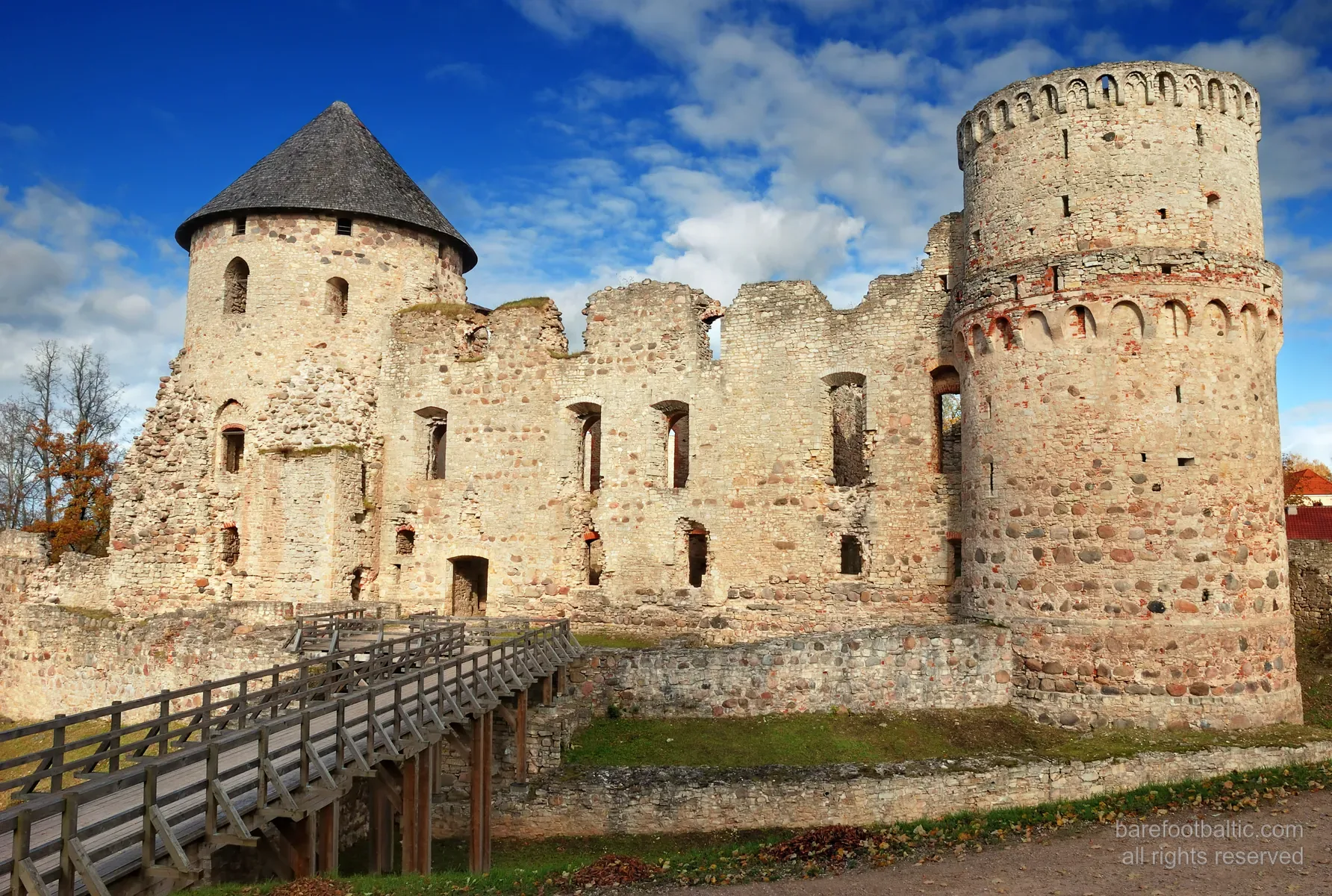
This is the Cēsis day I'd send you on if you can't get a guide. Direct train from Riga, four euros each way, two hours each way on a slow valley line that earns the trip on its own. The Old Town is small enough to walk in a morning and dense enough to fill it. The castle deserves three hours and a candle lantern. Lunch is a Latvian buffet on Raunas iela. Coffee, if you've kept any afternoon, is on a quiet table outside Bekko or, if you started early, at the coffee-only Melnais gulbis across from the church. You'll be back in Riga by half past eight, with rye bread in your bag and the lantern figure's keys still half in your mind.
What follows is the hour-by-hour I'd write down for a friend the night before. Seventeen blocks. Two coffee options. One honest answer about when the €94 guided day makes more sense than two train tickets and a slow morning.
How to use this guide
Read it in order, then ignore whichever bits don't fit your stamina. The block I'd never skip is the candle-lantern walk through the medieval castle — the post-castle stamina collapse is real and it’s why lunch sits at four o’clock here, not at noon. If you want the deep version of any one stop, see our nine-stop list of things to do in Cēsis. This post is the timed walk through them. Half-day version is at the bottom.
Travel: ~2 hours each way by direct train · Cost: €4 one-way, around €65 a head for the full day · Sites: 17 stops over ~10 hours door-to-door · Walking: 4–6 km on cobblestones · Best season: April–October for the trails, year-round for the castle
If you'd rather have someone else drive, narrate the medieval politics, handle the timing, and add Sigulda in for the same day, our Sigulda, Cēsis & the Gauja Valley day trip is the version with all of that built in. €94 per adult, year-round, small group up to twelve, picks up from your Riga hotel.
Two ways to do this day trip
By train (this post). The cheap, slow, self-led version. Two trains, two walks, three hours of castle, late lunch. Total cost per head: around €60–70 depending on where you eat. Total time: ~10 hours door to door. Suits travellers who like their own pace and don’t mind missing the language layer at the New Castle museum.
Guided. Our Sigulda, Cēsis & the Gauja Valley day trip is the version that adds Turaida Castle, the Soviet-era Sigulda cable car, and the medieval politics of who fought whom in this valley between the 13th century and 1991. €94 per adult, small group up to twelve. The single biggest difference: the language layer. The New Castle museum runs heavy Latvian-language signage; the medieval-trade-route context of Cēsis as a Hanseatic stop is the kind of thing a guide fills in on the drive in.
Before you go
Book nothing in advance for the train. Buy the ticket at the kiosk at Rīga Centrālā stacija on the day or use the Vivi app (the operator is now Vivi — the older Pasažieru vilciens branding is still on the platform). The Cēsis train is the Rīga–Valka line, and it doesn’t fill in summer. €4 a head one way, the same back.
Bring layers. The castle's chamber rooms are kept dark and cool year-round — the lantern walk is the whole interior experience and the stone holds its winter even in July. A light jacket inside, a warmer one outside between October and April.
Bring some cash — not much. Latvia is near-universal card, including the train, the castle, Pasēdnīca, and the cafes. The two places I'd carry a small cash float for: the artisan stalls inside the castle courtyard in summer, and the wood-fired bakery if you want to take a whole loaf home and the card terminal is having a morning.
If it's Sunday or Monday, swap your coffee. Melnais gulbis, the coffee-only spot across from the church, runs Tuesday through Saturday only. Bekko (the people-watching cafe on Rīgas iela) is the safer pick if your day falls outside that window.
The hour-by-hour
09:15 — Walk to Rīga Centrālā stacija
From most Old Town hotels, the central station is a ten-to-fifteen-minute walk south down Marijas iela. You want to be on the platform by 09:25 with a printed or app ticket. The kiosk inside the station opens early and the line moves. The app is faster if you have a Latvian SIM or working data roaming.
09:30 — Catch the Cēsis train
The Rīga–Valka line stops at Cēsis. Trains run every few hours; the first practical morning departure for a Cēsis day is around half past nine, after the April 2026 timetable shift. Around two hours each way, €4 the ticket. Sit on the right-hand side going north for the stretch between Sigulda and Līgatne — the line drops into the Gauja valley around the one-hour mark and the trees do honest work on the windows for ten minutes. It's the kind of view that sells the train to people who came expecting the bus.
11:00 — Arrive Cēsis station · walk into the Old Town
The Cēsis station is small and well-marked. Walk straight out, follow the signs for centrs, ten minutes east along Raunas iela. The Old Town spire is your landmark from about three minutes out. The walk passes the Pasēdnīca buffet on your right. Remember where it is, because that's lunch.
11:15 — The academy and the Chinese-style room
Start at Lielā Katrīnas iela 2 — the building is the Cēsis branch of the Riga Teacher Training and Educational Management Academy (Rīgas Pedagoģijas un izglītības vadības akadēmijas Cēsu filiāle), older than that mouthful suggests. The reason to come here is not the academy itself but the small Chinese-style room upstairs in the wing that used to be the building’s toilet. Look up from the courtyard side. The painted panels are a 19th-century quirk a Cēsis merchant put in, and the room rarely makes the brochures. Ten minutes, maximum — the room isn't always accessible, so half the time you're craning a neck and looking through a window. That's the right amount of effort for it.
11:30 — Hunt the sundial
Somewhere in the Old Town, mounted at the corner of a building's wall, is Cēsis's oldest sundial. I won't tell you which corner. If you walk the medieval grid attentively in the next fifteen minutes — eyes up, look at corners, especially anywhere a stone wall meets a stone wall above head height — you'll find it. If you don't, you're not the first. Ask in Bekko later. The staff there will tell you.
11:40 — The Holocaust memorial shoes
Outside the town hall, set into the cobblestones at knee height, are small bronze shoes. They mark where Cēsis's Jewish families were gathered in 1941 before deportation. There is no English signage. There rarely needs to be. Stand there for a minute. The flower someone left this morning will be fresh.
11:55 — St. John's Lutheran Church (Sv. Jāņa baznīca)
The 13th-century brick Gothic church is the centre of the medieval town and the centre of its religious history. Go inside — entry is free, the door is usually open between services. The interior is plainer than the spire suggests, whitewashed walls, a 17th-century carved-wood altar, medieval foundations under glass panels in the floor by the chancel. The thing to look for is the Polish-era influence in the side chapels — Cēsis was in the Polish-Lithuanian Commonwealth from 1561 to 1620 and the building carries that period in its detailing and in the gravestones along the south wall. Twenty minutes is enough unless a service catches you.
12:25 — Old Man Time (Gadsimtiem ejot)
On Torņa iela 3, beside the church, stands a bronze figure with a cudgel in one hand and a lantern in the other. Tourists call him the Old Man of Time. His proper name is the sculpture, Gadsimtiem ejot (Through the Centuries), made by Matiass Jansons and unveiled in July 2005 as the town's gift to itself on Cēsis's 800th anniversary. The legend behind him is a watchman's: an old man who walked the streets of medieval Cēsis after curfew with his cudgel and a brightly polished lantern, and as long as he walked, the town slept safely. One night he didn’t come back. The story now is that if you meet a man with a cudgel and a lantern, you should polish his lantern's glass, and its light will show the way for your good thoughts, your dreams, and your honest intentions.
Two details people miss. The bunch of keys at his hip carries the sculptor's initials, M.J. — Matiass Jansons, third generation of the Jansons family of Latvian sculptors and grandson of Kārlis Jansons. And the watchman's face is Matiass's own. He spent eleven months on the clay and plaster work, then sent the figure to Tallinn for the bronze pour. He'd have been thirty-something when it went up. The man you're looking at, in a sense, is a Latvian sculptor at the age he wanted to be remembered at, dressed as a 14th-century watchman, holding a lantern with somebody's polished hopes in it.
12:40 — Burning Conscience occupation museum
Pils iela 12. A small private museum, two rooms, about the Soviet occupation of Latvia and specifically about Cēsis's experience of it — deportations, the local resistance, the 1941 mass arrests, the lingering. Entry is by donation. Allow thirty minutes. It is not the National Museum of the Occupation of Latvia in Riga, and it isn't trying to be. The point is the local scale — one town, one set of names. If you've already done the Riga occupation museum, this is the small-town follow-up that grounds the bigger story.
13:15 — Cēsis Castle complex (the medieval ruin)
The ticket is €8, the lantern is included, the chamber rooms are deliberately kept unlit. Pick up your candle lantern at the ticket desk and walk through carrying it. That's the interior experience — no spotlights, no glowing labels, your own flame on the stone. The Livonian Order built this in 1214, the Knights expanded it for three centuries, the Tsar’s army blew most of it apart in 1577. The lower chamber on the west side — the one with the well in the floor — is where the castle's last residents shut themselves in when Ivan the Terrible's troops broke through the outer walls. The story goes that they took their own lives rather than be taken; the cellar still feels colder than the rest of the keep.
The adjacent towers carry a multimedia installation that explains the castle's eight-century timeline in five minutes per screen. Worth doing if it's your first medieval ruin in Latvia. In summer (roughly Easter through September), the castle courtyard runs an artisan-stall programme — a working bowyer with bow-and-arrow demos for children, a smith on Saturdays, one or two textile-craft tables. None of it is staged. The bowyer is the bowyer.
14:30 — New Castle (Cēsu Jaunā pils) and the tower climb
The 18th-century manor next door to the ruin is the Cēsis History Museum now. €4 entry, frequently bundled with the castle ticket; ask at the window. The reason to go in is the second floor — the medieval-trade-route exhibition that explains the German Baltic governance of this town and why the Latvian-language schools came so late. The reason to go up is the tower — the climb is short, the view across the medieval grid and the Castle Park is the best free orientation of the day. Forty-five minutes for the museum, fifteen for the tower.
15:30 — Castle Park and the Orthodox church
Walk through the Castle Park gates west of the New Castle. The park climbs gently along the old hillfort ridge — Riekstu hill at the top was the original Latgalian fortified settlement long before the Germans arrived, and the partly-preserved earthworks are still visible. Halfway up the path on the right is the Cēsis Orthodox Church of the Transfiguration. You won't usually go inside; the schedule is service-only. The thing to see is the exterior, blue dome on a small church on a green hillside, against the red brick of the New Castle in the foreground. The picture taken from the path below the dome is the one you'll come back to.
16:15 — Late lunch at Pasēdnīca
Raunas iela 15, two minutes from the central square. Latvian buffet-style — walk the counter, pick what looks good, weigh your plate, pay by weight. Around €6 for a plate, €10 with a drink. The proper pelēkie zirņi (grey peas with bacon and onion) on the line is the dish to try if you haven't had them in Vidzeme before; the Cēsis version is heavier than the Riga restaurant rendering, the way it should be. Kitchen runs into the evening, which is the reason this post puts lunch after the castle — the post-castle stamina collapse needs a sit-down and a full plate, not a sandwich at noon.
17:30 — Coffee at Bekko (or earlier at Melnais gulbis)
Two ways to do the afternoon coffee, depending on what day you came and how the morning ran.
Bekko, Rīgas iela 19, is the safer afternoon pick. Sit outside if the weather's any good. A coffee, a slice of pizza, half an hour of people-watching the Old Town's slow shift from afternoon to evening. Hours stretch later than the breakfast cafes. You'll get the table you want.
Melnais gulbis (Black Swan), Rīgas iela 20-14, is the coffee-only specialist directly across from the church — next to the building Studio Pizza occupies, the one that visibly leans like a small Cēsis answer to Pisa. The owner is one of two people I'd trust on a single-origin question in Latvia. Drawback: the place runs Tuesday through Friday 9 to 3 and Saturdays from 10, so it works as a mid-morning coffee before St. John's, or a Saturday-afternoon stretch, but not at 17:30 on a Friday. Plan around it.
18:15 — Walk back to Cēsis station
Same ten-minute walk in reverse, west along Raunas iela. The train back is on the same platform. The schedule is on the digital board inside the station.
18:30 — Train back to Riga
The evening Cēsis-to-Riga train runs around half past six on most days. It's the last sensible option for getting back to Riga in time for a proper dinner, and the one I'd take over the later trains that arrive close to half past ten. Two hours back, €4 the ticket. You'll be on the Rīga Centrālā stacija platform by about half past eight.
If you only have a half day
You can compress this trip to a six-hour-out, six-hour-back day if you cut hard. Drop Burning Conscience, drop the New Castle museum's second floor, give the medieval castle ninety minutes instead of two and a half hours, skip the Castle Park climb, and have a quicker lunch at Pasēdnīca on the way back to the station. You lose the Polish-history layer of St. John's, the Soviet-occupation grounding of Burning Conscience, and the long flame in the chamber rooms; you keep the castle as an event, the lantern walk, the central square, and lunch. It's the trip I'd do if Riga is on a layover.
If you want to add Sigulda
You can, in one day, but only if you're efficient. The honest read on combining both into a ten-hour day is in our breakdown of whether to attempt Sigulda and Cēsis in one day, and the short answer is: yes by car or by guided van, no by train. The train timing forces a choice between a deep Cēsis or a deep Sigulda — you can't run both in the gap between morning train and evening train.
If you want both in one day, the version with the driving and the medieval-politics narration is our Sigulda, Cēsis & the Gauja Valley day trip. €94 per adult, runs year-round, max twelve guests, picks up from your Riga hotel and drops you back. Cēsis sits at the long single block of the day. Turaida Castle and the Sigulda cable car fill the morning.
What this day costs
The DIY version, all in, comes out around €65 a head.
Train (return): €8. Castle ticket (with lantern): €8. New Castle: €4. Burning Conscience: by donation, allow a few euros. St. John's tower (if you climb): €2. Lunch at Pasēdnīca: €10 with a drink. Coffee at Bekko or Melnais gulbis: €4. Add a small contingency for an entry I haven't listed, and you land at €65.
The guided day trip is €94. The €29 difference buys you: the drive (no train timing constraints), the Sigulda half added on, the language layer at the New Castle museum filled in, the medieval-politics context filled in between sites, lunch coordinated with a kitchen that's open when you arrive, and a small group of twelve people maximum. Worth it if your time in Latvia is short or if you're travelling with someone who'd rather not navigate the train back at half past eight in the evening.
Frequently asked questions about a Cēsis day trip
What time should I leave Riga for Cēsis?
The first practical morning train under the April 2026 timetable leaves Rīga Centrālā stacija around half past nine. Earlier trains exist seasonally but aren't reliable for a day-trip-out plan — check Vivi (the operator's current brand — the older Pasažieru vilciens app still works for now) for your specific date. Leave your Old Town hotel by 09:15 to allow the walk to the station and the kiosk queue.
Can I do this trip without a car?
Yes — this whole post is the no-car version. Train each way, your feet in Cēsis. Everything except the side trips to Cīrulīši and Āraiši (both covered in our attraction guide, both technically reachable by foot or with a small detour) is walkable from the Cēsis Old Town. The car-required stops are only there if you want to extend a day-trip into a stay.
What time does the last train back to Riga run?
The evening direction has trains into the late hours, but the last sensible one for getting back to a Riga hotel at a reasonable time leaves Cēsis around half past six. There are later options — including one that arrives Riga close to half past ten — but they shorten dinner. The 18:30 train arrives Riga Centrālā stacija around half past eight, which lands you in time for a proper dinner at a Riga restaurant if you'd rather eat there than at the Pasēdnīca buffet.
Is the castle worth the entry fee?
Yes. Eight euros is the right price for two and a half hours of medieval ruin, a candle lantern you carry through unlit chambers, and the multimedia in the tower. I've never sent a guest who came back saying it wasn't worth it. If you've been to a heavily lit French or German castle and you're worried this is the same experience, it isn't — the chamber rooms here are the opposite call.
How much walking is in this itinerary?
About four to six kilometres on cobblestones over the day, in short bursts with sit-downs between. The longest single walk is the ten minutes from the station, twice. The castle interior adds another half a kilometre in the towers and chambers. None of it is steep except the climb up to the Orthodox church in the Castle Park, which is gentle.
Can I add Sigulda to a Cēsis day trip?
By train, no. The two stops are on the same Rīga–Valka line, but the train timetable doesn't give you enough hours to do both properly — you'd cut the castle to forty-five minutes and run all day. By car or by guided day trip, yes — see our combined-day breakdown and our Sigulda, Cēsis & Gauja Valley excursion.
Is the train comfortable for a two-hour ride?
The Vivi rolling stock on the Rīga–Valka line is post-2010 Skoda — comfortable seats, working air conditioning in summer, working heat in winter. Bring a book or trust the window. The Sigulda–Līgatne valley stretch around the one-hour mark earns the trip on its own; the rest is open fields and the occasional country station. If you're sensitive to motion sickness, the train tracks are smooth — nothing like a Latvian rural bus.
Do Cēsis restaurants accept card?
Yes, near-universally. Pasēdnīca, Bekko, Melnais gulbis, the castle ticket office, the bakery — all card. Bring a small cash float for the artisan stalls inside the castle courtyard in summer; some of the smaller vendors run cash-only.
What if it rains?
The castle interior is the right place to be in heavy rain — the chamber rooms don't change with the weather, and the lantern walk is arguably better when the rain is on the courtyard outside. The New Castle museum is fully indoor. Burning Conscience is two rooms indoor. Pasēdnīca's buffet is under cover. St. John's church is open. The only stops that suffer in rain are the Holocaust memorial shoes (still worth a pause) and the Castle Park walk (cancel without regret — the Orthodox-dome shot doesn't work in grey weather).
One last thing
The Cēsis day I think of most was a March Wednesday with a guest who'd come from Toronto specifically because her great-grandmother had been born in a Vidzeme village we couldn't find on the map any more. We did the castle in the morning, the church in the afternoon, lunch at Pasēdnīca in between. She stood for a long time at the Holocaust memorial shoes — long enough that I stepped back and let her have the square. When we left, she'd polished the glass on the Old Man's lantern with her sleeve and stood there for a minute longer. We made the half-past-six train. She sent me a postcard from Toronto in November.
The list above is the version I'd write for a friend the night before. Don't pace it against my times. Pace it against your light. Watch the corners for the sundial.
When you're ready to book the version with the driving, the medieval politics, Sigulda added in for the same day, and lunch coordinated with the kitchen, our Sigulda, Cēsis & the Gauja Valley day trip is €94 per adult, year-round, max twelve guests, picks up from your Riga hotel.