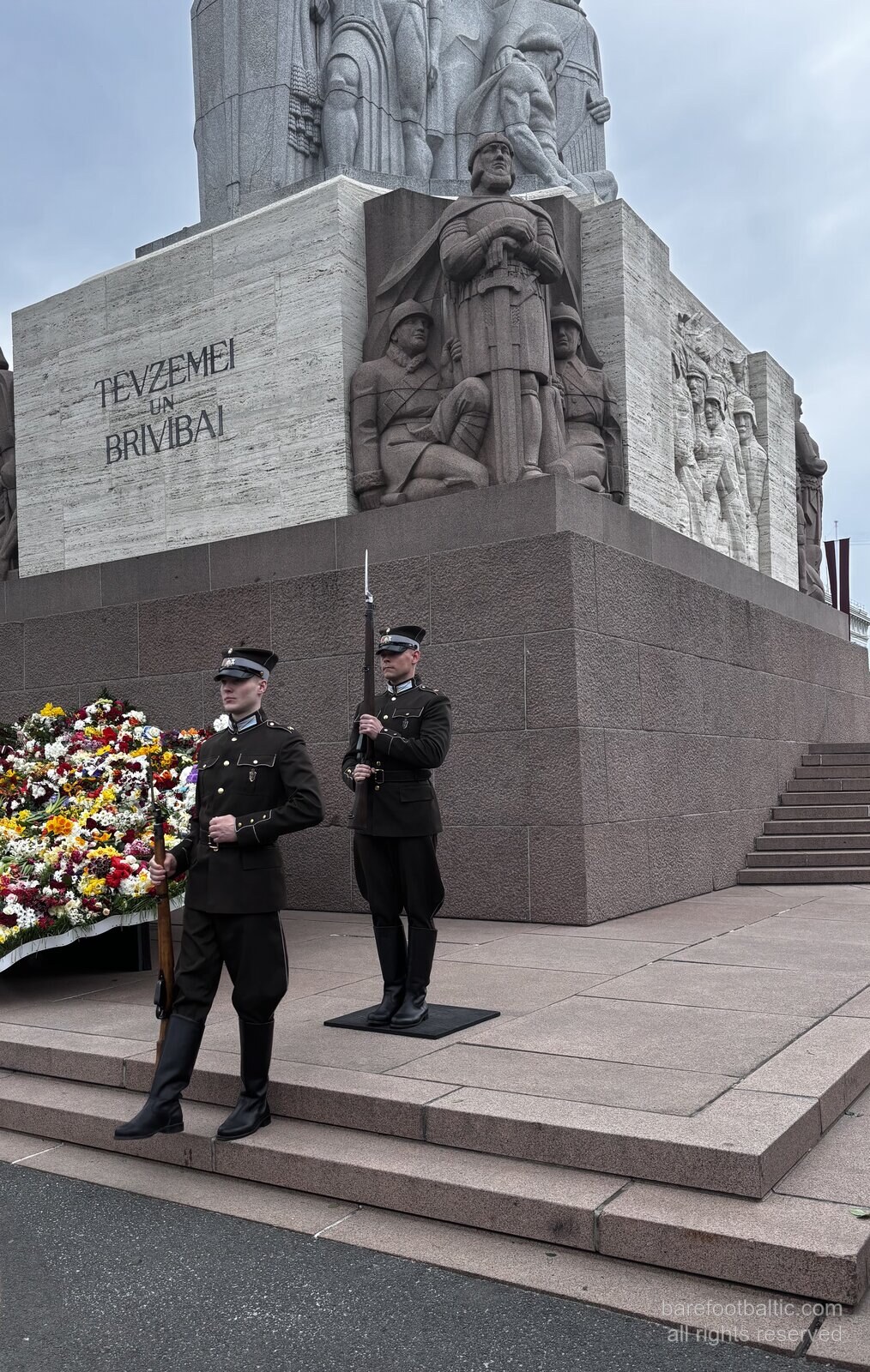
There were two honour guards in dress uniform standing at the foot of the Freedom Monument when I got there this afternoon, and a wall of flowers about waist-high running the length of the plinth. Yellow tulips, white tulips, daffodils by the thousand, single roses tied with a length of maroon-and-white ribbon, the small bouquets that elderly women buy from the lady at the corner of Krišjāņa Barona iela and bring across the road on foot. No music, no speech I could hear. People walked up in twos and threes, laid a stem on the heap, stood for a few seconds, and walked away. This is what the 4th of May looks like in Riga, and it is the kind of thing a country does when its independence has been a near miss twice in living memory and it is still slightly surprised to have it.
Short answer, before the long version
- 4 May is Latvia’s Restoration of Independence Day. In Latvian, Latvijas Republikas Neatkarības atjaunošanas diena. It marks the day in 1990 that the Supreme Council of the Latvian SSR voted, by a majority of its own deputies, to restore Latvian statehood and detach the country from the Soviet Union.
- It is the second of two Latvian independence days. The first one is 18 November, which marks the original 1918 proclamation. The 4 May vote did not invent independence. It brought it back. Hence atjaunošana, restoration.
- If you are in Riga today, public transport is free across the city. There is a folk-costume procession down Brīvības iela in the early afternoon, the Freedom Monument is the gathering point, and most Latvian families are eating outside on a white tablecloth. The mood is calm, not loud.
- The flowers are the thing. Since 2014 it has been a quiet civic habit to bring a yellow flower, a daffodil if you can find one, to the foot of the Freedom Monument on the morning of 4 May. By late afternoon there are thousands of them.
- It is not a big tourist day, in the sense that almost nothing is closed and there is no parade route blocking your sightseeing. But it is the day to walk through the centre slowly. You will see things you cannot see on any other day of the year.
Why Latvia has two independence days
The short version is that we lost it once and got it back, and both moments deserved their own date. The long version is more interesting.
The 18 November we celebrate in autumn is the day in 1918 that a hastily assembled People’s Council read out a proclamation in the National Theatre on Kronvalda bulvāris and declared the Republic of Latvia into being. The Russian Empire had collapsed in 1917, the German Empire was a fortnight from collapse itself, and a small group of Latvian politicians took the opening between the two and announced a country. They had no army, no border, no currency, and no recognition from anyone. They had a flag and a name. The independence wars that followed lasted until 1920 and decided whether the proclamation would mean anything. In the end it did, and the First Republic ran from 1920 until June 1940, when Soviet troops crossed the border.
What followed is the part of our history that is hard to write briefly. There were two occupations, Soviet then German then Soviet again. The deportations of June 1941 and March 1949, the war years, the post-war forest brothers, the Russification of the towns. By the late 1980s, Latvia had been part of the Soviet Union for nearly half a century and the official line was that the 1940 incorporation had been voluntary and final. In Latvian living rooms it had never been final.
The window that opened in 1989 and 1990 is the one a foreign visitor tends to find hardest to picture, because it had no equivalent in the West. Gorbachev’s reforms cracked the door. The Baltic Way of August 1989 pushed it further open, two million people holding hands in a chain from Tallinn through Riga to Vilnius. The Latvian Supreme Council elections of March 1990 returned a majority for the Popular Front. On 4 May 1990, in the Supreme Council chamber on Jēkaba iela, those deputies voted 138 to 0 (with one abstention and 57 deputies refusing to take part) to declare the 1940 Soviet annexation illegal and to begin restoring the independent Republic. The building’s windows were open and the speakers carried each vote out into the street. Every ‘yes’ was met with a cheer from the crowd waiting on Jēkaba iela.
It was not full independence yet. That came on 21 August 1991, after the failed Moscow coup. But it was the moment the country pivoted, on paper, from East back to West. The 4 May date is when the door opened. Keeping it open took the August coup eighteen months later. Both matter, but only one of them comes with daffodils.
The procession down Brīvības iela
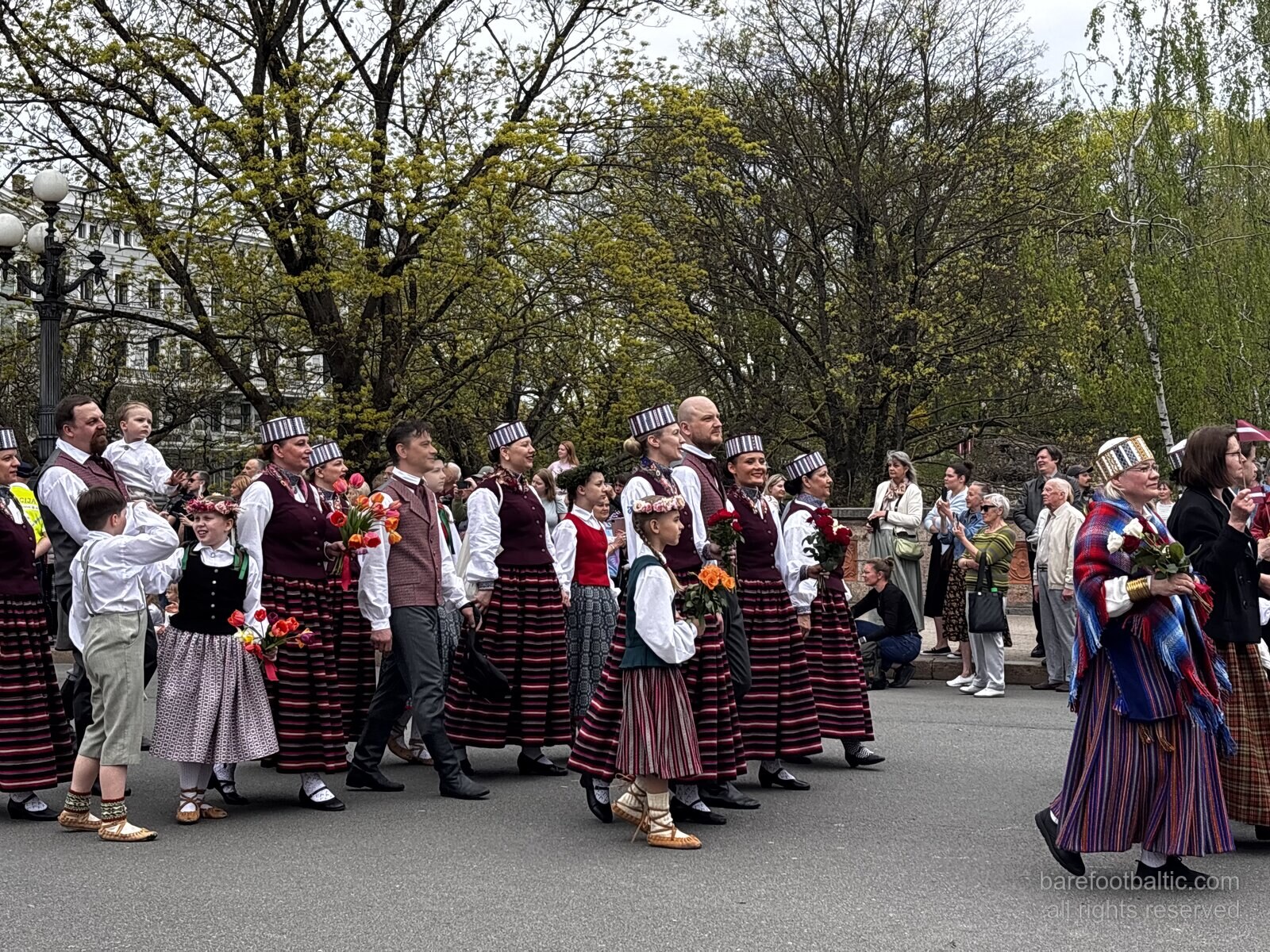
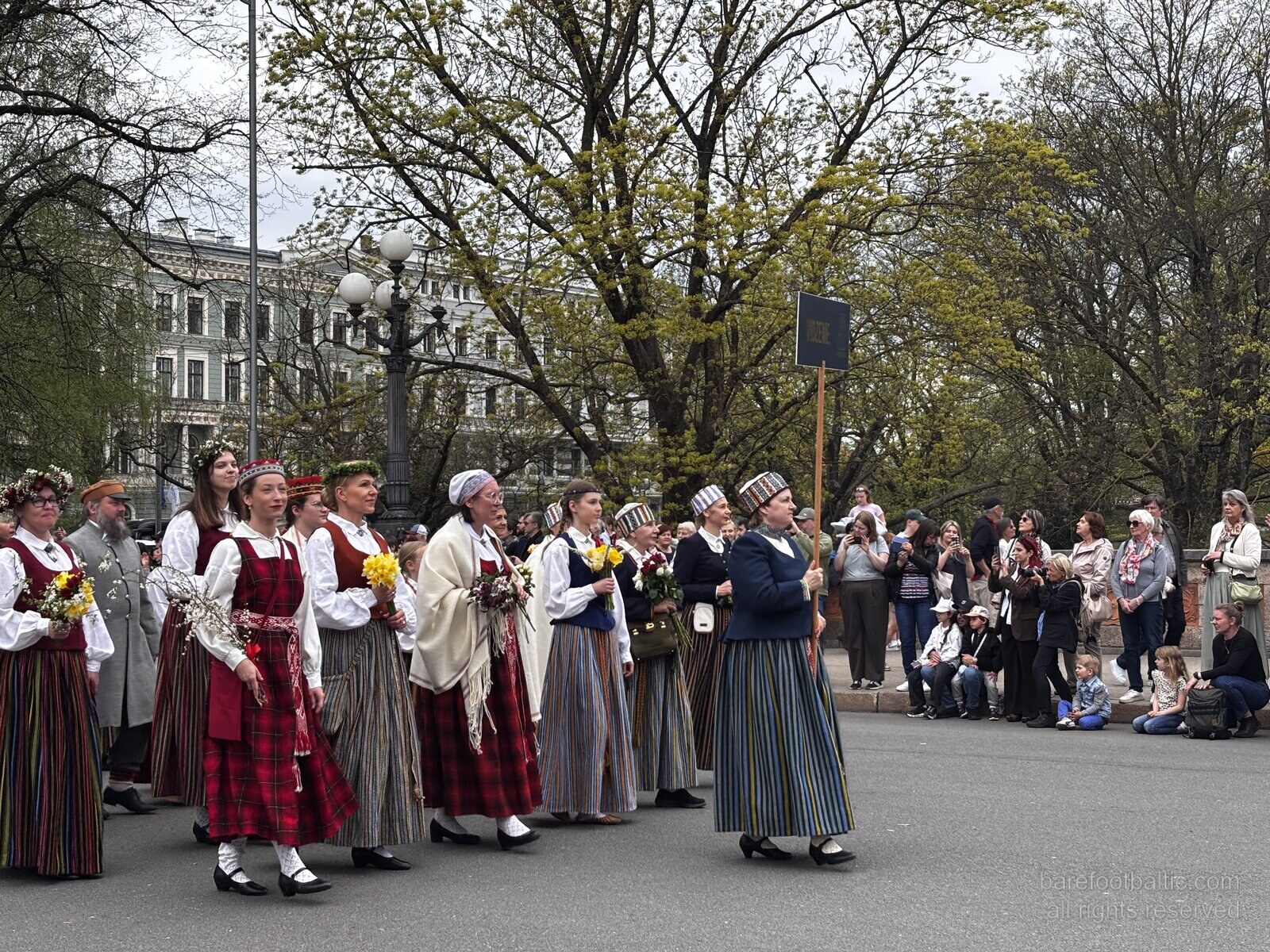
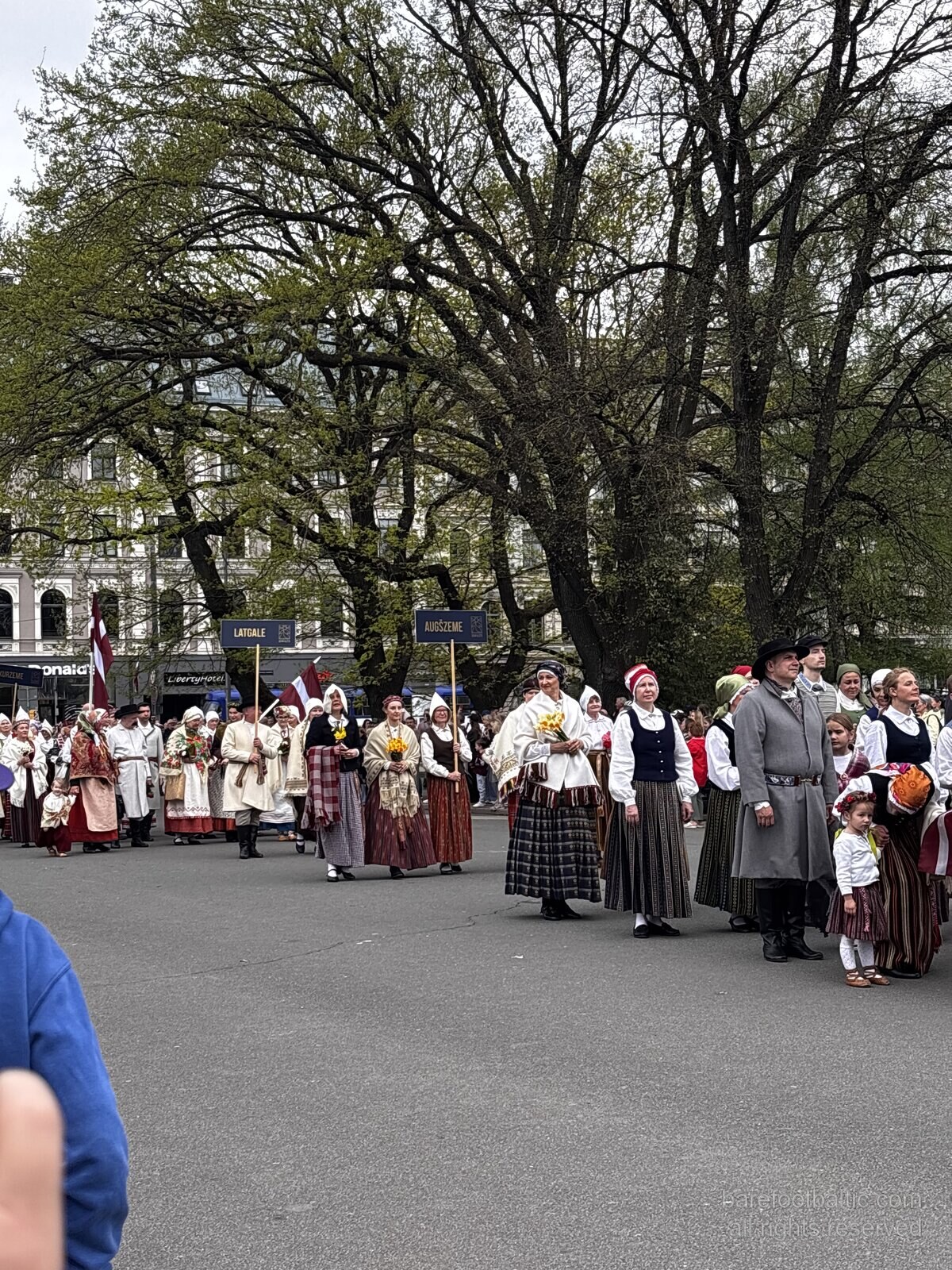
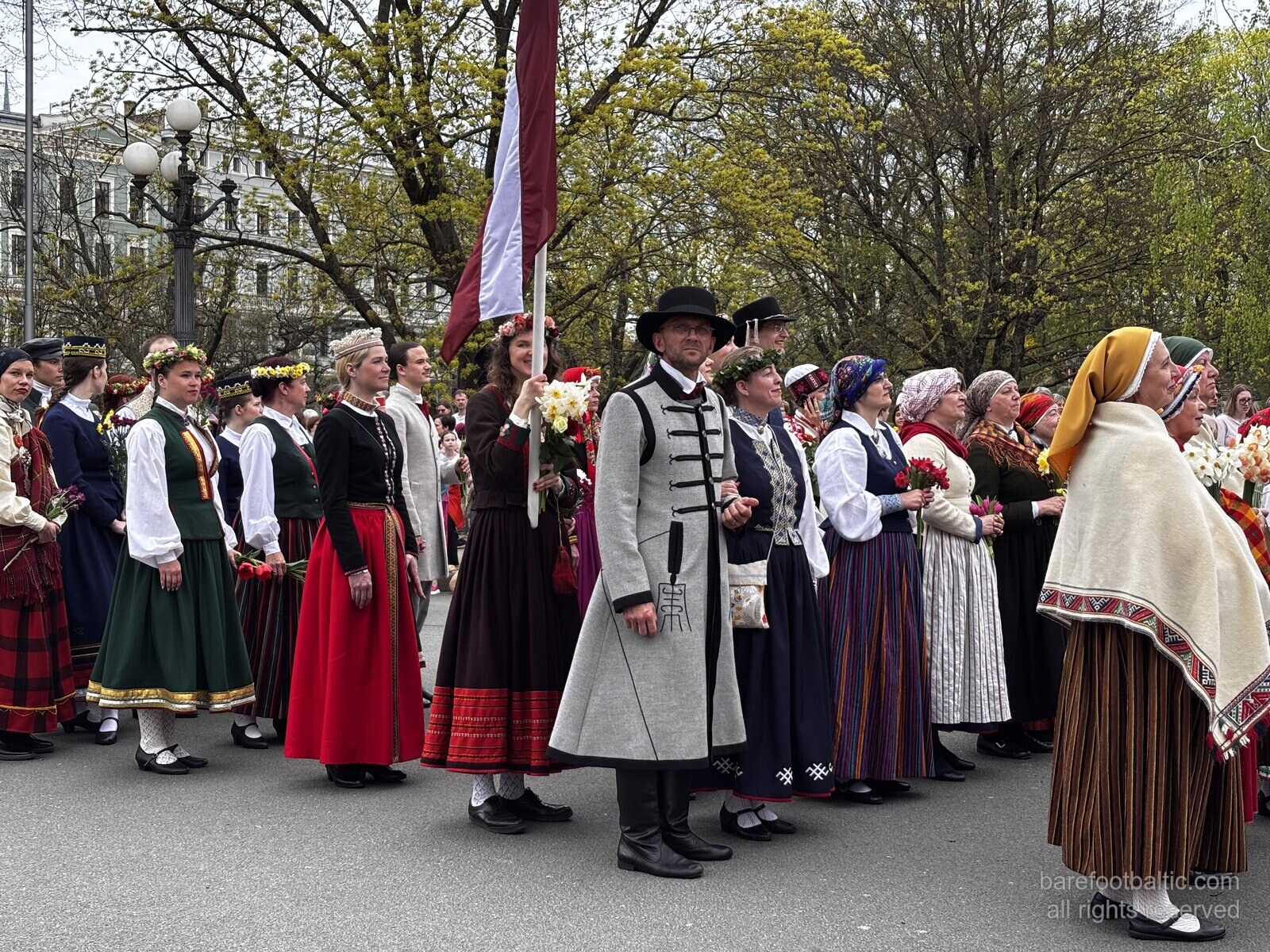
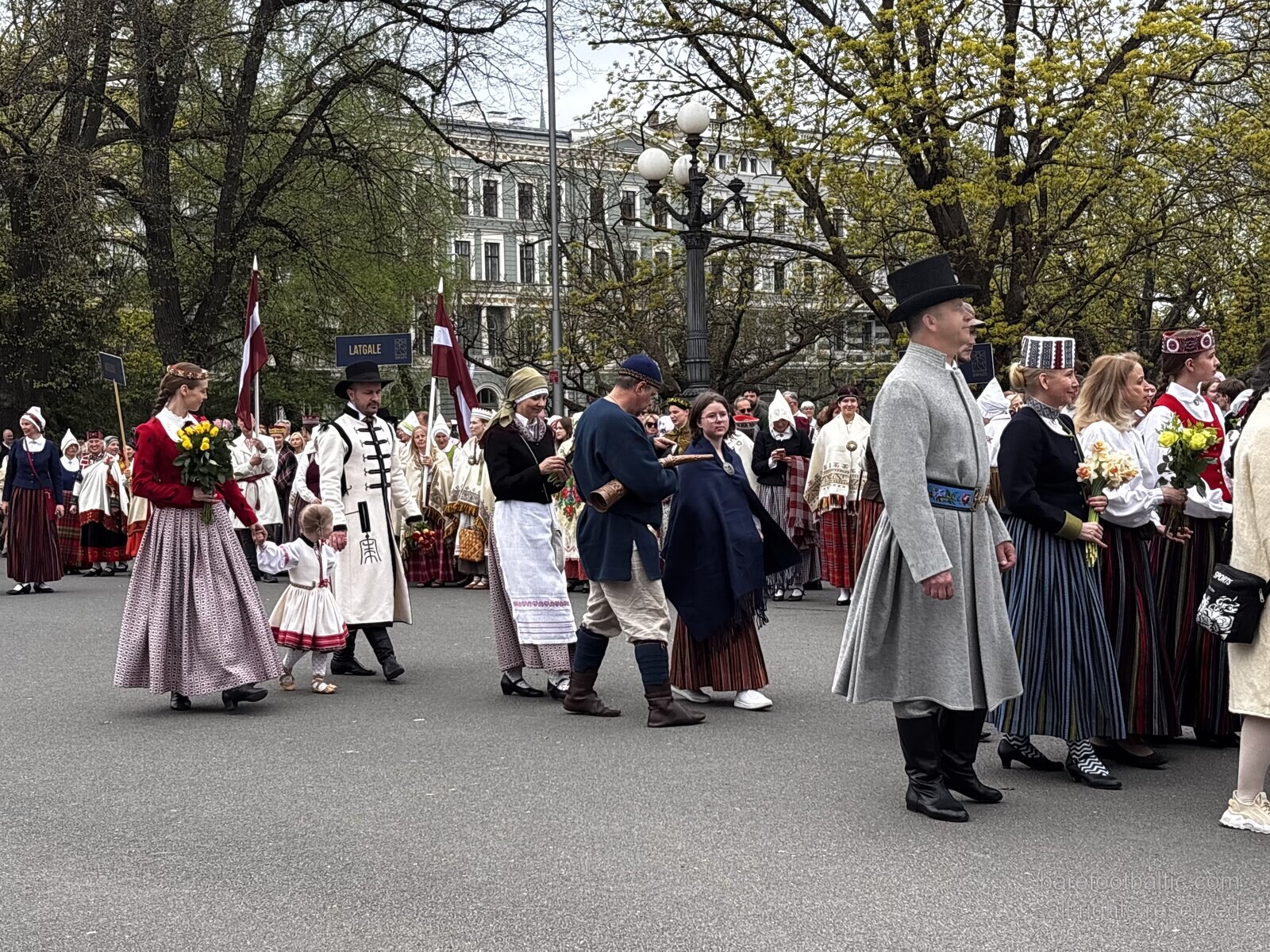
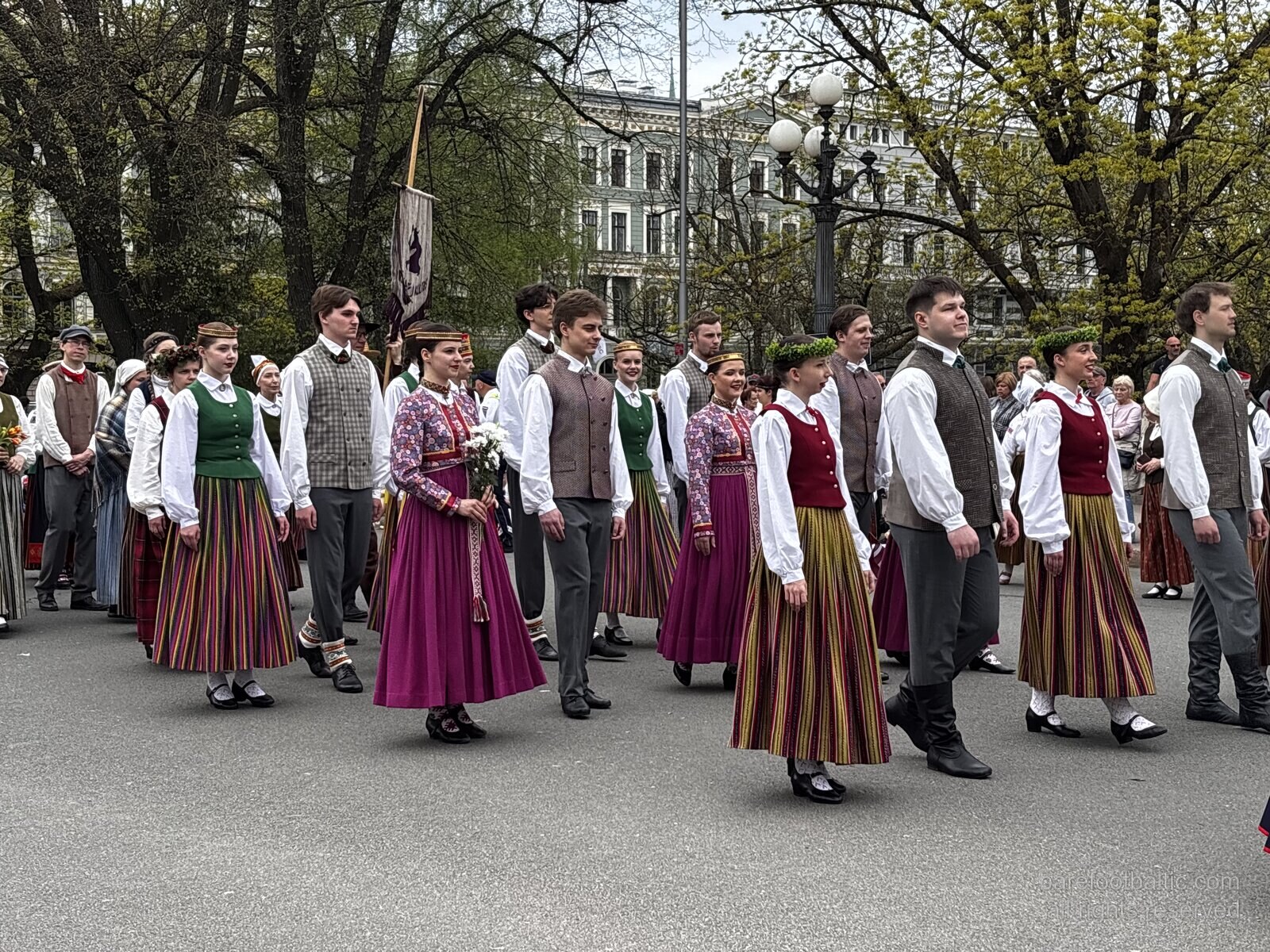
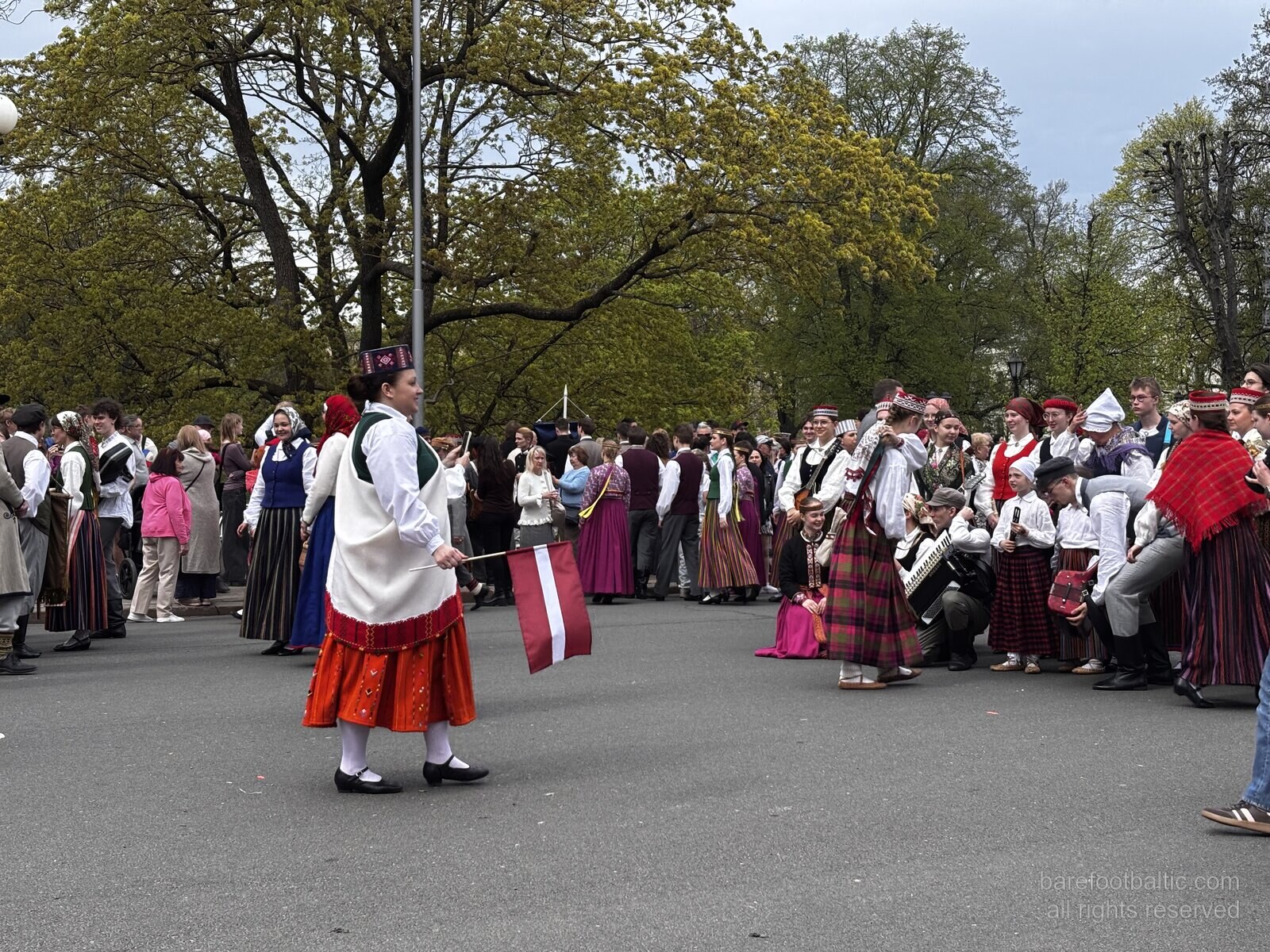
The first thing a visitor in town for the day will notice is the costumes. They start appearing on the trams in late morning, then thicken on the pavements around the Esplanāde and Vērmane Garden, and by 2pm they are walking in formation down the wide central section of Brīvības iela. Folk dance ensembles, choir collectives, regional cultural societies, university folklore groups, the academic tautas tērpu (folk-costume) clubs. Everyone in their own region’s pattern. The Lielvārde belts, the Nīca striped skirts, the Latgale fur-trimmed shawls, the Kurzeme silver brooches the size of your palm.
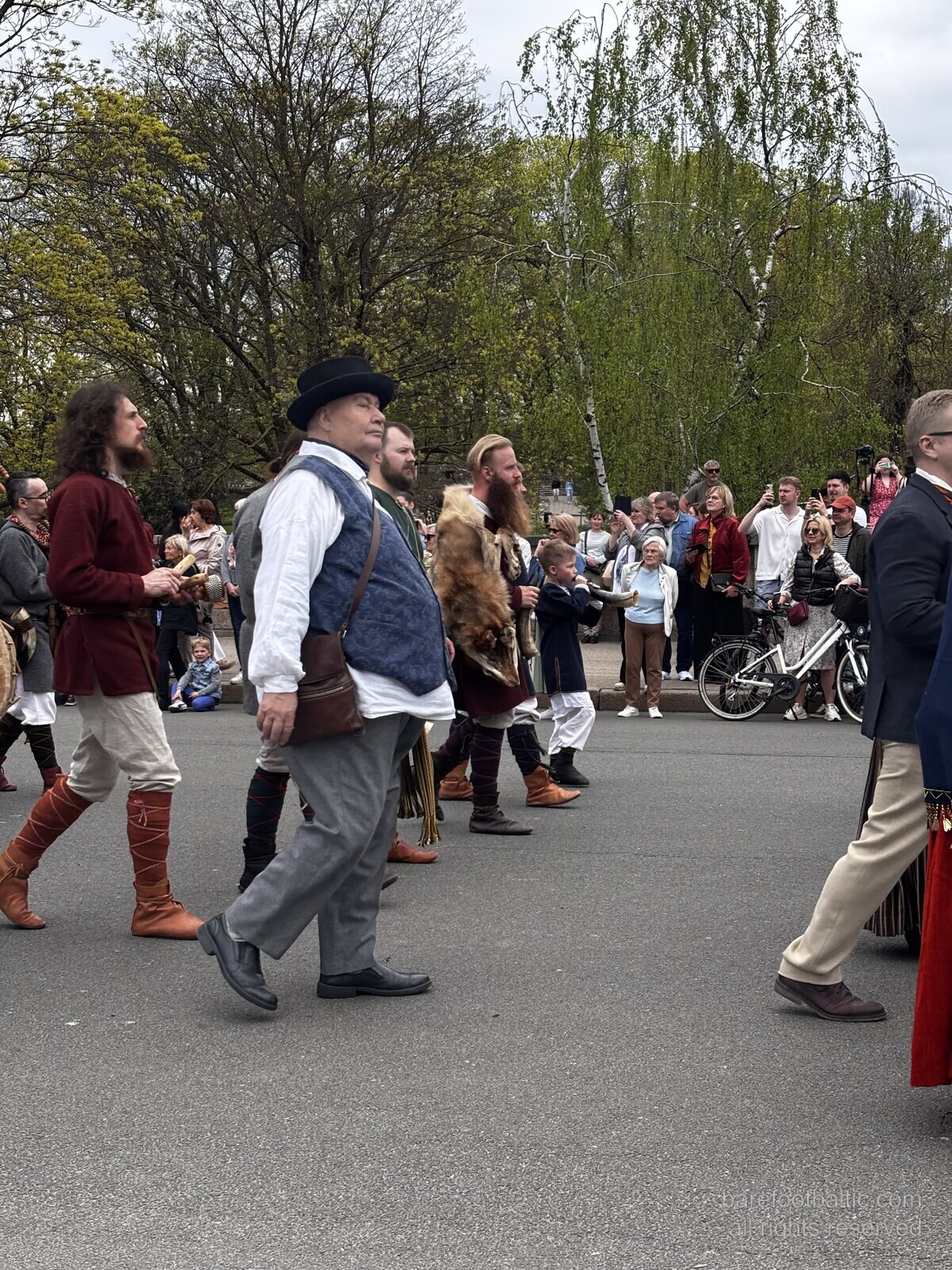
The route is not a parade in the German or French sense. There is no marching band, no military fly-past, nothing on tracks. It is closer in spirit to a Sunday-morning village procession than to a national-day spectacle. Groups assemble loosely at the upper end of the avenue, walk slowly in regional contingents toward the monument, regroup at the base, and wait for whoever they came with. Children weave between the adults carrying daffodils almost as big as their faces. The pace is human. Spectators clap when something is worth clapping for and otherwise watch quietly.
Among the regional folk groups walk a smaller number of historical reenactors. Men in 17th-century farmer dress, fur pouches, felt hats, the kind of working clothes a Latvian peasant in Vidzeme might have worn under Swedish administration. They are not strictly required by the day. They are there because the day is partly about walking the line of Latvian time, and the time stretches further back than 1990 or 1918.
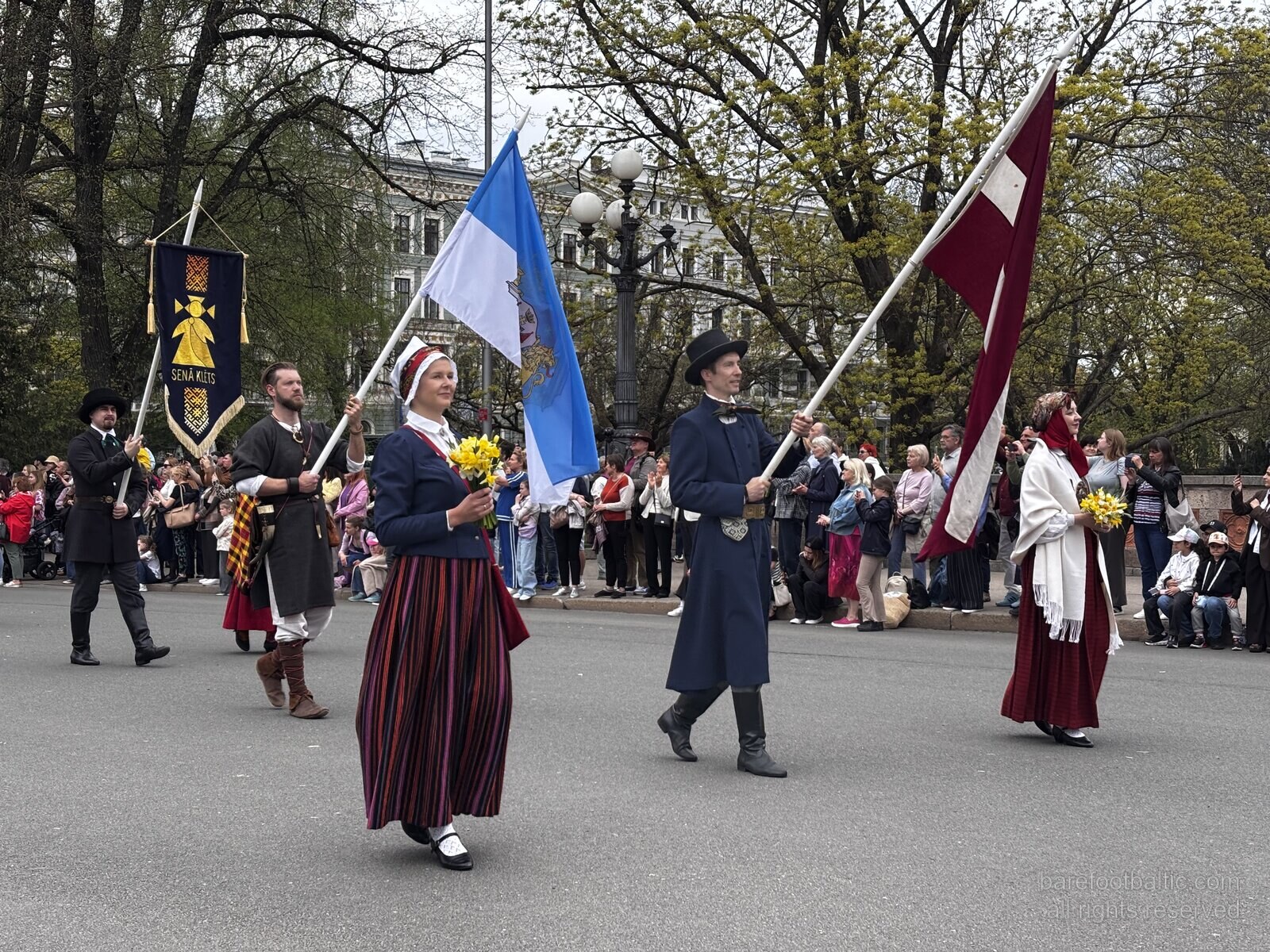
The regional contingents come in waves. Each region has its own banner, often hand-painted, and walks together. Latgale, the south-eastern Catholic-and-Orthodox region with the strongest distinct dialect, has the biggest costume contrast. The long fur-trimmed shawls, the dense beadwork, the men’s long grey coats. Vidzeme’s austere brown-and-blue palette belongs to the central north. Kurzeme’s westerners arrive in silver brooches and wide skirts. Zemgale, the south, in the deep reds. There are no rules. This is just how the costume tradition organised itself across the regions over the 19th century, and the costume people enjoy keeping the regional accuracy intact.
The flowers, and why daffodils
The flower part of the day is the youngest tradition on the list. It started in 2014, the 24th anniversary of the 1990 vote, when a small social-media campaign asked Latvians to bring a yellow flower to the Freedom Monument that day, specifically a narcise, a daffodil. The reasoning was practical and a little sentimental. Yellow because it is the colour of spring in Latvia after a long winter, and daffodils because they are what is reliably out in the gardens by the first week of May. The idea took. Within three years it was the dominant flower at the monument, and by the late 2010s the lady florists in central Riga had started selling pre-tied bunches of three or five daffodils with a maroon-and-white ribbon for the occasion.
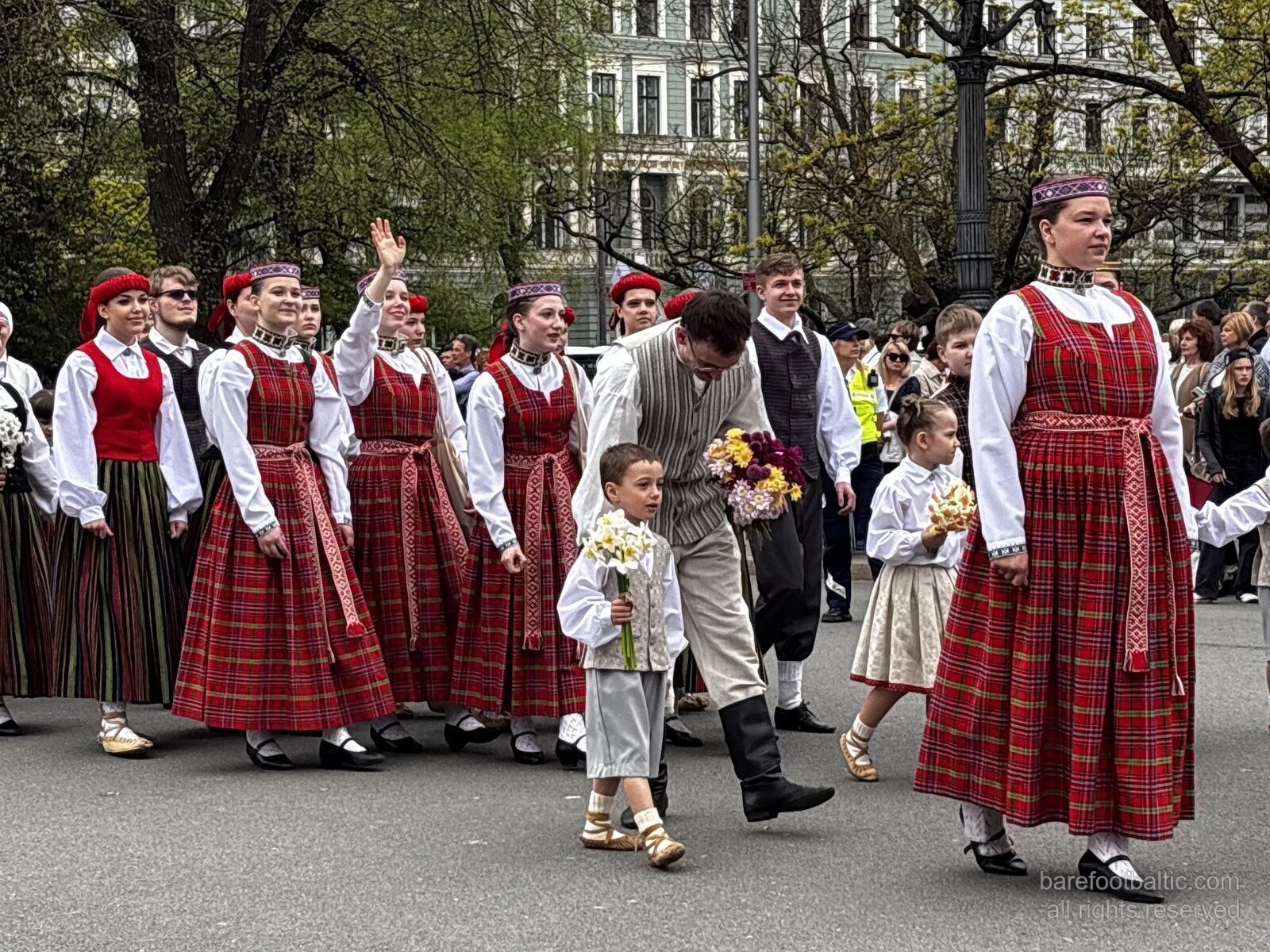
Today there are also tulips, hyacinths, and the small bouquets of any bright spring flower the florist had in stock. There are roses, especially among the older generation. The yellow daffodil is still the symbolic stem, and if I had to choose only one I would choose that. But the rule is loose. The point is that you bring something living to the monument, and you do it on foot.
At the monument itself
The Freedom Monument, Brīvības piemineklis, sits at the centre of the avenue named for it, between Old Town and the Esplanāde. It is 42 metres tall, finished in 1935, and the figure on top is a young woman holding three gold stars representing the three historical regions of inter-war Latvia. Latvians call her Milda. She is, as much as any single object can be, the country’s family doorway.
The plinth carries an inscription on the western face. Tēvzemei un Brīvībai. For Fatherland and Freedom. In Soviet times the monument was officially nothing. It was tolerated rather than celebrated, and laying flowers here during the Soviet regime could and did get people in serious trouble. The fact that the country can now stack thousands of flowers at its base, in the open, with no one watching to see who brought them, is the whole point.
Two soldiers in dress uniform stand the change-of-guard at the foot of the monument every hour on the hour, on every day of the year. On 4 May the change-of-guard is more crowded than usual, but the crowd is not really there for the ceremony. It is the slow, patient queue of people waiting their turn to lay a flower at the plinth, with photographers gathered respectfully off to the side. The relief unit is brought in discreetly by car to the back of the monument. The new pair takes the position, the old pair marches off. Nobody salutes the spectators and the spectators do not need them to.
The white tablecloth, indoors
The other tradition that runs alongside the procession is quieter and you will not see it on the avenue. It is called Baltā galdauta svētki, the White Tablecloth Festival. The instruction, broadcast each year by Latvian state radio and a long list of cultural institutions, is the same every year. On 4 May, eat your evening meal on a white tablecloth. Wherever you are, at home or a community hall or a school courtyard or a park, the cloth is white and the meal is shared. The conversation slows down.
The cloth is the symbol because, in the older Latvian household, the white tablecloth was reserved for the occasions when the family had something to celebrate together. It was put away the rest of the year. The civic version asks every Latvian to bring it out on the day the country brought itself back. The food does not have to be elaborate. Bread, cheese, smoked fish, roasted potatoes. Many families try to put one or two dishes on the table in red and white to echo the flag, a beetroot salad or a pink berry-and-whipped-cream dessert. The cloth has to be white.
This part of the day is largely invisible to a visitor unless you happen to be invited into a Latvian house, and most aren’t on first acquaintance. But when you walk past Vērmane Garden in the evening and see the trestle tables covered in white linen with families eating on them in folk dress, this is what is happening.
The free trams (and the rest of the practicalities)
If you are a visitor in Riga today and you want to do this properly, the practical notes are short.
- All Riga public transport is free on 4 May. Trams, trolleybuses, buses, and the city minibuses. You do not need to validate, and the e-talons are not required. This started as a gesture in 2010 and has become standard practice. It applies city-wide and runs from first service to last.
- The procession runs from roughly midday to about 4pm, with the heaviest density on the central section of Brīvības iela between the Esplanāde and the Freedom Monument. Stand on the pavement and do not step into the lane. There is no fixed start. The contingents arrive in their own order.
- The change-of-guard at the monument happens every hour on the hour from 9am to 6pm year-round. On 4 May the noon, 3pm, and 4pm changes have the biggest crowds. The 5pm change is usually quieter and a better time to be close.
- Most museums are open as normal, and several have free admission for the day. The Museum of the Occupation, the Latvian National Museum of Art, the Riga History and Navigation Museum. Check the door.
- The flower-laying continues all day, but the most photographically rich window is roughly 1pm to 3pm, when the contingents are still arriving. Late afternoon is quieter and (in my opinion) the better time to stand at the monument if you want to feel the day rather than capture it.
- Bring a flower if you want to. Visitors are welcome to. The lady at the corner of Brīvības and Krišjāņa Barona has small daffodil bunches with the maroon-and-white ribbon for €3.
My take
The 4th of May is not the loudest day in the Latvian calendar. November 18 is louder, and the Song and Dance Festival every five years is louder by orders of magnitude. May 4 is the day the country thanks itself for noticing the door was open in 1990 and walking through it. The mood is grateful rather than triumphant. The flowers are spring flowers because the country is, on some level, still a young country and is celebrating a recent thing.
If you are travelling to Riga and the calendar happens to put you here on 4 May, walk Brīvības iela in the early afternoon and stand at the monument by 4pm. Take the free tram back to your hotel. If you can find a Latvian friend with a tablecloth in the evening, accept the invitation. Otherwise, eat outside somewhere with a white napkin and watch the city ease down. The day asks nothing more than your attention, and it gives back the rare experience of watching a country on its quiet anniversary, doing the small civic things that keep an independence in working order.
Daiga