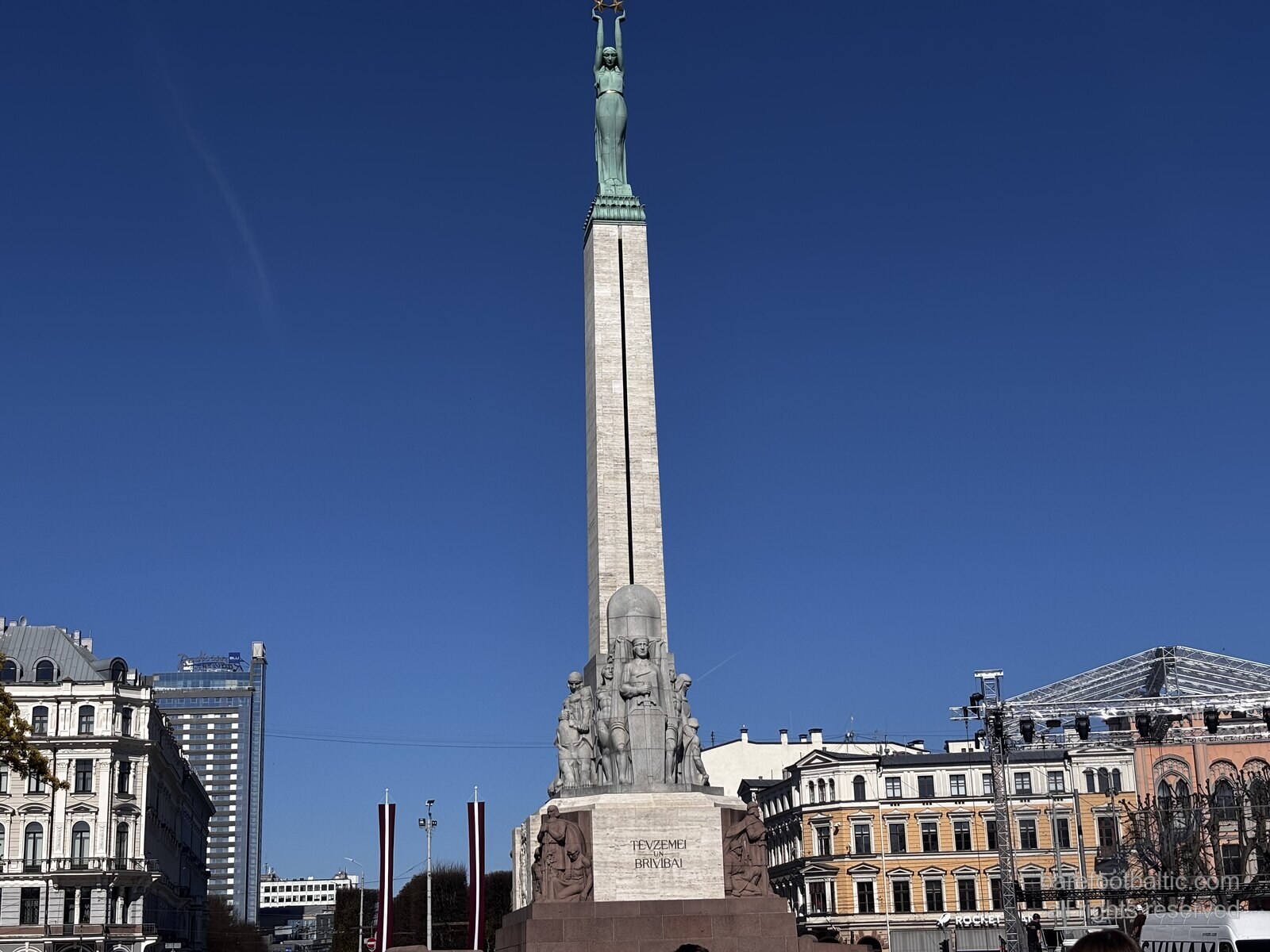
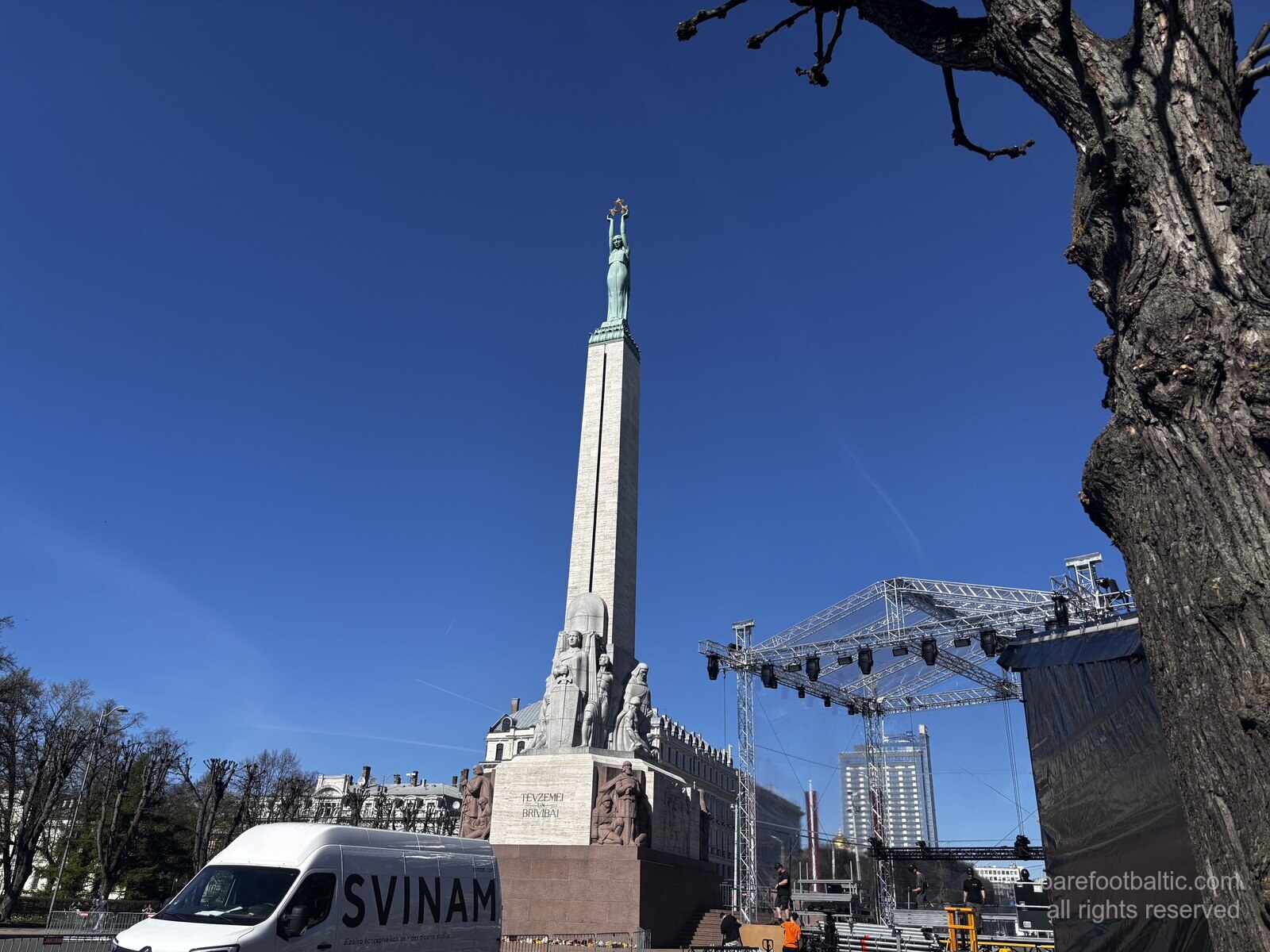
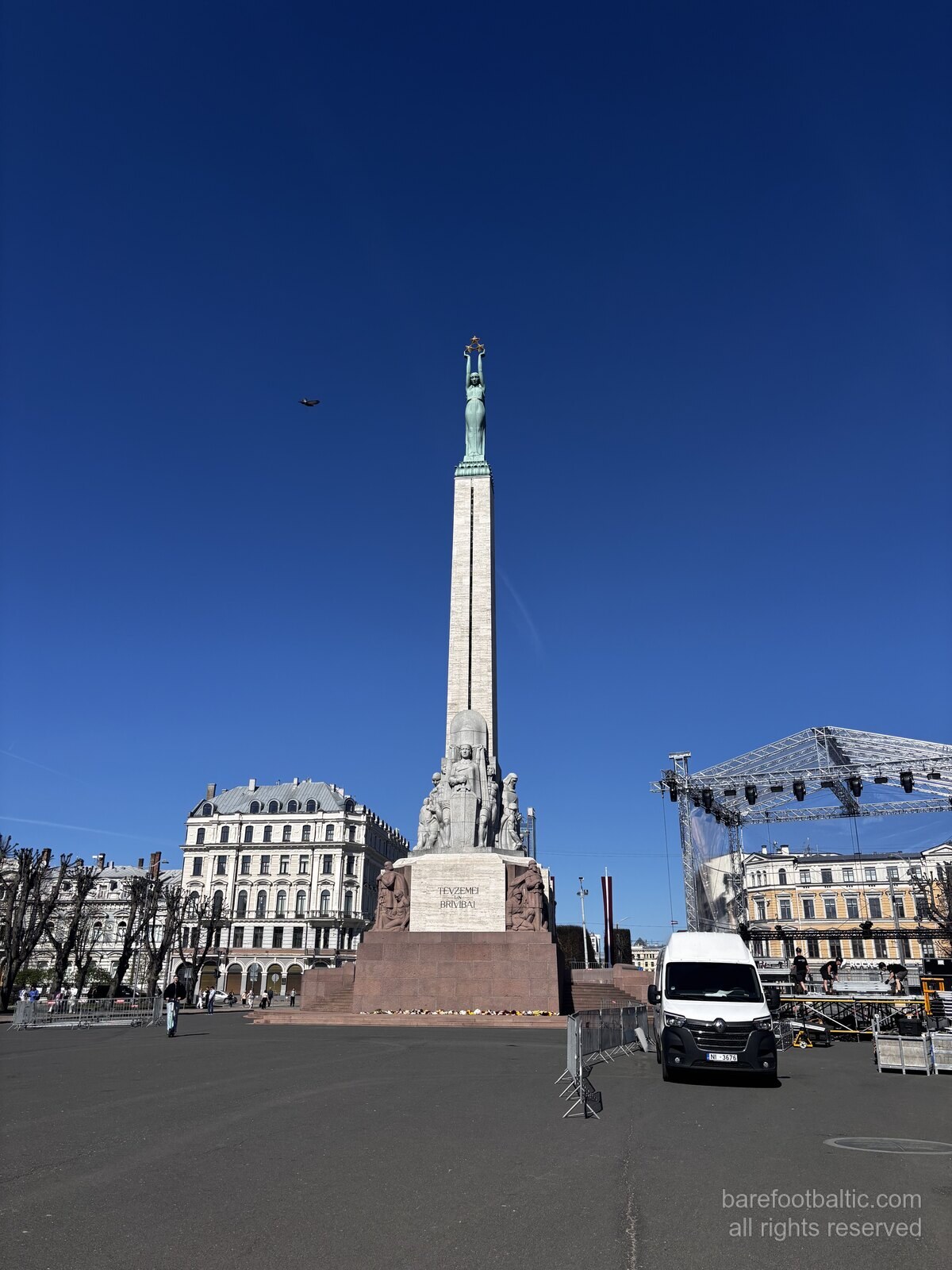
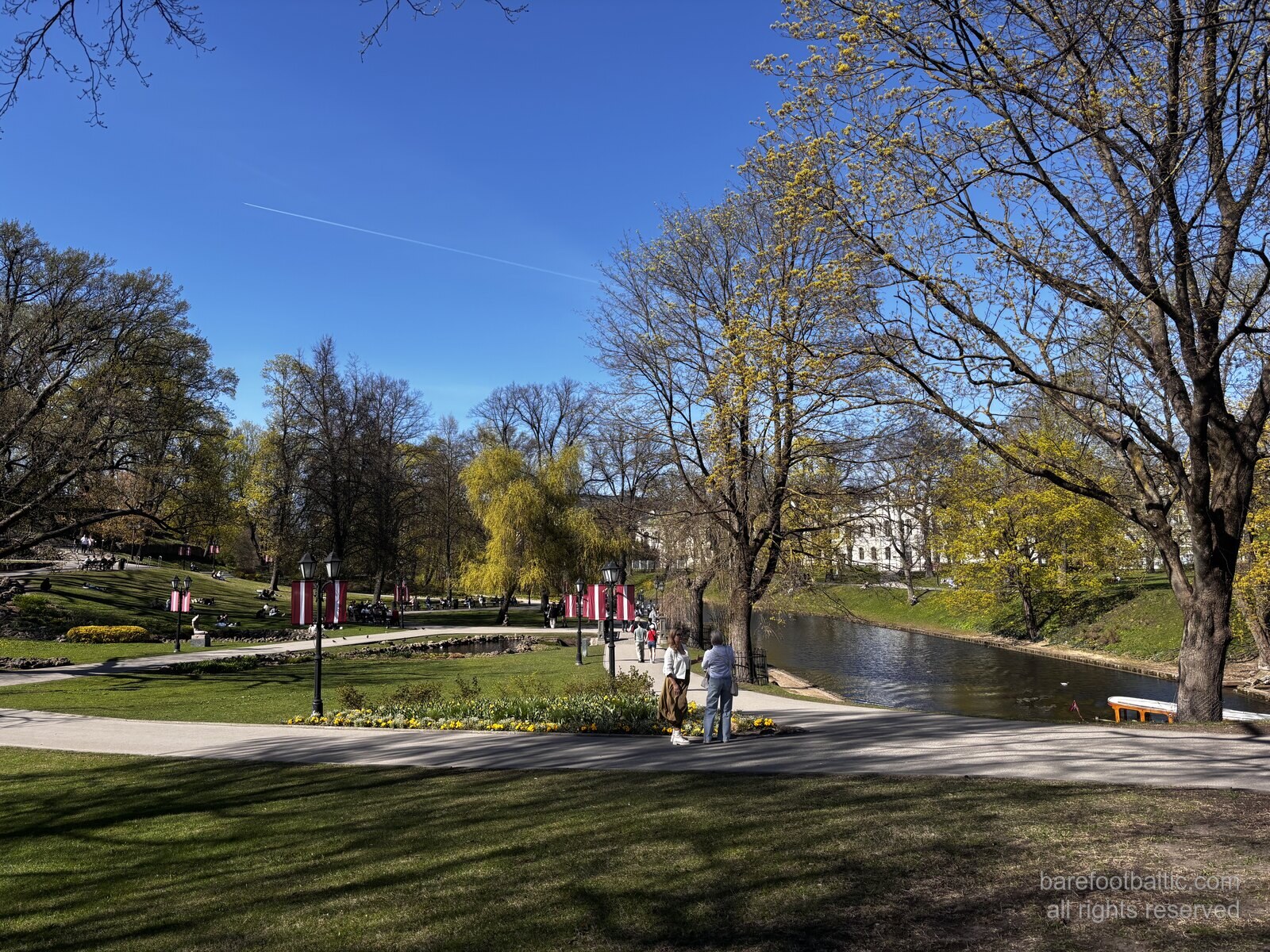
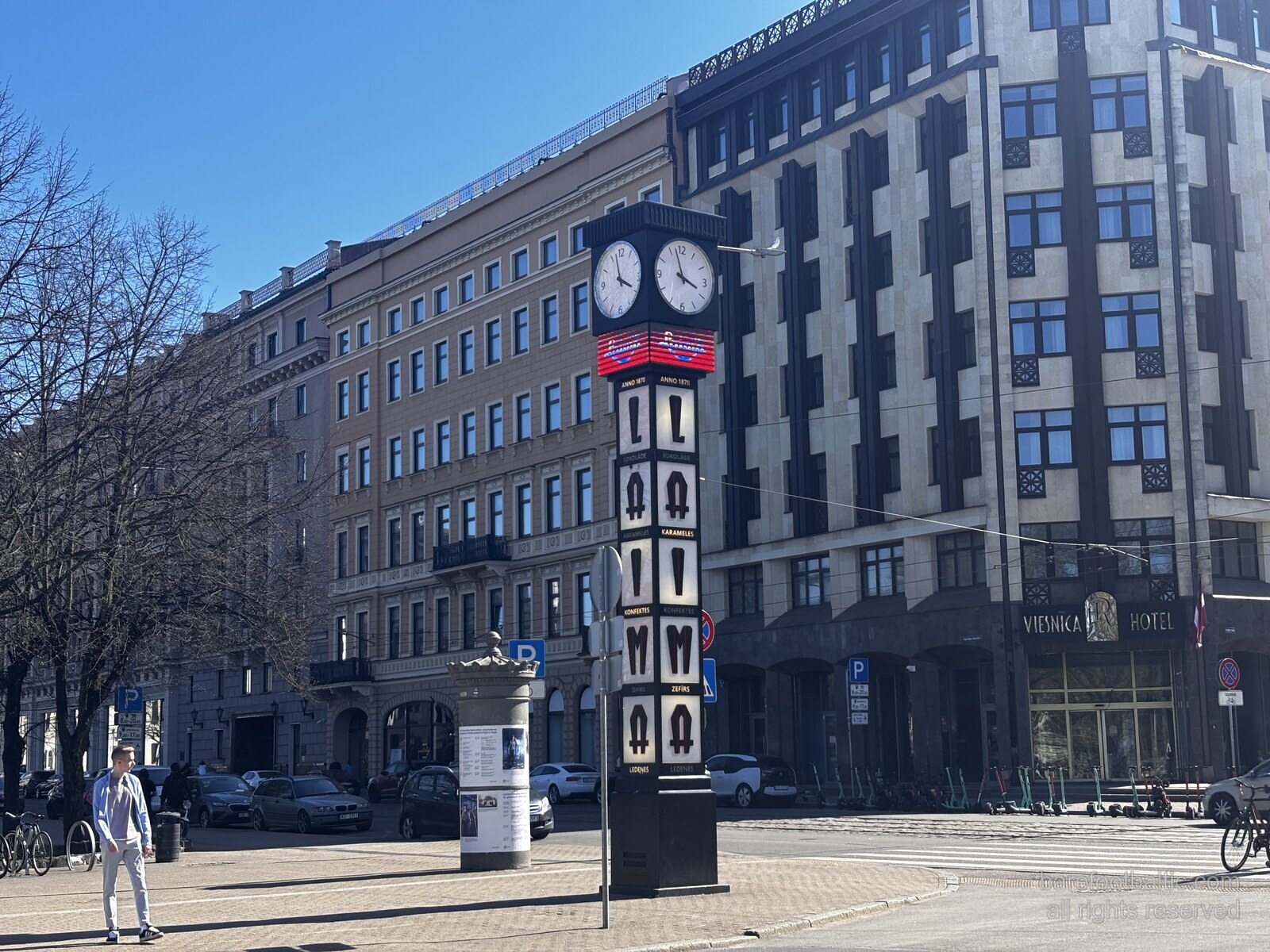
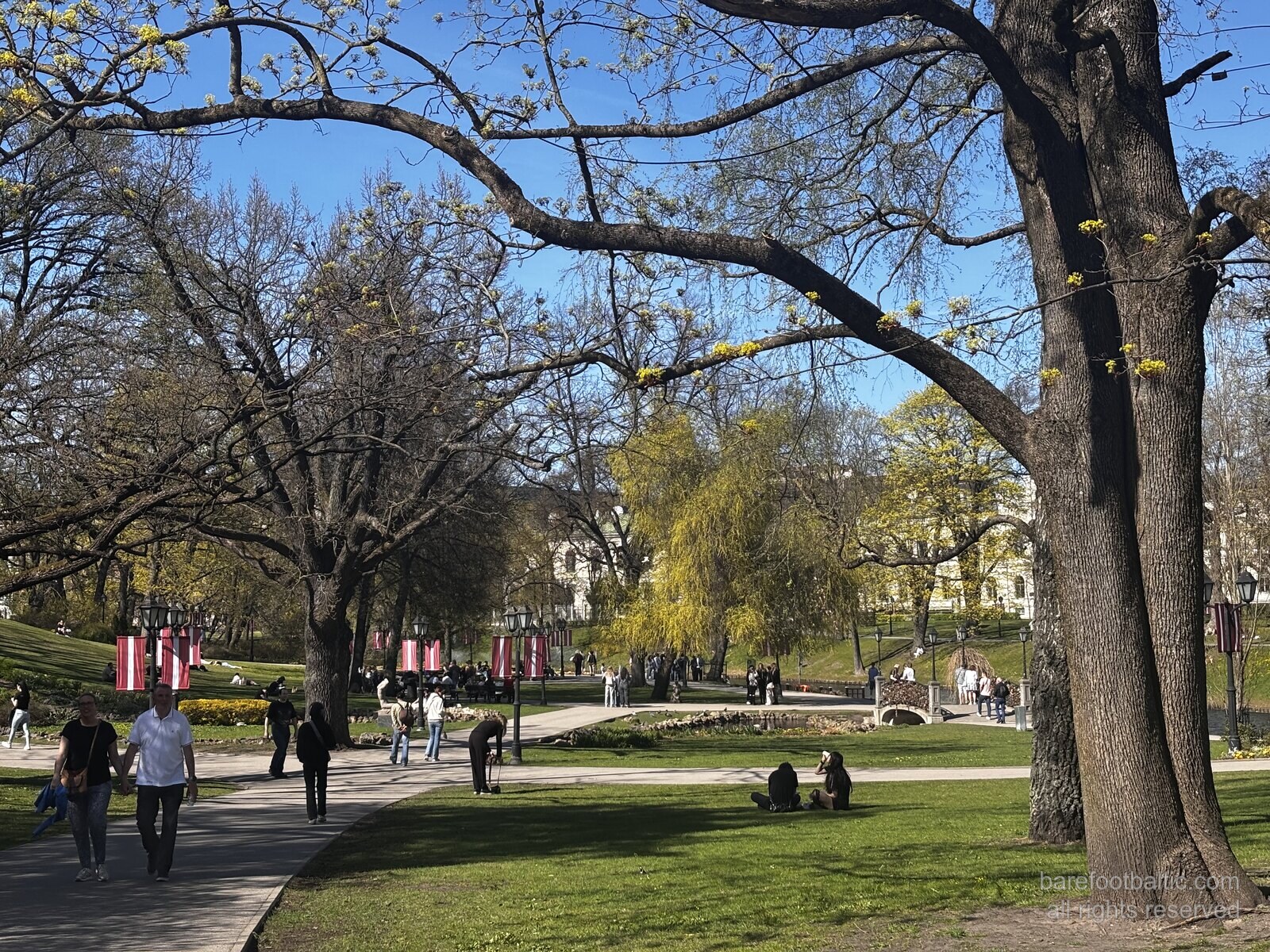
The monument, the park around it, and the Laima clock two minutes south. Click any image for the full-size view.
Short answer, what the Freedom Monument is
The Freedom Monument (in Latvian, Brīvības piemineklis) is the 42-metre limestone-and-granite column at the eastern edge of Riga’s Old Town, where Brīvības iela crosses the canal that used to be the medieval city moat. On top of it stands a copper figure of a woman with three gold-plated stars raised above her head. Latvians call her Milda. The three stars are the three historic regions of Latvia. Vidzeme, Latgale, and Kurzeme. The inscription on the base, in Latvian, reads Tēvzemei un Brīvībai, which means ‘For Fatherland and Freedom’.
It was built between 1931 and 1935 by the Latvian sculptor Kārlis Zāle, paid for entirely by public donations during Latvia’s first period of independence (1918 to 1940), survived fifty years of Soviet occupation, and is today the centre of Latvian civic and political life. Every state ceremony, every protest, every flower-laying on a grandparent’s name day happens here.
For visitors, it’s free, open 24/7, two minutes’ walk from the eastern edge of the Old Town. Honour Guard ceremonies during the day in summer. Five minutes is enough to look. Longer if you want to read what’s on the base.
A short history, because it matters
Latvia became independent for the first time on 18 November 1918, in the chaos at the end of the First World War. The young republic spent its first decade rebuilding a country (agrarian, broke, just out of the Russian Empire and the German occupations), and by the late 1920s was ready to think about how it wanted to commemorate its existence.
A national competition was held. The winning design came from Kārlis Zāle, then in his thirties, working in a stripped-classical style influenced by his time studying in Berlin. Construction began in 1931. Funded entirely by public donations from a country with a population of under two million, building took four years. The monument was unveiled on 18 November 1935, the seventeenth anniversary of independence.
It cost about 3.6 million lats (serious money for a small country), and the donor list included people who gave a single lat from a pension. By the time it went up, the monument was already understood as something belonging to ordinary Latvians, not to a regime.
Milda, and what the three stars mean
The woman at the top is universally called Milda in Latvia, though the name doesn’t come from any official inscription. The figure represents Latvia itself. The three stars she holds are the three historic regions.
- Vidzeme, the central region around Riga. Historically Livonia, formerly under Swedish then Russian rule.
- Latgale, the eastern region. Historically Catholic, longest under Polish-Lithuanian rule, and the only Latvian region with a distinct dialect still in everyday use.
- Kurzeme, the western region, the old Duchy of Courland. The part of Latvia that briefly had its own colony in Tobago in the 17th century.
The inclusion of all three regions in one figure is part of what makes the monument do its political work. Latvia in 1935 was still a young federation of pieces that had only recently been on different sides of different empires. Showing them as one figure with three stars was a quiet argument that the country was now whole.
The base of the column, below Milda, has 56 sculptural reliefs covering the history of the Latvian people. There are scenes from medieval resistance, from the 19th-century national awakening, from the 1905 revolution, from the 1918 independence struggle. The ones at the back, on the side facing the Old Town, are worth a slow look. The ones at the front are the ones photographs catch.
How it survived the Soviet occupation
This is the part of the story that almost every Latvian will eventually mention, so I’ll tell it the way I tell it on tours.
In June 1940, Latvia was occupied by the Soviet Union. Within months, the new regime was holding parades on this square. The first Soviet plan was to demolish the Freedom Monument and replace it with a statue of Stalin facing the other way. The famous Russian sculptor Vera Mukhina (who had Latvian roots) intervened, arguing that the monument was an artistic masterpiece and should be preserved. The plan was shelved.
Throughout fifty years of Soviet occupation, leaving flowers at the monument was forbidden. The KGB watched the square. Ordinary Latvians did it anyway, especially on 18 November (the suppressed independence day), often disguising the visit as a stop on a longer walk. Many were arrested. The monument stood the entire time, weathered and uncleaned but never demolished.
Mēs nelikām ziedus pie pieminekļa. Mēs vienkārši izgājām pastaigā, un ziedi nokrita.
How an older Latvian friend describes the Soviet years. "we didn’t lay flowers at the monument. We just went for a walk, and the flowers fell."On 23 August 1989, two million people across Latvia, Lithuania, and Estonia held hands in a human chain from Tallinn to Vilnius (the Baltic Way), protesting the 50th anniversary of the Molotov–Ribbentrop Pact that had handed all three countries to the Soviet Union. The chain ran through Riga, past this monument. Independence followed in 1991. On the morning the Soviet flag came down, the monument was where the city gathered.
The monument today
If you’re here in summer, you’ll catch the Honour Guard. Two soldiers from the Latvian National Armed Forces stand watch at the monument, ceremonially relieved every hour by a small marching detail. The ceremony runs through the warm months, daily, from morning to early evening. It’s small and serious. Latvians around you will go quiet for the minute or so the changeover takes.
If you’re here on 18 November (Independence Day) you’ll see the city’s major civic ceremony, with flowers laid by the President and by ordinary families. On 4 May (Restoration of Independence Day, 1990) you’ll see the same. On 14 June (the day Latvians remember the 1941 Soviet deportations) and 25 March (the 1949 deportations) you’ll see flowers and candles.
Day-to-day, it’s the place couples meet before dinner and the place tourists pause to read what the inscription says. Bastejkalns park behind it is a working park, with the canal, the willows, and the small bridge full of love-locks. A five-minute walk worth taking between things in central Riga.
Practical answers
Where it is and getting there
At the junction of Brīvības iela and the Pilsētas Kanāls (the city canal), at the eastern edge of Riga’s Old Town. From Riga Cathedral, ten minutes’ walk east. From Riga Central Station, twelve minutes north. The closest tram stop is Brīvības Piemineklis, served by trams 3, 7, 9, 11. Bus 22 from the airport drops you a five-minute walk away.
Times to visit
Anytime. It’s a public square, free, never closed. The Honour Guard runs roughly 09:00 to 18:00 in summer, with the changeover ceremony on the hour. For atmosphere, early morning before the city wakes up gives you the best photographs (low sun on the limestone). For meaning, 18 November (Independence Day) and 4 May (Restoration of Independence) are the days the square fills with Latvians. On those evenings the monument is lit. On others, it isn’t especially.
Combining with the rest of the Old Town
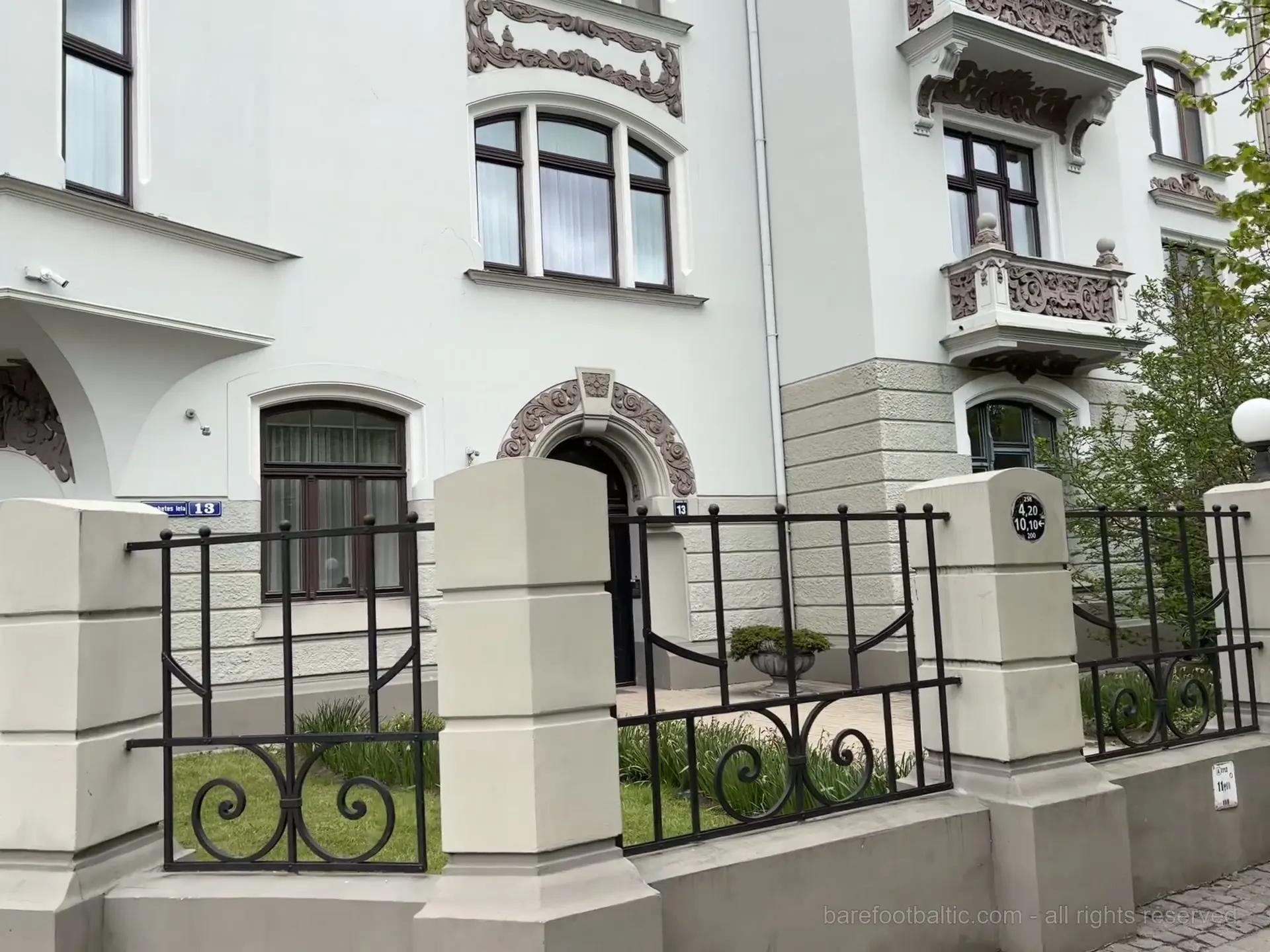
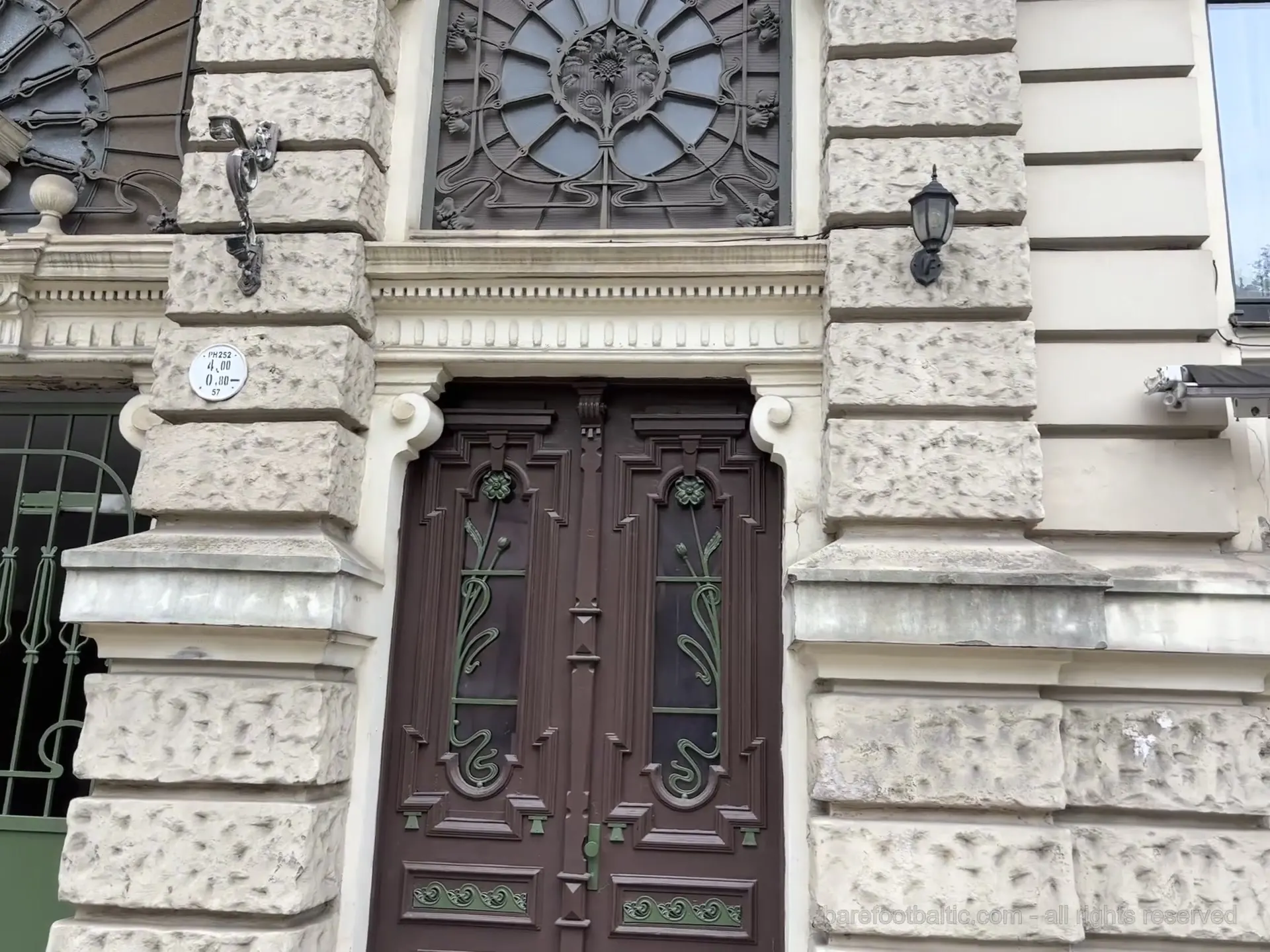
The Freedom Monument is the eastern bookend of any Old Town walk. From here, you can drop south through the Old Town pillar route, taking in the Powder Tower, the Three Brothers, and the cathedral, or walk five minutes north into the Quiet Centre for the Art Nouveau district. Bastejkalns park immediately behind the monument is a fine place to sit for ten minutes between things.
My take
For visitors who don’t carry the history, the Freedom Monument can read as ‘a column with a statue on top’, and that’s the version that ends up on the postcard. That’s fine. But the Latvians around you are reading more than a column. If you have ten minutes here, give a couple to the inscription and a couple to the back of the base, where the Latvian-history reliefs are carved. Spend the rest watching what people around you are doing. The single flower someone lays on the cobbles, or the older Latvians walking past on a Tuesday without looking up.
Frequently asked questions about the Freedom Monument
Daiga Taurīte is a licensed Latvian tour guide and co-founder of Barefoot Baltic, which runs small-group day excursions from Riga. She grew up in Riga, spent two decades working in London, and came home in 2024. Barefoot Baltic is licensed by Latvia’s Consumer Rights Protection Centre (PTAC), holds ATD passenger transport licence PS-01995, and is insured by BTA Baltic for civil liability.
The Freedom Monument is on every walking route we run through Riga. If you’d like a half-day in the Old Town with a licensed Latvian guide who can connect the monument to the rest of the city’s 20th-century story, get in touch.