Short answer, eat these first
If you only have a few days in Latvia and want to taste the country properly, here’s the shortlist I’d send any traveller on. The longer post explains each one in detail, but if you’re scanning, this is the bite-sized version.
- Rupjmaize, our dense dark rye bread. Try it plain, then come back for the layered dessert version (Rupjmaizes Kārtojums) and the cold rye-bread soup (Maizes Zupa).
- Anything with biezpiens, the Latvian curd cheese. Savoury with dill and sour cream over potatoes, or sweet as a chocolate-covered childhood snack (Kārums).
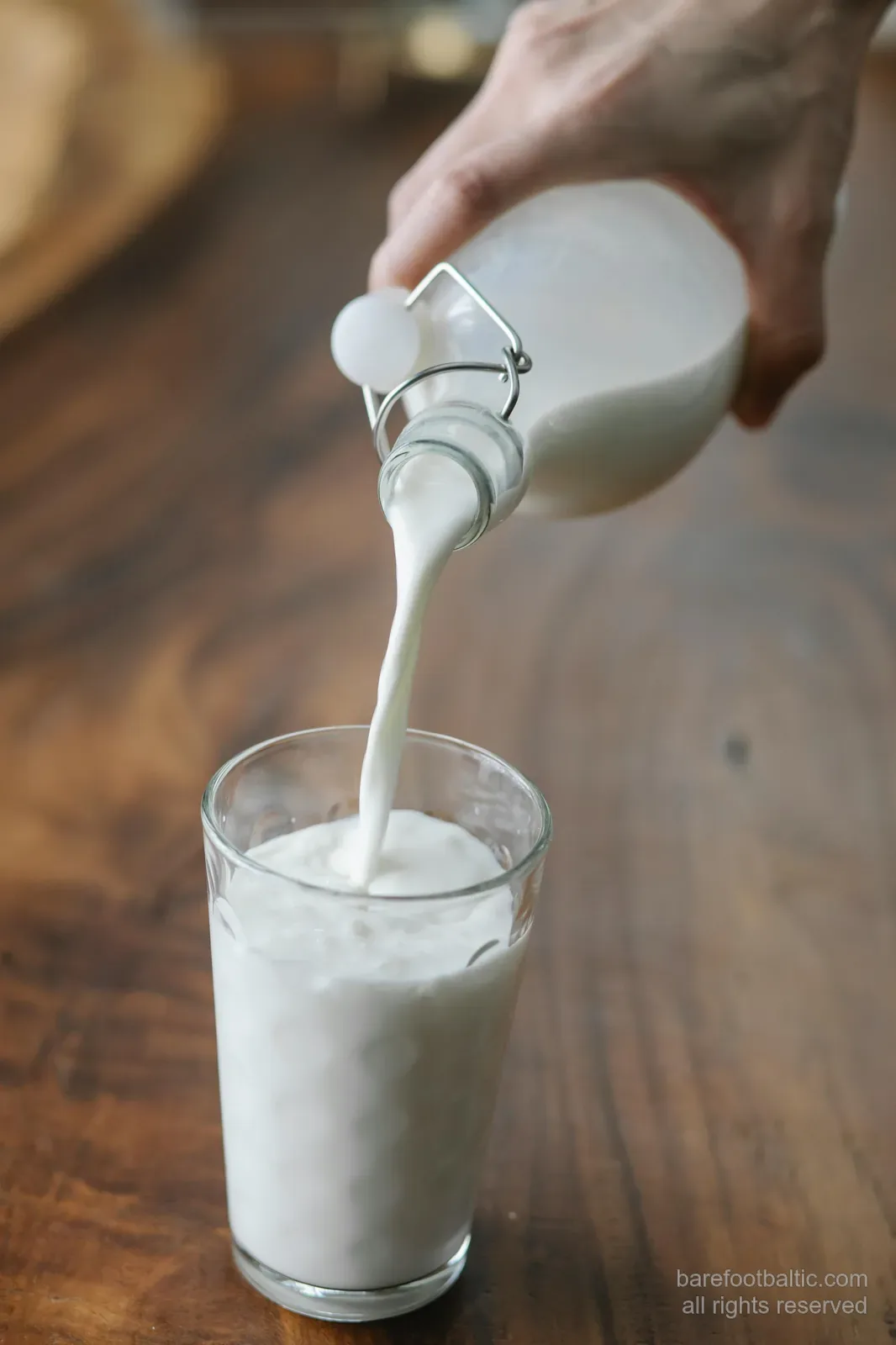
- A bottle of kefir. We’ve been drinking it for generations. The West has only just discovered it.
- Pelēkie zirņi ar speķi, our national dish. Grey peas with smoked bacon, served with a glass of kefir on the side.
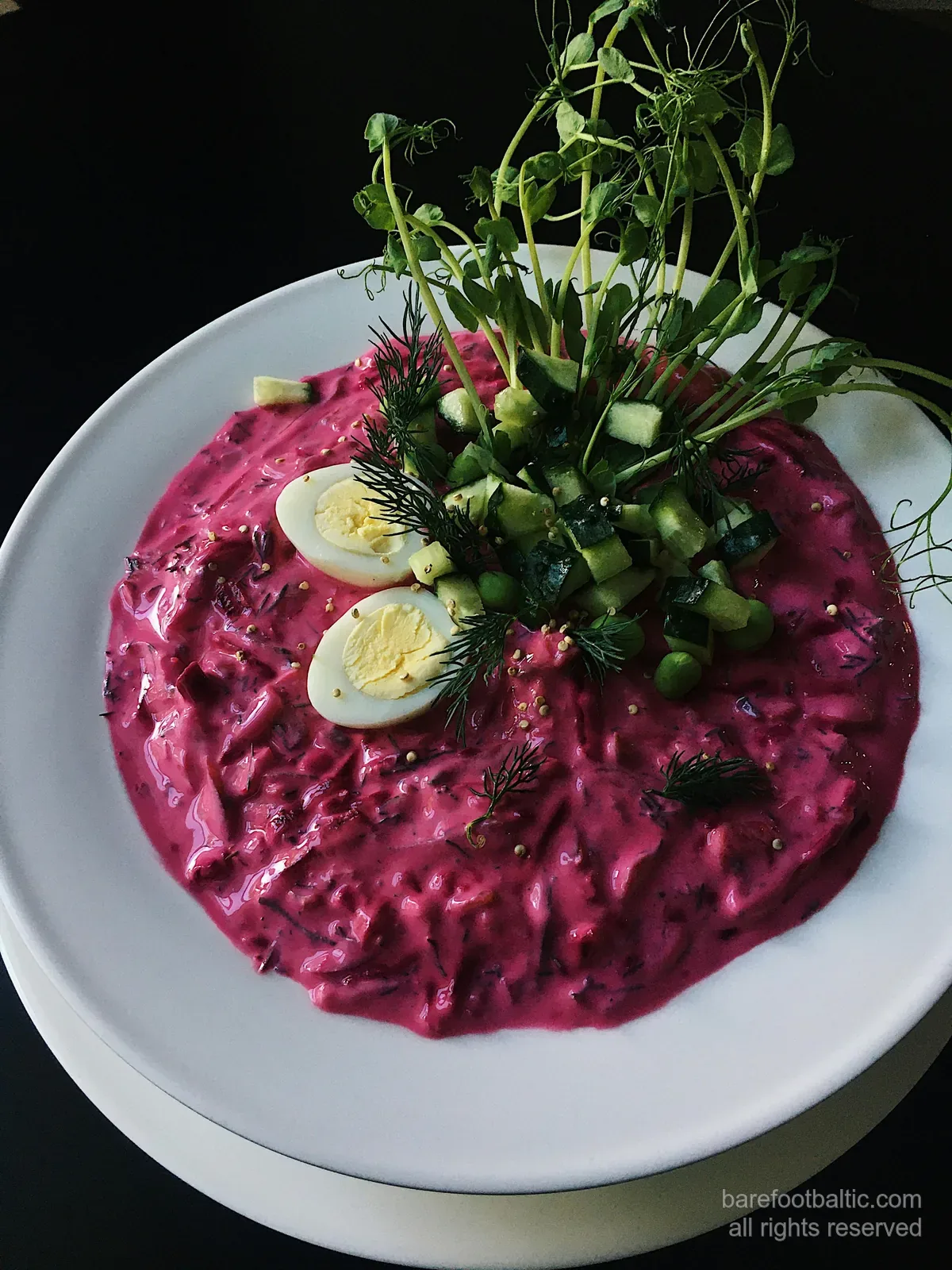
- Aukstā zupa in summer, June to August. The pink kefir-based cold soup with beetroot, cucumber, dill and hard-boiled egg. Properly weird-looking, properly delicious.
- Anything smoked at the Central Market. Sprats, eel if you can find it, cheese, pork ribs. The smokehouse counters do nothing but smoke fish, and you can taste the difference at the first bite.
- Karbonāde with chanterelle sauce, the comfort plate that grandmothers made on Sundays.
- Sklandrausis, the rye-and-root-vegetable pie from the western coast. Strange, sweet, and very Latvian.
- Bērzu sula (birch sap), if you’re here in April or early May. The clear, faintly sweet tree water tapped from birches during the short spring rise. Supermarkets now stock 1-litre bottles for the few weeks it’s in season. Drink it cold.
- A shot of Riga Black Balsam at the end of the meal, mixed into hot blackcurrant juice if you’re a beginner.
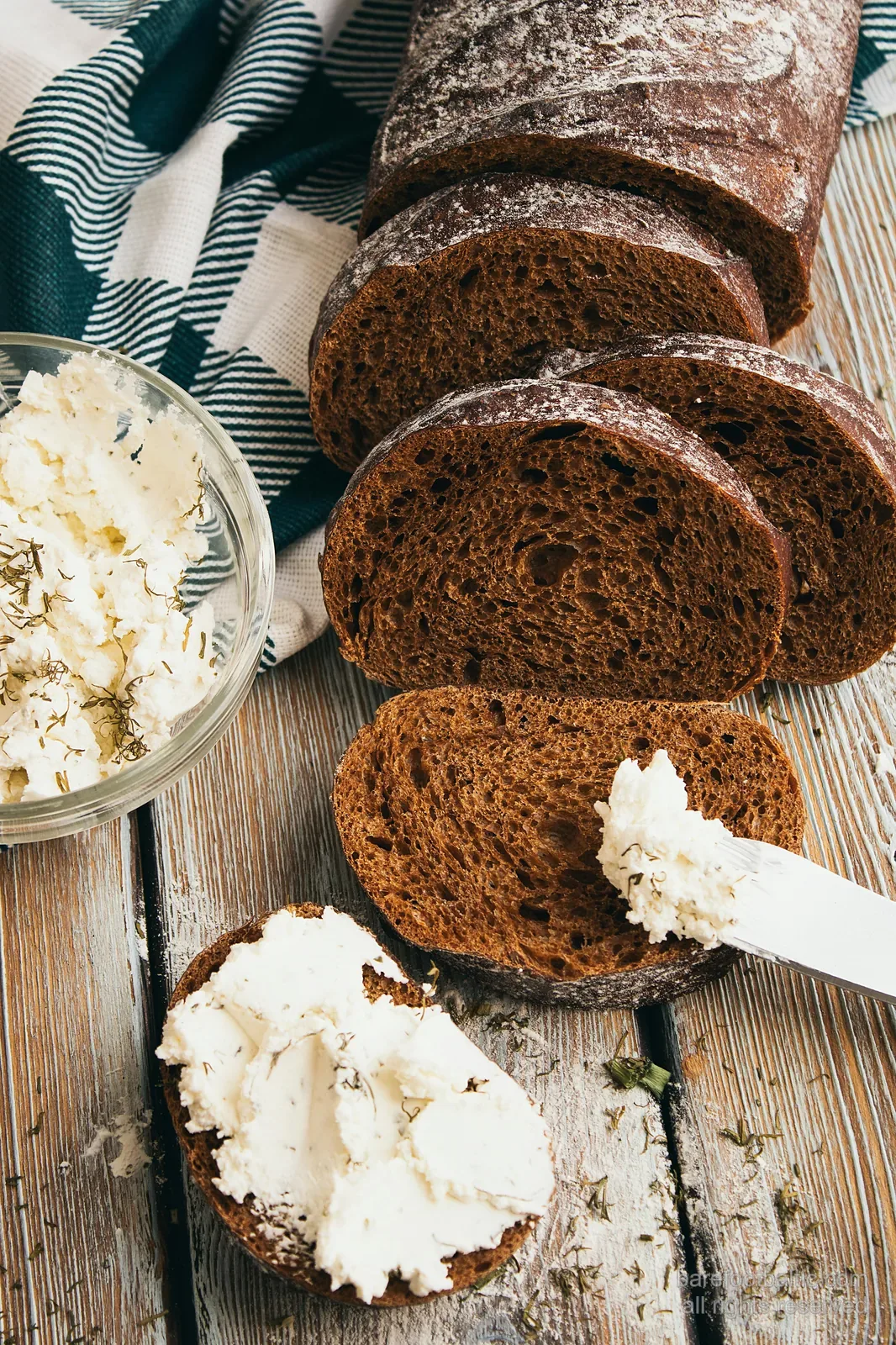
The bread shelf, where everything begins
Latvian food makes no sense without bread. We grew up with it on the table at every meal. We bring it to housewarmings (the salt-and-bread tradition is still alive in 2026). And we have far more types than the visitor expects.
Rupjmaize, the cornerstone
Rupjmaize (literally “coarse bread”) is our dense, slightly sweet, slightly sour dark rye bread, baked from sourdough rye flour, often with caraway seeds, sometimes with malt syrup. The good stuff is heavy in the hand, dark all the way through, and keeps for a week without going stale. A proper loaf is a serious commitment, you eat it slowly, in thin slices, with butter and cottage cheese and smoked fish, or with honey and quark for breakfast.
Rupjmaize is everywhere because it’s the engine of the cuisine. It is the backbone of the layered dessert Rupjmaizes Kārtojums (rye bread crumbs, whipped cream, lingonberry jam in a glass), it’s the base of the cold rye-bread soup Maizes Zupa (sieved bread, dried fruits, cinnamon, whipped cream on top), and it’s the silent partner of essentially every smoked-fish or cottage-cheese plate. If you only buy one food souvenir from Latvia, buy a vacuum-packed loaf of rupjmaize from a proper bakery (try Lāči or Liepkalni) and take it home.
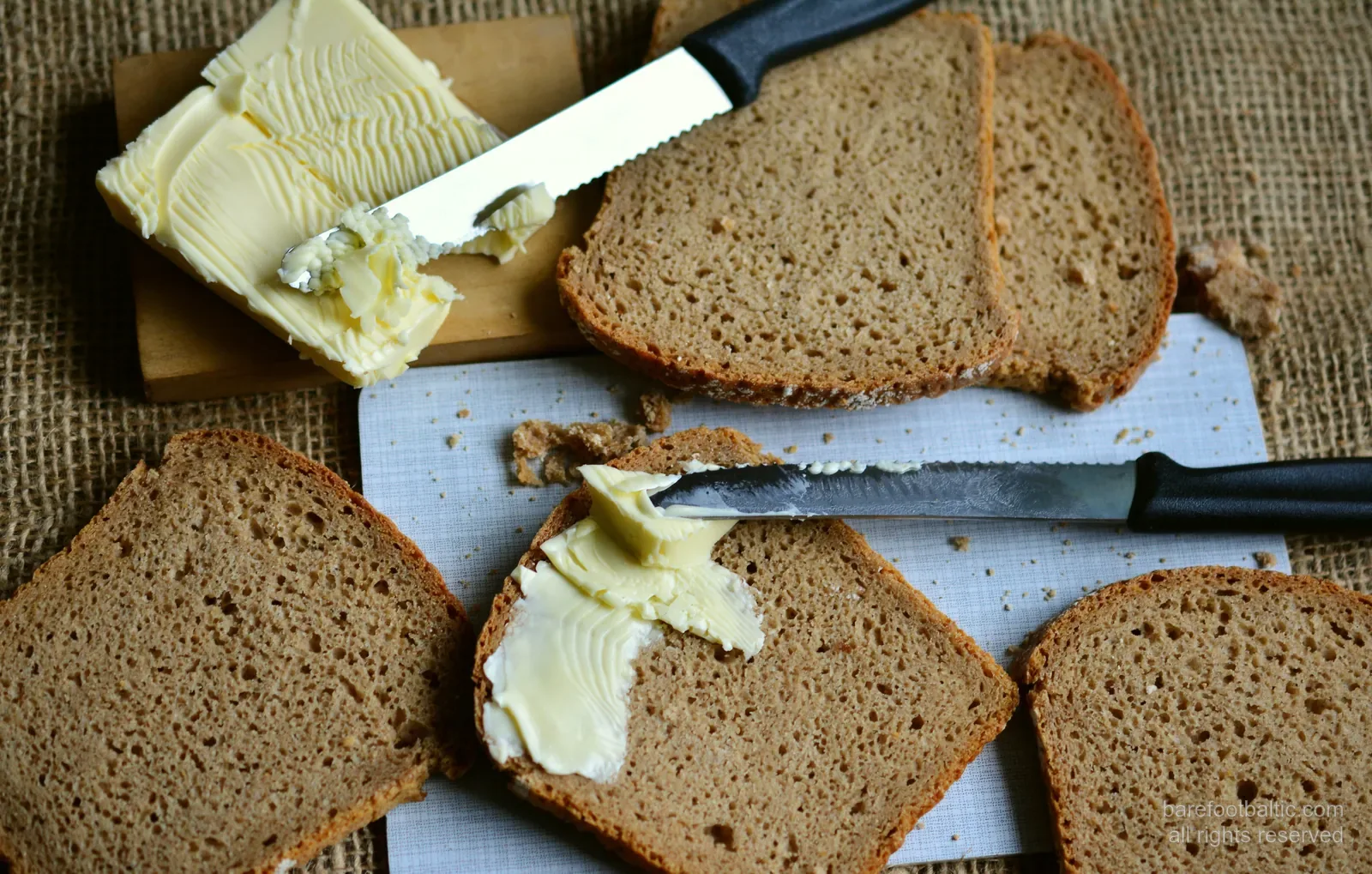
Saldskābmaize, the sweet-sour cousin
Saldskābmaize means “sweet-sour bread” and that’s exactly what it is. A softer, lighter rye, more honeyed than rupjmaize, with a complex sourdough tang. It’s easier on the international palate and the version foreign visitors usually fall for first. Goes brilliantly with smoked salmon, sliced cheese, or just butter. The Lāči bakery sells it everywhere in Riga.
Sklandrausis, the strange one from Kurzeme
This is the dish I most enjoy putting in front of visitors who think they know rustic European baking. Sklandrausis is a small, open-faced rye-pastry tart from the western Kurzeme region, filled with a layer of mashed potato topped with mashed carrot, sweetened gently, dusted with caraway, baked until the carrot caramelises slightly on top. It is sweet, it is savoury, it is unmistakably ancient (the recipe is documented from at least the 17th century), and it has EU protected status as a traditional Latvian product. It tastes like nothing else you’ve had. Look for it at the Central Market or at autumn farmers’ markets.
Kliņģeris, the namesday pretzel
If you’re ever invited to a Latvian birthday or namesday celebration, expect to see one of these in the middle of the table. An enormous saffron-coloured sweet pretzel, easily two feet across, glossy and golden, studded with raisins and almonds. Kliņģeris is celebratory bread, you bring it as a guest, and the host slices it ceremonially. It’s sweet, soft, slightly cardamom-scented, and impossible to find as a tourist unless you go to a proper bakery and ask. Worth seeking out.
Pīrāgi, the small pleasure
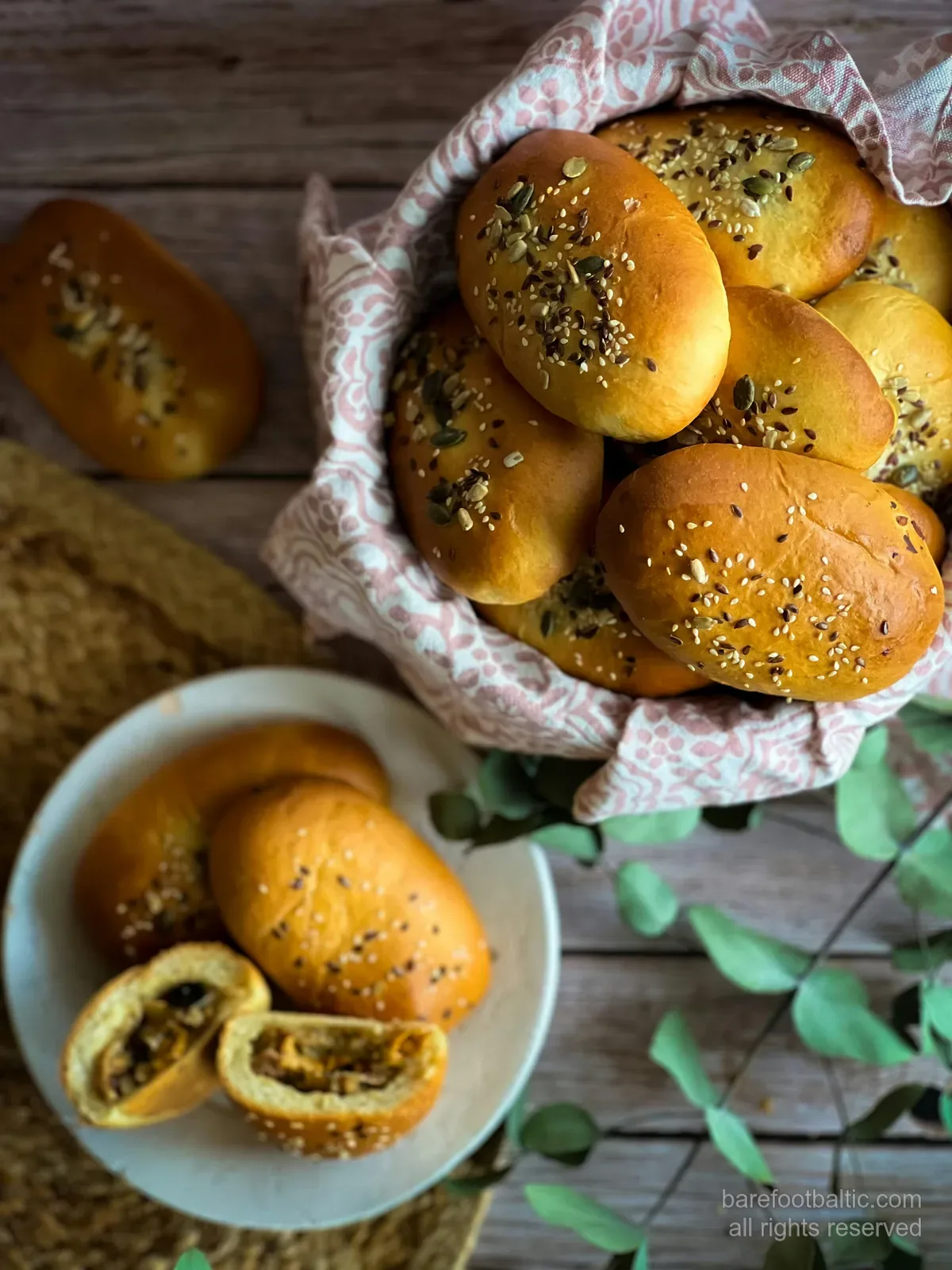
Pīrāgi are small, crescent-shaped, golden-baked buns filled most traditionally with finely diced smoked bacon and onion. They are the snack of every long bus journey, the buffet table at every gathering, and the thing you’ll see piled high in every bakery window. There are also versions with cabbage, with smoked salmon, with carrot, but the bacon version is the canonical one. Three of these and a glass of kefir is a perfectly good lunch.
The cottage cheese cult
If I had to pick the single ingredient that best explains Latvian eating, it would be biezpiens, our cottage cheese. It edges out even the bread. We eat it more days than not. We eat it sweet and we eat it savoury. We eat it for breakfast, lunch, dinner, and dessert, frequently in the same day. There are entire shelves of biezpiens products in every Latvian supermarket that simply do not exist in the UK or US, and once you understand the texture difference, you start seeing it everywhere.
What biezpiens actually is
Biezpiens (pronounced BEE-yez-pee-yens) is a fresh, soft, slightly tangy curd cheese, somewhere between Greek yoghurt and ricotta in texture, but lighter and drier than either. It comes in different fat contents (0%, 5%, 9%, 18%) and gets used differently at each level. The best stuff is made the traditional way from cultured raw milk, slowly drained, and tastes mildly of grass and pasture.
The savoury versions
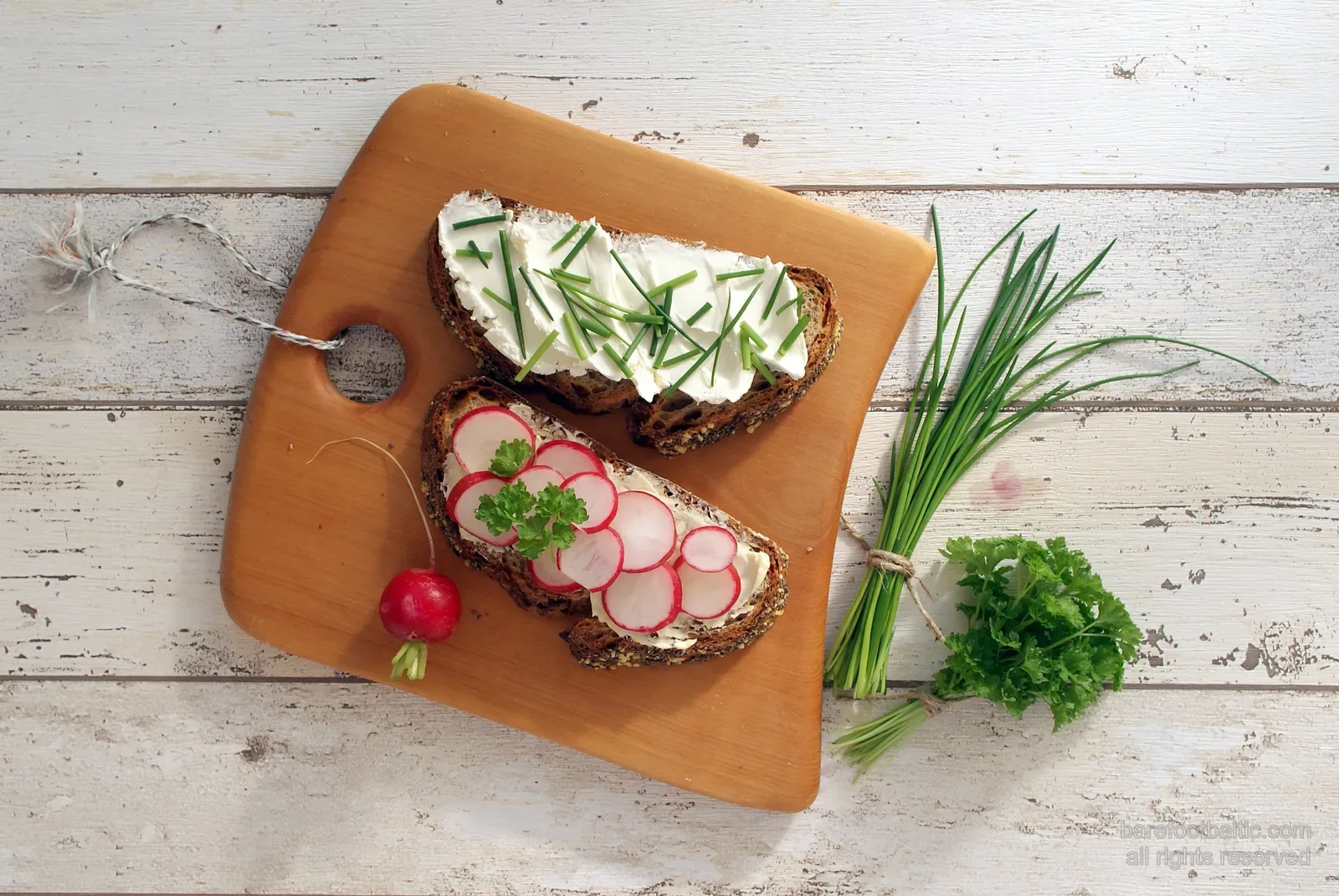
Here’s the classic Latvian summer plate. Hot boiled new potatoes, a generous spoonful of biezpiens mixed with sour cream and finely chopped dill, a few radishes on the side, a piece of pickled herring, a slice of rye bread. That’s lunch. Add fresh chives, spring onion, garlic, salt, pepper. The biezpiens is the unifying element, savoury, cooling, slightly tangy, and it makes everything around it sing.
You’ll also see biezpiens stirred into baked dishes (potato gratins, savoury pancakes), used as a filling for stuffed pancakes (biezpiena pankūkas), and dolloped onto soups in place of sour cream.
The sweet versions, where it gets interesting
Here’s where Latvia diverges from anywhere I’ve eaten in Western Europe. We make sweet biezpiens products that don’t really exist elsewhere, and that every Latvian grew up on.
- Kārums (and its rivals), the chocolate-coated curd cheese bar. Picture a small, palm-sized rectangle of slightly sweetened biezpiens, sometimes with vanilla or rum flavouring or a fruit-jelly centre, completely enrobed in milk or dark chocolate. Every Latvian child grew up eating these. They sit in the dairy aisle, not the chocolate aisle. They cost about a euro. Try one and tell me why this isn’t global.
- Biezpiena sieriņš, the more traditional, unchocolated version, a small palm-sized pillow of sweetened biezpiens wrapped in printed foil. Kārums makes the most-eaten one (orange wrapper, vanilla flavour), and it’s breakfast for half the country. Peel the wrapper, eat with a coffee, sixty cents at any supermarket. Look for the version with the cartoon crow on the front.
- Biezpienmaize, a soft sweet bread filled with sweetened biezpiens, eaten warm, often with a coffee mid-morning.
- Biezpiena pankūkas with jam, thin pancakes folded around sweetened biezpiens, served with sour cream and lingonberry or raspberry jam. The Sunday breakfast of countless Latvian childhoods.
- Rupjmaizes Kārtojums, the layered dessert made from rye bread crumbs, whipped cream, lingonberry jam, sometimes sweetened biezpiens, layered in a glass. Think Eton Mess, but Latvian and rye-based. You’ll see this on every modern Latvian restaurant’s dessert menu.

The kefir paragraph
Kefir has had a moment in the Western wellness world over the last decade. Whole Foods sells it in glass bottles for £5, “gut health” influencers post about it like it’s an exotic discovery, and Brooklyn cafés put it in smoothies. I find this funny, and so does every Latvian I know, because we have been drinking the stuff every day for generations.
Kefir is fermented milk, slightly fizzy, slightly sour, somewhere between drinking yoghurt and a probiotic buttermilk. The good Latvian stuff is properly tangy, properly thick, and costs about ninety cents for half a litre at any supermarket. It’s eaten cold, drunk straight from the glass, poured over hot grey peas (see below), used as a base for cold summer soup, and recommended by every grandmother as the cure for a hangover. There is no Latvian kitchen that doesn’t have a bottle in the fridge.
What makes Latvian kefir taste of Latvia rather than Sainsbury’s is the milk. We have a huge dairy industry, the cows are mostly pasture-fed, and the cultures used here have been bred locally for generations. Try a small bottle from Smiltenes Piens or Tūja or Latvijas Piens, and you’ll taste a depth and tang the supermarket version back home doesn’t have. If you like it, buy a few bottles, it travels well in checked luggage if you’re mad enough.
Pelēkie zirņi ar speķi, the national dish
The Latvian national dish is strange the first time you see it. Pelēkie zirņi ar speķi means “grey peas with smoked bacon”, and it is exactly that. Large, round, beige-grey peas (a variety almost unique to Latvia and Lithuania), boiled until creamy, mixed with diced smoked bacon and onion fried until golden, served hot, with a glass of cold kefir alongside.
The combination is the point. The peas are starchy and earthy, the bacon is rich and smoky, the kefir cuts everything with a cold, sour edge. It’s peasant food, traditionally a winter dish, the kind of meal that kept farming families going through dark months. You’ll see it on every traditional restaurant menu and at every winter solstice celebration in December (eating grey peas at solstice is a folk tradition, the legend says you must eat at least nine peas to ensure good fortune).
If you eat it once and decide it’s not for you, fair enough, it’s an acquired taste. But try it the way a Latvian eats it, with the kefir glass beside it, alternating mouthfuls of hot peas with cold sour kefir. That partnership is the recipe.
Aukstā zupa, the bright pink summer soup
If you visit Latvia between June and August and don’t eat aukstā zupa at least once, you’ve missed the most photogenic and most refreshing thing in the cuisine. It looks like a Wes Anderson film prop. It tastes brilliant on a hot day. It is somehow both ancient peasant food and the most Instagrammable plate on every modern Latvian restaurant’s summer menu.
Aukstā zupa (literally “cold soup”) is built on a base of kefir, often with a little water or buttermilk to thin it. Into the kefir goes finely grated raw beetroot or pickled beetroot juice (which gives it the electric pink colour), diced cucumber, plenty of fresh dill, sliced spring onion or chives, and on top, a hard-boiled egg cut in half. Sometimes with cubes of boiled potato on the side rather than in the soup. Always served properly cold.
What makes a good aukstā zupa is the dill, lots of it, fresh and chopped just before serving, and the kefir, which has to be properly tangy. The bad versions use sour cream and water and taste flat. The good versions taste like a cold beetroot Bloody Mary made by a grandmother who has been making this every summer since 1955. Look for it on summer menus at restaurants like Bibliotēka Nº1 or Vincents in Riga. The Central Market food court does excellent versions for €5.
The smoked everything
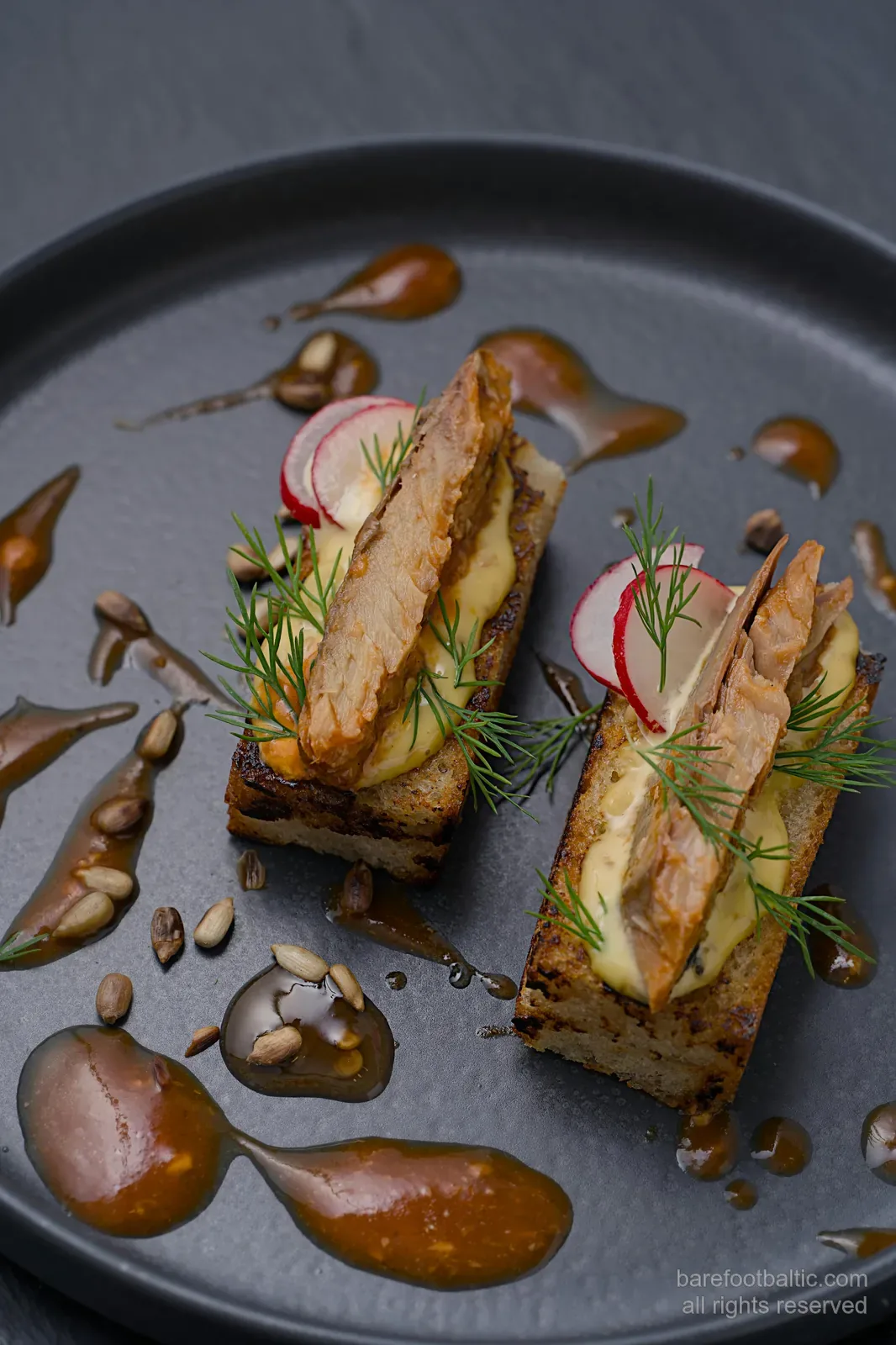
Latvia is a coastal country with a long tradition of smoking just about anything that holds still long enough. Walk into the fish hall at the Riga Central Market and the smell hits you before you see anything. Hot-smoked sprats, cold-smoked salmon, smoked eel, smoked mackerel, smoked herring, smoked perch. Then walk into the meat hall for smoked ribs, smoked pork shoulder, smoked sausage of every kind, smoked chicken. Then into the dairy hall, where they smoke the cheese.
Why smoke matters here
Latvian smoking traditions go back centuries and predate refrigeration by about a thousand years. The Baltic coast has produced smoked fish for the Hanseatic League since the 1200s, and many small fishing villages on the Kurzeme coast (Roja, Pāvilosta, Ventspils) still operate traditional smokehouses where the wood is alder or juniper and the fish is laid out in racks above a slow, cool fire. The result tastes nothing like supermarket smoked salmon. It tastes of woodsmoke and fish and time.
The ones to actually try
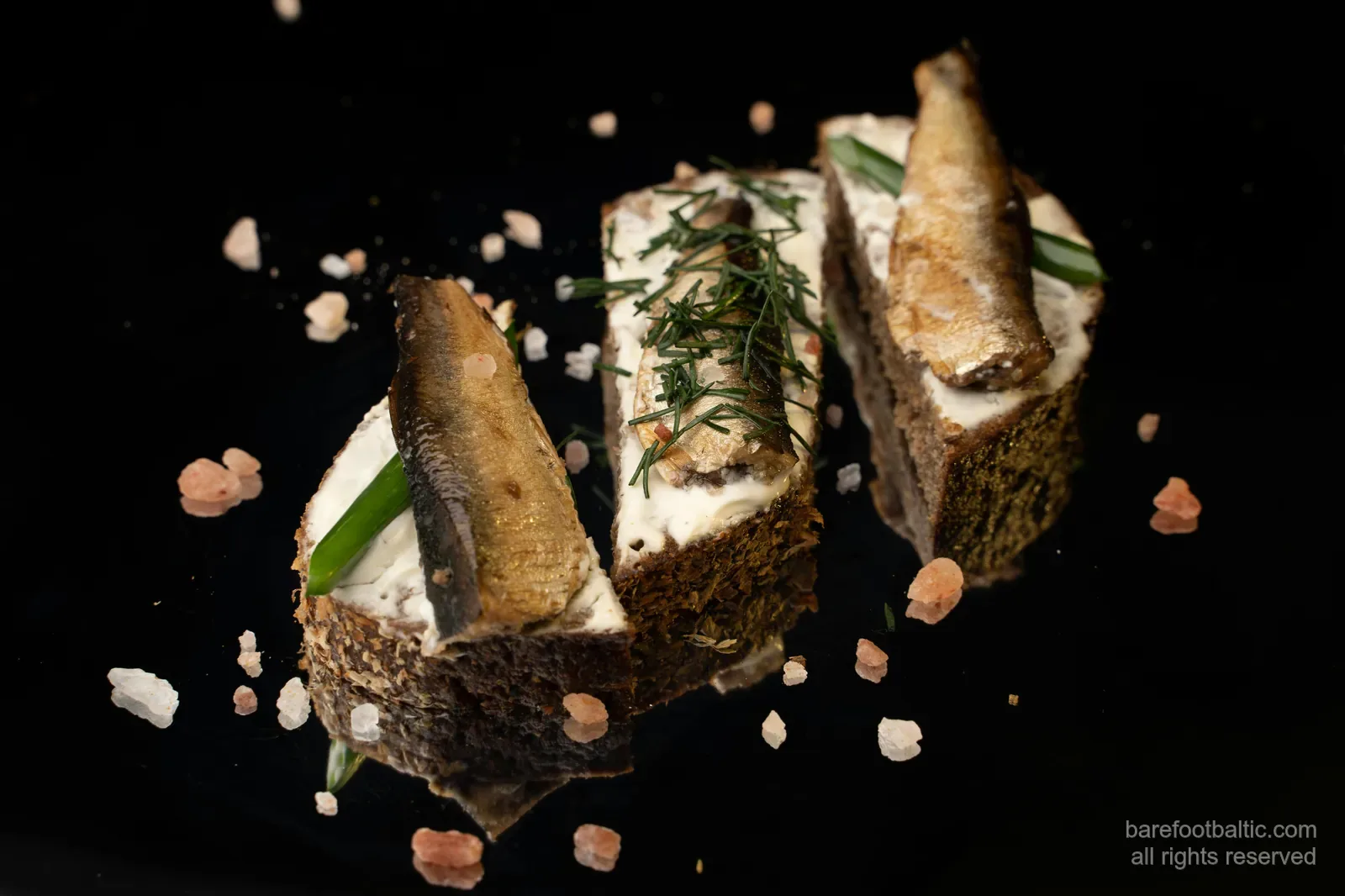
Smoked sprats are small Baltic herring, hot-smoked whole, eaten on rye bread with a little butter and a slice of hard-boiled egg. The classic Latvian appetiser. The tinned version (Riga Sprats) is iconic and well-loved internationally. The fresh, just-smoked version from the market is a different, far better thing.
Smoked eel from Pāvilosta is my secret luxury recommendation. Pāvilosta is a small fishing town on the western coast, and its smoked eel is the most delicious smoked fish I have ever eaten. Rich, fatty, woodsmoky, slightly sweet. Around €30 to €50 per kilogram, which sounds dear but is half what you’d pay for inferior eel anywhere in Europe. Look for it at the Central Market fish hall, or buy direct in Pāvilosta if you’re on the coast. Eat it cold, on rye bread, with horseradish.
Smoked cheese comes as golden-brown rounds of mild cheese smoked over alder. Slice thin, eat with rye bread, a slice of pickled cucumber on the side.
Smoked pork ribs are served whole, eaten with sauerkraut and boiled potatoes. The kind of thing every Latvian grandmother has an opinion about.
Pelmeņi and the dumpling family
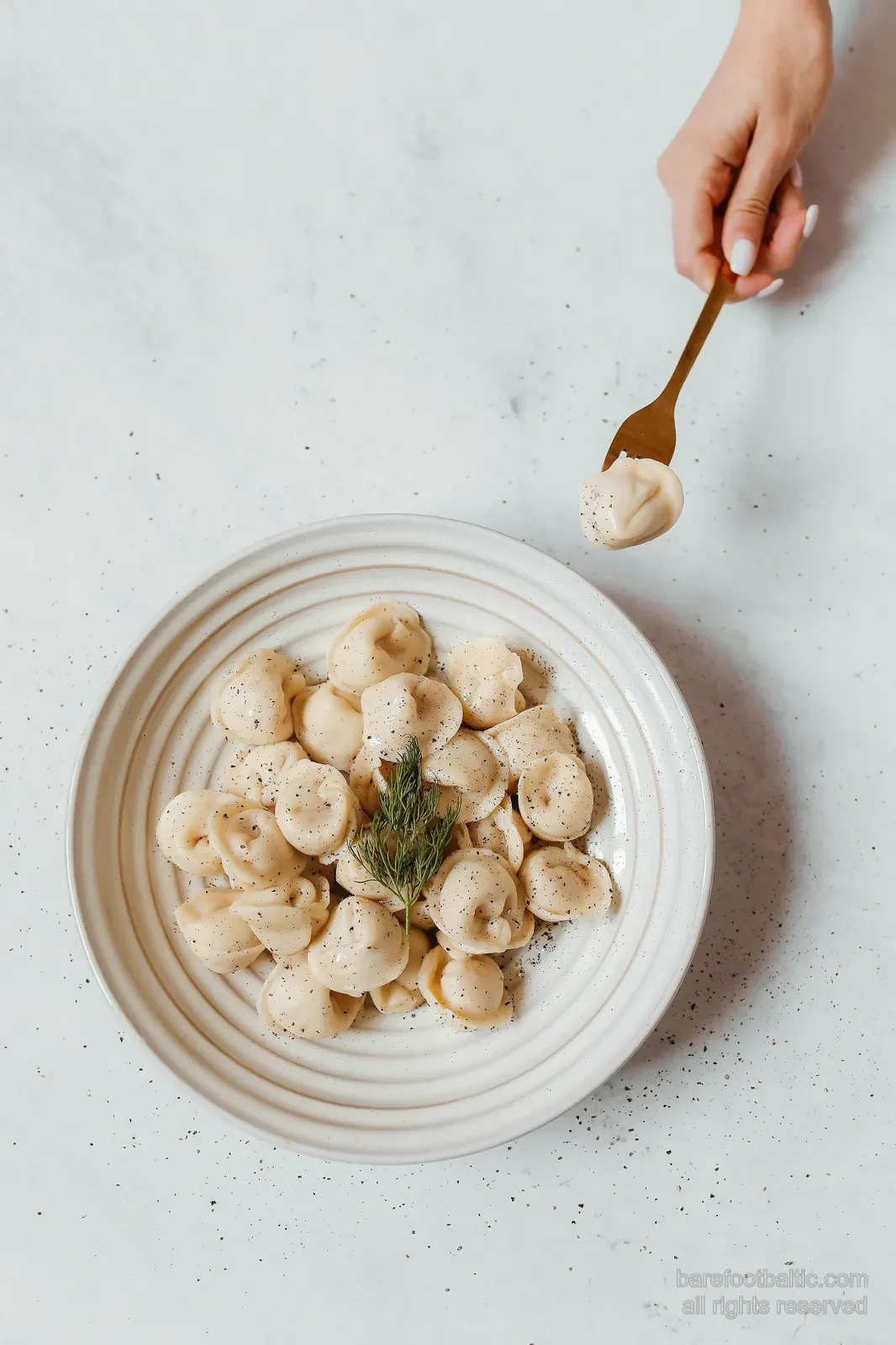
Pelmeņi are not uniquely Latvian, and I think that matters. They’re the small meat-filled dumplings eaten across the entire former Soviet space, originally Russian or Siberian (depending on which folk history you believe), and you’ll find them in Russia, Ukraine, Belarus, Poland, and Latvia. But they’ve been part of the daily Latvian diet for generations, every supermarket sells them frozen in 1kg bags, every Riga restaurant has them on the menu, and every Latvian household has a pelmeņi dinner once a month at minimum.
The Latvian version is small, thin-skinned, filled with seasoned minced pork or pork-and-beef, boiled in salted water for a few minutes, and served the way every former-Soviet country serves them, with a generous knob of butter, a spoonful of sour cream, a sprinkle of dill, salt and black pepper. Some people add vinegar. Some people eat them swimming in a clear broth. Both are correct.
If you want a true Latvian dumpling that isn’t shared with the rest of the region, look for karbonādes pīrāgi (savoury pasties) or kartupeļu pankūkas (potato pancakes, also called kartupeļu rieksti in some parts of the country). The potato pancakes are crisp, golden, served with sour cream, and they sit on every traditional restaurant menu.
The pickle question
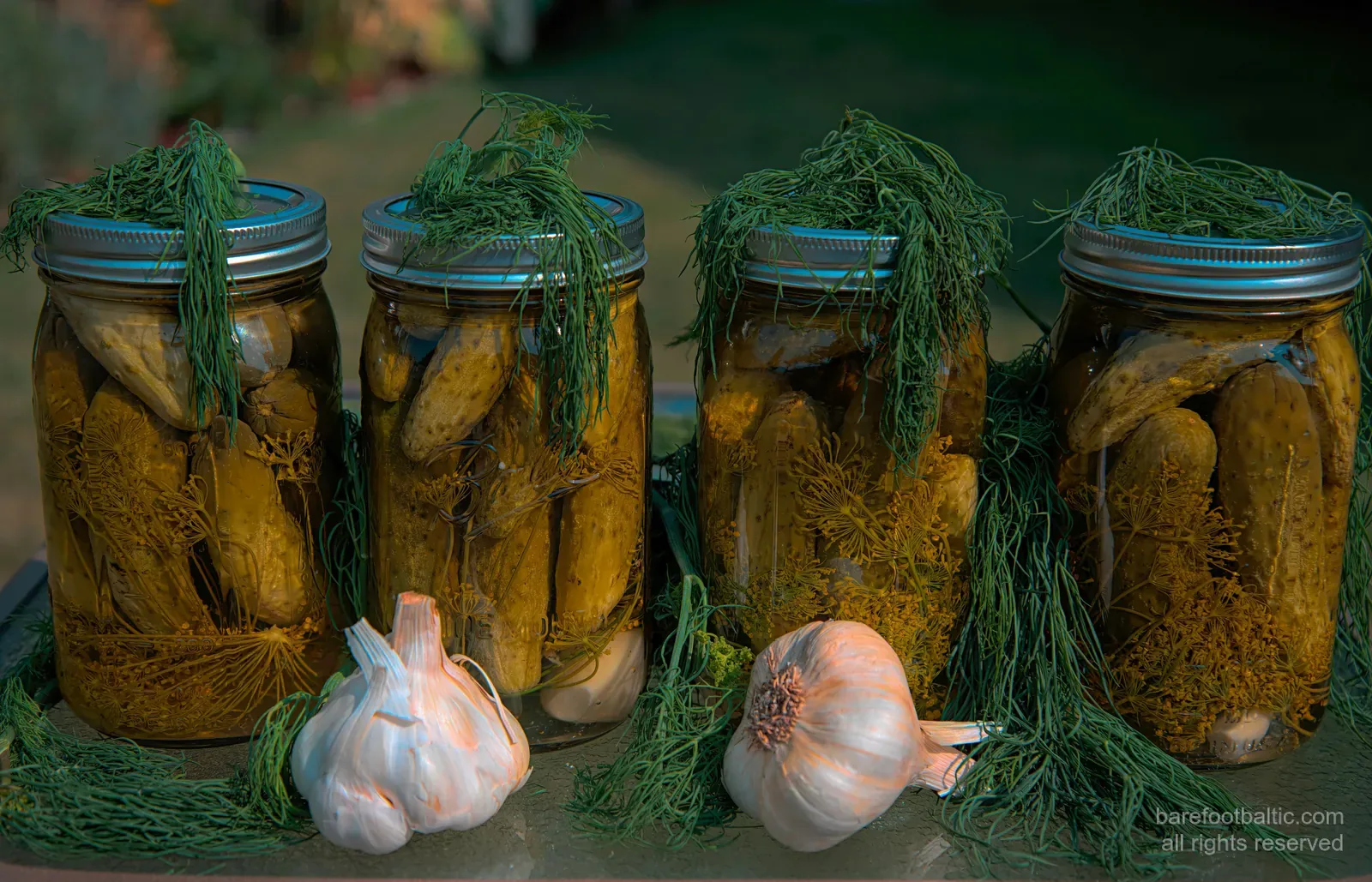
Every Latvian fridge has a jar of pickled cucumbers in it. The jar is always there. When the cucumbers are gone, you do not throw away the brine. You drink it.
The pickle-juice tradition has two purposes. First, the morning after a heavy night of celebrating, a small glass of pickle brine is the universally agreed Latvian hangover cure (the science actually backs this up, the salt and vinegar help with electrolyte balance and the lactic acid soothes the stomach). Second, it’s a chaser for vodka, a small glass of vodka, a small bite of pickled cucumber, a small sip of brine. Some bars in the Old Town will serve you this combination as a “Russian flight” without explaining it.
Beyond the brine, pickled cucumbers themselves are the silent partner of every Latvian meal. Sliced thin alongside boiled potatoes. Diced into the cold salad rasols (the Latvian potato salad with diced ham, peas, hard-boiled egg, mayonnaise, and pickles, which appears at every birthday and every funeral). Whole and crunchy alongside smoked fish. The good stuff is dill-pickled, lacto-fermented in the traditional way, and tastes nothing like the malt-vinegar British version.
The dill question
Yes, dill is on everything. Yes, this is by design. Yes, we know.
Dill (dilles in Latvian) is the default herb of Northern European cooking and Latvians use it on potatoes, on cottage cheese, on smoked fish, on pelmeņi, on salads, in soups (cold and hot), as a garnish for almost any savoury plate. Fresh dill is sold in enormous bunches at every market for around €1, and the average Latvian household goes through a bunch every few days in summer.
What I’d say to visitors who find this excessive is to try it on a few dishes before deciding. Dill on cold pink soup is the right answer. So is dill on hot boiled new potatoes with butter. Stir it into biezpiens with sour cream and you’ll stop arguing. Dill is occasionally overdone (when it’s used as a desperate garnish on a dish that doesn’t need it), and yes, the joke about “Latvian fine dining is just adding more dill” has some truth to it. But the real food has it for a reason. It cuts richness, brightens cold dishes, and pairs with kefir and biezpiens in a way no other herb does.
Karbonāde and the comfort plate
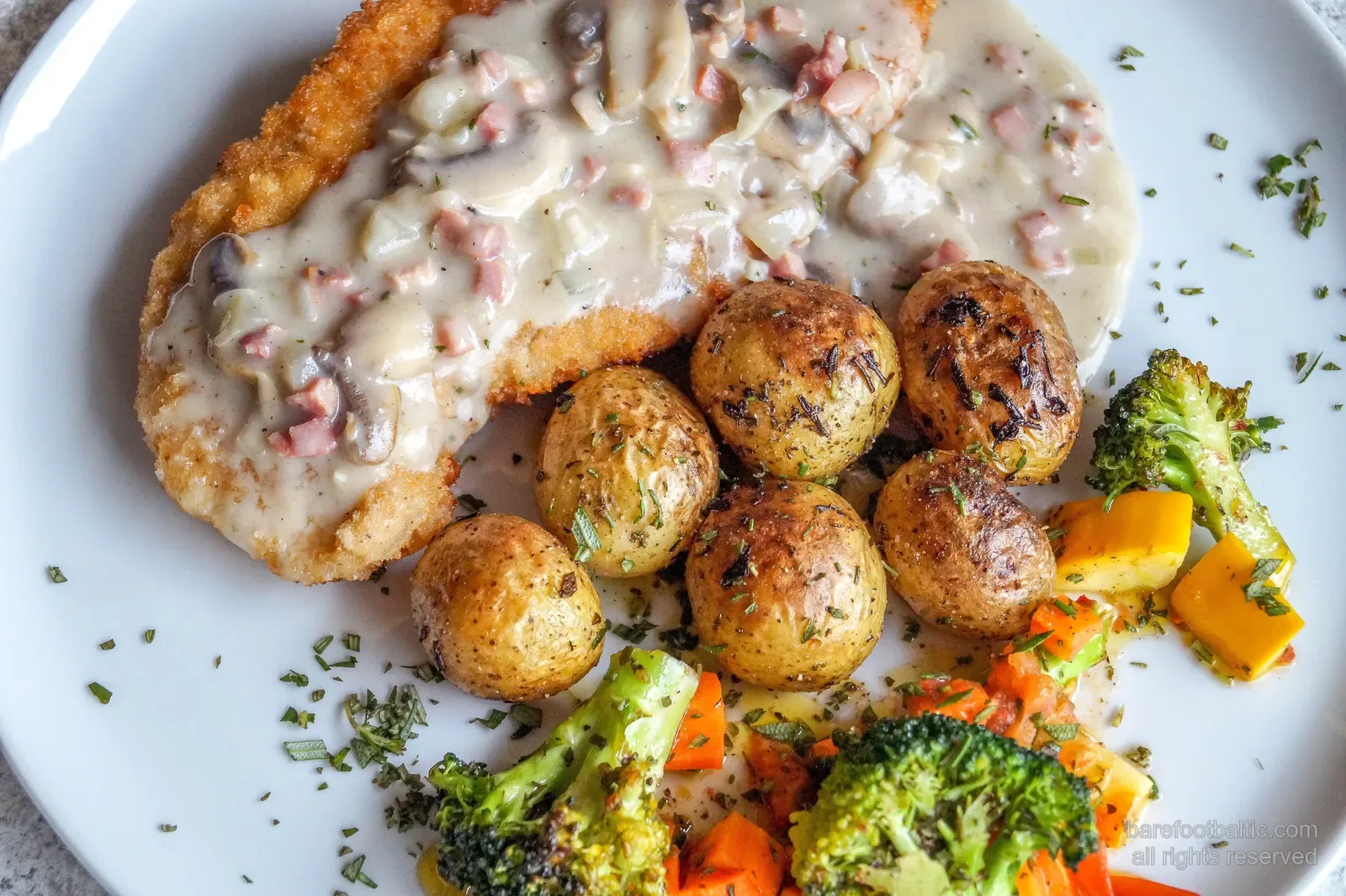
Karbonāde is the Latvian take on schnitzel. Pork loin, pounded thin, breaded with rye breadcrumbs, fried golden in butter, served with a generous ladle of creamy chanterelle mushroom sauce, alongside boiled potatoes and pickled vegetables. It is the Sunday lunch of countless Latvian childhoods, the kind of plate every grandmother has a slightly different recipe for, and the dish I’d order at any traditional restaurant where the menu doesn’t make me curious.
The chanterelle sauce matters. Latvian forests are full of wild chanterelles in late summer and autumn (foraging is part of the national psyche, more on this in a moment), and a proper karbonāde uses real chanterelles, gently fried in butter with shallot, finished with cream and dill. The cheaper restaurants use button mushrooms. You can taste the difference.
The drinks shelf
Riga Black Balsam
The Latvian national liqueur, dark as motor oil, 45% alcohol, made from a closely guarded recipe of 24 herbs, roots, and spices, in production since 1752. It’s an acquired taste, and the way it’s usually first poured for visitors (a shot at room temperature) is the worst possible introduction. The Latvian way is to drink it mixed. A tablespoon stirred into a glass of hot blackcurrant juice in winter, or into hot tea with honey, or over ice with a splash of bitter lemon. The blackcurrant version (called Black Balsam Currant, and yes, the company makes a sweeter ready-to-drink version too) is delicious and is what I’d serve a first-time visitor. There’s a Black Balsam museum and tasting bar at Riga’s Old Town if you want the full version.
Kvass
Slightly alcoholic (around 1%), slightly fizzy, slightly sweet fermented rye bread drink. Sold in bottles in every supermarket in summer, served on tap from yellow tanker-trucks parked in city squares in July (this is not a joke, look for them, they’re bright yellow and you can’t miss them). Kvass tastes a bit like flat dark beer mixed with lemonade and is properly refreshing on a hot day. The brand to look for is Ilgārzemes Kvass from the local brewery, but supermarket Cido is fine.
Bērzu sula, the spring drink with a narrow window
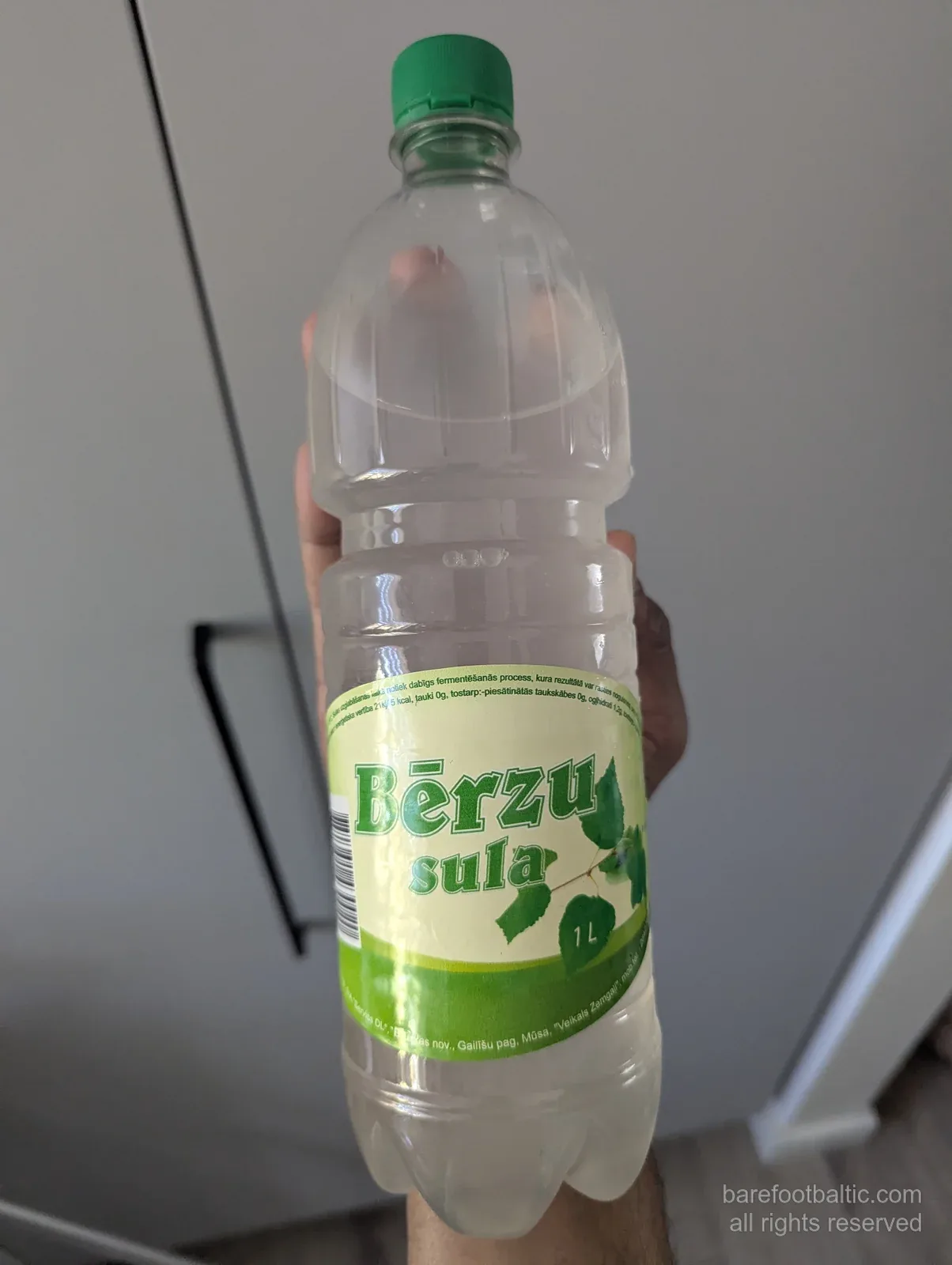
Bērzu sula (literally “birch sap”) is the clear, faintly sweet tree water that runs in birches for a few short weeks in spring, when the sap rises before the leaves come in. People used to tap their own from a tree in the garden, hammer in a wooden spigot, leave a bottle dangling overnight. In the last few years Latvian supermarkets have started stocking it too, in plain 1-litre PET bottles with a hand-drawn-looking green label, for under a euro. It tastes like water with a hint of forest floor, very slightly sweet, very slightly mineral. After a few days in the bottle it can develop a quiet natural fizz from spontaneous fermentation, which is normal and is on the label. The window is narrow, roughly mid-April to early May depending on the year. If you’re here in spring and see a fresh stack in the chilled drinks aisle, buy a bottle and drink it cold. You can’t get this back home.
Beer
Latvia has a serious beer culture, much older than the craft-beer wave (we’ve been brewing for centuries) but reinvigorated by it. The big mass-market brands are Aldaris, Cēsu, and Užavas, all decent, all light lagers. The interesting beers come from small breweries. Look for Malduguns from Cēsis, Brūveris in Riga, Valatas in Liepāja. Most Riga restaurants have a small craft-beer list. A pint costs €4 to €6.
Latvian wine
Yes, this exists, and it’s having a moment. We don’t grow grapes (too cold), but we make wine from rhubarb, currants, gooseberries, sea buckthorn, and apples, often beautifully. Look for Abavnieki rhubarb wine or any of the small farmhouse wineries in the Vidzeme region. Strange, often sweet, sometimes excellent. Worth at least one bottle as an experiment.
Where to actually eat in Riga
Three or four places I rate, kept short on purpose. These are the ones I’d send a friend to.
For grazing, the Riga Central Market
I keep mentioning this market and that’s deliberate, it’s the single best food experience in Riga and the cheapest. Five enormous Zeppelin-hangar buildings just south of the Old Town, one each for meat, fish, dairy, vegetables, and gastronomy. Go for lunch, walk every hangar, taste freely (most stalls will offer samples), and assemble your own meal. Smoked fish, rye bread, biezpiens, pickled cucumbers, a piece of smoked cheese, a slice of sklandrausis. Lunch for two for €15. The fish hall is the most photogenic.
For modern Latvian, try Bibliotēka Nº1, Vincents, or 3 Pavāru Restorāns
If you want to eat the modern, refined version of Latvian food (still local ingredients, still seasonal, still recognisable, but plated like art and priced accordingly), these are the three I’d send you to. Bibliotēka Nº1 is the most relaxed of the three and has the best wine list. Vincents is the most ambitious and the only one that approaches the Michelin-star end. 3 Pavāru Restorāns (“3 Cooks Restaurant”) is the open-kitchen, chef-led, tasting-menu option that locals know about and tourists mostly don’t. Reservation needed at all three. Expect €40 to €80 per person with wine.
For traditional Latvian without the tourist tax, Lido
Lido is a Latvian chain of self-service restaurants serving classic Latvian dishes at honest prices. It’s not fancy and it’s not trying to be, but the food is good versions of pelēkie zirņi, karbonāde, biezpiens dishes, and rasols, at €8 to €15 a plate. The Lido Atpūtas Centrs in the suburbs is the famous big one (huge, with a kids’ play area, often full of Latvian families on Sundays), but there are smaller branches throughout the city centre. This is where to go if you want to taste twelve traditional dishes in one sitting without a tasting menu price tag.
The seasonal calendar
Latvian food is properly seasonal. What’s on the table changes month by month. Here’s the quick version.
- Spring (March to May) brings the first wild garlic in April, fresh bērzu sula (birch sap) on supermarket shelves for the few short weeks it’s in season, fresh dill returning, new potatoes by May, the first asparagus from local farms, and fresh kefir tasting different because the cows are back on grass.
- Summer (June to August) is aukstā zupa season, with fresh berries (strawberries first, then bilberries, then raspberries, then blackcurrants), foraged chanterelles starting late July, cold smoked fish on the beach, and kvass from the yellow trucks.
- Autumn (September to October) is peak mushroom-foraging madness (chanterelles still going, then porcini, then a dozen others), with apple and pear season, sklandrausis at the autumn markets, and plums for slivovitz.
- Winter (November to February) means pelēkie zirņi for the solstice, hot smoked fish from the market, hearty bread soups, kliņģeris on namesdays, and Black Balsam in hot blackcurrant juice on dark afternoons.
What to skip, what’s overrated
The blunt bit, because I owe you that.
Skip the “medieval-themed” tourist restaurants in the Old Town, the ones with serving staff in costume and roast wild boar on the menu. The food is mediocre at best, the prices are double the Lido equivalent, and the “authentic medieval Latvian recipe” on the menu is invented for tourists.
Riga Black Balsam at room temperature. Almost no Latvian drinks it that way. If a bartender pours you a shot at room temperature with no chaser, they’re hazing you. Order it mixed with hot blackcurrant juice and you’ll see why we love it.
The pelēkie zirņi thing. I love this dish. But not every visitor will, and that’s fine. If you try one bite and decide it’s not for you, eat a bit of biezpiens and rye bread instead and we’ll call it a draw.
Frequently asked questions about Latvian food
Daiga Taurīte is a licensed Latvian tour guide and co-founder of Barefoot Baltic, which runs small-group day excursions from Riga. She grew up on this food in Riga. Two decades in London made her appreciate it properly. Barefoot Baltic is licensed by Latvia’s Consumer Rights Protection Centre (PTAC), holds ATD passenger transport licence PS-01995, and is insured by BTA Baltic for civil liability.
If you want to taste your way through this list with someone who can read the menu in Latvian, we run market tours and food-themed walks in Riga on request. Get in touch with your dates and dietary notes, and we'll build a half-day around it.