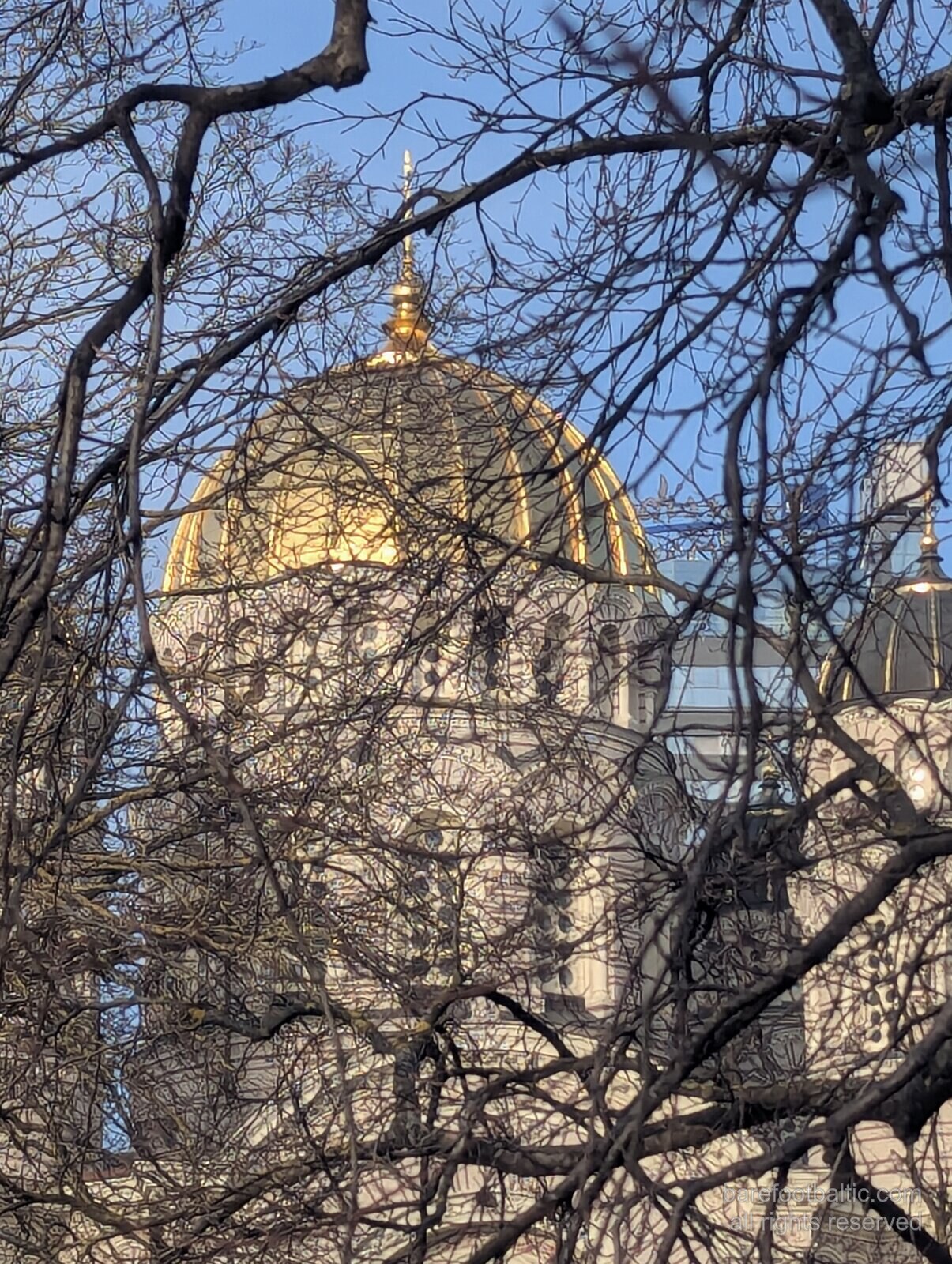
There’s a moment, walking down Brīvības bulvāris on a low autumn afternoon, when the sun catches the five gilded domes of Riga’s Nativity of Christ Cathedral and the whole sky seems to tilt. Locals barely look up. They pass it every day. But for a visitor, it stops you. Latvia is associated, abroad, with Lutheran spires and Catholic basilicas, so the sudden Byzantine drama of an Orthodox cathedral, all gold and ochre and copper, can feel like walking into the wrong fairytale.
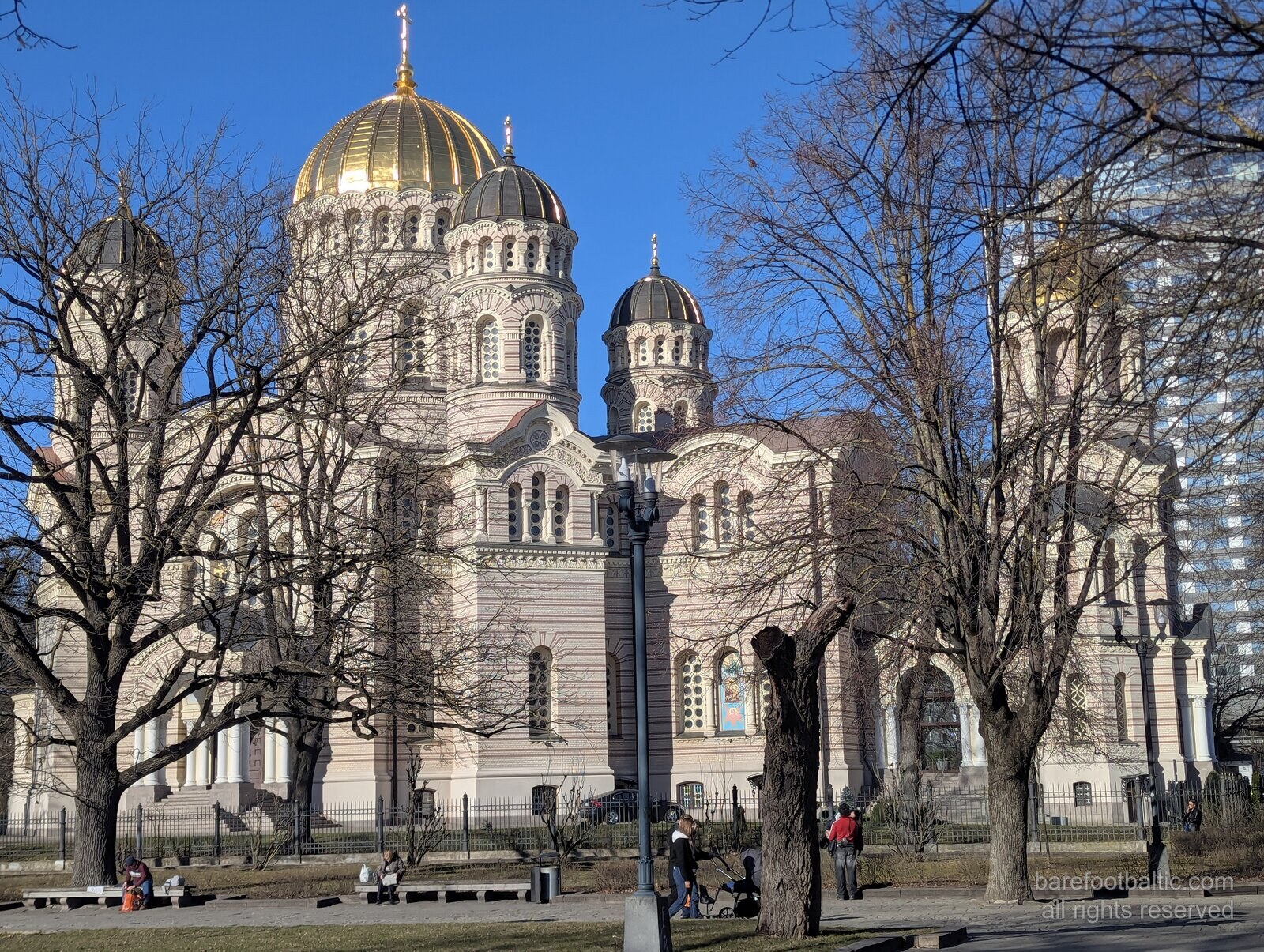
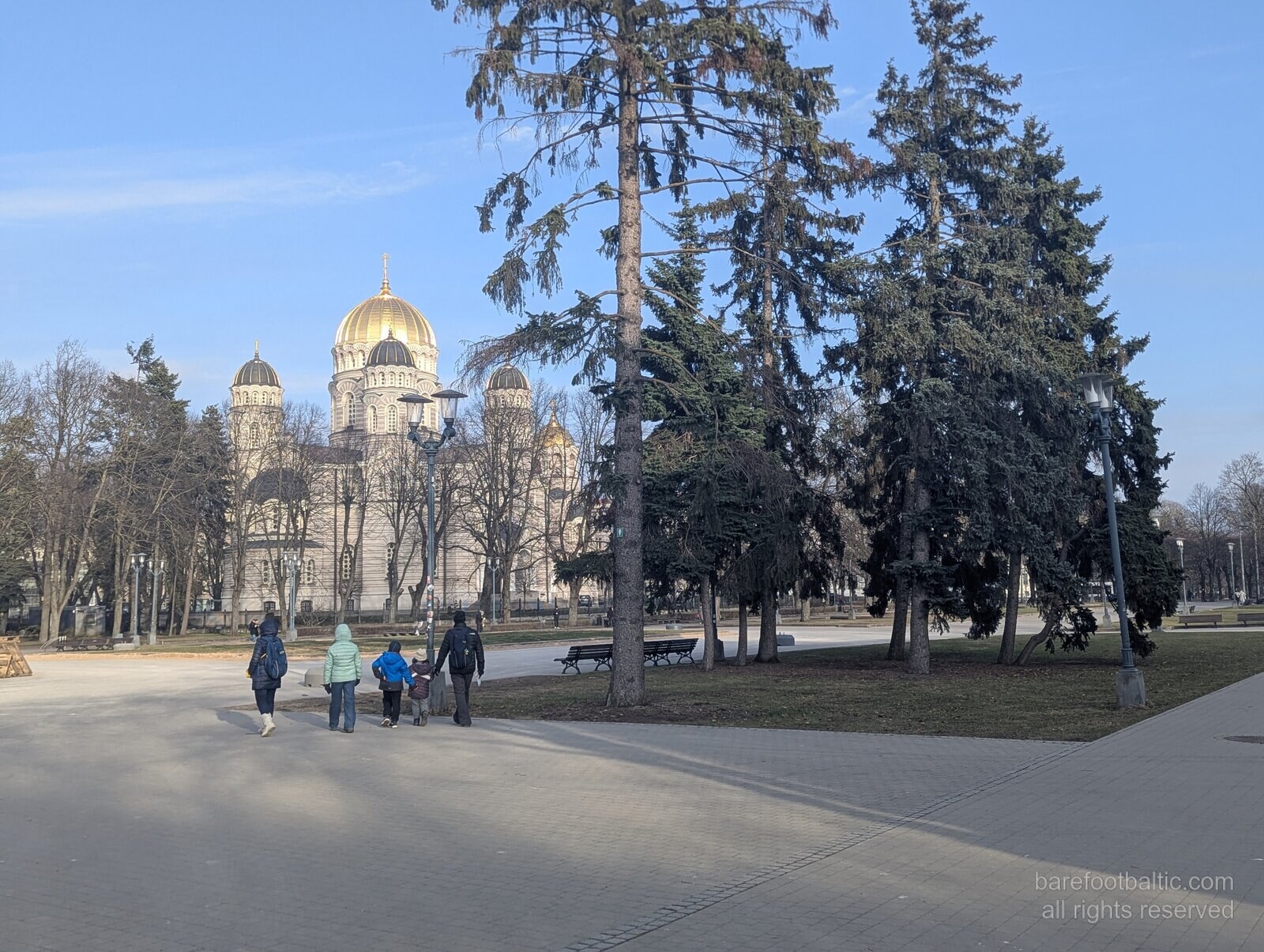
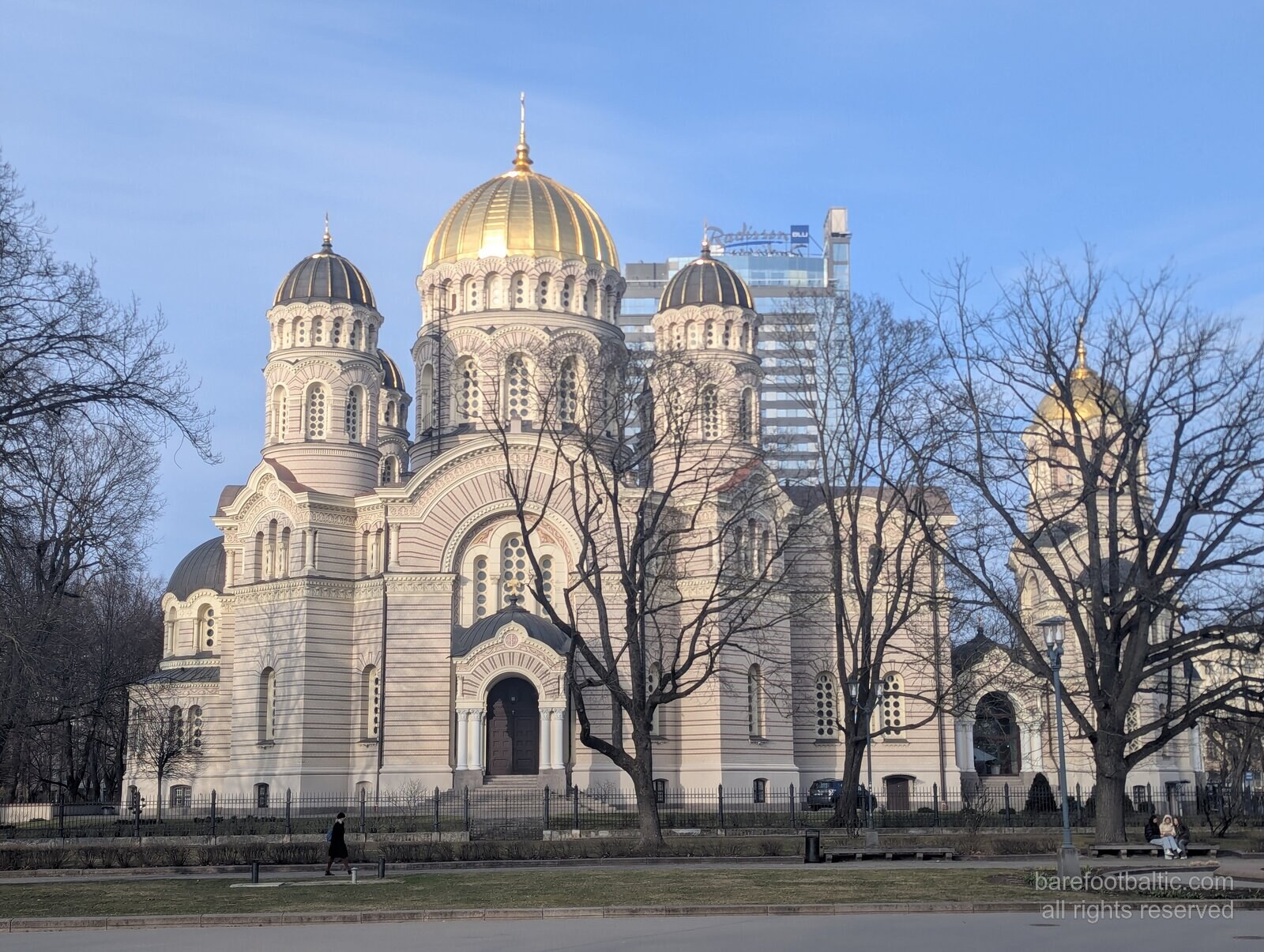
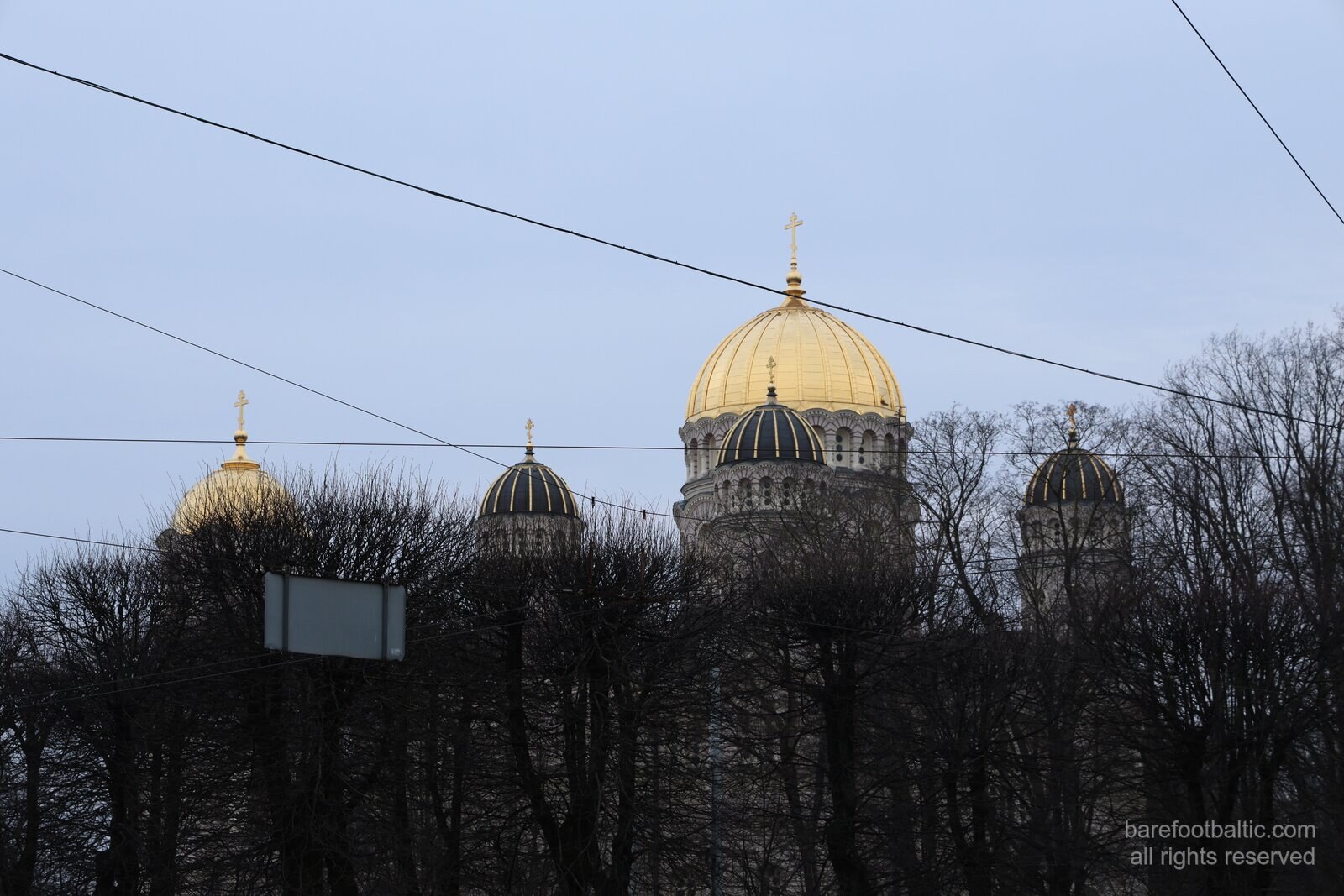
Photos: all five images below are of the Nativity of Christ Cathedral on Esplanāde, photographed across spring 2026. Tap any thumbnail or hero image to enlarge.
That surprise is the doorway. If you take it, you’ll find a religious tradition older than the Lutheran reformation, deeply tied to Latvia’s Russian-speaking communities, and the most visually generous of any Christian tradition you’ll encounter here.
This guide is for the curious traveller. You don’t need to be religious or Christian. Orthodox churches in Latvia are, almost without exception, open to visitors of every faith and none. A quiet hour spent inside one is among the more memorable things you can do in Riga.
Why visit an Orthodox church at all?
If you’ve already done St Peter’s tower and Riga Cathedral and you’re wondering what’s left, here’s the answer. Orthodox churches are experienced differently. There are no pews, no sitting, no processing from A to B. You stand, you wander, you light a candle if you want to. The senses are deliberately overloaded. Beeswax and incense in the air, deep choral singing if a service is happening, gold leaf catching every flicker of candlelight. It’s unapologetically beautiful, and you can walk straight in.
For travellers used to the austere whitewashed interiors of Lutheran churches just streets away, the contrast is the whole point.
Orthodox churches to visit in Riga
All four of the main Orthodox churches in Riga are working parishes, but they receive visitors warmly outside service times. None charges admission. A small donation in the candle box is the polite way to say thank you.
| Church | Address | Built | Style | Notable for |
|---|---|---|---|---|
| Nativity of Christ Cathedral | Brīvības bulvāris 23 | 1876–1884 | Neo-Byzantine | Largest Orthodox cathedral in the Baltics; five gilded domes; survived being a Soviet planetarium |
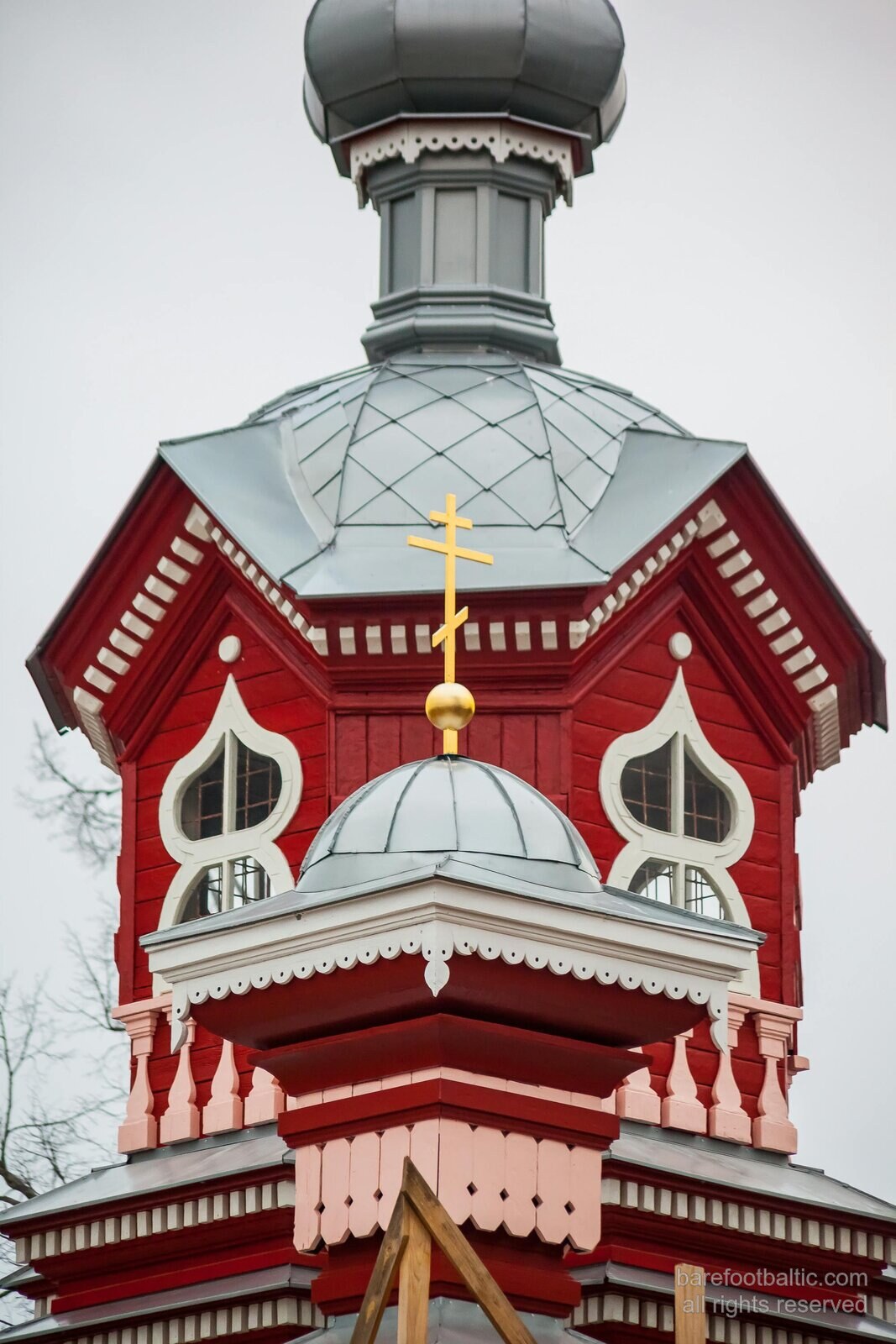
| Holy Trinity Cathedral of Pārdaugava | Meža prospekts 2 (Āgenskalns) | 1893–1895 | 17th-c. Moscow style | Painted onion domes, frescoes by P. Zikov, three-tier limewood iconostasis |
| St Alexander Nevsky Church | Brīvības iela 56 | 1820s | Wooden rotunda | Only wooden Orthodox rotunda in Riga; pre-dates the Nativity Cathedral by 60 years |
| Grebenshchikov House of Prayer (Old Believers) | Krasta iela 73 | 1814 (rebuilt 1906) | Neoclassical | Largest Old Believer parish in the world (~25,000 members); not strictly Orthodox but architecturally remarkable |
One note on the Grebenshchikov community. They’re Old Believers, who broke from the Russian Orthodox Church in 1653 over liturgical reforms imposed by Patriarch Nikon and have practiced an older form of the rite ever since. They’re not strictly Orthodox in the canonical sense. Worth seeking out, though, if you want to understand how schisms inside Eastern Christianity played out on Latvian soil.
How to visit, opening hours and practical info
| Nativity Cathedral | Holy Trinity Pārdaugava | St Alexander Nevsky | Grebenshchikov | |
|---|---|---|---|---|
| Typical hours | ~07:00–18:30 daily | Around services | Around services | Around services |
| Entry | Free | Free | Free | Free |
| Donations | Welcome | Welcome | Welcome | Welcome |
| Photography inside | Not permitted | Not permitted | Not permitted | Not permitted |
| Headscarves provided | Yes, at entrance | Sometimes | Bring your own | Bring your own |
| Walking time from Old Town | 10 min | 25 min (or tram) | 15 min | 20 min |
Hours flex around services and major feast days. For active worship visitors, services typically run early morning (around 8:00) and evening (around 17:00), with the main liturgy on Sunday mornings. If you want quiet contemplation rather than active worship, mid-afternoon on a weekday is the most reliable time.
Visitor etiquette and the rules
Orthodox churches are open and hospitable, but they’re also working houses of prayer. The rules are simple, sensible, and the same ones that would apply at any serious religious site anywhere in the world.
Dress code
- Everyone: cover shoulders and knees. Vests and shorts will get you turned away.
- Women: head coverings are traditional. Most cathedrals keep a basket of scarves at the entrance for visitors who haven’t brought one. Carry a light scarf in your bag if you’re unsure.
- Men: remove all hats and caps before entering.
- Avoid: tight clothing, low necklines, mini-skirts, anything with loud logos.
Behaviour inside
- Stand quietly. There are no pews. Orthodox worship is conducted standing. Benches along the walls are reserved for the elderly and infirm.
- Don’t cross the central aisle during a service.
- Speak in whispers, or not at all. Sound carries dramatically under Orthodox domes.
- Move slowly. No rushing, no calling across the nave.
Photography
- No photos inside. Even when no signs are posted, this is universal. Especially during services.
- Photograph the exterior as much as you like.
- No flash, no tripods, no video under any circumstances.
Lighting a candle (you’re welcome to)
- Drop a coin in the box, take a thin beeswax candle, light it from one already burning, place it in the sand or holder.
- You don’t need to be Orthodox or Christian. It’s a quiet contemplative gesture extended to all visitors.
- If a service is in progress and the candle stand is up front, wait until afterwards.
Icons and relics
- Don’t venerate icons (kissing, touching) unless you’re a believer doing so deliberately. Skipping it isn’t offensive. It’s what non-Orthodox visitors are expected to do.
- If you do choose to: never wear lipstick or balm. It damages the surface.
- Don’t lean on icon stands to take photos of yourself.
How many Latvians are Orthodox?
Depending on the survey, somewhere between 13% and 26% of Latvia’s population identifies as Orthodox Christian. That makes it the third-largest, or on some measures even the largest, Christian denomination in the country.
| Source | Year | Orthodox % | Lutheran % | Catholic % |
|---|---|---|---|---|
| Latvian Ministry of Justice | 2022 | 13% | 37% | 19% |
| SKDS sociological survey | 2018 | 26% | 17% | 20% |
| Pew Research Center | 2017 | 31% | 19% | 23% |
| ISSP survey | 2015 | 19.7% | 17.8% | 18.5% |
| CIA World Factbook | 2017 | 19.1% | 36.2% | 19.5% |
The discrepancy is a familiar one in post-Soviet states. It depends whether you count active parish membership, which gives lower numbers, or cultural self-identification, which gives higher ones.
What’s unambiguous is that Orthodoxy is concentrated in two places, Riga and the eastern region of Latgale. It’s overwhelmingly tied to the Russian-speaking minority, though there has always been a Latvian-speaking Orthodox community too. Services in Latvian were granted as far back as the 1840s.
Where in the world are Orthodox Christians found?
Orthodox Christianity is the second-largest branch of Christianity globally, after Catholicism, with somewhere between 220 and 260 million adherents. Unlike Catholicism, it never spread through Western European colonisation, so its geography is concentrated and recognisable. It runs in a belt through Eastern Europe, the Balkans, the Caucasus, and into the Levant.
| Country | Orthodox Population | % of Country |
|---|---|---|
| Russia | 101 million | 71% |
| Ukraine | 28 million | 65% |
| Romania | 16 million | 81% |
| Greece | 9.4 million | 90% |
| Belarus | 7.8 million | 83% |
| Serbia | 6.7 million | 85% |
| Bulgaria | 4.4 million | 59% |
| Georgia | 3.8 million | 84% |
| Moldova | 3.0 million | 93% |
| United States | 1.8 million | <1% |
| Germany | 1.5 million | 2% |
| Spain | 1.5 million | 3% |
| North Macedonia | 1.3 million | 65% |
| Bosnia & Herzegovina | 1.0 million | 31% |
| Italy | 0.9 million | 2% |
| Cyprus | 0.7 million | 89% |
| Montenegro | 0.4 million | 72% |
| Latvia | 0.35–0.4 million | 13–18% |
| Albania | 0.2 million | 7% |
| Estonia | 0.18 million | 14% |
Ethiopia is worth a note of its own. The Ethiopian Orthodox Tewahedo Church has around 36 million members, making it one of the largest Orthodox churches in the world. But it’s part of the Oriental Orthodox communion (along with the Coptic, Armenian, Syriac, and Eritrean churches), not Eastern Orthodox. The two have been separate since the Council of Chalcedon in AD 451.
Romania catches travellers out more than anywhere else in Europe. Romanian is a Romance language, Latin-derived like Italian and Spanish, which makes the country linguistically Western. But it sat on the historical dividing line between Rome and Constantinople, and after the Great Schism of 1054 its church aligned with Constantinople. Romanian Orthodox today number about 16 million, second only to the Russian Orthodox Church in Eastern Orthodoxy.
A brief history of Orthodoxy in Latvia
Orthodoxy came to Latvian soil very early, in the 11th century, as a mission outpost of the Russian Orthodox diocese of Polotsk. That predates the Catholic crusades that converted the region in the 12th and 13th centuries. Some Latgalian noblemen converted voluntarily in this period. Archaeological evidence shows Eastern Orthodox churches operating in the principality of Jersika before the Teutonic conquest.
The big change came after Latvia was absorbed into the Russian Empire in the 18th century, following the Great Northern War. Russian settlers, soldiers, and officials brought their faith with them, and the imperial state funded churches as a matter of policy.
| Period | What happened |
|---|---|
| 11th century | Orthodoxy first arrives via missions from Polotsk |
| 13th century | Catholic Teutonic Order conquers Latvia; Orthodoxy reduced to merchant communities |
| 18th century | Latvia annexed to Russian Empire; Orthodox population grows |
| 1840s | 40,000 Latvian peasants convert from Lutheranism to Orthodoxy; Latvian-language services permitted |
| 1876–1884 | Nativity of Christ Cathedral built in Riga |
| 1917–1918 | German occupation turns the Cathedral into a Lutheran church |
| 1921 | Archbishop Jānis Pommers defends the Latvian Orthodox Church under independence |
| 1934 | Pommers murdered; canonised in 2001 |
| 1940–1991 | Soviet occupation: churches closed, the Nativity Cathedral becomes a planetarium |
| 1991 | Latvian independence; Orthodox Church returned, restoration begins |
| 2022 | Latvian parliament directs the LOC to declare independence from the Russian Orthodox Church |
What makes Orthodoxy different from other forms of Christianity?
The split that created Eastern Orthodoxy was the Great Schism of 1054. It divided Christianity along roughly geographical lines. The Latin-speaking West became Roman Catholic, and later spawned the various Protestant traditions. The Greek-speaking East became Orthodox.
Orthodoxy never had a Reformation, so it never stripped its churches of imagery or simplified its liturgies. It never had a Counter-Reformation either, so it never rationalised or systematised its theology in the way Catholicism did at Trent. What you see in an Orthodox church today is, in its essential form, what a Christian in Constantinople would have seen in the 9th century.
| Feature | Orthodox | Catholic | Protestant |
|---|---|---|---|
| Central head | None. A communion of national churches | Pope in Rome | Varies / none |
| Calendar | Often Julian (Christmas Jan 7) | Gregorian | Gregorian |
| Clergy marriage | Parish priests can marry | Celibate (Latin rite) | Most allow |
| Icons | Venerated as “windows into heaven” | Used but not central | Generally avoided |
| Liturgy | Sung throughout, no instruments | Spoken or sung, often with organ | Varies widely |
| Iconostasis | Yes, the central architectural feature | No | No |
| Pews | None traditionally | Yes | Yes |
| Service language | Local language or Church Slavonic/Greek | Local language (was Latin until 1960s) | Local language |
| Number of sacraments | 7 (“mysteries”) | 7 | Usually 2 |
Why all the gold? Why blue? Why so much ornamentation?
This is the question every visitor asks, and there’s a real theology behind it.
The gold is light. Gold leaf in Orthodox iconography and architecture isn’t decorative wealth. It represents uncreated divine light, the same light that surrounded Christ at the Transfiguration. When candles flicker against gilded surfaces in a darkened church, the entire space becomes a moving icon of divine presence. The effect is the message.
The blue is heaven. Blue in Orthodox interiors, particularly inside domes, represents the heavens. Combined with gold stars and the figure of Christ Pantocrator (Ruler of All) at the apex, the dome becomes a visual cosmology. Stand under it and you stand at the meeting point of heaven and earth. This is why Orthodox churches are typically built around a central dome rather than a long nave. The building itself is meant to be a microcosm of creation.
The ornamentation makes a theological argument. Orthodoxy resolved an internal crisis about religious imagery, the iconoclast controversy of the 8th and 9th centuries, by declaring that because God became human in Christ, matter itself can be holy. Wood, paint, gold, stone, incense, beeswax, song. All of these can carry sacred meaning. So the maximalism isn’t decorative excess. It’s a deliberate theological argument that the physical world matters and can be transfigured by grace.
The iconostasis is the most distinctive feature, the wall of icons that separates the nave from the altar. It evolved over centuries from a low screen into a full wall, organised in tiers (Christ, Mary, John the Baptist, Apostles, Prophets, Feast Days). It functions both as a barrier (the altar is the “Holy of Holies”, entered only by clergy) and as a window (when the central Royal Doors open during the liturgy, heaven is symbolically opened to earth).
How does this compare to Greek, Armenian, and Anglican churches?
| Tradition | Family | In communion with Eastern Orthodox? | Visual style |
|---|---|---|---|
| Russian Orthodox | Eastern Orthodox | Yes | Onion domes, gold-and-blue, tall iconostases |
| Greek Orthodox | Eastern Orthodox | Yes | White marble, lower iconostases, Mediterranean light |
| Serbian Orthodox | Eastern Orthodox | Yes | Frescoes, Byzantine geometry |
| Romanian Orthodox | Eastern Orthodox | Yes | Some Latin influences, painted exteriors in Bucovina |
| Armenian Apostolic | Oriental Orthodox | No (separated 451 AD) | Conical domes, simpler stone interiors |
| Coptic Orthodox | Oriental Orthodox | No (separated 451 AD) | Egyptian-influenced, distinctive iconography |
| Ethiopian Tewahedo | Oriental Orthodox | No (separated 451 AD) | Round churches, drum-led liturgy |
| Roman Catholic | Western Christianity | No (separated 1054) | Long nave, statues, organ music |
| Anglican | Western Protestant | No | Stained glass, pews, hymns |
| Lutheran | Western Protestant | No | Austere whitewashed interiors |
Greek and Russian Orthodox are the closest cousins to what you’ll see in Riga. Same theology, same sacraments, different aesthetic accents. Armenian churches share the icon-rich sensibility but belong to a different communion. Anglican and Lutheran churches sit in a fundamentally different theological world, with no iconostasis, no veneration of icons, and a different sacramental theology.
Notable Orthodox churches outside Riga
Latvia is small, and a day’s drive can take you to several remarkable Orthodox sites well outside the usual Riga circuit.
| Church | Location | Notable for |
|---|---|---|
| Sts Boris & Gleb Cathedral | Daugavpils (Church Hill) | Largest Orthodox church in Latvia (capacity 5,000); ten gilded cupolas; built 1900–1905 |
| St Nicholas Naval Cathedral | Karosta, Liepāja | Tsarist naval cathedral 1900–1903; gilded domes against Soviet-era submarine base; foundation laid by Tsar Nicholas II |
| Liepāja Holy Trinity Cathedral | Liepāja town centre | Built 1868, rebuilt 1895–1896 |
| Saints Simeon & Anna Cathedral | Jelgava | Striking blue and white exterior; main Orthodox church of Zemgale |
| Holy Spirit Orthodox Church | Jēkabpils | Baroque-style Orthodox church (unusual combination) |
| Spaso-Preobrazhenskaya Hermitage | Near Jelgava | Founded 1894–1896; convent and pilgrimage site |
| Mārciena Manor Church | Mārciena | Designed 1872 by Jānis Frīdrihs Baumanis; sits on a hill above the manor |
| Slutiški Old Believer Village | Daugavpils area | Ethnographic village on the Daugava; not Orthodox proper but extraordinary atmosphere |
The Latgale region in eastern Latvia has the highest density of small wooden Orthodox and Old Believer churches in the country. Daugavpils Church Hill is a particularly remarkable stop. Four churches of four different denominations (Orthodox, Catholic, Lutheran, Old Believer) stand within a few hundred metres of each other, a rare demonstration of religious coexistence.
A final thought
If you’re in Riga for two or three days, walk into one Orthodox church. Just one. Skip the Wikipedia entry beforehand. Cover your shoulders, slip on a scarf if you have one, push open the heavy door and stand still for ten minutes.
You’ll notice the silence first. It’s a different silence from the Lutheran or Catholic kind, carrying incense and beeswax. Then the gold will start to register. The eyes of the icons. A deep choral hum if a service is happening somewhere in the distance. You won’t understand the language. That’s fine. The architecture is doing most of the talking.
This is one of those encounters travel makes possible. Latvia doesn’t “own” Orthodox Christianity, but it is one of the few places in Europe where the full richness of the Eastern Christian tradition sits, alive and accessible, alongside the Lutheran and Catholic traditions more visitors expect. To skip past the Orthodox churches because they look unfamiliar is to miss half the story of this country.
Walk in. They’re waiting for you.
If you want all four of Riga's working Orthodox parishes walked in one afternoon, with the etiquette explained as we go, that's a private half-day we run on request. Get in touch and we'll fold it into your Riga days.