Last updated: 24 October 2026
Sigulda is the day trip I send people on more than any other in Latvia. It's an hour from Riga by direct train, it sits at the edge of Gauja National Park, and it stacks a serious medieval castle, a Soviet-era cable car across the valley, an Olympic bobsleigh track, and a sculpture garden of folk songs into one walkable day. I've guided this loop for years. In mud, in late-September gold light, with snow on the ruins, with one guest who turned out to be a Polish historian and corrected me three times.
What follows is the list, in the order I'd actually walk it. Fourteen stops, with my pacing on each.
How to use this list
This is ordered the way I'd walk it from the train station. Town side first, then across the cable car to the valley's north bank, down to Turaida, then back into Sigulda for the evening. Most stops are free. Three need a ticket, one needs a booking, one only runs on weekends. I've marked each with how long it actually takes, not what the museum signage says. Half a day from Riga, do stops 1 through 7 and skip the rest. A full day with light to spare gets you about ten of the fourteen.
If you'd rather have someone else drive and tell the stories, our Sigulda, Cēsis & the Gauja Valley day trip covers the highlights with a Latvian guide. €94 per adult, year-round, small group up to twelve.
1. Sigulda Medieval Castle (Siguldas viduslaiku pilsdrupas)
Open: daily, dawn to dusk · Price: free · Time needed: 30–45 minutes · Best season: year-round
Start here, because it's a fifteen-minute walk from the train station and because this is the older of Sigulda's two castles. The Livonian Brothers of the Sword built it in 1207, on a sandstone outcrop above the Gauja, as a forward base in the German military order's century-long push north. They held it for the next three hundred years. The Great Northern War finished it. What you walk through today is a partial reconstruction laid into the original footprint, with wooden walkways across the ruins and a small viewing platform on the south tower's footprint.
Free entry. No ticket booth, no English signage worth mentioning. I'd give it half an hour. The reason to come isn't the castle itself. The museum at the New Castle next door does the interpretive heavy lifting. Come for the view from the south wall instead, the Gauja valley opening up in front of you, the cable car cables drawing a line across the gap to Krimulda. That's the geography of the day laid out in one frame.
2. Sigulda New Castle (Siguldas Jaunā pils)
Open: Tue–Sun, check the museum's current hours · Price: around €3 · Time needed: 30 minutes · Best season: year-round (indoor)
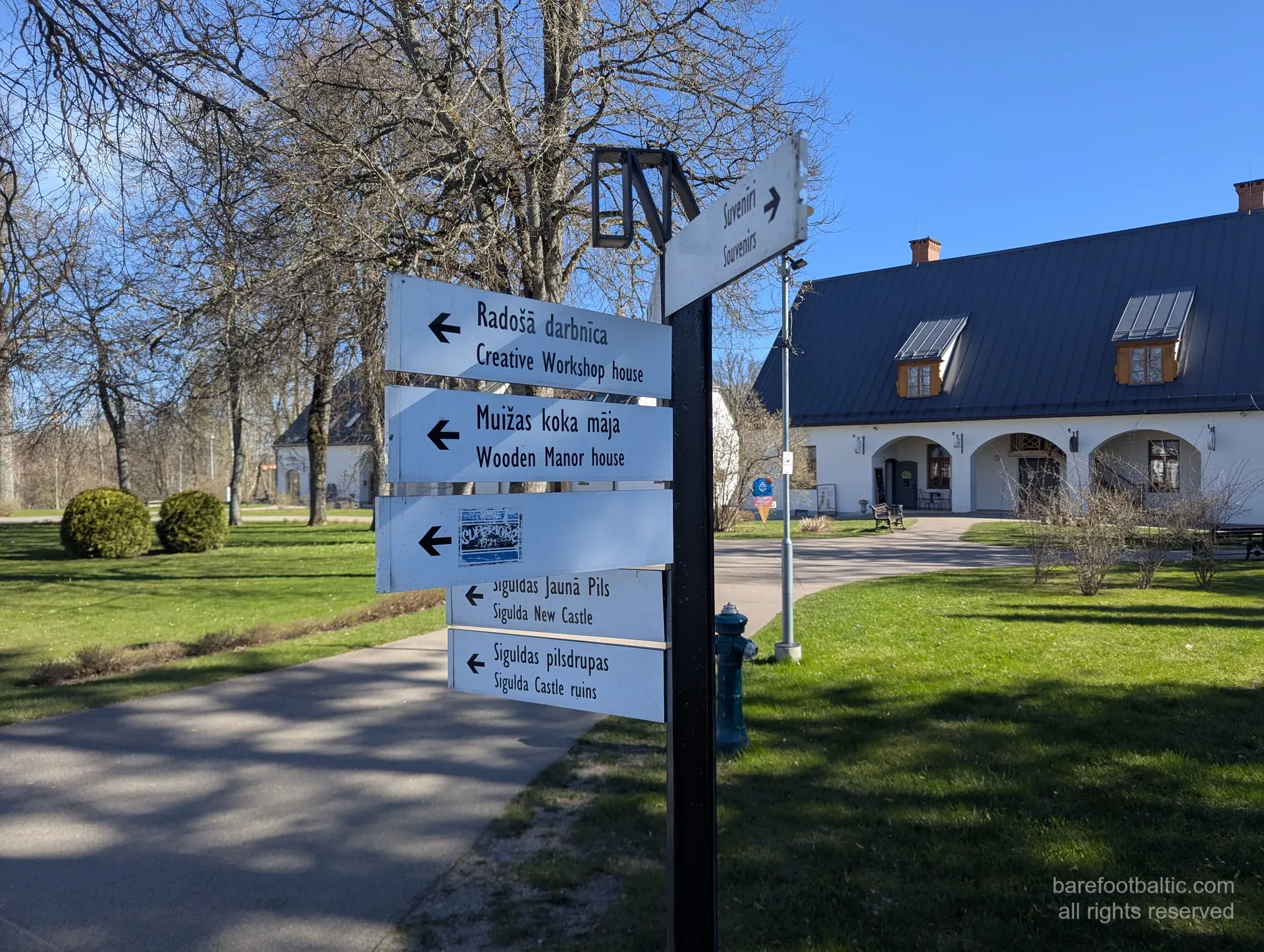
Next door, fifty metres from the medieval ruin, sits the New Castle, a late-19th-century neo-Gothic mansion built as the estate house for the Russian Kropotkin family on the foundation of the older manor. It's now the Sigulda Regional Studies Museum, with a part-time Writers' House in the south wing. The museum is small and properly thorough. It covers the region from the Livonian Order period through the Baltic-German estate years and into the Soviet decades after 1944. The Soviet rooms are honest.
Look up at the carved ceilings on the first floor. The east stair has the original wrought-iron banister. Entry is cheap (around €3 in 2026). Twenty minutes is enough on a sunny day. Longer in bad weather.
3. The Sigulda cable car (Siguldas gaisa trošu vagoniņš)
Open: daily, 10:00–18:00 · Price: €14 return · Time needed: 15 minutes (5-minute crossing each way) · Best season: late September for the autumn valley
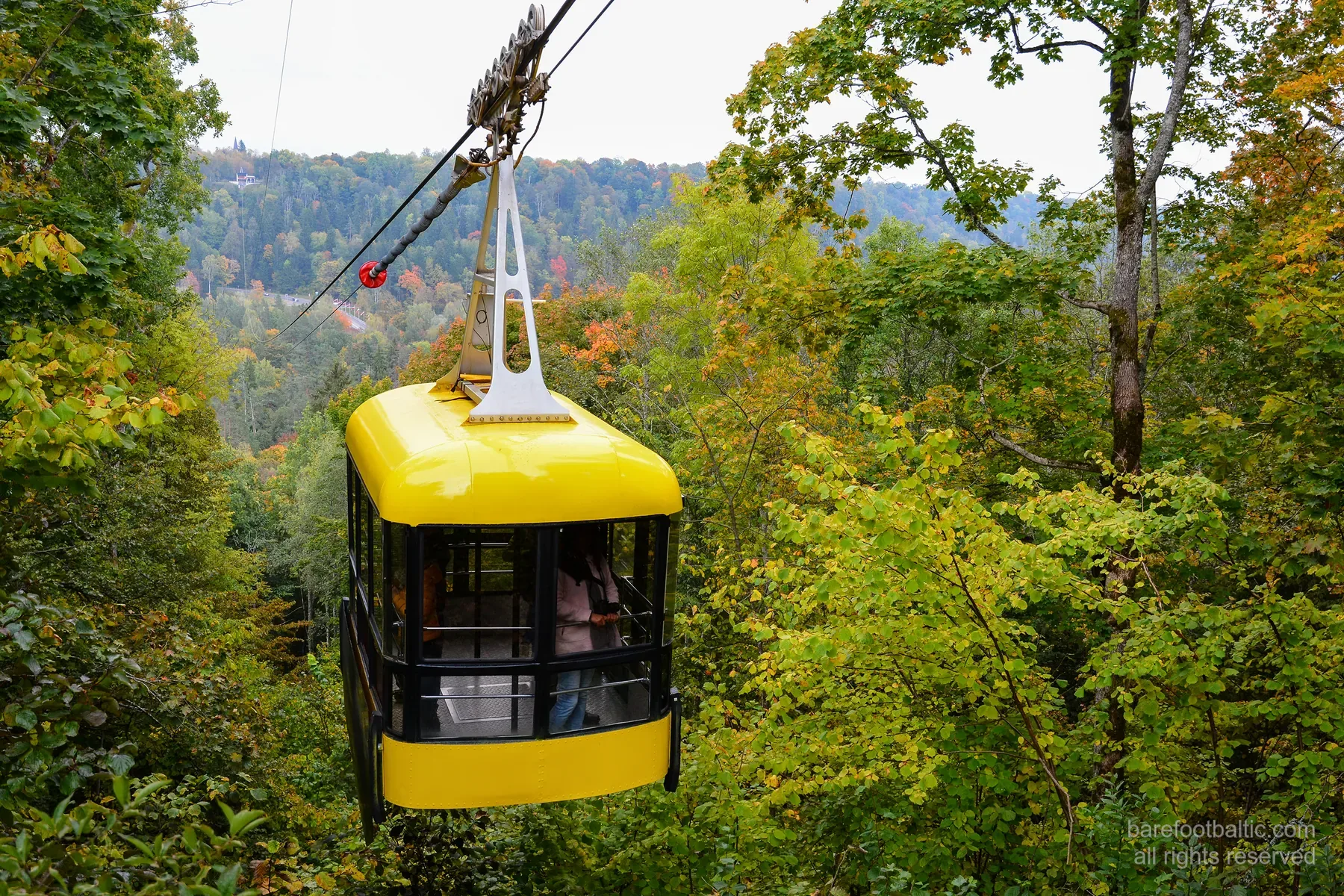
From the New Castle it's a ten-minute downhill walk to the cable-car station. The cabin is a yellow Soviet-era box that has been running across the Gauja valley to Krimulda since 1969. It's the only working cable car in the Baltic states. The crossing takes five minutes. The cables sag at the deepest point and you can feel the wind from inside the cabin. Most days that's a feature, not a problem.
It runs ten in the morning to six in the evening, year-round in normal conditions, €14 return as of 2026. The view at the midpoint is the photograph of the day. Turaida red brick visible to the north-east, the river bending below, Krimulda church on the rim. If you're afraid of heights, this is a manageable version of the fear. The cabin is enclosed, the crossing is short, and the structure has been carrying schoolchildren since 1969 without incident. If you want the bungee version, see stop 12.
4. Krimulda Manor and the walking trail (Krimuldas muiža)
Open: walking trail year-round, manor and gazebo seasonal · Price: trail free, manor admission varies · Time needed: 45–90 minutes · Best season: late September, May
The cable car drops you on the north rim of the valley, at Krimulda. The 19th-century manor is a 200-metre walk from the cable-car station, with a small overlook gazebo on the cliff edge that looks back across the valley to Sigulda. The manor itself has had a complicated life. Polish, Swedish, Russian, German owners in sequence, an army hospital in the First World War, a sanatorium in the Soviet period, a rehabilitation hospital still operating on part of the grounds. The cafe in the manor is a good place to sit with a coffee in this part of the valley.
From the gazebo, the path drops through pine and birch towards Gūtmaņa ala and Turaida, about thirty minutes' walk if you don't dawdle, an hour with photos. The trail is well marked, mostly flat at the top and then a long descent. Watch your footing in October when leaves cover the steps. The trees overhead change every year I walk it.
5. Gūtmaņa ala (Gutman's Cave)
Open: 24 hours (open-air cliff cave) · Price: free · Time needed: 15–25 minutes · Best season: year-round
Halfway down the trail from Krimulda you walk past Gūtmaņa ala, the largest cave in Latvia. It runs 10 metres tall, 12 metres wide, 19 metres deep. It's a sandstone hollow eroded by a small spring at the back, which still drips. The graffiti on the back wall has dates carved into it from the 1660s onwards. The oldest legible one is 1668, the next 1677. That makes Gūtmaņa ala, in a strictly factual sense, the oldest tourist attraction in Latvia. People have been carving their initials into this rock and writing about it in print since before Peter the Great was born.
The cave is also the setting of the Rose of Turaida legend. That story is a real 1620 murder case, not a folktale, with a court protocol that survives in Wolffeldt's 1848 transcription. If you want the proper version of who Maija was and what actually happened on the path between Turaida and Sigulda in the summer of 1620, see our deep dive on the Rose of Turaida. The on-site plaque doesn't get into that version.
6. Turaida Castle Museum Reserve (Turaidas muzejrezervāts)
Open: daily, hours seasonal · Price: €8 adult, €6 student · Time needed: 2–3 hours · Best season: late September, May
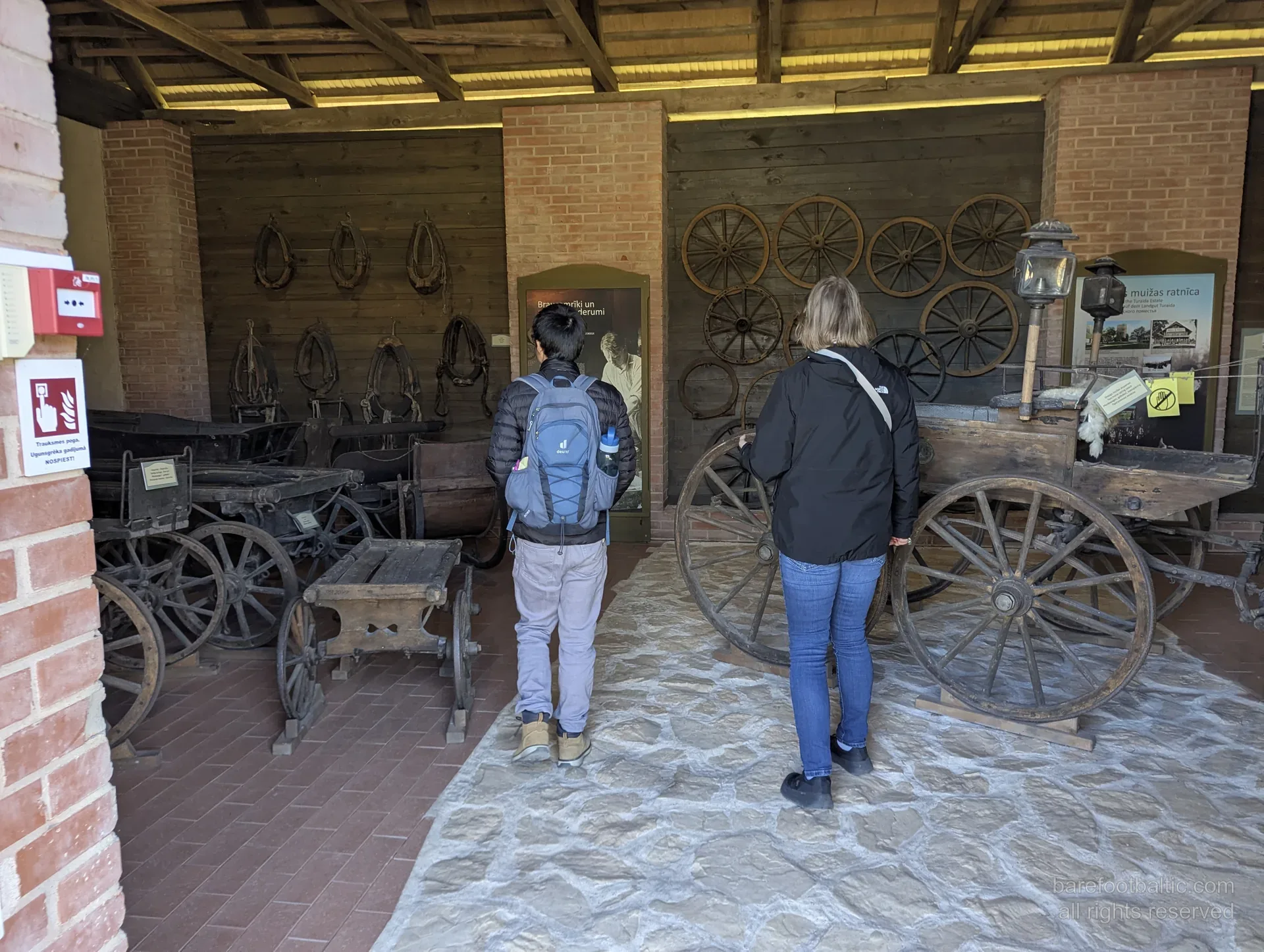
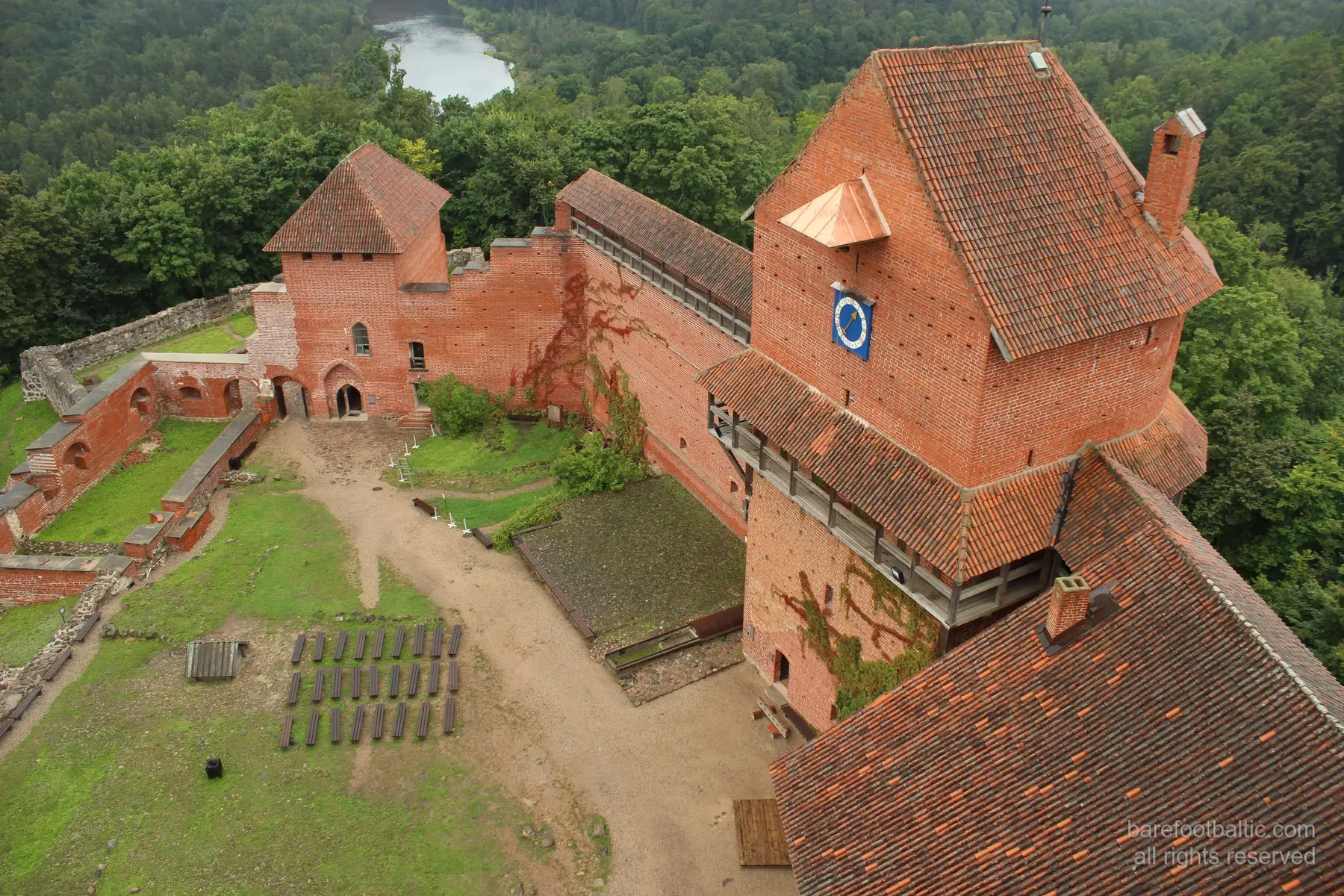
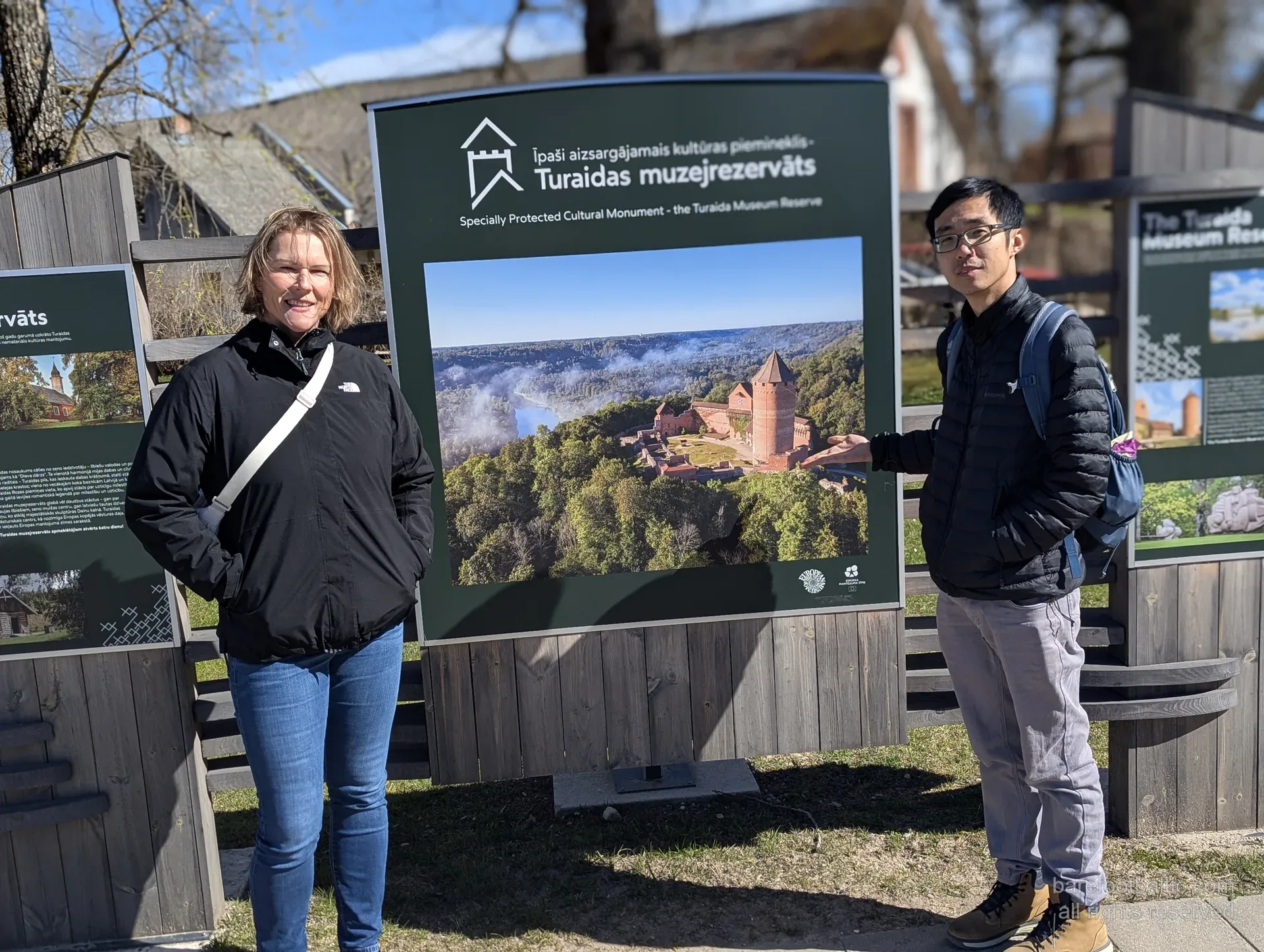
The anchor of the day. Turaida is the red-brick castle you see in every photograph of Sigulda, and it earns the visit. The Bishop of Riga built it in 1214 to control the river crossing and the Liv villages that controlled the river crossing before him. It changed hands through the Reformation, was rebuilt several times, burned down for the last time in 1776, and sat as a ruin for two centuries before the Soviet-era restoration that gave it back its tower and most of its walls. The tower is the centrepiece. About 100 steps up to a viewing platform that looks down the valley in three directions.
Inside the reserve you also get the 1750 wooden church (one of the oldest in Latvia, still consecrated, still used for occasional services), the Rose of Turaida's grave on the church's south side, a reconstructed Liv farmstead with a working blacksmith and bread-baking demonstrations on weekends, and the Nature's Pearls outdoor conservation trail with an insect hotel and heritage-tree markers. Two and a half to three hours is the right window. Less than ninety minutes means you've skipped one of the four parts.
Adult ticket €8 in 2026, student €6. Same ticket covers Dainu Kalns and the Song Garden, which is the next stop. Walking-stick makers sometimes set up outside the souvenir shop near the exit. See stop 14 for why.
7. Dainu Kalns (Hill of Dainas / Folk Song Hill)
Open: year-round, daylight hours · Price: included with Turaida ticket · Time needed: 1.5–2.5 hours · Best season: 23–24 June (Jāņi), 7 July (anniversary), summer weekends

Down the south-eastern slope of the Turaida reserve, a five-minute walk from the wooden church, sits Dainu Kalns. It's a sculpture garden of twenty-six granite carvings by Indulis Ranka, scattered through three hectares of oak meadow. Each sculpture is paired with a daina, one of the four-line folk songs that Krišjānis Barons collected in the 1880s and 1890s. Ranka and the museum director Anna Jurkāne signed a private agreement in 1980 to build it. The first sculpture went up in 1982, the rest over the next three years. The hill opened on 7 July 1985, on the 150th anniversary of Barons's birth.
It was also the place where, on 13 July 1988, the banned red-white-red Latvian flag was raised in public for the first time since 1940. Ten weeks later Soviet Latvia relegalised it. For the full backstory on how a national monument got built in granite under occupation, see our long read on Dainu Kalns and the Singing Revolution. For a sculpture-by-sculpture walk with the daina engraved on each stone, see the 26-sculpture field guide.
Allow ninety minutes minimum, two and a half hours if you want to read every plaque and walk down to the Dziesmu dārzs (Song Garden) amphitheatre below. The museum signage tells you twenty minutes. The museum signage is wrong.
8. Sigulda's cliff viewpoints (Paradise Hill, Emperor's View, Artists' Hill)
Open: 24 hours, viewpoints free · Price: free · Time needed: 15–45 minutes per viewpoint · Best season: late September, early October
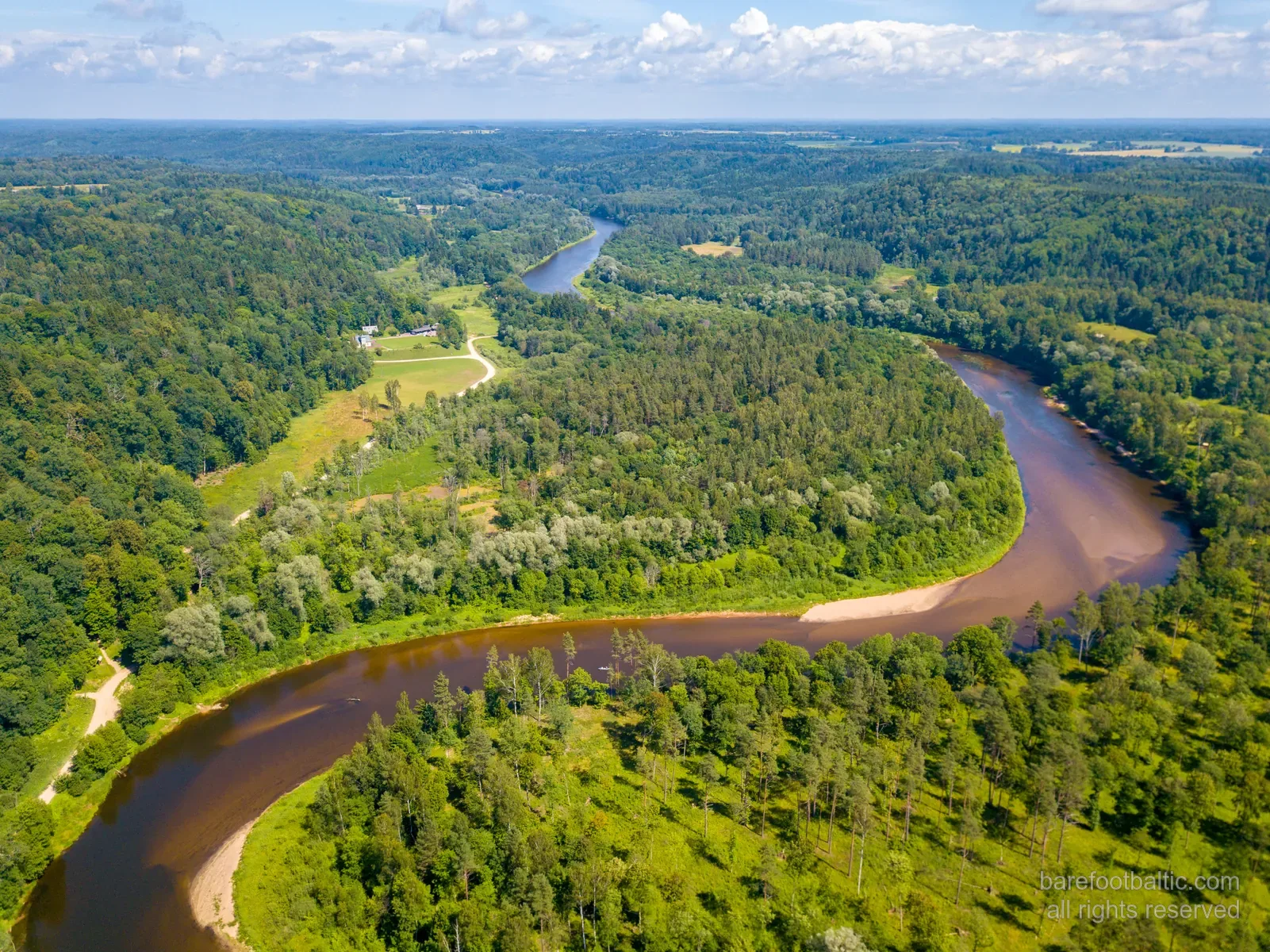
Sigulda has three named cliff viewpoints on the south rim of the valley, all free, open year-round in normal weather. Paradīzes kalns (Paradise Hill) is the closest to the town centre. The cliff edge sits about 80 metres above the river. Ķeizarskats (Emperor's View) is named after Tsar Alexander II, who stood there in 1862 and is reported to have been impressed. The platform sits 67 metres above the river and the angle of the view is different from Paradise Hill, wider, opening downstream. Gleznotāju kalns (Artists' Hill) is the one I send people to in the autumn, because the angle catches the late afternoon light on the sandstone.
None of them have parking attendants or interpretive signs in English. Signposts off the road are small. Latvian-only. In good weather you can connect Paradise Hill and Emperor's View on a thirty-minute walk along the rim. Sunrise at any of them in early October is one of the days I'd put high on a Latvia trip if you can get out of bed for it.
9. Gauja National Park hiking
Open: year-round · Price: free · Time needed: 1–6 hours depending on trail · Best season: late September, May

Gauja National Park is Latvia's oldest, established in 1973, and at 917 square kilometres it's the largest protected area in the country. The park runs along the Gauja river for about 100 kilometres. The Sigulda stretch is its most-visited section because the cliffs are concentrated here. The short walk worth doing from the town is the Krimulda–Turaida valley loop you've already done if you've followed stops 3 to 7. For a longer day, the Velnu klints (Devil's Cliffs) trail starts about 4 kilometres south of Sigulda, a 90-minute return walk along a wooden boardwalk through sandstone outcrops and pine forest.
Trail maps are sold at the Sigulda tourist information centre for €1, and the same maps are free at the Turaida reserve entrance. Mosquitoes from June through August on the river-edge trails. The bigger predators (lynx, wolves, the occasional brown bear) are real residents of the park but you will not see them on a daytime walk on a marked trail. They have better things to do.
10. The Sigulda Bobsleigh Track (Siguldas bobsleja un kamaniņu trase)
Open: tourist rides on weekends only · Price: around €40 per person · Time needed: 1 hour total for one run · Best season: open year-round, winter for real-ice runs
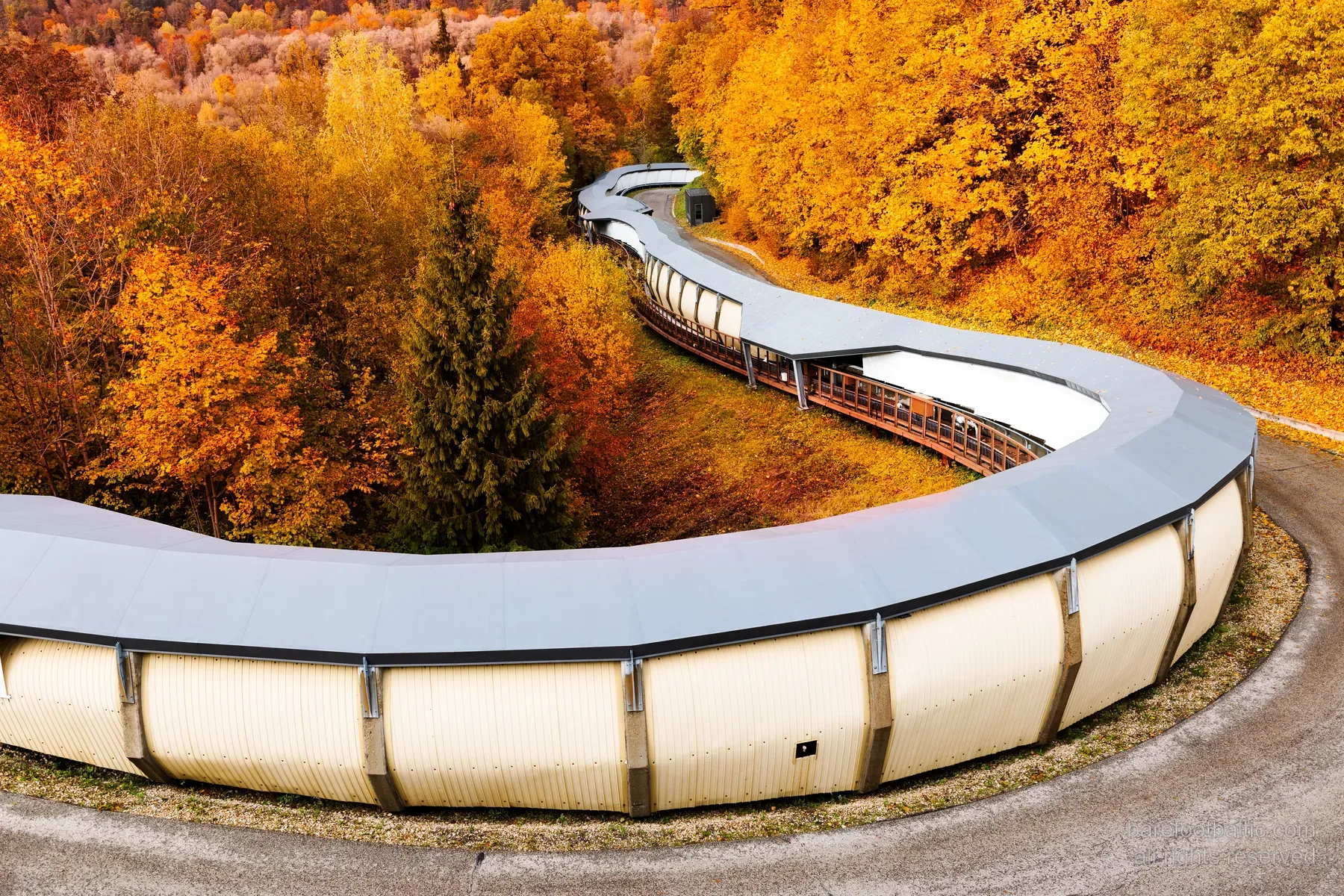
This is a working Olympic-grade training facility. The track was built in 1986 for the Soviet Union's Olympic bobsleigh and luge team. After 1991 it became the Latvian national training base and it has been continuously in use ever since. Most days of the year the track is closed to the public because Latvian athletes are training on it. On weekends in season, the track opens up tourist runs in what we call the Vučko, a rubber-and-canvas soft-bob designed for guests, named after the Sarajevo 1984 Olympic mascot.
The tourist run launches from the women's starting point at the lower part of the track, not the men's start (which is much higher and reserved for trained athletes). The ride is around 90 seconds, you reach about 80 km/h, and the price is around €40 per person. Book ahead. Weekend slots fill up. If you turn up on a Tuesday you'll get the visitor centre and a viewing platform, no ride. It's still worth a stop for the engineering. The kilometre-long curved trough through the forest is an unexpected piece of Sigulda's geography.
11. The cable-car bungee jump
Open: weekends in season, weather-dependent · Price: around €60 per jump · Time needed: 45 minutes including the cable-car return · Best season: May–September
The same Soviet cable car you took for the valley crossing also runs the only moving-cable-car bungee jump in Europe. The cabin stops at the midpoint of the cables, about 43 metres above the Gauja river, and you jump from beneath it. The cord is rigged on the underside of the cabin. It's a properly long fall by Baltic-bungee standards and the cabin's gentle sway adds about ten seconds of dread to the wait. The operator is the same crew that runs the cable car itself.
Weekends in season, weather-permitting. Around €60 per jump in 2026, taken on the spot in cash or by card at the cable-car ticket booth. The jumper goes up first, the rest of the cabin continues to Krimulda, and you collect them on the next run. Stand on the Sigulda-side platform if you want to watch. The cables are right above your head.
12. A proper pirts evening at Ziedlejas
Open: by booking only · Price: around €150 per person for a four-hour session · Time needed: 4 hours minimum, overnight pods available · Best season: winter is unbeatable, but year-round
A Latvian pirts isn't the Finnish sauna or the Turkish hammam you might be picturing. It's a wood-fired steam ritual with birch or oak besom whisks, a cold plunge, layered rounds of heat and cold, and at a proper one a pirtnieks, a trained pirts master, who runs the heat and the herbs and the rhythm of the rounds for you. The best one I know in the Sigulda area is Ziedlejas, about 10 kilometres outside town. It's a serious operation. Four-hour sessions, around €150 per person, by booking only. They also have small glamping pods on the grounds if you want to make a night of it.
Ziedlejas isn't a Sigulda-day-trip stop in the conventional sense. If you've decided to stay over, this is the evening to book. The combination of three rounds in the pirts, the cold plunge in winter when there's snow on the trees, and a quiet bed in a wooden cabin makes a twenty-four-hour window worth the booking. Book at least two weeks ahead in winter. They fill up.
13. Where to eat in Sigulda
Open: varies · Price: € (cafe) to €€ (sit-down) · Time needed: 30–90 minutes · Best season: year-round (winter hours shorter)
Three places. Different price points. None of them on the typical guidebook list.
Mr. Biskvits (Ausekļa iela 9). Bistro-style cafe with very good cakes, proper coffee, and short lunch menus that change with the season. The place I'd send someone for a long afternoon coffee after Turaida, or a slice of cake before the train back to Riga. Open most days from morning to evening.
Pasēdnīca (Rīgas iela 2). A buffet-cafeteria in the proper Latvian sense. You walk along a glass case, point at what you want, pay by weight at the till, sit down. The grey peas with bacon (pelēkie zirņi ar speķi) is what I'd order. The cabbage rolls and the cold beetroot soup in summer are also reliable. This is not a tourist restaurant. The Latvian-language menu and the speed of the line will tell you that.
Bucefāls (Ceļmalas iela). A sit-down restaurant about a kilometre out of the town centre, very much a locals' spot. Authentic Latvian cooking, generous portions, the kind of place where the menu has a 600-gram pork knuckle on it and no irony attached. Not the place for a quick stop. Give it ninety minutes minimum. Book ahead on weekends.
14. Hand-carved walking sticks (a small Sigulda tradition)
Open: vendor stalls at Sigulda castle ruins and Turaida souvenir shop · Price: €10–40 depending on the stick · Time needed: 5 minutes · Best season: year-round when vendors are around
If you've never bought a walking stick on a holiday before, hear me out. Sigulda has a local craft of hand-carved wooden walking sticks, often hazel or hornbeam, whittled from a single piece and finished with a coat of beeswax. The makers set up small stalls at the entrance to the Sigulda Castle ruins and, more reliably, outside the souvenir shop at the Turaida reserve exit. A simple stick runs €10 to €15. The properly carved ones, with a wolf's head or a Liv pagan symbol or a coat of arms, run €25 to €40.
You don't need one. That's the point. You'll come home with a beautifully made object that connects to the place you've been walking through, and over the next ten years you'll grow into needing it. I've seen guests buy one half as a joke and use it on every walk for the next decade. The makers are usually in their seventies and happy to talk.
Getting to Sigulda
By train. The way I'd recommend if you don't have a car. Pasažieru Vilciens runs the Riga–Sigulda line several times an hour from Riga Central. The journey is about an hour. The return ticket is around €5 in 2026, bought from the machine at the station or on the PV mobile app. Sigulda station sits a fifteen-minute walk from the Medieval Castle ruins.
By bus. Slower (about an hour and a quarter), cheaper (around €3 each way). Buses from the Riga international bus station run roughly hourly. Less comfortable than the train, useful if the train schedule doesn't fit your day.
By car. The A2 motorway out of Riga is fast and signposted, with the drive taking about fifty minutes door to door. Parking in Sigulda town is free in most public lots. Parking at the Turaida Reserve is free in the official car park, five minutes' walk from the entrance.
By guided day trip. If you'd rather have someone else drive, narrate the medieval history, and handle the timing, our Sigulda, Cēsis & the Gauja Valley day trip pairs Sigulda with Cēsis (the third castle in the Gauja Valley) and an award-winning bakery on the way back. €94 per adult, runs year-round, small group up to twelve guests.
Sigulda fits inside a wider Riga-day-trips universe. For the parent decision tree across the day trips I run, see Day Trips from Riga.
Best time of year
Spring (April–May). My second-favourite window. The valley colours up slowly. Birches go first, then oaks, lime trees in mid-May. Trails can be muddy through April. The cable car opens at Easter most years. Turaida's wooden church looks especially right against new green.
Summer (June–August). Peak crowds at Turaida, especially July. The pluses are long daylight, all the seasonal stops open (bungee, weekend bobsleigh), and folklore concerts at Dainu Kalns. Jāņi (23–24 June) is Latvia's biggest folk holiday and Turaida often hosts a concert. Check the museum's calendar.
Autumn (September–October). The reason the valley has the reputation it does. Late September through mid-October is when the Gauja turns the colours that earned it the "Switzerland of Latvia" nickname back in the 19th century. Sandstone red against birch yellow against dark pine against the river. The peak window most years is the first week of October. Cooler air, fewer tour buses, every cliff viewpoint at its best. If you can choose your week, choose this one.
Winter (December–February). Less popular and worth reconsidering. Sigulda runs a small but functional ski slope on the Krimulda side, the bobsleigh track switches to real ice, Turaida looks unreal in snow, and the cable car keeps running. A Ziedlejas pirts evening in midwinter is the right call. Hot sauna, cold plunge, snow on the trees. A few caveats. Smaller restaurants close or shorten hours, the cliff viewpoints can be icy, daylight runs out by 4 pm. There's a deeper winter version of this day, with what's open on reduced hours, the descent path I won't take in deep ice, and Daiga's named warming-up cafe. It's in the dedicated guide, Sigulda in Winter.
If I had to pick one weekend a year, I'd pick the first weekend of October.
Want a guide? Or doing it alone?
The day works either way. If you're still deciding whether Sigulda earns the day at all, see my answer on whether Sigulda is worth visiting.
Self-tour. A confident traveller with a smartphone and a paper map can do the loop alone. The train is easy. Bus 12 from Sigulda station to Turaida runs every half-hour. Turaida is signposted in English and the Sigulda New Castle Museum has English labels in every room. The cliff viewpoints have signposts (just). You'll miss the medieval politics of who held which castle from when, and the folk-song layer at Dainu Kalns. Both are heavily Latvian-language at the site. Read the deep-dives on Dainu Kalns and the Rose of Turaida before you go and you'll close most of that gap.
Guided. I lead our Sigulda, Cēsis & the Gauja Valley day trip year-round. €94 per adult, max twelve guests, picks up from your Riga hotel and drops you back. The day a guide gives you is one car instead of a timetable. The Latvian-language layers at Dainu Kalns and the Rose of Turaida grave get translated in real time. Cēsis goes on the back end of the day for the third castle. The medieval politics get filled in on the drives between the castles.
Frequently asked questions about Sigulda
How many days do you need in Sigulda?
One full day covers the essentials, nine or ten hours from Riga and back, with time at Turaida, the cable car, Sigulda's town side, and one cliff viewpoint. Two days lets you ride the bobsleigh on a weekend, do a full Gauja National Park trail, or book a Ziedlejas pirts evening. A long weekend lets you do the day trip slowly, add Cēsis on a second day, and still have time for an evening meal at Bucefāls without rushing.
Is Sigulda accessible without a car?
Yes. The train from Riga (about an hour, around €5 return) goes several times an hour. Bus 12 from Sigulda station to Turaida runs every thirty minutes and stops at the reserve entrance. Cēsis is another forty minutes further on the same train line if you want to combine the two. The awkward stops without a car are Ziedlejas pirts (10 km, taxi only), and the bobsleigh track (3 km, walkable on a dry day).
Is Sigulda kid-friendly?
Yes, particularly for kids who like castles and forest. Turaida's tower climb is a hit (about a hundred steps, no railings on the inside spiral, so hold small hands). The cable car works for any age. The Liv farmstead at Turaida has weekend bread-baking and blacksmith demonstrations that small children enjoy without translation. The bobsleigh ride is too intense for under-twelves. The cable-car bungee has a minimum age of fourteen. The cliff viewpoints have low fences in places, so supervise.
Are dogs allowed in Gauja National Park?
Yes, on a lead. Gauja National Park allows leashed dogs on all marked trails. They are not allowed inside the Turaida castle tower or the Sigulda New Castle Museum, but the Turaida reserve grounds, the Hill of Dainas, the cliff viewpoints, and the Krimulda trail are all dog-walkable. There's a water point at the Turaida reserve entrance for filling a dog bowl. The bigger forest predators (lynx, wolves) are real but reclusive. Keep your dog leashed in remote sections.
Can you swim in the Gauja River?
You can, with caveats. The Gauja has small public beach access points at a few spots in Sigulda. The current is mild in summer and the water is brown from the peat upstream, not from pollution. Most local swimmers go to the spot below the Sigulda cable car landing on the Krimulda side, where there's a small gravel beach. Avoid the river when the water level is high after spring melt (April to early May) or after heavy rain. There are no lifeguards anywhere on the Gauja.
How does Sigulda compare to Cēsis?
They work as a pair. Sigulda is the valley and the cable car and Turaida and the Hill of Dainas. Cēsis is a medieval town worth its own day, with a 13th-century castle you explore by candle-lantern in a deliberately unheated interior. If you have one day from Riga, do Sigulda. If you have two, add Cēsis on the second. For combining both into a single ten-hour day, see our breakdown of whether to attempt Sigulda and Cēsis in one day.
If the second day is yours, the version of Cēsis I'd actually walk is in our nine-stop list of things to do in Cēsis. That's the castle by candle lantern, lunch at Pasēdnīca, and the Cīrulīši cliffs on the way out, in the order I take groups from the train station.
What language do they speak in Sigulda?
Latvian is the everyday language. Russian is widely understood, especially among Latvians over forty (a relic of the Soviet decades). English is fine in hotels, restaurants near the centre, and at the Turaida reserve. English signage drops off sharply once you move away from the main tourist sites. The Sigulda New Castle Museum is in Latvian-only in places, the Dainu Kalns sculpture plaques are Latvian-only, and bus drivers usually have ten words. A pocket phrase or the Google Translate camera covers the gap.
Are restaurants open year-round in Sigulda?
The three I'd recommend (Mr. Biskvits, Pasēdnīca, Bucefāls) run year-round, though hours shorten in November and February. Smaller seasonal cafes inside the Turaida reserve and at the Krimulda manor close from late October to early April. If you're coming midwinter, Pasēdnīca and Bucefāls are both reliable. Check the hours before you set out because Bucefāls in particular sometimes closes Mondays.
One last thing
A Sigulda day doesn't need to be efficient. The version of this day that I remember best is one I led in October 2023 with two retired French teachers who wanted to read every plaque, sat on the bench by the Stone of Love for forty minutes, and made us miss the last cable-car run back. We walked across the valley instead, in dusk, in our boots, and made the train by eleven minutes. They are still our guests every spring.
The list above is the list I'd give a friend the night before. Use it as a menu, not a checklist. If you find yourself in front of the Dziesmu tēvs sculpture and the light is good, just stay.
Prefer to DIY the day from Riga by train instead? Our hour-by-hour Sigulda day-trip walk-through covers the train timing and an honest cost breakdown.
When you're ready to book, our Sigulda, Cēsis & the Gauja Valley day trip is the version of this day with the driving, the medieval history, and Cēsis included. €94 per adult, year-round, small group up to twelve guests, picks up from your Riga hotel.