Sit down for lunch in any traditional Latvian restaurant, in Riga, in Sigulda, in a roadside tavern in Latgale, and pick up the menu. You will see pork chops, pork patties (karbonāde), pork ribs in sauerkraut soup, smoked pork belly with grey peas, bacon-filled pastries (speķrauši), pork meatballs in dill broth, smoked sausages, blood sausage, ham, and roast pork knuckle. There will be one or two beef dishes, usually goulash, occasionally a steak, and a polite nod to chicken. But the menu is pork all the way down.
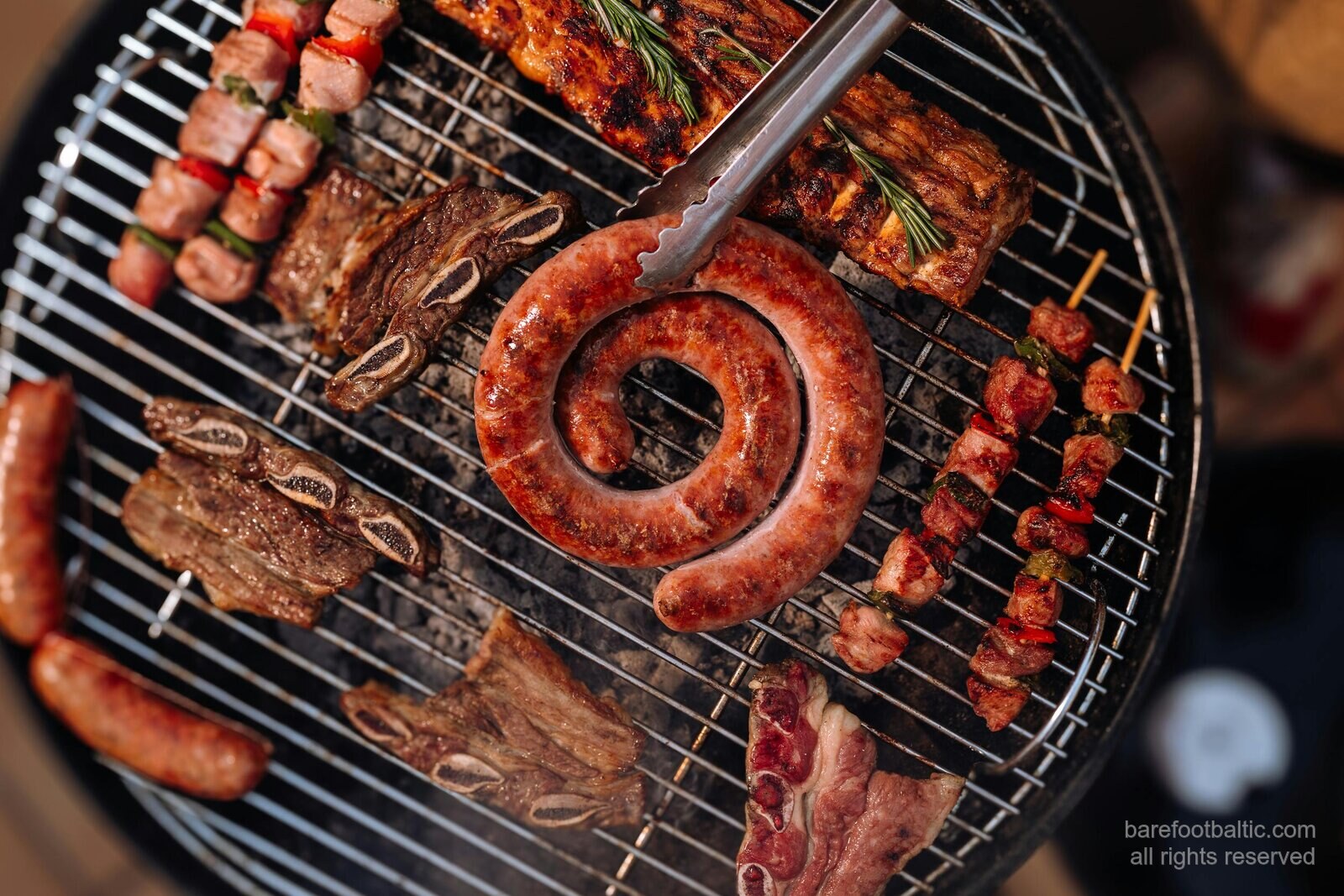
The national dish, pelēkie zirņi ar speķi, grey peas with bacon, is pork. The Christmas Eve dinner is pork. The summer solstice barbecue is pork sausages. The Latvian word for fat, speķis, comes from the same Germanic root as the English “speck” and refers specifically to cured pork belly. We have a national identity built on cured pig.
Meanwhile, in the basement of Spice or Alfa shopping centre in Riga, you can now buy a vacuum-packed Latvian-Hereford ribeye from a refrigerated vending machine, 24 hours a day, with your bank card. Premium beef, dry-aged, available next to where the kids buy ice cream. It feels like a futuristic intrusion into a country that has been running on bacon for nine centuries.
So why pork? And why is the beef story only happening now?
Latvia is a forest
Start with the landscape. Latvia is, and has always been, forest country. Even today, after centuries of clearance and a Soviet drive for agricultural collectivisation, more than half the country is still covered in forest. Pine, spruce, birch, oak, alder, ash. In the medieval period the forest cover would have been higher still. The villages were small clearings carved out of the woods, and the woods began ten metres from the back garden.
This matters enormously for what kind of farming was possible. In countries with large open grasslands, cattle make sense, because cattle need pasture, and pasture is what those countries have. England, Hungary, the Pampas, Texas. In Latvia, pasture was always limited and expensive. What Latvia had in abundance was forest. And the animal that thrives in a forest, almost without help, is the pig.
The medieval pig and the system of pannage
Here is the unexpected thing about medieval pigs. They were barely domesticated. They lived outside, year-round, foraging in the woods. They were closer to wild boar than to the modern pink animal we picture when we say “pig.” They wandered in herds and ate everything they came across, grass, roots, mushrooms, fallen fruit, beetles, small animals, and required almost zero input from the farmer.
In autumn, this casual arrangement became the central event of the agricultural year. Across all of forested Europe, peasants practised what was called pannage in English, and various local terms in Baltic and German lands. It meant driving the pigs into the oak and beech forests each season to fatten them on mast, the year’s fallen acorns, beechnuts, and wild fruit. A village’s right to pannage in the local lord’s woodlands was a precious legal privilege, fought over in court records across medieval Europe.
What’s remarkable is the agricultural economics. Acorns are toxic to cattle and humans. They are not toxic to pigs. So the oak forest, which is otherwise food-poor for everyone else, becomes for the pig a six-week buffet of free, dense, fatty calories. A pig that started the autumn weighing 50 kg could finish it weighing 100. And all the farmer had to do was walk the herd into the woods in September and walk it out, plumper, in November.
Then came the slaughter. Late November, early December, once the cold had set in so the meat would keep, was cūku kaušanas laiks, the pig-slaughtering season. Whole villages would slaughter together. Almost every part of the animal was preserved. Hams smoked in the chimney, bacon salted and hung, sausages stuffed with blood and grain (asinsdesa), trotters and ears made into jellied head-cheese (galerts), fat rendered into speķis and stored in clay pots for winter cooking. A peasant family that had a pig in November had food on the table until April.
You could not do this with a cow. Cattle did not fit the system.
What about the cow?
This is the part the textbook usually gets wrong about pre-modern Latvian farming.
Cattle were not absent. Every farmstead had a cow, often two. But cattle in the Latvian (and broadly Northern European) peasant tradition were primarily dairy animals, not meat animals. The cow was kept alive for as long as she gave milk, which is most of her productive life. You could not eat her without giving up the steady supply of milk, butter, cottage cheese (biezpiens), sour cream (skābais krējums), kefir, and soured milk (rūgušpiens) that she produced day after day. Killing the family cow for a single feast was something you did only when she was already too old to milk, or when starvation was the alternative.
This is why traditional Latvian cuisine is so heavy on dairy, and so unusually poor in beef. The country still has more types of fermented milk on the supermarket shelf than most of Western Europe. The cow was a factory, not a meal. Her offspring, the bulls, were either kept as draught animals (oxen pulled the plough) or sold off young, before they ate too much hay. Beef, when it existed, was old retired work-ox, tough and stewed for hours.
The two signature Latvian cattle breeds tell this story very clearly. The Latvian Brown (Latvijas brūnā), officially registered as a breed in 1922, and the Latvian Blue (Latvijas zilā), an even older coastal breed, were both selected over centuries for milk yield and butterfat content. Not for size or muscle. For milk. In the 1930s, during Latvia’s first independence, the country’s number-one export was butter. It went to Britain, Germany and the Netherlands, paid for the national budget, and built the agricultural identity of the inter-war republic. The cow was the source of an international butter trade, not of steak.
(Both heritage breeds are now endangered. There were 1.4 million Latvian Brown cows in 1980. Today there are around 23,000. The Latvian Blue has fewer than 200 registered animals. They are kept alive by enthusiasts and EU conservation grants. The Holstein has won.)
Pigs are also better at being pigs than cows are at being cows
There is one more reason pork dominated, and it is purely biological.
A cow takes nearly two years to reach slaughter weight, eats hay all winter, requires shelter from the cold, calves once a year, and produces one calf at a time. A pig reaches slaughter weight in six to nine months, eats whatever you don’t, fattens itself on free forest mast, and produces litters of eight to twelve piglets, twice a year.
If you were a peasant trying to feed a family of seven through a Latvian winter on a small plot of land and a forest commons, the maths was not subtle. You kept the cow alive for the milk and raised pigs for the meat. This was the universal answer across forested Northern Europe, and the cuisines all reflect it. Germany, Poland, Lithuania, Belarus, Russia, the Baltics. Where you find a pork-and-dairy peasant cuisine, you can be sure you are looking at a forested, cattle-dairy, pig-foraging agricultural system underneath.
The cuisine is the museum
Once you understand the underlying system, traditional Latvian dishes start to read like an archaeological record of how the food was actually produced.
Pelēkie zirņi ar speķi, grey peas with bacon, is the oldest dish and the plainest. Dried peas store all winter. Cured pork belly stores all winter. You boil one, fry the other, combine them, eat with a glass of rūgušpiens (sour milk). It is the dish you could make in February, in a Latvian peasant house in 1650, with what was actually still in the larder. It became the national dish because it is what kept everybody alive. Elegance had nothing to do with it.
Karbonāde, the breaded, slammed pork cutlet, is German peasant cookery adapted into Latvian, courtesy of the Baltic German nobility who ran the country from the 13th century to 1918. Speķrauši, small bacon-filled pīrāgi, are wedding food, the protein-rich pastry handed out at celebrations across all the Baltic and Slavic peasant cultures. Skābu kāpostu zupa (sauerkraut soup) is built around smoked pork ribs because the pork ribs are what was hanging in the smokehouse all winter. Aukstā gaļa (cold jellied meat) was traditionally made from pig’s head and trotters because nothing was wasted. Frikadeļu zupa (meatball soup) is pork mince in dill broth.
Even the cuts of pork that Latvians celebrate are revealing. We are a nation of pork belly, pork shoulder, pork ribs, pork cheeks, pork jowl. The fatty cuts. The peasant cuts, the ones that, in countries with surplus prime meat, get fed to the dogs.
The potato changed less than you’d think
The potato (kartupeļi) arrived in the Baltic from South America in the 18th century. By the early 19th it was staple. It transformed the peasant diet. A starch that stored well, grew on poor sandy soil, and yielded enormously per hectare. It pushed back the periodic spring famines that had defined Northern European peasant life.
But the potato did not change the pork-and-dairy structure. It just slotted in alongside. Today’s farmer’s breakfast (zemnieku brokastis), fried potatoes, onions, bacon, and eggs in a single skillet, is the dish that combines the ancient (pork, eggs from the henhouse) with the merely 19th-century (potatoes, onions). It is essentially what a Latvian peasant ate every morning for two hundred years before someone wrote it down on a restaurant menu.
Soviet times and the industrial pig
The Soviet collectivisation that began in 1946 destroyed the smallholder system that had supported the traditional pig-and-cow economy. Land was confiscated, animals taken into collective farms, and individual ownership broken up. Many of the old practices died.
But pork didn’t go away. It just industrialised. The Soviet collective farms in Latvia ran enormous pig-fattening operations producing standardised pork for the wider USSR. The Latvian White pig breed (Latvijas baltā), formally recognised in 1967, was developed specifically for the bacon production needs of the Soviet meat industry. Even in this radically altered context, Latvia kept producing pork, the way it always had. The home-table dishes, grey peas, karbonāde, speķrauši, survived the Soviet era because a pork-centred peasant cuisine could be reproduced even when collective farms had replaced family smallholdings. The state could industrialise the pig but it could not change the recipe.
And then, suddenly, beef
When Latvia joined the European Union in 2004, several things happened to the country’s agricultural economy at once. Subsidy systems aligned with EU agricultural policy. New export markets opened. A generation of farmers received grants to modernise. And, crucially, a new generation of urban Latvians with disposable income started asking for something other than pork.
Look at what is here in 2026. The Hereford-cattle ranches in Latgale, the dry-ageing rooms, the premium-beef shops in Riga (Hereford.lv being the most visible), the Wagyu imports, the steak vending machines in Spice, Alfa, and Akropole malls dispensing prime ribeyes and tomahawks 24 hours a day. All of it is the result of about twenty years of deliberate beef-cattle development on a country that, as recently as 1990, did not have a real beef industry at all.
The vending machines in particular are a phenomenon worth pausing on. They are not gimmicks. They are part of a global trend. Germany has had them for over a decade, and America discovered them during COVID. But they have landed in Latvia with an interesting cultural twist. They place premium beef, historically a luxury, rare, restaurant-only product in this country, directly into the path of ordinary middle-class shoppers buying nappies and washing powder. The message is that beef is now an everyday choice, and a Latvian one. The beef in the machine is, increasingly, raised in Latgale on Latvian Hereford stock, slaughtered in Latvian abattoirs, dry-aged by Latvian butchers. This is one of the more modern things happening in Latvian food culture, and it is happening fast.
But the new beef sector is small. It is mostly aimed at urban professionals and export markets. Walk into a roadside tavern in rural Vidzeme tomorrow and the menu will still be 80% pork. Christmas dinner at a family home is still grey peas with bacon. The vending machine is the future leaking into the present. Pork is still the present.
The smell of a Latvian winter
The thing that nobody writes about, but which any Latvian over forty knows in their bones, is the smell of pork. Not raw pork. Cured, smoked, salt-aged pork. The smell of kūpināts speķis (smoked bacon) being sliced for breakfast. A smokehouse in early December with hams hanging in it. Grease and rendered fat, and the slightly sweet bottom-note of juniper and apple wood used in good Latvian smoking.
This is the smell of a Latvian rural winter, going back centuries. It is the smell of survival, frankly. Of food that would not spoil, of calories that would last until April, of a system that turned a free autumn forest into a year’s worth of dinners. Modern Latvians who buy their bacon vacuum-packed at Rimi do not meet this smell as often as their grandparents did, but it sits in the cultural memory. That is why pork, in this country, carries a weight beef has not had the centuries to earn. Beef in Latvia is a recent guest. Pork is family.
So what should you actually eat?
If you are visiting Latvia, do both. Order karbonāde at a traditional restaurant. The Latvian places, Lido, Folkklubs Ala Pagrabs, Province, or any of the older taverns in Old Riga. Try grey peas with bacon at least once, ideally in winter. If you want to taste the modern beef story, book dinner at Hereford Steakhouse on Skanstes iela in Riga. It is the headquarters of the new Latvian beef movement, and the steaks come from cattle they raise themselves in Latgale. It is excellent.
But understand what you are tasting. The karbonāde is nine hundred years of forest pannage and November pig-slaughter and smokehouse winters distilled into one breaded patty. The Hereford steak comes from twenty years of post-Soviet agricultural reinvention. Both are Latvian, just from very different parts of the timeline.
On our excursions
Food is woven through every excursion we run. On the Rundāle Palace tour we usually stop for a traditional Latvian lunch on the way back, and yes, the menu will be pork-heavy. That is simply what Latvian food is. On the Sigulda and Cēsis day trip you are travelling through some of the country’s prime forest and farming country, and the smokehouses and roadside meat stalls along the route are part of the landscape you are looking at. If you are interested in the modern beef story specifically, ask Daiga. She can point you to the better Riga restaurants doing serious Latvian-grown beef, and to the heritage farms in Latgale that still raise blue and brown cows for milk the way their grandmothers did.
We are a country shaped by what could survive a long winter. Pork survived the winter. So did peas, cabbage, rye bread, and sour cream. Everything else, including the steak in the vending machine, is a recent and welcome addition.
If you want the pork tradition tasted properly, karbonāde, smoked rib, pelmeņi, the whole Sunday lunch, that's a half-day we can build for small groups in Riga. Get in touch.