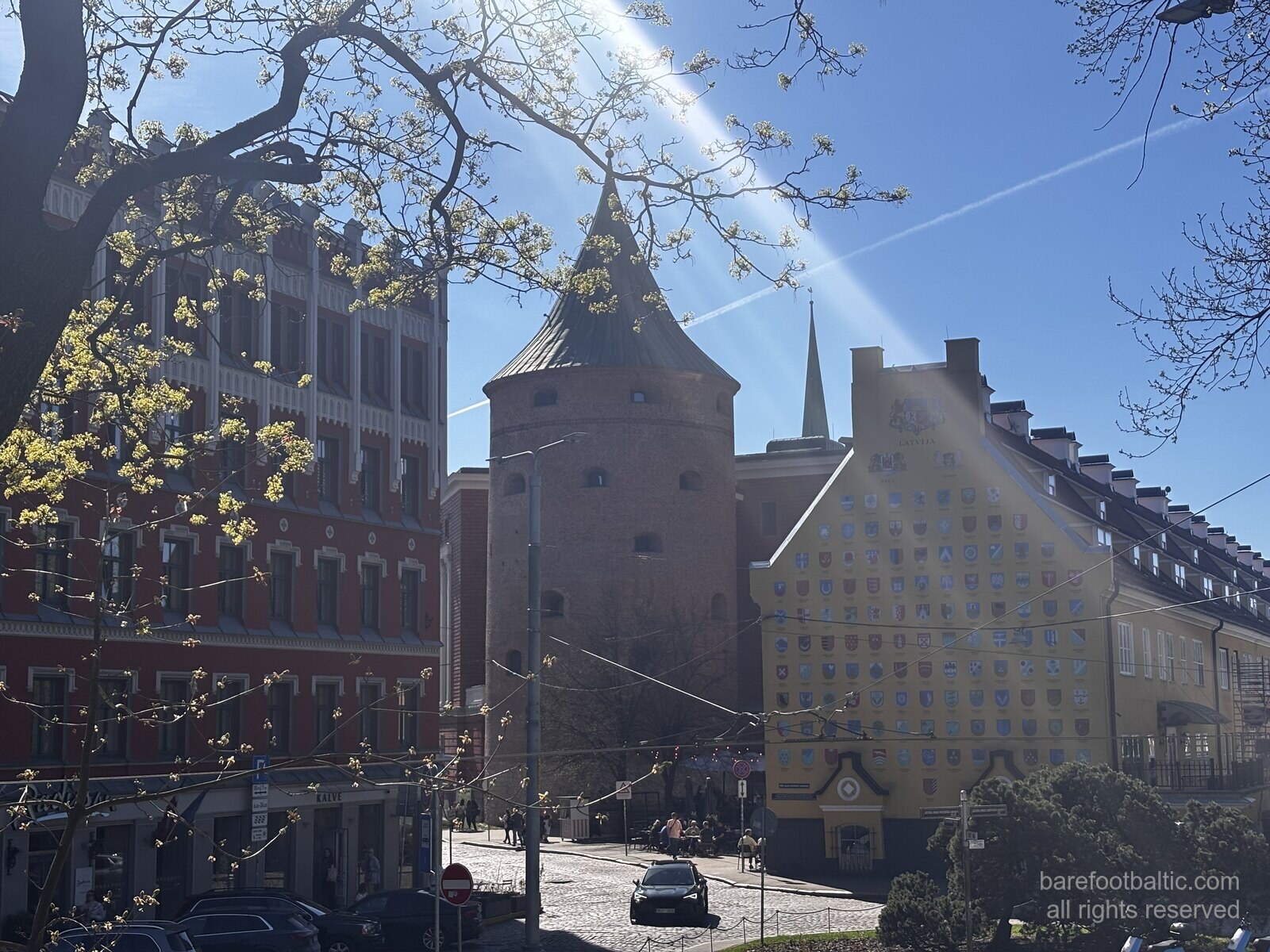
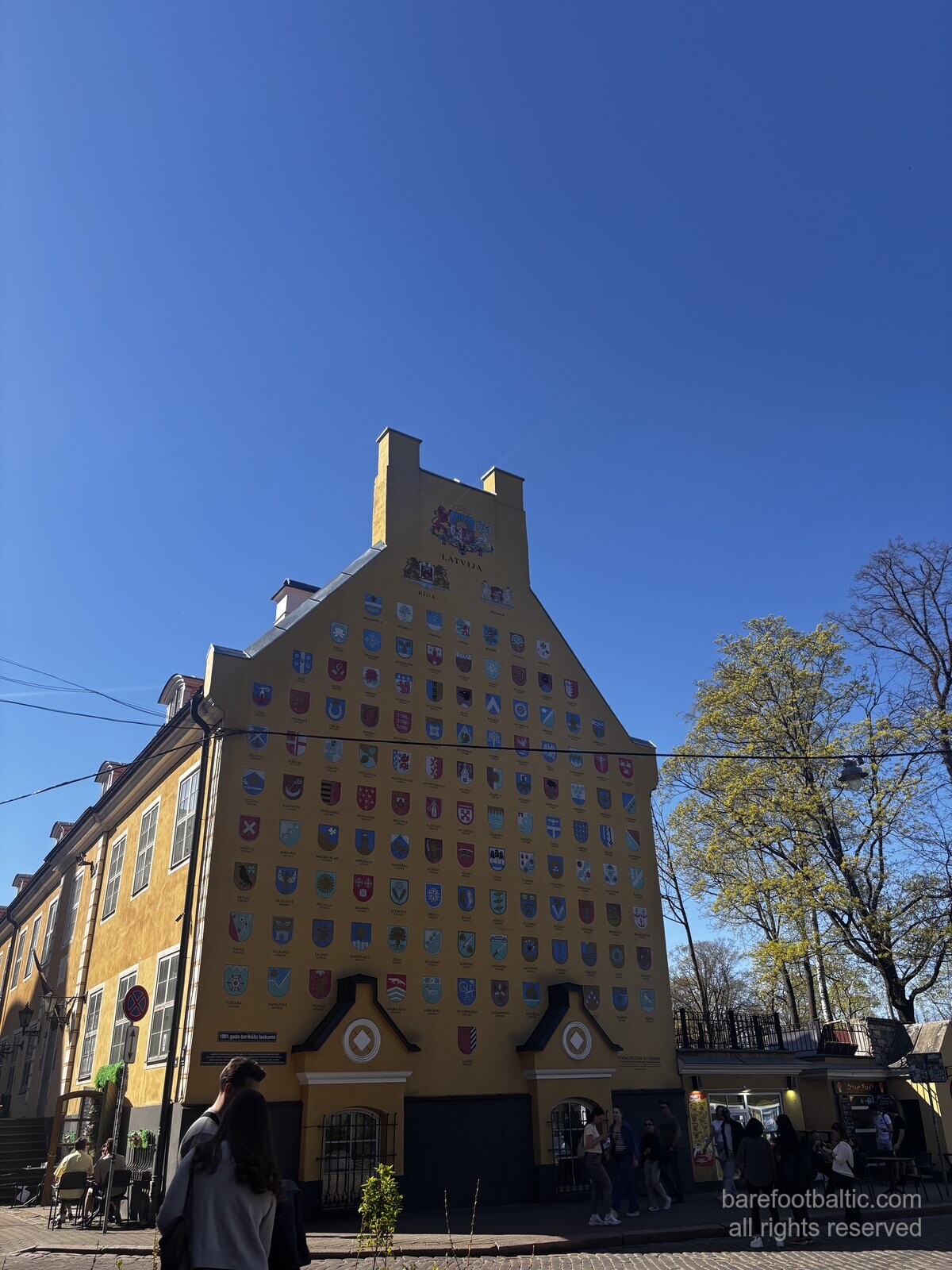
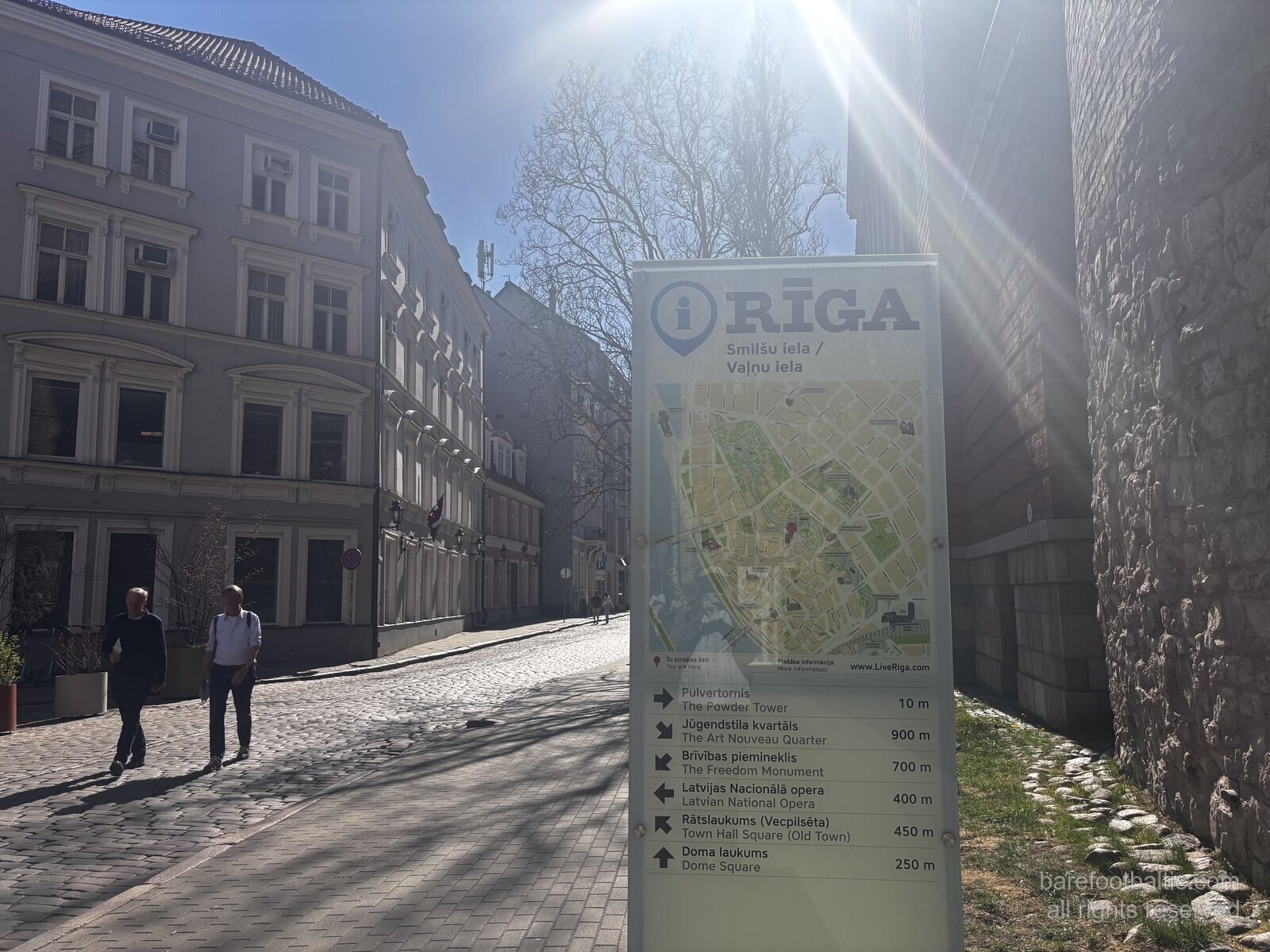
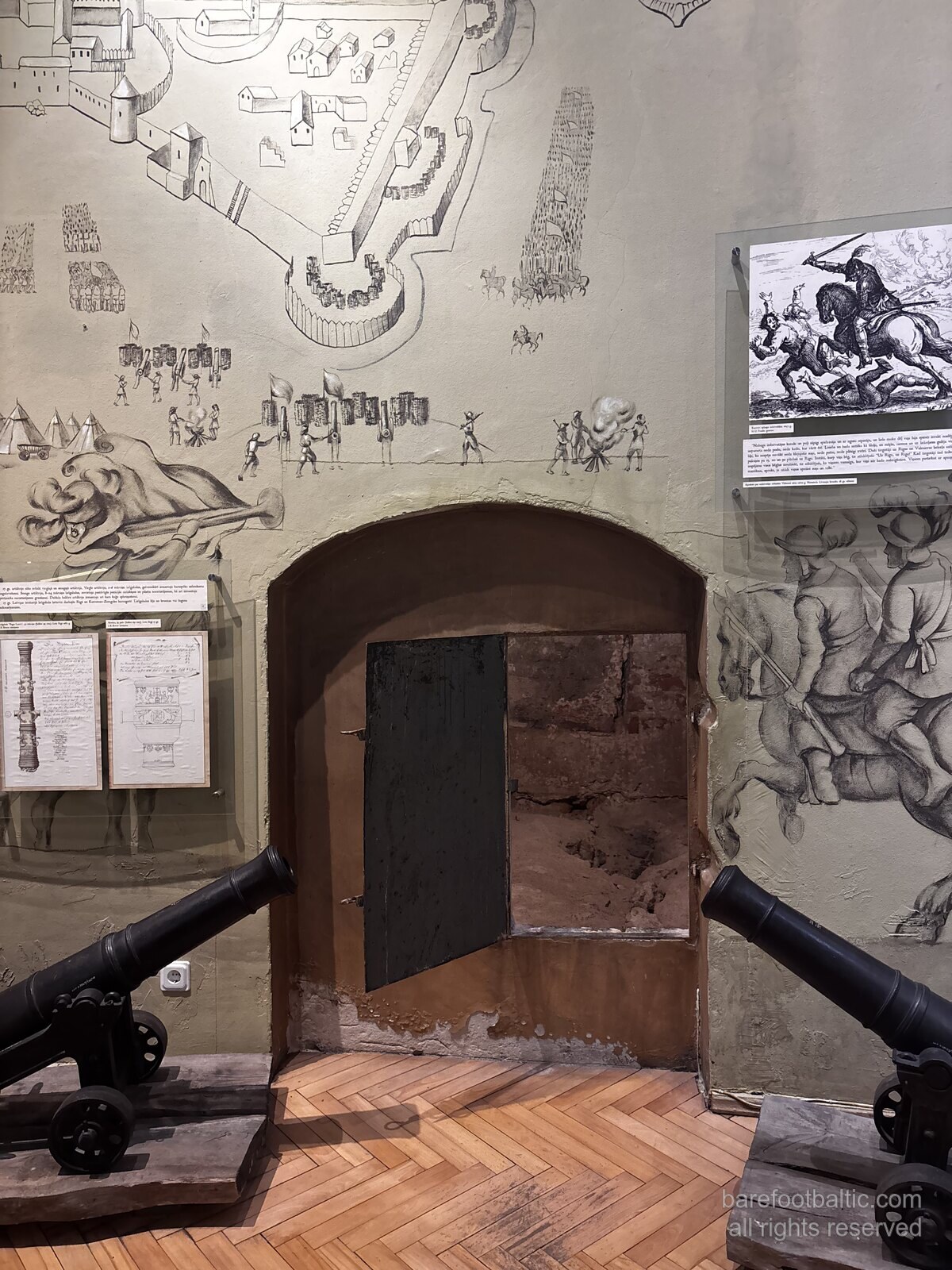
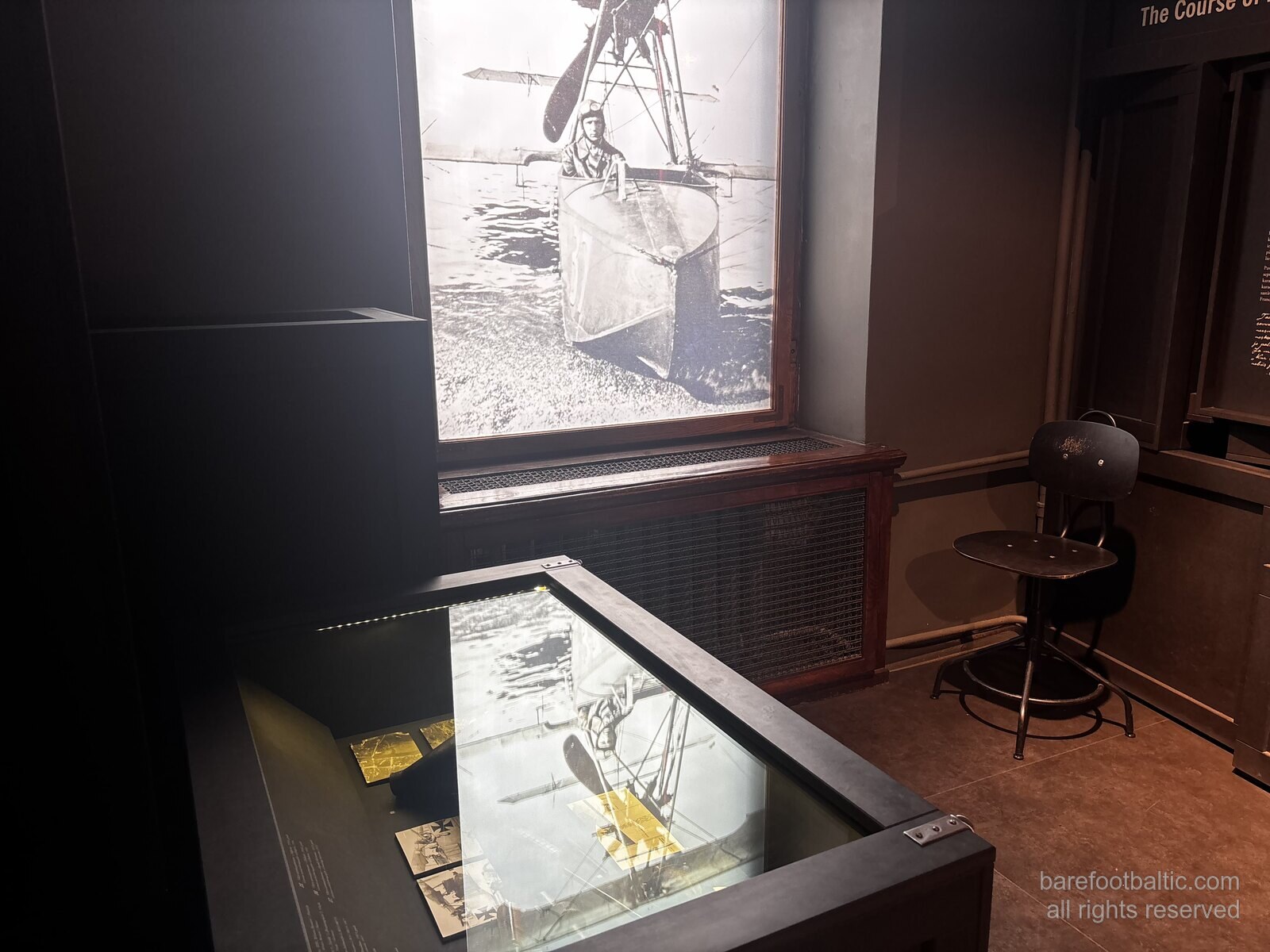
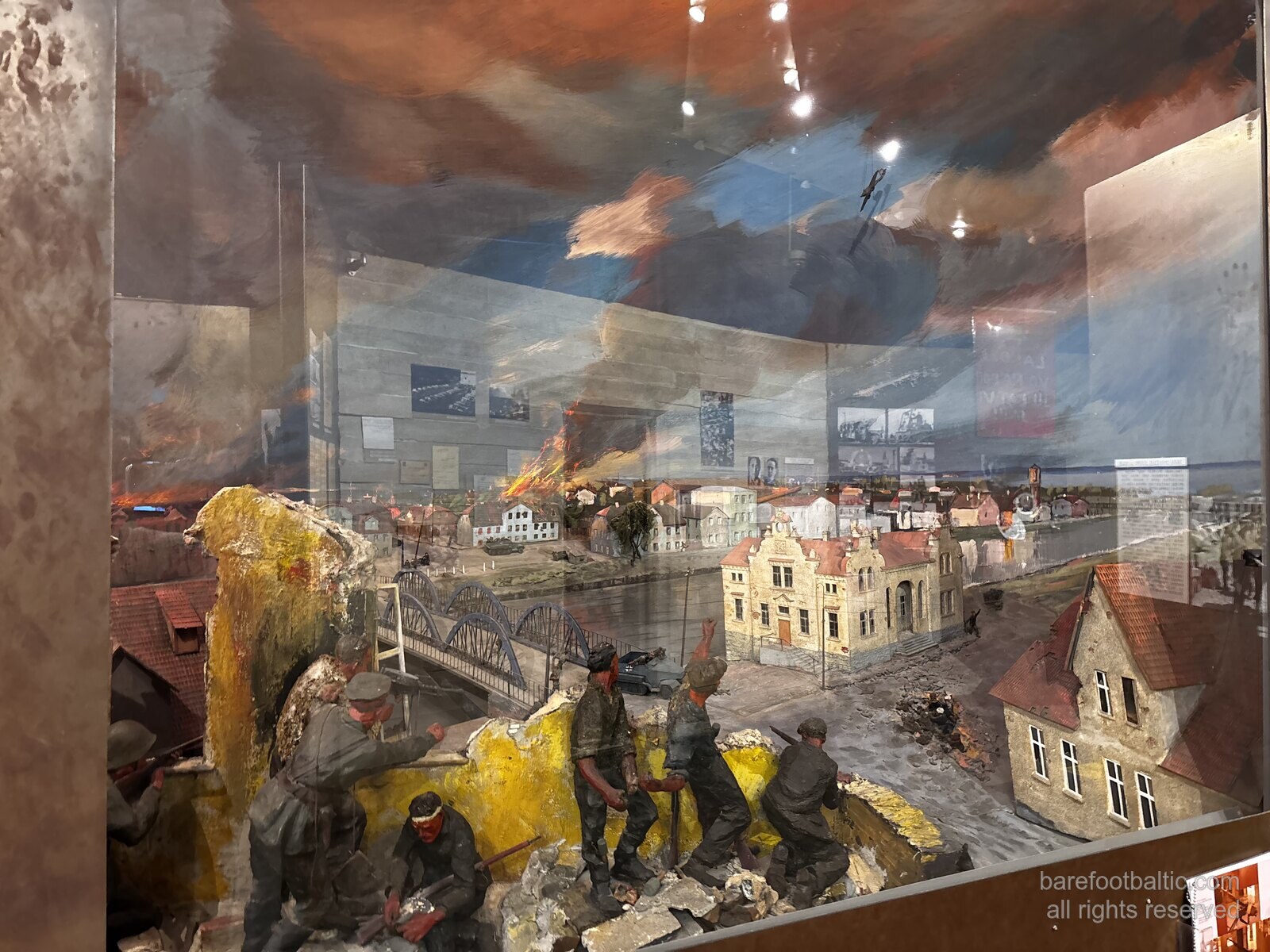
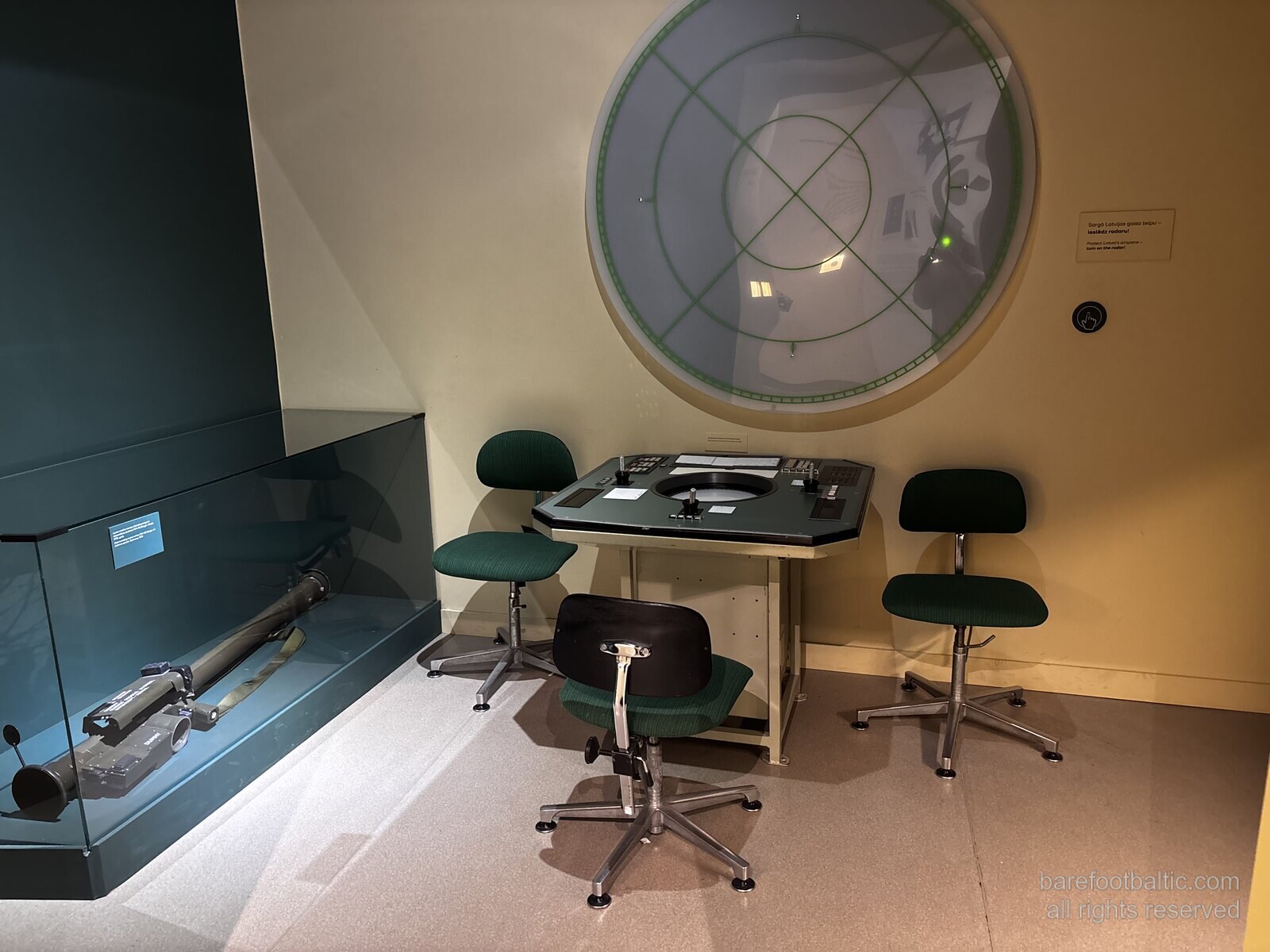
The tower, the museum gable, and the displays inside. Click any image for the full-size view.
Short answer, what this stop is
The Powder Tower (in Latvian, Pulvertornis) is the only surviving tower of Riga’s medieval city walls. It stands on Smilšu iela at the northern edge of the Old Town, and it has been there in some form since the 14th century. It is a thick squat round tower of dark brick, three storeys, with a conical wooden roof and nine cannonballs still embedded in its north face from a 1656 siege.
Inside the tower, and the long yellow building extending east from it, is the Latvian War Museum (Latvijas Kara muzejs), the second-largest history museum in Latvia, free to enter. It covers Latvian military history from the medieval Livonian wars through both World Wars, the Soviet and Nazi occupations, the road to independence, and the present. Allow 90 minutes for a moderate visit, two hours if you read every label.
Three minutes’ walk south of the Freedom Monument, three north of the Three Brothers, on the way between the eastern and western halves of the Old Town. If you only have one museum stop in Riga, this is one of the two contenders (the other being the Museum of the Occupation).
A short history
The Powder Tower was first mentioned in 1330, originally called the Sand Tower (Smilšu tornis) for the sandy approach beneath it. It was part of a ring of defensive towers along Riga’s medieval city walls. At the height of the system there were around 25 towers and eight gates. The Sand Tower was rebuilt several times after sieges. The 1656 siege by Russian forces under Tsar Alexei is the most consequential, and the cannonballs still in the north wall date from then. By the 17th century the tower had been adapted as a gunpowder store, which is where the modern name comes from.
The medieval city walls were largely demolished in the mid-19th century by the Russian Imperial authorities to make way for boulevards, parks, and the Bastejkalns canal. The seven other surviving gates went with them. The Powder Tower stayed because it had become useful. It served as a working gunpowder store, then briefly a prison, then a corporate clubhouse for the Riga student fraternity Rubonia in the late 19th century. In the 1930s, in independent Latvia, the building was converted to its present role as the Latvian War Museum, with a long extension built east along the line of the old wall. The museum was preserved through the Soviet occupation as the ‘Museum of the Latvian SSR Revolution’, then re-curated as a Latvian state museum after independence in 1991.
What you’re looking at outside
From Smilšu iela the tower reads as squat and round. Thick walls (three metres at the base), small windows, a conical wooden roof. Walk around to the north side and look at the wall. Nine cannonballs are visibly embedded in the brick face, mostly at first-floor height. They’re from the 1656 siege. Leaving siege damage in place instead of repairing it ‘invisibly’ was a Riga tradition that locals quite liked, as a public memorial to defended urban autonomy. The tradition has been kept on subsequent restorations.
The yellow gabled building extending east from the tower is the early-20th-century museum extension. Look at the gable. The coats of arms of every Latvian town and historic region are painted on it in a checker pattern, with bigger arms (Riga, Daugavpils, Liepāja) more central and smaller ones along the edges. It’s a quiet civic detail and was painted in the 1930s as the museum was being expanded. Worth a minute’s reading.
Deviņas lodes joprojām sienā. Mēs tās neizņemam, jo tās ir atgādinājums.
What an old Latvian guide used to say. “Nine cannonballs still in the wall. We don’t take them out, because they are a reminder.”The Latvian War Museum, what’s inside
The museum is the largest single reason to plan more than five minutes here. It is the second-largest history museum in Latvia, after the National History Museum in Riga Castle, and entry is free. The chronology runs across multiple floors, in roughly this order.
- medieval Livonian conflicts
- the 17th-century siege wars
- the 1812 Napoleonic period (Riga held against the French)
- the 1905 revolution
- the Latvian Riflemen of the First World War
- the wars of independence, 1918 to 1920
- the armed forces of the first independent Latvia
- the Second World War, with serious attention to Latvian conscription into both Soviet and German forces, and what that meant for ordinary families
- the Soviet occupation, the resistance, and the road to restored independence in 1991
- the contemporary Latvian armed forces and NATO membership
The 20th-century section is where most of your time will go, and it is properly weighty. Latvia’s 20th century includes the country being occupied three times in ten years (1940 Soviet, 1941 German, 1944 Soviet again), the deportations of 1941 and 1949, the ‘forest brothers’ partisan resistance that lasted into the 1950s, the slow Sovietisation that followed, and the 1989 Baltic Way and 1991 restored independence. The museum doesn’t ask you to take a side. It documents what happened to families. English-language signage is full and good.
One small note. The museum’s coverage of the Latvian Legion and Waffen-SS-conscripted Latvian units in the Second World War is candid. Men were drafted, and refusing meant deportation or execution. The Latvian Legion has nothing to do with the modern far-right, a confusion that occasionally surfaces in international press. If you want to understand why the 16 March commemoration is contested, the museum is where to start.
Practical answers
Where it is and getting there
Smilšu iela 20, on the northern edge of Riga’s Old Town. Three minutes’ walk south of the Freedom Monument, three north of the Three Brothers, three west of the Swedish Gate. The Old Town is pedestrianised. You arrive on foot.
Hours, costs, accessibility
The exterior of the tower is on a public street, free, accessible 24/7. The Latvian War Museum is open Tuesday to Sunday, roughly 10:00 to 17:00, closed Mondays. Hours run longer in summer, so check the door for the current schedule. Entry is free. It is one of the few free major museums in Riga. Photography is allowed, no flash. The ground floor and several upper floors are wheelchair-accessible via lift. The top of the medieval tower is reachable only via narrow stairs. Allow 90 minutes for a moderate visit, two hours for a deeper one. The museum is at its quietest mid-morning Tuesday through Thursday and busiest weekend afternoons.
Combining with the rest of the Old Town
The Powder Tower sits on the northern arc of an Old Town walk, between the Freedom Monument and the Three Brothers, with the Swedish Gate and the medieval wall section three minutes south. A good half-day route runs Freedom Monument, Bastejkalns park, Powder Tower + War Museum, Swedish Gate, Three Brothers, Riga Castle, ending with coffee on Pils iela. The full circuit is in the pillar guide.
My take
The Powder Tower is a quick exterior stop. Five minutes for the cannonballs and the gable. The War Museum inside is one of the two museums in Riga that I send first-time visitors to. The other is the Museum of the Occupation, which is more focused on the 1940 to 1991 period. The War Museum is broader, covers more centuries, and is free. The 20th-century galleries take up the bulk of a visit.
And the cannonballs in the wall outside, on your way in or out, are worth two minutes of looking up.
Frequently asked questions about the Powder Tower & War Museum
Daiga Taurīte is a licensed Latvian tour guide and co-founder of Barefoot Baltic, which runs small-group day excursions from Riga. She grew up in Riga, spent two decades working in London, and came home in 2024. Barefoot Baltic is licensed by Latvia’s Consumer Rights Protection Centre (PTAC), holds ATD passenger transport licence PS-01995, and is insured by BTA Baltic for civil liability.
The Powder Tower and War Museum is the museum stop on every Old Town walk we run. If you’d like a half-day with a licensed Latvian guide that includes the museum and the wider Old Town, get in touch.