The name says everything you need to know. Jūra means sea. Mala means edge, side, margin. Jūrmala is the seaside, with the definite article, the way Londoners say the Tube or Parisians say la Seine. There is one, and this is it, and it has been the place Latvians go to be near the sea for over two hundred years.
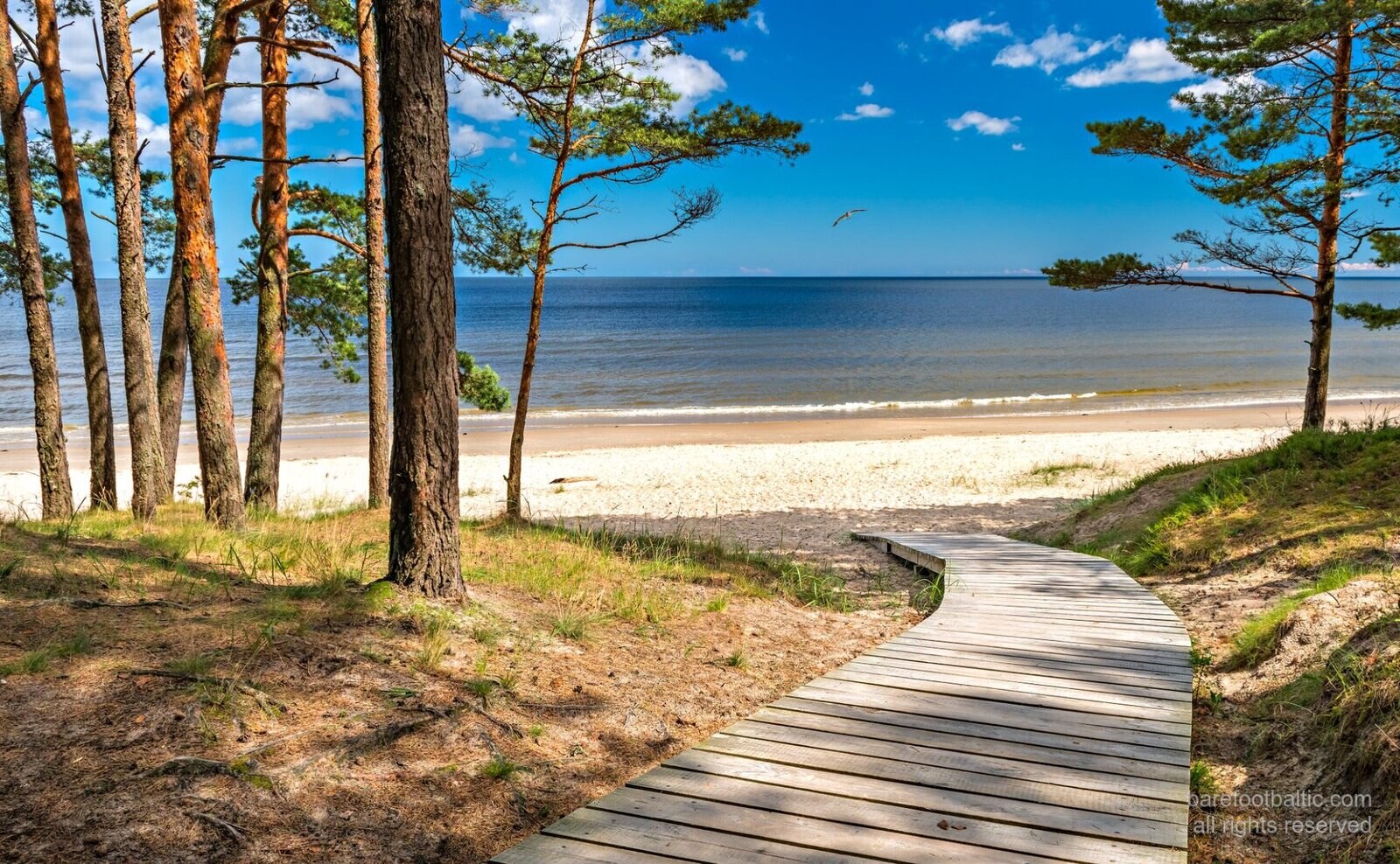
It sits twenty-five kilometres west of Riga, sandwiched between the Gulf of Riga and the Lielupe River, a thin strip of pine forest and dunes that runs for thirty-two kilometres along the coast and consists, technically, of fourteen separate former fishing villages now stitched together into one resort. Majori is the centre. Bulduri, Dzintari, Dubulti, Ķemeri. These are the names you’ll see on train signs as you arrive.
I love this place. I walk on its beach in the early morning whenever I can. The Baltic at six in the morning, with the mist still lifting off the sand and the gulls already at work, is one of those things that resets you. By the time the rest of the resort wakes up you have already had the best of the day to yourself.
The beach itself
Thirty-three kilometres of white quartz sand. That alone would make Jūrmala worth the trip. But the remarkable thing about this beach, the thing children love and parents quietly bless, is that the Baltic Sea here is shallow. Astonishingly shallow. You can wade out from the shore for several hundred metres before the water reaches your waist. On a calm summer day, with the right tide, you can walk five hundred metres into the sea and still see the bottom. It is the most welcoming water I have swum in anywhere in Europe.
This shallowness is what made Jūrmala a family resort and a children’s resort, going back centuries. It is also what makes the early-morning beach so beautiful. The water is glassy, the horizon impossibly far, and on a still day the surface mirrors the sky so completely that you cannot tell where one ends and the other begins.
The sand is fine and white, almost too bright at noon in midsummer. There are descents to the beach designed for prams and wheelchairs, playgrounds, volleyball courts, and football pitches drawn straight onto the sand. In the late afternoon you will see locals playing real football matches on the beach as if it were a regular pitch. Children, teenagers, off-duty fathers, with goalposts of driftwood and shoes. It is one of the small pleasures of summer here.
The spa town it has always been
What gets forgotten, in all the talk of beaches and beach bars, is that Jūrmala began as a place people came to in order to get well, and it is still that place today.
The story starts at Ķemeri, at the western end of the resort, where natural sulphur springs bubble up through the ground and have been doing so for as long as anyone has lived here. The healing properties of the water were noticed by local foresters in the late 18th century, who would heat it in oak tubs and offer baths to ailing landowners from the Courland nobility. The first chemical analysis of Ķemeri spring water was carried out in St Petersburg in 1801. By 1838, Tsar Nicholas I had granted the land for a proper public bathhouse, and Ķemeri was on its way to becoming one of the most famous spa resorts in the Russian Empire.
Russian officers wounded in the Napoleonic Wars came here to recover. After the railway from Riga to Tukums opened in 1877, the trickle became a flood. Moscow and St Petersburg gentry took the train out for the summer, built wooden villas under the pines, and Jūrmala became a fashionable resort on the European map.
The architectural high point came in 1936 with the opening of the Ķemeri Sanatorium, designed by the Latvian architect Eižens Laube and nicknamed the White Ship (Baltais kuģis) for its sleek modernist lines. It had over a hundred rooms, hot and cold running water, and treated everything from rheumatism to nervous exhaustion. During the Soviet era it remained a respected medical facility serving the entire USSR. Today it stands empty. A botched 1990s privatisation left it in limbo. But the surrounding park has been beautifully restored, and you can climb the 42-metre water tower for a view across the bog and the forest. The sulphur water still flows. You can sip it from the Ĝirzaciņa (Little Lizard) spring in the park. It tastes exactly how rotten eggs smell. That, they say, is how you know it’s working.
Modern Jūrmala has carried this tradition forward in a way few European resorts have. The Baltic Beach Hotel in Majori, the Hotel Jūrmala SPA, Light House Jūrmala, Jaunķemeri Rehabilitation Centre, Hotel Pegasa Pils. These and a dozen others offer the full range of treatments, from straightforward Finnish saunas to mud baths, sulphur soaks, ozone capsules, salt rooms, cryotherapy, and massage traditions sourced from across the world. After consulting with an in-house doctor, patients can undertake structured multi-day or multi-week courses targeting specific conditions.
The clientele has shifted in recent years. Through the Soviet decades and the early post-Soviet period, the spa scene was overwhelmingly Russian. Russian-speaking guests still arrive in small numbers, but post-2022 visa requirements have substantially reduced that flow. What has filled the gap is a steady increase in Lithuanian visitors crossing the border to enjoy what they consider some of the best-value spa treatments in the Baltic, alongside growing numbers of Estonians, Finns, and Western Europeans. The crowd looks more international now, and less exclusively post-Soviet. The depth of expertise has not changed.
The wooden Art Nouveau
The architecture is the deeper layer.
The town has an official register of 414 protected historical buildings and over 4,000 surviving wooden structures, most of them from the second half of the 19th century and the early 20th. This is one of the largest concentrations of historic wooden architecture anywhere in Europe.
What you’ll see, walking the side streets behind the main beach drag, is a particular kind of architecture you do not really get anywhere else. It’s wooden Jugendstil, also called wooden Art Nouveau. This is the same style Riga is famous for in stone, the Mikhail Eisenstein masterpieces on Alberta iela, the carved facades and stylised plant motifs and asymmetric windows, only rendered in pine and oak instead. Carved wooden gables, stained-glass verandas, towers and turrets and balconies. The colours are pale yellow, soft green, dusty pink, the occasional defiant blue.
These were summer dachas. Built between roughly 1880 and 1914 for wealthy merchants from Riga, St Petersburg, and Moscow, by Baltic German, Russian, Finnish, and Latvian architects working in the styles of their time. Neo-classicism, National Romanticism, and increasingly Art Nouveau as the century turned. Each villa is its own small project, no two alike, all of them wooden, many of them still occupied or restored as small hotels and guesthouses. Walking the streets between Majori and Dzintari is an open-air museum of an architectural moment that elsewhere only survives in textbooks.
Alongside these, modern Jūrmala has its other extreme. Ultra-luxurious sea-facing private mansions, mostly of recent construction, set behind tall hedges in the choicest stretches of beach frontage. Walking the back streets you pass from one to the other and back again. A 1905 wooden villa with peeling paint and a wisteria climbing the porch, then a hundred metres further down a pristine glass-and-concrete villa with security cameras and a yacht in the driveway. Both belong to Jūrmala. Both are part of why people come.
Jomas iela and the summer scene
The main pedestrian street of the resort is Jomas iela in Majori. About a kilometre of wooden buildings turned into restaurants, ice-cream shops, amber jewellers, summer cafés, a few slightly tacky souvenir places, and the occasional excellent bookshop. In summer the whole length of it is alive with people from morning until late, and the pavement tables spill onto the street.
The beach-facing bars are where the resort really shows its summer face. Some are upscale and serve cocktails for Riga prices. Others are open-air shacks with plastic chairs and inexpensive beer and a view of the sea. Live music happens often, small acoustic acts, jazz duos, the occasional indie band, sometimes scheduled and sometimes not. The Dzintari Concert Hall, an open-air venue dating to 1936, hosts proper concerts on summer evenings. Latvian National Opera stars come out, and there are classical recitals and festival bookings through the season. If you happen to be there when one is on, go. The acoustics in the open-air hall, with the sea breeze coming through the pines, are something.
One thing to plan around. In July and August, especially on weekends, Jūrmala is chock-a-block. The trains arrive packed. Jomas iela in the afternoon is a slow river of people. The beach in front of Majori in peak season has more humans per square metre than is strictly necessary. And the prices can run higher than Riga. A beachfront restaurant lunch in August will cost you noticeably more than the same meal in the Old Town, and hotel rates in summer reflect the demand.
The locals know how to handle this. We come in early summer (late May, June) before the schools break, or in September when the sea is still swimmable and the crowds have thinned. If the beach itself is the goal, we come at six in the morning, any month, when the resort belongs to the early walkers, the dog-owners, and the fishermen.
Getting there by train
This is the easy part.
The train from Riga is one of the great practical pleasures of visiting Jūrmala. It runs from Riga Central Station (Stacijas laukums) every 30 to 60 minutes throughout the day, costs €1.50 for a one-way ticket to Majori, takes about 30 minutes, and drops you within a few minutes’ walk of the beach.
From Riga Central, look for trains heading to Tukums I, Tukums II, Sloka, or Ķemeri. They all pass through Jūrmala. Trains depart from Tracks 3 and 4 on Platform 4. Buy your ticket at the counters in the main hall, slightly cheaper online via the Vivi app or Mobilly, or from the conductor on board for a small surcharge.
Within Jūrmala itself there are 13 to 14 stations, but these are the ones to know.
- Lielupe. Eastern end, quieter beaches, walking distance to the Open-Air Museum.
- Bulduri. Gardens, wooden villas, a calmer alternative to Majori.
- Dzintari. The concert hall and a forest park with a 33-metre observation tower.
- Majori. The main centre, Jomas iela, the tourist information office, the action.
- Dubulti. The famous concrete-shell modernist train station, designed in 1977, now an art gallery.
- Ķemeri. The historical sanatorium, the park, the sulphur springs, the entrance to Ķemeri National Park and the bog.
A return ticket plus a day on the beach plus a meal will set you back less than thirty euros per person. There is no better way to spend a summer day from Riga.
Or by car, if you must
You can drive out on the A10/E22, which takes about twenty minutes from central Riga in good traffic and a great deal longer on a Saturday morning in July when half of Riga has the same idea. There’s plenty of parking, much of it free or cheap.
But here is the thing. Since 1996, Jūrmala has charged a daily entrance toll on every motor vehicle entering the city limits. The fee was €3 per day until 1 January 2026, when it rose to €5 per day. Long-term passes are available, €20 for a week and €60 for a month, but for a casual day trip you’ll pay €5 per car, regardless of how many people are in it.
The toll is collected at two checkpoints. Priedaine is the one you hit arriving from Riga, and Vaivari if you come from the west. You can pay in advance, or up to 23:59 on the day of entry, via the Mobilly app, the Citadele Bank app, the official Jūrmala website, or at the toll-point machines. Those take card only. Cash is no longer accepted at the machines as of 2026.
If you forget to pay, the fines are unpleasant. They check.
The municipality is open about why they do this. They want to discourage car traffic in the resort, protect the dune ecology and the air quality, and nudge visitors onto the train, which is also better for them. They have a point. Take the train.
Practical information
| Detail | Information |
|---|---|
| Distance from Riga | ~25 km / 30 minutes by train, 20 minutes by car (without traffic). |
| Train | Every 30 to 60 minutes from Riga Central, Platform 4, towards Tukums / Sloka / Ķemeri. €1.50 to Majori. Bicycles welcome (a small luggage ticket required). |
| Car toll (2026 onwards) | €5/day, payable via Mobilly, the Jūrmala app, or at toll-point machines (card only). Long-term passes €20/week, €60/month, €100/three months. |
| Beach | 33 km of white quartz sand. Free, public, accessible, swimmable May to September. The water is shallow for hundreds of metres, exceptionally safe for children. |
| Best time to swim | Late June to mid-August, when sea temperatures reach 18 to 22 °C. |
| Best time to visit overall | Late May, early June, or September, for the warmth without the crowds. |
| Best time for a quiet beach walk | Any morning before 8:00, year-round. Bring a thermos. |
| Where to base yourself | Majori for the action, Dzintari for the concerts, Bulduri for the wooden villas, Ķemeri for the spa heritage and the bog. |
| Don’t miss | A walk along Jomas iela, the Dubulti train station, the Ķemeri Park and water tower, a proper spa treatment at any one of the major hotels, a sunset on the beach. |
The official tourism site is visitjurmala.lv. Useful for events, the spa directory, and buying a car pass online before you set off.
On our excursions
Jūrmala isn’t on our standard day-trip excursion list, because it is a do-it-yourself destination. The train is too easy and the resort too sprawling for a guided coach tour to add much value. But we tell every guest who asks. If you have a free day in Riga and the weather is good, take the morning train out, walk the beach, eat lunch on Jomas iela, soak in a sulphur bath at one of the spa hotels in the afternoon, and take the early evening train home.
You will sleep better than you have in weeks.
That, more than anything else, is what Jūrmala has been doing for Latvians, Russians, Lithuanians, and everyone else who has wandered out here for two hundred years. It is the place we go to be put right. It still works.