Say the word sauna almost anywhere and people picture the same thing. A small wooden room with a heater in the corner, a thermometer on the wall, an automatic timer, and a sign that says fifteen minutes is the maximum recommended session. This is what saunas have become at neighbourhood gyms and chain hotels, and there is nothing wrong with it. It does what it says on the tin.
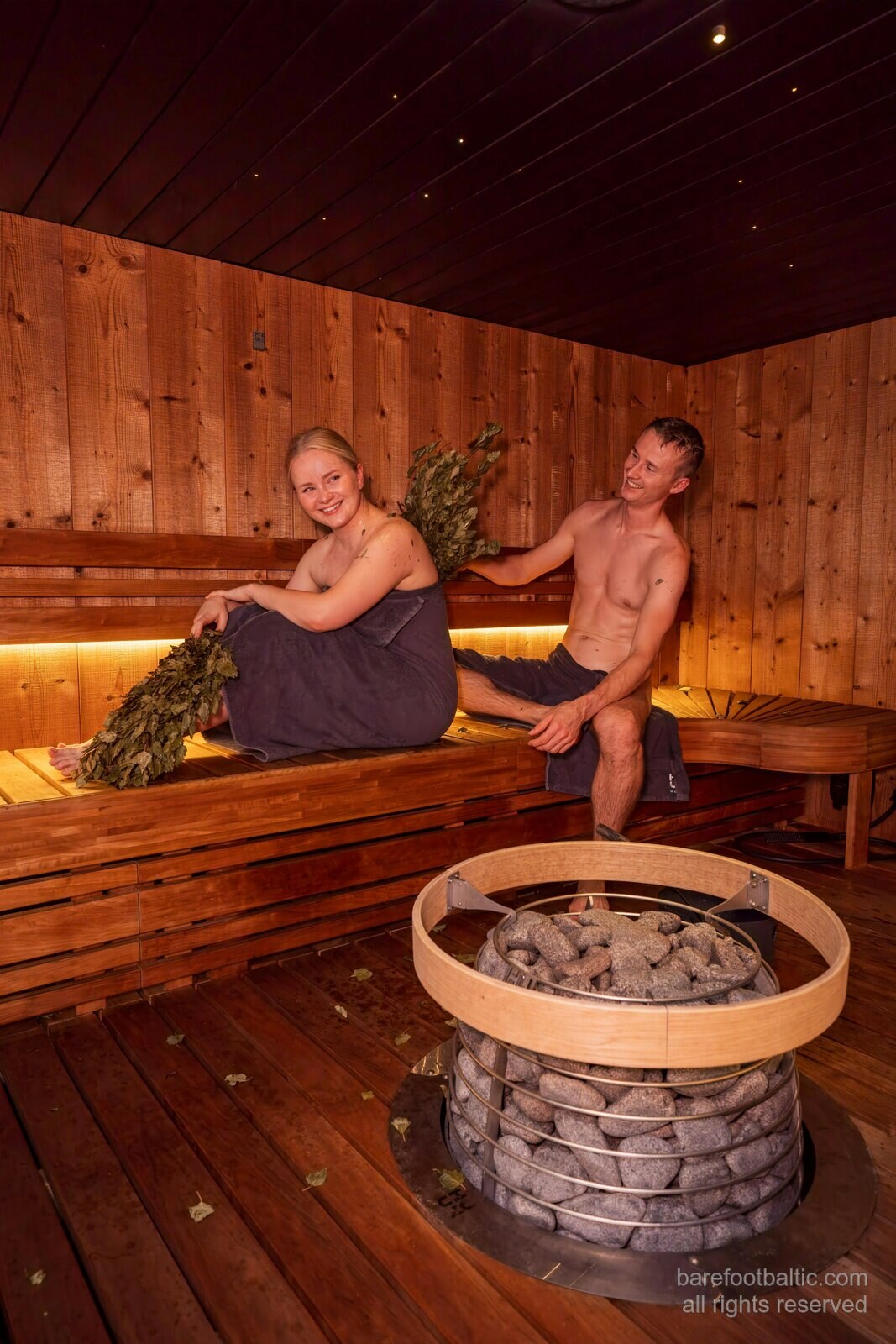
But it is not what a sauna actually is, in the part of the world where the practice was born. In the forests and lakes between Helsinki, Tallinn, Riga, and Vilnius, and in the high valleys of Norway, where the tradition almost died and is now coming back, a sauna is a building, a ritual, a social institution, sometimes a sacred space. Historically it was the place where you were born and the place where you were washed for the grave. The gym box and a real Baltic sauna share the word and very little else.
Let me try to compare them.
Finnish sauna, the brand name
The word sauna is Finnish, and the Finns won the linguistic war so completely that “sauna” is now the global term for every variant of the practice, in dozens of languages. There is one Finnish person for every two or three Finnish saunas. That is roughly three million saunas for a population of five and a half million. UNESCO inscribed Finnish sauna culture on the Intangible Cultural Heritage list in 2020.
The Finnish style at its most traditional is the savusauna, the smoke sauna. No chimney. A pile of stones over a wood fire that burns for hours, filling the room with smoke. When the wood has burned down, the smoke is vented, the soot-blackened walls retain the heat for hours, and the air inside turns soft and deep, almost velvet. No electric heater on Earth has ever replicated it. This is what older Finns mean when they tell you a regular sauna isn’t really a sauna.
The modern, more accessible Finnish sauna is hot (80 to 110 °C) and relatively dry. You pour water on the stones to create löyly, the burst of steam that is the whole point. People generally sit in silence. Nudity is the default. Mixed-gender saunas are family-only or single-sex. Lauantai on saunapäivä, Saturday is sauna day. Almost every cottage has one. Helsinki’s Burger King has one too, which says something about how deeply this is woven in.
The Estonian suitsusaun got there first
In southern Estonia, in a region called Võrumaa, you find the oldest continuous smoke sauna tradition on Earth. It was inscribed on the UNESCO list in 2014, six years before the Finns made their entry, and the Estonians remember that.
The Estonian suitsusaun (in the local Võro dialect, savvusann, which is closer to the Finnish word) is functionally identical to the Finnish savusauna. A stone pile, wood fire, no chimney, soot-darkened walls, soft persistent heat. What the UNESCO listing actually preserves is the tradition rather than the building. The bathing customs, the making of bath whisks (viht), the building and maintenance of saunas, and crucially the smoking of meat in the same building during the off-hours.
This last detail tells you something important about the smoke sauna’s place in rural life. It was a multi-purpose building. You bathed in it on Saturday evening. You cured your ham in it during the rest of the week. You gave birth in it. You washed your dead in it before burial. It was the cleanest, hottest, most sterile space on the entire farm, and so it was where the most important biological events of human life happened. UNESCO calls this “a way of life” rather than an architectural form, which is exactly right.
The Latvian pirts became a ritual
This is the one I know best, because it is mine.
The Latvian pirts shares the deep Baltic-Nordic root with all of the above. Wood-fired heat, water on stones, leafy whisks, the cold-water plunge, often a smoke variant in the older tradition. But somewhere in the last few decades, while the Finns were industrialising the sauna and putting one in every office basement, the Latvians took the opposite route. We turned the pirts into a ritual. A four-hour ceremonial event guided by a trained master, working on one or two people at a time.
Here is what that actually looks like at the better venues.
You arrive in the late afternoon. You meet your pirtnieks, your pirts master, who will spend a few minutes asking you what you need. They might pour you a herbal tea and ask you to set an intention for the session. Not in a cringing, performative way. Quietly, the way a doctor might ask what hurts.
You then enter the warm room. The heat builds gradually, because the Latvian pirts is gentler than a Finnish sauna, with a careful balance of temperature and humidity that the masters are taught to read by feel. You are wrapped, scrubbed with salt or honey, brushed with bundles of birch, oak, juniper, mugwort, or whatever the master has chosen for your particular session, depending on the season and what they have decided you need. The whisking, pēršana, is a slow rhythm, almost a percussion, worked over your whole body while you lie there with your eyes closed. Nobody is hitting you.
After each round of heat, you go out and plunge into a cold pond. Then you rest. Then you go back in. This cycle repeats three or four times over the course of three to four hours. There is honey rubbed into your skin near the end. There may be singing, herbal infusions, contrast with snow in winter. The master keeps your head cool with a wet cloth or a felt sauna hat, because overheating the head is what people get wrong in untrained saunas, and times your sessions so that you sweat without exhausting yourself.
The whole thing is deep. By the end of it you are not so much relaxed as processed. People sometimes cry. People often sleep better that night than they have in months.
To do this work properly, a pirtnieks trains formally for one to two and a half years at one of several pirts schools, among them Lielzemenes and the Pirts School at Ziedlejas. Most masters keep studying long afterwards. There are hundreds of medicinal plants to learn, dozens of whisk techniques, a proper understanding of when to apply heat and when to release it, and an entire body of folk knowledge about the seasons. The Finns may have the most saunas per person. We probably have the most pirts masters per person.
A few things from older tradition still surface in modern practice. The pirtīžas is a ritual performed soon after a baby is born. Historically the pirts was where the baby was actually delivered, and it is still where mother and child take their first formal bath together. At the other end of life, the deceased were traditionally washed in the pirts before burial. Folk songs call the bathhouse Māras pirts or Laimas pirts. Māra and Laima are old Latvian goddesses, and the songs say they are present in the pirts when new life begins. Latvians did not give up these beliefs when they were Christianised. They quietly kept them in the bathhouse.
A proper pirts ritual at a premium venue runs €150 to €200 per person, sometimes €300 for a couple at the more luxurious resorts (Ziedlejas, Žadeīta Pirts, Meža SPA). It is not cheap. But you are paying for four hours of one person’s full attention, in a space they have heated all afternoon for you, with herbs they collected themselves and prepared by hand. By the metric of “money spent per actual change in how you feel afterwards,” it is one of the better deals available in Europe.
Lithuanian pirtis, the older sibling
Lithuanians do have their own sauna tradition, and the word is one letter different from ours. They say pirtis where we say pirts. The histories are deeply intertwined. Both Latvian and Lithuanian descend from a common Baltic root, and the bathing customs developed together in pre-Christian times.
The Lithuanian pirtis tradition leans more toward herbal medicine and quiet ritual than the Latvian theatrical four-hour ceremony. There is a distinguished Lithuanian Bath Academy that trains practitioners. The whisk is called vanta in Lithuanian (versus slota in Latvian). The plant knowledge is similarly deep. Archaeological evidence from Kernavė, the medieval Lithuanian capital, has unearthed a 14th-century smoke sauna with unbarked pine logs, suggesting that the practice was widespread in Baltic tribal life centuries before the Christianisation of Lithuania in 1387.
If you ask a Lithuanian about pirtis, they will tell you that “you should be in the pirts as you are in church.” It is a real saying, and it tells you a lot about how the Baltic peoples have always understood this practice.
Norwegian badstu almost died out
This one has the most surprising history.
The Norwegian word for sauna is badstu, from bad meaning bath and stu meaning a heated room (related to the English “stove”). The Vikings had badstuer. Norwegian farms had them through the medieval period. Then the Reformation arrived in Scandinavia, and Lutheran moralists decided that communal nude bathing was indecent, and over the following centuries Norwegian badstu culture quietly died. By the 1860s an ethnographer was claiming to have found the country’s last practising bather, in a remote southern valley.
What kept the tradition alive in Norway, ironically, was Finns rather than Norwegians. The Kvens in the Arctic north and the Forest Finns in the southeast, both recognised national minorities, who never stopped bathing and never explained themselves about it. For three hundred years, the badstu in Norway was a Finnish-minority practice on Norwegian soil.
Then around the year 2000, something remarkable happened. Norwegians started building badstuer again. A Finnish architect named Sami Rintala built a floating sauna in a fjord. Other people copied him. Now Oslo Harbour has more than a dozen floating saunas, with bookings months in advance, and Norwegian sauna culture is undergoing a full-scale revival. It has a particular Norwegian character to it, much more architectural and open than the older Finnish tradition. The look matters more than the ritual.
The Norwegian story is interesting for what it shows. When the tradition dies, the cultural rules die with it, and what comes back is freer to invent itself. Many of the global sauna trends we are seeing now look more like Norway than like Finland. Public floating saunas, architect-designed buildings, prices ordinary people can afford.
The gym sauna
Now we come to the small wooden box at your neighbourhood gym.
What you have there is the modern, electric, dry-air variant, running at 80 to 100 °C, no humidity to speak of, fifteen minutes of timer, glass door, mostly silent. Nothing wrong with it. Heat does what heat does. You will sweat, your circulation will improve, your shoulders will unclench, and on a cold winter day it is a small mercy.
But it is a different thing from any of the traditions described above. No fire, no smoke, no master, no four-hour arc. The gym sauna is heat extraction without context, the way an espresso shot in a paper cup is caffeine extraction without the Italian café. Both do something for you. Neither is the original.
The rest of the world is currently rediscovering the original. Public bathhouses are reopening in London, Brooklyn, Berlin, Melbourne. People are training as bath masters. Latvians and Finns are travelling abroad to teach the techniques. The gym box is being supplemented by something deeper.
The third place
There is a sociologist named Ray Oldenburg who in 1989 published a book called The Great Good Place, in which he argued that human beings need three different sorts of social space to function properly. Your first place is your home. Your second place is your work. Your third place is somewhere else, the neutral ground where you go regularly, where the conversations are unscripted, where you might know the regulars but you owe them nothing, and where the social hierarchies of home and work do not apply.
The classic third places are cafés, pubs, barber shops, market squares, the post office. Oldenburg argued that societies which lose their third places become anxious, lonely, and politically polarised, because there is nowhere left for ordinary unobligated human contact to happen.
Anyone who has spent time in a Baltic or Nordic country will recognise that the sauna has been a third place here for a very long time. Saturday at the village pirts. Friends gathering at a country sauna in summer for an evening that runs late. The old men in a Finnish public sauna who have been arguing about the same things for forty years. The Estonian smoke-sauna farmer who hosts strangers and locals indistinguishably. None of that happens at home, and none of it happens at work. It happens in the heated wooden room, and has done so for a thousand years.
The pirts, particularly, takes the third-place idea further than anywhere else I can think of. Latvian families gather at the bathhouse for birthdays, for the arrival of new babies, for the months after a death, for marriages, for the first day of spring. It is the place where major life events are processed, in a way that combines the spiritual function of a church, the social function of a pub, and the medical function of a clinic. Modern psychology is only now arriving at what the bathhouse has done all along.
A word on the dark water
I want to talk about the part I, personally, struggled with for years.
When you do a proper Latvian pirts ritual, the cold-water plunge is essential. You go from the heat into water that is barely above freezing for 10 to 30 seconds, and the contrast is what makes the whole thing work. Circulation, immune response, mental clarity, all of it.
The problem, for me, is that the cold water is usually a Latvian pond. And Latvian ponds look a bit alarming the first time you see one. The water is almost black. The bottom is invisible. There is something soft and muddy underfoot. The whole thing looks like the kind of pond where, in a fairy tale, something with too many teeth lives.
I am happy to report that the science is on our side, and I wish someone had explained this to me earlier.
The dark colour of Latvian pond and lake water comes from dissolved organic matter, mostly humic and fulvic acids, that leach out of the surrounding peat bogs and pine forests. Sphagnum moss decomposes slowly under acidic, low-oxygen conditions, and the products of that decomposition stain the water the colour of strong tea. There is nothing wrong with the water. It is simply dressed in the colour of the land it flows through.
It gets better. Those same humic acids have mild antimicrobial properties and act as a natural sunscreen for the lake, suppressing bacterial growth and protecting aquatic life from UV damage. This is why historical travellers in northern Europe used to say “if it’s brown, drink it down.” Bog water has been keeping people alive in this part of the world for a very long time. It looks bad and is biologically excellent.
Once I understood this I stopped flinching at the surface. The water is dark for the same reason the forest smells the way it smells. You’re immersed in the chemistry of the bog. The chemistry of this whole country. It is faintly embarrassing, being a Latvian who took twenty years to make peace with the colour of the local water, but there it is.
The muddy bottom underfoot is, I’ll admit, still a separate issue. You get used to it.
So which one should you try?
If you are visiting Latvia, the answer is straightforward. Book a Latvian pirts ritual with a trained pirtnieks at one of the proper rural venues. Ziedlejas in the Gauja National Park, Žadeīta Pirts in Jūrmala, Meža SPA on the Kurzeme coast. Plan for half a day, and expect something to actually happen to your body and your nervous system. I do not mean that as a metaphor.
If you are visiting Finland or Estonia, find a real smoke sauna rather than a hotel one. The smoke sauna is the ancient form, the UNESCO-listed form, and the form that produces the soft, deep heat that everything else is trying to imitate.
If you are in Norway, go to one of the floating saunas in Oslo or Bergen and afterwards plunge into the fjord. It is more architectural than ritualistic, but it is lovely. The new Norwegian movement is where the design conversation in sauna culture is moving.
And if all you have is the gym sauna at your local fitness centre, that’s fine too. Sit in it for fifteen minutes. Breathe slowly. Drink water afterwards.
Just know that there is a much deeper version of this, going back a thousand years, still very much alive in the forests of this part of Europe. And if you ever find yourself in Latvia in winter, with four free hours and €150 to spend, I cannot think of a better way to spend either.
The Latvian pirts tradition is best understood the way it has always been understood, by walking into one. We can build a small-group sauna evening into our Riga visits when the season is right. Get in touch if you want to try a real Latvian pirts as part of your trip.