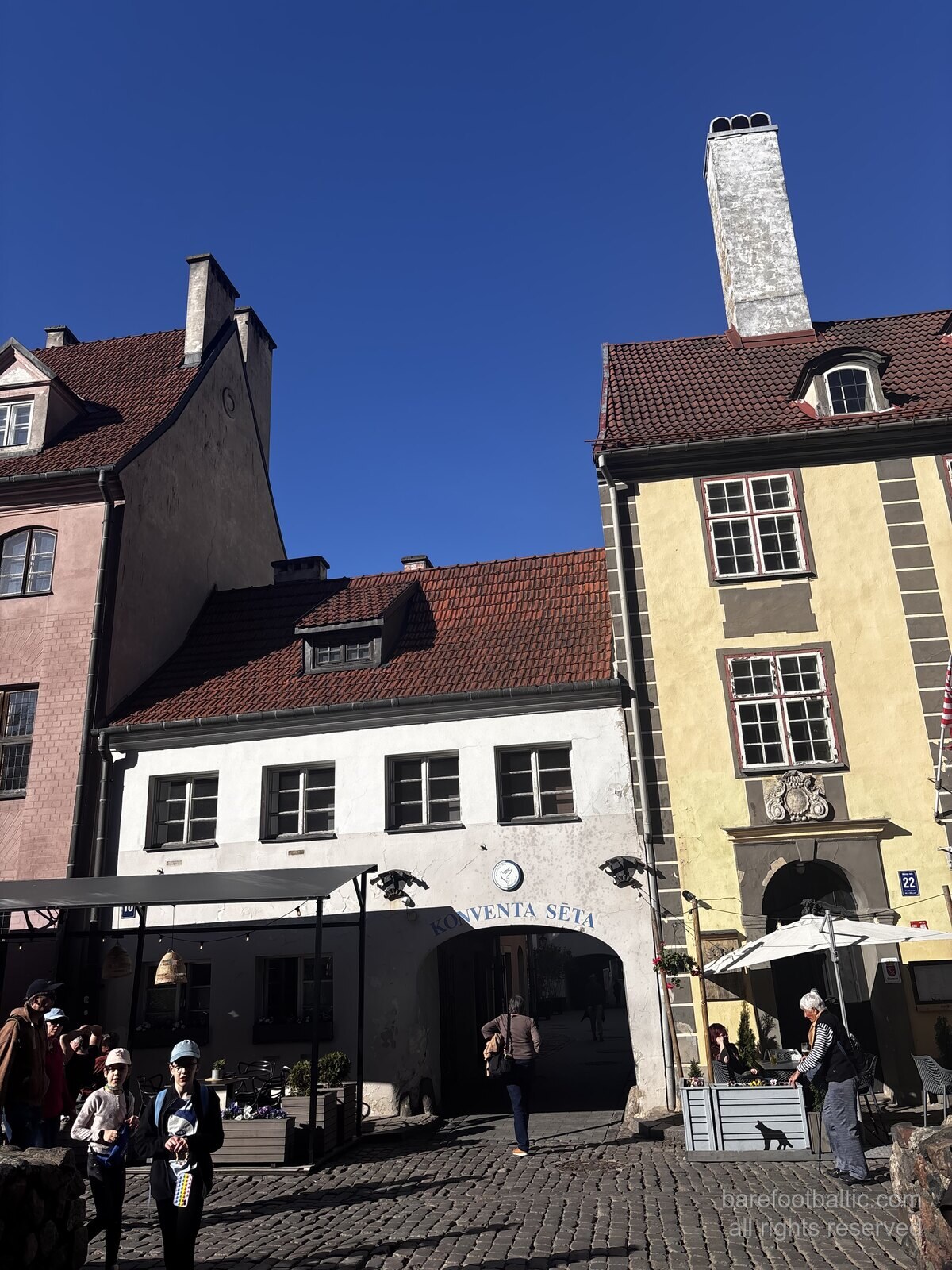
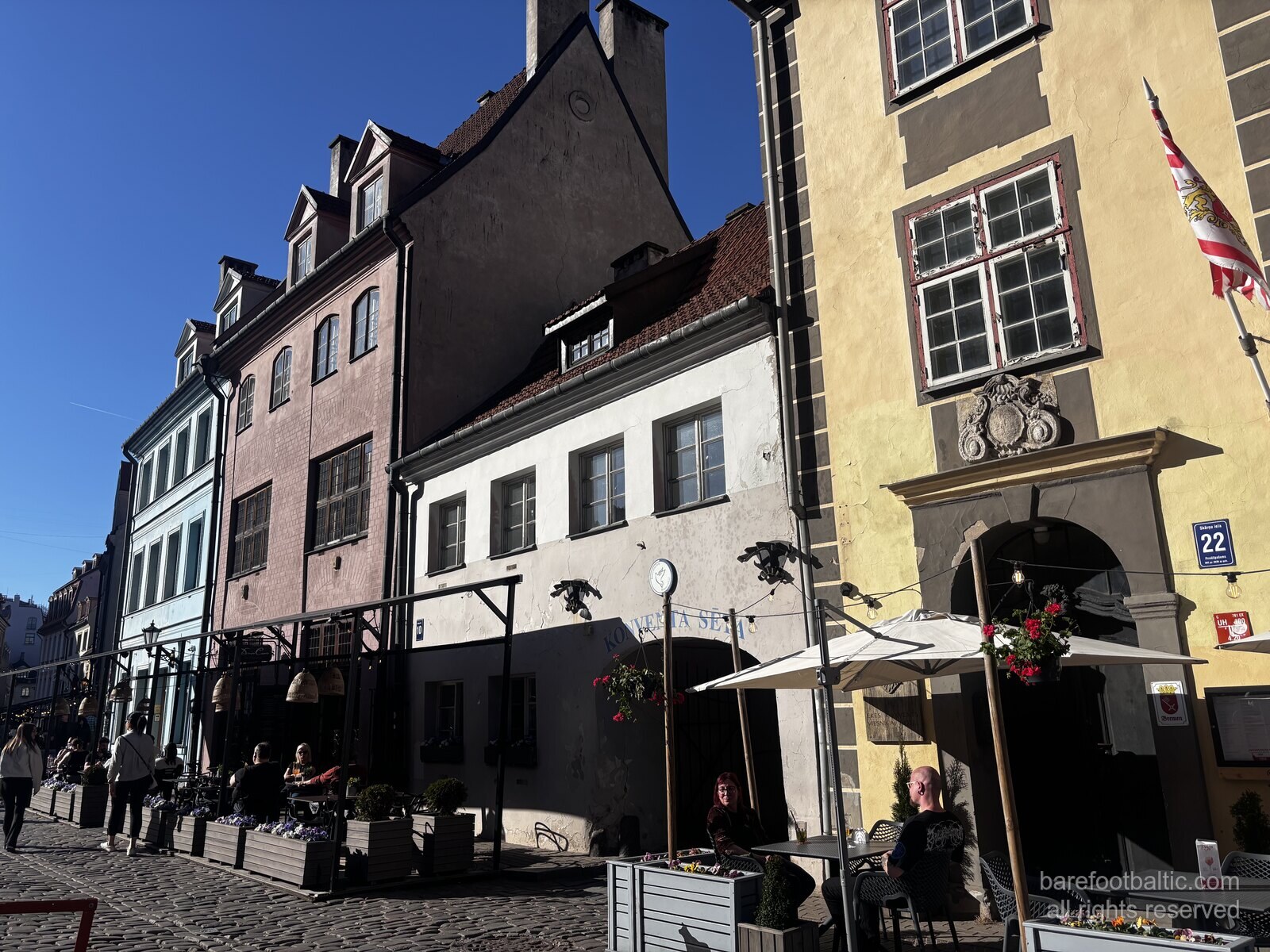
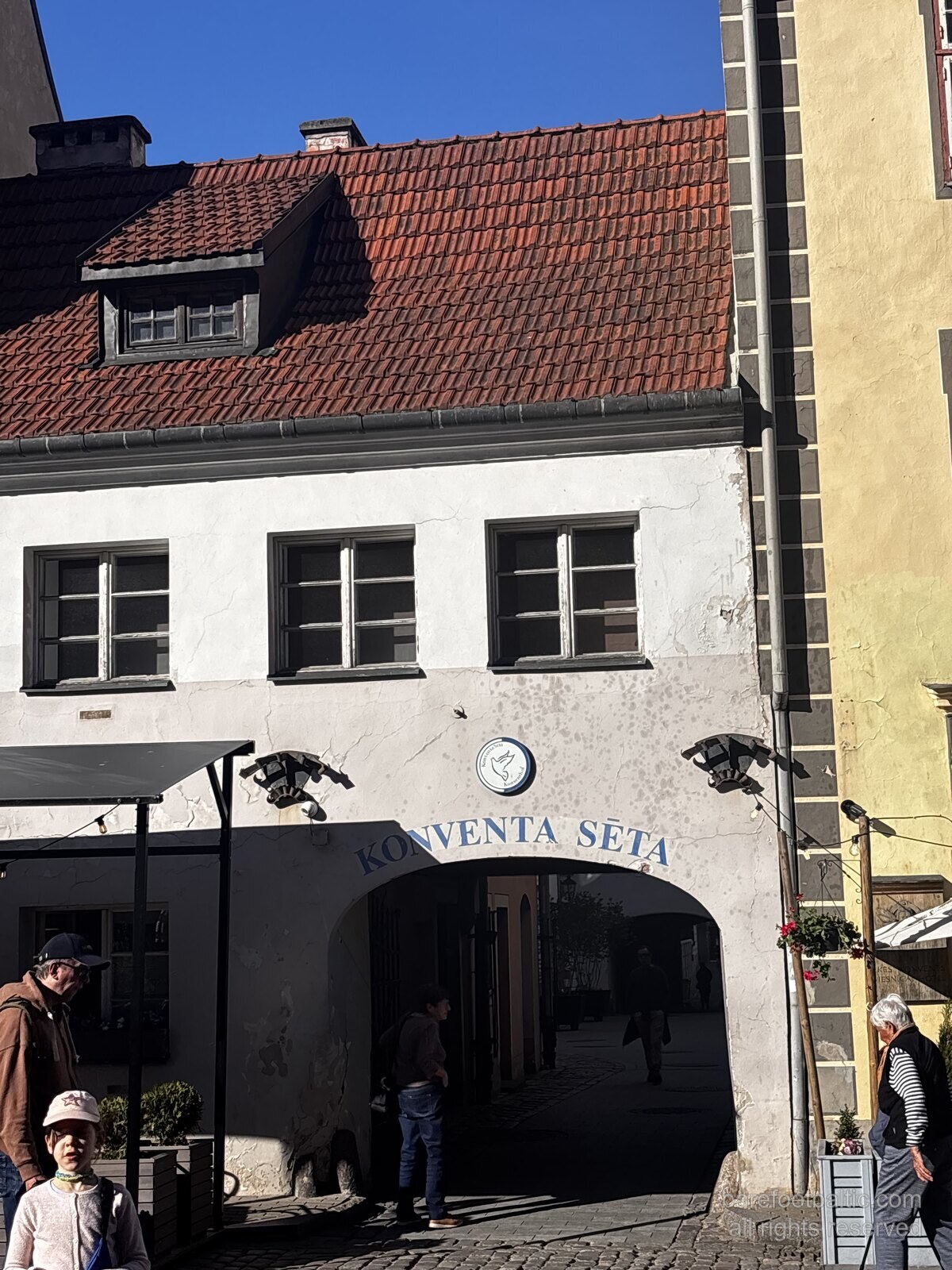
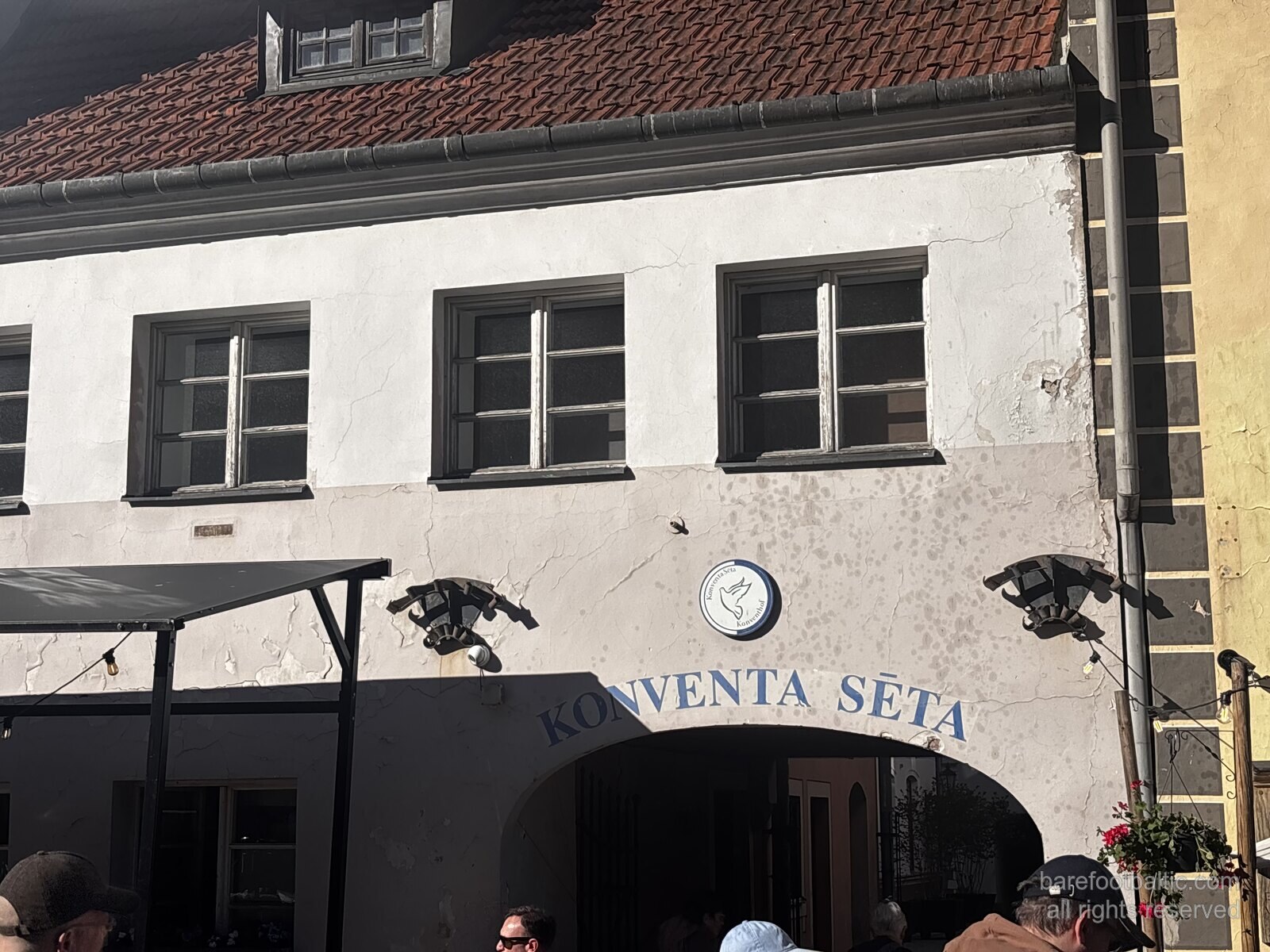
A medieval courtyard, a dove on a keystone, and a modern apartment block leaning in from behind. Click any image for the full-size view.
Short answer, what Konventa Sēta is
Konvents means convent in Latvian, and sēta is yard or courtyard, so the name reads as Convent Yard. It’s a quiet medieval cluster of about a dozen 16th-to-18th-century buildings, on 13th-century foundations, arranged around a small inner courtyard between Kalēju iela and Skārņu iela in Riga’s Old Town. Today the cluster holds a hotel, a small porcelain museum, a few cafés, and a couple of shops. The blue dove on the keystone above the main entrance is the Holy Spirit. That’s what the convent was for, and that’s where the name comes from.
A few quick facts before the rest.
- Address Kalēju iela 9/11, Old Town, Riga.
- Cost the courtyard is free and open all the time. The Riga Porcelain Museum charges around €5.
- What’s on the ground Hotel Konventa Sēta in most of the cluster. The Riga Porcelain Museum on Kalēju. A few small shops and cafés in the courtyard.
- Origins a 13th-century Livonian Brothers of the Sword fortress stood here until the citizens of Riga destroyed it in 1297. The Holy Spirit Convent moved in during the 14th century and gave the place its name.
- Status state-protected cultural monument no. 6546.
- Five minutes’ walk from St Peter’s Church, and five from the House of the Blackheads.
If you’re walking through the Old Town from the cathedral quarter to St Peter’s tower and you have ninety seconds to spare, cut through here. That’s the local move. The rest of this is what you’re actually walking past, and why it’s worth a slower look on the way back.
Centuries of layers on one plot
Some places in Riga are easy to read. The cathedral is a cathedral. The Powder Tower is a tower. Konventa Sēta is harder, because it isn’t one building. It’s twelve, give or take, on top of one of the older plots of ground in the city, and the layers do not politely separate.
Start with what was here first. In the 13th century the Livonian Brothers of the Sword (the German military-religious order that had founded Riga in 1201) built a small fortress on this ground. The order ran the city for the better part of a century. Then in 1297 the citizens of Riga, fed up with them, destroyed the castle. The Brothers regrouped, and in the 1330s they built the much larger fortification you can still walk past on the river. That one is Riga Castle.
The empty plot they left behind on Kalēju iela became charity ground. In the 14th century the Holy Spirit Convent moved in. A hospice and almshouse, the medieval combination of hospital and homeless shelter. Two more refuges were added later. A Beguine sisters’ house, and the Kampenhauzen shelter, endowed by that family in the 18th century. The buildings you see today are mostly 16th-to-18th century, raised on the medieval foundations as the convent’s purpose evolved. By the 19th century the religious function was thinning. Merchants started using the back buildings as warehouses.
The 20th century mostly left it alone, which by Riga standards is the highest compliment a building can earn. No Soviet demolition, no big reconstruction. By the 1990s the cluster was tired and used for storage. The restoration that turned it into the small hotel and museum you see today happened across the 1990s and 2000s, with a further reconstruction round in 2023.
What that history leaves you with is unusual. Not one big dated building, like the Three Brothers up the road. Just a courtyard. You stand in it and you can look at six different rooflines from six different centuries, all hanging together because nobody had the money to knock any of them down.
The dove on the keystone
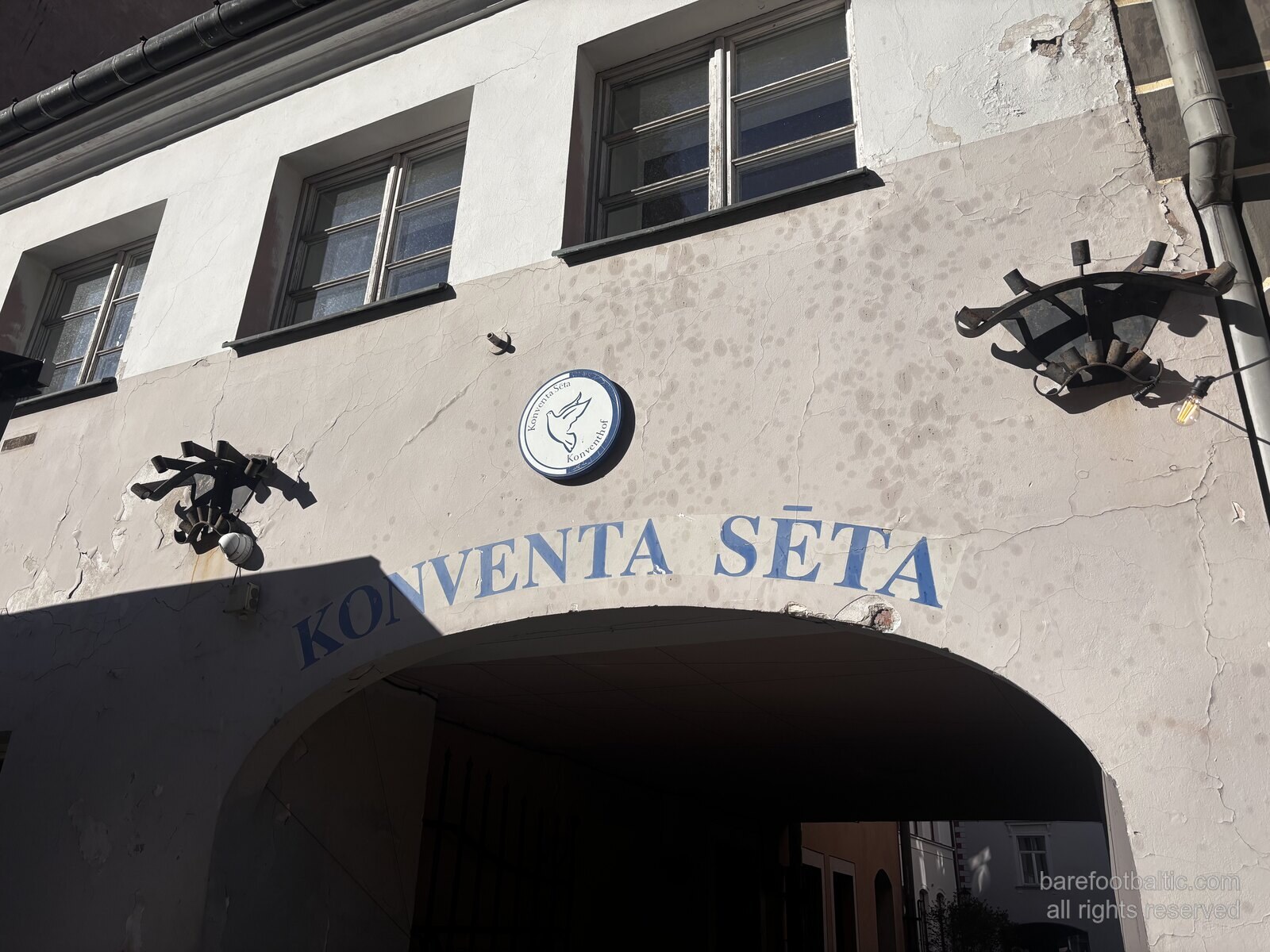
The way you meet Konventa Sēta, walking up Kalēju iela from the south, is the arched entrance. White-stuccoed building above, dark stone arch below it. And on the keystone of the arch, a small blue plaque with a white dove, wings spread, in a halo. That dove is the Holy Spirit. The convent was the Holy Spirit Convent, and the dove has been there, in different periods of paint, for several hundred years.
Look up from the dove and you’ll see two black ironwork sconces, one on each side of the keystone. They look like dragons or bats unless you’ve been told what they are. They’re stylised lantern brackets, original to the building. They’re also one of the small giveaways that the building you’re standing under is older than its soft stuccoed face suggests.
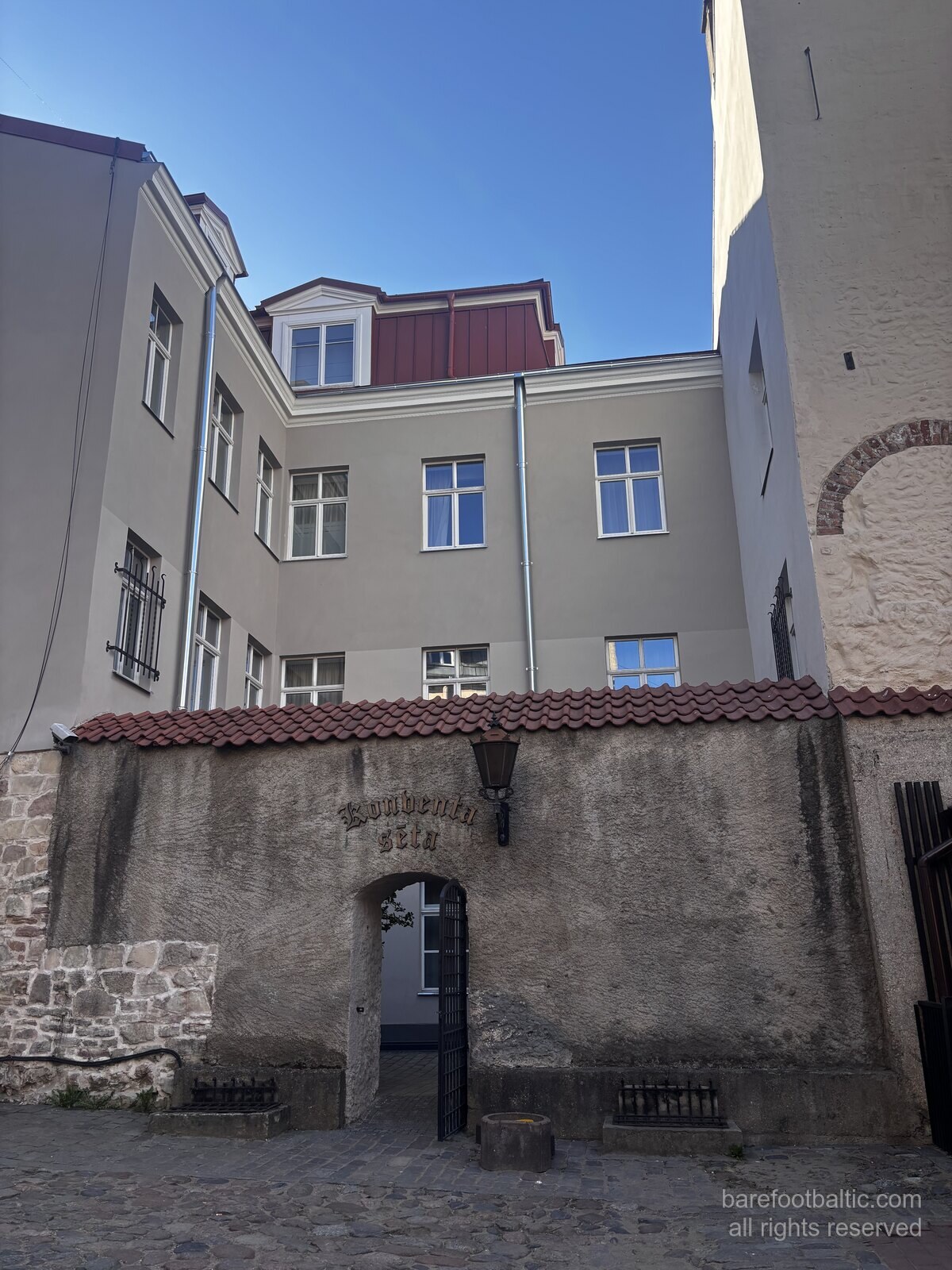
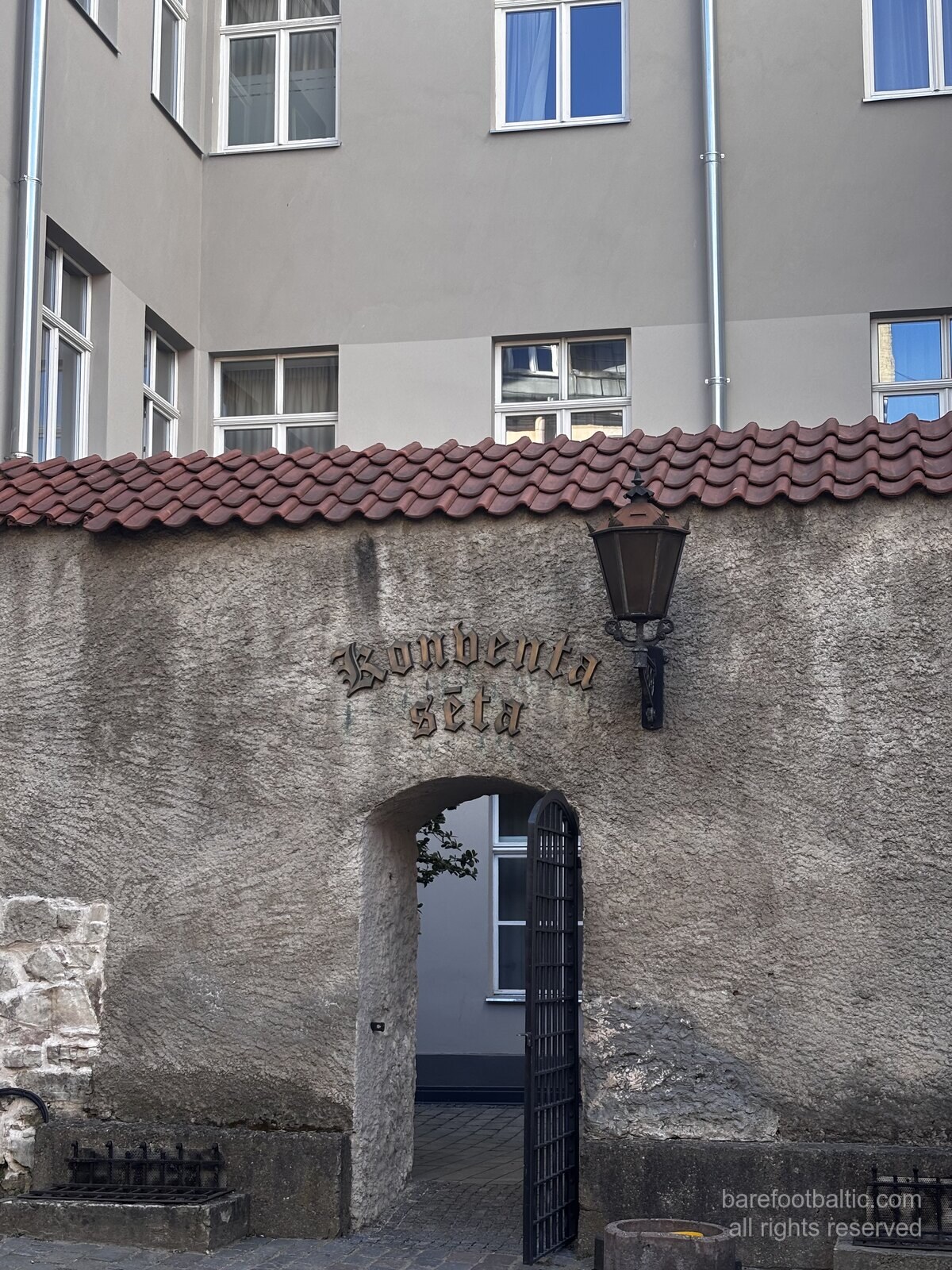
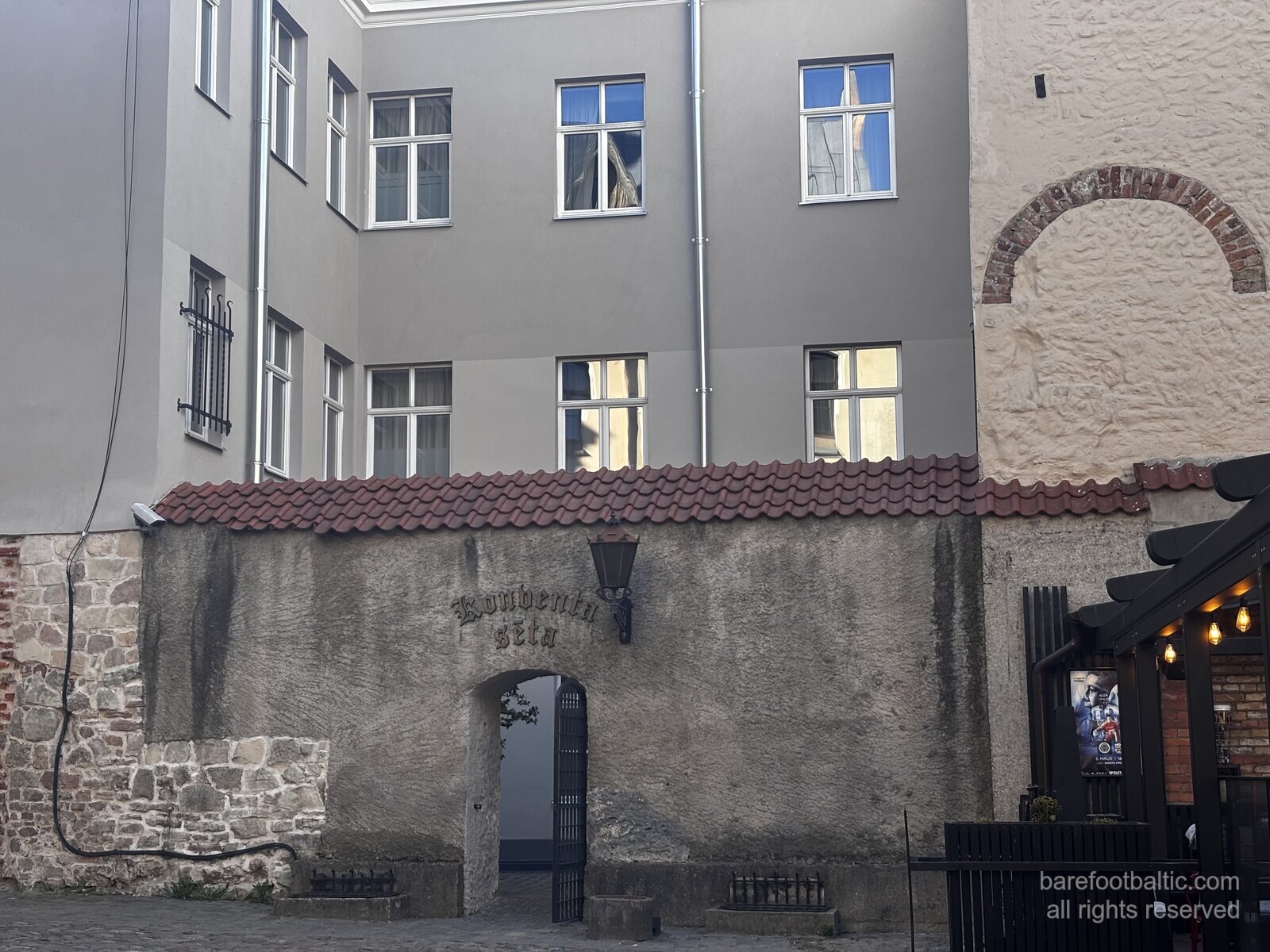
The other entrance, on Skārņu iela, is plainer. A simple stone arch in a rough rendered wall, with a gothic-script Konventa sēta picked out above it in faded gold paint, a small tile-roofed cap and a wrought-iron lantern. No dove. The Skārņu side reads as the back gate of a private property, which it more or less still is. That sign on the rendered wall is one of my favourite small things in the Old Town. Nobody ever photographs it, because nobody ever stops on Skārņu. That’s the street people use to get from St Peter’s to the river.
Iesim cauri Konventai.
What a Latvian Rigan says when she’s walking from the Cat House quarter to St Peter’s and would rather take the quiet way. It means ‘Let’s cut through the Convent.’Inside the courtyard
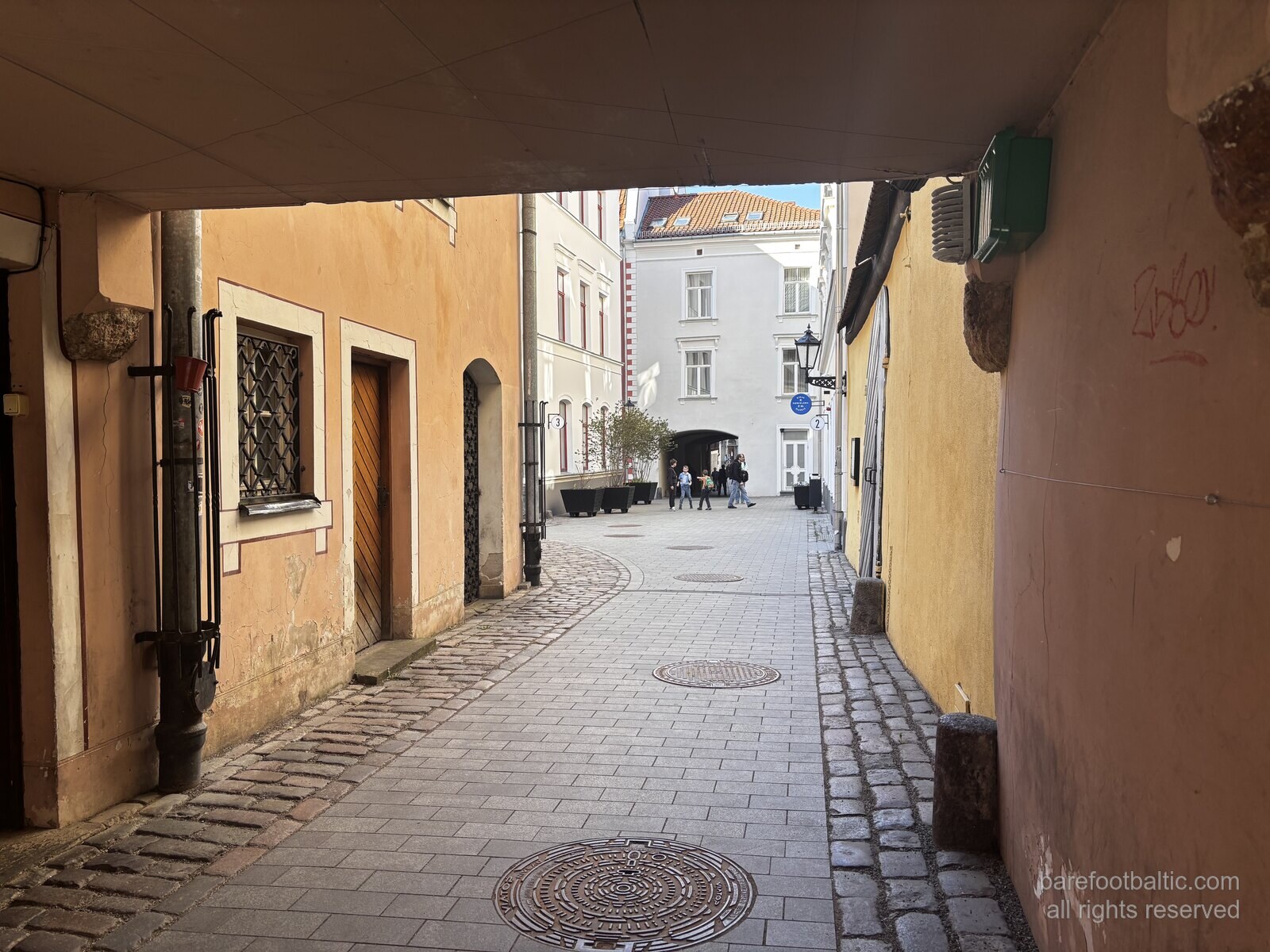
The cobbled passage past the dove arch runs maybe twenty metres before it opens into the small inner courtyard. There’s a second arched gate at the far end, the one onto Skārņu. Walking from one to the other takes about ninety seconds. People do it twenty times a day without noticing what they’ve passed through.
The courtyard itself is small. Cobbled, partly shaded, café tables in spring and summer, almost nothing in winter. Around the perimeter, on three or four storeys, are the windows of Hotel Konventa Sēta, a 140-room mid-range hotel that occupies most of the historic buildings, run by Latvian Hotels Group. The rooms vary widely. Some are in the older 16th-to-17th-century parts of the cluster, with low beams and small windows. The 19th-century additions feel like a normal hotel anywhere. Fair-priced for the location, comfortable, the kind of hotel I’d send a guest to who wanted to wake up inside Vecrīga instead of around it.
On the ground floor along Kalēju, two or three small shops sell a slightly-better-than-airport assortment of Latvian linen, amber, and ceramics. None of them are bad, and none are reasons in themselves to come. The cafés that come out into the courtyard in the warmer months are pleasant and not particularly cheap.
The single piece of the cluster that earns ten focused minutes of your day is the Riga Porcelain Museum (Rīgas Porcelāna muzejs), at Kalēju iela 9/11. Latvia had a substantial porcelain industry in the 20th century, with the Riga Porcelain Factory and the Kuznetsov factory before it. The museum holds the largest collection of Latvian and Soviet-era porcelain in the country. Pre-war work by Romans Suta and Aleksandra Beļcova, two of Latvia’s leading interwar porcelain artists. I’d argue this is the best art in the building. There are also Soviet propaganda figurines from the 1950s and dinner services made for state ministries. A small interactive section if you have kids with you. Entry is around €5. Opening hours are roughly Tuesday to Sunday, 11:00 to 18:00, but check before you go because small Riga museums adjust their hours seasonally and on Mondays.
If design history or the Soviet era is your thing, plan 45 minutes. The rest of us walk through and find a coffee.
Practical answers
Where it is and how to find it
Kalēju iela 9/11, in the eastern half of Riga’s Old Town. The Kalēju entrance, with the dove, is the photogenic one. Skārņu is the back gate. From St Peter’s Church, walk two minutes south on Skārņu iela. The back gate is on your right, easy to miss. From the House of the Blackheads, five minutes east through the Old Town. The closest tram stop is 11. Novembra krastmala on the Daugava embankment. The Old Town is largely pedestrianised, so you’ll arrive on foot.
Hours, costs, and what’s actually open
The courtyard is free and open all the time. You can walk through any time of day. The Riga Porcelain Museum charges around €5 for adults and is open roughly Tuesday to Sunday, 11:00 to 18:00 (winter hours can be shorter). The hotel reception is open 24/7 if you’re a paying guest. Otherwise the lobby is private. The cafés keep café hours, generally 09:00 onwards in the warmer months and reduced hours in winter.
Combining it with the rest of the Old Town
Konventa Sēta sits on the central arc of an Old Town walk. Two minutes north on Skārņu and you’re at St Peter’s. The House of the Blackheads is five minutes west, Riga Cathedral ten minutes north-west of that. The full circuit, with timing and rest stops, is in the Old Town pillar guide. If you’re walking the cathedral-to-St-Peter’s leg, the four-minute detour through Konventa Sēta is one I’d build into the route every time.
Photography, what works
The Kalēju iela facade with the dove faces roughly south-east, so morning light hits it cleanly until about 11. Late afternoon throws it into shadow but lights up the row of medieval houses on the same street to the south. For the keystone dove, you want a phone with a half-decent zoom. The dove is small. The cobbled passage between the two gates is best photographed from the Skārņu end looking back towards the dove, in the late morning when the light reaches all the way through. The back gate on Skārņu, with the gothic-script sign, is in shade most of the day. Bring a steady hand.
My take
Konventa Sēta is not a wow stop. There’s no view from the top, no famous painting, no entry queue. You walk through an arch and stand in a small cobbled yard. That’s what’s on offer.
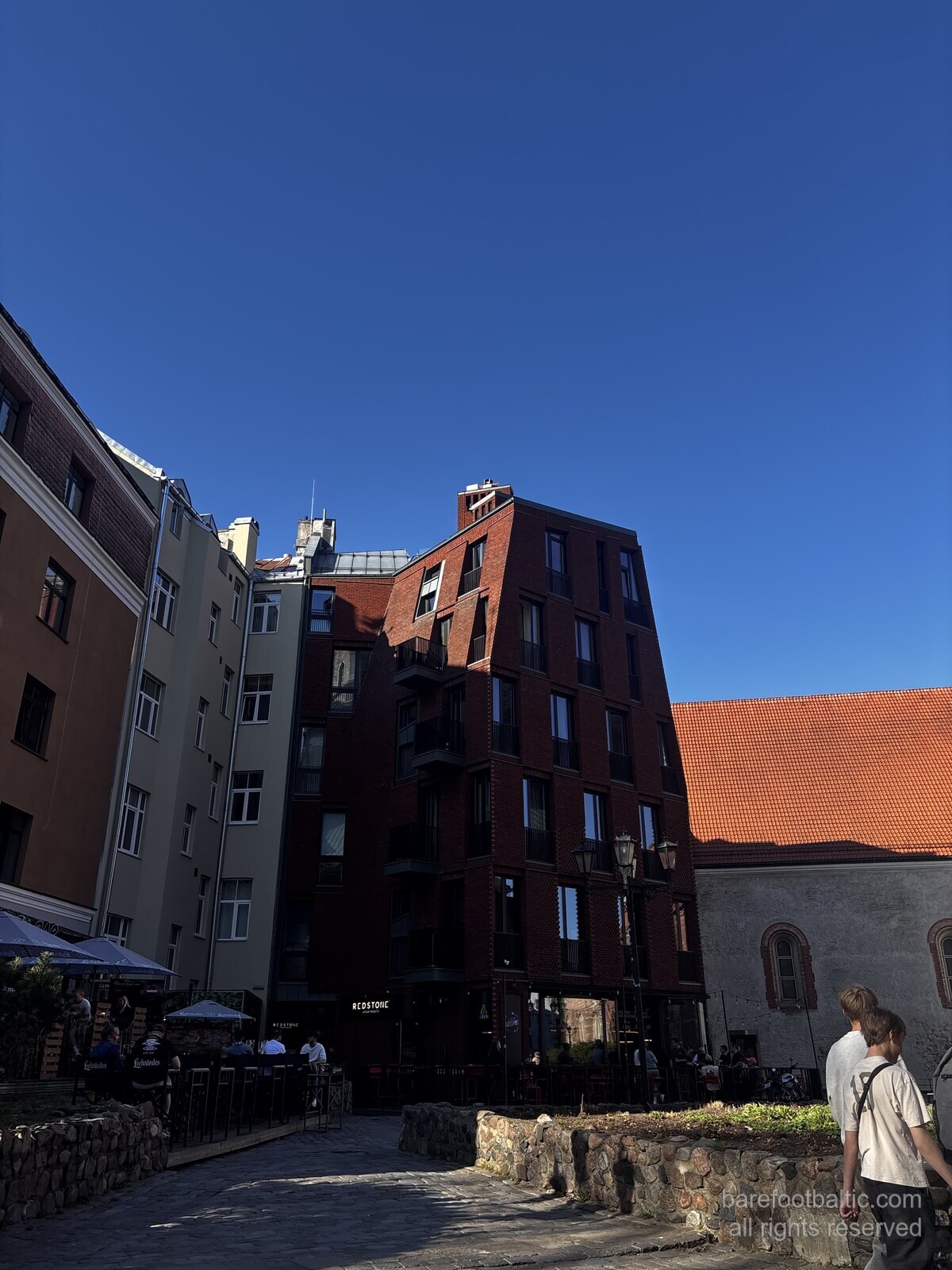
What’s worth your time is everything else. The dove. The porcelain museum that ended up here. The afternoon hour when the day groups have moved on and the courtyard goes quiet. Then there’s the contrast. A tall red-brick block of modern apartments is visible at the back of the courtyard, a 2010s development that now leans over the medieval cluster from the Skārņu side. It’s the cleanest one-photograph illustration I know of how Riga’s Old Town actually works, medieval and 18th century and Soviet and contemporary, all next to each other, none politely cleared. Allow ten minutes if you’re walking past. Forty-five if you stop at the porcelain museum.
Frequently asked questions about Konventa Sēta
Daiga Taurīte is a licensed Latvian tour guide and co-founder of Barefoot Baltic, which runs small-group day excursions from Riga. She grew up in Riga, spent two decades working in London, and came home in 2024. Barefoot Baltic is licensed by Latvia’s Consumer Rights Protection Centre (PTAC), holds ATD passenger transport licence PS-01995, and is insured by BTA Baltic for civil liability.
Konventa Sēta is on every Old Town walk we run between St Peter’s and the House of the Blackheads. If you’d like a half-day with a licensed Latvian guide that builds the dove arch, the porcelain museum, and the back-gate cut-through into one route, get in touch.