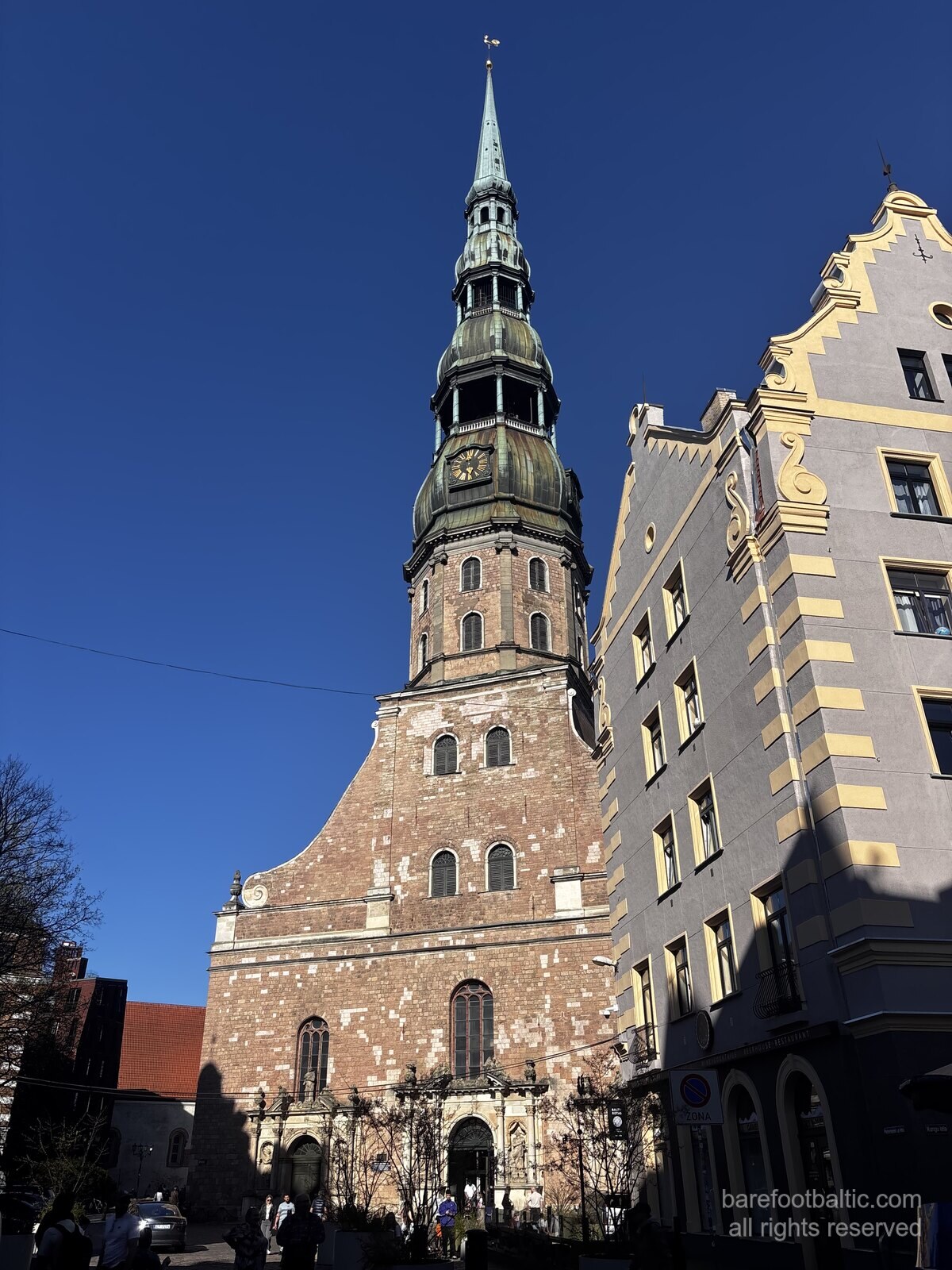
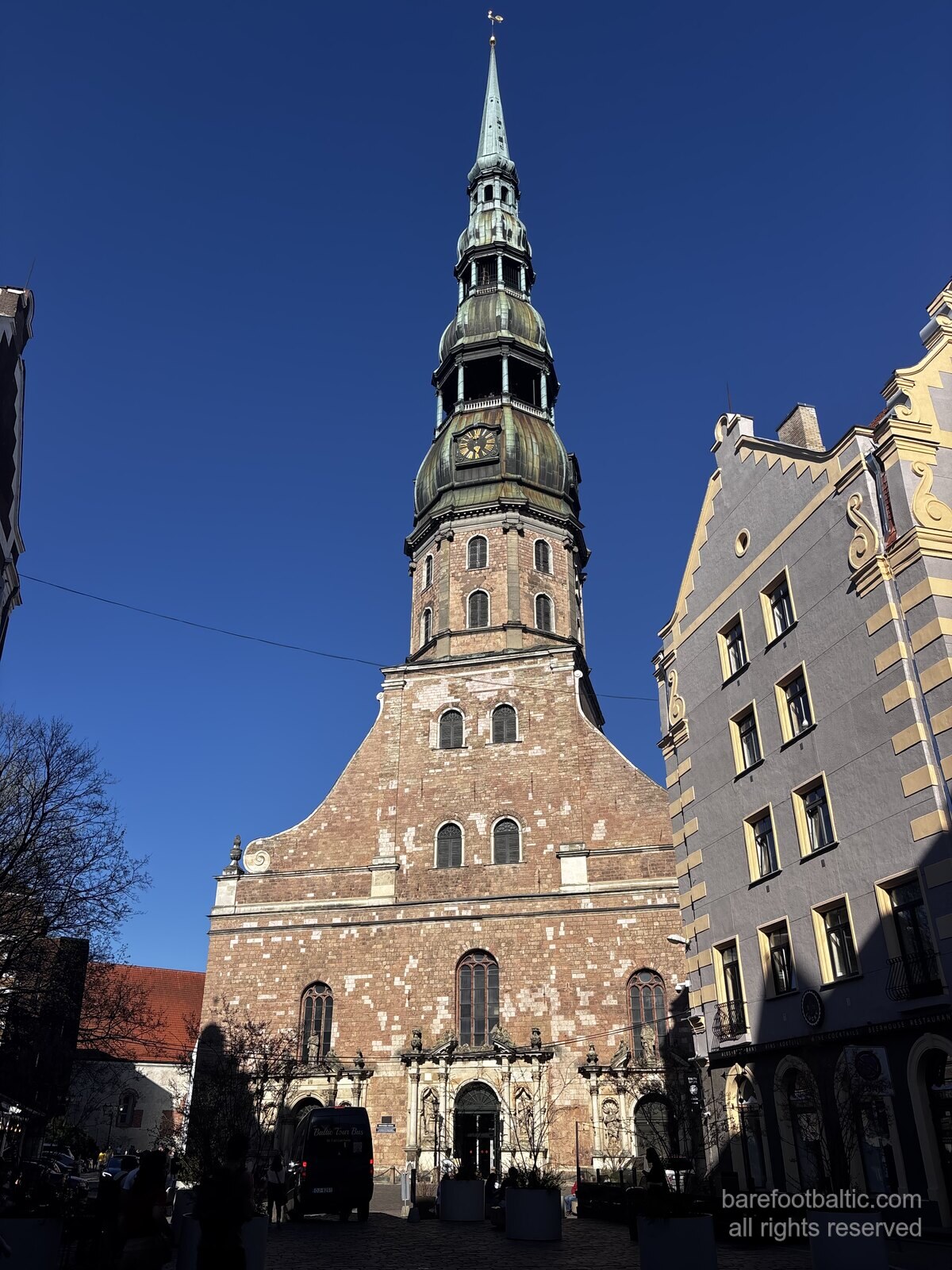
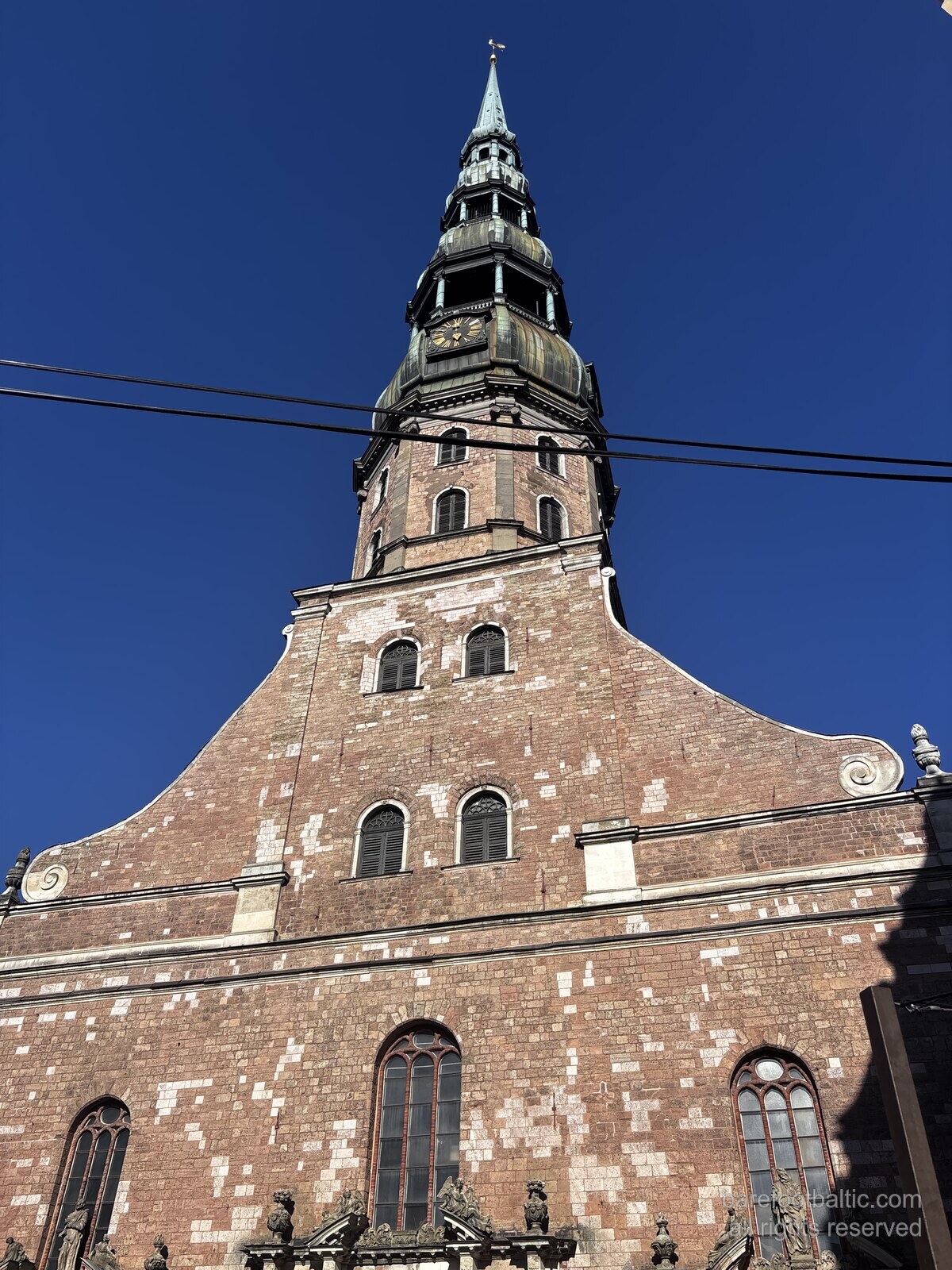
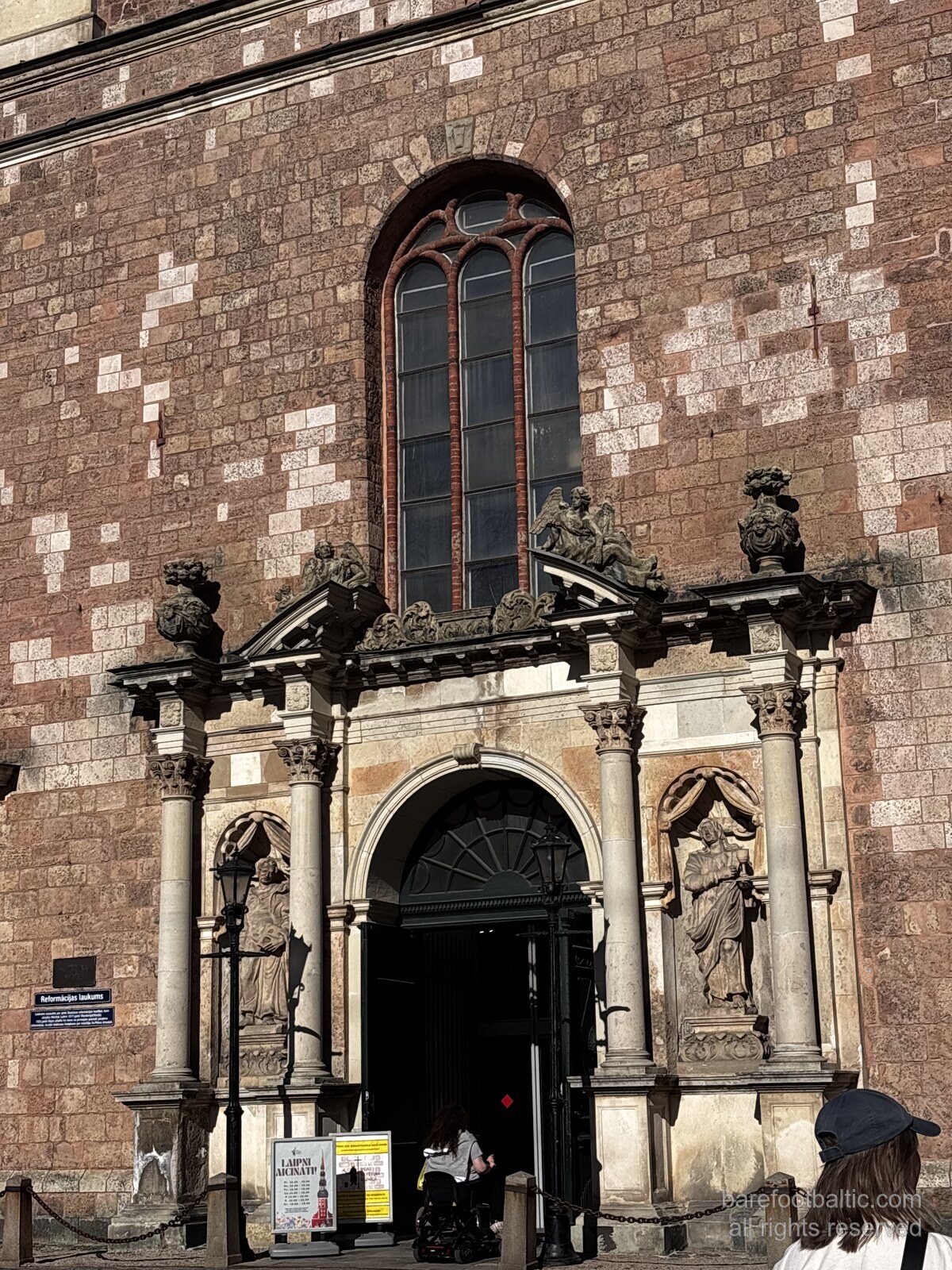
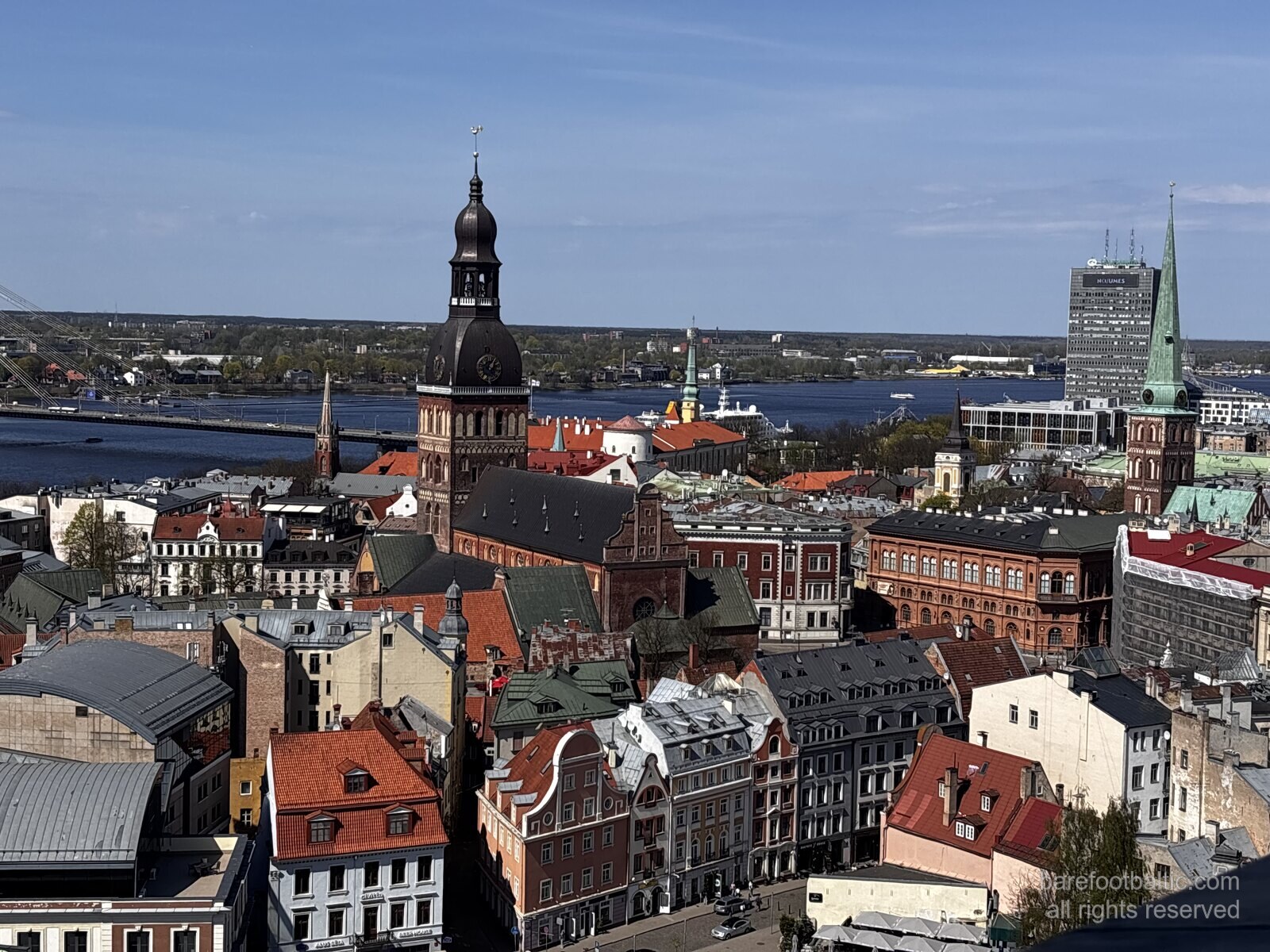
The church, the tower, the inside, and the panorama from the top. Click any image for the full-size view.
Short answer, what St Peter’s is
St Peter’s Church (in Latvian, Sv. Pētera baznīca) is the great red-brick Gothic church on Skārņu iela in Riga’s Old Town. The tall green spire is the city’s defining silhouette and has been since the 13th century. The tower stands 123 metres tall, and the lift takes you in two stages to a viewing platform at 72 metres with a 360-degree view of the Old Town, the Daugava river, the Art Nouveau quarter, and on a clear day all the way out to Jūrmala on the coast.
It is, in my opinion, the single best paid sight in Riga. Tickets are around €9, the lift is fast, the panorama is the panorama, and the church itself has the bones of a serious medieval interior. Allow an hour. If you only have one tower-climb, this is the one.
First mentioned in 1209. Tower destroyed twice (lightning 1721, German artillery 1941) and rebuilt in steel in 1973. Open daily. Check seasonal hours.
A short history, because the rebuilding matters
St Peter’s was first mentioned in a written record in 1209, two years before the cathedral was founded. It was a parish and merchant’s church, not the bishop’s, and that distinction matters. The cathedral was built and run by the German ecclesiastical authorities. St Peter’s was built and run by the Riga merchant class, which made it the more independent of the two churches and, eventually, the more architecturally ambitious.
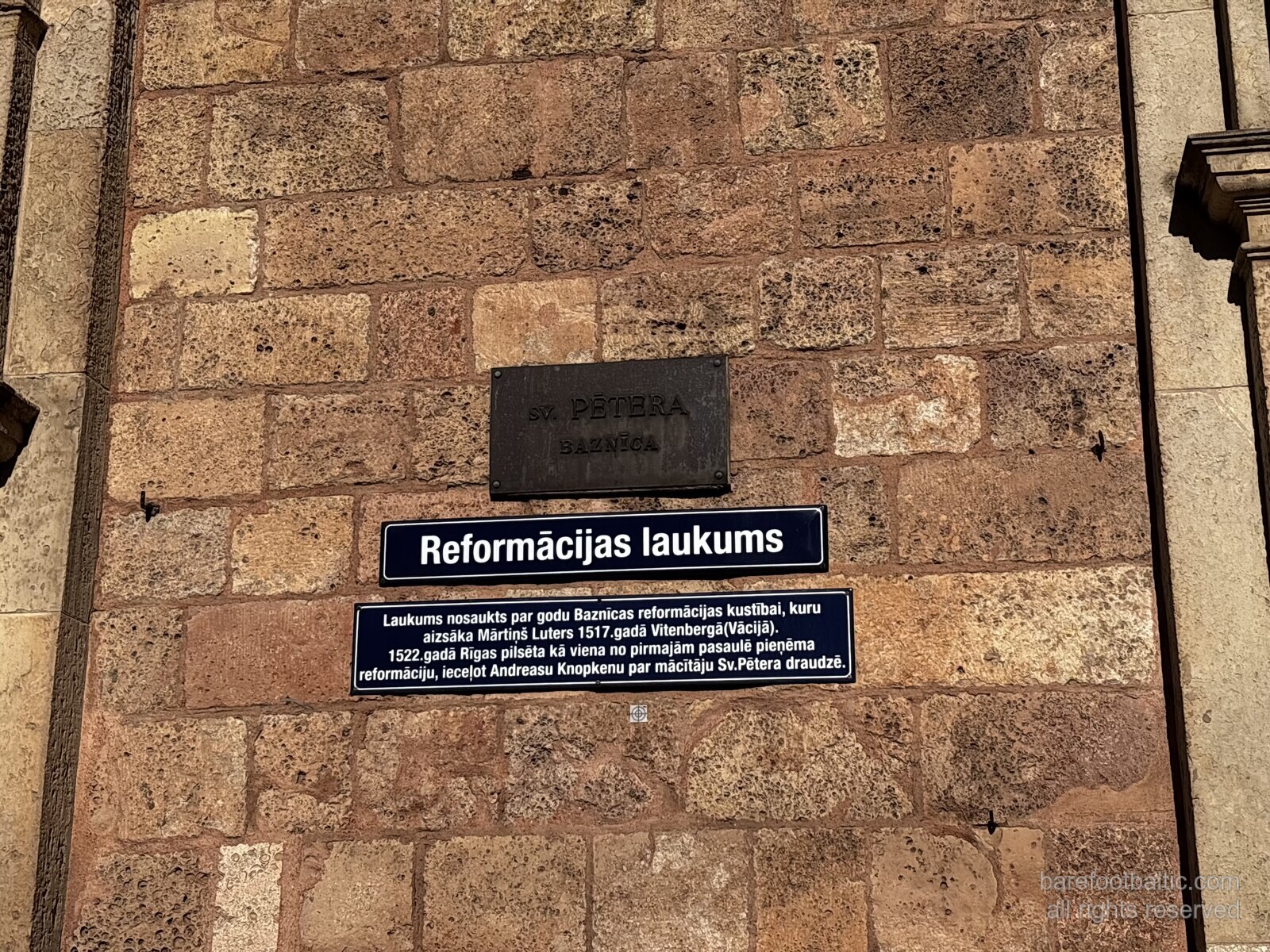
The Gothic body of the church we see today is mostly 14th and 15th century, with the rebuilding of the eastern choir and the heightening of the tower running into the 16th. By the time the Reformation arrived in Riga in 1522, St Peter’s was already the largest non-cathedral church in the eastern Baltic. The Reformation, when it came, started here. Andreas Knopken, the German Lutheran preacher whose sermons in 1522 swung the city, was based at St Peter’s. The small square at the eastern end of the church is now called Reformācijas laukums, Reformation Square, in his memory.
The tower has had four different versions. The medieval Gothic tower was lost to a great fire in 1666 and rebuilt taller, in baroque, finished in 1690 and topped with a wooden spire that for a period made it one of the tallest wooden structures in Europe. That spire was struck by lightning and destroyed in 1721. Rebuilt in 1746, it stood for almost two centuries. In June 1941, in the first weeks of the German invasion of the Soviet Union, the tower was hit by German artillery shells fired from across the Daugava. It burned down. The walls of the church burned out with it. The Soviet-era reconstruction, finished in 1973, used a steel framework inside the rebuilt brick to keep the silhouette honest while making the structure stable enough to take a lift. That’s the version you climb.
The choice to rebuild in steel instead of wood was controversial at the time and is still debated by Riga architecture nerds. The compromise they landed on keeps the silhouette faithful and the structure modern. A steel tower should outlast every wooden one that came before it.
Climbing the tower
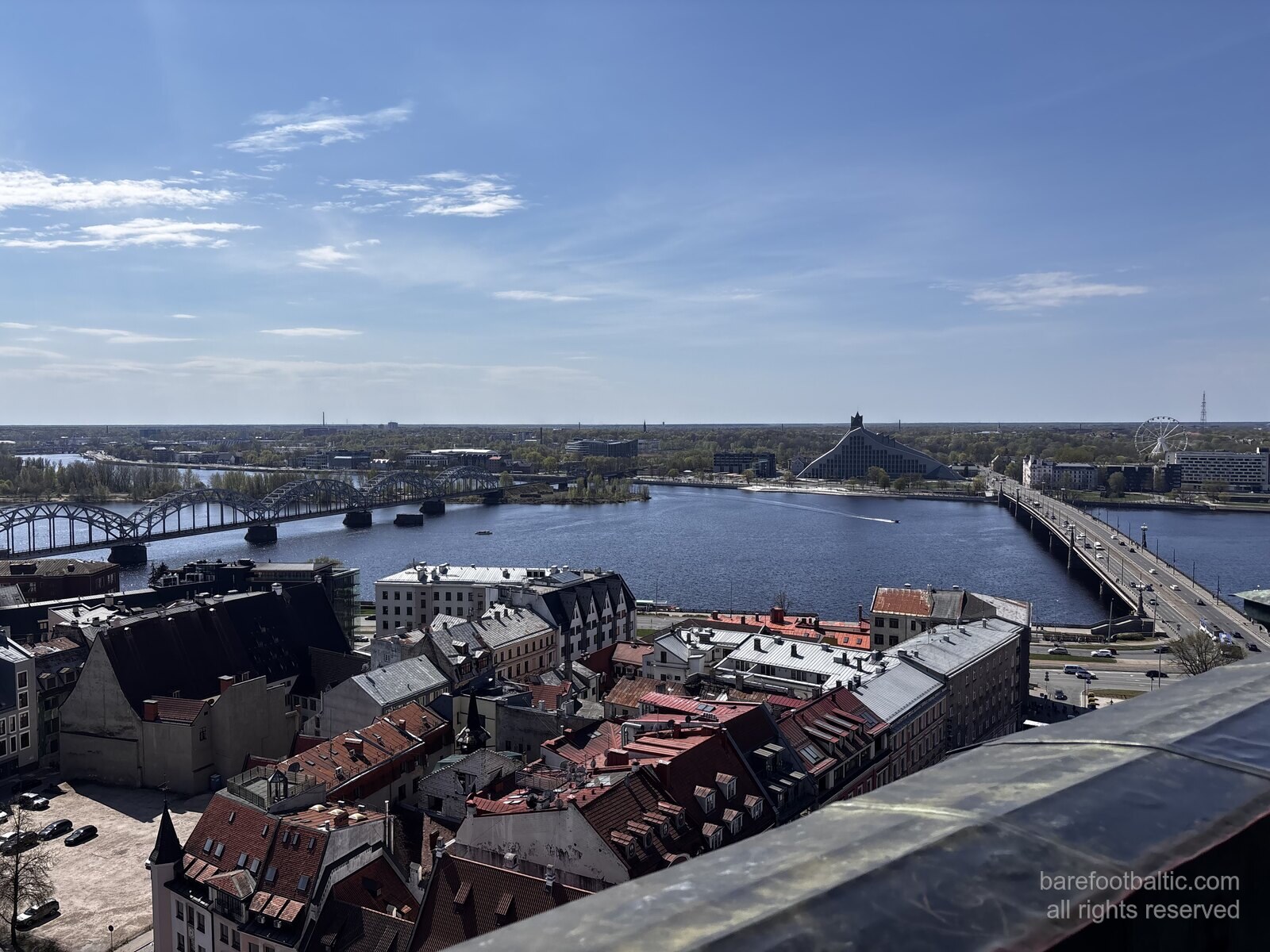
The lift goes in two stages, with a small intermediate landing at 57 metres and the main viewing platform at 72 metres. The whole trip up takes about three minutes. The viewing platform is wrapped around the outside of the tower with a chest-high railing, and on a clear day the panorama is a full 360 degrees. There are larger windows you can lean against and smaller telescope-mounted spotting scopes if you want to look at the Latvian National Library or the bridges over the Daugava in detail.
What you can see, in rough order of compass. North toward the Cathedral and the Castle, with the curve of the Daugava heading out to the Gulf of Riga. East over the Old Town rooftops, then the leafy line of the canal, then the dense block of the Art Nouveau quarter. South toward Town Hall Square and the green-domed Latvian Academy of Sciences (the ‘Stalin Cake’) further out. West across the Daugava to the National Library, the Spīķeri district, and the railway bridges. On clear days you can see all the way to the smokestacks of the Riga power station and, if you know where to look, the spire of Doles sala.
Šis ir vienīgais Vecrīgas tornis ar liftu.
What I tell visitors. “This is the only Old Town tower with a lift.”A few practical notes. Tickets are around €9 for adults, less for students and children, sold at the entrance inside the church. The lift queue is rarely longer than ten minutes outside peak July. Best light is in the hour before sunset, golden hour over the rooftops. The worst light is mid-morning when you’re shooting into the sun on the eastern side. Take a jacket. It’s windier 72 metres up than at street level.
The interior
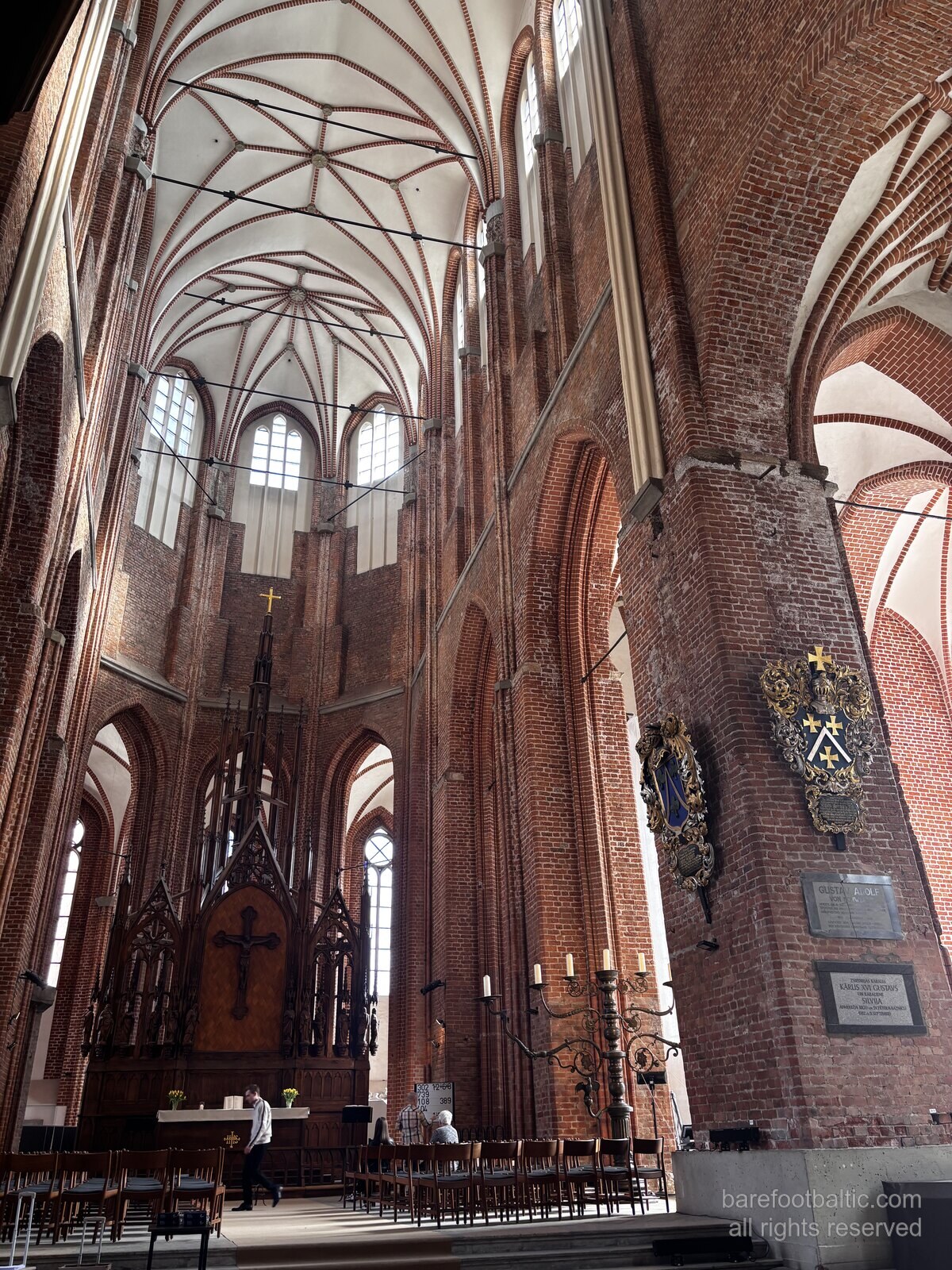
People walk past the interior on the way to the lift, and shouldn’t. Inside St Peter’s is, to my eye, the most striking medieval church interior in Latvia. A tall Gothic nave with red-brick walls, vaulted ceilings of star-pattern brickwork, and the post-1973 reconstruction sympathetic to the bones of the medieval building. Most of the interior fittings burned in 1941 and were not replaced. The church now serves as a working Lutheran parish and as an exhibition space.
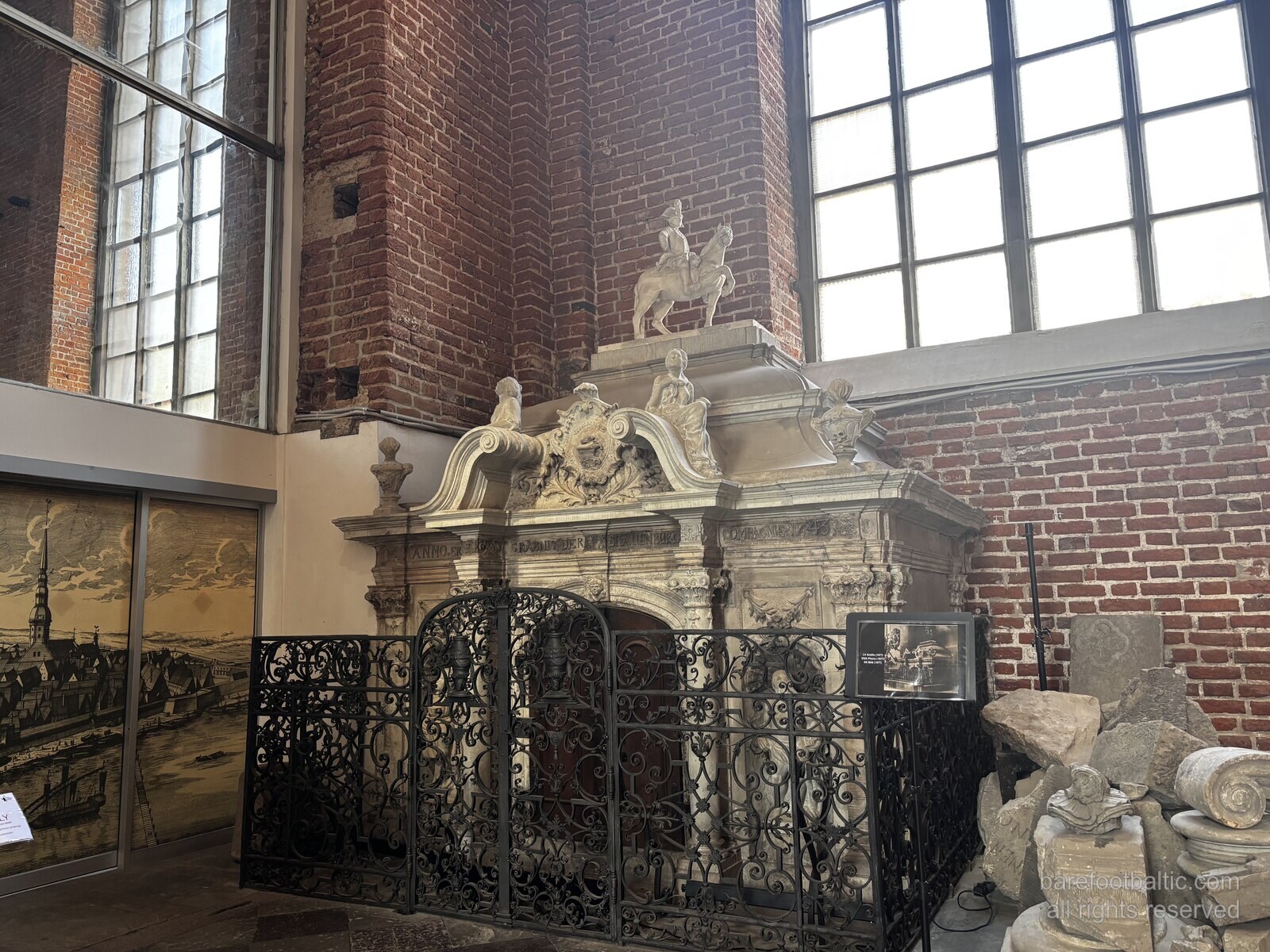
A handful of baroque memorial tombs and family chapels did survive the 1941 fire and are still in place along the side aisles, behind iron grilles. Look for them on the southern side. They are the families that mattered in 17th- and 18th-century Riga. Merchants, mayors, the men whose names ended up on streets and chapels. Their carved arms and Latin inscriptions are still legible.
There’s usually a small temporary art exhibition running in the side aisles, ceramics, photography, occasionally textiles. Worth a slow walk through.
Around the church
Two small things outside that are worth pausing for.
The Bremen Town Musicians. A small bronze sculpture against the east wall of the church, on Skārņu iela. A donkey, a dog, a cat, and a cockerel piled on top of one another, all looking through what they imagine is a window. Donated by Riga’s twin city of Bremen in 1990, in a year when both cities were emerging from a difficult forty years. West Germany reunifying with East, Latvia inching toward independence from the Soviet Union. The sculpture is by Christa Baumgartel after a Brothers Grimm fable. People rub the donkey’s nose for luck, and you’ll see it polished bright.
The Roland statue. A copy of the medieval Roland statue stands on Town Hall Square three minutes south, in front of the House of the Blackheads. The original (early 20th-century, an 18th-century replacement of a medieval one) is now in the museum inside the Blackheads. Rolands were standard town-hall sculptures across the Hanseatic world. They stood for civic justice, market rights, and the autonomy of the merchant town from the local bishop. Riga’s is the only one in the eastern Baltic.
Practical answers
Where it is and getting there
Skārņu iela 19, in the southern half of Riga’s Old Town. Five minutes’ walk from Riga Cathedral, two minutes from the House of the Blackheads. The Old Town is pedestrianised, so you arrive on foot.
Hours, tickets, photography
Open daily, roughly Tuesday to Saturday 10:00 to 18:00 plus Sunday 12:00 to 18:00, with shorter winter hours and longer summer hours. Closed Mondays in the off-season. Adult ticket around €9, including the tower lift. Children, students, and seniors get reduced prices. Photography is free inside the church and from the tower platform. Tripods are allowed if the church isn’t crowded.
The lift, the queue, accessibility
The lift goes to the platform at 72 metres in two stages, takes about three minutes, and runs continuously. Queues are usually short outside peak summer. The platform is wheelchair-accessible, since the lift takes wheelchairs all the way up, and the platform itself has waist-high railings. The church interior is wheelchair-accessible from the south portal. Ask staff at the main entrance.
Combining with the rest of the Old Town
St Peter’s is the southern bookend of an Old Town walk and pairs with the House of the Blackheads two minutes south, with the cathedral five minutes north, and with the Bremen Town Musicians sculpture against the east wall of the church itself. End the day at the panorama in golden hour. The full circuit is in the Old Town pillar guide.
My take
Climb it for the view. The ticket pays for itself on that alone. There’s a second reason that lands once you’re up there. From above, the rest of your visit on the cobbles starts to make sense. The Old Town is small enough that you can take it in as a single object from the platform, and the half-day you’re going to spend walking around it gets its mental map. One smaller thing. From up here you can look down on the cathedral spire. There aren’t many spots in central Riga where you can do that.
Frequently asked questions about St Peter’s Church
Daiga Taurīte is a licensed Latvian tour guide and co-founder of Barefoot Baltic. She runs small-group day excursions from Riga. She grew up here, spent two decades in London, came home in 2024. Barefoot Baltic is licensed by Latvia’s Consumer Rights Protection Centre (PTAC), holds ATD passenger transport licence PS-01995, and is insured by BTA Baltic for civil liability.
The St Peter’s climb is the panorama at the end of every Old Town walk we run. If you’d like a half-day with a licensed Latvian guide that ends at the platform in golden hour, get in touch.