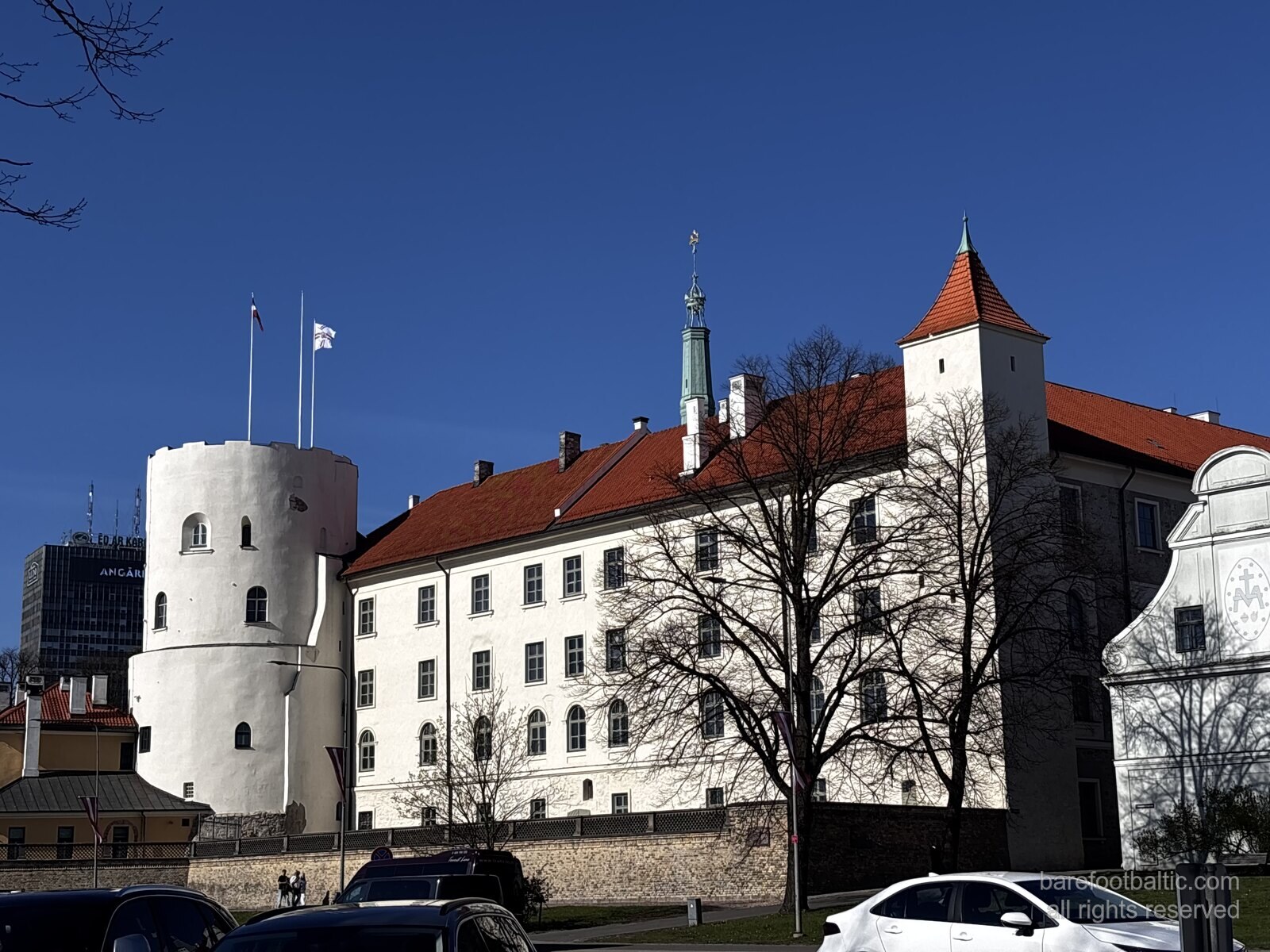
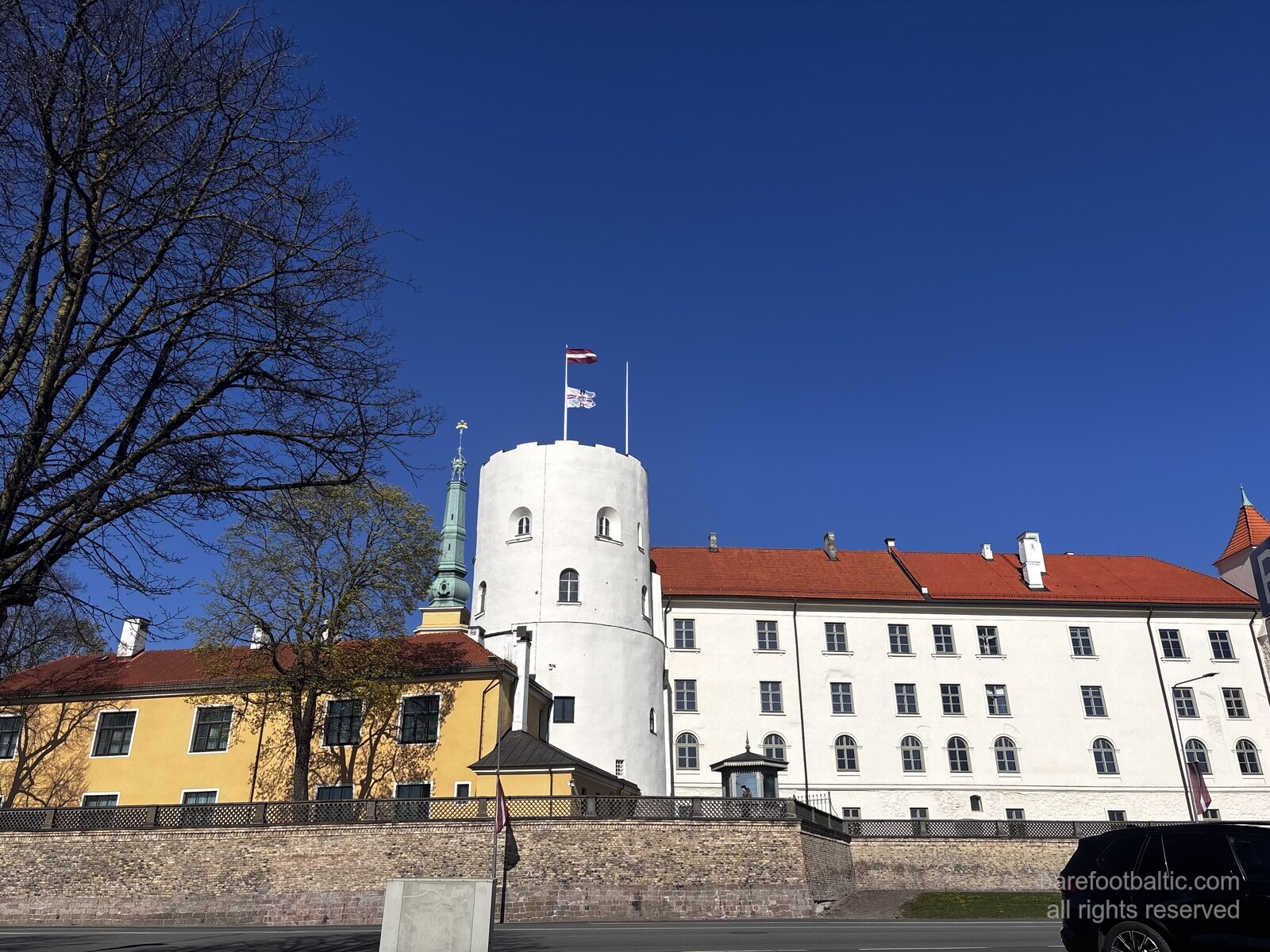
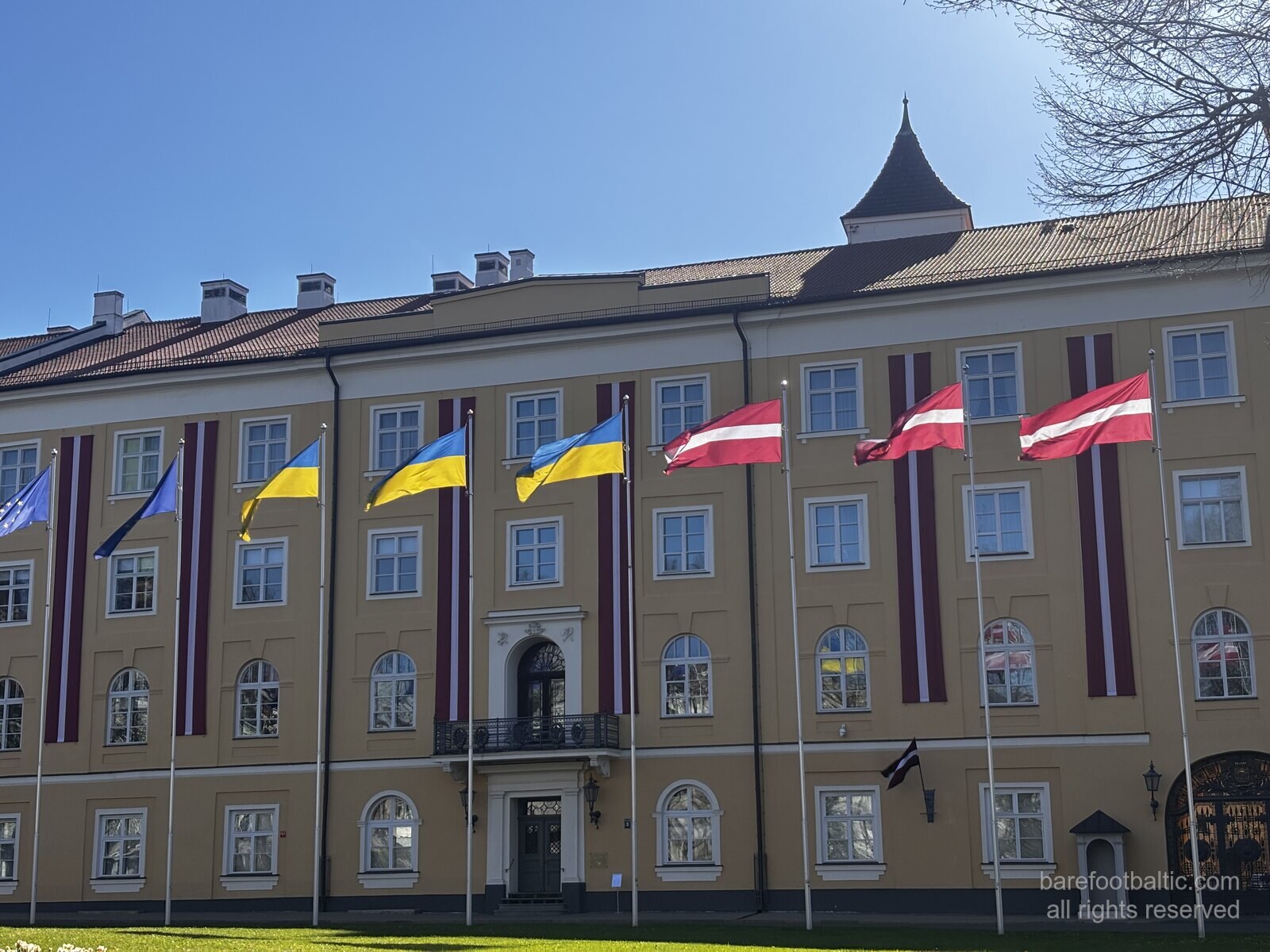
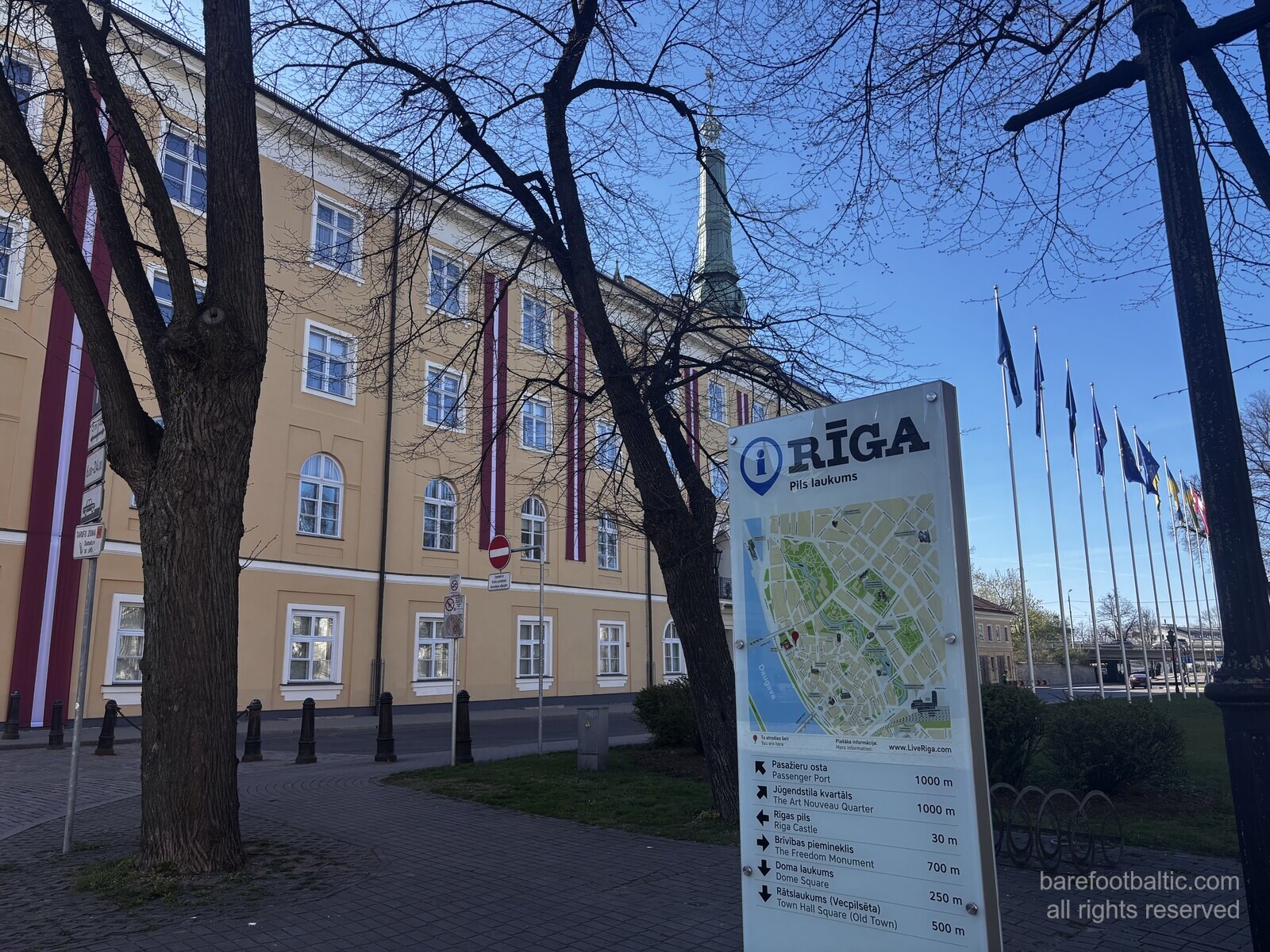
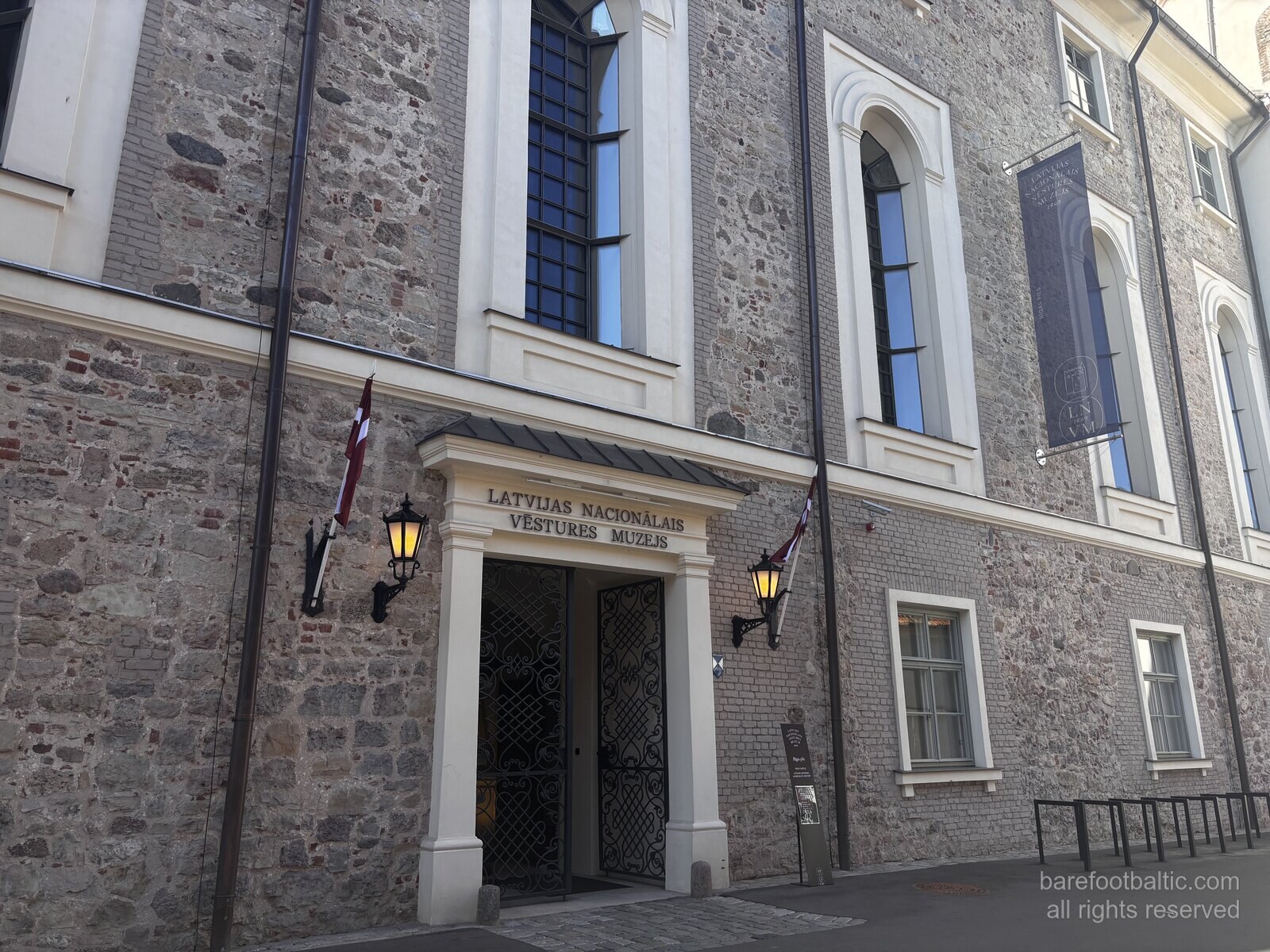
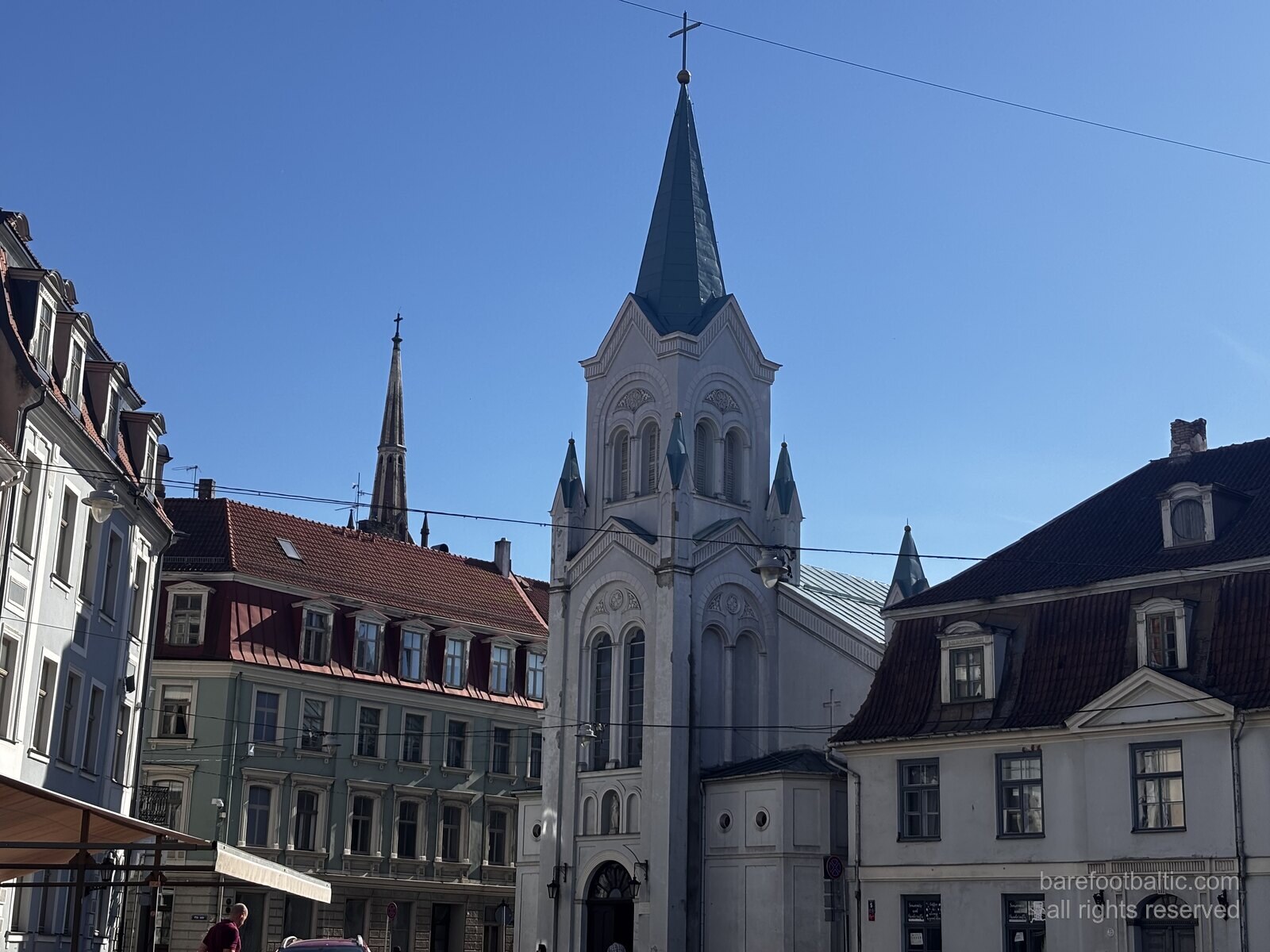
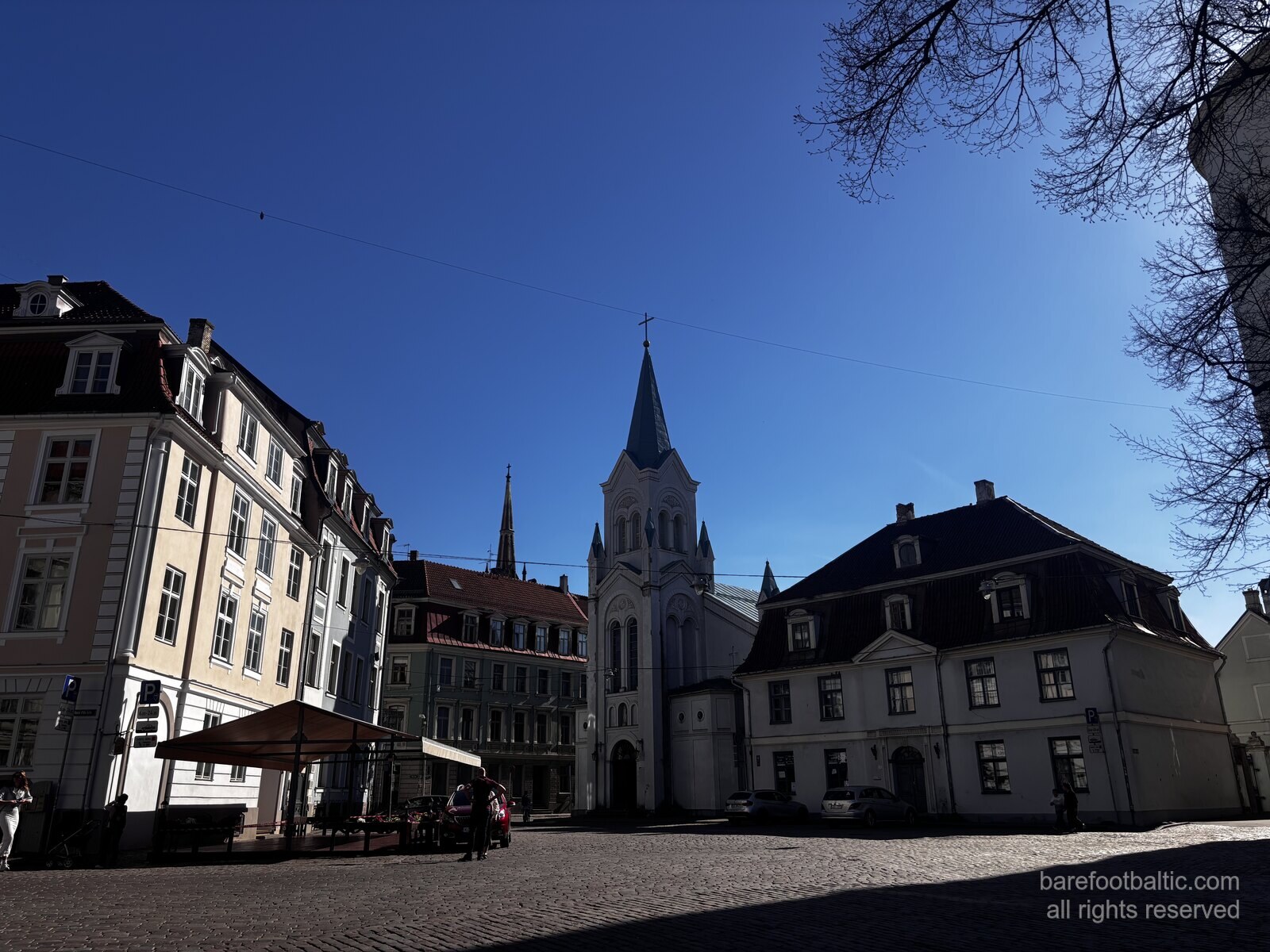
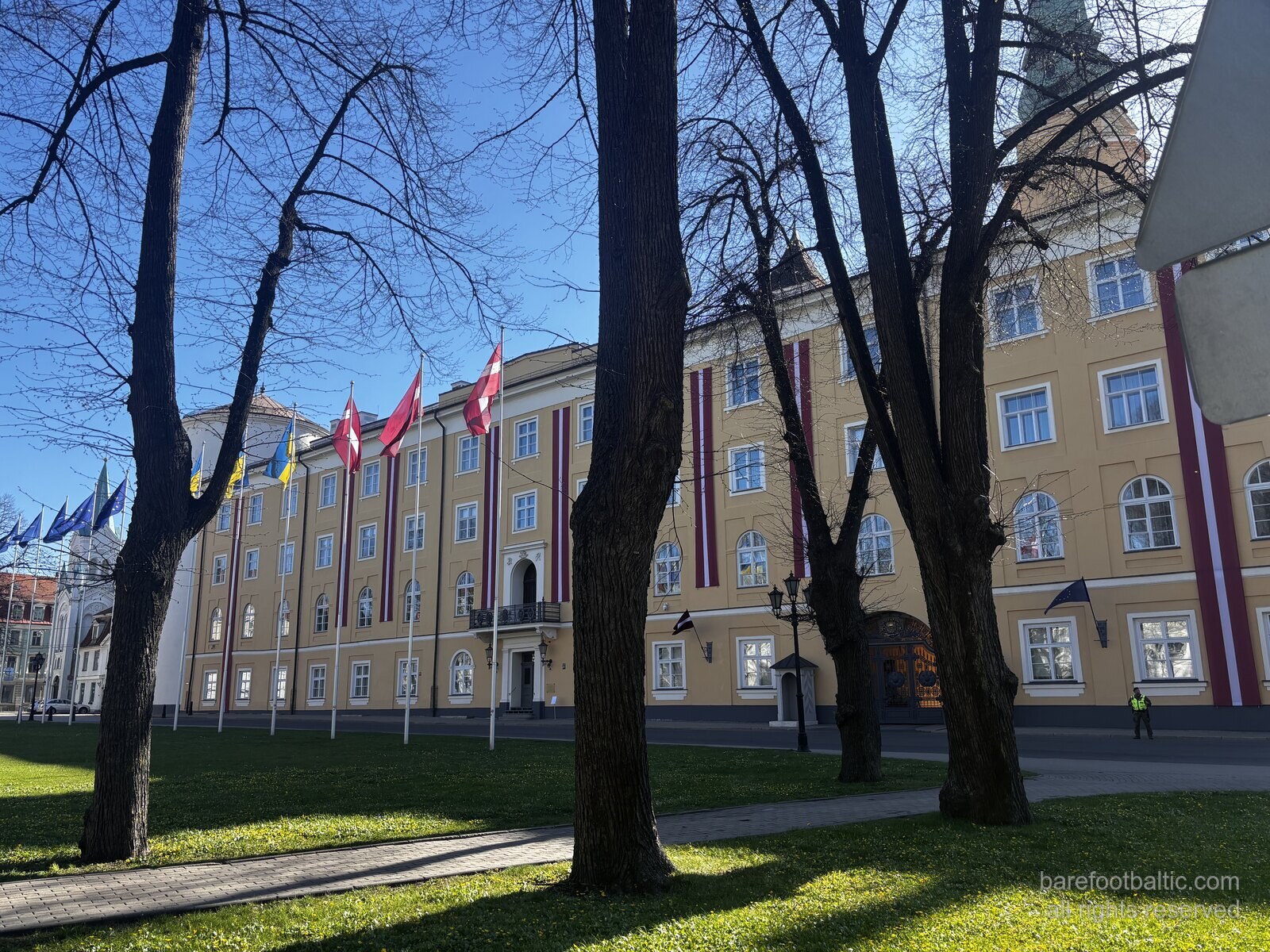
The castle, the museum entrance, the small Catholic church on Pils iela, and the square in front. Click any image for the full-size view.
Short answer, what Riga Castle is
Riga Castle (in Latvian, Rīgas pils) is the official residence of the President of the Republic of Latvia, on the riverfront at the north-western edge of Riga’s Old Town. It is a working castle, in continuous institutional use for nearly 700 years. Built in 1330 by the Livonian Order after a Riga uprising destroyed their original castle, it has been the seat of every government Riga has had since. Livonian, Polish-Lithuanian, Swedish, Russian Imperial, briefly German occupational, the first independent Latvian state, the Soviet Latvian SSR, and now independent Latvia again. The President moved in in 1995.
You can’t tour the President’s offices. That part of the castle is a working office, with security and ceremony. What you can visit is the Latvian National History Museum, which occupies the eastern wing and is the largest museum in Latvia. You can also walk freely around the exterior on Pils laukums (Castle Square) and along the Daugava riverfront.
Free outside, paid museum inside (around €5). Five minutes’ walk north of the Three Brothers, eight from Riga Cathedral.
A short history
The first Riga castle was built around 1209, on a different site closer to the Daugava’s edge. In 1297 the citizens of Riga rose against the Livonian Order, the German military religious order that effectively ran the eastern Baltic at the time, and demolished the original castle. After three decades of dispute, mediated by the Pope, the Order was given the right to build a new castle, on the current site, well to the north of the existing town. Construction started in 1330 and finished a few decades later. The Order’s plan was a square fortress with four corner towers, of which the round Holy Spirit Tower (Svētā Gara tornis) is the principal survivor.
Successive rulers expanded and remodelled the castle. In 1481 a second uprising damaged it again, and a long restoration ran into the 1490s. Under Polish-Lithuanian and then Swedish administration in the 16th and 17th centuries, the structure was extended for ducal residence and parade-ground use. The Russian Empire after 1721 used it as a governor’s residence and added the eastern wing. In 1922, with Latvia independent, the castle became the residence of the President of the new Republic. Under Soviet occupation it served as the Pioneer Palace and a museum. Since 1995 it is again the Presidential residence.
A serious fire in 2013 destroyed the eastern wing and damaged parts of the central buildings. The restoration finished in 2016 and the castle reopened in time for the centenary of Latvian independence in 2018. The version you see today is the 2016 restoration, faithful to the surviving 17th-century shell with modern interventions inside.
The castle today
Day-to-day, Riga Castle is the working office of the President of Latvia (currently Edgars Rinkēvičs, since July 2023, though that may have changed by the time you read this). The Presidential standard flies from the Holy Spirit Tower whenever the President is in residence. State visits, ambassador credentialings, the New Year’s presidential address, and the 18 November Independence Day reception all happen here.
Two visible details. First, the flags. The Latvian flag flies permanently from the round tower. The Presidential standard appears beside it when the President is in. The eastern wing facing Pils laukums often carries Latvian and Ukrainian flags side by side, a small public statement that has been there continuously since February 2022. Second, the security. It is visible during state events but generally unobtrusive. Pedestrians can walk all the way around the exterior of the castle, including along the Daugava riverfront, without restriction.
Pils ir mūsu valstī viena no nedaudzajām vietām, kur valdība ir burtiski arī māja.
Said in Latvian by an old colleague. "The castle is one of the few places in our country where the government is also literally a home."The Latvian National History Museum
The museum is the part of the castle you can actually go inside. It occupies the eastern wing of the castle and is the largest history museum in Latvia. The collection runs from prehistoric stone tools and Bronze Age burials, through medieval Livonian artefacts, the Hanseatic merchant period, the Russian Imperial era, the first independence (1918 to 1940), the occupations (1940 to 1991), and into the contemporary period. The best of it is the Latvian ethnographic galleries on the upper floor. Full traditional costumes from each of the country’s ethnographic regions, woven textiles, jewellery, and tools.
Adult ticket is around €5, with concessions for students, seniors, and children. Allow 90 minutes for a moderate visit, two hours if you read every label. English-language signage is full and good. The museum closed for several years during the post-2013 castle restoration. What you see today is essentially the fresh re-opening, from 2018 to 2019, with modern display and lighting. For a full sweep of Latvian history from the Bronze Age forward, this is the place.
Pils laukums and the riverfront walk
Pils laukums (Castle Square) sits on the eastern side of the castle, ringed by trees and benches. It’s a quiet square, used for occasional civic ceremonies and as a small bus terminus for the open-top tourist hop-on-hop-off. I don’t recommend that one. The Old Town walks itself in less time. The square has a few benches, the tourist information sign, and a clear view of the Holy Spirit Tower.
The walk around the castle, north along Pils iela and then west along the Daugava embankment, is one of the prettiest short walks in central Riga. From the riverside, you get the photograph people come for. White-painted walls and red-tiled roofs, the round tower, the long Daugava in front, the National Library’s glass mountain on the far bank. Best in late afternoon. In May, the trees on the embankment come into leaf and the whole stretch turns green.
Our Lady of Sorrows (Sāpju Dievmātes baznīca), the small Catholic church on Pils iela 5, sits between the castle and the cathedral quarter. White-painted exterior with a slim spire, late-18th-century Classicist with a Catholic interior. Built for the Catholic minority of Riga in the period after the Russian conquest, when the city’s German-Baltic Lutheran majority dominated everything else in the Old Town. Worth a five-minute pause if you’re passing.
Practical answers
Where it is and getting there
Pils laukums 3, on the north-western edge of Riga’s Old Town. Five minutes’ walk north of the Three Brothers, eight from Riga Cathedral, fifteen from the Freedom Monument. The Old Town is pedestrianised. You arrive on foot. Closest bus stop is on the embankment (11. novembra krastmala) for routes that skirt the Old Town.
Hours, costs, what you can visit
The exterior of the castle is on a public square and is free, accessible 24/7. The Latvian National History Museum (the part you can go inside) is open Tuesday to Sunday, roughly 11:00 to 17:00, closed Mondays. Longer hours in summer. Adult tickets around €5. The President’s offices, the formal state rooms, the chapel, and the courtyard are not open to the public except on a few designated open days a year (usually Independence Day, 18 November) when limited tours run. Photography is allowed outside, in the museum, and on the embankment. Check museum signage for room-specific restrictions.
Combining with the rest of the Old Town
Riga Castle is the northern bookend of the western half of an Old Town walk. From here, the Three Brothers are three minutes south, Riga Cathedral eight minutes south-east. The riverfront walk along the Daugava is twenty minutes to the House of the Blackheads if you want to combine the western Old Town with the southern. The full circuit is in the pillar guide.
My take
Riga Castle is more institutionally important than it is architecturally striking. It’s a working office that happens to be 700 years old. The architectural drama you sometimes hope for in a castle is largely absent. What it does have is the National History Museum inside the same walls, and the riverfront walk along the western elevation. An hour gives you the museum and the river walk together. Twenty minutes is enough for the round tower and a look across the Daugava.
Frequently asked questions about Riga Castle
Daiga Taurīte is a licensed Latvian tour guide and co-founder of Barefoot Baltic, which runs small-group day excursions from Riga. She grew up in Riga, spent two decades working in London, and came home in 2024. Barefoot Baltic is licensed by Latvia’s Consumer Rights Protection Centre (PTAC), holds ATD passenger transport licence PS-01995, and is insured by BTA Baltic for civil liability.
Riga Castle is on every walk we run through the western Old Town. If you’d like a half-day with a licensed Latvian guide that includes the Castle, the Three Brothers, the Cathedral, and the riverfront, get in touch.