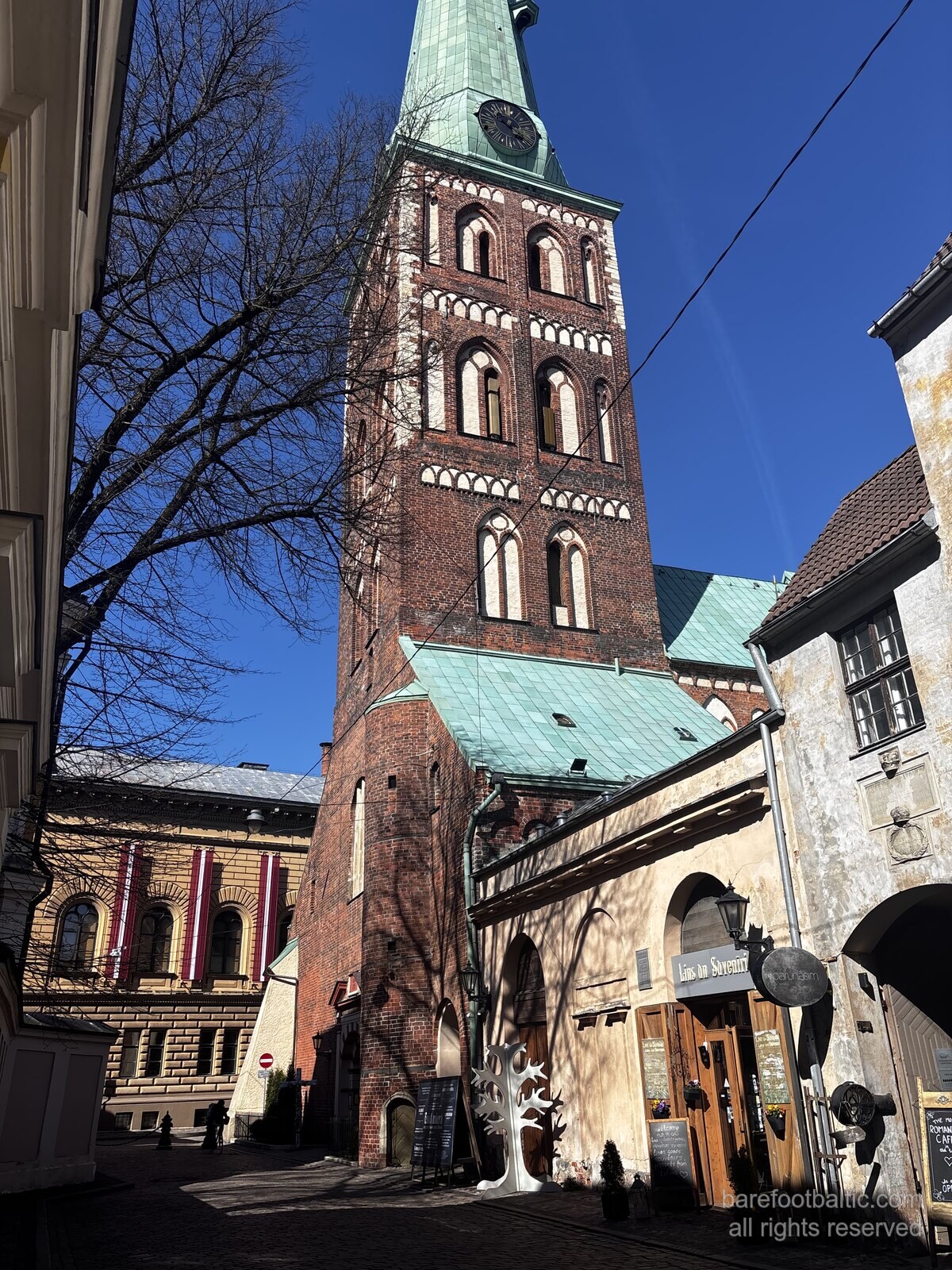
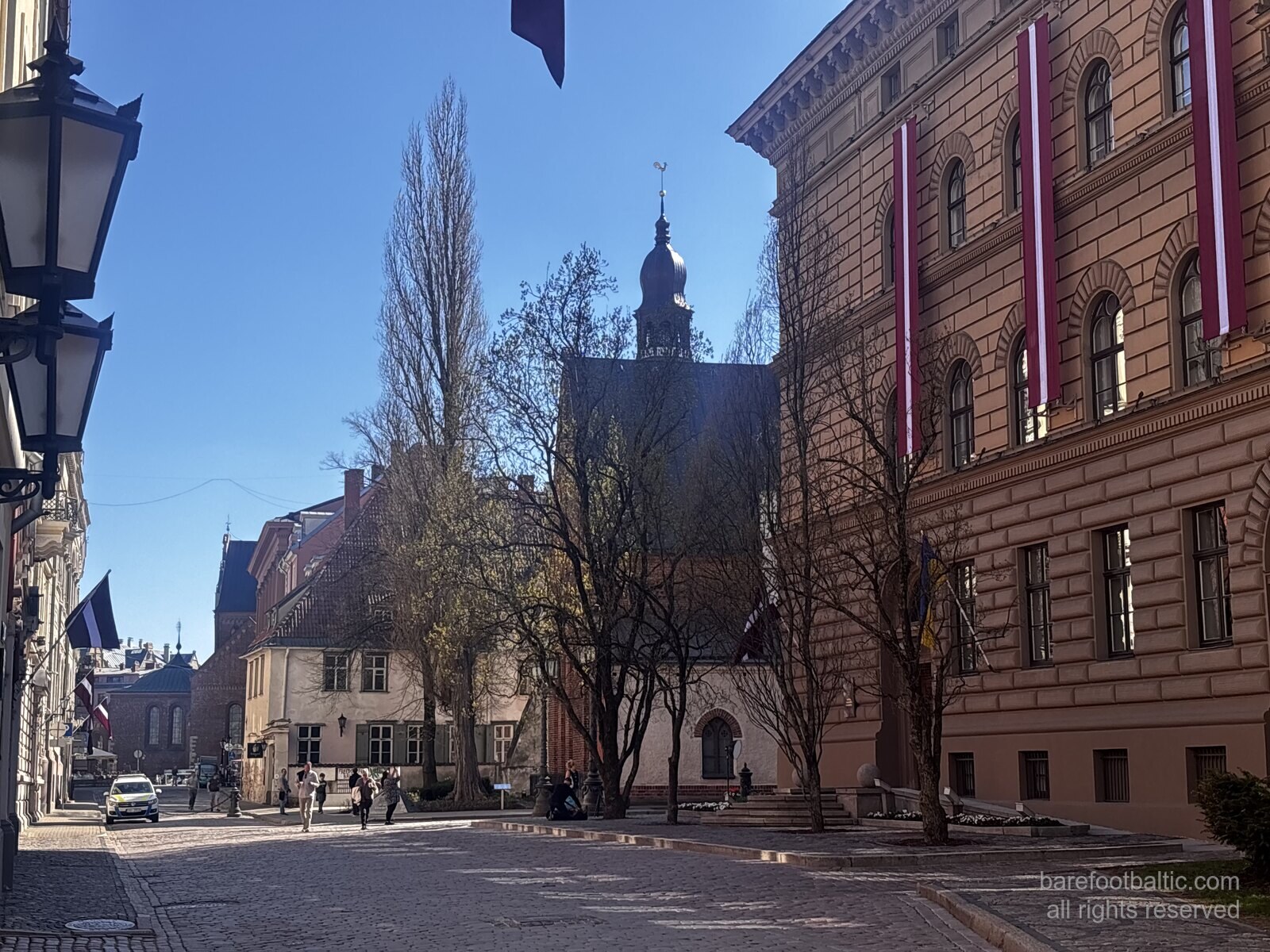
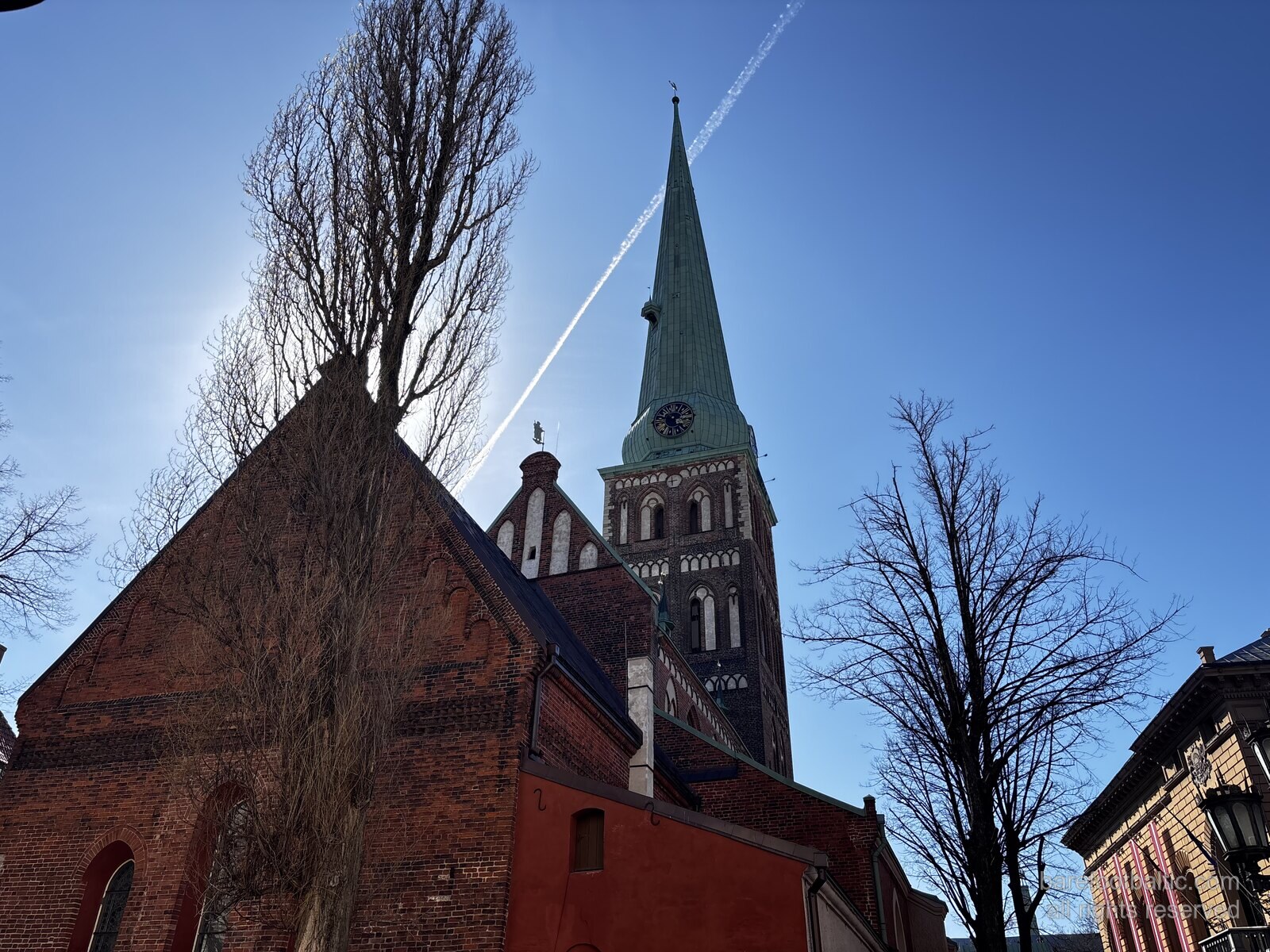
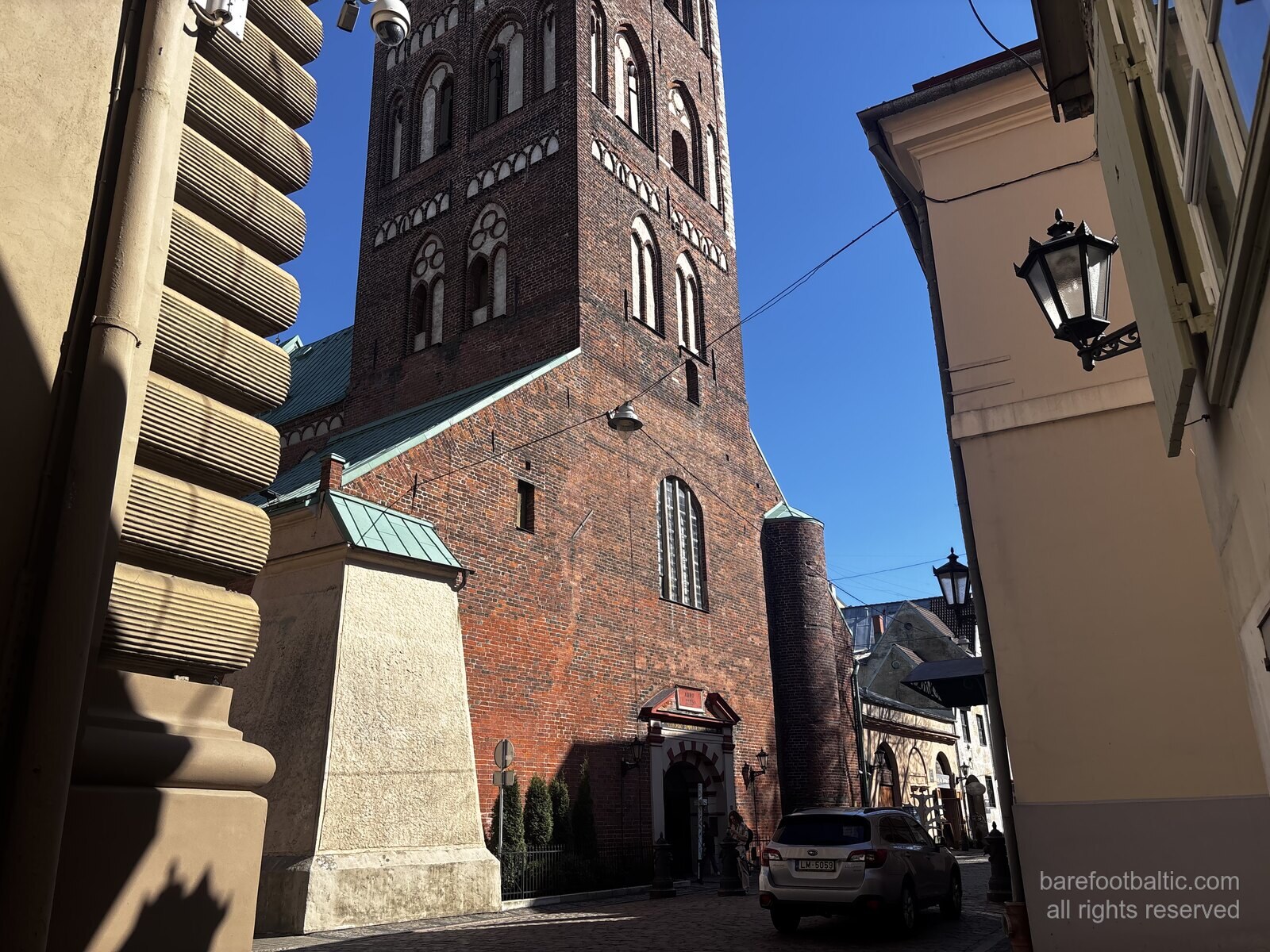
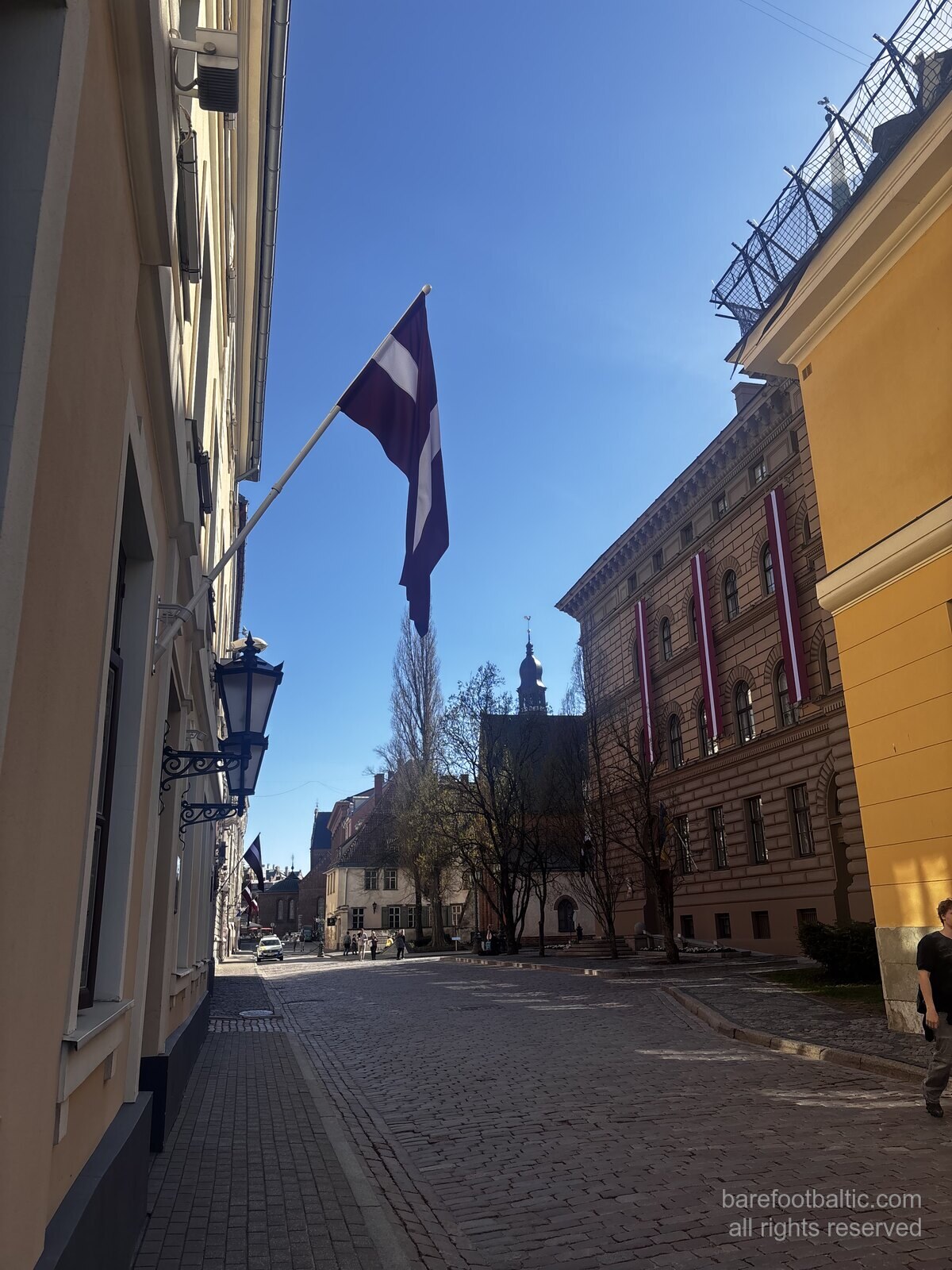
The cathedral, the spire, the entrance portal, the Catholic interior, and the Saeima next door. Click any image for the full-size view.
Short answer, what St James’s is
St James’s Cathedral (in Latvian, Sv. Jēkaba katedrāle) is the Roman Catholic cathedral of Riga, on Jēkaba iela in the western half of the Old Town, directly next to the Latvian Parliament building (the Saeima). By some accounts it is older than its more famous neighbour, Riga Cathedral. It was first mentioned in 1225, and built mostly between the 1220s and the 1330s. It is smaller, slimmer, and significantly less visited than the Lutheran Doma baznīca, but it is the seat of the Roman Catholic Archdiocese of Riga, and one of the prettier interiors in the Old Town once you go through the door.
It’s also the most stylistically restless church in Riga. It’s been Catholic, Lutheran, briefly Catholic again under Polish-Swedish dispute, Orthodox-flavoured under Tsarist administration, and Catholic again since 1923. The interior reflects all of that. The famous red-and-white baroque entrance portal is from the 1660s.
Free to enter, open most days. Five minutes’ walk from Riga Cathedral and the Three Brothers.
A short history
St James’s was first mentioned in a 1225 document and was the parish church of the part of medieval Riga that lay outside the original bishop’s palisade. This was the side of town where the artisans, the merchants, and most of the Latvian population lived. German burghers preferred the cathedral side. It was not founded by the bishop and not run by him. The lay community of this neighbourhood built and maintained it. That distinction made it the more popular church, the more politically restive, and eventually the focus of Riga’s most charged religious switches.
When the Reformation arrived in Riga in 1522, St James’s went Lutheran with the rest of the city, and stayed Lutheran until the 1582 Polish-Swedish dispute returned it briefly to Catholicism. Through the 17th century, under Swedish administration, it was used variously as a Latvian-language Lutheran church, a Polish-Catholic church, and at one point as a Jesuit centre. The red-and-white baroque entrance portal dates from this restless period (1660s). Under the Russian Empire after 1721 it was again Lutheran, with a Latvian-speaking congregation. In 1923, in independent Latvia, the building was returned to the Catholic Church and made the cathedral of the newly created Archdiocese of Riga. It has been Catholic since.
This switching is part of why the building reads visually as a layered hybrid. Medieval Gothic bones carry baroque furniture and portal, 19th-century glass, and 20th-century Catholic restoration sitting on top of each other.
What you’re looking at from Jēkaba iela
The body of the church is brick Gothic, mostly 13th to 14th century. The spire stands around 80 metres. That’s tall by Old Town standards but shorter than St Peter’s, and considerably slimmer. It carries a small golden weather-cock at its top, like the cathedral and St Peter’s. Together the three roosters are one of Riga’s skyline signatures.
The most-told story about the St James’s rooster is the ‘ringing’ legend. Older Riga guides will tell you that the cock used to ring or crow out loud whenever an unfaithful wife passed underneath it. It’s the kind of folkloric warning attached to many medieval church towers across northern Europe. The sound, of course, was the wind catching the rooster’s metal vanes. The legend pinned a moral story onto a meteorological one. It hasn’t rung audibly in the modern reconstruction. People still tell the story. I tell it on tours.
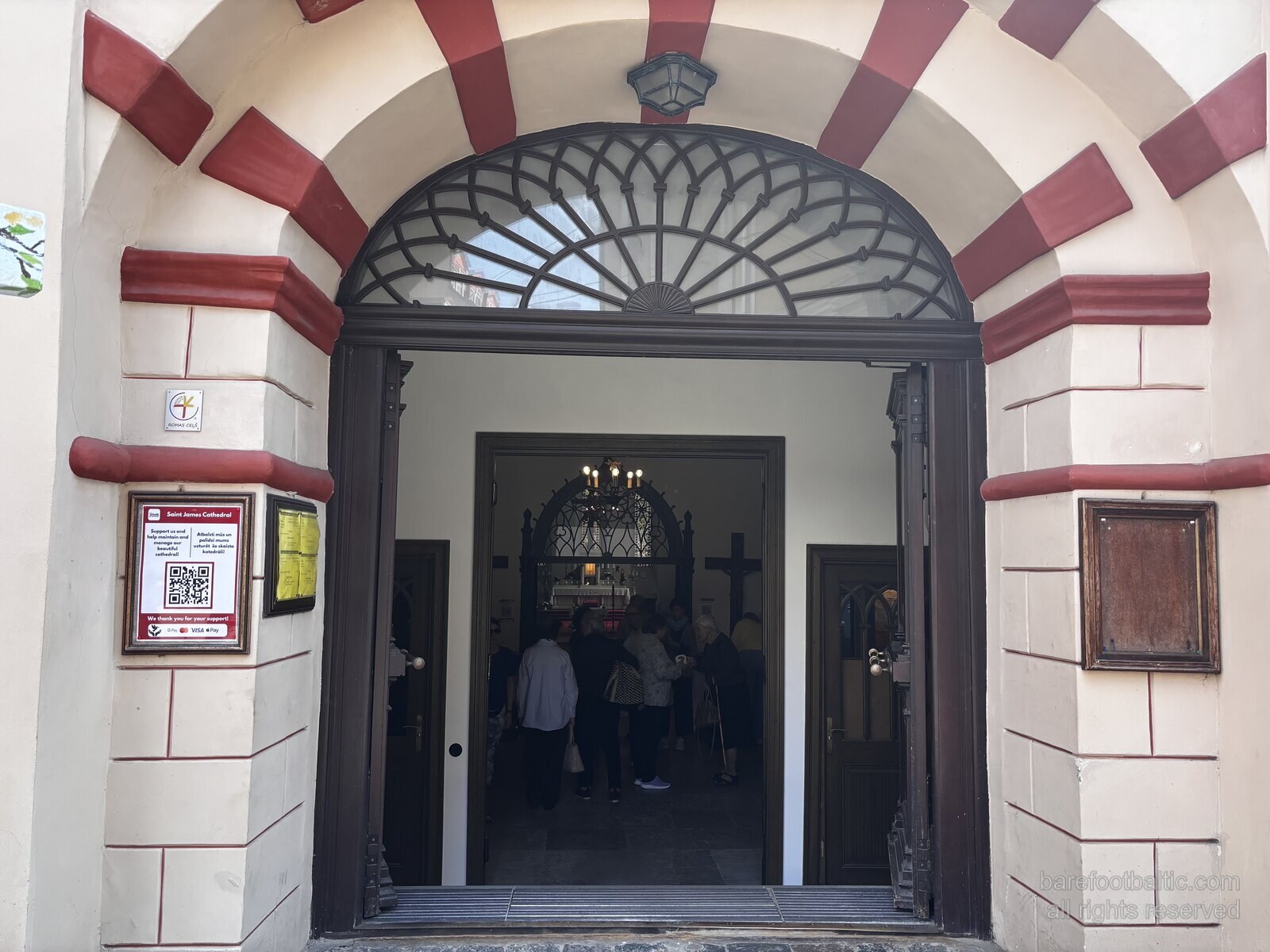
The most striking detail of the exterior is the red-and-white baroque entrance portal on the south side of the church, on Jēkaba iela. White stone framing in alternating bands of red, almost like a candy-stripe, with broken pediments and a fan-light over the door. From the 1660s, original work, restored in the 1990s. It’s the prettiest entrance door in the Old Town, and the one I’d stop you to photograph.
Inside
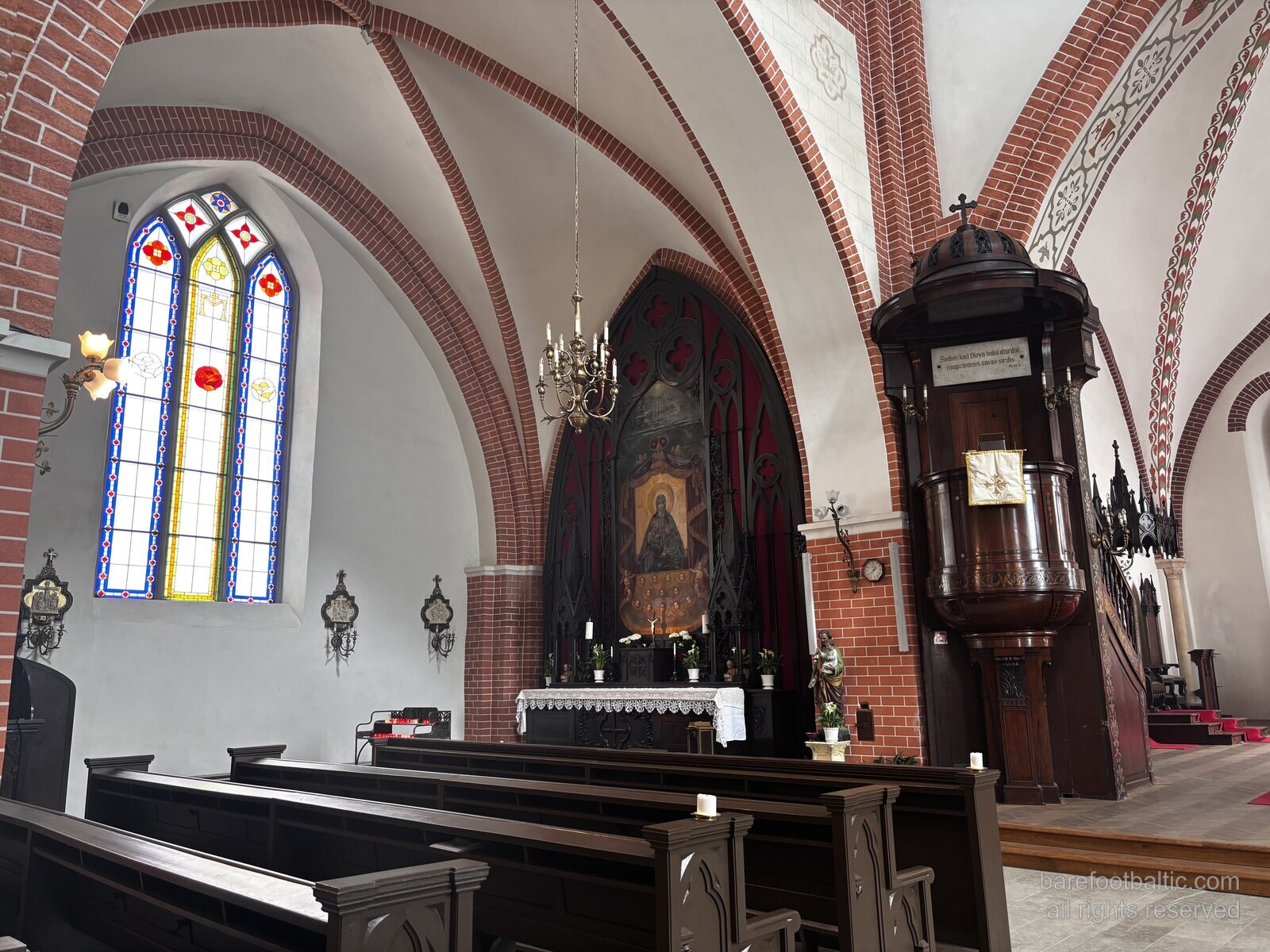
The interior is significantly more ornate than its Lutheran counterparts a few minutes away. Catholic worship needs an altar you can look at and pictures of saints, and Lutherans tend to clear those away. The result inside St James’s is a tall Gothic nave with red-brick walls, white-vaulted ceilings, stained glass in the side aisles, and a high altar with a painted Madonna and child as its centre. The pulpit is dark baroque wood, modestly carved. The pews are dark and modern. The whole thing reads as a working parish church. Modest, unfussy, in regular use.
Sv. Jēkabs ir mazākā pilsētas baznīca, kura ir lielāka par to, ko Jūs pirmoreiz redzēsit.
A Latvian way of putting it. "St James’s is the smaller city church that’s bigger than what you first see."If you have ten minutes inside, look at the high altar first. Then the stained-glass windows in the south aisle, mostly 19th- and early-20th-century replacements after fire damage. There is a small side chapel dedicated to John Paul II, who visited Riga in September 1993 and held a Mass at this cathedral. A few baroque memorial slabs are set in the floor near the western end. The acoustics are good. If you happen to walk in during a recital or a Mass with sung liturgy, stay.
Next door to Parliament
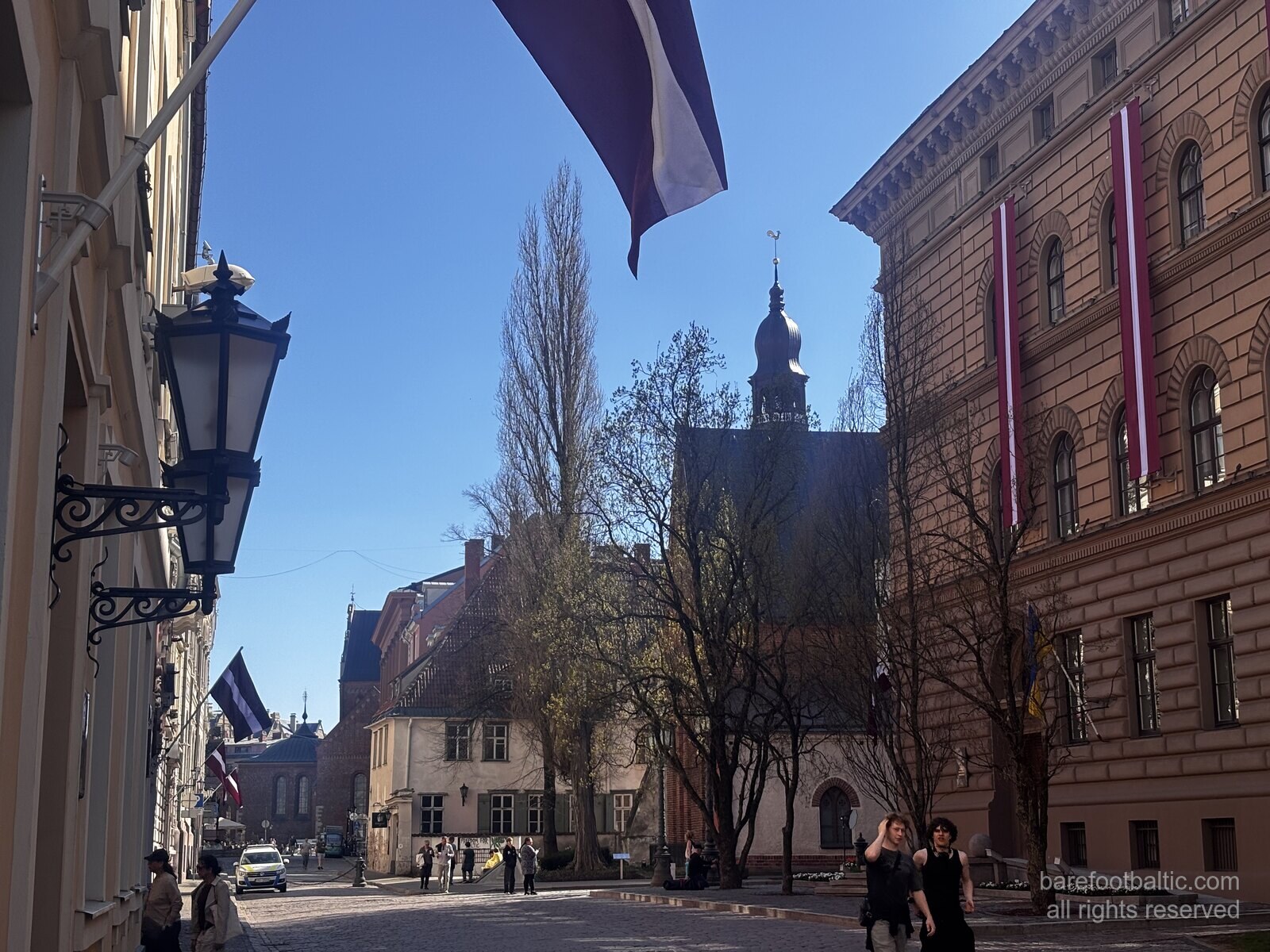
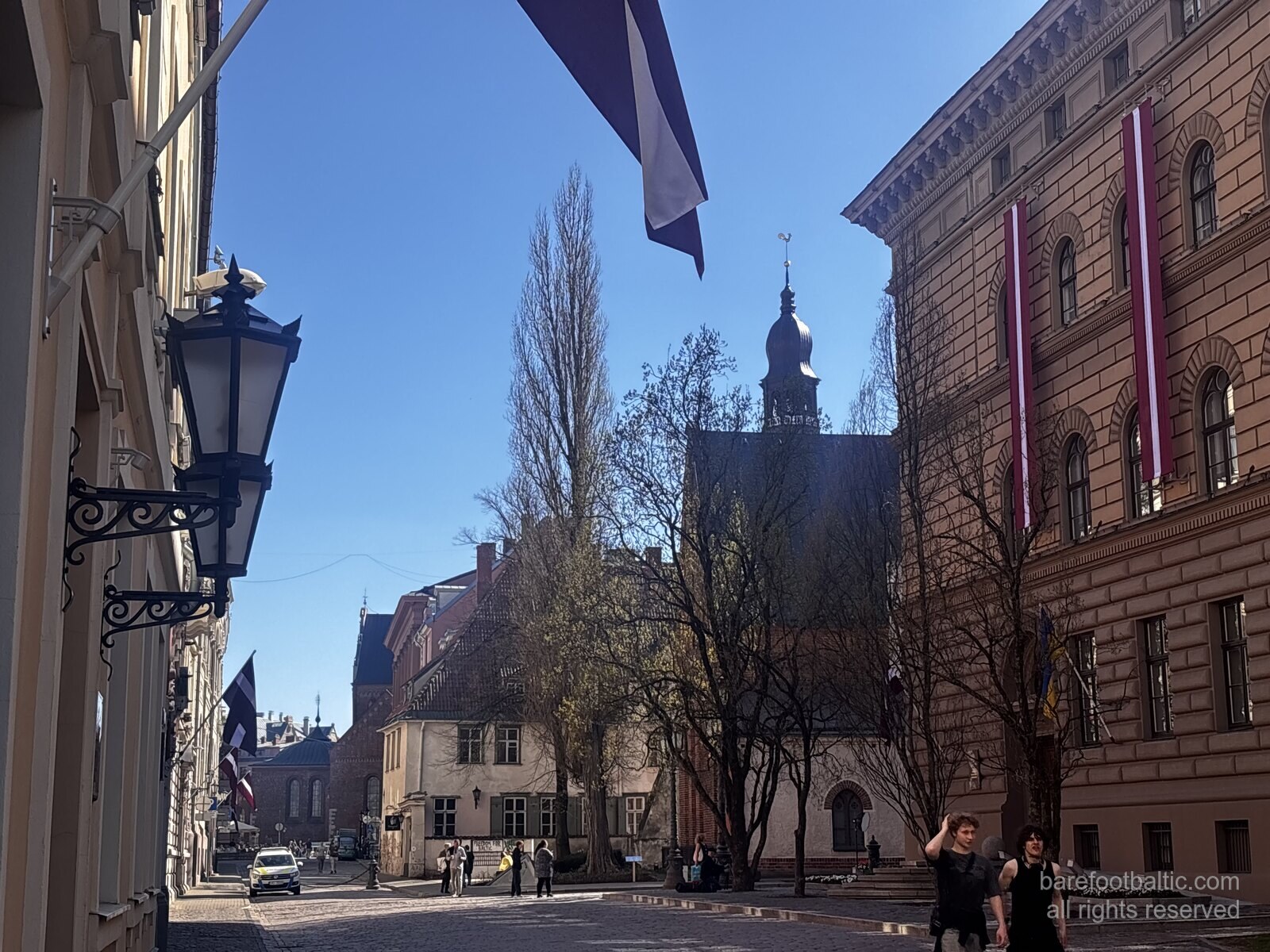
St James’s shares a wall with the Saeima, the Latvian parliament, on Jēkaba iela. The Saeima building is the large yellow-stuccoed structure with the Latvian flags hung from its facade. It was built in 1867 in a romantic neo-Renaissance style as the headquarters of the Vidzeme provincial government, became Latvia’s parliament in 1922, was used by the Soviet authorities under occupation, and returned to its parliamentary role at independence in 1990.
A few practical things follow from the adjacency. Security is visibly present on Jēkaba iela (police cars, occasional checkpoints, sometimes restrictions on vehicle access), but pedestrians can walk freely and access to the cathedral is unaffected. The small square in front of the Saeima is also one of the venues for civic gatherings, the protests and vigils and the occasional state ceremony, so on those days the area gets busier. And there is the photograph. A medieval cathedral spire and a 19th-century parliament, both on one short cobblestone lane, the Latvian flag flying from one and the rooster on the other.
Practical answers
Where it is and getting there
Jēkaba iela 9, in the western half of Riga’s Old Town. Five minutes’ walk west of Riga Cathedral, three minutes south of the Three Brothers, four minutes north of the Cat House. The Old Town is pedestrianised. There is occasional traffic on Jēkaba iela because of the Saeima, but visitors walk in.
Hours, costs, services
Open daily, free to enter. Sunday Mass is in Latvian. Some weekday services run in Latgalian, the eastern Latvian dialect, closer to Catholic communities. There is a Polish-language Mass on some Sundays for the Polish Catholic community in Riga. Candles for sale near the entrance, small donation expected. Photography is allowed in non-service hours, no flash. Please don’t walk around with cameras during a Mass.
Combining with the rest of the Old Town
St James’s pairs with Riga Cathedral as a Catholic-Lutheran contrast (do them in either order, ten-minute walk between). Add the Three Brothers and the Castle for the western half of the Old Town walk. The pillar guide stitches the whole circuit together.
My take
St James’s is the church I most often have to talk visitors into going inside. People come to Riga for Riga Cathedral, hear the organ, and walk back out toward Town Hall Square. It’s a small mistake. The interior here is more decorative than the cathedral’s, the baroque portal outside is the prettiest in the Old Town, and the cobbled lane in front puts the cathedral on one side and the working parliament on the other. There is not another street in Riga that does the same thing in the same fifty metres.
Allow twenty minutes. Stop at the portal, then go inside and sit for two minutes with the stained glass and the altar. Pair with a coffee on Jēkaba iela afterwards.
Frequently asked questions about St James’s Cathedral
Daiga Taurīte is a licensed Latvian tour guide and co-founder of Barefoot Baltic. She runs small-group day excursions from Riga. She grew up here, spent two decades in London, came home in 2024. Barefoot Baltic is licensed by Latvia’s Consumer Rights Protection Centre (PTAC), holds ATD passenger transport licence PS-01995, and is insured by BTA Baltic for civil liability.
St James’s is on the western half of every Old Town walk we run. If you’d like a half-day with a licensed Latvian guide that visits both cathedrals and walks past the Saeima, get in touch.